




Abstract
Abstract
Introduction:
In the evolving digital age, media applications are increasingly playing a greater role in the field of psychotherapy. While the Internet is already in the phase of being established when it comes to the care of mental disorders, experimentation is going on with other modern media such as serious games. A serious game is a game in which education and behavior change is the goal, alongside with entertainment.
Objective:
The objective of the present article was to provide a first empirical overview of serious games applied to psychotherapy and psychosomatic rehabilitation.
Method:
Therefore, a systematic literature search, including the terms “serious game” or “computer game” and “psychotherapy” or “rehabilitation” or “intervention” or “mental disorders” in the databases Medline and PsycINFO, was performed. Subsequently, an Internet search was conducted to identify studies not published in journals. Publications not providing empirical data about effectiveness were excluded.
Results:
On the basis of this systematic literature review, the results of N = 15 studies met inclusion criteria. They utilized primarily cognitive behavioral techniques and can be useful for treating a range of mental disorders. Serious games are effective both as a stand-alone intervention or part of psychotherapy and appeal to patients independent of age and sex.
Conclusion:
Included serious games proved to be an effective therapeutic component. Nonetheless, findings are not conclusive and more research is needed to further investigate the effectiveness of serious games for psychotherapeutic purposes.
Introduction
M
More recently, these features are realized in the development of serious games. At first glance, there appears to be a contradiction between the constituents of the term serious games; as the term game is associated with fun, entertainment, and relaxation, while serious goes with more weighty matters, the two concepts might seem to be mutually exclusive. Yet, keeping in mind the definition behind the serious games concept, both terms can easily be combined.
Definition
There is no current single definition of the concept of serious games, as there are as many definitions as there are authors and institutions. Abt 5 mentioned the term for the first time, stating: “Games may be played seriously or casually. We are concerned with serious games in the sense that these games have an explicit and carefully thought-out educational purpose and are not intended to be played primarily for amusement. This does not mean that serious games are not, or should not be, entertaining.” 5 Therefore, the purpose of a serious game is twofold: to be fun, entertaining, and engaging, and to develop new knowledge, train new skills, and change behavior.
Mechanisms
The underlying mechanisms through which the potential of serious games as a learning tool enhance learning, creativity, curiosity, imagination, and motivation are widely discussed. 6 In any learning situation, several kinds of factors can affect motivation and engagement; these include challenge, curiosity, control, choice, and teamwork. 7 More recent research areas contribute toward understanding intrinsic motivation in learning. 8
The theory of flow stresses the role of ideal challenge in explaining the high motivational values and engaging potential of serious games. The key element in achieving a flow state is to facilitate optimal experiences. Setting clear goals and rules, as well as recognizing and gauging feedback in creative activities, encourages greater performance and engagement. 9 Moreover, there needs to be the perceived possibility of negative or harmful consequences to facilitate learning. However, in the case of repeated failure, the serious game will provide assistance to help players achieve the goals. 10
Literature concerning the role of positive emotions on learning during game play is still scarce. According to Fredrickson, 11 most positive emotions, such as joy, interest, or pride, have the ability to expand people's personal resources. Similarly, Quinn et al. 12 argue that positive emotions are associated with a broader thought–action repertoire. While entertainment games generate a broad range of affects and emotions through nuanced stories or rich characters, in the case of serious games it is not unequivocally clear which subsets of emotions are closely relevant to learning outcomes and personal development.
Previous research
Serious games are effectively being applied to a broad spectrum of areas, such as healthcare, corporate management, and government. A systematic literature review by Connolly et al. 13 provides empirical evidence concerning the potential positive effects of serious games in a wide range of areas. Indifferent of platform, genre, and discipline, the N = 129 identified studies highlight that playing serious games yields cognitive, perceptual, behavioral, affective, and motivational impacts. In particular, most frequent outcomes were knowledge acquisition, content understanding, and affective as well as motivational changes. Another noteworthy meta-analysis (39 studies, N = 5547 participants) by Wouters et al. 14 provides additional support for the effectiveness of serious games. The authors investigated whether serious games are more effective in terms of learning and more motivating than conventional instruction methods. In line with the hypotheses and earlier research,15,16 findings showed that game-based learning yielded in higher retention of knowledge and cognitive skills than other instruction methods, whereas no significant differences were found in terms of motivation. In conclusion, findings corroborate earlier research stating that serious games can considerably improve learning outcomes, especially if combined with other instruction methods. 14 Although first overviews outline the opportunities for serious games, practical implementation still leaves much to be desired. For instance, several studies have shown a low compliance with the therapeutic program 17 and a decrease of intervention effect over time. 18 Considering the discussed, positive findings, such as increased motivation and longer lasting learning outcomes, serious games might help overcome some of the shortcomings of conventional e-health programs. Therefore, the development of serious games for therapeutic purposes has more and more become the focus of attention in the last few years. A first meta-analysis by DeSmet et al. presents the overall effectiveness of serious games on healthy lifestyle promotion. 19 In summary, serious games had a small positive effect on healthy lifestyles and their determinants, especially for knowledge, and on clinical outcomes. First results for serious games applied as part of psychotherapy are equally promising. For example, a review by Horne-Moyer et al. indicates that serious games are often equivalent to more traditional psychotherapy in terms of efficacy and even might be more enjoyable for some customers. 20 Similarly, a more specific review investigating the available evidence regarding serious games for depression found high rates in terms of adherence and in terms of impact on symptoms. 21 Included programs were partly therapist-guided interventions, and also stand-alone serious games. Sample size was generally small with adolescent participants aged from 9 to 25 years. However, the active development of such tools is just beginning. So far, there is no research giving an overview of the overall impact and mechanisms of serious games as stand-alone interventions or as part of psychotherapy. Therefore, the objective of the present article is to summarize the available literature and provide a first empirical snapshot of serious games concerning therapeutic practice and research. In the following section, the current state of research of the application of serious games in relation to psychological disorders will be outlined systematically. Additional examples ranging from behavior therapy for anxiety and depressive disorders to behavioral medicine, in particular for chronic disorders in childhood and adolescence, will illustrate the wide variety of possible therapeutic application areas of serious games.
Method
Search strategy
A systematic search of the literature was performed in the electronic databases PsycINFO and Medline from 2005 to October 2016. The main search terms were “serious game” or “computer game” plus “psychotherapy” or “rehabilitation” or “intervention” or “mental disorder”, as part of “Title,” “Abstracts,” or “Keywords.” In addition, to gain access to studies and references not published in journals or books, yet relevant for the review, an Internet research using Google was conducted. This was to ascertain that studies which did not achieve significance were also identified, since nonsignificant findings are less frequently submitted and published in research journals. Finally, applicable articles were identified through screening reference lists of relevant articles. The initial screening was deliberately broad to retrieve articles that could inform the background and discussion, and to avoid missing any fundamental sources.
Initial screening of studies was based on the information contained in their titles and abstracts. When a decision on inclusion or exclusion could not be reached solely based on this preliminary information, the full text was retrieved. All eligible studies were reviewed by two researchers to reduce the risk of bias.
Inclusion criteria
Studies were eligible for inclusion if they were English or German language peer-reviewed articles. On account of serious games being an emerging area of research, few inclusion criteria were specified to allow an appropriate number of studies to be selected. In this review, any study design was included given that it had at least a pre/postmeasurement. Therefore, only studies that did provide empirical evidence relating to the effectiveness of serious games were included. The intervention had to be delivered online and/or via digital technology, including via a CD-ROM, the Internet, or computer. Serious games were defined as outlined above. For the purposes of this literature review, we included serious games that utilize gaming mechanisms as an integral and primary method for achieving their purpose to treat mental disorder or support a professional psychotherapeutic setting.
Exclusion criteria
The present review focused solely on computer-based applications, where effectiveness research is comparatively most established and systematic research principles and guidelines are available. 22 First of all, studies that did not include sufficient data in terms of empirical evidence, such as symptom measurement pre- and postintervention, were excluded. Second, concept articles and also unsystematic case studies were excluded (e.g., prevention of alcohol and drug use). 23 In addition, letters to the editor, meta-analyses, and review articles were not included. Third, studies investigating the influence of conventional games on mental states were not considered (e.g., Tetris against the build up of flashbacks after trauma), 24 because being developed as an entertainment tool focusing primarily on fun these programs differ strongly from serious games where therapeutic goals are central. Fourth, articles on videogames in a different, nontherapeutical context such as articles on video (e.g., effects of playing violent videogames 25 ) or educational games (e.g., serious games and language learning 26 ), publications about nontherapeutic applications (e.g., developing serious games 27 ) were removed. Finally, studies reporting the effects of serious games on the therapy of physical problems, such as diabetes 28 or stroke, 29 were excluded.
Results
As a result more than 100 studies published until October 2016 were found. Figure 1 shows a flow diagram of the reviewed studies.
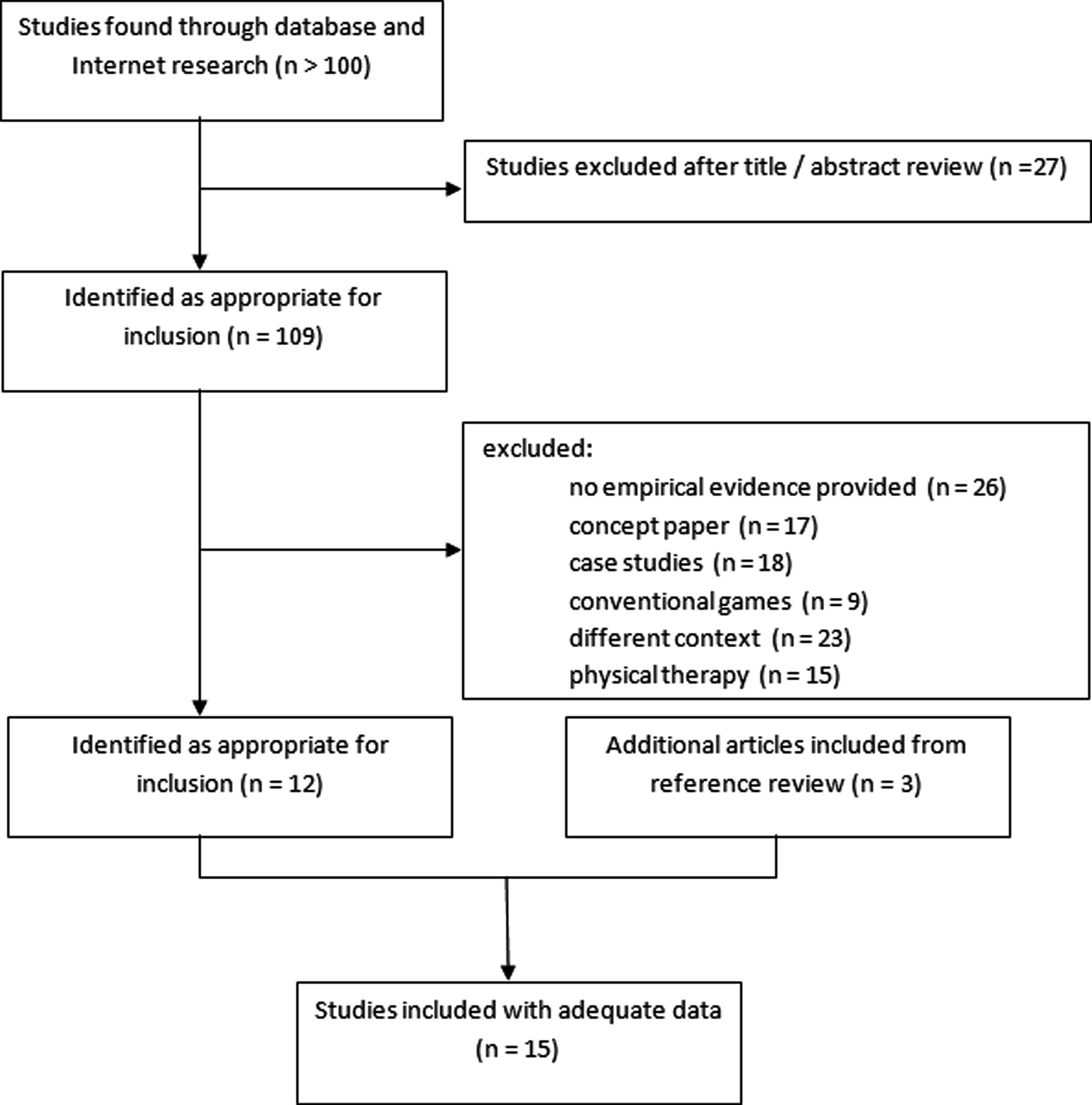
Flow chart of included/excluded studies.
From these studies, N = 15 articles focusing on n = 9 serious games met the inclusion and exclusion criteria and were identified as relevant to the current review.
Information from the included studies was abstracted into a standardized computer-based form. The following information was collected: authors, year, number of participants, population characteristics, health topic, inclusion/exclusion criteria, game idea, story, game goal, game mechanics, setting, clinical support, data retention, intervention characteristics, health behavior theories, study duration, and outcome measures. In the event data were missing, the study authors were contacted. This data extraction was checked and resolved for anomalies, inconsistencies, or queries. On basis of the health topic, included studies were sorted along the dimension “mental disorder.”
Table 1 shows the characteristics of the included studies. For a case-by-case overview of the included serious games, please refer to Table 2.
ADHD, attention deficit hyperactivity disorder; CBT, cognitive behavioral therapy; PTSD, posttraumatic stress disorder.
Study design
Of the 15 included studies, 10 were randomized controlled trial (RCT). Some studies were reported in two publications.35–42 Most studies compared two study groups: an intervention group in which the treatment was a serious game intervention and a control group receiving usual care or no care. Exceptions were the study of Steiner et al., 38 in which additional comparisons were made with a cognitive training intervention. Furthermore, the study by Khanna and Kendall 31 consisted of four intervention arms.
The duration of the follow-up measurements varied from 10 weeks 33 to 6 months. 40
Mental disorder
Included studies investigated the effectiveness of serious games targeted at a range of different mental disorders: post-traumatic stress disorder, anxiety disorder, depression, Asperger's syndrome, attention deficit disorder, and impulse disorder.
There were also serious games focusing on facilitating regular face-to-face psychotherapy.
Participants
The number of participants varied from 12 to 375. Studies differed regarding patient characteristics. For example, three serious games were aimed at adults, whereas the remaining six were explicitly designed for children. None of the interventions was aimed at older adults. Patients were recruited through announcements on websites, referrals, and community recruitment, and also through screening of clinical samples.
Intervention characteristics
Most serious games utilized interventions based on a cognitive behavioral framework. Therefore, most interventions contained psychoeducation on the specific problem, and different cognitive behavioral therapy (CBT) modules such as cognitive restructuring, relaxation techniques, and social skills training. The duration of the interventions ranged between 2 days and 14 weeks.
Effectiveness
All included studies report positive results for the investigated serious game, suggesting some improvement for the outcome variables. Serious games were not only superior to a waiting list control condition in learning and behavioral outcomes, such as extending knowledge of effective anxiety and anger management strategies, but also in helping with depression symptoms and stress. Furthermore, some serious game interventions proved to be at least as good as treatment as usual.31,32 Finally, serious games proved useful in increasing adherence to therapy and as a helpful tool in psychotherapy, increase motivation, and strengthen the therapeutic relationship. Unfortunately, regarding effectiveness, no generalizable conclusions can be drawn due to the overall small sample size of included studies.
Most studies reported usability, acceptability, and credibility ratings of the serious game, highlighting that an overwhelming majority of patients were content with the program's design and using it as part of therapy.
Game characteristics
Gaming aspects of included studies are summarized in Table 2. These descriptions are derived to the best of our ability from the limited information describing each program.
Discussion
Although some literature reviews13,16 have been conducted suggesting the usefulness of serious games in fostering learning and motivation, there is a lack of research considering the effectiveness of serious games in treating psychological disorders. The few articles attempting to analyze serious games as a therapeutic tool for mental disorders have been summarized in this review. Unfortunately, to date, serious games that are not presented here mostly lack evaluation or even finalization. Furthermore, the lack of conclusive detail and the limited nature of published studies do not allow carrying out a meta-analysis at this point of time. That said, some conclusions can be drawn. First, all included serious games proved to be an effective therapeutic modality. Patients not only reported to find the gaming experience satisfactory and enjoyable but also made significant improvements regarding their disorder. Second, serious games utilize similar mechanisms, foremost cognitive behavioral techniques and positive emotions, also found in traditional psychotherapy. As a consequence, investigated serious games were at least as (Camp Cope-A-Lot) and partially even more effective (Play Attention) in the treatment of mental disorders than conventional psychotherapy. Third, the range of possible therapeutic application areas for serious games is vast. Effectiveness did not depend on targeted mental disorder, genre, or whether an assisting therapist was present or not.
Findings in this review augment the limited, existing literature available on serious games. While some studies45, 46 only report outcome effects for knowledge retention, others highlight that serious games can also lead to improvements in behavioral and clinical outcomes. 19 Consistently, in the present review, most of the included serious games had some form of positive effect on mental disorder symptoms. Both games evaluated as part of psychotherapy and as stand-alone versions were effective. Due to the limited number of studies available, no conclusions can be drawn whether guided serious games have a higher effect size as it has been proven for a majority of other computer-based interventions. 47 How game mechanisms need to be adapted for stand-alone versus guided serious games to yield highest effectiveness can only be hypothesized at the moment. For example, there was a large heterogeneity in game duration with no influence on effectiveness. Rahmani and Boren 48 mentioned insufficient playing time as potential reason for lack of effectiveness, whereas other research found no correlation. 19 Consequently, future investigations are needed to further explore the high heterogeneity within the role of game mechanisms. Finally, serious games were available for different age groups as well as both sexes, confirming earlier research that serious games can work in various populations, when their preferences are taken into account.
All serious games examined used some form of text, reading, video, or diagrams. Furthermore, explicit and enforced rules are a key ingredient of discussed serious games. Many incorporate high interactivity via videos or a virtual coach. Other frequent gaming features include a narrative and mystery in the form of an engaging story. However, other qualities deemed important for a successful game were only utilized by some serious games. 49 While some elements can be found, such as three-dimensional environments (gNATS) or self-representation with avatars (SPARX), others are missing completely, such as virtual economies or player reputation. Making use of these elements might increase immersion and flow of serious gaming considerably.
Concluding, serious games can be a valuable and likely effective part of modern psychotherapy. As the use of psychotherapeutic videogames is not bound to specific therapy times, they can yield therapeutic progress in between therapy sessions. 50 Being able to decide about place, time, and learning pace also increases patient autonomy. This aspect needs to be addressed in therapy to avoid evoking feelings of being shunted off to technology in dependently structured patients with a strong need for care based on biographical experience. Furthermore, a psychotherapeutic game can help to structure therapy sessions and to explain important theoretical concepts in a user-friendly way. Serious games might constitute attractive electronic homework assignments and help rehearse basic psychoeducational parts of treatment. 51
Accordingly, even if currently available serious games are predominantly based on cognitive behavioral theory, they could also be used in psychodynamic therapy. A possible area of application is the strengthening of the working alliance at the beginning of therapy. Within the context of relationship building, where understanding patient's central needs, motivation, and personality structure plays a central role, serious games that consider these aspects could support the therapeutic process. Thus, serious games fulfill a “dependent” patient's need for an “inner connection” to the therapist even outside therapy. Furthermore, serious games could support therapeutic processes, such as reducing resistances or limiting transmission reactions, by strengthening the patient's active role in the treatment. Finally, how patients play serious games might provide useful insights into patients' personality.
However, serious games are limited in providing nonverbal behaviors, interpersonal relationships, and a therapeutic alliance that are undeniably key ingredients in the therapeutic process. 52 Another considerable concern noted about serious games relates to crisis management. The ability of a serious game to reliably detect and adequately deal with a crisis is limited. 40 Therefore, applied to psychotherapy and psychosomatic rehabilitation, serious games should ideally only be one component of a comprehensive treatment concept, especially when keeping in mind that not only for serious games in general 53 but also for Internet-based interventions, 54 learning outcomes are highest when supplemented with therapist guidance.
The currently limited research findings do not allow us to draw reliable and firm conclusions about the efficacy of serious games. Investigating only a small number of psychological disorders and relying only on small selected samples decrease the empirical value of the available research literature. The results highlight that, unfortunately, RCTs are barely available at the moment. While articles using quasiexperimental designs and surveys implying a low quality of empirical evidence add to the understanding of the outcomes of serious games, RCTs clearly offer more thorough evidence about effectiveness. Therefore, one recommendation of this study would be that more research following the CONSORT guidelines should be conducted. 55 Moreover, as conclusions are only tentative, well-controlled studies investigating the relative effectiveness of unguided compared with therapist-assisted systems, about the relationship between outcome and training, and whether serious games work equally well for different individuals and in different settings are required to consolidate our findings.
Inconsistent definitions and the lack of a consistent nomenclature used to describe serious games targeted at users with mental disorders added complexity in setting inclusion and exclusion criteria studies for this review. We have endeavored to make considerate judgments about inclusion. It was difficult to find out meaningful information about the characteristics of the interventions. These limitations complicate meaningful data analysis at the moment. As with all reviews, it was limited by the applied search terms and the databases included. A broad focus was chosen deliberately to take into account that relevant research is still at its infancy. A different set of search terms may yield other conclusions regarding the effectiveness of therapeutic serious games. Including additional search criterions, such as “mental health,” in future research would be a useful addition to literature. Similarly, another review might explore the impact of serious games applied to other platforms and utilizing upcoming technologies. Finally, because serious games are an emerging technology, many of the presented studies were conducted by the developers. Thus, findings need to be replicated in independent studies. However, the games discussed in this article provide a first overview of empirical literature on effectiveness of serious games applied to psychotherapy and psychosomatic rehabilitation, which is representative of the current state-of-the-art.
Conclusion
People with psychological disorders are asking for a greater integration of modern media into therapeutic treatment. 56 Web-based intervention programs can rely on a growing amount of empirical verification.47,57 Notably, therapist-guided Internet-based psychological treatments have been found to be most effective. 58 By now, some statistical evidence supports the assumption that serious games promote treatment motivation in children. 59 Adequately adjusting serious games to accommodate older patients is an important topic for future work. Given this, it is not surprising that further possible application areas of serious game are currently being tested. Even if their development was guided by cognitive behavioral principles, serious games can be integrated into, for example, psychodynamic therapy or psychosomatic rehabilitation, provided that certain treatment prerequisites are obeyed. There are already recommendations for the design of corresponding therapeutic games. 60
Footnotes
Author Disclosure Statement
No competing financial interests exist.