




Abstract
Abstract
Objective:
Given that many households in western countries nowadays have home access to the Internet, developing health-promoting online interventions has the potential to reach large audiences. Studies assessing usage data of online health interventions are important and relevant but, as of yet, scarce. The present study reviewed usage data from Monkey Do, an existing online health game developed specifically for children from 4 to 8 years old. In addition, the effect of advertising on usage was examined.
Materials and Methods:
In an observational study, a web-based analysis program was used to examine usage data of all visits to the online health game for the first 31 months following the launch. We reported descriptives for usage data. We analyzed the relationship between advertising and usage with a Mann–Whitney U test, and used a Pearson's chi-square test to investigate the association between advertising and the number of first-time visitors.
Results:
In the period of data analysis, there were 224,859 sessions. Around 34% of the visitors played the game more than once. Compared with first-time visitors, the average session time of returning visitors was doubled. The game was most frequently accessed via search engine query, on a desktop computer (compared to mobile devices). Advertising was found to be positively related to the number of sessions and the number of first-time visitors.
Conclusions:
Placing a game online can reach a large audience, but it is important to also consider how to stimulate retention. Furthermore, repeated advertisement for an online game appears to be necessary to maintain visitors over time.
Introduction
N
To increase daily fruit and vegetable consumption among children, many educational health interventions have been conducted.6–8 Unfortunately, these interventions often require several face-to-face contact moments and, in terms of effectiveness, show mixed short-term results and often limited long-term effects on consumption.9–13 As many households in western countries have home access to the Internet, 14 using internet-based health interventions is a promising approach, and also because these health interventions are relatively inexpensive and available at all hours of the day. 15 Indeed, various studies show that offering health interventions online can be effective for behavioral change.16–18 The media that can be used to access online digital interventions, (i.e., computers, smartphones, and tablets), have become increasingly popular (especially among young people) and user-friendly.19,20
With the plethora of information on the web, accessibility, discoverability, usage, and retention of an online health intervention are important to consider when evaluating its effectiveness. A clear name and obvious search terms can increase discoverability, as can referring to the health intervention on other websites using hyperlinks. 21 Equally important to consider is how retention can be maintained over time, given the high attrition rates of web-based health interventions demonstrated in previous research.22,23 Important factors for these high attrition rates are losing interest and not seeing the immediate benefit of the health intervention. 24 When a health intervention program is not frequently revisited, total exposure to the health intervention remains low, and this may not lead to the intended results as a consequence. One factor that may impact on the access, discoverability, and usage patterns is advertising. 25
Health games are an increasingly popular tool to instigate behavioral change. 26 For example, the element of fun in games attracts, captures, and maintains attention, thus having the capacity to enhance exposure to the health intervention. 27 In addition, games can be processed on a more automatic level, especially when the message is delivered more implicitly or via a precursor of the behavior. 28 However, until now, the main focus of research on health games has been on effectiveness, and little is known about the usage of this type of health interventions when placed online. Next, to the question of whether the games are played, having insight in the target group's search behavior and their device of choice provides valuable information about changes, improvements, and future development of health games aimed to reach a specific population.
The first aim of the present study was to assess usage of the online health game Monkey Do (i.e., number of sessions, frequency of sessions, and session time). Based on previous research,15,29,30 this usage information was considered to be an essential prerequisite of effectiveness of online health games. The second aim was to assess how the game was accessed; via what traffic source visitors arrived on the webpage and which types of devices were used to play the game. The third aim was to examine whether there was a relationship between advertising and (first-time) usage.
Materials and Methods
Monkey Do
The present study examined the online health game Monkey Do (short for Monkey See Monkey Do, in Dutch titled Na-aapje), developed for children from 4 to 8 years of age. Monkey Do is a game of skill and revolves around a monkey that has to collect fruits and vegetables hanging in a tree, to earn points. Collecting these healthy foods in a specific displayed sequence heightens the score. Controlled by the arrow keys on the keyboard, the monkey swings from branch to branch. Missing a branch causes the monkey to fall down. Falling three times results in game over, after which the player can try again. The primary goal of the game is to be entertaining. The secondary aim is to expose children to fruits and vegetables in an unobtrusive way, without a didactic component. Based on the principle of evaluative conditioning, 31 the rationale behind this game is to strengthen the association between positive emotions and fruits and vegetables. Consequently, having a more positive attitude toward fruits and vegetables could result in increased fruit and vegetable intake.32,33
We selected this game, because it functions as an example for online health games. Monkey Do was featured on the website of the Netherlands Nutrition Centre (NNC) website, the Dutch authority on providing information on diet and nutrition. The NNC website has ∼9 million visits per year. Monkey Do was developed by the NCC, in collaboration with the Knowledge Centre for Sport Netherlands, and was part of a broader national campaign aiming to improve dietary lifestyle among Dutch children by increasing their parents' healthy example behavior (i.e., increase parents' awareness that children learn from and copy their behavior.) The game was freely and easily accessible, without having to create an account or sign up on the website.
The game was advertised by the NCC during two separate periods. The first period of major advertising, lasting 20 days, started on June 4, 2012, 7 days after the game was launched. It consisted of a 25-second commercial broadcast on several television networks during prime-time child or family programs; ∼460 radio commercials aired on 18 different national and regional radio stations; banners on various websites and availability on national websites featuring free games. Continuing after the 20-day period of major advertising were the radio commercials (∼230 more commercials for another 10 days) and the online advertising (for several more months). The second period of major advertising, lasting 17 days, started on December 21, 2012 and was online only, with a site-wide banner on the NCC website and on one of the most popular Dutch game websites (www.spele.nl).
Design and procedure
In present observational study, we analyzed usage data from all visits to Monkey Do made in natural setting, using Google Analytics. The first 31 months after launch (May 29, 2012 to December 31, 2014) were included in the data analysis period. Google Analytics is a free web-based analytics service with a strict confidentiality policy, which allows you to track visitors' behavior, using cookies, by adding a few lines of program coding on each web page. 34
Because this was a retrospective study in naturalistic setting, no informed consent was acquired. However, a few days after the game was launched, the cookie legislation was implemented, based on the European e-Privacy Directive. In the Netherlands, unambiguous consent is required to accept cookies. At the NCC website, this message included a statement that the settings for cookies used for analysis could be adjusted. Therefore, all visitors accepting the cookies gave active consent to track their behavior on this website. Given that the game did not request personal information and no individual characteristics were recorded, we also included the data recorded between May 29, 2012 and June 5, 2012 (6926 sessions by 5835 visitors).
With regard to the first aim, to assess usage of the game, we first reviewed the number of sessions, making the distinction between first-time and returning visitors. In addition, session time was reviewed. With regard to the second aim, how the game was accessed, we reviewed via what traffic source visitors arrived on the Monkey Do webpage and which devices were used. With regard to the third aim, we examined whether advertising was positively related with (first-time) usage, by comparing the periods with versus without advertising on number of sessions and on visitor type (i.e., first-time vs. returning).
Measures
In the present study, most variable names were adopted from Google Analytics. Google Analytics registered all views from unique IP addresses, termed “visits,” but in the present study referred to as “sessions,” and allowed distinction between novel and repeated sessions. Visitors who accessed the website for the first time were labeled as “first-time visitors.” Multiple sessions from the same IP address within the study period were labeled as “return sessions,” made by “returning visitors.” A session ended after 30 minutes without activity or when leaving the website. Resuming or returning to the website then counted as a return session. It must be noted that the number of first-time visitors was an approximation, because visitors could have used multiple devices or shared their device(s) with other users.
Session time, as an approximation of play time, was recorded by subtracting the time in minutes of the last action (i.e., mouse click) on that specific page, minus the time of landing on the page. Periods of inactivity (<30 minutes) followed by resumed activity on the web page overestimated session time. Only uninterrupted sessions, without spending time on other (pages of the) website(s), were used to calculate session time.
Traffic source referred to how visitors got to the game website. There were four main categories: direct (i.e., accessing the page directly by entering the exact name or the URL); referral (i.e., through links from another websites); paid search (i.e., via paid text ads or banners); and organic search engine (i.e., finding the page through search engine queries). However, in first instance, traffic source was not included as trackable information. This tracking feature was enabled on July 25, 2013. Thus, the traffic source of all sessions before this date was referred to as “not available.”
Google Analytics also records whether visitors access the website using a mobile device (i.e., smartphone or tablet), or desktop (with laptops falling in the latter category). Having insight in the device of choice provides valuable information about future game development.
Data analyses
For number of sessions, frequency of sessions, session time, traffic source, and use of device, group means were reported. No further analyses could be performed because individual data were not provided by Google Analytics. To examine the influence of advertising on usage, we compared the two periods with major advertising (i.e., the 20-day period of advertising with television, radio, and internet commercials and the 17-day period of online advertising in December) against the periods with minor to no advertising. A nonparametric Mann–Whitney U test was conducted to analyze the relationship between advertising and the number of sessions. A Pearson's chi-square test was performed to compare the number of sessions of first-time versus returning visitors during the periods with versus without advertisement. The statistical software program SPSS 22.0 (IBM Corp., Armonk, NY) was used to conduct the analyses.
Results
Usage information
To address our first aim, we reviewed the number of sessions, frequency of sessions, and session time. In the first 31 months after launch, Monkey Do had 224,859 sessions (Table 1). Approximately, two-third was made by first-time visitors. The average session time increased with number of sessions (Table 2). While first-time visitors played for 5:10 minutes, those with two sessions or more doubled this time to 10:50 minutes, and for visitors with 10 sessions or more, session time almost tripled to 13:42 minutes.
Way of access
To address our second aim, we assessed how the visitors accessed the game and which device they used. The majority of visitors accessed the game through organic search engine, followed closely by direct search (Table 1). Visitors accessing the game through these sources also had the highest averaged session time. With regard to device, most visitors accessed the website using a desktop (versus mobile devices).
Advertising and usage information
To address our third aim, we examined whether advertising for the game would be related to (first-time) usage. Figure 1 shows the total number of sessions per month. The figure clearly reveals two peaks of number of sessions, corresponding to the two periods of major advertising, in June and December 2012 (month 2 and 8, respectively). Due to the large variation in sessions between the periods, we also show the total number of sessions of the first and second major advertising period, ranging from 1 week before and up to 1 week after advertising (Figs. 2 and 3, respectively).

Total number of sessions per month for the first 31 months after launch. *Advertising in June 2012 (month 2) and December 2012 (month 8).
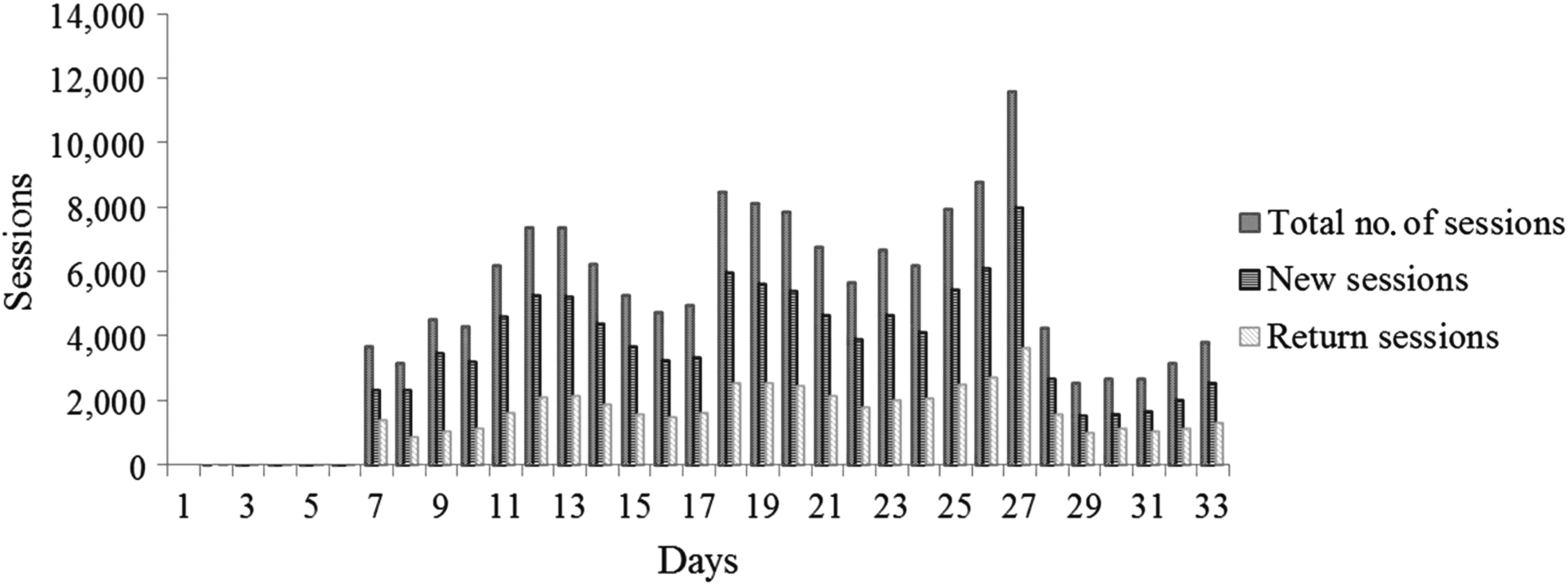
Total number of sessions, new sessions, and return sessions around the first period of major advertising, starting from day 7 up until day 27.
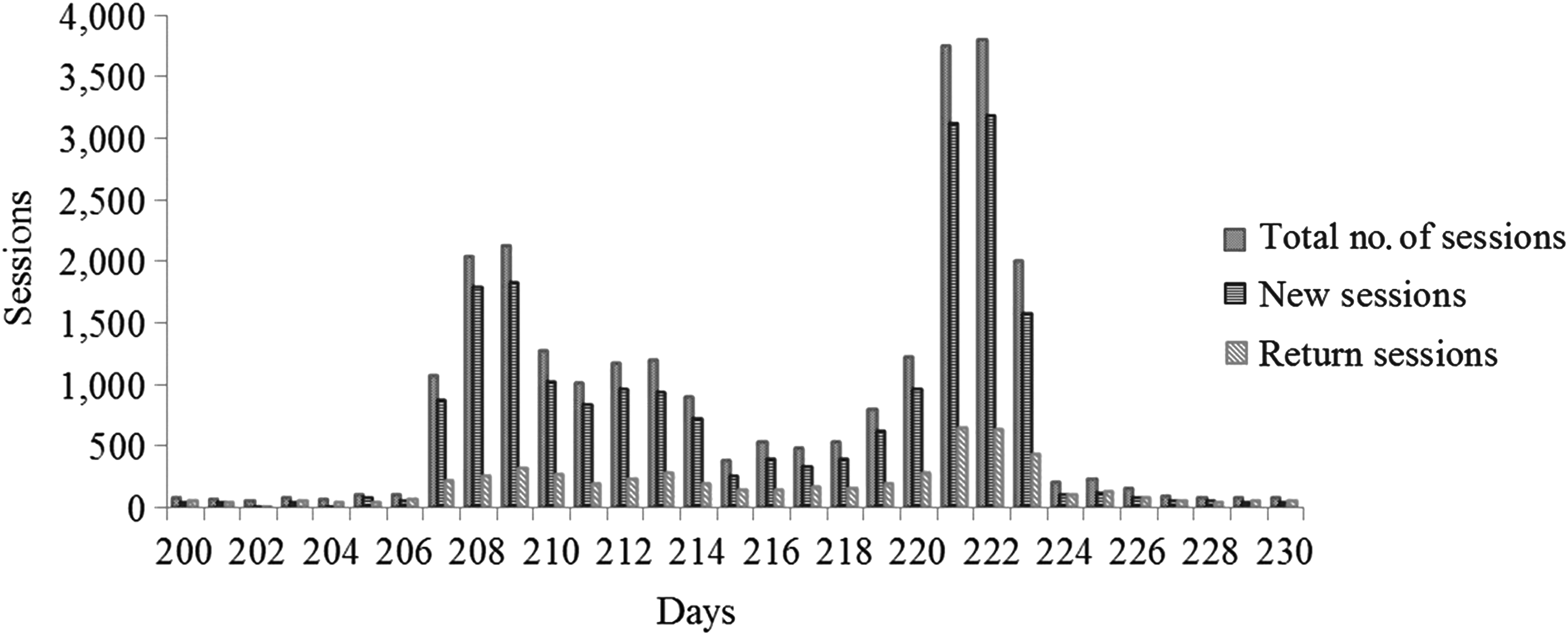
Total number of sessions, new sessions, and return sessions around the second period of major advertising, starting from day 207 up until day 223.
First, we compared usage during major advertising against minor and no advertising. The Mann–Whitney U test showed that advertising was positively related to the number of sessions, U = 34,372.00, z = 10.37, P < 0.001, and r = 0.34. Furthermore, the Pearson's chi-square test showed a significant association between advertisement and whether visitors were there for the first time or returning, χ2(1) = 5823.39, P < 0.001. Based on the odds ratio, the odds of being a first-time visitor after advertisement was 2.07 times higher than the odds of being a first-time visitor in the periods without advertisement.
Discussion
The aims of this study were to (1) assess usage of the online health game Monkey Do, (2) to assess how the game was accessed, and (3) to examine the relationship between advertising and (first-time) usage of the game.
With regard to the first aim, examining usage revealed that around one-third of the visitors returned. Returning visitors played more than twice as long as single-session visitors. For visitors with 10 sessions or more, session time almost tripled. It is therefore plausible that visitors who returned enjoyed playing the game, whereas nonreturning visitors might not have enjoyed the game that much. Results from an unpublished qualitative study 35 that examined attitudes toward the game revealed that especially the older children, between 10 and 12 years of age, thought that Monkey Do was somewhat childish and better suited for younger children. Therefore, it is likely that visitors who played more frequently and with a longer duration were of a younger age, although in the current study, it was not possible to determine the age of the users. It might be an undesirable fact that around two-thirds of the visitors who showed initial interest in the game (developed for young children) did not play for a long time and did not return to the game. Given that session time is a possible moderator of game effectiveness,36–38 future target population effectiveness studies should examine if children who play the game more often are affected to a larger extent than children who play the game only once.
With regard to the second aim, during the 31-month period of analyses, Monkey Do had 31,648 sessions (14%) from mobile devices. Because this game did not support using such devices, exposure was low for these sessions. Given that mobile devices gain in popularity and their use increases, 19 future game designers will benefit from making the game available for mobile devices.
With regard to the third aim, the results showed that advertising was positively related to number of sessions and with the ratio of first-time versus returning visitors. Without advertisements, usage decreased over time, although this decrease was gradual. Thus, our results suggest that online health interventions seem to benefit from repeated advertisements. Further research is needed to investigate and optimize (online) advertising for this population.
This study presents a valuable addition to studies investigating game exposure in a more controlled manner in three respects. First, it provides important information about usage data of an online health game in a noncontrolled and voluntary setting. Second, in combination with a qualitative component, these findings can be used to further optimize online health promoting games. Third, long-term usage data could be investigated and the two separate periods of advertising allowed for causality testing, indicating a positive relationship between advertising and usage.
The current study also had some limitations. First, no detailed information about engagement, immersion, and motivation to play (and replay) the game was recorded. This could have provided useful information for further development of Monkey Do to make it more appealing to a larger audience. Second, no information on age and sex of the players was recorded. Future studies examining characteristics of returning visitors might provide information that can be used to tailor future advertisements and media choices. There were also some limitations related to Google Analytics. First, visitors are identified based on unique IP address, thus, the number of unique visitors is an approximation. Second, periods of inactivity (<30 minutes), followed by resumed activity on the web page overestimate session time. Third, it was only possible to determine access of the visitors to the webpage, not their actual playing behavior. Fourth, for the period of data analysis, Google Analytics did not yet provide individual data or standard deviations, which limited statistical testing. Fortunately for future research, a feature to extract data based on IP address has been added to Google Analytics in 2016. This will enable researchers to better examine the data and perform statistical analyses for data from 2016 onward.
Conclusions and Implications
This quantitative analysis, reviewing usage over time in a natural setting, provides a valuable contribution to the body of research, investigating the effectiveness of health games in a more controlled manner. Using a web-based analysis software program such as Google Analytics facilitates such usage research. However, careful consideration of required coding is recommended to maximize its full potential, especially when the game is part of a larger website. To our knowledge, no previous study has examined usage data of online health games in a naturalistic setting. Research investigating health promotion15,29,39 and safe driving 40 indicates that (returning) visitors are often already motivated to change behavior, 39 or they do not fall in the highest risk group.15,40 Because around 66% of the visitors did not return, the focus of future online health games should lie on making the game more appealing to those who need the intervention most, to increase retention and reach, and to become more effective as an intervention.
This study also clearly shows that advertising stimulates usage and attracts new visitors. Therefore, we recommend that funds for advertising should be allocated in the budget, when designing and developing online health games aimed to reach large audiences. Without some form of promotion, it is likely that exposure to the online interventions will decrease over time. Advertising via different platforms is necessary to maintain the number of visitors, both new and returning.
Footnotes
Acknowledgments
The game and advertising were developed by the NNC, in collaboration with the Dutch Institute for Sport and Activity. The air time (television, radio and online bannering) was funded by KidsVitaal. The Behavioral Science Institute, Radboud University funded this research.
Authors' Contributions
E.A., J.V.R, P.K., I.G., and M.B. developed the study concept and contributed to the study design. E.A. analyzed the data. E.A. interpreted the data under supervision of J.V.R., F.F., D.J.A. and M.B. E.A. drafted the article, F.F., D.J.A., J.V.R., I.G., P.K., F.M., and M.B. provided critical revisions. All authors approved the final version of the article for submission.
Author Disclosure Statement
No competing financial interests exist.