




Abstract
Abstract
Objective:
This study aimed to evaluate movement acceleration characteristics in adolescents with Down syndrome (DS) and typical development (TD), while playing bowling and golf videogames on the Nintendo® Wii™.
Materials and Methods:
The sample comprised 21 adolescents diagnosed with DS and 33 with TD of both sexes, between 10 and 14 years of age. The arm swing accelerations of the dominant upper limb were collected as measures during the bowling and the golf games. The first valid measurement, verified by the software readings, recorded at the start of each of the games, was used in the analysis.
Results:
In the bowling game, the groups presented significant statistical differences, with the maximum (M) peaks of acceleration for the Male Control Group (MCG) (M = 70.37) and Female Control Group (FCG) (M = 70.51) when compared with Male Down Syndrome Group (MDSG) (M = 45.33) and Female Down Syndrome Group (FDSG) (M = 37.24). In the golf game the groups also presented significant statistical differences, the only difference being that the maximum peaks of acceleration for both male groups were superior compared with the female groups, MCG (M = 74.80) and FCG (M = 56.80), as well as in MDSG (M = 45.12) and in FDSG (M = 30.52).
Conclusion:
It was possible to use accelerometry to evaluate the movement acceleration characteristics of teenagers diagnosed with DS during virtual bowling and golf games played on the Nintendo Wii console.
Introduction
D
Computer games are being used as a tool for physical, cognitive, or psychological rehabilitation based on the use of computer games for functionally exercising the muscles of people with diverse types of disabilities.6–8 The Nintendo® Wii™ is often used in rehabilitation due to characteristic interactivity and low cost. 4
Several researchers have reported using the Nintendo Wii games as a therapeutic alternative. However, few studies have evaluated motor functions in people with DS using this game console.9,10 Due to the complexity of human movement, it is of paramount importance that any analysis be based on a precise kinematic description that involves the concepts of position, speed, and acceleration. 11
There are many systems available for the precise quantification of the characteristics of human movement such as Optotrak, a three-dimensional system for movement characterization, and electroneuromyography can be used to analyze muscle activity.12,13 However, these systems are expensive and require sophisticated setups for their use, which are an impediment for their exploitation for the rehabilitation of individuals with DS.14,15
Accelerometry has been studied and used since the 1970s to analyze and quantify human movements, as it is a simple, efficient, inexpensive, and practical method. Its use in science to analyze the characteristics of movement has become common. The three-axis capacitive accelerometer has been used as an alternative to other devices in the study of motricity. 16 However, few studies have used it to monitor and measure movement in individuals with intellectual deficits such as DS. 17
Iwaoka et al. 18 applied three-axis accelerometers in 23 subjects aged between 18 and 49 years, who presented intellectual deficits of unknown causes. The objective of the research was to quantify and compare the energy cost of these subjects in comparison with a control group of typically developing individuals in diverse levels of activities (basal, supine, sitting, standing, and walking at 30 and 50 m/min). As the energy cost of the subjects was found to be higher than that of the control group at resting, accelerometry was used to investigate the cause of this phenomenon. It was found that the subjects with intellectual deficits presented excessive movement. The accelerometers were used to investigate the results of a study on energy costs rather than characterize the movement patterns of the groups.
Champagne and Dugas 19 used multiaxis accelerometers during hippotherapy sessions with one 2-year-old child and one 3-year-old child, both with a diagnosis of DS, with the objective of improving their gross motor function and postural control.
Agiovlasitis 20 used one-axis accelerometers to examine whether the relationship between metabolic rate and activity count rate differs between individuals with and without DS. This study tested 18 individuals with DS. The results indicated that people with DS show an altered metabolic equivalent to activity count rate relationship during exercising. However, the focus of the work was not on a comparison between the parameters of subjects with and without DS during the execution of the same physical activity.
Phillips and Holland 17 studied the level of physical activity of a group of 152 individuals, aged between 12 and 70 years with and without DS, by means of the use of accelerometers. The collected data showed that subjects with DS practiced less exercise, and that there is a relationship between age and decreasing physical activity. The accelerators were used as motion sensors, and there was not any attempt to analyze the data other than to indicate the level of activity.
It is important to note that in all the studies mentioned above, the accelerometers were efficiently used in the measurement of energy cost in different levels of activities, during changes in the postural control and in the estimation of metabolic rate in individuals with DS. However, in none of these studies was the attempted goal to quantify and analyze variables of movement.
Our current study addresses a gap in the literature, namely that relating to movement quality assessed by acceleration. Through the use of accelerometry, the characteristics of the movement of adolescents with DS were analyzed while playing videogames, and the data collected were compared with corresponding data for adolescents with typical development (TD).
Movement data collecting system by means of wireless accelerometers
In this study, the Mma7361 1.5–6 g—Arduino Pic (Peripheral Interface Controller) AVR (one of the first microcontroller families to use on-chip flash memory) capacitive triaxial accelerometer produced by Freescale was used because capacitive sensors based on microelectromechanical systems offer high sensitivity, low power consumption, an excellent noise performance, and respond quickly to movements. They are also inexpensive and can be used in a wide range of applications. 21
An accelerometer is a specific type of sensor that provides an output (either a voltage or a digital signal) proportional to the instant acceleration to which they are submitted. Due to the modern techniques, they are very compact, reasonably cheap, and extremely light.22,23 A three-axis accelerometer measures acceleration in three orthogonal directions aligned with the edges of its rectangular package. Therefore, as the tested individuals perform movements, the absolute position of the accelerometer changes, and the inertial reference is lost. For this reason, this study is limited to the absolute value of the acceleration. Future versions of this remote device will include an electronic gyroscope and a magnetometer.
The wireless communication between the remote device and a computer is implemented by means of Zigbee transponders. Two development kits by Texas Instruments, namely EZ430-RF2500, were used. 24 The EZ430-RF2500 wireless networking solutions were coupled to a box and fixed to the wrist of the participants to collect the data. Zigbee is an industrial wireless communication protocol, operating in an industrial, scientific, and medical band at 2.4 GHz. The data rate is around 250 kbit/s, although the useful payload is much less than this, after protocol data are taken into consideration.
The acceleration data are stored in a file in the reception node. Each file contains a sequential number of the sample and the three acceleration values (x, y, and z axis). A special software interface written for the MATLAB environment allows the file to be used as input data for the analysis (Fig. 1A, B).
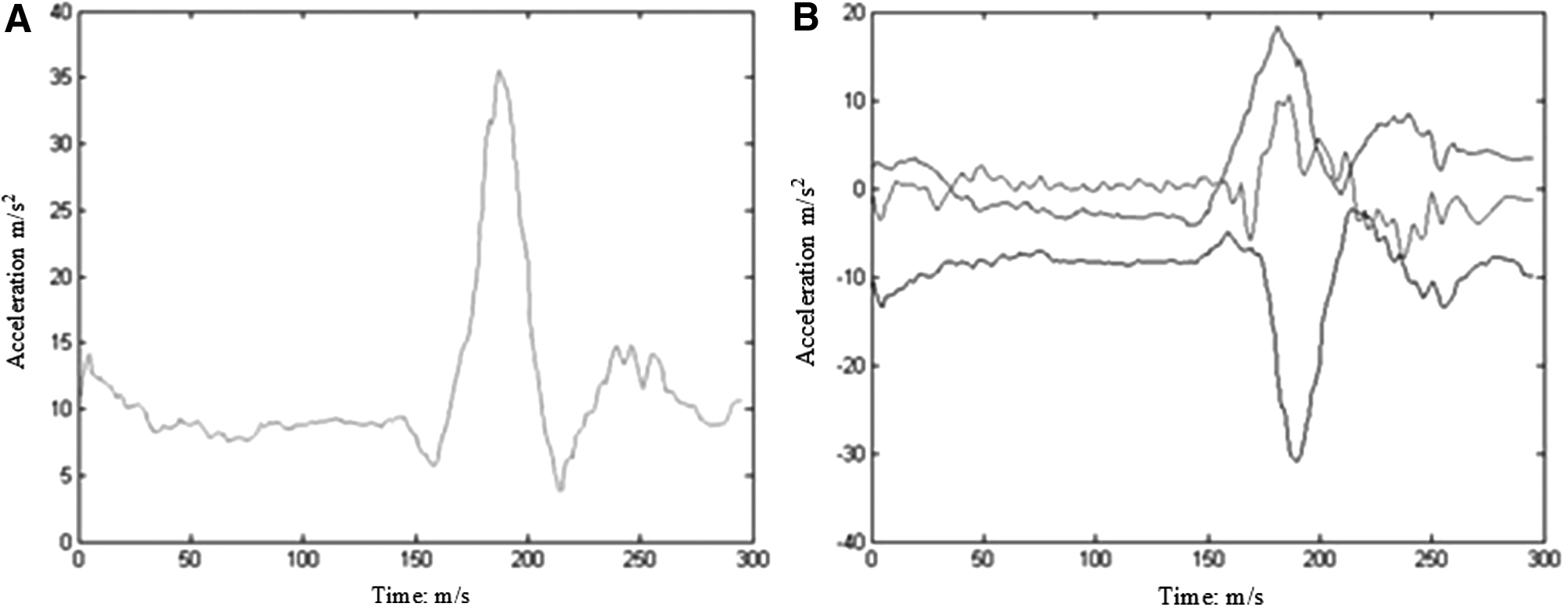
Data analysis.
Materials and Methods
This was a cross-sectional observational study focused on an evaluation of the characteristics of the acceleration of arm swing of adolescents with or without DS, while playing a bowling and golf game on the Nintendo Wii console. For this purpose, the movement acceleration was captured using three-axis capacitive accelerometers. The data were collected for both the groups with and without DS. Subsequently, the data collected from the two groups were compared. The study demonstrates the feasibility of associating the Nintendo Wii console with accelerometry technique for the evaluation of upper limb (UL) movements in children and adolescents with and without DS.
Ethical aspects
All participants in this study were studied according to the principles of the Declaration of Helsinki and the Nuremberg Code, subject to the guidelines for research with human beings (Res. 466/12) of the National Health Council after approval by the Research Ethics Committee (CEP) of the Mackenzie Presbyterian University (number 124.354). Also, the parents or legal guardians of the adolescents signed a consent declaration, giving permission for their participation in the study.
A convenience sample of 21 subjects with DS of both sexes, 7 being female (33%), aged between 10 and 14, was selected with intellectual conditions to understand simple rules and who did not have any medically prescribed contraindication to playing video games. A control group of 33 subjects, 16 being female (48%) with TD was also selected. The mean chronological age for the Down syndrome group was 11.2 years for girls and 11.9 years for boys, whereas for the control group the mean chronological age for girls was 11.8 years and for boys was 12 years.
A single evaluation was carried out with the selected population of participants diagnosed with DS and with TD, during March and April of 2013.
Data collection sites
The data were collected at the Disabled Children Parent Associations (APAE–Associação dos Pais e Amigos dos Excepcionais) in the cities of Itu, Piedade, Salto, São Roque e Sorocaba in the state of São Paulo, Brazil. APAEs are institutions specialized in the care of disabled people. Data for the control group were collected at two regular schools in Sorocaba, a city also in the same state of Brazil.
Data collection procedure
The remote device was contained in a small plastic box and strapped to the wrist joint parallel to the radial styloid process of the dominant limb, by means of an elastic band and a velcro fastener. 25
On the evaluation day, all participants were allowed to use the Wii and play both games for 5 minutes to become familiar with them, each player in the study location taking their turn. The participants were then instructed to play the bowling game, and then the golf game, to have the same sequence of games. Each game lasted 15 minutes with a 5-minute break between them, to avoid any muscle fatigue. The accelerations of the arm swing of the dominant UL were collected in the three axes (x, y, and z) as measures during the bowling and golf games. The data were captured from the first and second consecutive arm swing of each game on the same day, and the first valid measure was used for data analysis. The measure was considered valid when the software generated an acceleration graph in the three axes of motion, and also generated a graph of the maximum acceleration peak. Using this method, it was possible to visualize the characteristics of the data and to observe if there were any problems with the data capture.
Results
The studied subjects were 21 adolescents with DS, 7 of them were female (33%) and 33 adolescents with TD, 16 of them were female (48%). For data analysis, the adolescents were divided into four groups, which are: Female Down Syndrome Group (FDSG), Male Down Syndrome Group (MDSG), Female Control Group (FCG), and Male Control Group (MCG).
Maximum movement acceleration measurements for both games were collected and used in the analysis. The data from the bowling game for two male participants with TD and from the golf game for one male participant with TD were disregarded as the wireless system suffered an interference problem while the information was being collected.
The comparison of the measurement results between Control Group (CG) and Down Syndrome Group (DSG) of both sexes was carried out using absolute acceleration in time [m/s2 × ms] produced by the MATLAB program. As an example, what follows is one comparison of results of the maximum acceleration of one adolescent in the CG (Fig. 2A) and one adolescent in the DSG (Fig. 2B), both of them aged 10.

A comparison of two individual results of maximum acceleration.
Bowling game
At a significance level of 10%, for the bowling game, there was adherence to the normal distribution of the maximum peaks of acceleration obtained by the four groups, namely: FCG (P = 0.127), MCG (P = 0.162), FDSG (P = 0.110), and MDSG (P > 0.150).
Table 1 presents the 90% confidence interval for the maximum peaks of accelerations in [m/s2] for the four bowling groups.
FCG, Female Control Group; FDSG, Female Down Syndrome Group; MCG, Male Control Group; MDSG, Male Down Syndrome Group.
Table 2 reports the results for the tests of the hypothesis of equality between the means and variances in two groups as per the Student's t- and F-tests, respectively. Both comparisons according to sex, between groups, and within the same group were made, performing the two tests for each one. Using the Bonferroni method, for a significance level of 10%, each test should be performed with a significance level of 5%. When there was no adherence to normal distribution of the two contrast variables, the Mann–Whitney test was used to compare the means, and the Levene's test was used to compare variables. When there was such adherence, the Student's t-test and the F-test were used, respectively.
Table 2 compares the maximum accelerations per group (CG and DSG), according to sex, between groups, and by sex, within the same group (CG and DSG).
The results indicate that, using a 10% significance level, there is no difference among the variances of the acceleration maximum peaks. The choice of the 10% significance level was due to the reduced size of the sample, to better control the statistical power. 26
The groups presented significant statistical differences, with the maximum (M) peaks of acceleration for the MCG (M = 70.37) and FCG (M = 70.51), when compared with the MDSG (M = 45.33) and FDSG (M = 37.24). However, there were no significant statistical differences between sexes for the CG and DSG, as shown in Tables 1 and 2, as well as in Figure 3A.
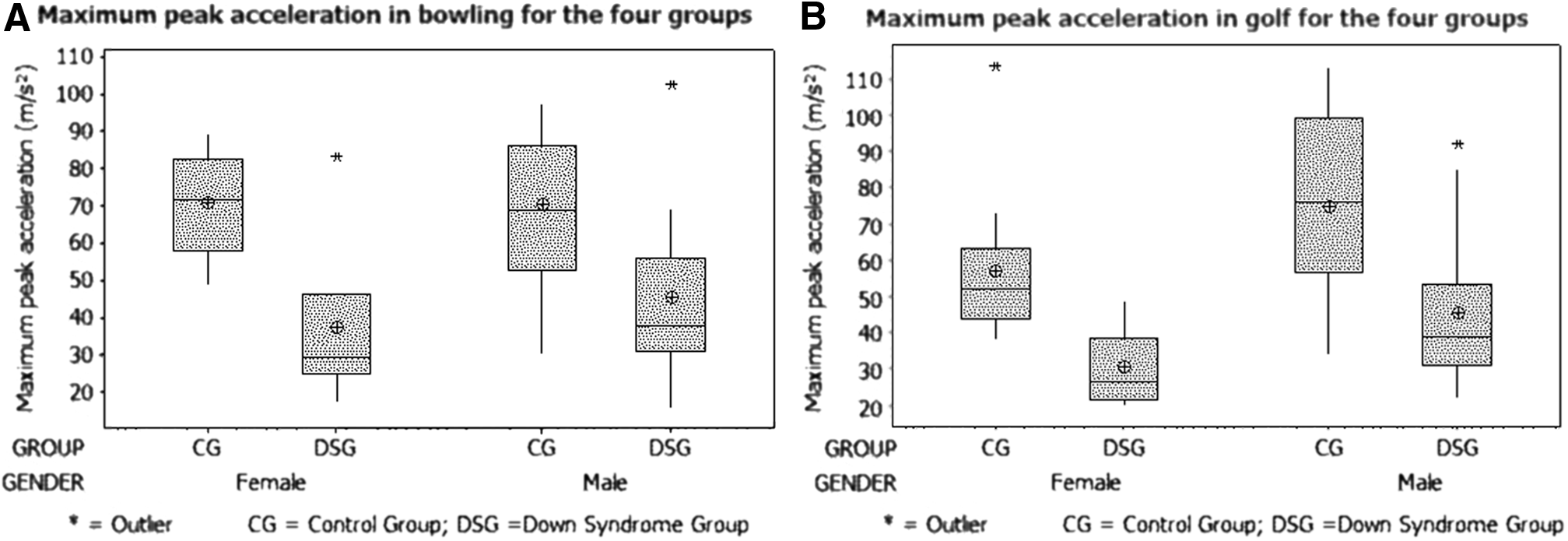
Results
Golf game
At a significance level of 10%, for the golf game, there was adherence to the normal distribution of the maximum peaks of acceleration obtained by the groups: FCG (P > 0.150), MCG (P = 0.612), and FDSG (P = 0.410). At a significance level of 10%, there was no adherence to the normal distribution of the maximum peaks of acceleration for the MDSG (P = 0.029).
Table 3 shows the 90% confidence interval for the maximum peaks of acceleration in [m/s2] for the four groups for the golf game. These intervals were calculated by using the Student's t-test in the cases where there was adherence to normal distribution and using a bootstrap test when there was no such adherence.
Table 4 reports the results for the tests of the hypothesis of equality between the means and variances in the two groups as per the Student's t- and F- tests, respectively. Both comparisons according to sex, between groups, and within the same group were made, performing the two tests for each one. Using the Bonferroni method, for a significance level of 10%, each test should be performed with a significance level of 5%. When there was no adherence to normal distribution of the two contrast variables, the Mann–Whitney test was used to compare the means, and the Levene's test was used to compare variables. When there was such adherence, the Student's t-test and the F-test were used, respectively.
Table 4 compares the maximum accelerations per group (CG and DSG), according to sex, between groups, and within the same group (CG and DSG).
The results indicate that, using a 10% significance level, there is no difference among the variances of the maximum peaks of acceleration. The choice of the 10% significance level was due to the reduced size of the sample, to better control the statistical power. 26
The groups presented significant statistical differences, with the maximum (M) peak of acceleration for the male groups, which had superior averages compared with the female groups, observed in both the MCG (M = 74.80) and FCG (M = 56.80), as well as in the MDSG (M = 45.12) and FDSG (M = 30.52), as shown in Tables 3 and 4 as well as Figure 3B.
Discussion
The present study showed that accelerometry can be used to capture measures of acceleration of movement during video games being played by adolescents with a diagnosis of DS, as accelerometry is a technique that does not require an understanding of its use by the participant.
The results correspond to the current knowledge about DS, that is, that there is a general delay in development and a slowness in motor responses,3,17,27 as shown during bowling and golf video games play, when the maximum peaks of acceleration were higher for the CG than for DSG. These conclusive data were visualized by statistical calculations and by means of absolute time acceleration graphs and motion pattern graphs produced by the MATLAB program—Version 7.11.0.584.
The acceleration peak was chosen as the variable to be studied because, although the literature describes the slow movement in DS caused by the presence of hypotonia and joint ligament laxity, this slowness has not been quantified. This type of analysis allowed us to quantify the movement of the population with DS and compare it with that of children with TD. Acceleration varied for both groups and also for both games studied. The values found for DS were always lower, corresponding with the characteristics of global delay development described in the literature.
With regard to the benefits of computer games as a rehabilitation tool for those with DS, the literature shows that, even given the limited number of studies, it is possible through their use to observe changes in the performance in variables such as balance28,29 motor learning and coordination.9,30,31
The reduced movement acceleration for the DS participants may be explained by the studies of Marconi, 32 Deffeyes, Karst, Stuberg, and Kurz, 33 who considered that muscle hypotonia and the limpness of the joint structures in DS make the joints less stable. As a result, individuals with DS use a movement strategy called coactivation in an attempt to compensate for the lack of joint stability. However, these researchers observed that coactivation rapidly becomes inefficient, as once movement starts, the agonist muscle is activated and the articulation is accelerated toward the target, however, the antagonist muscle activation occurs concomitantly, thus the same articulation is simultaneously decelerated, as a result, the limb moves too slowly.
In addition, the study established that movement acceleration measures can be taken using the Nintendo Wii, and that this video game can be an important tool and play strategy for assessing UL movements in adolescents with DS, who presented a very high acceptance of this method.
The use of accelerometry to evaluate people with DS allows performance measurements in intervention sessions, which can be programmed through training programs using virtual games. Despite the fact that the literature searched suggests good results in physiotherapeutic interventions using the Nintendo Wii console games, a usage protocol using the same games, the same physiotherapy session time, the same duration of the total intervention, and the same study variables was not found. On the contrary, the variability of all these factors is great, and it is not possible to reach a consensus on the conclusions, although it is possible to note that the use of virtual reality improves motor coordination, manual dexterity, enhancement of sensory integrative functions, muscle strength, agility performance, and speed of movement, but only through the observations of the assessor.
In addition, the EZ430-RF2500 development kit described was found to be an inexpensive solution and was suited for application developments in this area. 24
By using the accelerometry, it was possible to evaluate the acceleration movement characteristics of the superior limbs of the studied population, diagnosed with DS, by playing virtual golf and bowling games using the Nintendo Wii console. The data suggest that the accelerometry technique can be used as an evaluation tool in association with the Nintendo Wii console. For this, parameters for the placement of accelerometers on the dominant UL can be established, following the “wearability map” proposed by Gemperle et al., 25 which suggests that the accelerometers are fixed on the body region to be studied, or in the place closest to it, and always on a rigid structure, usually on a prominent bone section. The developed software enabled data capture and decodification. The data collected showed better performance for the control group, with lower movement acceleration in the DS group. These computer games can be used to practice acceleration movement and improve motor performance. The use of the Nintendo Wii, associated with the accelerometry, may be an effective resource to evaluate movement acceleration patterns in population with DS and the characterization studies of motricity for these individuals may contribute to the development of intervention programs to help improve performance.
Limitations
Although there are many important points in the present study, there are also some limitations, such as the small number of adolescents with Down syndrome who were able to understand the instructions of the researcher in the bowling and golf games, and the absence of a cognitive evaluation in this population.
Footnotes
Acknowledgments
This work was supported by the Coordenação de Aperfeiçoamento de Pessoal de Nível Superior (CAPES)/Brazil and Mackpesquisa/Mackenzie Presbyterian University/São Paulo-Brazil. We thank CAPES (Ministry of Education, Brazil) and the Mackenzie Presbyterian University for the Science initiation and Master's Degree scholarships.
Author Disclosure Statement
No competing financial interests exist.