




Abstract
Abstract
Objective:
Pokémon Go is a mobile game released in 2016 that gained great popularity. The goals of this pilot study were to investigate player's game-related behavior pattern, to evaluate Pokémon Go's impact on players' physical activity (PA) and game enjoyment, and to examine the influence of neighborhood environment on game behavior.
Materials and Methods:
Forty-seven valid online surveys were collected. Participants were asked questions from five aspects regarding their (1) game status, (2) demographic background and pre-game physical activity, (3) game enjoyment and socializing motivations, (4) perceived game impact on their post-game physical activity, and (5) neighborhood environment's influence on their choice of game location. We examined the first four aspects through descriptive statistics and t-tests, and we investigated the neighborhood impact using logistic regression.
Results:
Sixty-four percent of participants felt that Pokémon Go made them exercise more than before, about three more times, 3 additional hours, and 5.6 extra miles of PA in total per week. This impact did not vary by gender or body weight status. However, 78.7% participants started to quit or reduce game time by the time of the survey. We also found that players' choice of playing Pokémon Go in the neighborhood is positively associated with the perceived safety level and the walk score of their neighborhood, but negatively associated with the number of Pokéstops near home.
Conclusions:
Pokémon Go as a location-based mobile game is a promising tool for promoting PA, but more research is needed to prolong its positive impact.
Introduction
T
Pokémon Go is a location-based augmented reality game (ARG) released in July 2016 that can be played using mobile devices outdoors. Players move around to discover and capture a randomly appearing Pokémon creature and must walk a certain distance, for example 2, 5 or 10 km, to hatch a Pokémon egg to get a new Pokémon. Players can also travel to a Pokéstop (located at various selected places like a historical marker, an art sculpture, or a fountain in the park) to collect free items they need in the game or visit a Pokémon Gym (usually located at a landmark in public places, such as a church, a shopping mall, or a restaurant) to train their Pokémon through competing with other players. Only a week after its launch, Pokémon Go had attracted 25 million smartphone users in the United States 7 (see Fig. 1. Game in Play).
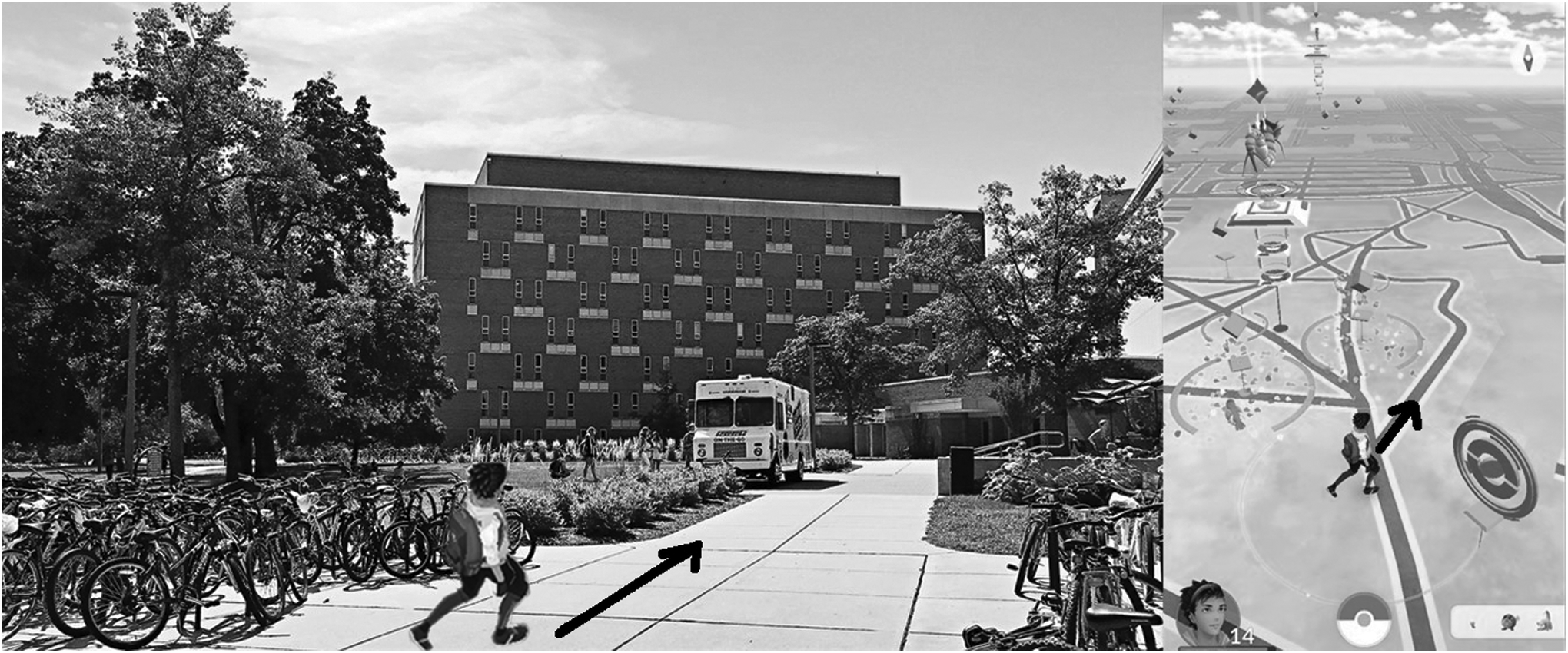
Game in Play. Player's view of the outdoor environment (left) and view in Pokémon Go (right). Black arrows in the image show the walking direction on the road in photo and the corresponding road in game interface. Photo was taken on September 13, 2016 on Michigan State University campus. Flower petals in the game interface on the right side indicated that some college student players dropped Lure Modules (a kind of game item) near Pokémon stops (icons) to attract Pokémon when they played the game outside during their lunch break.
Pokémon Go is not classified under the “Health & Fitness” category in app stores. However, due to Pokémon Go's location-based features that involve physical movement of players, multiple studies8–13 have demonstrated this game's positive influence on promoting PA. Through survey and/or collecting the built-in accelerometer data from players' smart devices, these existing studies8–13 investigated the increase in players' PA due to the game. However, there is not enough study on exploring players' game behavior patterns to answer questions like how players play the game and whether location or social network matters to them. 14
To investigate Pokémon Go as a potential intervention to obesity, we also need to test if there are biases among players of different gender and weight status. Studies on players' behavior patterns may also contribute to the parameterization and calibration of (spatially explicit) behavior models that simulate obesity interventions using ARGs. Consequently, we did a small-scale pilot study in late September, 2016, to answer the following operational questions:
What are the characteristics of Pokémon Go players? What is the players' game-related activity pattern? Did the players perceive influences of Pokémon Go on their PA? Does Pokémon Go's attraction fade over time? Does the neighborhood environment have any influence on Pokémon Go activity?
Materials and Methods
To answer our research questions, we collected data from Pokémon Go players using an online survey. Multiple questions were included addressing each of the five research questions mentioned previously (please see the survey instrument online as Supplementary Material at www.liebertpub.com/g4h). To further investigate neighborhood environment's impact, with the reported residence zip code, we also collected a walkability index value for each observation (walk score, www.walkscore.com). We geographically limited our participants either from California or Michigan, two states that provide demographic diversity and of which the geographic data are available to us. We also hypothesized that Michigan and California are states with contrasting technology adoptions as described by Roger's diffusion of innovation curve. 15
Survey instrument was created in Qualtrics (www.qualtrics.com) and distributed through Amazon's Mechanical Turk (www.mturk.com). We posted the survey on September 24th, 2016, providing 80 cents compensation per survey. On average, participants spent 7 minutes to complete the survey. The study was approved as exempt category by the Michigan State University Institutional Review Board (x16-1153e; i052314).
We received 51 complete responses. Our preliminary question asked about the player's choice of team, which served as a screening question. Four participants who did not choose from the three valid options (Team Blue, Red, or Yellow), that is, they selected other teams that do not exist in the game, were removed from the dataset; thus the final dataset had a total of 47 observations.
We cleaned our data before conducting further analysis. To evaluate participants' obesity level, we asked everyone's weight and height to compute the Body Mass Index (BMI). 16 One participant refused to disclose weight and height; thus, we used a sample size of 46 for BMI-related analysis. We also created a categorical variable “BMI level” by grouping BMI into “underweight,” “normal,” “overweight,” and “obese,” four classes according to Centers for Disease Control and Prevention (CDC). 16 We further classified BMI into two groups, overweight and nonoverweight, to prepare for comparison analysis.
To investigate the impact of Pokémon Go on PA, we asked retrospective questions about weekly PA frequency and duration of each workout when they had not installed Pokémon Go (pre-game) and when they played the game (post-game). For the pre-game question, “in a normal week before you played Pokémon Go, how many times did you exercise? (Never, 1, 2, 3, 4, 5, more than five times),” we recoded “more than five times per week” as 6 to make a numerical variable. After exploring and plotting the variable of pre-game exercise duration, seven observations with normal exercise lasting two hours or more (≥120 minutes) were identified as outliers for the variable; thus, we excluded these values from calculating mean pre-game exercise duration.
In terms of post-game questions, for people who felt Pokémon Go promoted their PA, we asked two additional questions: “how many times on average do you estimate Pokémon Go added your workout frequency per week on top of your regular exercise routine before playing the game” and “how many hours in total per week do you estimate Pokémon Go adds your PA on top of your weekly exercise routine before playing the game.” After exploring and plotting the data, answering 15 or more times for the first question (two observations) and 40 hours or more for the second question (three observations) were identified as outliers; so we excluded these five values from related analyses.
STATA 14 17 was used for data analysis.
Results
Descriptive statistics of participants
The descriptive statistics of our participants are shown in Table 1. On average, our participants were in their late 20s with diverse race and ethnicity. California participants clustered in Bay Area and around Los Angeles (Fig. 2), and most Michigan participants were within a 40-mile radius of Detroit (Fig. 3). Our two-sampled t-test showed that there is no significant difference between Michigan and California participants in terms of game installation date (P = 0.41 and Cohen's d = 0.30); thus we failed to reject our hypothesis that participants from these two states adopted this new game at a different rate.
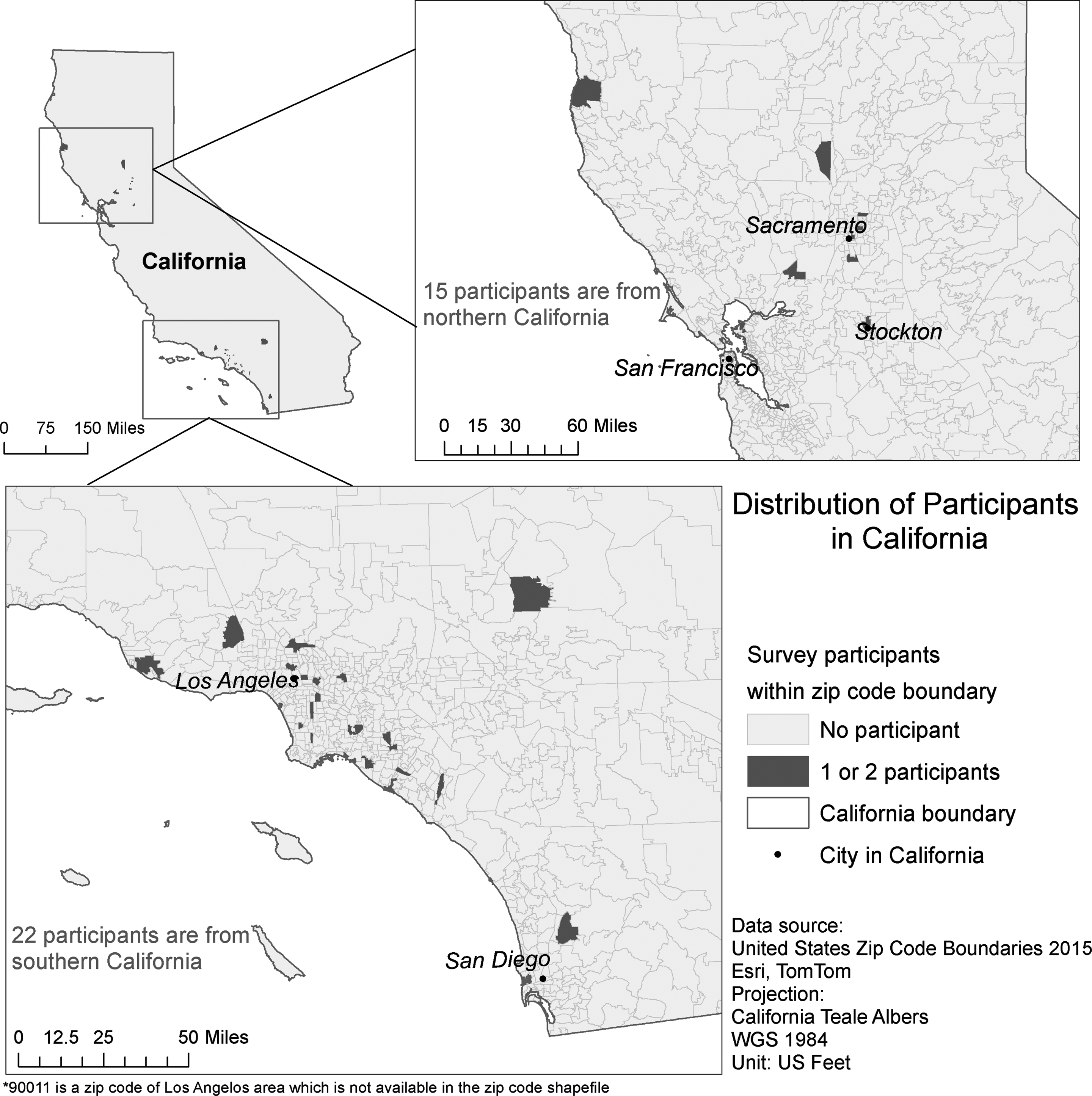
Distribution of participants from California.
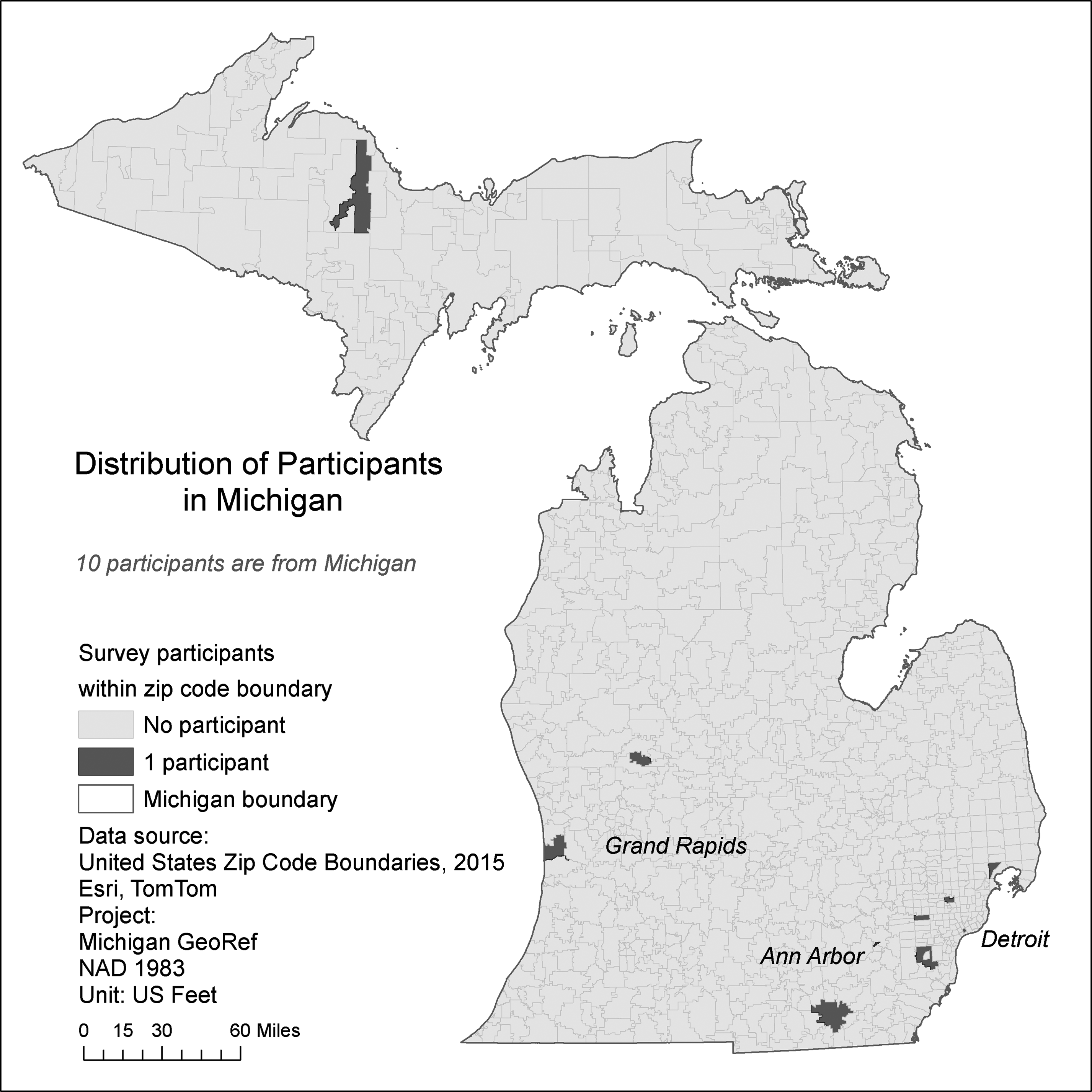
Distribution of participants from Michigan.
There was one missing value in the BMI records. Data are reported in the format of mean (standard deviation) or frequency (percentage). BMI-related variables were calculated with an N of 46 (Female = 22, Male = 24) due to one missing value. “Duration per workout in minutes before Pokémon Go installation” was calculated with an N of 40 (Female = 20, Male = 20) after excluding outliers.
CP, combat power; HISP, Hispanic or Latino or Spanish; NHWHITE, non-Hispanic white; NHASIAN, non-Hispanic Asian; NHBLACK, non-Hispanic Black and other; BMI, body mass index.
We first investigated participants' game status and tested if there was any gender difference. The Pokémon Go level and maximum combat power of a player's strongest Pokémon can be viewed as two indicators of a player's skill and the resources (especially time) devoted to the game. Through two-sample t-tests, we found no significant difference between males and females in terms of age (P = 0.42 and Cohen's d = 0.24), game level (P = 0.77 and Cohen's d = 0.09), number of days since they started playing (P = 0.89 and Cohen's d = 0.04), and the maximum combat power (P = 0.58 and Cohen's d = 0.16). Thus, given our sample dataset, we did not observe any significant difference between men and women in terms of game status.
To test game status difference between overweight and nonoverweight players, we did t-tests and found that number of game days, Pokémon Go level, and the maximum combat power were not significantly different between these two groups (P = 0.50, 0.79, and 0.72 and Cohen's d = 0.20, 0.08, and 0.11, respectively). This finding might indicate that Pokémon Go was attractive to both overweight and nonoverweight players.
Players' answers to our retrospective questions about their pre-game PA frequency and duration per workout provided a baseline to evaluate Pokémon Go's impact on PA. Our participants on average exercised two to three times per week. A two-sided t-test showed a significant difference between men and women in terms of pre-game weekly workout frequency (P = 0.02 and Cohen's d = 0.73), where men exercised about one more time per week than women. In terms of duration, average exercising time per workout was 40 minutes. Males exercised 12.5 minutes more than females per workout, but this difference was not significant (two-sided t-test, P = 0.14 and Cohen's d = 0.48). Surprisingly, we did not find any difference between overweight and nonoverweight participants in terms of their weekly workout frequency (two-sided t-test, P = 0.20 and Cohen's d = 0.39) or workout duration (P = 1.0 and Cohen's d = 0.00).
Participants' Pokémon Go activity pattern
We surveyed the frequency with which our participants played Pokémon Go in the last seven days, that is, from September 17th to 23rd, 2016. On average, our participants played the game 2.7 days per week. Females reported significantly higher frequency of days in a week (mean = 3.5 days, n = 22) than males (mean = 2 days, n = 25) (two-sided t-test, P = 0.03 and Cohen's d = 0.67). In terms of playing frequency each day, there was no significant difference between men and women (Mann–Whitney U test P = 0.14, r = 0.21). During a particular Pokémon hunting or egg hatching trip, participants reported they spent, on average, 40 minutes on walking/jogging/biking covering a distance of 2.5 miles.
Walking was the major method of playing Pokémon Go. A few participants chose a combination of walking and driving, which indicated that they traveled to a farther place to catch Pokémon or played the game on their way to a destination for other activities. Data also showed that a higher ratio of females chose the way of combining driving and walking.
In terms of locations to play the game, over half of the participants reported that they mainly played around where they lived, that is, “in my neighborhood.” Over one-fourth of the participants combined the play with other primary activities, for example, on their way to work/school/shopping/restaurants. According to our data, participants either played alone or with friends and significant others (Table 2).
Data are reported in the format of mean (standard deviation) or frequency (percentage). “Playing place” and “Playing PG with” questions allow multiple choices, thus total percentage is greater than 100. PG, Pokémon Go.
Pokémon Go's influence on PA
Did Pokémon Go promote PA of players who participated in our study? We found that among the 47 participants, nine people (19%) reported “I feel that Pokémon Go makes me exercise much more than I used to,” and 21 people (45%) reported that Pokémon Go made them exercise a little bit more. Cumulatively, 64% participants thought that Pokémon Go made them exercise more while they played the game. Seventeen people (36%) thought Pokémon Go had no impact on the amount of their exercise. We also offered the options of “much less exercise” and “a little bit less exercise,” considering the possibility that Pokémon Go could take up some leisure time previously allocated for exercising and/or the players mainly drove around to hunt for the creatures. None of the participants chose these two options. Our Fisher's exact tests showed that this selection of Pokémon Go's impact did not have a significant relationship with gender (P = 0.81, Cramér's V = 0.10) nor their obesity level, that is, whether they were overweight/obese (P = 0.08, Cramér's V = 0.33).
We further asked those 30 participants who felt that Pokémon Go made them exercise more to quantitatively estimate the influence of Pokémon Go on their weekly exercise frequency and duration. After excluding outliers, the reported increase in PA due to Pokémon Go is shown in Table 3. Our t-tests showed that none of these measurements (PA frequency added per week, PA hours added per week, and PA miles added per week) was significantly different between men and women (P = 0.27, 0.17, and 0.60 and Cohen's d = 0.45, 0.57, and 0.21, respectively), or overweight and nonoverweight participants (P = 0.18, 0.16, and 0.48, and Cohen's d = 0.57, 0.60, and 0.29, respectively).
Data are reported in the format of mean (standard deviation). There is one missing value in BMI records. Five outliers were excluded from analysis. PA, physical activity.
Game enjoyment
After about two months of gaming, most people denoted that they “still play now and then, but spend less time on it than before,” and 23.4% participants indicated that they “almost quit or already do not play it anymore.” Only a small portion of participants did not anticipate they would cut the game time or thought they would devote more time on Pokémon Go. This result is consistent with our expectation that people's interest in the game fades over time.
To further evaluate the decrease in game enjoyment, we asked participants how much they enjoyed the game when they just started and during their recent experience on a one to ten scale with ten being the most enjoyable. Based on our analysis, the average rating dropped from 8.2 to 5.9 and there was no significant difference between males and females (P = 0.10 and Cohen's d = 0.49) or between overweight and nonoverweight participants (P = 0.60 and Cohen's d = 0.16) in terms of score dropping. The Spearman's rank correlation test showed that decrease in enjoyment had a significant (although modest) positive correlation with the number of game days (ρ = 0.41, P = 0.004).
We listed four game motivation factors (Table 4) with an emphasis on socializing and asked participants to rate their importance from one to five with five meaning extremely important and one meaning not important at all. “Exploring the real world while playing Pokémon Go just for the sake of exploring it” was rated the highest and situated between moderately important to very important, but other motivators did not receive high ratings.
Data are reported in the format of mean (standard deviation) or frequency (percentage).
Pokémon Go and neighborhood environment
Based on our pre-game questions, we found that among 25 participants who played Pokémon Go near where they live, 64% of them also exercised in their neighborhood at least once a week. This may imply that if a player's neighborhood is suitable for exercising, she is likely to play Pokémon Go in the neighborhood.
We found that player's perceived walkability was not significantly correlated with the walkability index (collected from www.walkscore.com) at the zip code level (P = 0.42, ρ = −0.12). Through logistic regression analysis (Table 5), we found that the likelihood a player chose to play Pokémon Go in the neighborhood was significantly and positively associated with the perceived safety level in the neighborhood and the walk score index at the zip code level, but negatively associated with the number of Pokéstops that players estimated within a 30-minute walk from home. There was no significant association between playing the game in the neighborhood and the perceived participant walkability level.
Walk score index is collected from www.walkscore.com based on participants' zip code.
DV, dependent variable; IV, independent variable; CI, confidence interval.
We failed to find a correlation between neighborhood environment variables and participants' game enjoyment level or between neighborhood environment and the impact of Pokémon Go on their PA.
Discussion
Through our analysis, we found Pokémon Go had a positive influence on promoting PA for some players. Thirty participants (64%) in this project felt that Pokémon Go promoted their PA. According to Table 3, these 30 participants estimated that Pokémon Go made them walk 5.6 extra miles per week. Assuming that it takes 2000 steps to walk a mile, 18 given the total added miles per week, we can estimate that those participants who reported that Pokémon promoted their PA walked ∼1600 more steps daily (5.6 miles per week × 2000 steps per mile ÷7 days per week).
This estimate is greater than the daily increase in steps reported in two existing studies by Althoff et al. 10 (1472 steps) and Howe et al. 11 (955 steps). This overestimation is probably caused by selecting only participants who reported positive influence of Pokémon Go on their PA and/or participants' overestimating Pokémon Go's influence. In our analysis of Pokémon Go's influence on PA, we did not detect differences between different gender or body weight status groups from our sample dataset, which might indicate that Pokémon Go was equally attractive and influential to all kinds of players.
From our analysis, we found that participants' game enjoyment dropped over time. We believe this is because there were not enough new features introduced to the game by the time we conducted this study, so the game lost many active players. 19 In the evaluation of Socializing motivation, our participants did not rate those motivators high (Table 4), which may suggest that, although we usually observe clusters of people near Pokéstops/Gyms, socializing is not very important to players. On the other hand, we found that exploring the world was an important driving factor for players to engage in the game. Exploring the world was also a feature that differentiated Pokémon Go from traditional computer or smart device games.
When investigating neighborhood environment impacts, we did not find a significant correlation between the neighborhood environment and Pokémon Go's impact on PA, which was consistent with the finding of Howe et al. 11 This might imply that Pokémon Go's influence on PA did not vary between urbanized and rural areas. Our analysis showed that participants' perceived walkability level was not significantly correlated with the walkability index of neighborhood at the zip code level. This might be because each participant defined walkability differently, and/or for different participants, the perceived neighborhood and the zip code defined area were at different geographic scales.
The logistic regression analysis (Table 5) indicated that whether players chose to play the game in their neighborhoods was associated with their neighborhood environment. To the best of our knowledge, such influence of neighborhood on player's choice of game location was not assessed by other existing studies.8–13 The positive coefficients indicated that higher perceived neighborhood safety level and more walkable neighborhoods would increase the chance of a player playing Pokémon Go near home.
Unexpectedly, the number of Pokéstops near home is negatively associated with choosing to play in the neighborhood. A possible reason is that a high density of Pokéstops appears at very urbanized areas, which may discourage some players who would prefer exploring places with more green space or scenic views. If games like Pokémon Go will be used as tools to promote local communities' physical activity, we would argue that it is also important to improve the local environment, such as improving community safety and esthetics, and increasing pedestrian paths.
Limitations
We recognize the limitations of this study.
First, this is a small-scale study with a small sample size, which largely limits the statistical power of our analysis and precludes us from generalization. Our failing to reject some of the null hypotheses might result from insufficient power (i.e., higher chance of committing a Type II error); thus a larger dataset should be collected in our future study.
Second, we did not use an existing validated questionnaire, and all of our data are self-reported values rather than physical measurements recorded preintervention and postintervention in a controlled experiment. The accuracy of self-estimated values varies among participants, which can influence the results of our analysis. Moreover, it is likely that survey participants are those who played Pokémon Go a lot and were interested in the topic, which could also bias the result.
Third, when surveyed about the neighborhood, participants were not asked to provide their home addresses, which limited our ability to precisely assess the relationship between players' neighborhood environment and their game-related behavior.
Fourth, for this pilot study, we only did the survey once. Although we tried to detect behavior and attitude change through retrospective questions, estimates are quite subjective and the temporal resolution is fuzzy.
With these limitations in mind, we hope that the findings of this study provide some useful insights and information to guide a larger scale, longitudinal study to further investigate the potential health benefits of location-based games like Pokémon Go.
Conclusion
Our findings indicated that Pokémon Go as a location-based mobile game is a promising tool for promoting physical activity. However, as players' game enjoyment faded over time, more improvements to the game and more research are needed to prolong this game's positive impact.
Compared to some existing studies,8–13 this study is unique in terms of its comprehensive questions that cover multiple aspects of Pokémon Go-related behavior, such as players' game enjoyment and influence of neighborhood environment, with an emphasis on PA. Although we did not find a significant correlation between the neighborhood environment and Pokémon Go's impact on PA, we would argue that where the players live may have an impact on where they choose to play the game.
We also recognize many limitations of this study. This study is only exploratory and preliminary due to budgetary constraints. We believe that it is necessary and valuable to further investigate the influence of Pokémon Go on PA, especially by combining with spatial information and spatial analysis through a more comprehensive research. If studies keep tracking the spatial-temporal pattern of players' behavior, researchers might be able to discover ways to improve player retention to prolong the positive influence of Pokémon Go or similar games on PA. There are also some negative effects of Pokémon Go such as safety (playing may interfere with traffic) and ethical issues. 20 Given these shortcomings, more research needs to be done to evaluate Pokémon Go experiences and design better ARGs that can effectively promote public health in the long run.
Footnotes
Acknowledgments
The authors would like to thank the editor and the reviewers for their suggestions. The authors would also like to express their gratitude to Yue Dai from Department of Communication, Michigan State University, for her help in using Qualtrics and Amazon Mechanical Turk in this study. This study was not funded.
Author Disclosure Statement
No competing financial interests exist.
References
Supplementary Material
Please find the following supplemental material available below.
For Open Access articles published under a Creative Commons License, all supplemental material carries the same license as the article it is associated with.
For non-Open Access articles published, all supplemental material carries a non-exclusive license, and permission requests for re-use of supplemental material or any part of supplemental material shall be sent directly to the copyright owner as specified in the copyright notice associated with the article.
