




Abstract
Abstract
Objective:
We studied which games and underlying game mechanics are considered motivating by older adults, so that designers and therapists make informed choices when designing or selecting virtual reality (VR)-training interventions.
Materials and methods:
We conducted a repeated measures design with 30 older participants, who played eight different VR-training games and afterward filled out the intrinsic motivation inventory (IMI). Differences in intrinsic motivation between games were analyzed using Friedman's tests. In addition, in-depth interviews were conducted according to the laddering technique, to unveil the underlying game mechanics that lead to the players preferences.
Results:
IMI scores were relatively high for all games, indicating that these VR games seem effective for inducing a high intrinsic motivation. Wii yoga and Kinect Adventures were the highest scoring games on all but the negative subscale tension. Both games provided regular positive feedback. An important game mechanic was Variation, which showed a strong link to important values such as: to Stay Focused, Improve Fitness, and Health and Independency. Furthermore, the game mechanics Visual Feedback and Positive Feedback, which lead to an increased Drive to Perform, were perceived valuable. Seemingly contradicting, but both important attributes such as Speed versus Slow Movements emphasize the importance of designing VR training that adapts to the skill level of the player.
Conclusion:
We have shown that games with different game mechanics can induce high intrinsic motivation. When designing or selecting VR balance training games for older adults, these game mechanics should be incorporated to optimize a positive user experience and increase intrinsic motivation.
Introduction
A
The term VR covers a wide range of applications 12 ; in physical rehabilitation, computer games that are controlled with body movements are often referred to as exergames or VR training; the latter is the terminology adopted in this work.
While several studies assessed the usability of VR training, only few studies investigated the motivational affordances of VR-based training. For example, a review by Nawaz et al., which focused on acceptability, concluded that VR games are received well by older adults. 13 Furthermore, studies on the preferences of older gamers show that older gamers prefer casual games, such as puzzle games, over so-called hardcore games.14,15 However, the preferences of older adults, specifically for VR-training games, are not yet extensively investigated, even though adjusting VR training to their preferences might increase intrinsic motivation. 16 Intrinsic motivation is the motivation to participate in an intervention because the intervention in and of itself is motivating.17,18 Therefore, if we want to improve adherence in VR training, we should aim to incorporate game mechanics that optimize the intrinsic motivation of VR-training games. The intrinsic motivation inventory (IMI) can be used to measure intrinsic motivation to perform a task.16,19 A study on VR balance training for older adults showed higher IMI scores in the subscales enjoyment in an exergaming intervention compared to conventional training. 20 Furthermore, intrinsic motivation has previously shown to be predictive of the time invested in playing a game. 15
The relationship between game mechanics and player motivations can be further investigated through the lens of Means-End Theory. Means-End Theory posits that consumers or players in this case will prefer one game to another because of how certain attributes or game mechanics lead to certain benefits, or desired consequences, or ultimately tailor to the goals or values a player seeks. Hence, the goal of the player is the end point of an action, the way to get there are the means.21,22 This approach thus allows studying which characteristics of the game (attributes) the individual considers important for what outcomes (consequences) and why these consequences matter to the individual (values).
User Experience Laddering (UX-Laddering) is a technique to reveal Means-End chain (MEC) structures. 23 Using a semistructured interview participants are asked to select their favorite choice, often through preference ranking. 24 The interviewer will then derive the attributes, consequences, and values underlying the choices of the participants, by means of in-depth interviews. UX-Laddering has previously been applied in Human-Computer Interaction and games research, for example, to understand gaming preferences of preschoolers. 24 However, it has not yet been applied to the field of VR balance training for older adults.
The aim of this study was to reveal which VR-training games older adults perceive as being intrinsically motivating, as measured by the IMI. Furthermore, we studied their preferences and the underlying Means-End structures to uncover game mechanics that explain why certain VR-training games are more appealing to older adults.
Materials and Methods
Participants
We recruited 30 older adults (Table 1), who reported to have no physical or cognitive diseases and could stand for at least 20 minutes, by distributing flyers at the sports facilities and social events for older adults. All participants were older than 65, lived independently, and scored above the inclusion threshold of 26 on the mini mental state examination. 25 All participants signed a written informed consent, in accordance with the declaration of Helsinki. The local ethics committee (Commissie Medische Ethiek K.U. Leuven) approved the study.
Participants' Characteristic Values Are Displayed as Mean (Standard Deviation)
MMSE, mini mental state examination.
Games
Eight VR-training games, which were played on three different systems, Wii (Nintendo, Kyoto, Japan), Xbox 360 (Microsoft, Redmond, WA), and Dynstable (Motekforce Link, Amsterdam, Netherlands), were chosen for this study. Games were selected to represent a varied but realistic sample of games, to be used in VR training. The Wii and Xbox are both of the shelf gaming systems, whereas Dynstable is developed for the rehabilitation market. The games we selected and the abbreviations we used are listed in Table 2. A brief description of the included games is included in the Appendix 1.
List of Included Games
Protocol
The order of the games was determined by a computer-based random number generator. 26 Participants played each game thrice, except for the Kinyoga and Boxing games, which were longer games that already incorporated repeating sequences. IMI questionnaires were filled out in Access (Microsoft, Redmond), directly after playing each game. After all games were played, we commenced the UX-laddering interview.
IMI Analysis
The questions of the IMI questionnaire are categorized to form seven different subscales from which the relevant subscales can be included in the study. 19 We excluded the subscales perceived choice, because the game selection was predetermined, and relatedness, because this subscale measures how well the person can relate to the character in the game. Most of the included games did not involve such a character. We included the following subscales: enjoyment, competence, effort, value, and tension, of which tension is a negative trait and enjoyment can be considered as a self-report of intrinsic motivation. 19 For all subscales, Cronbach's alphas were relatively high (Table 3), indicating internal consistency between the items that constitute each subscale.
Cronbach's Alpha for Each Subscale
IMI, intrinsic motivation inventory.
To test the hypothesis that different games elicit different levels of intrinsic motivation, we choose Friedman's tests, because the data were not normally distributed. The ranking and further statistical analysis was performed in IBM SPSS Statistics Version 21.0. To reduce the amount of comparisons, post hoc analysis was done using stepwise step-down analysis, in which homogeneous conditions are clustered.
UX-laddering interview
In the UX-laddering interview, we presented the participants with screen captures of the games they played, in pairs of two, according to a preference ranking method, shown previously to be effective for laddering studies (Fig. 1). 24 The order was the same as the order in which they played the games. For each pair, participants were asked to identify their preferred game, which started the semistructured interview in which the interviewer probed the participant with the question “why” in an attempt to reveal the UX ladder. The participant was asked why they preferred this game; this usually leads to the consequences that drew the participant toward their preferred game. This question was followed by the question what aspect in the game caused this consequence, to reveal the preferred attributes. The next question, why the mentioned consequence is important to them, aimed to reveal the underlying personal values of the participant. The responses were noted down, to be coded and analyzed. We also kept a record of the preferred games; their second and favorite game would receive one and two points, respectively.
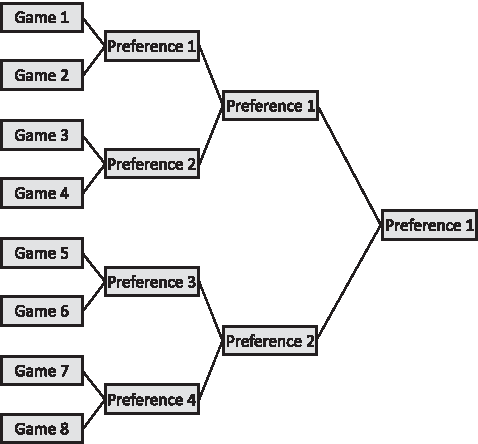
Schematic representation of the laddering procedure.
Analyzing the UX-laddering interviews
Two independent coders translated the interviews into key terms or core elements, which formed the elements of the individual ladders. The ladders from both coders were entered in the UX-laddering software. 27 These ladders form the implication matrix, where for each core element it is charted how many times it has been linked to another core element. From the implication matrix the Hierarchical Value Map (HVM) is created. The HVM is a web-shaped figure, which graphically visualizes the connections between the core elements. Cutoff values had to be established, for the minimal number of connections between core elements that would be represented on the HVM. Even though the literature recommends to use cutoff values that maintain about two-thirds of all links in the HVM, 23 we set stricter cutoff values, to achieve a stable yet clear HVM, which maintained 40% of all linkages.
Results
Quantitative analysis
All the results from the IMI questionnaires are shown in Figure 2, in which we present the descriptive statistics in the upper panels to show the distribution of the data and the results from the Friedman's tests with stepwise step-down analysis in the lower panels. Note that the order along the X-axis was determined by the rank of each game, placing the highest ranked game for each subscale at the left and the lowest ranked game at the right side to accommodate the visual representation of the homogeneous groups. Overall, the median IMI scores seem quite high, but some differentiations can be made.
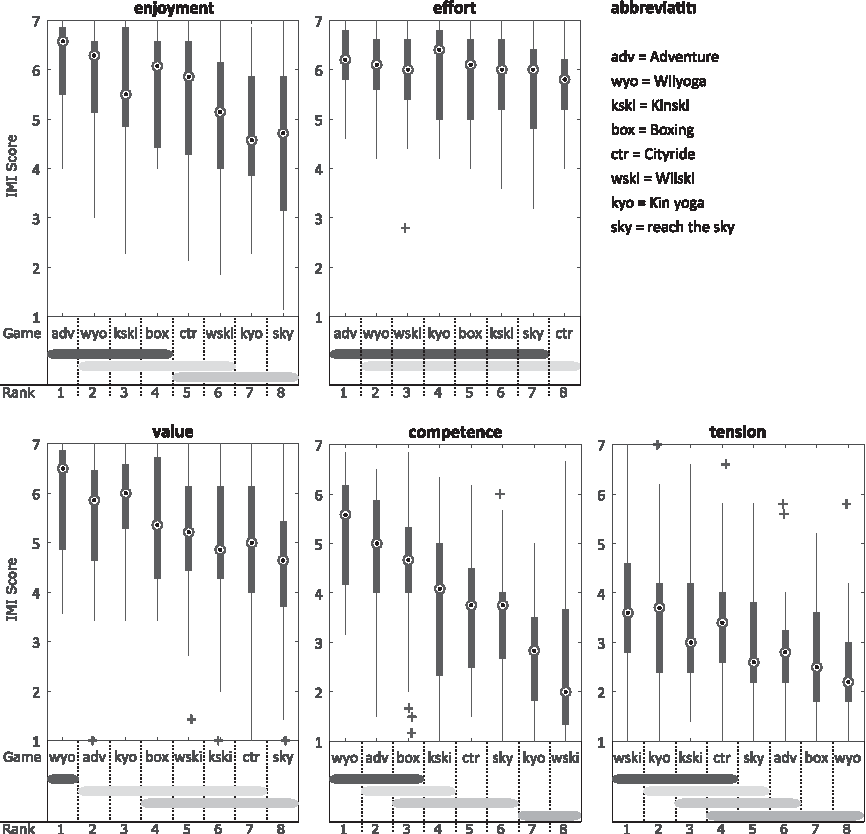
Questionnaire data are shown in the upper panels for each subscale. Higher scores represent a better evaluation of the game, except for the subscale tension, which represents a negative characteristic. Medians are marked as a circle, the box ranges from the 1st to the 3rd quarter. Whiskers indicate the range of the data, and outliers are marked “+.” The lower panels, for each subscale, show the results from the Friedman's tests and the clustering from the stepwise step-down analysis. Homogeneous groups are marked in the same colors. Note that for each subscale the order along the X-axis was determined by the ranked analysis.
Significant differences in ranking on the subscale enjoyment were found, X2(7) = 49.516, P < 0.001. Post hoc analysis shows that especially the games Adventure, Wii yoga, Kinski, and Boxing had high rankings and appeared in the highest ranked homogeneous subset.
On the subscale effort, significant differences were found, X2(7) = 18.865, P = 0.009. However, all games, except the Cityride game, were part of the highest ranked homogeneous subset.
Significant differences in ranks were also found in the subscale value, X2(7) = 49.304, P < 0.001. Wii yoga distinguished itself from all other games, showing up singled out in the highest ranked homogeneous subset. The second homogeneous subset contained all other games except for Reach the Sky.
The subscale competence also resulted in significant differences, X2(7) = 81.035, P < 0.001. Three games, Wii yoga, Adventure, and Boxing, formed the highest ranked homogeneous subset, which were all three also in the highest ranks for the subscale interest.
Finally significant differences in ranks were found in the subscale tension, X2(7) = 31.631, P < 0.001. The games Wiiski, Kinyoga, Kinski, and Cityride form the highest ranked homogeneous subset. The three games that were in the highest ranked subset on both competence and interest ended up as the lowest three for the subscale tension.
Qualitative analysis
To understand why older adults preferred certain games, we analyzed the MECs as obtained through UX-laddering and preference ranking. We ranked the games according to the preferences, in which second and favorite games received one and two points, respectively. The top three games were Adventure, Kinyoga, and Boxing (Fig. 3).
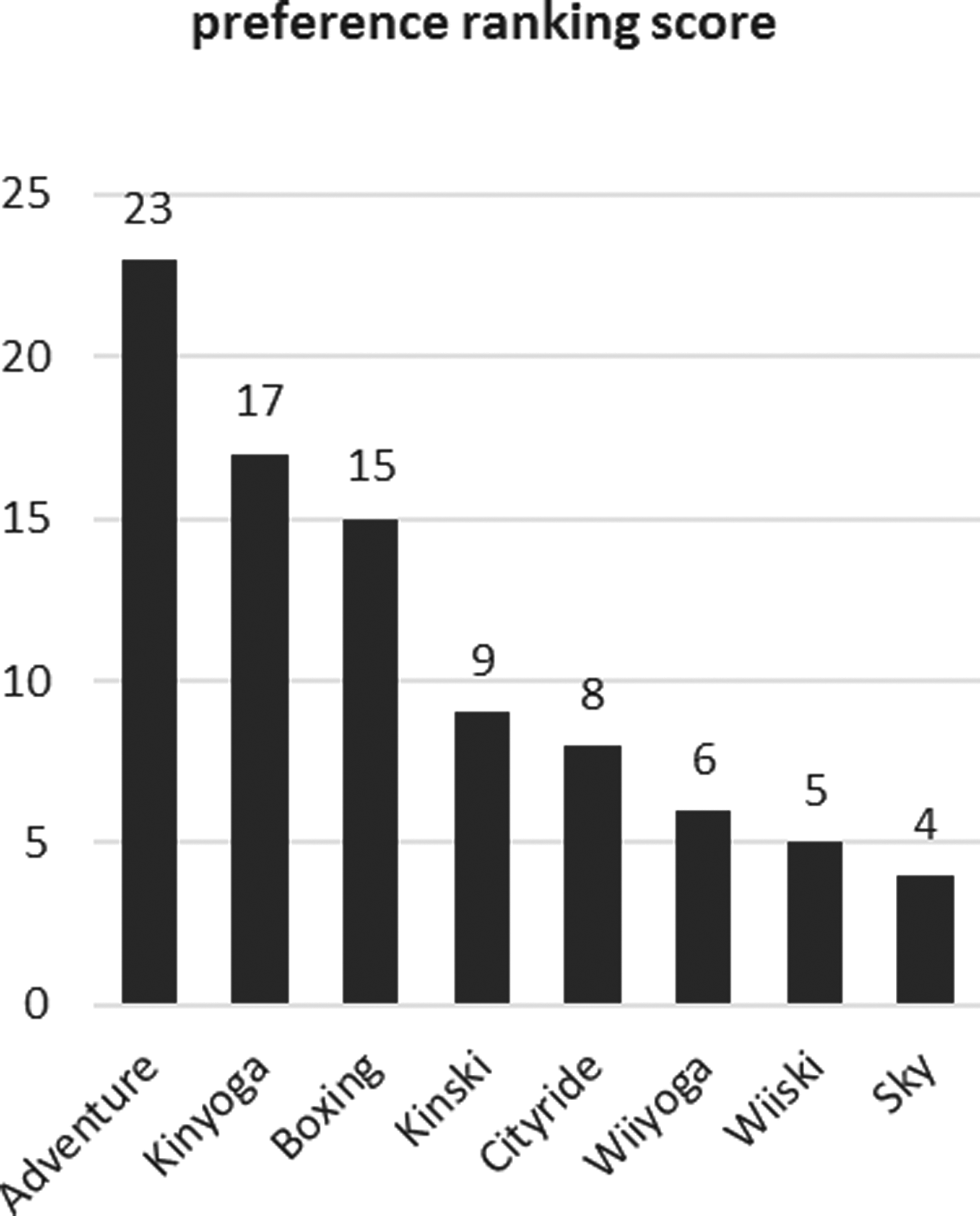
The total score of the preference ranking for each game is shown. Two points were given to the preferred game and one point to the second favorite.
From the interviews 859 data points were obtained from 30 participants, which formed 224 ladders. We differentiated 17 different attributes, 7 consequences, and 7 values. We will highlight a few key MECs; a comprehensive overview of the links can be detected from the HVM (Fig. 4).
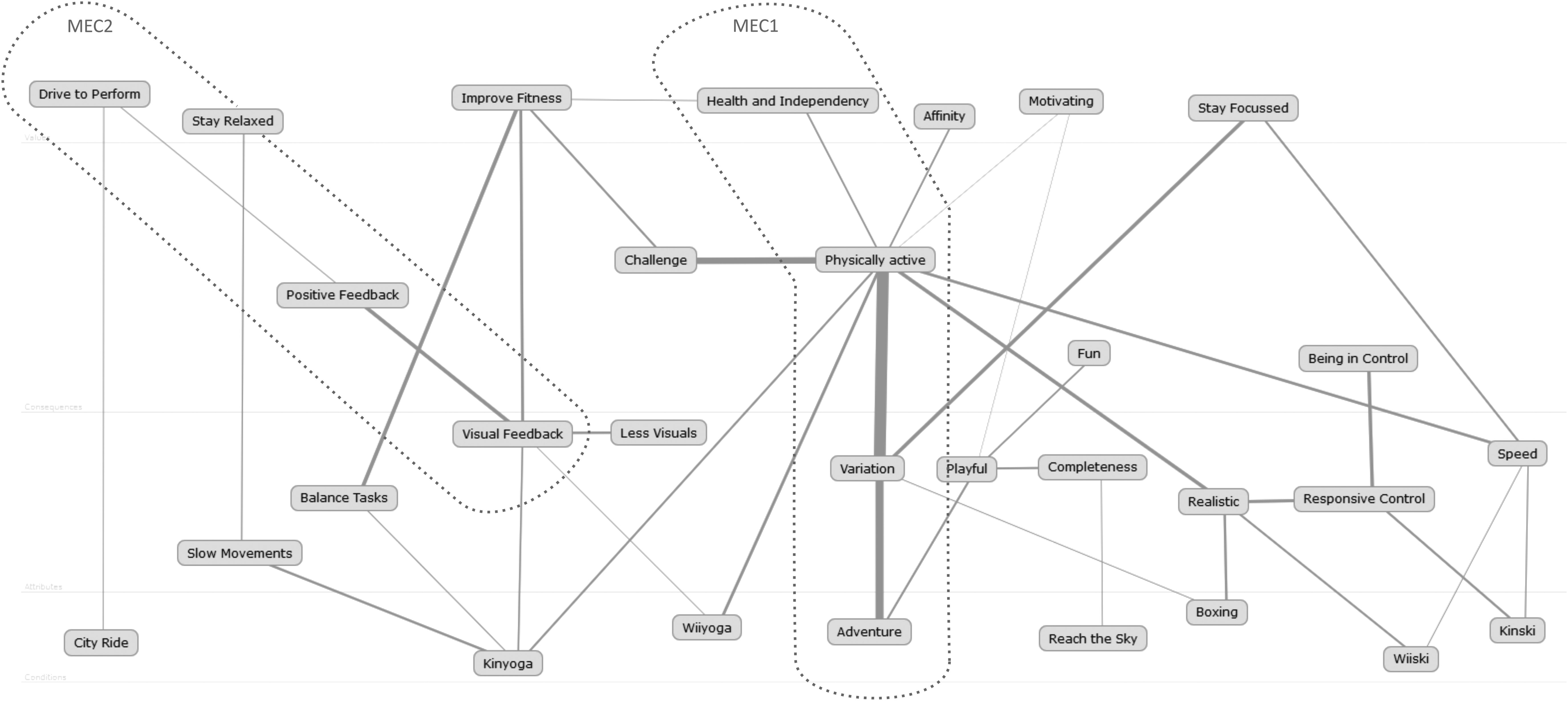
Hierarchical Value Map (HVM). Key terms derived from the UX-laddering interviews that are repetitively linked will show up on the HVM. A thicker line on the HVM represents frequent connections between key elements. From the bottom to the top, the layers represent conditions (different games), attributes, consequences, and values. Two major MECs are emphasized by red-dotted outline. MEC, means-end chain.
MEC1–variation–physically active–health and independence
The consequence “Physically active” plays a central role as shown by the multiple links. Especially the link between “Physically active” and the attribute “Variation” is strong. “Physically active” is further connected to the values, “Health and Independency,” “Affinity,” and “Motivating and Improve Fitness.” Participants often mentioned phrases like: “The game was very active because I had to duck and jump,” “I want to remain independent,” and “I want to able to do the things I used to do.”
MEC2–visual feedback–positive feedback–drive to perform
Another important value is “Drive to Perform,” which is linked to “Visual Feedback” and “Positive Feedback.” Participants would mention phrases such as: “I liked it because I received a good score” and “It feels good to perform well.”
The value Affinity was mentioned in ladders that started from the attribute “Realistic.” Participants mentioned things like: “I used to enjoy this activity” when they recognized things like skiing, driving a car, or even boxing.
Discussion
The value of VR games
The IMI scores on the games were quite high, indicating that our participants were motivated by playing VR balance games. Furthermore, scores on the subscale enjoyment, which is considered the subscale that represents self-reported intrinsic motivation, 19 were high. Furthermore, most games show high scores on the subscale value, indicating that older adults believe that these games can be effective. In this subscale, the Wii yoga game distinguished itself from the other games. Possibly, because this game included important attributes like “Visual Feedback” and is “Physically Active,” which helps to “Improve Fitness” (Fig. 4). Furthermore, the high score of this game on the subscale effort shows that older adults were motivated to put effort into the games. However, in previous work in which the challenge of VR games was studied by analyzing muscular activity, or by analyzing weight shifts, we have shown that very little muscular effort is needed to perform any of these games, 28 and games that targeted weight shifts leave room for improvement. 29 The high scores on the subscale effort are possibly due to a high cognitive challenge, after all “Stay Focused” was mentioned as an important value. However, cognitive challenge in VR training is hard to measure and has not yet been studied as far as we know.
Important game mechanics
Remarkable are the conflicting results of the yoga games when comparing the preference ranking with the IMI results. Kinyoga ranked second best on the preference ranking (Fig. 3), whereas it is badly ranked in the IMI subscales, tension, enjoyment, and competence. We speculate that this might be because Kinyoga looks attractive on a screenshot, as it clearly shows the potentially valuable “visual feedback.” However, the feedback was often inconsistent resulting in frustration and low scores. Furthermore, the laddering was done at the end of the experiment, when the negative experience might have diminished. The values on the HVM show the importance of “fitness and health” for older adults. These values are linked to the game mechanics “Physically Active” and “Variation.” Even though incorporating variation might increase complexity, variation was shown to be an important factor in this study and in previous studies. 30 A preference for “variation” in movements, as well as in the game environment, was shown. These game mechanics should not be neglected when developing VR-training games for older adults. The value “Drive to Perform,” which refers to the performance or score in the game, also shows to be an important value. This is in line with previous findings that show challenge, described as: “To push oneself to beat the game.,” is an important motivator for older adults. 14 The value “Drive to perform” is linked to “visual feedback,” and “positive feedback.” Adventure and Wii yoga stood out by being the highest ranked games in all, but the negative subscale tension. These games are very different games, but are similar in the fact that they both show clear positive feedback, although for the Adventure game this does not show on the HVM.
Considerations for the older gamer
A study by Broady et al. concluded that older adults can learn to use technology in the same ways as young, but emphasis should be on time to familiarize and on positive feedback to avoid fear of technology. 31 Furthermore, as age increased an increase in enjoyment, effort, and tension was observed, whereas competence declined. 31 The results of our laddering study also indicate the importance of presenting “slow movements,” which helps to “stay relaxed,” as can be seen in the HVM. All of the scores on the tension subscale were below the neutral score of three, indicating that little pressure was experienced. The games in the highest group of the subscale tension were games in which we often observed difficulties with the controls and the speed of the game. Moreover, games that induced high tension were games that scored low on the positive subscales.
Finally, some contradicting key elements show up on the HVM, such as “Slow Movements” and “Speed” (Fig. 4). It is clear that these attributes lead to different consequences and values. When considering these attributes and their links together, it can be concluded that game speed should be fast enough to increase challenge, but not so fast that it compromises the value “Stay Relaxed.” This emphasizes the importance of games to be adaptable to the skills of the player.
Limitations
The high IMI scores obtained in this study might be attributable to a selection bias. Participants volunteered which might result in a sample that holds positive views toward computer use and VR. In addition, some participants were recruited around sport facilities so that they will be inclined to the belief that physical activity is important. However, the repeated measures design enables us to differentiate between games.
The variation of game types, and thus attributes, that we introduced was limited because we exclusively tested readily available VR games that were controlled with body movements. Therefore, some attributes that are motivating for older adults might not be present in our HVM. For example, older players tend to prefer completion, choice, and enjoyment, 32 which are aspects of exploration type games which were not among the included games. The games were also played individually, which eliminated the impact of social interaction. Social interaction was shown to be an important element that correlated with longer playing time in older players. 14 Accordingly, further research is needed after adapting VR balance training for older adults to the knowledge that has been gained through recent research. This will lead to an evolution in understanding goal directed and population specific preferences in VR training.
Conclusions
We have shown that VR training can lead to strong intrinsic motivation; overall, older adults showed high enjoyment of VR based training games. Further dissecting what may explain high enjoyment, especially games that provide “positive feedback,” resulted in high IMI scores. “Health and Independency” and “Improve Fitness” were important values for older adults, connected to game mechanics like “Variation” and “Physically Active.” Furthermore, the “Drive to Perform” was important for our participants, which was enhanced by “Visual Feedback” and “Positive Feedback.” Contradictory favorable attributes such as “Speed” on one hand and “Slow Movements” on the other hand emphasize the importance of designing VR training that is adaptable to the skill level of the player. When designing or selecting VR balance training games for older adults, these attributes should be considered to optimize user experience, thereby increasing intrinsic motivation. Novel games will have to go through further user experience analysis to gain more detailed information about game mechanics that can increase motivation and finally improve adherence to VR balance training programs.
Footnotes
Acknowledgments
This research was funded by the European Commission through MOVE-AGE, an Erasmus Mundus Joint Doctorate program (2011-0015).
Author Disclosure Statement
No competing financial interests exist.
Appendix A1. Game Descriptions
Wiiski: A mini game from the package Wii Sports Resort (Nintendo, Kyoto, Japan). The player has to ski as quickly as possible down a slalom course; however, missed slalom gates will result in penalty time. The player controls the avatar using weight shifts, as captured by the Wii balance board (Nintendo, Kyoto, Japan).
Kinski: A mini game from the Kinect sports season 2 (Microsoft Studios, Redmond, WA) package. The objective is similar to the previous skiing game; however, extra speed can be gained by jumping at the right moments. The player controls the avatar using weight shifts, as captured by the Kinect sensor (Microsoft, Redmond, WA).
Wii yoga: A mini game from the package Wii Sports Resort (Nintendo, Kyoto, Japan). We selected the Half moon pose and the Warrior pose. In this game the player has to mimic a static pose while shifting their weight as little as possible. The weight shifts are measured by the Wii balance board, and feedback is provided on a gauge.
Kinyoga: We selected the yoga game from Your shape fitness evolved 2012 (Ubisoft, Rennes, France). In this game the player has to follow dynamic movements that are presented on the screen. The movements are tracked with the Xbox Kinect sensor, and feedback about the orientation of each segment is provided.
Boxing: The boxing game we selected is also part of the Your shape fitness evolved 2012 package. In this game punching and kicking movements, as shown on the screen, have to be performed. Scores can be improved by rhythmically moving in time. Movements are tracked by the Kinect sensor.
Adventure: We selected the Reflex Ridge mini game from the Kinect Adventures package (Ubisoft, Rennes, France). In this game the player stands on a platform that moves along a set of rails. Various objects have to be avoided by dodging, jumping, and taking side steps. Movements are tracked with the Xbox Kinect sensor.
CityRide: This game is part of the Dynstable package (Motekforce Link, Amsterdam, Netherlands). The game is played while standing on a platform that can translate in the horizontal plane. The goal is to steer a car through a busy street, avoiding traffic collisions. A collision results in slowing down and a small perturbation by the translating platform. The game is controlled with weight shifts, which are recorded by force plates embedded in the moving platform.
Reach the sky: This game is also part of the Dynstable package. The goal is to build a tower by collecting blocks. Precise mediolateral weight shifts have to be performed to catch falling blocks. Weight shifts are recorded by force plates embedded in the platform.