




Abstract
Abstract
Objective:
This study was performed to investigate the effect of strengthening executive functions through group games on social skills of preschool children.
Materials and Methods:
This was a quasiexperimental study with experimental and control groups and pretest–posttest design. The statistical population included all the preschool children in Bojnord, Iran. The study population consisted of 30 preschool children who were randomly assigned to experimental and control groups. The intervention of strengthening executive functions was based on games that were performed in twelve 45-minute sessions in the experimental group. The collected data were analyzed using independent t-test and Mann–Whitney U test in SPSS, version 23.
Results:
At the posttest stage, suitable social behaviors, nonsocial behaviors, and aggressive-impulsive behaviors were significantly different between the experimental and control groups by controlling the effect of pretest.
Discussion:
Strengthening the dimensions of executive functions, such as inhibitory response, self-regulation, and cognitive flexibility, through team games improves social skills in children.
Conclusion:
Group games by strengthening executive functions can develop social skills in preschool children.
Introduction
I
Previous studies found a positive correlation between social communications and executive function and the related mental health consequences. 5 In fact, sociality is based on various executive skills that are necessary for social interactions with others. 6 Executive functions include the ability to initiate a behavior, the ability to inhibit the dominant responses or competitive actions, storing and manipulating information, working memory, targeting the related task, planning and organizing thoughts and behaviors, and developing flexible thinking to solve problems. In other words, adaptation to changes in the person's environment, emotional regulation, and monitoring thoughts, emotions, and behaviors are classified as other subsets of executive functions. It also has been reported to be associated with academic achievement,7,8 social function, 9 and behavioral problems10,11 in clinical and nonclinical populations.
Few studies have been carried out in relation to executive functions and their effects on social skills and behavioral regulation. 11 In accordance with the studies conducted in this field, executive skills influence friendships, social relationships, and daily tasks such as returning a favor, understanding social signs, and preserving concentration on a task. Any shortcomings in these skills can lead to a problem in communication with other people and isolation. 6 Impaired social communication is argued to be the result of deficits in basic executive functions. 12 Hungerford et al., 11 in a study, argued that deficiencies in executive functions of children 6–9 years old were related to lack of social skills. Seçer et al. 13 found that children showing impulsive behaviors have less efficiency in social situations and social participation than reflective and thoughtful children. Muscara et al. 14 indicated that defective executive functions are associated with lack of social skills in brain-damaged children.
Some studies indicated that low scores on executive functions were associated with high scores on externalizing behaviors.15,16 Mackelprang et al. 17 examined the relationship between executive function and social skills among children and found that social skills were influenced by the ability to plan, initiation, inhibitory response, and shifting cognitive sets that necessitate behavioral and emotional regulation and self-control.
In recent decades, the impact of training executive functions on children's cognitive, educational, and social processes has been investigated. 18
In a study by Elias and Berk, 19 it was determined that impulsive preschool children who played complex sociodramatic games with their peers showed improved self-regulation functioning. Ahangarghorbani et al. 20 confirmed the effectiveness of training executive functions on social skills in dyslexic students. Shokoohi-Yekta et al. 21 showed that an intervention program based on problem-solving method significantly improved social skills and reduced behavioral problems. Ghobari-Bonab et al. 22 suggested that training inhibitory response and working memory improved social skills of children with attention-deficit/hyperactivity disorder. Zetocha et al 23 revealed that interventional programs such as self-monitoring, self-control, and self-conversational skills have reduced impulsive behaviors and increased self-control in preschool children.
According to the presented matters, executive functions as one of the essential ingredients of social communication may influence social interactions. Without the essential executive skills, it is difficult for a child to interact successfully with others. Before responding to social contexts, executive functions conduct a child's behaviors by manipulating and maintaining information using memory, planning, and reasoning about interpersonal targets. 24 Nevertheless, the previous results indicated that executive functions are related to important cognitive skills for social interaction; we sought to examine the effects of strengthening executive functions through games on the components of social skills of preschool children. Therefore, the strengthening of executive functions may help to improve social skills.
Materials and Methods
Study design
This was a quasiexperimental study with experimental and control groups and pretest–posttest design. This study was reviewed regarding ethical considerations by the Research Committee of Islamic Azad University of Bojnourd, it was approved on February 20, 2017, with the code 1822070596999, and we followed the principles of the Declaration of Helsinki in all the procedures.
To observe ethical considerations, trainers and parents of children who were selected to participate in the study were invited to participate in a meeting, where we explained to them the study procedure and ensured them of the confidentiality of the data. Then, they signed an informed consent form to participate in the study.
Participants
The statistical population consisted of all the preschool children in Bojnord city, Iran. A preschool center was selected through cluster random sampling, including 95 5- to 6-year-old children. Given that a minimum of 15 samples is considered for each group in experimental designs, from among the 95 children, 30 children were selected using the simple random sampling method. The children were randomly allocated to experimental and control groups. In the experimental group, 66.7% (10 participants) were boys and 33.3% (5 participants) were girls. In the control group, 60% (9 participants) were girls and 40% (6 participants) were boys. In total, in both groups, 46.4% (14 participants) were girls and 53.4% (16 participants) were boys.
Instrument
Group Games for Strengthening Executive Functions: these games were extracted from an intervention designed by Dawson and Guare 6 for strengthening executive functions. These games were performed in twelve 45-minute sessions by the children. These sessions are presented in Table 1.
Group Games List for Strengthening Executive Functions
Dawson and Guare. 6
Social skills questionnaire
This scale was designed by Matson et al. 3 to measure social skills of children and adolescents 4–18 years old and it has parent, trainer, and student forms. In this study, according to the age of the participants, only forms of parent and trainer were used. The parent form has 55 items, and the trainer form contains five general items. Parents and educators should respond based on a 5-point Likert scale (1 = never to 5 = always). Social skills subscales include suitable behaviors, unsocial behaviors, aggressive-impulsive behaviors, self-assurance, and communication with peers. In Iran, Cronbach's alpha reliability of the social skills questionnaire was established by Yousefi and Khayer 25 to be 0.86.
Procedure
A total of 30 children were assigned randomly to experimental and control groups.
The intervention, games for strengthening executive functions, 6 was implemented in the experimental group in twelve 45-minute sessions. For higher efficiency, groups of children were divided into two groups of seven and eight individuals. The intervention program was performed for the control group after carrying out the posttest in the two groups. Game sessions were not performed by the preschool trainer, but they were exercised by a trainer familiar with the games related to executive functions. The social skills questionnaire was completed by the children's parents and preschool trainers at the pretest and posttest stages. The obtained data were analyzed using independent t-test and Mann–Whitney U test in SPSS, version 23.
Results
The means of social skill components in the parent and trainer forms are presented based on pretest and posttest phases and experimental and control groups in Tables 2 and 3. Descriptive data can be seen in Figures 1 and 2.
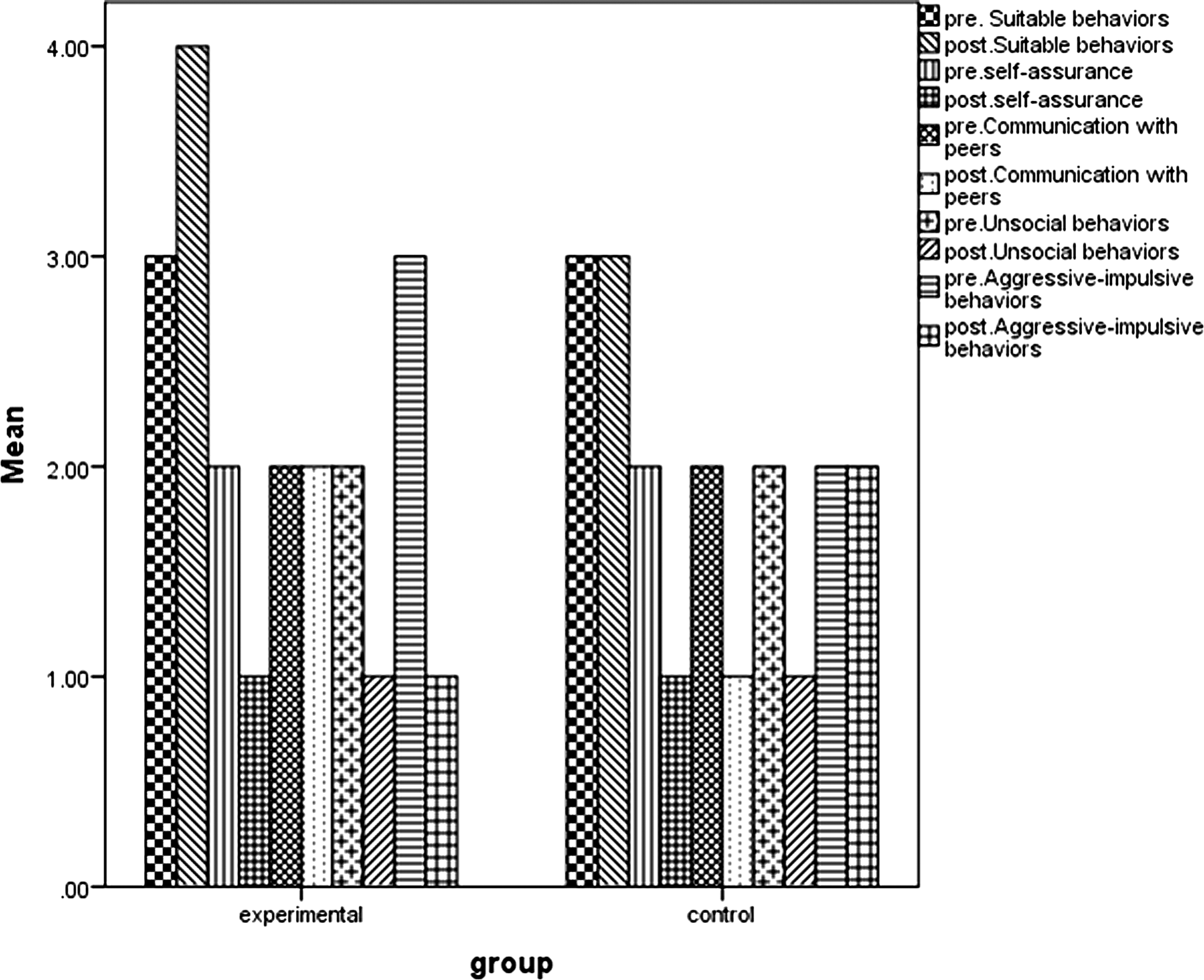
Mean of social skill components of the parent form in groups and separately in pretest and posttest.
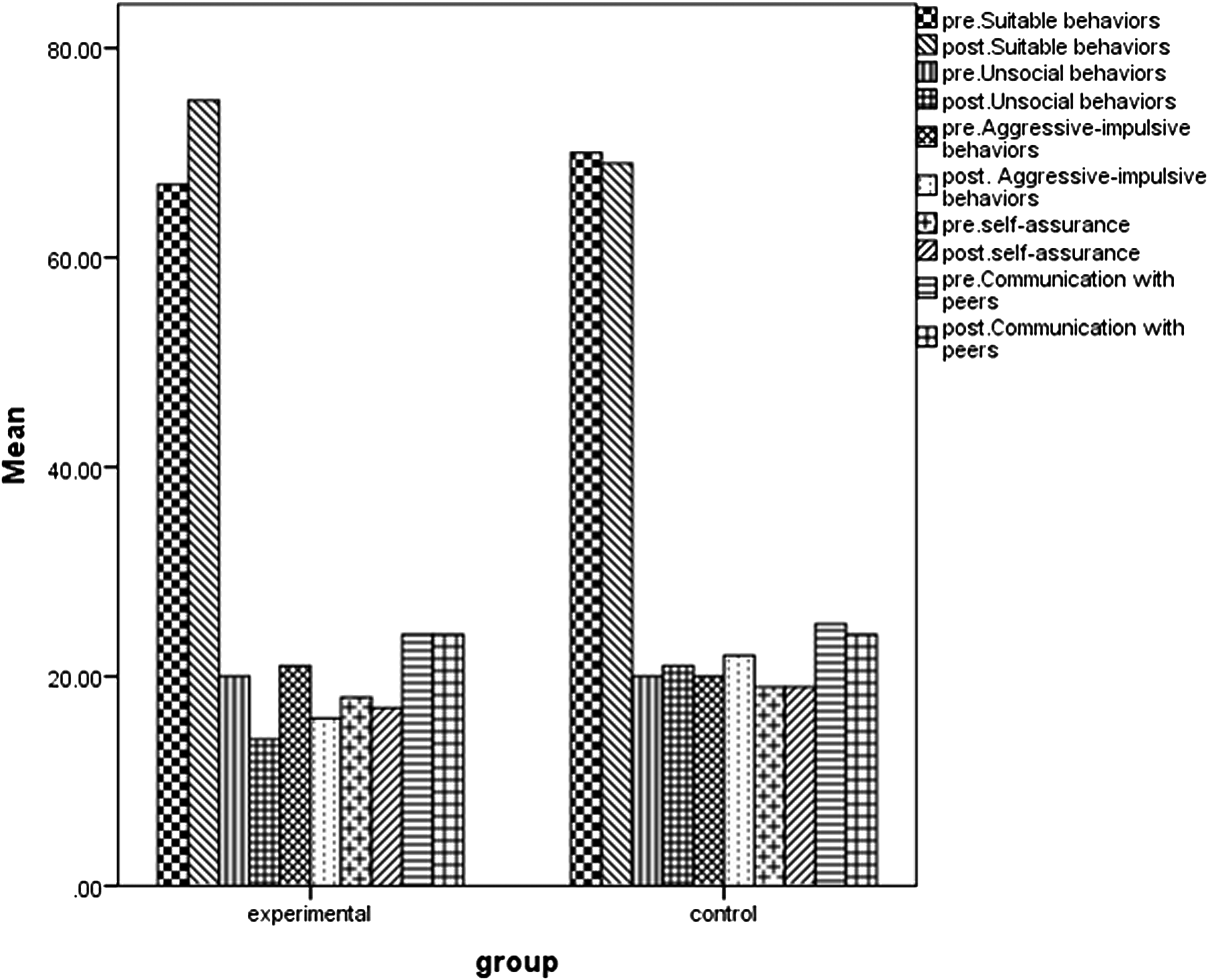
Mean of social skill components of the trainer form in groups and separately in pretest and posttest.
Descriptive Indexes of Social Skill Components of the Parent form in Groups and Separately in Pretest and Posttest
SD, standard deviation.
Descriptive Indexes of Social Skill Components of the Trainer Form in Groups and Separately in Pretest and Posttest
The results of Kolmogorov–Smirnov test showed that the data obtained regarding the social skills components in the trainer form at the pretest and posttest stages were not normally distributed in the control and experimental groups (P < 0.05). However, in the parent form, social skill components at the pretest and posttest stages were normally distributed in the control and experimental groups (P < 0.05). Regarding the nonnormal distribution of the data in the trainer form, the Mann–Whitney U test was used to analyze the data. However, for analyzing the data, the parent form, assumption of equality variances about the two groups, and the assumption of regression gradients homogeneity were considered; the variances in the components of social skills were equal in the two groups.
Regarding the variables of suitable behavior, self-assurance, aggressive-impulsive behaviors, unsocial behaviors, and communication with peers, the assumption of regression gradient homogeneity was established (P > 0.05). However, the assumption of regression gradient homogeneity on the component of unsocial behaviors was not found (P < 0.05). The assumption of the collinear relationship of the pretest and posttest was not found in the components of suitable behaviors, unsocial behaviors, aggressive-impulsive behaviors, and communication with peers. Therefore, to examine the difference between the two groups in the components of social skills, independent t-test was used.
The posttest and pretest differences of social skill components between the experimental and control groups were analyzed using independent t-test and Mann–Whitney U test.
Table 4 shows that the posttest and pretest stages were significantly different in the components of suitable behaviors, aggressive-impulsive-behaviors, and unsocial behaviors in the groups in both trainer and parent forms. In other words, by controlling the effect of pretest, games of strengthening executive functions reduced aggressive-impulsive and unsocial behaviors and increased suitable behaviors in the experimental group.
Independent t-Test and Mann–Whitney U Test for Comparing Posttest and Pretest Difference of the Social Skill Components in Groups
Significant level.
In the end, gender differences in components of social interaction were analyzed by Mann–Whitney U test in the groups and parent and trainer forms. As Table 5 shows, there was no significant difference between girls and boys in both group and stages (P > 0.05). Therefore, gender has no effect on the results of the study.
Mann–Whitney U Test for Comparing Gender Differences in Components of Social in the Groups and Parent and Trainer Forms
Discussion
The purpose of this study was to investigate the effect of strengthening executive functions through games on the social skills of preschool children. This study showed that strengthening executive functions through games 6 increases suitable behaviors in preschool children. Suitable behaviors include behaviors such as having eye contact with others, being polite, using names of others, and having the desire to interact with others in a useful and effective way. This finding is consistent with those of other studies.26,27 Barkley 26 argued that executive functions lead to behavioral modifications and appropriate behaviors and provide the possibility of receiving more positive reinforcement in the social domain. Similarly, the study of Matson and Rivet 28 showed that proper social behaviors lead to the perception of emotional states and emotional regulation.
In this intervention, to increase suitable behaviors, we used different games, including the opposite theater game, without the use of a thumb, a serious laugh game, and the swap game. These reinforced inhibitory response, flexibility, emotional control, initiation of a task, concentration, and observing turn taking. In explaining these findings, it can be stated that strengthening the various dimensions of executive functions such as impulse control, emotional and cognitive control, self-initiation, planning, inhibitory control, self-regulation, and self-monitoring can lead to improved suitable social behaviors.
In addition, our results demonstrated that strengthening executive functions through games 6 declined children's unsocial and aggressive-impulsive behaviors. Unsocial behaviors comprise such behaviors as lying, beating, caviling, and making annoying and abnormal sounds. This finding is consistent with the results of a large number of studies.2,11,14,26,28–30 The study of Zhang 8 indicated that deficiency in executive functions can lead to defects in social skills and cause people to fail in the evolution of social capabilities, and to be exposed to unsocial and high-risk behaviors.
Executive functions guide behaviors, improve control, and encourage thinking about consequences; any defect in emotional control and emotional regulation causes inappropriate social behaviors. Individuals with weakness in inhibitory response are unable to stop their thoughts, actions, and emotions or to correct errors and choose appropriate behaviors. These children with behavioral problems experience more stress than their peers due to incompatible skills of emotional regulation and negative thinking. It has been shown that negative thinking leads to delinquent behaviors. 26
The study of Avila and Parcet 31 showed that aggressive-impulsive behaviors are related to lack of inhibitory response and self-regulation. Barkley 26 suggested that impaired working memory and response inhibition are among the reasons for aggression. In fact, deficiencies in inhibitory control, emotional control, flexibility, and self-awareness, which are the key components of executive functions, provide a context for the emergence of violence, aggression, and dangerous behaviors and increase the risk of these behaviors. In addition, children with aggression who are unable to control their impulses usually have trouble delaying their behaviors and thinking; these children have a low threshold for failure and display intense reactions to critical situations such as anger, crying, aggression, and avoidance because of lack of powerful emotional control. 6 Barkley 26 argued that training strategies for increasing inhibitory response lead to relaxation, regulation, targeted behaviors, and reflection before response, which reduce the incidence of impulsive behaviors.
Games such as animal game, bulbs, scissors, knives and forks game, proper gesture, mirror image, human sandwiches, sock games, identifying objects, guessing the name of the animal, Stroop's shape, and postponing the prize, reinforce inhibitory response, organization, time management, concentration, and initiating a task. These games, through strengthening inhibitory response, emotional control, and maintaining attention, reduced unsocial and aggressive-impulsive behaviors because these games have a direct impact on the components of self-control.
This study displayed that strengthening executive functions through games 6 did not significantly affect self-assurance and communication with peers. Self-assurance behaviors include boasting, show off, pretending to know everything, and pride. Communication with peers involves behaviors such as greeting, talking about gatherings, and dating. In fact, self-determination and self-awareness are important components of executive functions that have a direct relationship with social and individual attitudes toward oneself, others, and the environment. Children with emotional and motivational adjustment problems have low visibility and self-esteem, while in some others, these problems cause excessive confidence and behaviors such as show off and claiming superiority to peers. 6 This result is inconsistent with those of studies by Gresham and Elliot, 1 Barkley, 26 and Muscara et al. 14 This discrepancy could be due to the short-term training process or the ineffectiveness of games of executive functions on self-awareness and self-assurance.
However, games strengthening executive functions 6 affected suitable behaviors and unsocial behaviors, which could, in turn, influence relationship with peers because these games are all played in a group and are focused on observing turn taking, working memory, inhibitory response, flexibility, and emotional control. It seems that children within the age range of 5 to 6 years have temporary relationships with their peers, and they still do not intend to establish lasting friendships with their peers, and these relationships are strongly influenced by the place of games, toys, and instructor. Therefore, in explaining why this hypothesis was rejected, it was due to the short duration of the training period because executive skills grow gradually and require more time.
The main limitation of our study was that our study population comprised normal children. Regarding social deficits in children with autism spectrum disorders 32 and learning disabilities, 33 as well as the impact of strengthening the executive functions on improving social interactions, it is recommended that future study be conducted in such specific groups of participants.
Conclusion
We found that the reinforcement of executive functions through games affected the social skills of preschool children. During the preschool years, children are motivated by collaborative group games to initiate and maintain engagement with peers. The social skills required for these collaborations are based on using working memory, inhibitory control, shifting attention, and in general, behavioral regulation. It is suggested to use games targeted to enhance executive functions to improve social skills in preschoolers.
Footnotes
Acknowledgments
We have no funding to report. We would like to thank all the authorities, trainers, children, and their parents in preschool centers who helped us conduct this research in Bojnord, Iran.
Author Disclosure Statement
No competing financial interests exist.