




Abstract
Objective:
Competitive exercise games are popular in areas like rehabilitation and weight loss due to their positive effects on motivation. However, it is unclear whether a human opponent is necessary, as the same benefits may be achievable with a “human-like” computer-controlled opponent or a human who talks to the player without playing the game. Our objective was to compare four opponent types in a competitive exercise game: a simple computer opponent, “human-like” computer opponent, human opponent, and a simple computer opponent accompanied by a player-selected human who chats with the player.
Materials and Methods:
Sixteen participants (3 women, 24.4 ± 7.7 years old) played a competitive arm exercise game in the above four conditions. Exercise intensity was measured with inertial sensors, and four motivation scales were measured with the Intrinsic Motivation Inventory. After playing, participants answered several questions regarding their preferences.
Results:
The human opponent was the favorite for 14 of 16 participants and resulted in the highest interest/enjoyment and exercise intensity. All participants preferred the human opponent over the computer opponent accompanied by a human companion. Finally, 12 of 16 participants preferred the “human-like” computer opponent over the simple one.
Conclusion:
Our results have two implications for competitive exercise games. First, they indicate that developing computer-controlled opponents with more human-like behavior is worthwhile, but that the best results are achieved with human opponents. Second, social interaction without in-game interaction does not provide an enjoyable, intense experience. However, our results should be verified with different target populations for exercise games.
Introduction
Competitive and cooperative serious games have become increasingly popular in diverse applications like motor rehabilitation,1–4 weight loss,5,6 language therapy 7 and education.8–10 The premise of such games is that, since both competition and cooperation are important sources of intrinsic motivation, 11 multiplayer games should result in higher player motivation and more intense gameplay than single-player (SP) serious games. This premise is supported by several serious game studies where human opponents resulted in higher motivation and exercise intensity than computer-controlled ones.3,12–14
However, some researchers have suggested that potential benefits of human opponents and partners may be exaggerated. For example, computer-controlled opponents in the aforementioned studies were predictable, behaving according to simple deterministic equations (e.g., move toward target with constant speed),3,13–15 so a more human-like computer-controlled opponent may be able to achieve the same motivational benefits as a human opponent. This was qualitatively observed in our previous studies, where multiple participants stated that they preferred human opponents due to their “unpredictable,” complex behavior.12,13 If feasible, replacing human opponents with human-like computer-controlled ones would increase the practicality of such games, as computer-controlled opponents are always available while human opponents are often unavailable. Alternatively, any motivational benefits may be due to social aspects (conversation with opponent) rather than actual competition or cooperation. While this may seem like a trivial distinction, it has implications for the design of multiplayer games for health: such games commonly involve algorithms that carefully adapt game difficulty to suit both players,2,3,15 but this may be unnecessary if players are motivated by socializing rather than by competition or cooperation.
To determine the importance of human opponents in competitive exercise games, we conducted a study where participants played a competitive exercise game against four opponents: a human opponent, a human-like computer-controlled opponent (actually a human disguised as a computer), a simple computer-controlled opponent, and a simple computer-controlled opponent accompanied by a second human who chats with the participant. Our hypotheses were:
-
-
Materials and Methods
Competitive game
The study was performed with a two-player competitive Pong game (Fig. 1) previously used in our arm rehabilitation studies.2,13 Each player controls a paddle near the top or bottom of the screen and moves it left or right using their controller. A ball bounces around the game field, and each player tries to intercept it so that it does not pass their paddle. If the ball passes a player's paddle and reaches the top or bottom of the screen, the opponent scores a point. The ball then moves in front of one player's paddle (randomly chosen) and begins moving toward the other player's side after a 1-second pause. Every 60 seconds, game difficulty changes according to a simple algorithm that changes the ball speed and paddle sizes depending on the players' score in the last minute. If both players are doing well/poorly, the algorithm increases/decreases ball speed; if one player is doing better than the other, the algorithm increases the worse player's paddle size and decreases the better player's paddle size. More details are available in our previous article. 2 Figure 2 shows two participants playing the game.

Screenshot of the competitive Pong game. Each player controls one of the two paddles. The current game duration, score, ball speed and time until next automated difficulty adaptation are shown on the right side of the playing field.
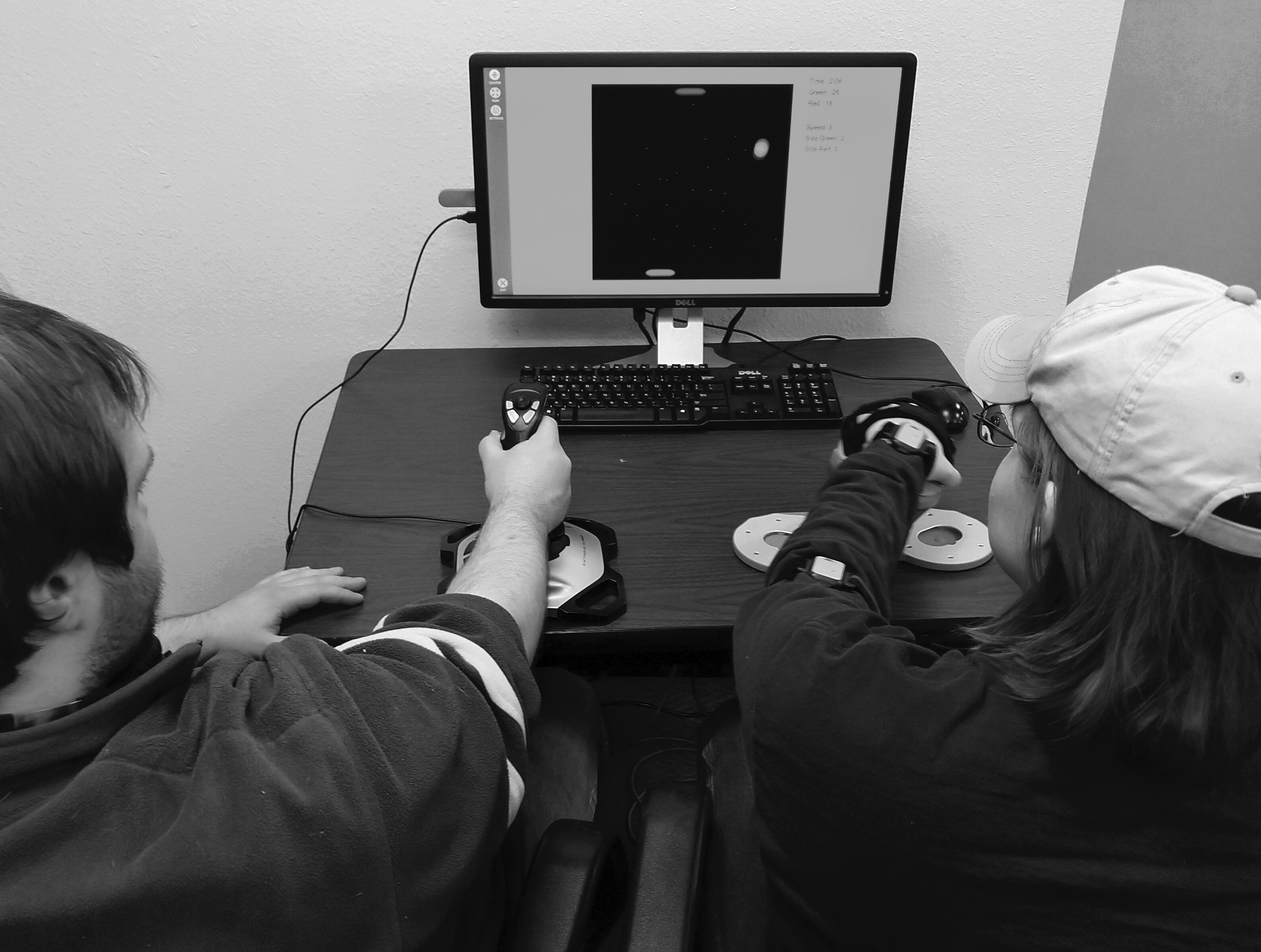
Two participants playing the Pong game. The primary participant (right) uses a Bimeo arm tracking device to play the game while the secondary participant (left) uses a joystick. Both participants explicitly agreed to be photographed.
Participants
The study involved 16 participant pairs (26 men and 6 women, 24.3 ± 6.4 years old). One participant per pair (13 men and 3 women, 24.4 ± 7.7 years old) was randomly designated the “primary” participant, participated in all study conditions, and served as the source of all data. The other participant was designated the “secondary” participant and only participated in conditions that required a second human; no data besides age and gender were collected from secondary participants.
Participants were recruited as self-selected pairs among students and staff of the University of Wyoming using flyers, electronic mailing lists, and social media posts. Study advertisements requested that participants already know each other (classmates, coworkers or friends), though the closeness of their relationship was not recorded. Pairs of strangers were not used since studies of competitive exercise games indicate that participants enjoy themselves more if they already know each other.2,12 Each pair contacted the experimenter together by e-mail and was scheduled for one study session. All participants signed an informed consent form and were paid $10 even though the secondary participant was involved for a shorter time.
Primary participants rated their competitiveness on a scale from 1 (least) to 7 and were asked how difficult they prefer games to be on a scale from 1 (least) to 7. Their Big Five personality traits (extraversion, agreeableness, conscientiousness, neuroticism, and openness to experience) were evaluated with the Ten Item Personality Inventory, 16 which has a range of 2–14 for each trait. These characteristics were not analyzed further, but are available in the Supplementary Data.
Primary participants played the game using the Bimeo (Kinestica d.o.o., Slovenia), an inertial-sensor-based arm motion tracker that was used in our previous work2,13 and allows measurement of exercise intensity. The system consists of three inertial sensors: two on the upper arm and forearm and one in a hand module that rests on a table (Fig. 2, participant on the right). Participants had to tilt the hand module left or right up to 20° from the center position to move their paddle left and right. Secondary participants played using a joystick, with left-right tilting corresponding to left-right paddle movement.
Study protocol
The study was approved by the Institutional Review Board of the University of Wyoming and conducted in accordance with the Helsinki Declaration. Participants played the game in four conditions:
- Single-player (SP): The primary participant controlled the bottom paddle and played against a simple computer-controlled opponent that tracked the ball's current horizontal position with a constant speed without delays, as in our previous study. 13 The secondary participant was absent. Participants were told that this was a deterministic computer-controlled opponent that was not necessarily better or worse than the other computer-controlled opponent, merely exhibited different behavior.
- Single-player with company (SP+C): The primary participant played against a simple computer-controlled opponent as above. The secondary participant sat next to the primary one and was encouraged to talk with them but did not play the game. Based on qualitative observations, nearly all pairs talked to each other continuously during this condition.
- Human-human competition (2P): Both participants played against each other, with the primary participant controlling the bottom paddle. They sat next to each other and were again encouraged to talk to each other; based on qualitative observations, nearly all pairs talked to each other during this condition.
- Disguised researcher (DR): The primary participant played against what was presented as a “stochastic” computer-controlled opponent that exhibits more unpredictable behavior than the other computer-controlled opponent. However, this was actually a member of the research team who played the game using a joystick and second screen in a side room. The researcher had previously practiced the game and thus exhibited a stable skill level that was constant for all participants and generally higher than that of the secondary participant (due to practice) or the computer-controlled opponent. This DR can be considered a computer-controlled opponent that displays human-like gameplay behavior, but without any social aspects. Participants were not introduced to this researcher or told of the deception until the end of the experiment. The secondary participant was absent. The opponent was described as “stochastic” and “unpredictable” since this was considered less likely to bias participants than the terms “human-like” or “smart.”
Each condition was 5 minutes long and included the previously described difficulty adaptation algorithm. All conditions were played within a single session in two blocks of two conditions, with a 2–5-minute break (as desired) between blocks. The SP + C and 2P conditions were always in the same block so that secondary participants could arrive or leave during the break; however, the order of blocks and order of conditions within each block were random. This is illustrated in Figure 3. Participants were explicitly told that neither computer-controlled opponent (actual one or DR) was necessarily better than the other, and that they differed primarily according to the amount of randomness in their behavior. At the end of the session, participants were debriefed about the DR, and the experimenter verified that participants did not realize the deception during the study.
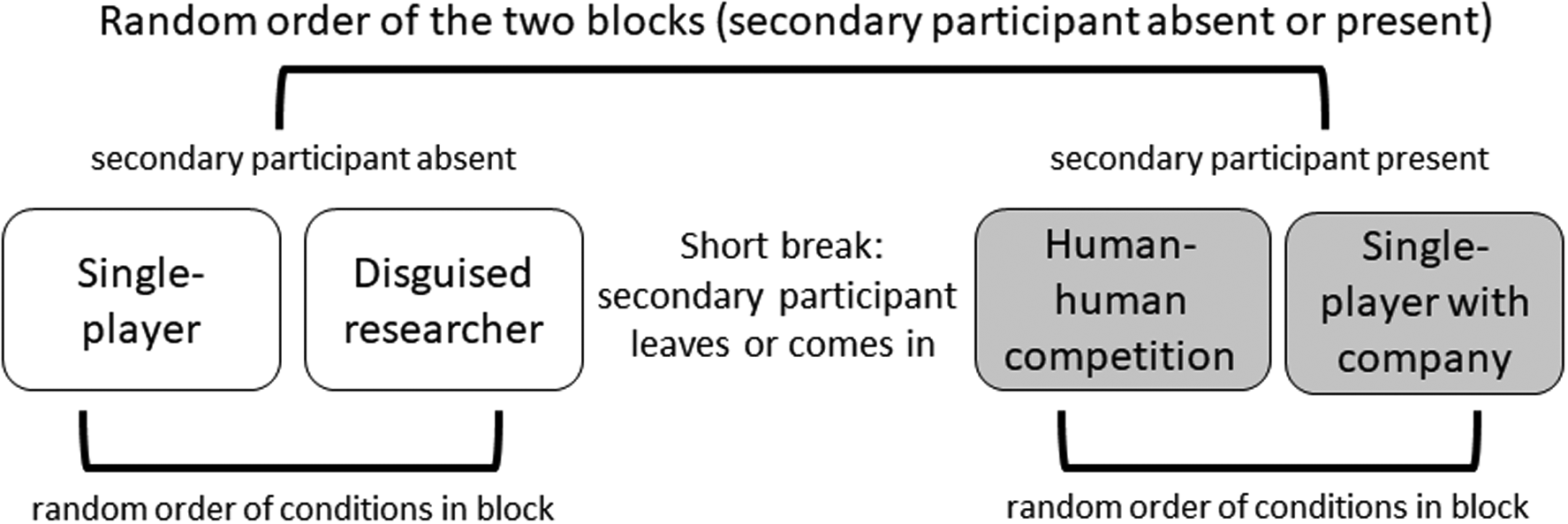
Timeline of the study protocol.
Measurements and data analysis
After each condition, primary participants filled out the Intrinsic Motivation Inventory (IMI) questionnaire, which measures four aspects of motivation: interest/enjoyment, effort/importance, perceived competence, and pressure/tension. While multiple IMI versions exist, we used an 8-item version also used in our previous work. 2 For each aspect, the possible range is 2 (minimum) to 14.
In each condition, primary participants' exercise intensity was logged as the root-mean-square of angular hand velocity measured using the sensor in the Bimeo's hand module over the entire condition, an established measure of arm exercise intensity. 17 Furthermore, the score difference was calculated as the difference between the number of points scored by the primary participant and by their opponent.
After the last condition, primary participants were asked for their favorite and least favorite conditions. They were also asked whether they preferred the first or second computer-controlled opponent they played against (options: strongly preferred first, weakly preferred first, no preference, weakly preferred second, strongly preferred second). Finally, they were asked whether they preferred playing against a human opponent or against a computer-controlled opponent with a human for company (five options similar to previous question).
IMI aspects and exercise intensity were compared between conditions using one-way repeated-measures analyses of variance (ANOVA) with Holm-Šidák corrections in post hoc tests (chosen over Bonferroni corrections due to higher power). The significance threshold was 0.05, and analyses were done in SigmaPlot 13. For the final questionnaire, we counted the number of participants who gave a particular answer to each question.
Results
Anonymized data are available in the Supplementary Data, which includes each primary participant's characteristics and their IMI, exercise intensity, and score for all conditions.
ANOVA found differences between conditions for interest/enjoyment (P < 0.001), effort/importance (P < 0.001), perceived competence (P = 0.041, but no significant post hoc differences), pressure/tension (P = 0.019), and exercise intensity (P = 0.008). Boxplots of results and significant post hoc differences are presented in Figures 4 (IMI) and 5 (exercise intensity).
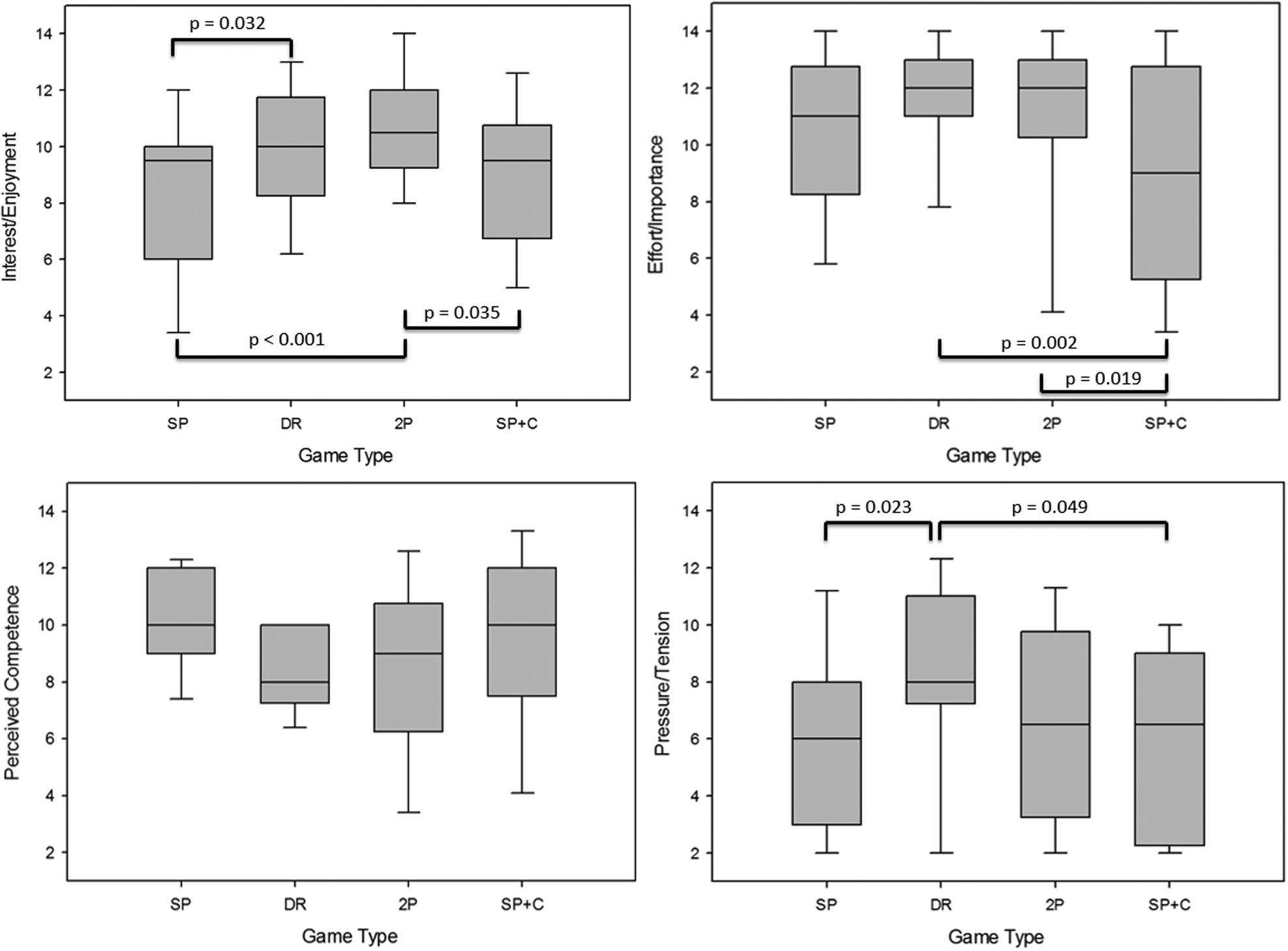
Results of the four Intrinsic Motivation Inventory aspects in all four study conditions. All four have a possible range of 2–14. 2P, human-human competition; DR, disguised researcher; SP, single-player; SP+C, single-player with company.
As their favorite condition, 14 participants chose 2P, 1 chose SP+C, and 1 chose DR. As their least favorite condition, 10 participants chose SP, 4 chose DR, and 2 chose SP+C. When asked which computer-controlled opponent they preferred, 11 strongly and 1 weakly preferred the DR, 3 strongly preferred the actual computer-controlled opponent, and 1 was indifferent. When asked if they preferred 2P or SP with company, all 16 strongly preferred 2P.
Score differences were calculated for each condition, with a positive difference indicating that the primary participant won. Score differences were 15.1 ± 6.3 for SP, −6.1 ± 6.1 for DR (the researcher tended to win), 3.2 ± 8.4 for 2P, and 13.1 ± 8.1 for SP+C.
Discussion
Implications for serious games
Results indicate that, in competitive exercise games, 2P (2P condition) is preferred both to human-like computer-controlled opponents (DR condition) and to social interaction without competition (SP+C). SP + C results in lower interest/enjoyment and effort/importance than 2P (Fig. 4); while the difference in exercise intensity is not significant (P = 0.15), it is large enough (Fig. 5) that we believe it would be significant in a larger sample. Thus, a second person who talks to the player is not considered motivating. The DR condition was more enjoyable than SP + C (Fig. 4), but resulted in slightly lower exercise intensity than 2P (Fig. 5; P = 0.15), and most participants chose 2P as their favorite condition.

Exercise intensity (measured with the Bimeo as the root-mean-square of hand angular velocity) in all four study conditions.
These results have two important implications for multiplayer exercise games. First, social interaction alone (SP + C condition) does not provide an enjoyable, intense gameplay experience, and appropriate in-game interaction between players is thus critical. This underscores the importance of appropriate difficulty balancing methods (algorithms that ensure a moderately challenging experience for each participant.2,15,18) and effective human-human interaction paradigms (ways for players to support or challenge each other—e.g., haptic connections between players3,4), both of which are currently major research focuses in two-player games for health. Second, making computer-controlled opponents more human-like would increase motivation (indicated by differences between DR and SP conditions), but would not achieve quite the same benefits as human opponents. This is a mixed result for practical deployment of competitive exercise games: it indicates that improving the artificial intelligence of computer-controlled opponents is worthwhile, but the optimal gameplay experience still requires a human opponent (who is often unavailable). However, we acknowledge that the human-like computer-controlled opponent in our study exhibited no social element at all. Thus, better results may be achievable using, for example, computer-controlled avatars that exhibit emotions and talk to players during the game. However, such expressive avatars would likely be difficult to tailor to each player and might instead distract or annoy them.
Our study was performed with a co-located second human, and a follow-up question is thus: are the benefits of 2P also present in online games? This would make competitive serious games more practical, as the second player would not need to be located in the same room. The feasibility of such online gameplay likely depends on the target population: studies of entertainment games indicate that older players (common in, e.g., rehabilitation) do not find online gameplay as motivating as younger players, even if video and audio of the other player is available. 19 Nonetheless, online gameplay is critical for applications like telerehabilitation, and we will explore it in future studies.
Study limitations
Three study limitations should be mentioned. First, several factors were not controlled between conditions and may have biased the results. Most importantly, as evidenced by score differences between conditions, the DR was a more challenging opponent than the secondary participant and computer-controlled opponent. The difference between conditions thus is not necessarily simply due to the lack of social elements, as the increased difficulty could have affected enjoyment either positively (fun challenge) or negatively (frustration). In future studies, this could be addressed by having the DR match their performance to that of the secondary participants or by having secondary participants play against primary participants from a separate room—a “disguised secondary participant” rather than “disguised researcher” condition. It could also potentially be addressed by having the researcher replace the secondary participants in 2P and SP + C conditions, but this would likely reduce the amount of social interaction (as indicated by our previous work12,13). Furthermore, since the DR's movements were not recorded, we cannot be sure whether the difference between opponents was due to the researcher's higher skill level or due to, for example, their unpredictability—since the researcher had practiced the game and could predict the ball's trajectory, they often waited longer before moving their paddle, giving an impression of unpredictability.
Second, the amount and type of conversation between primary and secondary participants were not controlled or quantitatively measured. We qualitatively observed that all participants talked to each other in both 2P and SP + C conditions, and that SP + C appeared (qualitatively) to involve slightly more conversation than 2P; however, without detailed measures, we cannot analyze whether, for example, participants had a more positive experience if they talked to each other more. In parallel to the current study, we have developed a questionnaire to measure the amount, valence, and game-relatedness of conversation in two-player serious games, 20 and will use it in future studies. Future studies should also control for the type of relationship between participants (e.g., friends vs. casual acquaintances), which likely affects results.
Third, the study was conducted with a competitive game and healthy co-located university students/employees, and the results may not generalize beyond this situation. For example, target populations for exercise games (e.g., overweight adults, stroke survivors) have different gameplay motivations than our participants, as they play for improved health and wellbeing rather than for fun or money. Participants' age and setting (co-located participants in a laboratory) may also have an effect. For example, studies of entertainment games indicate that younger participants like both co-located and online human opponents, but older participants only like co-located human opponents. 21 As another example, participants who play serious games at home may have different experiences than those who play in a laboratory or clinic. 2 The findings also may not generalize to cooperative games where participants, for example, may not be able to coordinate with computer-controlled partners as effectively as with human partners. While we believe that our findings would generalize to some degree (our previous studies have shown some generalizability from participants without motor impairment to stroke survivors12,13), these factors should be investigated further.
Conclusions
Our study demonstrated that, in competitive exercise games, 2P achieves better results than playing alone against a human-like computer-controlled opponent or playing against a simple, predictable computer-controlled opponent while accompanied by a nonplaying human. Significant differences were observed in intrinsic motivation, exercise intensity measured by inertial sensors, and participants' preference rankings. Furthermore, a human-like computer-controlled opponent was significantly more enjoyable than a simple, predictable one. This has two implications for competitive exercise games. First, it indicates that improving the artificial intelligence (gameplay behavior) of computer-controlled opponents is worthwhile, but that the best results are achieved with human opponents. Second, intelligent design of the interaction between players in a competitive exercise game is critical, as social interaction alone does not provide an enjoyable, intense experience. However, we acknowledge that our results should be verified with different target populations for exercise games, and that adding social aspects to computer-controlled opponents (e.g., verbal statements, artificial emotions) may improve their effectiveness.
Footnotes
Acknowledgment
The authors wish to thank Yubi Regmi for help with data collection.
Author Disclosure Statement
No competing financial interests exist.
Funding Information
Research supported by the National Science Foundation under grant no. 1717705 and by the National Institute of General Medical Sciences of the National Institutes of Health under grant no. P20GM103432.

References
Supplementary Material
Please find the following supplemental material available below.
For Open Access articles published under a Creative Commons License, all supplemental material carries the same license as the article it is associated with.
For non-Open Access articles published, all supplemental material carries a non-exclusive license, and permission requests for re-use of supplemental material or any part of supplemental material shall be sent directly to the copyright owner as specified in the copyright notice associated with the article.
