




Abstract
Messages containing descriptive norms have been manipulated and tested for effects on dietary intake in a number of studies. The effects have been mostly small or nonexistent. This narrative review analyzed the structural elements of the nutrition messages most likely related to effectiveness. Elements examined included the following: source, similarity of source to the participant, reference group, identification with or evaluative significance of the reference group, delivery, salience, background, tailoring, gain-loss framing, and whether an assessment of the group norm was conducted before designing the descriptive norm message. Most studies incorporated few of the reviewed structural elements, and message manipulations appeared weak. Controlled, systematic studies are needed to examine the effect of the structural elements, singly and in combination, on behavior and its mediators. Videogames are designed to be delivered in the same way to players; therefore, they offer a controlled environment for extensively and systematically manipulating structural elements of messages and examining the resulting behavioral effects. How this might be accomplished was described. Experimental research was identified as being necessary to delineate the individual and combined element effects, thereby contributing to the body of literature on videogame design and effectiveness.
Introduction
Dietary intake has been related to many and diverse health outcomes. 1 Descriptive norm messages have been employed to help change dietary intake. 2 Most descriptive norm messages concerning dietary intake attempted to increase the purchase or intake of fruit and vegetables (FV) due to their health benefits. 3 Descriptive normative nutrition messages have also targeted sweets/chocolate, snacks, junk food, pizza, and “healthy” foods. 2 “Healthy food” is not an accepted specific category of food, but the name carries the implication that their consumption should be increased. Sweets/chocolates are often grouped with snacks and as a category is a major contributor to energy intake. 4 “Junk food” is not a clearly defined category, but the title carries the implication that it should not be eaten. Pizza is considered a mixed dish 4 ; is one of the three main contributors to energy intake and sodium 4 ; thus, its intake is usually discouraged.
Videogames have been used to influence dietary intake.5,6 However, they often emphasize increased knowledge and awareness, resulting in modest to no effect on intake. 7 More theoretically informed behavioral procedures are needed to address this important health behavior outcome. 6 Social factors, such as descriptive norms, 2 have been shown to influence dietary intake. Descriptive norms are a person's beliefs about what other people do (e.g., “most other people eat few or no vegetables”), which have predicted diverse behaviors8–10 and influenced children's self-reported FV intakes. 11
Descriptive norms have correlated substantially with vegetable intake in both cross-sectional and longitudinal research. 12 Peer FV norms were related to concurrent and FV intake 1-year later. 13 A conceptual model of how descriptive norms influence behavior has been suggested. 14 It hypothesized that a descriptive norm message initiates a social comparison process of the self in regard to a reference group (i.e., me compared to what I believe my friends do). Systematic reviews examining the relationship of descriptive norms to dietary behavior have shown statistically significant, but generally small, effects. 2
Serious videogames are likely to be more effective than other media, for example, posters, in delivering health messages. Videogames have incorporated diverse behavior change procedures 15 and can employ story and animation, which can be engaging and immersive, which would increase the attention to the message. 16 This article reviews the literature on descriptive norms and analyzes 10 characteristics likely influencing behavioral outcomes with an emphasis on how to design videogames to optimally deliver these messages.
Theory
Conventional descriptive norm-based interventions attempt to manipulate an individual's perceived descriptive norm to come closer to the actual or desired descriptive norm. Descriptive norms have been relatively easily manipulated but had effects in only some members of a target group under some circumstances. 2 Some of the descriptive norm messages may not have worked because the true reference group norm was not known or was misspecified. Figure 1 presents a graphic hypothesized representation of the theory-specified relationships among personal preferences (behaviors), perceived descriptive norm, reference group's actual descriptive norm, and injunctive norm (i.e., either the expectation(s) others may have for the participant's behavior or a government or professionally specified prescription for level of intake).
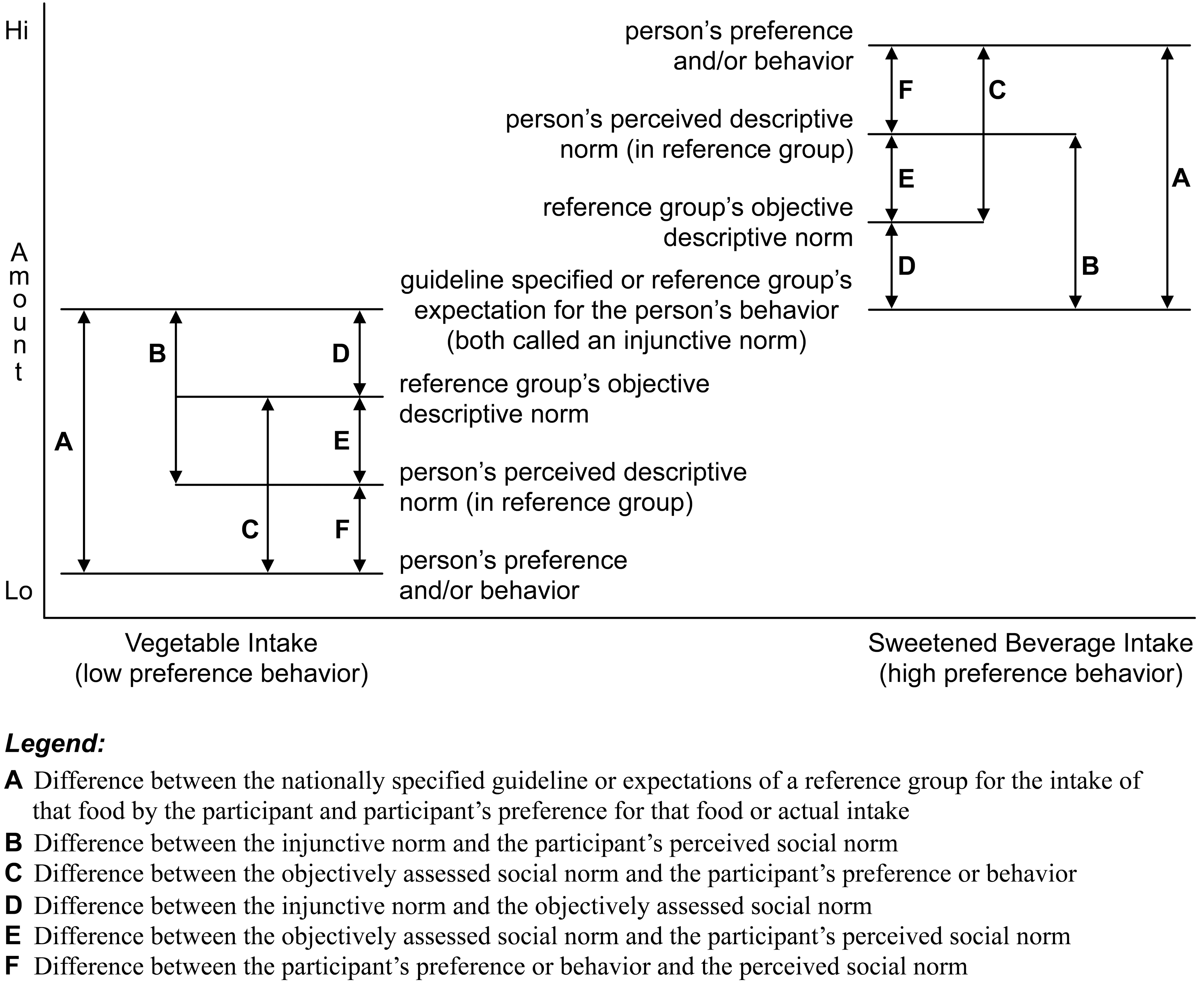
Likely relationships among preference, perceived social norm (in a reference group), objective social norm (in a reference group), and some nationally specified guidelines or expectations of a reference group (generally called injunctive norms) for a generally liked food (sweetened beverages) and a generally disliked food (vegetables).
In Figure 1, levels of descriptive norms are specified concerning a person's preferences for vegetables (i.e., a less-preferred behavior that health professionals would like to increase, e.g., vegetables) and sweetened beverage intake (i.e., a more preferred behavior that nutritionists would like to decrease, e.g., pizza). This hypothesized participant's preference for vegetables is low (left side of Fig. 1), and their perception of the reference group's (e.g., best friends and kids your age) descriptive norm for eating vegetable intake is low (line F). However, the reference group's objectively assessed descriptive norm for eating vegetables is higher than the perceived descriptive norm (line E), but is lower than national dietary guidelines (line D). 17 The same kinds of relationships can be specified for a highly preferred behavior such as pizza (right half of Fig. 1).
Participants are motivated to conform to perceived reference group norms. 17 Manipulating the person's perception of intake by a reference group will only have the desired effect if the person's preference (or behavior) is more extreme from guideline-specified healthy alternatives than the person's perception of the reference group's descriptive norm (line F). For example, the vegetable recommendation for teens is approximately 2–3 cup equivalents per day; if an individual rarely eats vegetables, and they perceive their reference group eats ∼1.5 cup equivalents per day, they may decide they need to eat more vegetables. A message stating the objectively assessed reference group descriptive norm (line C) is a common way to manipulate descriptive norms in an intervention. If the person's preference or behavior is less extreme than the reference group's descriptive norm, then a manipulation of the reference group's descriptive norm may only serve to decrease the vegetable intake (or increase the sweetened beverage intake, called a boomerang effect). Thus, descriptive norm message interventions should assess reference group behavior to specify the norm. If the participant's preferences or behaviors are further from the healthy level (line A) than the reference group's intake (lines B or D), the normative message should have an effect. If there is equal distribution of the participants' preference above and below the reference group, a study risks zero effects (increasing half and decreasing the other half). 18
Structural Elements
Health messages are complex. 19 While methods for designing and testing procedures for use in community programs have been developed, 20 little attention has been given to analysis of the many elements constituting the structure of these messages. Ten structural elements of messages can be identified from descriptive norm messages: source, identification with source, personal relationship to source, reference group, identification with or evaluative significance of the reference group, method of delivery (direct, surreptitious, or story), salience, environment, tailoring, gain-loss framing, and group norm assessment. (See Table 1 for a description of each element.) Some of these elements have been shown to influence outcomes.
Structural Elements of a Descriptive Norm Message
FV, fruit and vegetables.
The first element, source, is the person, group, or institution from which the message was communicated. When “adolescents” were the source of a message, adolescent participants reported increased beliefs about the adverse effects of and negative attitudes toward smoking. 21 Greater similarity of the participant to the source 22 can lead to identification with source 23 and having a personal relationship with the source (e.g., friend) influenced the participant's behavior. 24 Reference group is the group about which the relevant norm is communicated. Identifying with the reference group (e.g., sharing similar characteristics)23,25,26 or perceived similarity with the reference group's values (called evaluative significance), both, influenced behavior.17,18 Comparing typical students, friends, and parents as reference groups revealed that descriptive norms among typical students and friends predicted adolescent alcohol intake. 27 Identification with the referent group was measured in one study and had a marginally significant interaction effect with the norm manipulation and vegetable intake. 8
Method of delivery of the descriptive norm message can be direct, surreptitious, or by story. Direct delivery concerns whether the message was just stated, often using quantitative representations, for example, “most students.” 28 Surreptitious delivery concerns whether the participant needed to see something and interpret it as a statement of norm (e.g., notice the empty wrappers next to a container of wrapped candies, and infer how much others were eating). Finally, story/narrative concerns whether the message was communicated using others as examples, for example, animated characters doing the behavior as part of a story that reinforces the importance of the behavior. 29 We know of no study that varied the method of delivery, but we believe story holds the biggest promise since stories can be immersive and thereby can better engage participants to attend to the messages.16,29
A message may not influence a participant unless they are aware of it. 18 Salience concerns the extent to which the participant was aware of the message at the time of performing the behavior. 22 One study may have manipulated the salience of the message by having the participant perform the experimental manipulation right after seeing the poster with the message. This manipulation had no effect on behavior. 17 In another study, the experimenter specifically pointed out the message just before the assessment, but this was confounded with other design factors. 20
Background is the context in which the message is communicated (e.g., poster and school). For example, a poster promoting FV intake may have a typed message in the midst of an appealing colorful background of FV. While we know of no study that systematically varied background, we hypothesize a background consistent with the message (e.g., pleasing FV in the background of a FV message) and appealing (e.g., colorful and audience pleasing images) would have greater impact. Tailoring, that is, whether the message was individualized to some characteristic of the target person (normally based on the collection of data about that person) can effectively change behavior.30,31 One study tailored the message by providing feedback in relationship to the participant's prior consumption. Both individualized feedback groups with incentive, and without, increased healthier purchases than a control group at the end of the intervention, but were not different from the control group after 3 months. 18 A group getting individualized feedback consumed more FV during the ensuing 8 weeks. 22
Framing, that is, whether the message was expressed to the participant as a benefit (positive framing), or avoidance of loss (negative framing), has also been an effective communication strategy.30,32 A gain-framed message would state the benefits of eating fruit, while the loss-framed message would state the costs of not eating fruit. The gain-framed message resulted in significantly greater fruit intake 1 week after receiving the message, but did not affect intention to eat fruit either right after the manipulation or 1 week later. 33 Group norm assessment concerns whether the message framer actually did research to identify the prevalence of the behavior, from which the group norm in the message might be expressed. This should avoid the problem of selecting a norm level that was not realistic, and thereby not being able to influence behavior (Fig. 1).
Limited research exists on each of the descriptive normative structural elements. While there is variability across studies on how each of the elements was employed, few studies manipulated a specific element in the study.
This article reviews how descriptive norm messages have varied on each of the 10 structural elements and proposes innovative procedures that may influence dietary intake within a videogame.
Methods
Since we were not conducting a meta-analysis of behavior outcomes, but simply qualitatively examining the structure of the messages, we needed a representative sampling of articles containing descriptive norm messages, not a definitive list of all relevant studies. We identified experimental studies that tested descriptive norms in regard to dietary intake. Our inclusionary criteria were that a descriptive norm for dietary intake was tested, either in a randomized trial or a field experiment, and the target behavior (e.g., FV) was measured. Since we were interested in the diet-related effects of normative messages, we inserted the terms “norms and diet” and “norms and food” into PubMed. In addition, the reference lists from published articles were reviewed to identify candidate articles. As a result, we used all articles identified in our search that met the inclusionary criteria.
The first author conducted a preliminary review of articles for meeting inclusionary criteria, and then abstracted the article author's name, date of publication, academic home, research design, sample size, method of dietary intake assessment, method of manipulating descriptive norm, and results primarily concerning the effects of the descriptive norm statement (Table 2). Table 2 describes how each study in sequence of appearance in the literature manipulated descriptive norms plus other information to understand the results.26,33–51 Table 3 presents the descriptive norm messages found in these articles. Several studies used the same, or highly similar, message as prior studies, which accounts for the number of statements being smaller than of studies.
Manipulation of Descriptive Social Norms
2 × 5 × 3, A systematic factorial design where all combinations of the three conditions are tested; ANOVA, analysis of variance; arm, number of experimental conditions; HM, health message;; M&Ms, a form of chocolate candy; n, sample size; RCT, randomized clinical trial; SN, social norm.
Nonduplicative Listing of the Social Norm Messages or Procedure Manipulations
Related messages for different conditions are separated by /or/.
5+, 5 or more; FV/day: fruit and vegetables per day.
Table 4 characterizes each study's descriptive norm message in regard to the 10 elements, in the same sequence of studies as in Table 2. The second author reviewed the abstracted information for accuracy by comparing the tables to the articles. Differences, for example, about how to categorize aspects of each study according to each element, were discussed and resolved. A meta-regression analysis relating descriptive norm message characteristics to dietary intake was not conducted since (1) the focus of our review was analysis of the descriptive norm elements, (2) there were inadequate numbers of articles in some subcategories of the characteristics, and (3) the presence of some characteristics were likely interrelated leading to likely confounding, which makes a meta-regression analysis difficult to interpret. 52
Characteristics of the Descriptive Norm Messages on 10 Structural Elements in Sequence of the Studies in Table 1
[U], a specific university, not specified.
Results
Twenty articles reporting 28 studies were included in this review. Descriptions of each of the studies are included to provide context for the message analysis. Table 2 lists the studies in sequence by year of appearance in the literature. The first article appeared in 200934 and the last in 2019. 51 Ten of the articles were primarily based in the United Kingdom,34,38,40,42–44,47,49–51 six in the Netherlands,26,33,35–37,39 three in the United States,41,45,48 and one in Canada, 46 while several of these articles involved collaborations across multiple countries.44,49,50 Sixteen of the individual studies were one-factor randomized clinical trials (two to four groups)26,35–40,43,45,47,48,51; seven were field studies of various designs37,41,49,50; five were randomized factorial designs33,42,44,46; and one was a randomized, two-group interview. 34
Study sample sizes ranged from 5126 to 267218 participants, 35 7568 to 9445 meal purchasers,23,24 or 396,017 to 575,689 person transactions 41 per study. Eleven studies targeted vegetables alone26,36,40,42,44,47,49,50; one study targeted skin carotenoid values (a proxy for vegetable intake) 48 ; five studies targeted FV34,38,40,41; three studies targeted snacks43,51; five studies targeted sweets35,37; two studies targeted fruit alone33,39; and one apiece targeted small pizzas 46 and green (GO foods, those to eat more of) foods. 45
The method of measuring intake varied substantially, including 12 studies with a weighed, or number of, selection of item(s) from a bowl35,37,40,42–44,47,51; 4 with observation of meal selections45,46,50; 2 each for selections from a buffet,38,40 food choice on a school lunch line, 36 purchase of produce during a shopping visit, 41 self-reported intake of “sufficient vegetable intake,” 26 and self-reported intake of fruit33,39; and one each of number of the items selected, 37 cash register receipts, 49 skin carotenoid value, 48 and rating of intention to consume. 34 The nature of the control groups varied substantially.
Whether the descriptive norm intervention influenced the dietary intake measure varied across studies. Twenty studies reported at least one significant effect for the descriptive norm manipulation.26,34,36–43,45,47–51 The patterns of successful change varied substantially across studies. When descriptive norm manipulations worked, the effect tended to be small.
The descriptive norm text messages (Table 3) varied on targeted food, the specified reference group, the level of norm for high and low, and whether the message specifically mentioned the target behavior or negatively mentioned the opposite behavior (hoping that the target behavior would respond positively). The descriptive norm message statements varied across studies with substantial variety in the method of delivery and message, which indicates a more quantitative assessment of effectiveness was not desirable, or even possible. Table 3 is a nonduplicative list of descriptive norm manipulations.
Source: identification and relationship
In regard to the structural elements of descriptive norm messages (Table 4), the source of the message (i.e., from whom it came) in most of these studies was an experimenter,26,33–35,38–40,42,44,46,47 with one each for grocery chain, 41 board game, 43 employer, 45 class teacher, 48 workplace restaurant, 49 and university cafeteria, 50 or some anonymous source.36,37 In no case was there an attempt to manipulate or emphasize any similarity or relationship of the source to the participant.
Reference group: identification and evaluative significance
The reference groups were more varied, including students at their university or high school,26,36,38,39,43,44,48 people from their country,33,34 other research participants,37,42,46,47 other customers at the store or cafeteria,37,41,45,49,50 most or typical students, 40 other children or children like you, 43 and 2 of the top 10 vloggers. 51 The identification with or evaluative significance of these reference groups appears minimal.
Method of message delivery: direct, surreptitious, and story
The descriptive norm was directly delivered to participants,26,33,34,36,38–40,44,45,48–50 including providing a sheet of paper with a message on it, posters with the message sometimes with flyers,4,7,9,14,20 a sign on a grocery shopping cart, 41 player information cards as part of a board game, 43 messages displayed at a salad and grill bar, 36 four letters sent to customers of a cafeteria, 45 and video of attractive social media vloggers with images of six foods. 51 Surreptitiously delivered messages in three studies used bowls of empty wrappers (indicating consumption by previous confederate customers or participants), 37 two studies each with a video of a confederate engaged in the behavior, 35 a sheet of information on fictitious prior participants,42,46,47 and one unknown method of delivery. 33 In no study was a story used to convey the norm; no study systematically varied the method of message delivery; and no study used a videogame to deliver the message.
Salience
Salience was not specified or manipulated in 10 studies26,33,39–41,43,47; was not clear if it was addressed in 8 studies34–36,42,43,45,46,49,50; and was manipulated in 8 other studies. Salience was clearly manipulated when the experimenter pointed out the data column on the form, 42 or asked the participant to read the poster. 44 We inferred salience when free candy or food was offered (free candy 37 and food being attention getting 38 ), a popular vlogger held the messages, 51 and personal carotenoid values were presented to the participant (assuming personal biometric data generated attention). 48 In one case, a large number of posters were present and should have increased attention, 45 but this was not manipulated, nor was a measure of salience employed.
Background
The backgrounds mostly reflected the environments in which the message was delivered. Deliberately employed specific backgrounds included use of university logo and images of the school lunchrooms on posters, 36 images of junk food on the poster with the message, images of V or FV on a poster with the message,40,43,44 a listing of the top 10 FV purchases on the grocery store cart, 41 letters with colored columns for the types of foods, 45 and attractive colorful posters. 49
Tailoring
While most studies did not tailor, two studies tailored the message to the participant's purchase at a cafeteria 45 ; one tailored to baseline skin carotenoid value 48 ; and one study tailored by providing feedback in relation to the participant's prior consumption. 18 Both individualized feedback groups with incentive, and without, increased healthier purchases than a control group at the end of the intervention, but were not different from the control group after 3 months. 18 Feedback was provided about the participant's skin carotenoid level in comparison to a low norm, versus no individualized feedback. The group getting individualized feedback consumed more FV during the ensuing 8 weeks. 22
Framing: gain or loss
Gain or loss framing of the message was manipulated in one study. 33 The gain-framed message stated the benefits of eating fruit, while the loss-framed message stated the costs of not eating fruit. The gain-framed message resulted in significantly greater fruit intake 1 week after receiving the message but did not affect intention to eat fruit either right after the manipulation or 1 week later. 33
Assessment of group norm
Only six studies conducted an assessment of the usual intake in the reference group to specify the descriptive norm message.17,34,36,38,48,49 One study assessed perceived intake in “other children.” 43 None used videogames to deliver descriptive norm messages.
Discussion
Consistent with a meta-analysis of the descriptive norm effect literature, 2 these descriptive norm messages influenced dietary behaviors under some circumstances and/or with some populations, but the significant effects were weak. Part of the limitation on effects may be whether the message was structured and combined to provide maximal effect. We explore how descriptive norms might be optimally structured in videogames to do the same. Videogames may be more advantageous than other media because they permit structuring the environment consistent with, supportive of, and making the intended messages attractive; and can deliver messages with high fidelity to the underlying construct with a consistent presentation across all participants. This ensures strong tests of manipulation.
None of the descriptive norm message studies specifically stated the source of the message, although it could be inferred as the experimenter or grocery store, a fairly anonymous attribution. Within the context of a videogame, the message source could be an avatar or an on-screen character similar to the participants' reference group. Avatars tend to enhance motivation, but need to be carefully considered in terms of one versus several avatars, and whether the avatar should be designed to be self-representational (i.e., created from a digital image of the participant) 53 or have similar characteristics (e.g., clothes, age, appearance, color of skin, and hair style), 54 including participant and avatar body size. 55 Alternatively, the player could be asked to create an avatar that appeals to them or they feel represents their “ideal self,” thereby possibly enhancing the influence of the source in the videogame. 56 A story could be designed to generate the perception of a relationship to the avatar. The characteristics of the source that need to be similar to the participant's to enhance the effectiveness of the message need to be addressed in experimental research. 16
The reference group manipulation in the descriptive norm studies appeared to be weak. Social modeling of food intake demonstrated a confederate has more influence on the participant's behavior when represented as a student at the same university versus another university. 25 This was interpreted as a manipulation of social identity, which likely applies to reference groups and involves similarity to and/or identification with group. 14 Although the reference group being students from the same university attended by the participant influenced the dietary selection effectiveness of a descriptive norm manipulation,26,36 videogames offer stronger possibilities. The reference group could be made to appear like the participant to varying degrees. Identifying with, and evaluative significance of, the reference group could be manipulated by story elements that showed how the characters, much like the participant, encountered outcome behavior-related events or situations.
Directly stating or otherwise presenting the descriptive norm to the participant would appear to be more effective than surreptitious presentation, since surreptitious presentation requires that the participant notices and interprets often subtle information. Surreptitious manipulation of norms can employ cues in the characters' environment (similar to the bowls of empty wrappers or the characters making selections of foods in environments frequented by the player, e.g., cafeterias and convenience stores) without verbalizing this. Augmented reality could be designed to provide direct descriptive norm messages as the player approached a food store (identified by GPS or Google maps). None of the descriptive norm studies used a story/narrative to present the descriptive norm, but story/narrative appears to be a promising approach, which could also enhance identification and evaluative significance. 57
The salience of the message, when manipulated in the descriptive norm studies, involved the experimenter reading the message or encouraging the participant to read the message. A likeable videogame character could be created with which the child identifies. Having this character believably state the message with conviction may enhance message salience. Other ways might include incorporating and highlighting the descriptive norm message into an immersive storyline.
Two studies tailored the message to the participant.45,48 Providing the participant's carotenoid value within the context of the distribution of the reference group's values 48 was creative. However, it may not have effectively manipulated descriptive norms, if the participant's value was at the healthier end of the distribution. Tailoring has been shown to be effective in a number of studies58,59; and can be easily done in a videogame by collecting relevant data early in a game and providing messages predicated on the initial assessment. However, collecting data near the beginning of game play on a relevant characteristic could interfere with immersion or message processing, both of which have been shown to be associated with behavior change in a videogame. 60
The environment of the descriptive norm messages in these studies was most commonly manipulated by providing images of the targeted food on a poster or other medium delivering the message. This manipulation similarly appears to be weak. The environment of the message in a videogame could be manipulated by presenting the message in multiple environments, perhaps reflecting the environments in which the player may perform the behavior (e.g., home and school). Virtual crowds could chant the norm; posters, graffiti, or crowds in the virtual world could be programmed to enhance the norm message.
Participant selection of foods in a virtual reality game with a buffet line, after exposure to a descriptive norm message, might be used as the outcome measure as an inexpensive way of studying descriptive norms. 61 However, this method needs to be further validated. Spatial storytelling 62 might be used to create a three-dimensional (3D) environment in which participants can explore, perhaps interact with other players, which personal meanings are assigned to aspects of the environment over time into which FV (or other food items) are inserted. Correspondence between the fantasy and real worlds could be created by assigning tasks in the real world, including descriptive norm messages reflecting players in the 3D world.
One study manipulated gain-loss framing of messages. 33 The gain frame had a greater effect on behavior. None of the other messages was gain framed. Gain framing would appear to be an easily implemented manipulation of a descriptive norm message.
To induce change, the descriptive norm message needs to be higher than the participant's behavior for desired increased intakes or lower than the participant's behavior for desired decreased intakes (Fig. 1). In part, this might be done by having the game obtain participant baseline information as part of the game player profile, and systematically conveying one or more norm messages in the virtual world that is higher than their specified desired behavior or lower than their specified undesired behavior.
Videogames offer other possibilities to enhance the effect of descriptive norm messages. The message might be a statement of the norm with an added intention. Multiple characters might make similar statements, but there is likely a limit to the number that enhances effectiveness. The characters could state they are engaging in the behavior or indicate who else is doing it. It could be stated in an obvious way, or offhand, surreptitiously, to be less authoritarian. The character could simply state the descriptive norm, or perhaps it would be better to demonstrate the norm by having animated characters engage in the behavior without corresponding verbalizations. Videogames can simulate restaurants or grocery stores in virtual reality to enhance the experience of immersion, 63 and thereby increase acceptance of the message.
While cross-sectional and longitudinal research designs can reveal whether social norm variables influence intake in natural settings, experimental studies are needed to isolate effective intervention procedures and components thereof. 64 A systematic review and meta-analysis of 16 experimental studies concluded that social norms influence what and how much participants selected to eat. 2 In most of these studies, the norm was presented as the behavior of prior participants in the research (no other personalization).
An important first step in testing these ideas would be to maximize the descriptive norm message effect by manipulating as many of the 10 structural characteristics as possible. If the desired change is obtained, ensuing research could experimentally manipulate one structural element at a time.
The above discussion concerns the structure of descriptive norm messages. The same kinds of issues could be raised for other psychosocial determinants of behavior (e.g., persuasive messages for attitude change, perceived behavioral control, and self-efficacy).
Conclusion
Videogames provide innovative procedures for systematically manipulating many elements in the descriptive norm message structure. Experimental research is needed to determine the optimal structure of messages in regard to influencing dietary intake, both by manipulating individual elements and then by combination of the more effective elements. Research of this type will provide insight that can lead to the design of effective videogames that achieve behavior change goals.
Footnotes
Acknowledgment
This work is a publication of the United States Department of Agriculture (USDA/ARS) Children's Nutrition Research Center, Department of Pediatrics, Baylor College of Medicine, Houston, Texas.
Author Disclosure Statement
No competing financial interests exist.
Funding Information
This work had been funded, in part, with federal funds from the USDA/ARS under Cooperative Agreement number 58-3092-5-001.