




Abstract
Objectives:
An empirical study is carried out based on Plague, Inc. to explore whether the game has raised awareness of public health and urged players to make a better choice about health.
Materials and Methods:
Twenty-six college students from 24 cities in 11 provinces of China were investigated for a week-long survey. According to grounded theory principles, we coded original records from 69 diary reports using qualitative analysis tools.
Results:
We constructed nine core categories from participants' journals and drew the mechanism chart of the game as a means of health communication. The results showed that participants had experienced (1) an iterative learning process based on the authenticity and multiperspective features of the game and obtained specific learning outcomes; (2) deep thinking through the association between the game and the real world. And we extracted variables that are highly predictive of behavior change, including cognition of seriousness, cognition of susceptibility, action clue, and self-efficacy. Furthermore, noncore categories (including emotions and gameplay) directly and indirectly impacted players' learning and behavior change.
Conclusion:
The study shows Plague, Inc. has played a positive role in health communication (mainly reflected in the improvement of players' cognitive level, the establishment of health belief, and behavior changes). Moreover, it is concluded that reflection plays an important role in health communication interventions. However, careful consideration should be given to the use of this game as a means of health intervention due to its limitations and certain deficiencies.
Introduction
Since December 2019, it was reported that unidentified pneumonia cases have appeared in Wuhan, Hubei Province, China. Chinese researchers found that a new coronavirus 1 caused such disease. Due to the vast population movement with the advent of the Spring Festival holiday in China, the epidemic spread rapidly across the country for more than 1 month. As of 24:00 on January 30, there were 9692 confirmed cases in China. 2 On the same day, the WHO (the World Health Organization) released the COVID-19 epidemic as a public health emergency of international concern. 3 During the early stage of the COVID-19 epidemic, Plague, Inc., a type of simulation game launched by a British game company Ndemic Creations in May 2012, regained popularity. In late January 2020, the game has ranked first among paid iPhone Operating System (IOS) games, with more than 130 million downloads in China. At the same time, Plague, Inc. has been hotly debated on large social media platforms. Due to the limited information available in the early stage of the COVID-19 epidemic, many players regarded Plague, Inc. (screenshots of the game in Fig. 1 with the Plague release interface, pathogen evolution interface, and the game icon) as a reference for understanding epidemic transmission.

Screenshots of Plague, Inc. with the Plague release interface (left), pathogen evolution interface (middle), and the game icon (right).
In 2013, James Vaughn, founder of Ndemic Creations, was invited by the CDC (Centers for Disease Control) to give a detailed introduction of Plague, Inc.'s model. The CDC's Office of Public Health Preparedness and Response praised the game as an “unconventional means of public communication about epidemiology,” and believed that it had improved public awareness of epidemiology, disease transmission, and pandemics. 4 Unlike other means of health communication, games can provide audiences with a contextualized environment to explore and experience. The compelling story narration of games can enhance audiences' participation motivation, 5 and stimulate the audiences' in-depth information processing capabilities. 6 Also, games containing behavioral theory can more effectively promote health knowledge dissemination and behavioral interventions. 7 Instead of describing something at a time, games are programmatic by showing players the A to B process. When a player enters the infectious disease process from the epidemic to an outbreak, changes of in-game elements and their relationships will provide a learning experience that cannot be achieved by other learning mediums.
Plague, Inc. has potential value in health communication, but no empirical study of its effectiveness has been conducted so far. This study explores whether the game Plague, Inc. has promoted the dissemination of knowledge about infectious diseases, helping the audience make proper behavioral decisions in real life at the beginning of the coronavirus outbreak.
Review on Related Research
In September 2005, 4 million World of Warcraft (a popular game) players witnessed an outbreak of plague in the game that caused social chaos known as the “Blood of the Fall.” Lofgren and Fefferman provided a vital reference model for studying infectious diseases by analyzing the similarities between the spread of epidemics in games and real life. 8 James Vaughn, the founder of Plague, Inc., has said the ideas of this game were influenced by the “Blood of the Fall.” 4 However, instead, Plague, Inc. adopts a combination of macro- and microperspective, requiring players to manipulate pathogens with the aim to infect all human beings on the planet through a series of strategies. Servitje analyzed the game from the perspective of a science fiction narrative and believed that it reflected the social intermediary relationship between humans and pathogens to a certain extent, revealing how humans, as a social and technical species, were shaped by their relationship with pathogens. 9 Subsequently, Mitchell and Hamilton also analyzed the political map, the viral realism, and visual culture contagion, exploring the game's interpretation of epidemic concepts. They found that the game was a success in the light of game immersion and demonstrated the public's awareness and popular discourse about the threat of disease. 10
Even though similar research exists, an empirical study of Plague, Inc. lacks in the aspect of health communication. The value of games in promoting healthy behavior change has focused on scholars' attention in health communication. As changes in health behavior are associated with many factors, behavioral scientists attempt to change mediators that are highly predictive of behaviors. Examples of such mediators include immersion, attention, functional knowledge, self-regulatory skill development, self-efficacy, internal motivation, and feelings of competence, autonomy, and relatedness according to social-cognitive, 11 self-determination, 12 and transportation theory, 13 as well as the Elaboration Likelihood Model. 14
Critical studies of infectious disease games provide the audience with necessary enlightenment. Nowak et al. applied immersive virtual reality technology to improve flu vaccines' awareness among vaccine opponents aged 18–49. They found that virtual reality interventions increased participants' sense of presence, which allowed participants to be more concerned about the spread of influenza and their willingness to be vaccinated. This increased awareness is related to the perceived benefits of vaccination. 15 They also believed that immersive virtual reality games could help understand some key immunological concepts (e.g., community immunity) through creative means. 15 Besides, the improvement of self-efficacy plays an essential role in the decision-making of healthy behaviors. Cates et al. designed serious games to promote the HPV vaccine to children aged 11–12, which indicates the potential effectiveness of serious games in promoting the HPV vaccine and recommendation. They believed that it was related to the improvement of self-efficacy. 16 Jiang et al. designed a game to popularize knowledge of Chlamydia disease for low-income groups in Boston and the United States through iterative design and testing. The game enables players to feel that individual decisions affect the whole group's health status from the angle of community transmission. 17 The final research results showed that participants' cognitive level and attitude toward the chlamydia test improved significantly after playing the game, and the effectiveness of learning was highly correlated with participants' emotional level before playing the game, which may be explained by the fact that positive and optimistic participants were more willing to accept and retain the knowledge gained from the game. 17 Similar studies include Chu et al.'s research on Making Smart Choice 18 and Miller et al.' s SOLVE project. 19
The above research on serious games of infectious diseases has proved that serious games designed for healthy behavior intervention can improve the cognitive level, self-efficacy, attitude, and motivation. However, as Plague, Inc. is not a game primarily designed for serious purposes, there may be a lack of seriousness. Therefore, this study hopes to further explore the value of this game in the context of serious game research. Malone's research emphasized that intrinsic motivation and designing for different play-type activities are vital for deep learning and behavioral change.
20
The cognitive complexity model proposed that a participant's affective (e.g., motivation and attitudes) and cognitive (e.g., memory, knowledge base, and executive control) processes interact with each other and with sensory information from educational content to enhance his/her knowledge.
21
The widely used Health Belief Model regards individuals' perception of risks, benefits, and obstacles adds to their readiness to act or lack readiness.
22
Plague, Inc. provides a contextual and procedural learning environment that is vital for promoting knowledge gain and behavior change.6,7,17 Also, it gives the player a great deal of autonomy and allows for emotional stimulation and deep thinking by putting the player on the opposite side of humans. Players learn how, why, and what to do while confronting infectious diseases and pandemics by thinking backward. Thus, we make the following hypotheses:
Hypothesis 1: Plague, Inc., has the potential to improve audiences' cognitive level, self-efficacy, attitude or attention about contagion in the early stage of the coronavirus outbreak. Hypothesis 2: Plague, Inc., as a health communication instrument, disseminates knowledge and alters audiences' decision-making process in a unique mechanism.
Research methods
In this study, we adopted qualitative research methods and applied the grounded theory proposed by Barney Glaser and Anselm Strauss to research Plague, Inc.'s value in health communication in the initial stage of the epidemic outbreak. According to the grounded theory and general operating procedure guidelines, we encoded the detailed data of players' diary about playing Plague, Inc. in three levels—open coding, selective coding, and theoretical coding.
Data collection: structured journal
Due to time limitations and physical conditions at the initial stage of the outbreak, it was unable to complete face-to-face interviews. Thus, our research group used an online data collection method by a structured diary survey in this study. We presented open-ended questions in surveys and requested that the participants describe their experience in depth by completing each diary. The formally structured diary survey, which is shown in Table 1, was posted to participants every other day early in the morning (8:00 am). We think it is a proper time interval to get data variety by considering both reality and game. Participants were required to record their game time, emotions, and mood changes, perception of the epidemic situation, the game experience of the day, and thoughts related to the epidemic situation in as much detail as possible following their real-life experience and game experience, to form a corresponding relationship with the questions.
Diary of Plague, Inc. in the Face of COVID-19
Participants and samples
Our study procedures were approved by the Institutional Review Board (IRB) at Beijing University of Chemical Technology. Signed consent forms were obtained online from participants recruited for this study. For the protection of the human subjects, the research data will not be disclosed unilaterally by researchers, and participants were given the right to enroll or exit the experiment freely. We take Chinese college students who had experience in games as the research objects. Participants from Beijing University of Chemical Technology and Tsinghua University were recruited through a Game SIG (Special Interest Group), which affiliates with the researchers. In the online registration and screening process, we posted a statement about “A study on fighting the epidemic by playing a game” and screened the students who had no Plague, Inc. experience. A total of 26 eligible college students aged 19–24 enrolled online. They are students studying in Beijing but stuck at home during the early stage of the outbreak. At the time of the study, they happened to be living in 24 different cities of 11 provinces and went through variant life, which increased the diversity of research content.
Research Process
The week-long study lasted from January 27, 2020, to February 2, 2020. To fulfill the online survey, the researchers used WeChat, an online instant chat tool, to create communication groups for participants. Participants download Plague, Inc. from Android or the IOS App store and got refunds from the researchers. Each participant was requested to play for at least 20 minutes a day (Fig. 2 shows the representative icon of the participants' test) and submit his or her journal on January 27, January 29, and February 1, respectively. At the end of the survey, a total of 69 pieces of original data text were obtained, with “NO.—name abbreviation—date number” as the file name and marked as “Case” for an independent analysis of the participants later. Table 2 shows the number of journal entries that each participant provided. Seventy-three percent of the participants provided complete data for 3 days.

An example of participants' test interface (left), scene (middle), and result (right).
Journal Entries of Each Participant
Data Analysis
Data coding
This study follows the “localization” principle of grounded theory from the original data summarized, selecting open coding and selective coding and theoretical coding to process the original data, which means the concepts and categories need to be refined and modified to achieve theoretical saturation.
Open coding
The researchers coded the original sentences in the survey “sentence by sentence” based on full familiarity with all original data. The process of conceptualization is based on localized language and the researcher's creation. There is no doubt that the coding process strives to be as precise as possible, and the concepts were categorized. We obtained 61 initial concepts through the first stage of open coding. After repeated induction and refinement of the initial concepts, 38 categories were preliminarily formed. Examples are shown in Table 3.
Open Coding Examples
Selective coding
Selective coding is a process of clustering categories formed by open coding to rearrange them in a novel way to propose a higher-level category. 23 According to the principle of selective coding, the researchers performed a cluster analysis of 38 categories from open coding to form classes further. After analyzing and coding, 38 categories were grouped into 9 main categories, namely, characteristics, learning process, reflection after the game, learning promotion, health belief promotion, emotions, game strategy, and the external environment. Table 4 shows the relationships of the summarized 38 subcategories and 9 main categories.
Correspondence Between Main Categories and Subcategories of Selective Coding
Theoretical coding
Theoretical coding, also known as tertiary coding, integrates initial coding and focused coding into a complete theoretical framework by constructing a “storyline” that can guide all categories, that is, the question “where, how, why, and what results are produced by what factors” will be answered. 24 According to the research questions and the comparison of primary data pieces repeatedly, it is found that the storyline of “features of learning tool—learning mode—learning results” can support the game as the basis for knowledge dissemination. In other words, the game promoted the learning of relevant knowledge. “External environment cognition—game strategy—reflection” can explain the basis of players' deep thinking and the thinking mode after the game. Forming the basis of behavior change makes the game a health intervention tool. Health interventions have indirect impact on emotional and gameplay factors that influence factors mentioned above as auxiliary factors (the relationship between core categories and main categories of selective coding is shown in Table 5).
The Relationship Between Core Categories and Main Categories of Theoretical Coding
Coding reliability test
The encoding reliability of this study is mainly realized in two ways. First, “coding consistency percentage” is adopted to measure the coding consistency. Materials were coded independently by two researchers, respectively. Results showed that the coding consistency percentage was between 83.75% and 98.04%. The researchers adjusted the inconsistent codes through mutual consultation. Second, we established a sound trust relationship with the participants and got in touch again after coding during the research. A total of 12 participants agreed to evaluate the coverage rate of coding on the survey, and all said that the coding results reflected their real experience and feelings.
Results
Learning
We summarized Plague, Inc.'s learning tool feature, participants' in-game learning processes, and learning outcome (game promotes learning) into a learning module based on data analysis.
Plague, Inc.'s learning tool feature mentioned by participants mainly manifests in two aspects: authentic and multiperspectives. If Plague, Inc. is used for learning, the first concern is the authenticity and accuracy of its content. Participants believed that the virus transmission process, transmission mode, and pathology depicted in the game correspond to the truth they know about the COVID-19. For instance, 11-WXY-01 mentioned that “This game is very realistic, and it is in line with the current development status of COVID-19,” and 02-GRC-02 mentioned that “Viruses will run wild (if not controlled properly) in the game just like COVID-19, and some of the symptoms it depicts are similar too.” The game's multiperspective feature offers different play perspectives for players, including microbe, human beings, players, and spectators. The microbial perspective means that players striving to achieve the game's goals try to play the role of viruses and other microorganisms in the game. In contrast, the human perspective indicates the players take the role of a country or the public who consider the virus an enemy. The player's perspective means that he/she takes the game as a means of entertainment without choosing a role. The spectators' perspective means that players view the game as a documentary about “virus and human,” view it from bystanders' angle, or switch between virus and human to achieve their purposes. The game's affordance of multiple perspectives can serve as another feature of its learning tools, and, together with viral realism forms the basis for the learning process and promoting learning outcomes.
The in-game learning process supported by Plague, Inc. has an iterative feature. Games are naturally suitable for inquiry learning, which are problematic, procedural, open, 25 and iterative. Participants view the game as an experimental space for inquiry learning. For example, 13-YB-02 said, “The cost of failure in games is low, but the cost of failure in real life is painful; teaching humans how to fight against epidemic through games is an effective and efficient means with low risk.” Participants got immediate feedbacks from the game, as 11-WXY-01 said: “(in the game) we can see the evolution of the epidemic more visually.” The process of the game urged players to analyze variables (e.g., “initial place, drug resistance, drug adaptability, transmission path, infectivity, symptoms, antidote development, DNA points”), reflect on game experience (10-SRT03: “I kept reflecting as the game progressed”), adjust strategy (11-WXY-02: “I learned from previous experience, set the first infected area to Greenland, and increased the pathogen adaptability….; I succeed eventually”), and repeatedly experiment (01-CDY-03: “I repeatedly tried to see the effects of different operation combinations”). Participants' behaviors mentioned above form a closed loop of iterative learning summarized in Fig. 3.
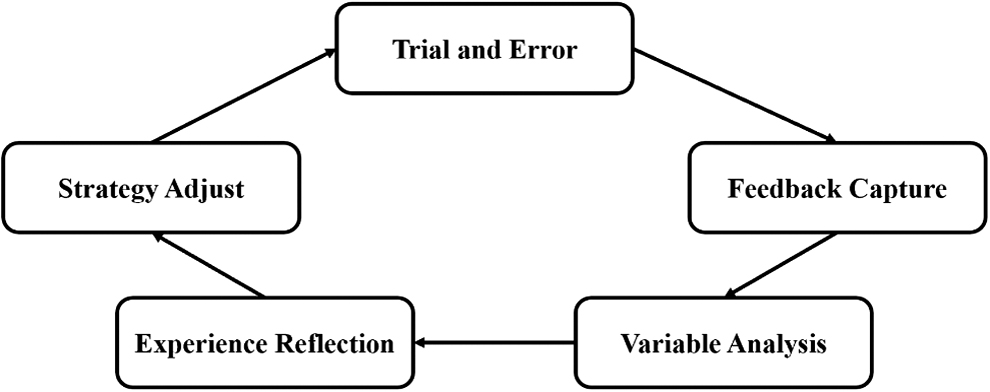
The iterative learning process in Plague, Inc.
Learning outcomes represented the participants' subjective feelings about their learning in games, which indicated that they have subjectively recognized the game's educational value. The game has promoted learning in five dimensions: cognitive ascension, knowledge acquisition, prior knowledge integration, new knowledge application, and motivation (for further study) enhancement. The players learned the relevant expertise (e.g., the virus transmission path, symptoms, and lethality). They conjured up prior knowledge (e.g., the impact of climate, terrain, and dimensions on the virus transmission) and combined it with the knowledge acquired in the game (e.g., increasing the cold, heat resistance of pathogens, and other environmental adaptabilities) to complete the game challenges. Moreover, the players are willing to accept further information from other sources.
Deep thinking
Learning from games has typical initiative compared with other vertical and one-way educational learning methods. In terms of knowledge acquisition, learners no longer acquire declarative but systematic procedural knowledge through the game's interactive process, fostering learners' deep thinking ability to think about the problem itself. From data collected through the survey, it is observed that the participants are unconsciously associating the real-life experience with their game experience, and they re-examined their living environment and the virtual game world.
The external environment perceived by participants is multidimensional, also serving as one of the foundations for deep thinking. In the early stage of the COVID-19 outbreak (January 27, 2020, to February 2, 2020), the participants obtained some negative perceptions from the external environment, including the reckless internet, preventing difficulty caused by individuals, and acceleration of the epidemic. They also gained several positive perceptions, including the adequately protected individual or group, fast and vigorous related research, and the well-managed government.
The game strategy category mainly summarizes and summarizes the player's correct strategy (i.e., the strategies selected when the game is successfully cleared). The proper game strategies come from repeated experiments and learning in the game, resulting from deep thinking. Players usually need to do the following:
Select the right place to start (considering factors such as climate and geographical location). Give priority to the development of infectiousness. Select the appropriate transmission mode. Degenerate symptoms to hide. Improve drug resistance and adaptability. Increase lethality to delay the development of an antidote. Follow the news. Grasp the opportunity and plan “DNA” rationally.
Players need to use the above strategies comprehensively to gain in-game success.
Whether it is the cognition of the external environment, or the strategy formulated for victory in the game, it directly prompts the player to reflect on reality and the game after playing. Reflection is an essential stage of game-based learning. Reflection and summary during or after the game are an effective way to ensure knowledge dissemination. 26 The study found that the survey respondents adopted association-based thinking mode while reflecting, including the association of situations, pathological representation, strategy adoption, identity substitutions, development process, and possible results.
Behavioral variables
From the survey, we extracted behavioral variables that are highly predictive for behaviors: cognition of seriousness, cognition of susceptibility, action clue, and self-efficacy. According to the health belief model, a person's behavior may shift when he/she (1) realizes a disease or disability could be prevented or avoided; (2) is aware that it can be prevented by taking recommended measures (or actions); (3) is confident about changing his/her behavior successfully. 26 Individuals' cognitive level of the seriousness and susceptibility of problems and destructive behaviors is a crucial antecedent variable for them to think twice about changing their behaviors.
Cognition of seriousness indicates that they perceived the severe consequences caused by viral transmission and spread depicted in the game. As 13-YB-03 said: “I think playing Plague, Inc. is a great way to make players realize the horror of virus transmission, and force people to pay attention to the spread of the epidemic. Otherwise, the human will eventually be ruined as described in the game.” Cognition of susceptibility refers to the player's perception of vulnerability probability. As 15-ZY-01 said, “My strongest feeling about today's gaming experience is that population migration causes cross-infection easily.” Under the joint impact of the cognition of seriousness and susceptibility, individuals perceived threat and changed their attitude toward the disease. Besides, 13-YB-02 argues that “The game teaches players in reverse what effective measures humans will (should) take in the event of the epidemic outbreak.” The specific action clues that players obtain from the game include the following: (1) develop healthy habits; (2) cooperate with isolation and prevention measures; (3) reduce exposure to wild animals; (4) support doctors and scientists; and (5) call for the world to work together. Participants' self-efficacy about “isolation, personal hygiene, dietetic hygiene, and wildlife connection” (quotes from 24-WHX-03)” is also improved. Moreover, they also mentioned supporting medical staff and scientific research on COVID-19. Even though we did not investigate whether they made specific behavior changes, some noted they had adopted strict isolation and personal hygiene measures (such as reducing travel, wearing masks, and washing hands frequently). This describes a complete behavior change process that comprised perceiving threats and action clues, reflection on behaviors, change of attitude, and adoption of action strategies.
Emotional factors
After encoding the emotional state of each case, we found some emotional differences, which included positive emotions (e.g., happiness), negative emotions (such as anxiety, anger, worry, depression, and helplessness), neutral emotions (e.g., calmness), and combined emotions. The word frequency analysis showed that “calm,” “anxiety,” “happiness,” and “depression” appeared more frequently, reflecting the primary emotional state of the participants manifested during the early stage of the COVID-19 epidemic. The in-game process had also led to some emotional shifts. It embodied both positive effects (such as 02-GRC-01 said, “the game let me know more about the virus and reduce my panic”) and negative effects (e.g., 06-LZH-03 said, “ In this particular time, I play with more anxiety. The over-realistic pictures and UI, watching viruses I cultivated upgrading and the news of panic in the game makes me feel uncomfortable.”). Few female players said the game drives them positively, while few male players got more negative after the game.
Gameplay
In journals, participants described some gameplay attributes, such as immersion and surrealistic narrative features. Immersion refers to participation in activities and subjective feeling of existing in the virtual world, which is a powerful game experience and an essential factor for generating flow and engagement. 27 Based on the cross-analysis of immersion and the dates, we found that the participants' expressions of game immersion exist in the later investigation stage. For example, 01-CDY-03 indicated that “We are more immersed in the game itself when playing.” Players can no longer gain new knowledge from the game after playing for a certain amount of time, so they regarded it as a pure game and immersed in it. Surreal narrative features are unreal expression techniques aiming to enhance the playability of the game. Some participants believe that fictional elements (maps, virus motivation, virus mutation methods, temporal distortion, government response speed, etc.) increased the game's surreal attribute. 02-GRC-02 believes that the designers' intent for doing so is “to create a difference from the real world to make it receptive for the audience.”
The mechanism of Plague, Inc. as a means of health communication
We summarized Plague, Inc.'s health communication mechanism in this study based on the categories of participants' statements in the tertiary coding shown in Tables 3 and 4 and the above quotes.
The learning tool features, including realism and multiple perspective attributes, supported the learning process in the game and directly affected the learning outcome of the game, constituting the “learning” module. Under the combined effect of external environment cognition and game strategy, players reflect on the game after playing, whose process comprises the “deep thinking” module. The gameplay and the player's emotional factors are noncore categories that indirectly affected the reflection after the game. Learning and deep-thinking modules are core categories that affected players' cognition of seriousness and susceptibility, enabling them to obtain action clues and self-efficacy, thus influencing their behavior changes. Fig. 4 shows the mechanism in detail.
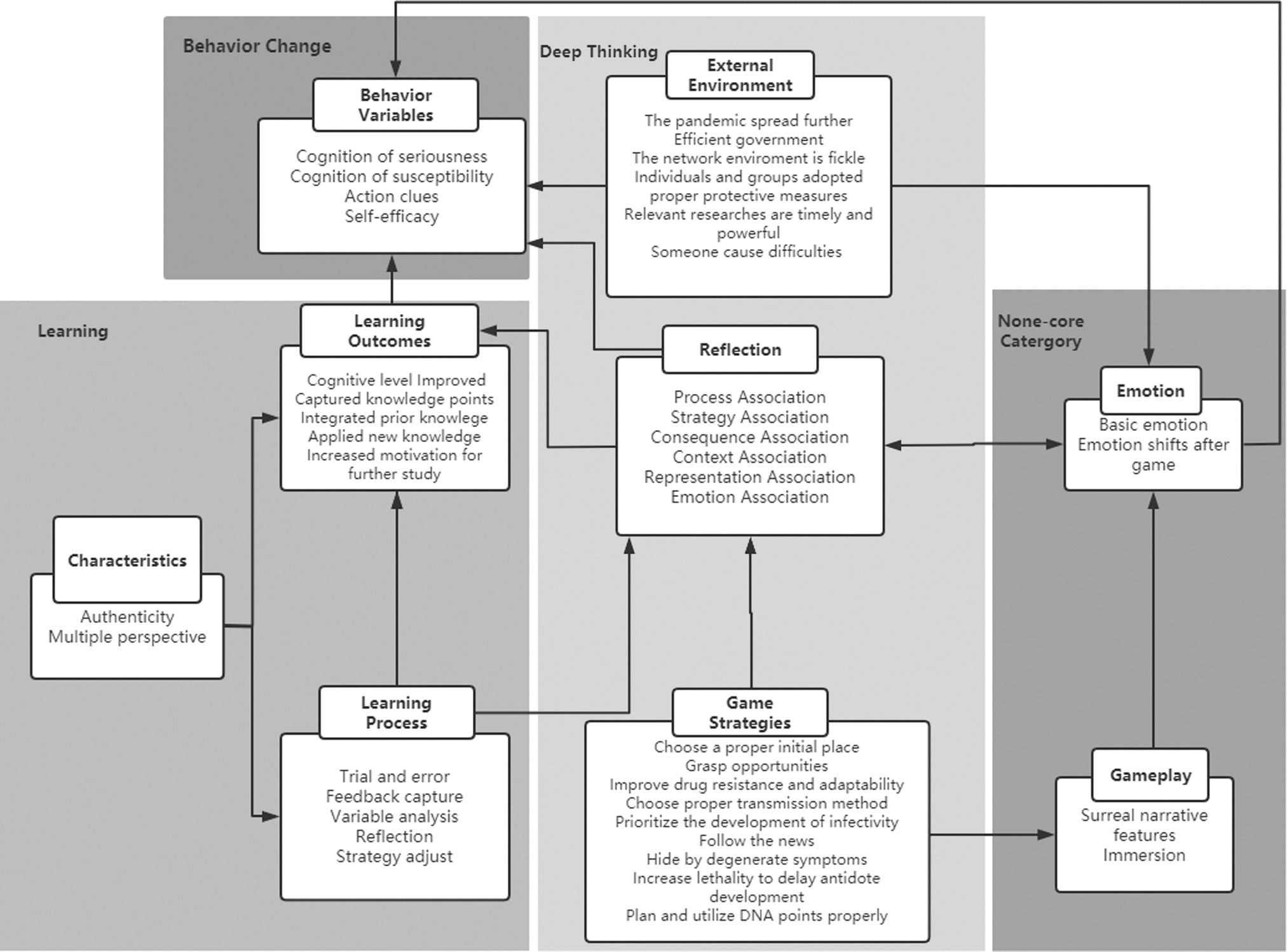
The mechanism of Plague, Inc. as a means of health communication.
Discussion
The game Plague, Inc. plays an active role in health communication
At the early stage of the COVID-19 epidemic, Plague, Inc. played a positive role in increasing the public's antiepidemic awareness. Participant affirms that “In the game, we saw virus spread extremely fast, whether succeeded or not, they painted the map red. Even though it is uncomfortable, we get a more powerful and meaningful experience than what we get from TV, newspapers, Internet, and oral descriptions.” (20-WQ-01). Its health communication value was mainly reflected in the improvement of cognitive level, the establishment of health beliefs, and behavior changes.
The improvement of cognition level shows that the public can gain knowledge and improve their learning ability in the game. Participants subjectively believed that the game promoted their learning of knowledge, which enabled them to recognize the educational value and learn specific knowledge of antiepidemics. This is correspondent with the criteria of Bloom's Educational Objective Taxonomy. 28 The game also helps them cultivate higher order thinking, which is a mental activity that occurs at a higher cognitive level or cognitive ability that occurs at a higher level. 29 Learners think about problems from multiple perspectives, using learning methods such as analysis, synthesis, evaluation, and creation, to solve problems iteratively in a real and complex environment created by the game to establish a three-dimensional knowledge system. 29 The results are consistent with Malone's theory about the requirement of “different play-type activity” and are also in line with the inquiry learning model. The learning process cultivates learners' problem-solving ability, decision-making ability, critical thinking ability, and creative thinking ability, conducive to maintaining the rational and healthy thinking ability for the public in the early stage of the epidemic outbreak.
The establishment of health concepts and behavior variables indicates that the public realized they could avoid the epidemic by taking recommended measures, which is confident of protecting themselves after gameplay. Promoting to build up health concepts is a prerequisite for the game Plague, Inc. as a means of health communication. From the game, based on the improvement of cognitive level, the public perceived the threat of infectious diseases, realized the seriousness of epidemic and individual susceptibility, reflect on their behaviors, and obtained a high degree of self-efficacy. Furthermore, specific action clues were provided in the game, and the participants expressed approval of these clues. These variables are important mediators for health behavior change.11,13,22 And, without investigating behavior changes, some participants mentioned that they have further regulated their epidemic prevention behaviors (mainly about isolation and personal hygiene).
Reflection is the core of promoting health communication of Plague, Inc.
Reflection is a review of personal experience while detached from an event or situation. It is the key to promote knowledge transformation and knowledge dissemination. The positive impact of the game Plague, Inc. relies on a deep-thinking process based on reflection.
In the mechanism of games as a means of health communication (as shown in Fig. 3), reflection is the core intermediary connecting reality and the game world, associated with almost every module. Players' cognition of the external environment, game-related experience (learning process in the game, game strategy adopted), and emotional cognition are the basis of reflection. These modules support players to carry out specific thinking processes such as association and deep-thinking promotion.
The process of reflection includes high-level thinking processes such as information processing, understanding, and practical verification. Players are required to make judgments from intuitive feelings or observations and synthesize internal and external data and make decisions about objective facts. 30 The entire thinking process promotes the formation of the thinking self. 31 It enables players to acquire self-relevance cognition that affects other cognitive abilities and directly acts on “knowledge” (in-game learning) and “action” (behavior changes).
Emotion factors have influence on learning and behavior change
Emotion has a substantial influence on humans' cognitive processes, including perception, attention, learning, memory, reasoning, and problem solving. 32 The research results support the cognitive complexity model by showing that emotion and cognition work together on participants' learning process. As 01-CDY-03 said, “I unconsciously associate the evolutionary options (in the game) with real-life experiences, and there are even various emotions mixed in it. The mess in my mind, coupled with today's news, makes me think and study intensely.”
Also, emotion could modulate the selectivity of attention, which is crucial for behavior change. 11 The game raises participant attention by causing greater engagement of negative affect, which is vital to motivating change. 33 However, this game not only creates anxiety and mental stress, but it also improved some participants' emotional health. For example, they gained a sense of control through games, which relieved their pressure in the face of the epidemic.
Shortcomings of Plague, Inc. as a means of health communication
The game Plague, Inc. is not a game designed with serious goals as the main goal, so it has shortcomings as a means of health communication. Its shortcomings are mainly reflected in two aspects, the incomplete content and the short-term effect.
The incompleteness of the content is reflected in the lack of procedural display about fighting the epidemic. For example, 11-WXY-01 mentioned that “There is a lack of introduction of the protective measures against the plague, even though we realized the causes and consequences of the plague, we cannot respond it with specific measures (in the game).” Mitchell and Hamilton also note that Plague, Inc. is an incomplete text that relies on other existing media for popularizing epidemic knowledge. As games are one of the most critical media for young people to be familiar with, they can be used as an auxiliary method for health communication and a supplementary tool for other forms. Some respondents said that as their familiarity with the game deepened, they paid more attention to the game itself and used it less as a teaching material for understanding the epidemic. Therefore, the game has a short-term effect on the health of players.
Limitation and future work
The data source and data size presented herein, representing a small sample (N = 26) of Chinese college students, limit the generality of results from the research and lead to some population bias. While we believe that these results are useful and relevant to that population, we have no way of knowing whether they would continue to hold true for other populations. Thus, more work is needed to replicate the results. Furthermore, the diary questions in Table 1 were to obtain adequate information, which made us unable to rule out the possibility that “Deep Thinking” problems promote deep thinking. It prevents us from drawing a firm conclusion, but it does offer a possible one.
We conducted cross-analyzing based on date, gender, and game effect on emotion and saw some difference in emotion shifts of sex. However, due to the insufficient sample size, it is difficult to draw a conclusion. We will discuss this interesting finding in subsequent studies.
Summary
Against the background of the significant public health incident of COVID-19, this research chose to explore the scientific value of Plague, Inc. and its role in the early stage of the epidemic from the perspective of the game for health research. Based on the grounded theory, the study sorted out the game's mechanism as a health intervention. Therefore, we believe that this study's results can partially support Hypothesis 1 and Hypothesis 2 by showing that the game improved audiences' cognitive level, self-efficacy, and attention about contagion in the early stage and disseminated knowledge and altered health belief in a unique way. So our conclusions are drawn as follows: (1) the game promoted the learning about infectious diseases through the presentation of real and multiperspective information with the iterative nature; (2) under the joint action of the external environment and the game, players can do deep thinking, which relies on the association and comparison of the reality with the game; (3) through the overall improvement of cognitive level, the game works as a health intervention as it offers primary conditions for behavior changes, put it in another way, severity cognition, susceptibility cognition, and action cues. Although the game cannot act as a perfect way for publicity and education, its guiding role cannot be ignored during the epidemic outbreak. Its influence provides an essential reference for health game design. In future studies, researchers will further explore the effectiveness and relevant factors of intervening in healthy behaviors with games.
Footnotes
Acknowledgments
We are grateful to the 26 participants who supported our study and completed a week of game testing and diary feedback.
Author Disclosure Statement
No competing financial interests exist.
Funding Information
National Social Science Foundation of China Major Arts Project (No. 20ZD20). National Major Project of Ministry of Science and Technology of China (No. 2020AAA0105204).