




Abstract
Objective:
The purpose of this study was to investigate the efficacy of a digital game-based course to build domain knowledge and social emotional competencies of empathy and compassion in adolescents.
Materials and Methods:
The study used a digital game Bury me, my Love with an accompanying course which was administered to 201 participants between ages 13–18 across United Arab Emirates (UAE) and India. Standardized self-reports were used to score participants on measures of knowledge and attitudes, empathy, and compassion before and after the intervention. Mixed analyses of variance were conducted with 1 between-subjects factor (gender) and 1 within-subjects factor (time) to determine the impact of the intervention, followed by post hoc t-tests.
Results:
Increased effects of intervention were obtained for both knowledge and social emotional learning in both UAE and India. Specifically, there was a significant increase in awareness of migration and refugees in both India (P < 0.001) and UAE (P < 0.001). Interesting effects of gender were seen in which females in both countries showed increases in compassion from others (P < 0.05).
Conclusion:
This study opens a new window in game-based learning. The design of a structured course with learning outcomes that are centered around a digital game establishes its potential to create engaging and accessible solutions to simultaneously build domain knowledge and social-emotional competencies in adolescents.
Introduction
Digital games have emerged as powerful pedagogical tools that promote active participation. Unlike traditional digital tools which merely transfer knowledge or information, digital games are transactional in the sense that they allow learners to practice actions and develop thinking strategies. This process of “situating the learning experience” in terms of actions, images, and dialogs that learners relate to builds learner agency and exposes them to real-world scenarios. 1
In digital games, a player has agency over the outcome, which leads to them experiencing “deep, socially based emotions.”2(p10),3 Players may feel guilt, regret, joy, pride, or shame from choices made in gameplay4–6 and in the process become aware of and identify different emotions. Playing videogames (like Peacemaker, for instance) with ethical quandaries can “open the doors to true empathy via perspective-taking as well as the opportunity to utilize empathy in abstract realms such as hypothetical scenarios and virtual domains.”7,8
Given the usefulness of digital games in promoting better social and emotional behaviors, many researchers and educators have come up with interesting ways of using existing games to build social-emotional skills in addition to content and disciplinary knowledge in students. 9 Social-emotional learning can be broadly described as the process of integrating thoughts, emotions, and behaviors to build emotional awareness of the self and others, to develop skills of perspective-taking, and to take constructive and responsible decisions to manage behaviors and improve the lives of others. 10
In this study, we extend the idea of using digital games to build social-emotional learning by proposing a game-based course. Game-based courses leverage the narrative of impactful digital games as “central text” around which a course is structured. The digital course in turn can consist of information in the form of text, videos, and podcasts to convey information and activities and exercises like journaling, dialog, and reflection that are designed to extrapolate experiences of a player from within a game to scenarios outside of the game world. Thus, a game-based course can (1) build new knowledge about various themes or subjects, and (2) explicitly cultivate key elements of learning and skills using interactive immersive digital technologies, and thereby achieve specific learning outcomes.
Social and emotional competencies have emerged as important skills that children need to cultivate to meet the changing demands of society. In increasingly diverse societies, children must learn to achieve academically, work cooperatively, make responsible decisions, resist negative peer and media influences, contribute constructively to community, and acquire the skills, attitudes, and values necessary to become productive workers and citizens. To motivate the learner toward building knowledge around a socially relevant theme, we chose the global refugee crisis and focused on games that addressed this topic.
The global refugee crisis is estimated to have displaced more than 80 million people worldwide and has more than doubled in the last decade. 11 In today's increasingly globalized yet divided societies, it is imperative that classrooms include knowledge and discussions on issues like migration and refugee crisis to inculcate responsibility at a local and global level and build social-emotional skills. 12
We identified the digital game Bury me, my Love, which is centered around the contemporary global issue of migration. 13 Told on a chat-based interface, the reality-inspired game explores a narrative that is centered around the refugee crisis. This narrative was developed in close consultation with refugees who had migrated from Syria to Germany during the Syrian refugee crisis. In the game, the player role-plays a husband whose wife is fleeing from Syria to Europe. Through the course of her journey, the protagonist relays events to the player using text messages, and the player is presented with choices to respond with. The consequences of these choices can range from trivial to life-altering for the protagonist. The game is played over a text-messaging app interface, and this ease of access coupled with the real-life experience inspired narrative made it a strong candidate to build a course around to teach contemporary issues of migration. Full description of the game is presented in Table 1.
Characteristics of a Videogame to Build Knowledge and Social-Emotional Competencies: Bury Me, My Love
In Bury me, my Love, players are given time to contemplate uncertainties of what may or may not happen next when selecting from a list of conversation responses 14 (Fig. 1). Players first encounter factors that cause sudden migration (e.g., civil war) and then are required to guide characters through a series of ethical quandaries. 15 These challenges unfold as “the travel diary of exile,” 16 an interactive narrative that models the arduous difficulties of refugees. 15
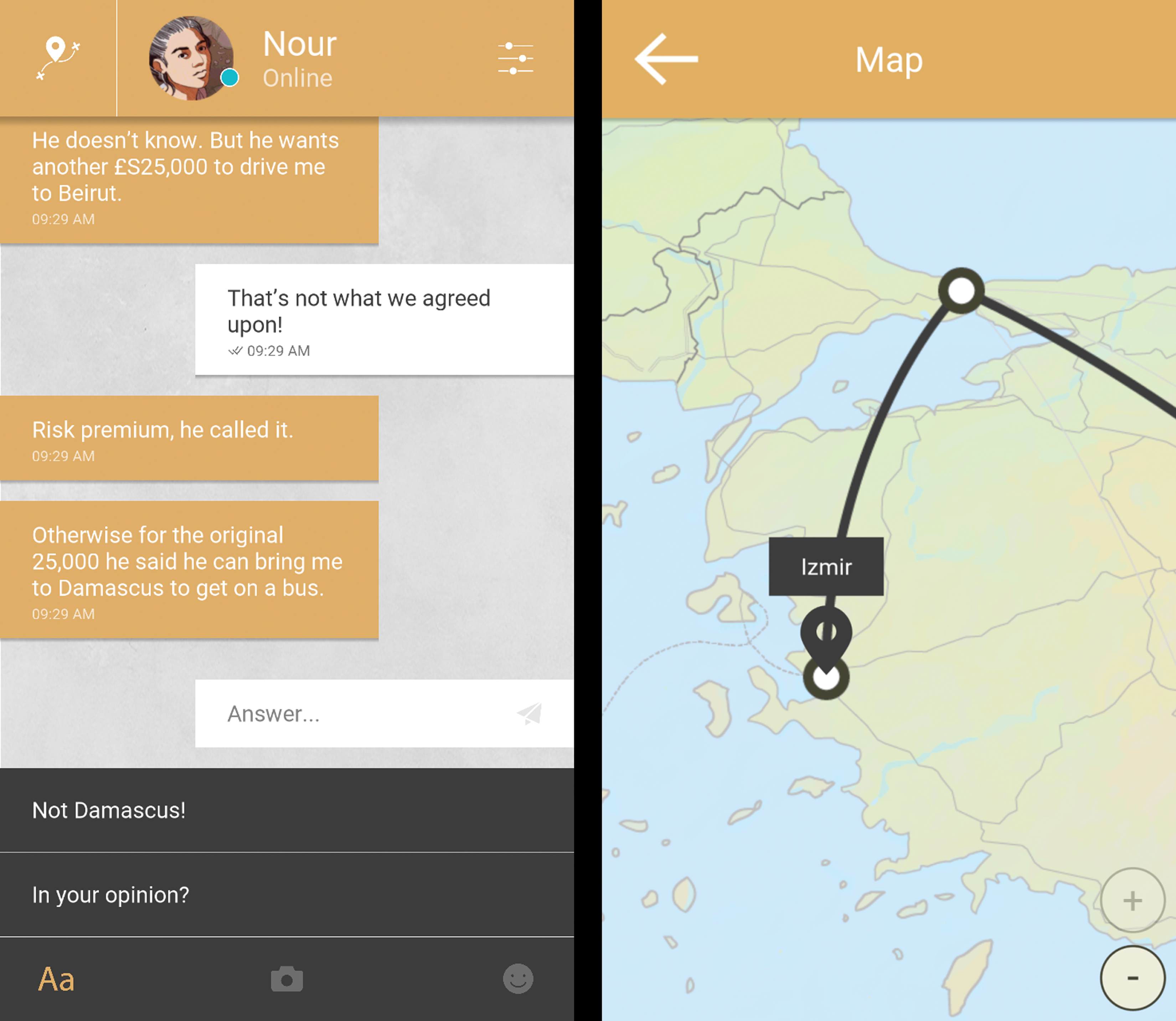
Screenshots from Bury me, my Love. Color images are available online.
We sought to leverage these unique features of the game narrative to design an online course to build social-emotional competencies such as empathy and compassion, along with knowledge and attitudes about the refugee crisis and people from different cultural backgrounds. The game-based course consisted of three modules, starting with Migration and Refugee Crisis, which aimed to build knowledge and understanding of the refugee crisis and positive attitudes to other cultures. This was followed by Home and Belonging which explored concepts related to community and one's relation to it; and the third module titled Identity and Dreams, which was to build an understanding of the self and the impact of migration on one's aspirations. Each module of the course was designed to include discussions, reflections, synchronous, and asynchronous tasks to discuss the different reasons underlying migration.
Explicit activities that required learners to pause and introspect their emotions reflect at critical pause points to recognize and share their perspective and the perspective of the migrant, and those that could drive positive action and change toward migrants were used to cultivate specific competencies of empathy and compassion. In addition, the course had three teacher-facilitated classroom activities.
The purpose of this research study was to report the efficacy of such a game-based course toward building both domain knowledge and social-emotional competencies of empathy and compassion in adolescent learners (age range 13–18 years) from two countries, India and United Arab Emirates (UAE). We used standardized assessments to test the pre- and post-impact of course intervention. To assess domain knowledge of migration, we created assessments of knowledge and attitudes to migration and validated them in-house. For empathy, we used the Basic Empathy Scale (BES) 17 developed by Jolliffe and Farrington, and for compassion, we used the Compassionate Engagement and Action Scales (CEAS) 18 developed by Gilbert et al., both of which have been standardized for adolescent children.
Three hypotheses were generated: H1: adolescent students who participated in the intervention would show significant impact in learning outcomes of the course, namely increase in knowledge and attitudes related to migration and increase in both empathy and compassion, H2: since past research suggests that females are more empathetic than males, 19 greater changes in female adolescents would be obtained compared to males, irrespective of country, and H3: since past research has suggested that compassion and empathy are correlated, 20 empathy and compassion scores would be correlated.
Materials and Methods
Participants
Participants for the study were recruited from five schools each in the UAE and India. These schools were identified based on convenience and ease of course implementation and were required to have English as their primary language of instruction. Thirty students from each school in India and UAE took part in the study, leading to a pool of 300 participants. Requirements for participation included access to a computer and internet device. Informed consent for using the data generated in the study was taken from all participants and their parents and/or adult caregivers. No personally identifiable data were collected at any time during the implementation of the course. The responses collected were anonymized and could not be traced back to any participant. The study protocol was approved by the University of Northern Colorado's Institutional Review Board (IRB), and all participants signed the IRB-approved consent form.
Measures
Knowledge of migration and attitude toward other cultures
We assessed knowledge as awareness about migration and refugees (awareness one has about concepts related to global issues of migration and refugee crisis). Attitude toward people from other cultures was assessed using two subscales—respect for people from other cultures (one's capacity to respect and value other people as equal human beings irrespective of their cultural background) and interest in learning about other cultures (the desire or willingness to learn about other cultures). A self-report questionnaire consisting of 14 items was constructed and divided into three subscales: (1) awareness about migration and refugees (6 items), (2) respect for people from other cultures (3 items), and (3) interest in learning about other cultures (5 items). This questionnaire consisted of adapted items from the Programme for International Student Assessment Global Competence Questionnaire 21 along with a few self-created items to assess the knowledge of migration and refugees. Since this was a self-constructed scale, it was first validated by conducting a factor analysis. The questionnaire and details of its validation are included in the Supplementary Data.
Empathy
We assessed the two components of empathy 17 : cognitive empathy (the ability to understand another person's emotional state) and affective empathy (the capacity to feel an appropriate emotional response when one is confronted with the affective state attributed to another person) using the BES. 17 It consists of 20 items that are responded to on a 5-point Likert response scale ranging from 1 (Strongly Disagree) to 5 (Strongly Agree). Nine items on this scale assess cognitive empathy (e.g., “I can often understand how people are feeling even before they tell me”) and 11 items assess affective empathy (e.g., “My friends” emotions don't affect me much). The BES is one of the most frequently used measures of empathy in research and has been validated among several populations, including adolescents and adults17,22,23 because of its high internal consistency (Cronbach's α between 0.77 and 0.87).
Compassion
Three components of compassion: self-compassion (the ability to be compassionate toward oneself), compassion to others (the ability to be compassionate toward others in distress), and compassion from others (the ability to receive compassion from others) were assessed using the CEAS. 18
The CEAS consist of three scales with 13 items each, that measure self-compassion (e.g., “I reflect on and make sense of my feelings of distress”), compassion to others (e.g., “I am motivated to engage and work with other peoples’ distress when it arises”), and compassion from others (e.g., “Others notice and are sensitive to my distressed feelings when they arise in me”). Participants are required to rate each statement according to the frequency of its occurrence on a Likert scale ranging from 1 (Never) to 10 (Always) for all the 39 items. The CEAS have been previously shown to have good factor structure, internal consistency (Cronbach's α ranging from 0.74 to 0.94), and convergent validity. 18
Intervention
Design
The intervention was conducted online over 16 weeks from September to December 2020 and consisted of four parts. In lieu of COVID-19, it was also conducted remotely. Part 1 consisted of pre-assessment using knowledge and social-emotional measures, part 2 required students to play the game. In part 3, students undertook the four-module online course, and in part 4, they took the post-assessment, which required them to complete the same assessments undertaken in part 1.
In part 1 of the intervention, participants completed the self-report measures described above. In addition to this, a demographic questionnaire that sought information on their gender and age was completed by the participants.
In part 2, participants were introduced to the game Bury me, my Love on personal desktop computers and were required to play the game unsupervised by teachers/facilitators. They were provided instructions on how to install the game on their system and an optional virtual logbook on Framerspace 24 —an online interactive digital content delivery platform—to track their journey as they played the game. Each participant was asked to complete the whole game at least once before taking the course. There were no restrictions on discussing their gameplay experience with peers.
In part 3, the participants took the online course. Teachers were suggested milestones for each of the modules and were free to pace them around existing schoolwork. A cohort took 8 weeks on average to finish parts 2 and 3 of the intervention.
The final step of the study required the participants to take a post-assessment test to evaluate their scores on the same measures for comparison.
Data collection
Data were collected through virtual forms designed on Typeform. These included pre- and post-assessments that were emailed to the students at the beginning and at the end of the intervention. Each assessment consisted of the knowledge and attitudes scale, the BES, and the CEAS and was taken independently by each participant. In addition to the assessments mentioned above, an additional questionnaire that included demographic information such as country, gender, and age was also completed by each participant. Participation in the assessments was voluntary and anonymous, which meant that no personally identifiable information such as name or email address was collected throughout the process. Instead, the pre- and post-assessment responses were identified through an anonymized unique ID assigned to each user on Framerspace.
Data analysis
Sample characteristics
A total of 313 entries (143 from India and 170 from the UAE) were received on the pre-assessment questionnaire, and 270 entries (136 from India and 134 from the UAE) were received on the post-assessment questionnaire. The data collected were examined for duplication and attrition.
A total of 205 entries remained after all duplicates and dropouts were removed. Of the participants, 44.8% reported their gender as male (N = 92), 53.2% as female (N = 109), and 2% preferred not to disclose their gender (N = 4). Data from participants who preferred not to disclose their gender (N = 4) were excluded. The mean age of the participants (N = 201) was 14.89 years (standard deviation = 1.15). Of the 201 participants, 89 were from India and 112 from UAE. Unpaired t-tests and Chi-square tests indicated that the samples were matched across age and gender (Table 2).
Sample Characteristics
SD, standard deviation; UAE, United Arab Emirates.
Effects of the intervention on knowledge and social-emotional competencies
The effects of the intervention were assessed by comparing differences in pre-and post-assessment scores of knowledge, attitude, and social-emotional learning measures. All data analyses were performed using R version 4.0.2. 25 The knowledge and attitudes scale was first validated using exploratory and confirmatory factor analysis (details in Supplementary Data).
Then, the reliability of the scales was tested. Reliability estimates revealed satisfactory results (Cronbach's α >0.60) 26 for all subscales of empathy and compassion: affective empathy (αpre = 0.68, αpost = 0.72), cognitive empathy (αpre = 0.70, αpost = 0.75), self-compassion (αpre = 0.67, αpost = 0.80), compassion to others (αpre = 0.80, αpost = 0.86), and compassion from others (αpre = 0.89, αpost = 0.91). Similarly, for the self-developed scale, the reliability estimates on the sample were satisfactory: awareness of migration and refugees (αpre = 0.68, αpost = 0.76), interest in learning about other cultures (αpre = 0.72, αpost = 0.79), and respect for people from other cultures (αpre = 0.68, αpost = 0.79).
This was followed by a preliminary analysis to determine baseline gender differences in each country. Given that past research 19 has indicated gender differences in empathy and compassion, gender effects were also explored while determining the impact of the intervention. For this, two-way (2 × 2) mixed analyses of variance (ANOVAs) were conducted with one within-subjects factor (time) and one between-subjects factor (gender). Significant main effects and interactions were followed up with paired t-tests. Finally, Pearson correlations between delta scores (change in scores from pre-assessment to post-assessment) were calculated and interpreted.
All assumptions were tested before conducting statistical tests. Univariate normality of scores was examined using visual inspection of Q–Q plots. Homogeneity of variance between groups was examined using Levene's test for equality of variances.
27
Wherever the distribution was heteroscedastic, Welch's statistics was reported. The Greenhouse–Geisser correction was applied wherever the assumption of sphericity was violated for mixed ANOVAs. Extreme outliers in the data were eliminated using the |z| > 3 rule.
28
In addition, effect size measures for ANOVAs (partial eta-squared,
Results
Pre-intervention scores
Mean pre-intervention scores of the samples can be found in Tables 3 and 4 (along with other results of other postintervention analyses). Unpaired t-tests were conducted to determine baseline gender differences on the subscales of knowledge and attitudes, empathy, and compassion.
Mixed Analysis of Variance Results for Time Effects of the Intervention in India (n = 89)
P < 0.05, ***P < 0.001.
ANOVA, analysis of variance; BES, Basic Empathy Scale.
Mixed Analysis of Variance Results for Time Effects of the Intervention in United Arab Emirates (n = 112)
P < 0.05, ***P < 0.001.
Knowledge and attitudes
Females scored significantly higher than males on the subscale of interest in learning about other cultures in both India [t(72.98) = 2.42, P < 0.05, d = 0.52] and UAE [t(95.89) = 1.98, P < 0.05, d = 0.37]. In addition, females also showed significantly higher scores on respect for people from other cultures in both countries (India: [t(61.51) = 2.72, P < 0.01, d = 0.59], UAE: [t(96) = 2.36, P < 0.05, d = 0.45]).
Empathy and compassion
Females scored significantly higher than males on affective empathy in India [t(84.52) = 2.71, P < 0.01, d = 0.57], as well as UAE [t(109.77) = 2.61, P < 0.05, d = 0.49]. The subscale of cognitive empathy showed no differences across gender.
In UAE, males scored significantly higher than females on the subscale of self-compassion [t(107.31) = 3.10, P < 0.01, d = 0.58]. The other two subscales of compassion showed no gender differences.
Effects of the intervention on knowledge and social-emotional skills/competencies
The effects of the intervention were assessed by conducting 14 independent 2 × 2 mixed ANOVAs (7 each for India and UAE).
Time effects
Main effects of time on knowledge and social-emotional competencies are presented in Table 3 (for India) and Table 4 (for UAE).
Knowledge and attitudes
Students from both India and UAE showed a significant increase in awareness about migration and refugees post intervention (India: [F(1,87) = 77.001, P < 0.001,
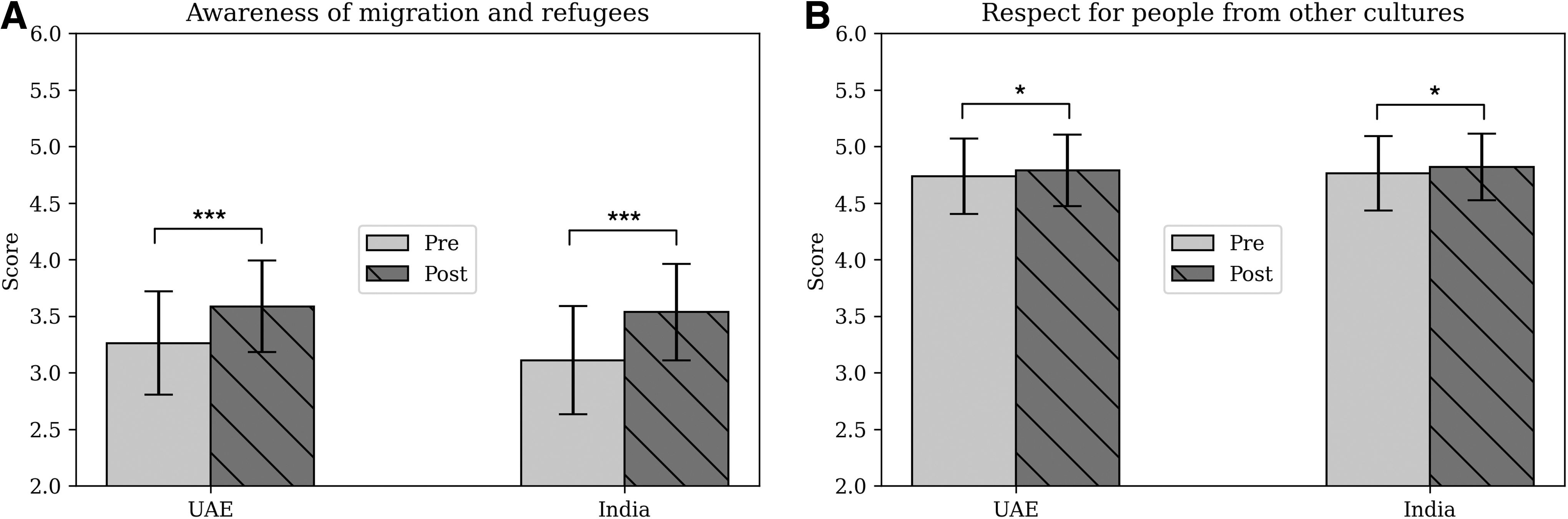
Significant increases (***P < 0.001) in awareness of migration and refugees
Empathy and compassion
The subscales of empathy and compassion did not show any main effects of time (all P-values >0.05).
Based on these results, H1 was partially accepted because a significant overall increase was seen in knowledge and attitude components post intervention, but not in components of empathy and compassion.
Time × gender effects
The time × gender interaction effect obtained from ANOVAs, along with their post hoc tests for both countries, is presented in Tables 5 and 6 (for India and UAE, respectively). Since several P-values of these effects were close to significance, post hoc t-tests were performed on all of them to investigate potential underlying effects.
Mixed Analysis of Variance Results for Time × Gender Effects of the Intervention in India (n = 89)
P < 0.05, ***P < 0.001.
Mixed Analysis of Variance Results for Time × Gender Effects of the Intervention in United Arab Emirates (n = 112)
P < 0.05, **P < 0.01, ***P < 0.001.
Knowledge and attitudes
A significant time × gender interaction was seen for awareness of migration and refugees in UAE, but not in India. However, post hoc tests revealed that females and males showed a significant increase in awareness of migration and refugees in both India [males: t(39) = 6.86, P < 0.001, d = 1.08, females: t(48) = 5.69, P < 0.001, d = 0.81] and UAE [males: t(51) = 4.03, P < 0.001, d = 0.55, females: t(59) = 6.48, P < 0.001, d = 0.83]. A significant interaction for interest in learning about other cultures also revealed that in the Indian sample, males showed a significant increase [t(39) = 1.99, P < 0.05, d = 0.31] in post-assessment scores compared to pre-assessment scores. However, for UAE, even though the time × gender interaction for interest in learning about other cultures was significant [F(1,110) = 3.934, P = 0.05,
Empathy and compassion
Female participants in both India [t(48) = 1.89, P < 0.05, d = 0.27] and the UAE [t(59) = 1.75, P < 0.05, d = 0.22] showed significant increases in the score on compassion from others. These results have been represented graphically in Figure 3. Other subscales of knowledge and attitudes, empathy, and compassion did not show any significant time × gender effects.

Significant increases (*P < 0.05) in compassion from others in females post-intervention (construct measured on a scale of 10).
Based on these results, H2 was partially accepted since a greater (and a significant) increase in compassion from others was seen in females from both India and UAE.
Correlations
Pearson correlations were computed (country wise) to investigate the relationship between increases in scores across knowledge and attitudes and social-emotional competencies. They are represented in Table 7. We report here some consistent trends seen in both countries. In both UAE (r = 0.50, P < 0.01) and India (r = 0.60, P < 0.01), significant correlations were seen between changes in self-compassion and compassion to others. Similarly, significant correlations between changes in compassion to others and cognitive empathy were seen for both India (r = 0.23, P < 0.05) and UAE (r = 0.29, P < 0.01). Changes in compassion from others also correlated positively with changes in compassion to others in both India (r = 0.61, P < 0.01) and UAE (r = 0.39, P < 0.01). Since there was a significant correlation seen between changes in the subscales of empathy and compassion, H3 was accepted.
Pearson Correlations for Change in Scores Post-intervention (Country Wise)
*P < 0.05, **P < 0.01.
Discussion
The goal of this study was to evaluate the effects of a game-based course on building domain knowledge related to migration, attitudes toward people from other cultures, and social-emotional competencies of empathy and compassion in adolescents in India and UAE. In this section, we seek to discuss results that were consistent across both countries. As per the analysis which was conducted in two parts, we first discuss the results of the analysis on pre-assessment scores in the two countries. Following this, we discuss the effects of the intervention in both countries.
The pre-assessment analysis consisted of a gender-wise comparison of scores in the domains of knowledge, empathy, and compassion across the two countries. For both India and UAE, females scored significantly higher than males on knowledge of migration, specifically, on the subscales of interest in learning about other cultures and respect for people from other cultures. This result was consistent with the results of a recent global study conducted by the Organisation for Economic Cooperation and Development using an extended version of the same questionnaire used in this study. Out of the 65 countries that took part in the study, females in all 65 countries scored higher than males on respect for people from other cultures. Similarly, females in 63 countries scored higher than males on interest in learning about other cultures. 31 This is also consistent with other research on gender differences in intercultural skills, which suggests that females tend to sympathize with vulnerable groups that have similar histories of prejudice and injustice, such as marginalized groups and minorities. It is the historical and social position of females that might lead to them responding differently than males on attitudes related to migration, refugees, and people from different cultures. 32
Females in both countries also scored higher than males on affective empathy. Previous studies in other countries like the United Kingdom have also reported that females have scored higher than males on measures of trait empathy and particularly on affective empathy.23,33,34 It however remains unclear whether this difference is a “true” difference (i.e., because of females being more socialized to respond to feelings of others than males) or it occurs due to biased responding on self-report questionnaires (i.e., since females are expected to be more responsive to feelings of others, they might respond to the measure based on that stereotype). 17
To investigate the effects of the intervention, pre- and post-assessment scores of participating students were compared to see changes in knowledge of migration, attitudes toward people from other cultures, empathy, and compassion. As per hypothesis 1, adolescent students who participated in the intervention showed significant increase in learning outcomes of the course, namely increase in knowledge of migration and attitudes toward people from other cultures. In particular, significant increases were seen on the subscale of awareness about migration and refugees in overall samples of both countries (Fig. 2). This statistically significant increase was also consistent across males and females in both countries (Tables 5 and 6) and indicates that the game-based course was able to successfully build knowledge about issues of socially relevant themes like migration and the refugee crisis through the medium of a digital game and an accompanying course structured around it. This finding was stronger in India compared to UAE (see P-values in Tables 3 and 4), which may be attributed to the fact that the game and the game-based course might have been the first in-depth exposure for participants from India to issues such as the refugee crisis. UAE, on the other hand, comprises societies that are more multicultural in nature, 35 and thus, the students there might be more predisposed to issues faced by migrants and refugees than those from India. This finding was also consistent across males and females in both countries.
We also saw a statistically significant increase in respect for people from other cultures in participants from both India and UAE. This result can be attributed to participants navigating the game through the eyes of a refugee and engaging in activities designed to practice perspective taking. This also supports the power of games as mediums to inculcate perspective-taking, which require participants to get into the shoes of the other. 36 In the past decade, the growth of multicultural societies has prompted a call for respect for different cultures. This has been coupled with the increased migration from developing to industrialized countries. It is therefore vital that students are taught to acknowledge and recognize pluralism in this globalized world through the means of such interventions. 37
Regarding social and emotional competencies, there were no statistically significant increases observed for empathy. However, for compassion, females saw significant increases on the subscale of compassion from others. As hypothesized, this effect was seen in both countries suggesting that it can be attributed to gender and not culture. Studies with human infants have evidenced that females exhibit higher rates than males in various rudimentary forms of empathy, such as contagious crying, social referencing, and so on, which prove that these sex differences have phylogenetic and ontogenetic roots in biology and are not merely cultural by-products driven by socialization. 19 Another study showed that female adolescents score higher on perceived social support compared to males. 38 This perception of social support might in turn make females more open to receiving compassion. It has also been suggested that the traditional gender-role expectations for females, such as nurturing and affiliation, which are also very prevalent in both these countries, might enable them to develop new supports more easily. 39 It might be because of these inherent and learned differences that females showed significant increases in receiving compassion from others after the intervention, compared to insignificant increases in males. A possible although unproven suggestion is that since the protagonist of the game is a woman, the female participants could have felt more invested in participation.
Since past research has suggested that compassion and empathy are correlated, 20 we expected to find similar correlations in empathy and compassion scores. The correlation analysis uncovered several significant associations in both countries. In particular, a positive correlation was revealed between subscales of empathy and compassion (Table 7), which confirmed hypothesis 3. Changes in compassion to others were found to be correlated with cognitive empathy in both India and UAE. This is in line with previous research which suggests that in individuals experiencing adversity, increased levels of empathy, specifically cognitive empathy, lead to greater levels of compassion. 40 In another study, it was argued that compassion for others naturally arises through empathy when one sees others suffering and experiences a desire to alleviate their suffering through altruistic behavior. 41
Moderate to strong positive correlations seen between changes in subscales of compassion, that is, self-compassion with compassion to others and compassion from others with compassion to others, were also in line with previous research performed on samples of American, British, and Portuguese participants. 18 Practicing self-compassion involves soothing oneself in times of distress without being carried away with negative thoughts. 42 This may help self-compassionate individuals deal with others’ suffering with greater emotional balance, although the directionality of this influence is not certain. 43 It may also be possible that an overarching factor of emotional resilience helps people to be more self-compassionate and less distressed by the suffering of others. 44 Other research has shown that the ability to receive care predicts compassion to others. 45
In summary, the game-based course was able to build knowledge and skills of migration and social-emotional learning in adolescent students in both countries.
Limitations and future directions
Some limitations of the present study and implications for future research must be noted. First, there is a need to review the design of activities in the game-based course that were aimed at building skills of empathy by making them explicit. Several activities in the course involved the participant empathizing with another individual, and these could have in fact played a role in building skills of compassion in the participants instead of empathy.
The study used a modest sample size, and thus, it must be replicated on bigger populations to confirm the effects seen. Conducting a randomized controlled trial with a control group might also help strengthen the results further. The evaluation of associated skills was done through self-report measures. One of the biggest disadvantages of using self-report measures is that the respondents may be influenced by the bias of “social desirability.” 46 There is therefore a need to transition to behavioral/neuroscientific measures, which, however, present the problem of being resource and cost intensive. Another alternative is using game-based skill assessments, which can incorporate stealth assessment, that is, assessment being done without students realising.47,48 Some participants may have played the game more than once. However, this was not factored into the study, and the effects of this could not be analyzed.
Moreover, since the participating schools were selected based on ease of implementation, only private schools were a part of this intervention. Students from private schools are likely to be from high-income backgrounds who are already familiar with social-emotional learning practices and, therefore, might not show the expected results postintervention. In addition, they might not be representative of a country overall. Finally, it is crucial that the long-lasting effects of such an intervention be investigated and evaluated by conducting a longitudinal study.
Conclusions
To the best of our knowledge, this is the first study of its kind that explores the efficacy of a game-based course to build knowledge and social and emotional competencies in the classroom. The course was tested during the COVID-19 pandemic when students engaged in remote learning and showed moderately successful results. Such game-based courses thus offer the potential of making socially relevant themes accessible and engaging to adolescents by combining a game with an online immersive course. The large-scale penetration of computer technology, the familiarity of young learners with it, and the maturation of games as a medium for engaging storytelling make them novel candidates to be adopted into the classroom.
Footnotes
Authors’ Contributions
V.M. and M.S.: contributed equally to this study. V.M.: study design, study implementation, data analysis, data interpretation, drafting, and critical revision. M.S.: data analysis, data interpretation, drafting, and critical revision. A.S.: study design, study implementation, data interpretation, drafting, and critical revision. R.S.: study design, drafting, and critical revision. M.F.: drafting, and critical revision. N.C.S.: study design, study implementation, data analysis, data interpretation, drafting, and critical revision. All authors were accountable for the final version of the article.
Acknowledgments
The authors thank the project team: Mahima Bhalla, Akash Saini, Devesh Kumar, Aditi Pathak, Renuka Rautela, developers of the game Bury me, my Love: The Pixel Hunt Studio, and teachers and partners involved in facilitating the study.
Author Disclosure Statement
The authors declare that the research was conducted in the absence of any commercial or financial relationships that could be construed as a potential conflict of interest. The game Bury me, my Love is commercially available.
Funding Information
The study was funded by intramural funds from UNESCO Mahatma Gandhi Institute of Education for Peace and Sustainable Development.

References
Supplementary Material
Please find the following supplemental material available below.
For Open Access articles published under a Creative Commons License, all supplemental material carries the same license as the article it is associated with.
For non-Open Access articles published, all supplemental material carries a non-exclusive license, and permission requests for re-use of supplemental material or any part of supplemental material shall be sent directly to the copyright owner as specified in the copyright notice associated with the article.
