




Abstract
It can be difficult to understand the process of making decisions in health care, because of both the complexity of health care systems and the demands faced by health care professionals. Serious games offer an underexplored opportunity to elicit data about decision-making. In this article, we present and reflect on a methodological case study where we used a serious game as part of a semistructured interview to study the process of decision-making. The game Resilience Challenge presented a patient's journey through a hospital, where a player had to make decisions that influenced patient care. The game was used during interviews with 20 nurses, both in person and remotely. Having a mini debrief with a participant after each game scenario provides to be a helpful technique to understand the participants' decision-making process and elicit tacit knowledge about their work. Serious games show promise as a methodological research tool to elicit the process of decision-making among health care professionals.
Introduction
It can be difficult to study the decision-making process of health care professionals, in part because of the complexity of health care systems. Although the outcomes of health care professionals' decision-making may be visible (i.e., an action), it is harder to study their process of decision-making. It is known that serious games, using a decision-making game mechanic, are effective tools to produce outcomes such as practicing surgical procedures and emergency response.1–4 However, less is known about the process of making decisions in games, or whether games with a decision-making mechanic could also work as an elicitation tool in research. The aim of this article was to report the methodological potential of using a serious game with a decision-making game mechanic to elicit information about health care professionals' process of making decisions. Using serious games as elicitation tools could increase the feasibility of studies exploring decision-making processes, and lead to insights that support good clinical practice.
Health care professionals' decision-making is a critical part of providing safe health care. 5 The value of decision-making has been recognized by researchers who have studied decision-making among pharmacists, 6 nurses,7–9 physicians, 10 and managers. 11 It can be difficult to elicit health care professionals' decision-making process using traditional research methods, especially as clinicians can face continuous interruptions at work.12,13 Observing clinicians can also produce different outcomes than asking them to narrate their thoughts, as clinicians underreport the number of decisions they make at work. 14 It was important to identify new research methods to elicit decision-making, to continue to build evidence supporting safe patient care.
Serious games have the potential to simulate clinical environments and are increasingly valuable in the context of COVID-19. The pandemic has limited the ability of researchers to be present in a clinical setting. The pandemic has limited in-person contact, and may be a barrier to elicitation techniques such as contextual inquiry,15,16 participant observation,17,18 or clinical simulation. 19 Researchers need to use other techniques to elicit information about decision-making that do not require a researcher to be physically present in a clinical or simulation environment, such as a hospital ward.
The use of serious games, defined as games that are used for purposes other than pure entertainment, 20 is increasingly popular in health education. There is a growing body of evidence about their efficacy in education, indicating they are both effective and engaging learning tools.21,22 However, serious games also have the potential to be used in a research method. Owing to their ability to promote reflection,23–25 serious games have potential to be a powerful elicitation tool. There are opportunities for researchers to use serious games to yield richer insights into participants' decision-making processes, including research conducted remotely. Serious games have been used to elicit intentions around behaviour, 26 and we hypothesized that a serious game could also elicit information about decision-making.
This article presents a novel research method of using a serious videogame as an elicitation tool in qualitative interviews about patient safety with nurses. The design process for the serious game and its outcomes are reported in full elsewhere. 27 This article considers the methodological implications of serious games as an elicitation tool in research studies.
Serious Games
Many serious games prompt decision-making for educational purposes, to support skill development. In health care, serious games have been used successfully with health care professionals to support various aspects of clinical work. These include training in surgical procedures, assessment, patient skin integrity, and reading electrocardiographs. 2 Iacovides and Cox 25 and Iacovides et al. 28 explored the use of different games to raise awareness and prompt reflection on blame culture in health care. In addition, Hannig et al. 29 reports the development of eMedOffice, a game that introduces medical students to patient flow challenges that can impact their work.
There are also examples of virtual patients, which enable students to simulate patient care by progressing through digital clinical scenarios.30,31 These examples indicate that games can serve as tools for engagement, reflection, and learning for health care professionals. To our knowledge, although these games have been reflected upon in research studies, serious games have not been used directly as an elicitation tool during the research process.
Value of Serious Games for Research Methods
Serious games could be used as elicitation tools, due to their ability to simulate clinical decision-making, and prompt participants to reflect on issues they face in clinical practice. They would allow researchers to share the same game with multiple participants online and to connect with participants across a larger area than what would be feasible if a researcher use observational methods in person.
Serious games have can focus on tacit knowledge, 32 defined as knowledge that is acquired outside of formal learning activities, that is used for problem-solving and decision-making. 33 New methods are needed to better understand tacit knowledge among health professionals, including nurses. 34 Serious games may prompt participants to reflect on their decision-making and articulate the reasoning behind their choices, thus making it possible to understand how clinicians make decisions that are informed by tacit knowledge. In turn, an increased understanding of tacit knowledge could contribute to discussions of how this decision-making can relate to patient safety in a clinical setting.
Case Study: Resilience Challenge
Resilience Challenge is a scenario-based videogame where a player makes decisions that guide a patient's journey through a hospital. In each of the five scenarios, the player must address realistic clinical dilemmas, and decide on one of three options to respond to the scenario. The game was created to translate concepts from resilient health care for clinicians, such as the idea that works as it is planned does not always correspond with the work that happens in a clinical setting. 35 Resilient health care is a paradigm that holds promise for improving safety in health care. 36 Resilience Challenge was developed as a tool to engage clinicians around these concepts. 27 Using Resilience Challenge as an elicitation tool enabled us to ask questions about how health care professionals make decisions in less-than-ideal circumstances and interpret their decision-making process through a patient safety lens.
Resilience Challenge takes <5 minutes to play, which made it a feasible addition to a semistructured interview. Figure 1 presents an image from Resilience Challenge, where the graphic illustrates a nurse who is alerted to the patient deteriorating.
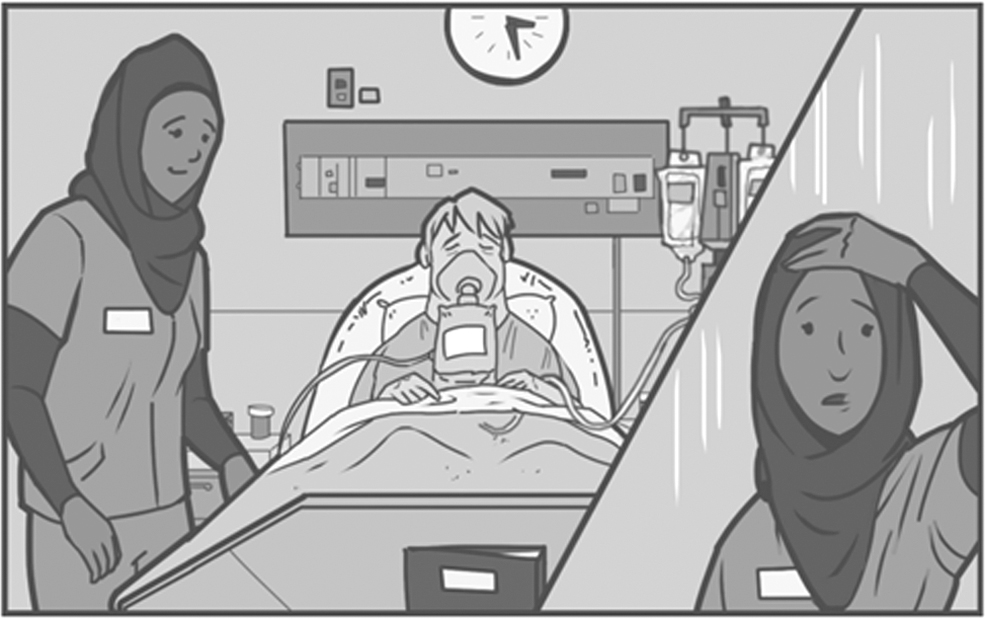
Second scenario in Resilience Challenge with the nurse and patient.
In each scenario, there is only one decision that allows a player to move through the game. When a decision was made, the players receive feedback about their answer and why it was or was not the response that advances the game. Players may choose different responses until they select the response that advances the game (Fig. 2). The feedback that is provided explores the implications of each decision, to prompt reflection from the player.

Example of the question response screen.
Resilience Challenge was designed as an interactive narrative game with graphics for health care professionals to work through how they would respond to realistic scenarios. The purpose of the game was not to create a realistic simulator or virtual patients for clinical practice. Instead, clinicians were asked to consider how they adapt their work in less-than-ideal scenarios. The evaluation of Resilience Challenge is presented elsewhere. 27 The findings included participants' reports that the game helped them reflect on competing pressures in clinical environments, such as the need to balance management priorities and patient safety. Participants also reported that Resilience Challenge prompted them to consider when patient care needed to be adapted and what impact this adaptation could have on safety. Some participants wrote about why they agreed or disagreed with the game, and whether there was ever a “right answer” in health care.
Methods
To explore the game's potential as an elicitation tool, Resilience Challenge was used as part of an interview study to explore nurses' experiences of adapting their work. The study included 20 semistructured interviews, where Resilience Challenge formed part of the interview protocol. Interviews were conducted both in person and over Skype (before COVID-19). During in-person interviews, participants were observed while they played the videogame on a designated iPad with the researcher. This technique provided the researchers the opportunity to see which decision the participants were making when they played the game. The interviews were audio recorded and participant choices were verbalized (“I see you chose the option to send the patient to the orthopaedic ward”) so that this information would be retained in the transcript of the interviews. The Skype interviews proceeded similarly to those conducted in-person. Researchers have found interviews using videoconferencing software to be valuable in other studies as well.37–39
Full ethical approval from the Florence Nightingale Faculty of Nursing, Midwifery & Palliative Care at King's College London was obtained on November 3, 2016, LRS-16/17-3787.
Interviewing technique
As participants played through the game, they would read and reflect on each scenario, decide about how to adapt their work, and then receive feedback in the game as to whether that choice would advance to the next scenario or not. After the feedback, the researcher asked participants, why did you select that choice? This prompt enabled participants to explain their reasoning and elucidate the issues they had considered when making their decisions.
The interview technique with the serious game was refined over the course of the study. Initially, the plan was to use the “think aloud” method,40,41 a technique where participants are asked to narrate their thoughts while they are observed carrying out a task. Ideally, this technique would prompt participants to speak about what factors they consider in their decision-making. However, this technique did not work, as participants would mainly read the videogame text and instructions off the screen. The game was not amenable to the think aloud technique, as it required participant reading throughout the decision-making process.
In response, the interviewing technique changed to having a mini debriefing discussion after each scenario in the videogame and asking about the participants' decision-making and what motivated their choices. In this context, debriefing was an opportunity for participants to explain what choice they had made and why, what factors they considered in their decision-making, and how they felt about their choice. This debriefing method after each scenario, rather than trying to get the participant to verbalize their thoughts while playing, was much more useful at eliciting detailed responses and think aloud method was not attempted further.
In addition, participants were asked for specific examples from their clinical practice during interviews.42,43 This was a fruitful technique, as participants illustrated how nursing work occurs in their settings. We were concerned that the game may not translate for the participants, some of whom worked outside hospital settings. However, participants were able to readily connect their experiences to those depicted in the game, including participants who worked in mental health and community settings.
Participant Responses to Method
Overall, using a serious game was an acceptable method of eliciting participant decision-making and reflections on their work. The debriefing technique after each scenario worked well to elicit participants' experiences. Participants reported that playing the game during the interview helped them to reflect on their own work. As one participant explained:
But I enjoyed, because I didn't know what to expect from the video game, I enjoyed the process because it was more about what you can learn from the way I'm thinking, rather than okay, what decisions am I making, why? (P5, nursing student)
The game helped participants move beyond providing a right or wrong answer and explain the factors that they considered when they make decisions about how to adapt.
In addition, the game was also useful for eliciting tacit knowledge. Participants with more nursing experience were quick to make decisions in the game about an appropriate adaptation to the patient's care. During the debriefing discussion, this participant explained how they applied their knowledge to the scenarios:
I think it was interesting with the game that actually, the scenarios, it was relatable to different departments but also actually thinking about those situations, you think actually, because I go to A&E regularly if [need to see patients there], so you have a little bit of an understanding of all these different areas in healthcare even if you've never actually worked there. But actually, you're picking things up all the time through your working life, aren't you? And you don't even really realise it (P14, advanced practice nurse, outpatient setting).
This participant was able to draw on their accumulated knowledge and use it to inform their decision-making during the game. The scenarios prompted the participants to reflect, in a way that may have been difficult to achieve without the game providing context to spur their decision-making.
For instance, this participant explained how the issues in the game were transferable to their practice setting:
It made me think about my work because it's things that you do have to deal with quite regularly. And even in an outpatient scenario or in the community scenario you don't deal exactly with this. But you still deal with many situations that have several similarities in terms of the process of taking the patient through the treatment and their recovery (P9, clinical nurse, outpatient setting).
This participant was able to relate to and reflect on the scenarios, despite working in a practice setting that was not directly addressed in Resilience Challenge. The relatability of the game was wider than the context that was directly depicted, as nurses from settings such as mental health were able to extrapolate beyond the scenarios to their own work. The inclusion of nurses from multiple practice settings added greatly to the richness of these data about participant decision-making.
Strengths and Limitations of this Method in Research
There are several strengths of using a serious game as an elicitation tool. The game created a novel experience, which simulated elements of a clinical environment, without the potential disruption or time required for clinical observation. This could be particularly advantageous during COVID-19, when in-person interview techniques may not be available to researchers. In addition, the game also avoided the issue of having to make individual recordings for each participant (which would be required for video-stimulation techniques) and meant recruitment was not restricted to a specific geographic area.
Using a serious game for elicitation in research showed promise for interviewing nurses about their decision-making, in a variety of settings. The game's resonance is not limited to people who are directly involved in a game's context. The debriefing technique prompted participants to discuss how they adapted their work, revealing tacit knowledge. Semistructured interviews can be less detailed and focus more on recall than reflection.44 Using a serious game to understand the process of decision-making among health care professionals may elicit more detailed information than a standard interview format. Serious games may be particularly useful to use when interviewing during COVID-19 when methods such as simulation are practically difficult.
The strengths of the elicitation from Resilience Challenge were due to it being a short relatively simple game to play, with a familiar premise. The game was advanced by clicking on an option, which was a familiar process for participants. The game avoided tasks that required learning a new skill or how to play the game. These considerations meant that participants could engage with the game directly and focus on the intended elements of the interview. To explore the role of serious games as elicitation tool, researchers are encouraged to incorporate simple decision-making mechanics into other interviews.
Using a serious game was not without limitations. The interviews were reliant on a computer and/or tablet, and the need for Wi-Fi. This may limit the context for application or exclude participants who have unstable internet connections. There was also a 5-month period of game development before implementation, and fees for a game design agency. The cost and time requirement may be a barrier to some researchers, as the time and money required to develop the game was far beyond that of a standard interview guide. However, researchers may be able to overcome the time and cost barriers by applying an existing educational game as an elicitation tool, to understand decision-making in a research context.
Conclusion
Serious games offer a novel elicitation tool that can be used during interviews to understand participant experiences of their work and associated tacit knowledge. Serious games have been created for clinical education and can be applied more broadly within interview contexts. A short game with a relatively simple premise meant that participants could focus on adaptation and sharing their clinical decision-making, rather than solving complex medical issues. Using a debriefing technique during in-person and online interviews was a useful method for eliciting participant experiences during an interview context. Researchers can consider applying existing serious games, or creating new ones, to elicit a rich understanding of participants' experiences.
Footnotes
Authors' Contributions
J.J. designed the study, obtained funding, and collected and analyzed the data. J.I. supported videogame design, the literature review, and the evaluation criteria. Both authors contributed to writing and editing the article.
Acknowledgments
We would like to thank Karman Interactive Ltd. for partnering with us to create Resilience Challenge. We would also like to thank the participants for their valuable contributions.
Author Disclosure Statement
The authors have no competing interests to declare.
Funding Information
This study was supported by the Arts for Health and Wellbeing fund from the Cultural Institute at King's College London. Additional support was received from the Canadian Institutes for Health Research.