




Abstract
Background:
Serious games (SGs) have been proposed as a type of technology-enhanced simulation that may provide nursing students with an opportunity to practice their clinical reasoning and decision-making skills in a realistic and safe environment.
Materials and Methods:
The aim of this study is to determine the effect of serious play on nursing students' self-confidence (SC) and anxiety in clinical decision making. The randomized controlled trial evaluated the efficacy of SGs for undergraduate nursing students using pre- and posttests. The study was conducted during nursing students' clinical practice and teaching. All undergraduate nursing students (n = 120) attending internal medicine nursing lesson were approached. Sixty students out of 120 answered the questionnaires at both baseline and follow-up (30 in the experimental group [EG] and 30 in the control group). The students answered the questionnaire after taking the first clinical practice, taking the endocrine course. In the 1 week, the EG played the game and both groups returned to clinical practice. Questionnaire data were collected after clinical application.
Results:
SC and two subdimensions, using the information in hand to determine the problem, and knowing and taking action, were improved in the intervention group and a significant interaction effect was found for changes over time between the two groups. Anxiety scores between groups were not statistically significant differences.
Conclusions:
Nursing professional educators can adopt SGs to improve cognitive and attention skills, strengthen judgment, require making time efficient, practice making safe decisions, and encourage the exploration of decision.
Introduction
Serious play has been gaining momentum in an educational context as an interactive and motivating approach to learning.1–3 Because of these advantages and compared with traditional methods of training, serious games (SGs) are increasingly used for training in military, health, and education. SGs have been used to educate health students and professionals and have a positive effect on knowledge or skills' development.
Nurses are expected to take clinical decisions and apply them in limited time. Such pressures adversely affect the problem-solving skills of nurses. For this reason, nursing students should have effective time management, clinical reasoning, and problem-solving skills when applying care for patients.4,5 In this context, SGs strengthen judgment and improve cognitive skills, practice time, and attention skills. The interactivity and instant feedback provided by the games encourage students to make deeper thinking and active learning in subsequent games, with a fixed cycle of decision making, enabling students to make sense of previous decisions. SGs also draw attention to the need for nursing students to decide in a safe, realistic, simulated environment, to search for decisions, and to make clinical decision-making experience.4,6 Thus, when students are in the clinical setting, their stress and anxiety levels will decrease, and the self-confidence (SC) in learning the clinical environment and approach to the patient will increase. 7
According to Suppan et al., the SGs that hospital staff prepared about infection prevention and control to prevent the transmission of COVID-19 among themselves and with patients, have been shown to encourage safe behaviors and increase motivation in the COVID-19 process. 8 Hara et al. showed that motivating critical thinking and decision making in a safe environment, provided easy successive training moments within the pace of individualized learning. 9 In a systematic review, it has been shown that SGs appear to be at least as effective as controls, and in many studies, more effective for improving knowledge, skills, and satisfaction. However, the available evidence is mostly of low quality and calls for further rigorous, theory-driven research. 10
The literature points out to studies with the application of the SGs in different contexts, for example, to teach nursing students about the patients' care with chronic obstructive pulmonary disease at home and in health services, 11 or in the context of neonatal resuscitation, 12 adopted by nursing students and professionals, and nursing students with experience in the simulation of cardiopulmonary resuscitation. 13
Although serious play has been proven to be effective for nursing learning, this statement is important to support the effects of serious play on the teaching process by conducting randomized controlled studies. In this systematic review, it is suggested that studies can be carried out with SGs that define pedagogical strategies and sound methods for the future practice of students and nursing professionals, with proven effectiveness by the quality of the evidence. 14 The aim of the study, which was carried out considering all these suggestions, is to determine the effect of SGs on the SC and anxiety of nursing students in clinical decision making.
Materials and Methods
Study design
The randomized controlled trial evaluated the efficacy of SGs for undergraduate nursing students using pre- and posttests. The randomization scheme was generated by using the website Random.org (https://www.random.org/). Students who were interested in participating in this study were assigned to an experimental group (EG) or control group (CG) using the website of randomization for a block size of two. The group allocations were not revealed to the participants to prevent bias. The CG followed the usual nursing curriculum (theoretical courses and practice). The SG group completed the CG as an additional game. This study conformed to the CONSORT guidelines. 16
Participants
The target users of the SG were second-year undergraduate nursing students. As the content and objectives of the SG needed to fit the users' knowledge and experience, the syllabus has examined to determine their current expected level of competencies in anatomy, physiology, and subjects in nursing. The students were recruited from professional nursing programs at one university between October and December 2019. Eligible students were sophomore (second year) undergraduate nursing students who received endocrine lesson, clinical practice, agreed to participate in the study, and signed a consent form after receiving a detailed explanation of the study. Additionally, a written informed consent form was sent through e-mail; people only who signed and returned this form had their data included in the study (Fig. 2) (n = 60). Participants were determined by purposive sampling method. Inclusion criteria were: (1) being a nursing student, (2) being a second year, and (3) agreeing to voluntarily participate in the survey. The sample consisted of 60 nursing students who volunteered to take part in the survey. Students who dropped out of the study were excluded (n = 0).
Theoretical basis of SG
Based on the theoretical information given to the students within the scope of the endocrine course, a case was created from real patient data. The case is diabetic ketoacidosis. Here is the basic information about the case in the game:
Patient History Vital signs Physics Examination Order Laboratory Findings Nursing Care Plan
A team of specialists, including nurses, professors, and nursing students, reviewed and validated all content used in the SGs.
Learning objectives of SG
In the SG, players adopt the role of a nursing student who visits the patients' rooms (Fig. 1). The students were given questions and expected to select different options in the correct order in each section. Total points are determined by the number of options. The total point for this SG was 77 points. The SG has six sections: patient histories (5 points), physical examination (14 points), vital signs (7 points), order (1 point), and laboratory findings of patients (1 point). The student could choose only one option. At the end of each section, they could see the score and correct answers. At the end of the SG is a score table to enable competitive scoring between participants.
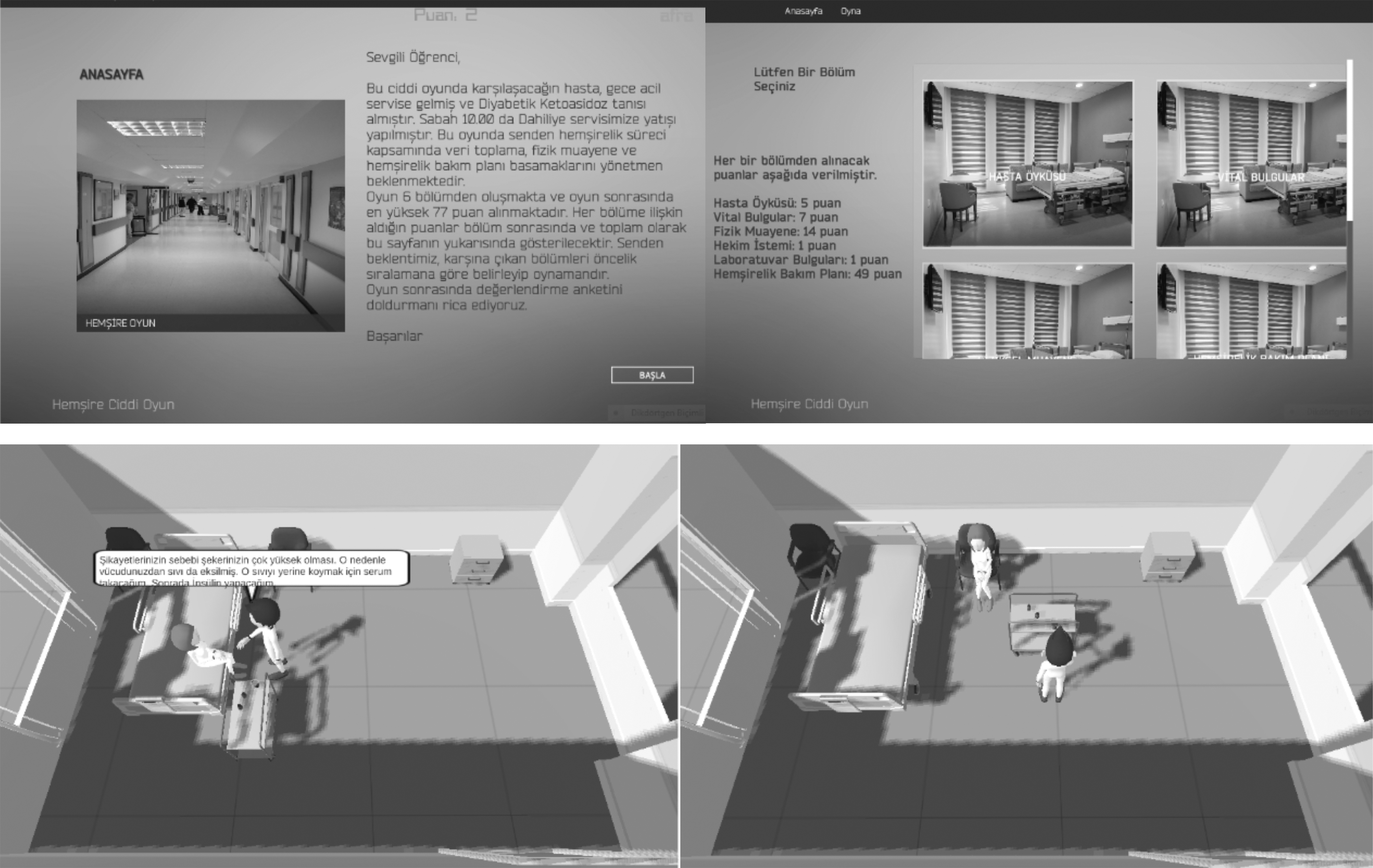
Four screenshots of the serious game developed. Top left: The player is given information about the game. Top right: The player selects an option. Bottom left: The player experiences casual interaction with patients. Bottom right: The player measures vital signs.
SG development
The SG used for the study was developed by the researcher and a software engineer, as the development of the SG required close collaboration with domain experts. The development team collaborated with lecturers from the Internal Diseases Nursing program. The game storyboard was designed by the researcher and the software engineer made its prototype. After the learning objectives were determined, first a storyboard was prepared. The storyboard was designed under titles such as screen time, sample screen, learning outcomes, and animation. The prepared storyboard was applied in the UNITY 3D program. The software engineer was paid $625 without funding for the prototype. The SG, the website was encrypted. The students were accessing through their e-mail addresses during the study. The SG is available by clicking on the next link: https://calikafra.itch.io/nursing-game
Data collection
The students made the first clinical practice after taking the endocrine course. After the application, online questionnaires were sent to the students who accepted to participate in the research. In the next 1 week, the EG played the game and CG did not intervene. Both groups returned to clinical practice. Questionnaire data were collected online after clinical application.
Data collection instruments
Two instruments were utilized to collect data in this study. First, the six questions, adapted from Johnsen et al., 11 assessed the beta testing usability evaluation for the SG prototype postgame assessment. The first questionnaire was included the questions:
What did you like most about the game?
What did you like least about the game?
Was the website easy to use?
Would you recommend any changes to improve this game?
Would you recommend it to others?
Do you have any other comments?
Second, the Nursing Anxiety and Self-Confidence with Clinical Decision-Making Scale (NASC-CDM) was used to assess participants' anxiety and SC related to clinical decision making. The permission was obtained from the instrument developer to utilize in this study. NASC-CDM is a 27-item questionnaire in which participants rate their level of agreement with each statement related to both anxiety and SC on a six-point Likert scale, ranging from 1 (not at all) to 6 (totally). The SC section of the form has three subscales: “using sources to acquire information and listening to them carefully (SC1),” “using the information in hand to determine the problem (SC2),” and “knowing and taking action (SC3).” The anxiety section has three subscales: “using sources to acquire information and listening to them carefully (A1),” “using the information in hand to determine the problem (A2),” and “knowing and taking action (A3).” 16
The sample consisted of 60 nursing students enrolled in an internal medicine nursing corresponding clinical rotation (EG = 30, CG = 30). The level of significance was set at 0.05 with a large effect size. Baseline differences in study groups were assessed with independent sample t-tests of the pretest state and SC, anxiety (A) and its subdimension mean scores for each group and indicated no significant difference.
Students enrolled in the endocrine course after the first day of internship applied the online SC and Anxiety Scale for Clinical Decision Making in Nursing (NASC-CDM). After applying the scale, the EG were allowed to play the SG before the first internship while CG is not applied to practice. All of the students filled the scale after their internship.
Ethics statement
Students' participation was voluntary. Students were orally informed about the nature of the study in which a new instructional method was investigated to the benefit of the students before its routine deployment. After the information, the students wanted to sign the consent form. The intervention of the study (game playing and filling in a questionnaire) was not part of any examination, so that a participation or nonparticipation would have no consequences on their grades.
The Ethics Committee at our institution (Noninterventional Clinical Researches Ethics Board-Hacettepe University-GO959-23) confirmed. In addition, the written approval was taken from the university's nursing department. When participating in the study, the students agreed to the anonymous analysis of their data.
Analysis
For the study, the SPSS software program was used for data analysis. Performance scores T that were taken before and after SG were entered into SPSS by the researcher. A t-test was performed to determine the mean performance scores for the two groups.
Usability evaluation was measured, and a questionnaire was designed by the researcher and administered to the students the day after their practice at the SG. The questionnaire had six open-ended questions.
Results
Of the 128 students in the classroom, 60 agreed to participate in the study. The age of the majority of the students was 20 years and most were female (n = 55; 91.66%) (Table 1). Data from all participants were included in the data analysis. The flow chart in Figure 2 shows the progress of participant screening, enrollment, and follow-up.

Flow diagram of the participants of this study.
Demographic Characteristics
Responses to usability scale statements are presented in Table 2. The small response rate (n = 10) limits the inferences from these data. During the usability test, 2 of the 10 participants commented that they would like to be able to view their wrong answers to evaluate their learning. The time to complete the scenario was an average time of 10 minutes.
Responses to Usability Scale Statements (n = 10)
As Table 3 shows, paired t-tests were used to compare anxiety and SC related to clinical decision making before and after the SG. There was a statistically significant increase in SC mean, SC2, and SC3 subdimensions of the scale after completing the SG in EG (P < 0.005).
Summary of Results Obtained for Scales (Experimental Group = 30, Control Group = 30)
P < 0.005.
SC, self-confidence.
The differences between EG posttest and CG posttest are highlighted in Table 4 (P < 0.005). The mean score for SC and subdimensions was higher in the EG.
Experimental Group and Control Group Posttest Comparison (Experimental Group = 30, Control Group = 30)
P < 0.005.
Discussion
Today's young adults are motivated by educational games like SG, which are common among them. Playing this type of game can constitute a support and supplement for traditional teaching methods for learning. 17 In addition, games improve cognitive and attention skills, strengthen judgment, require making time efficient, practice making decisions safely, and encourage the exploration of decision.4,6,18,19 The games perform these benefits by creating environments similar to the clinic. For instance, the goal of del Blanco et al. was to assess the potential of a self-developed game-like simulation to enhance the experience of visiting the surgical block for the first time. This case showed less fear, perceived to have committed fewer errors, and a more collaborative attitude. 20 Besides, different studies assessed cardiopulmonary resuscitation (CPR) instruction and results indicate that the SGs support the benefit of CPR.21,22
Final examples in the field of diabetes are: SGs for education of patients, a few technology-based initiatives for education of health professionals, education of health professionals on diabetes and insulin, and dietary behavior change.23,24 The present study appears to be the first study to compare the experiences of the anxiety and SC related to clinical decision-making efficacy of a SG in teaching ketoacidosis in diabetes mellitus.
Results from this study illustrate clear evidence that the exposure to the SG had a significant effect on SC, using the information in hand to determine the problem, and knowing and taking action. Increased activation in the SC in this study corroborates these earlier findings. 25 This study findings concur with Garris et al., who indicated individuals with greater confidence in their task capabilities were more resilient to the difficulties faced when applying in a real-world environment skills. 26 In contrast to earlier findings, however, a lack of evidence of confidence, no transfer of experienced emotions to the virtual environment was detected.27,28 There might be several possible explanations for this result such as insufficient experience, lack of knowledge, difficult patients, fear of making mistakes, difficult patients, discomfort at being evaluated by educators, issues related to death and dying, and concern about harming a patient.
The feedback to usability scale indicates that SG was available and was felt in the hospital environment. Students also state that they liked the nursing care plan and, recommended to other students. Besides, the students proposed the development of the game's visual effects and selection criteria, and increased diversity among the scenarios. Several reports have shown that students held highly favorable views about the use of SGs. 20 The similar finding was also reported by Müller and Price that participants' opinions of the gameplay were positive, with users finding the game fun and relaxing; avatars added realism and emotion to the educational process. 29
SGs can improve to minimize anxiety of students, enhance comprehension of previously studied subjects, and enhance the pace of learning.13,30–32 On the other hand, high anxiety levels of students in the clinic can involve with families and health care professionals coupled with how they perceived preceptors' attitudes, the feeling that professional incompetence prevents them from meeting patient expectations. 33 Contrary to expectations, this study did not find a significant difference between the levels of anxiety. A possible explanation for this might be that playing the SG for 5 days (between two clinical practices) was not effective on anxiety. Despite the lack of such a review in the literature, evidence suggests that repeated practice conducted in multiple short sessions distributed across time is more effective in improving performance than repetition conducted in one session. 34
Limitations
Because there was no funding for this study, the researchers obtained finance. The limited financial support caused to lack image quality. As it is a pilot trial, there are many features to be developed.
Conclusion
In conclusion, to prove the usefulness of SGs, this study may show that their specific characteristics (i.e., from the design stage, they are intended to serve a useful purpose) increase SC in students. This is important, because of its contribution to the clinic, being accessible by the learners in their own time and rhythm, at possibly smaller costs, and have a number of significant potential advantages. Although many authors seem convinced of the effectiveness of SGs,18,20,23,35 the experimental evidence in favor of this position is meagre. Large randomized controlled trials can provide more definitive evidence. However, evaluating the effectiveness of the educational content and assess the long-term effect of using SGs will provide a good option for the use of SG as an educational tool.
Footnotes
Author Disclosure Statement
No competing financial interests exist.
Funding Information
No funding was received for this article.