




Abstract
Objective:
With the elements of competition and reward, digital game-based learning is reportedly more effective than traditional instruction methods. Moreover, children with attention problems are reportedly often interested in internet games. We hypothesized that digital game-based learning can improve the effectiveness of educational opportunities in Russian immigrant children and could be more effective in children with attention-deficit/hyperactivity disorders (ADHD) compared with other children.
Materials and Methods:
This study was designed as an 8-week crossover study that comprised 4 weeks of game rounds and 4 weeks of control rounds for two groups. Wise-Ax™ is a casual digital game for vocabulary education among Russian immigrant children. To develop the game, 1200 Korean words were selected from the word pool suggested by the Korean Government's Department of Education. A total of 26 students participated in the study. At 4 and 8 weeks, all students took the Korean language ability tests.
Results:
The study found that more than 80% of the children were satisfied with their digital game-based Korean education, which greatly improved their Korean language ability compared with the traditional teaching methods. Children with ADHD showed a greater increase in the Korean ability test compared with children without ADHD in the game round.
Conclusion:
Wise-Ax could be an effective tool to help improve the Korean language ability of Russian immigrant children, especially those with ADHD.
Introduction
Language education using digital games
From its inception, there has been debate regarding the benefits of computer-assisted language instruction over traditional instruction methods.1,2 Several reports have suggested that a simple program design could not provide enough opportunities for student interaction in a linguistic environment. 3 However, consequent studies have suggested that computer-assisted language learning is effective in improving language education and that there is a diverse genre of computer-assisted language learning. 4 Digital game-based learning is one such genre.
In a meta-analysis of the digital game-based learning of English as a foreign language, digital games were effective for students' procedural knowledge. 5 Digital games have the potential to engage learners and encourage foreign language interactions. 6 With the gaming elements of competition and reward, 7 digital game-based learning is reportedly more effective than traditional instruction. 8
Over the past decade, digital game-based learning has given rise to mobile learning apps, which follow gamification concepts that incorporate elements of play and fun.9,10 Digital game-based learning may be conducted with two module-based learning objectives that incorporate fun and allow the students to control their learning. 11 In addition, the merit of digital game-based learning is its ability to improve educational opportunities by minimizing the differences in education levels between students and reducing instructor bias. 12
Language education for foreign students in Korea
The number of foreign students (elementary, middle, and high school) in Korea has increased by ∼10-fold over the past decade. 13 Among students from several countries, including China, Vietnam, and other central Asian countries, the number of Russian immigrants has rapidly increased in the Kyunggi province of Korea. 14 The Kyunggi Office of Education has revised its educational system in response to the increased number of multicultural students in Korea. In 2018, the Kyunggi Office of Education shared the following vision for multicultural students: “Students who grow together, a diverse and harmonious school.” 14 In 2020, it declared that the multicultural student education system would strive to create an educational foundation for students for more learning opportunities. 15
Before Russian children came to the country, Korean had seldom been taught as a foreign/second language. In Korea, the Korean language has long been taught in an examination-oriented and drill-driven manner. 16 As per the modern vision of the Kyunggi Education Office, which believes that more students should have additional educational opportunities, we believe that digital game-based learning would benefit the language education of Russian children in Anseong, Korea.
Attention problems, gameplay, and education
Several studies, including nationwide population surveys, report a high prevalence of attention problems in immigrant children.17,18 Attention problems are associated with difficulties in adaptation, interpersonal relationships, and learning disabilities. 18 Recently, a correlation between attention-deficit/hyperactivity disorder (ADHD) and internet gaming disorder in children and adolescents has been reported. 19 Pathologic internet gaming may disturb regular life patterns and promote learning disabilities and conflicts with family members in children with ADHD. 20 However, we believe that the tendency of ADHD children's addiction to internet games could be used to increase their interest in education. Children with ADHD have a tendency to “hyperfocus” on an activity in which they are interested. 21 Therefore, we observed the correlation between ADHD and digital game-based Korean learning in immigrant children in this study.
Research questions and hypothesis
We formulated several research questions considering the characteristics and merits of digital game-based learning. First, could digital game-based learning be more effective in language education for immigrant children compared with a traditional class? Second, what neuropsychological factors could enhance the effectiveness of digital game-based learning? Based on these research questions, we hypothesized that digital game-based learning could improve the effectiveness of educational opportunities in Russian immigrant children and be more effective in children with ADHD than in those without the condition.
Materials and Methods
Participants
There were two Korean language classes for Russian students in Anseong Elementary School, Anseong, South Korea. Each class comprised 13 students. There were no significant differences in age (z = −1.28, P = 0.20), sex ratio (χ2 = 0.17, P = 0.99), school grade (χ2 = 0.19, P = 0.91), first language (unanalyzable), and immigration months (z = −1.31, P = 0.18) between class 1 and class 2. There were no significant differences in attention (z = −1.75, P = 0.08), depression (z = −0.26, P = 0.98), and anxiety (z = −1.80, P = 0.86) between the two groups. There were no significant differences in the final game stage (z = −0.82, P = 0.41) and game level (z = −1.07, P = 0.29) between the two groups (Table 1).
Demographic, Psychological, and School-Learning Characteristics
CES-DC, Center for Epidemiological Studies Depression Scale for Children; K-ARS teacher version, Korean Attention Deficit Hyperactivity Disorder Rating Scale; PSWQ, Korean version of the Penn State Worry Questionnaire.
All students spoke Russian as their first language and had immigrated to Korea within the past 2 years. All students and their parents provided written informed consent in both Russian and Korean. The research protocol was approved by the relevant university's review board (IRB No. 2133-004-459).
Game for Korean vocabulary education: Wise-Ax
To develop the Korean vocabulary education game Wise-Ax™, 2 elementary school teachers selected 1200 words in the Korean word pool suggested by the government. 22 Of these 1200 words, 300 each were in the easy level for grades 1 and 2, normal level for grades 2 and 3, hard level for grades 3 and 4, and hardest level for grades 5 and 6.
Wise-Ax is a simple, casual, vocabulary education game. It consists of 1200 stages with 300 stages in 4 levels. The game application can be installed on an Android tablet PC, preferably with a 10.1-inch panel (Samsung Galaxy Tab 4®). The game involves a woodcutter who can cut wood at regular intervals with an ax. A bar moves repeatedly from left to right at the bottom of the screen. When the bar reaches the red or hitting zone, the gamer hits the button for the woodcutter to cut the wood. If the woodcutter cuts the wood promptly, the gamer obtains several candidate syllables. The gamer can then select one syllable and drag it to fill in the blank of an incomplete Korean word within 2 minutes. If the selected syllable completes the word, the gamer can listen to the correct pronunciation of the word and view the Russian explanation of its meaning.
The gamer can obtain game gold as a reward for completing the word and then can advance to the next stage. After completing all 300 words, or stages, at each level, users are promoted to the next difficulty level (Fig. 1).
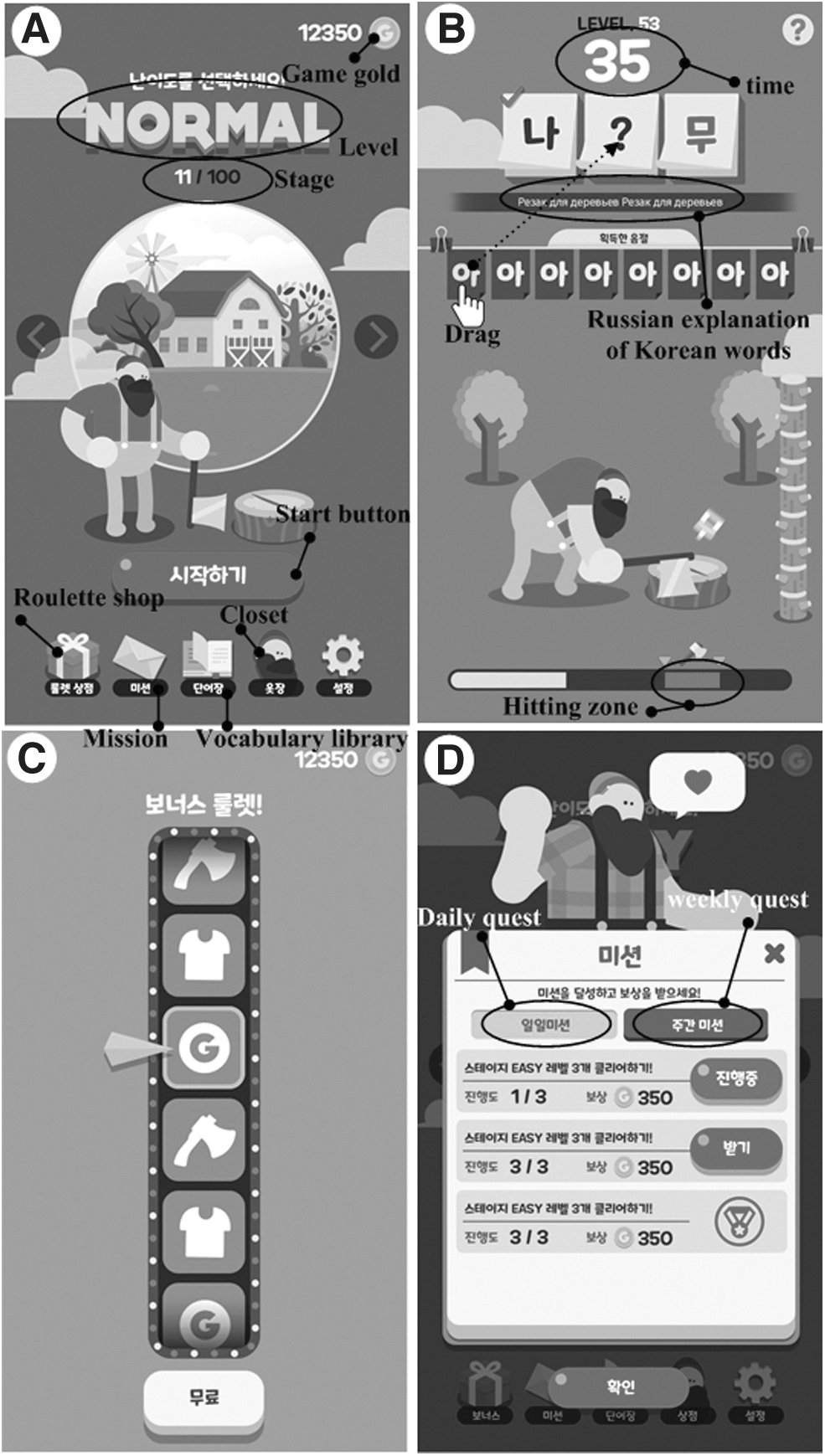
Game for Korean vocabulary education, Wise-Ax™.
The lobby menu of Wise-Ax consists of a roulette shop, missions, vocabulary library, and closet. At the roulette shop, gamers use game gold and push buttons to purchase items, including t-shirts, pants, or axes, for the woodcutters. These items are stocked in the closet menu. The mission menu presents the daily and weekly quests. The daily quest recommends a replay of the cleared stage for game gold, while the weekly quest recommends more than three-level upgrades for game gold. The words that the gamer comes across are displayed in the vocabulary library (Fig. 1).
Study procedure, Korean ability test, and scales for clinical status, language learning competencies, and game satisfaction
This study was designed as a crossover study consisting of a game round and a control round with two groups (Fig. 2). All students completed psychological scales and basic learning competency tests with the help of Korean and Russian teachers. Teachers rated their attention and tested their Korean language ability using the attention rating scale and the Korean word test, respectively. During the first 4 weeks, 13 students in class 1 attended a 30-minute general Korean class with a textbook and played Wise-Ax for 10 minutes (game round). Also, 13 students in class 2 had 40 minutes of general Korean class with a textbook (control round) 5 days a week. The language class was taken by a Korean teacher and a Russian teacher who could speak Korean.
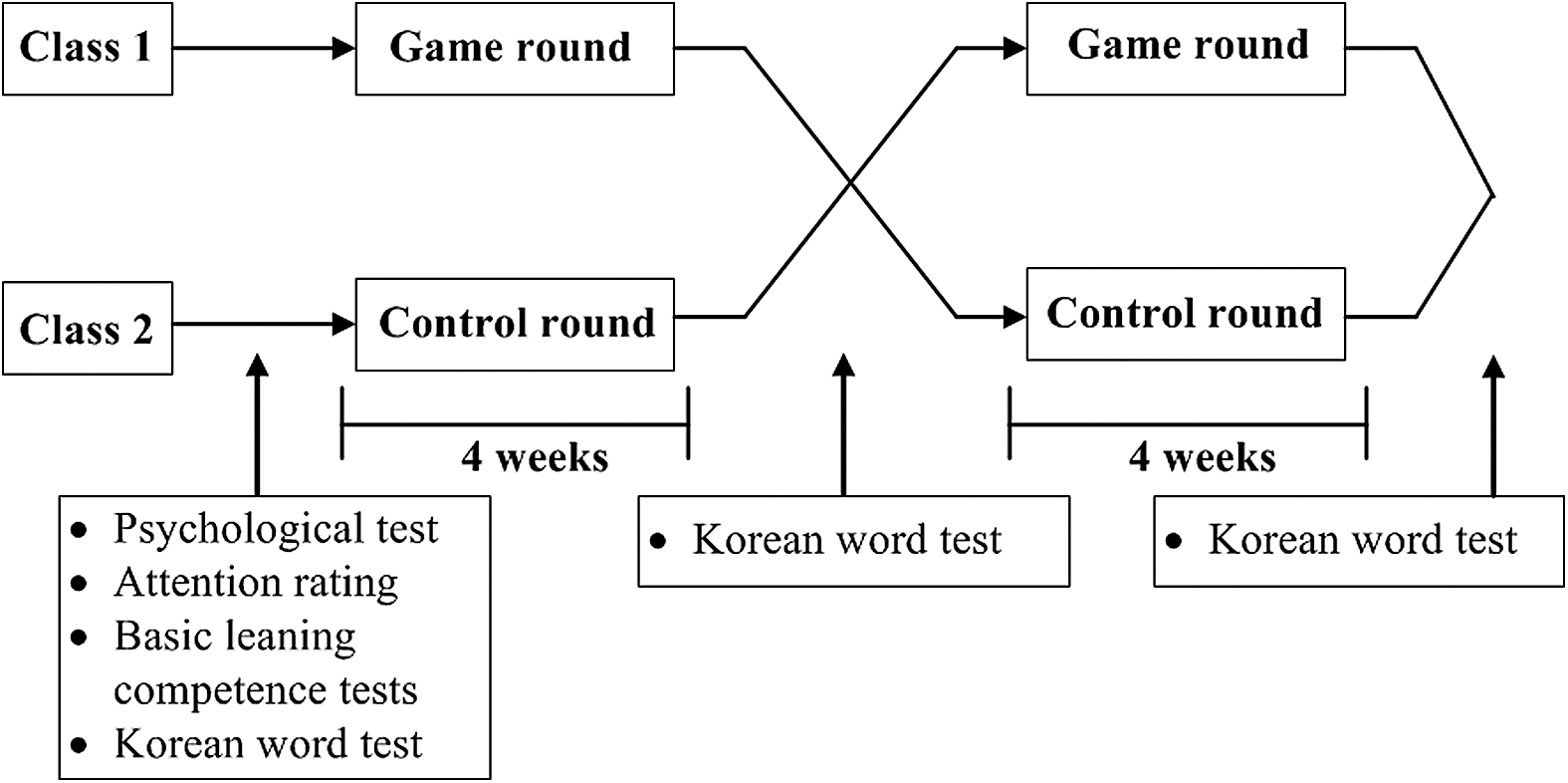
Study flowchart.
During the next 4 weeks, 13 students in class 1 had a control round, while 13 students in class 2 had a game round 5 days a week. At the end of 4 and 8 weeks, all students took a Korean word test consisting of 30 questions. The tests included 15 questions on Korean word recognition and 15 on Korean writing. All students in the first 4 weeks and the second 4 weeks learned the same level of Korean vocabulary words.
The psychological status of students was assessed using the Center for Epidemiological Studies Depression Scale for Children (CES-DC), the Korean version of the Penn State Worry Questionnaire (PSWQ), and the teacher-version of the Korean Attention Deficit Hyperactivity Disorder Rating Scale (K-ARS). The CES-DC is a 20-item self-report scale for rating depressive symptoms in children aged 6 to 17 years. 23 Each item was rated on a 4-point Likert scale, ranging from 0 (very rare) to 3 (very frequently). It had good internal consistency (Cronbach's α = 0.89). A score of 15 or above signifies clinical depression. 24
The PSWQ is a 14-item self-reported scale for rating worry in children. 25 It too had good internal consistency (Cronbach's α = 0.90). 25 Each item was rated on a 4-point Likert scale, ranging from 0 (not at all) to 3 (always). A Korean teacher assessed the attention level of all children using the K-ARS teacher version. A Korean psychiatrist (D.H.H.) educated a Korean teacher on assessing attention levels using the K-ARS teacher version. The intrarater reliability of the K-ARS teacher version in the Korean teacher was 0.89.
The K-ARS teacher version with good internal consistency (Cronbach's α = 0.77–0.87) was originally developed by DuPaul et al 26 and verified by Kim et al. 27 It consists of two subcategories as follows: rating inattention and hyperactivity. Each subcategory has nine items, rated using a 4-point Likert scale ranging from 0 (never true) to 3 (very true). The cutoff value for ADHD was 19 or above. 26
The Korean teacher assessed basic language learning competencies in all children using the Manual of Reading and Writing in the National Institute of Special Education-Basic Academic Competence Test (NISE-B·ACT). 28 The Korean National Institute of Special Education developed a basic academic competence test for children aged 5–14 years. Reading ability was assessed in three categories as follows: letter recognition, vocabulary, and phrase comprehension. The intrarater reliabilities of letter recognition, vocabulary, and phrase comprehension of NISE-B·ACT in the Korean teacher were 0.94, 0.95, and 0.94, respectively.
To assess the level of satisfaction with Wise-Ax, all children were asked six questions: Q1: What percentage of game content do you use while playing games? Q2: Is the game easy to play? Q3: Is the game fun? Q4: Is the game helpful for studying Korean? Q5: Do you want to play games like Wise-Ax for other classes? Q6: Would you recommend Wise-Ax to other students who want to study Korean? All children were asked to answer on a 10-point Likert scale ranging from 1 (very bad) to 10 (very good).
Statistics
The differences in demographic characteristics, psychological status, basic learning competencies, and final game level and stage between the two groups were analyzed using the Mann–Whitney U test and the chi-square (χ2) test. The changes in Korean language ability were analyzed using repeated-measures ANOVA. The Wilcoxon signed-rank test was used in the post hoc analysis of the changes in Korean language ability in the groups from phase 1 to 2 and from phase 2 to phase 3. The differences in the changes in Korean language ability between the game and control rounds were analyzed using repeated-measures ANOVA.
Predictive factors for the improvement of Korean language ability were calculated using linear regression analysis with the independent variables of sex, age, K-ARS-teacher scores, CES-DC scores, PSWQ scores, letter recognition grade, writing grade, and game stages, and the dependent variable of improvement of Korean language ability.
The differences in the changes in Korean language ability between children with and without ADHD were calculated using repeated-measures ANOVA, controlling for letter recognition ability and game stages. All statistical analyses were performed using the IBM SPSS software version 24 (IBM SPSS®, Korea). Statistical significance for all analyses was set at P < 0.05.
Results
Clinical status and the Korean learning ability of children
In all students, the mean scores of K-ARS, CES-DC, and PSWQ were 9.7 ± 9.8, 25.1 ± 10.4, and 13.7 ± 6.5, respectively. Eight children had ADHD, with evidence of K-ARS scores above 19. There were 17 children who had grade 1 letter recognition ability, and 9 who had under grade 1 letter recognition ability. All children had an under grade 1 vocabulary and phrase understanding ability. Also, 16 children had grade 1 writing ability and 10 had an under grade 1 writing ability. Six children had grade 1 mathematics ability, and 20 had under grade 1 mathematics ability. There were no significant differences in demographic, psychological, and school-learning characteristics between groups 1 and 2 (Table 1).
Gameplay and game satisfaction
During the game round, 26 children played the game until stage 488.8 ± 91.3 (minimum 375, maximum 715) in level 2.2 ± 0.4 (minimum 2, maximum 3). There were no significant differences in the stage and game levels between groups 1 and 2 (Table 1).
The children said they used ∼83% of the game content. The mean scores and standard deviation of Q2 (how easy the game is), Q3 (how much fun the game is), Q4 (how helpful it is to learn Korean), Q5 (whether they want similar games for other classes), and Q6 (how likely they are to recommend it to others) were 8.1 ± 0.9, 8.5 ± 0.8, 8.7 ± 1.0, 8.2 ± 0.8, and 8.4 ± 0.7, respectively.
Comparison of changes in Korean language ability in the game and control rounds
In group 1, the Korean test scores during the game round significantly increased (z = 2.41, P = 0.01), whereas the scores of the control round did not (z = 0.29, P = 0.77) (Fig. 3). In group 2, the Korean test scores during the control round did not significantly increase (z = 1.66, P = 0.09); however, the scores of the game round increased significantly (z = 2.02, P = 0.04). In all rounds, the scores of the game round significantly increased compared with the control round (F = 11.45, P < 0.01) (Fig. 3).
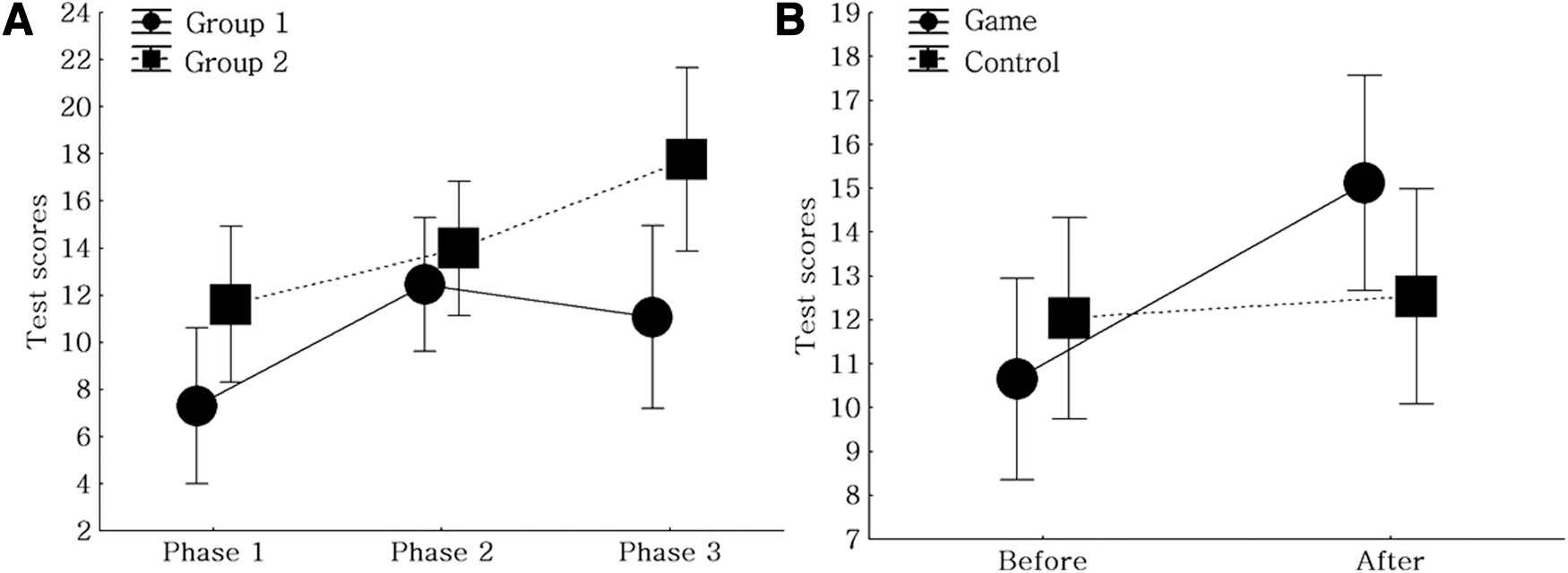
Comparison of the changes in Korean language abilities between the game and control rounds.
Predictive factors for improving Korean ability
In all rounds, grade 1 letter recognition ability (B = 2.57, β = 0.260, t = 1.86, P < 0.05) and game stage (B = 0.04, β = 0.78, t = 5.23, P < 0.01) could predict Korean language ability improvements. In the game round, the ADHD scale score (B = −0.24, β = −0.53, t = −2.20, P = 0.04), grade 1 letter recognition ability (B = 2.91, β = 0.33, t = 2.97, P = 0.01), and game stage (B = 0.05, β = 1.29, t = 5.30, P < 0.01) could predict improvements in Korean language ability. In the control round, no factor could predict the improvement in Korean language ability (Table 2).
Linear Regression Analysis
Dependent variable: changes in Korean ability test scores.
G-stage, game state; LR-1, letter recognition-grade 1.
Comparison of the changes in test scores between children with and without ADHD and between children with and without grade 1 letter recognition
During the game round, children with ADHD showed a greater increase in Korean language ability compared with children without ADHD (F = 13.33, P < 0.01) (Fig. 4). However, there was no significant difference in the change in Korean language ability between children with and without grade 1 Korean letter recognition (F = 1.62, P = 0.22).
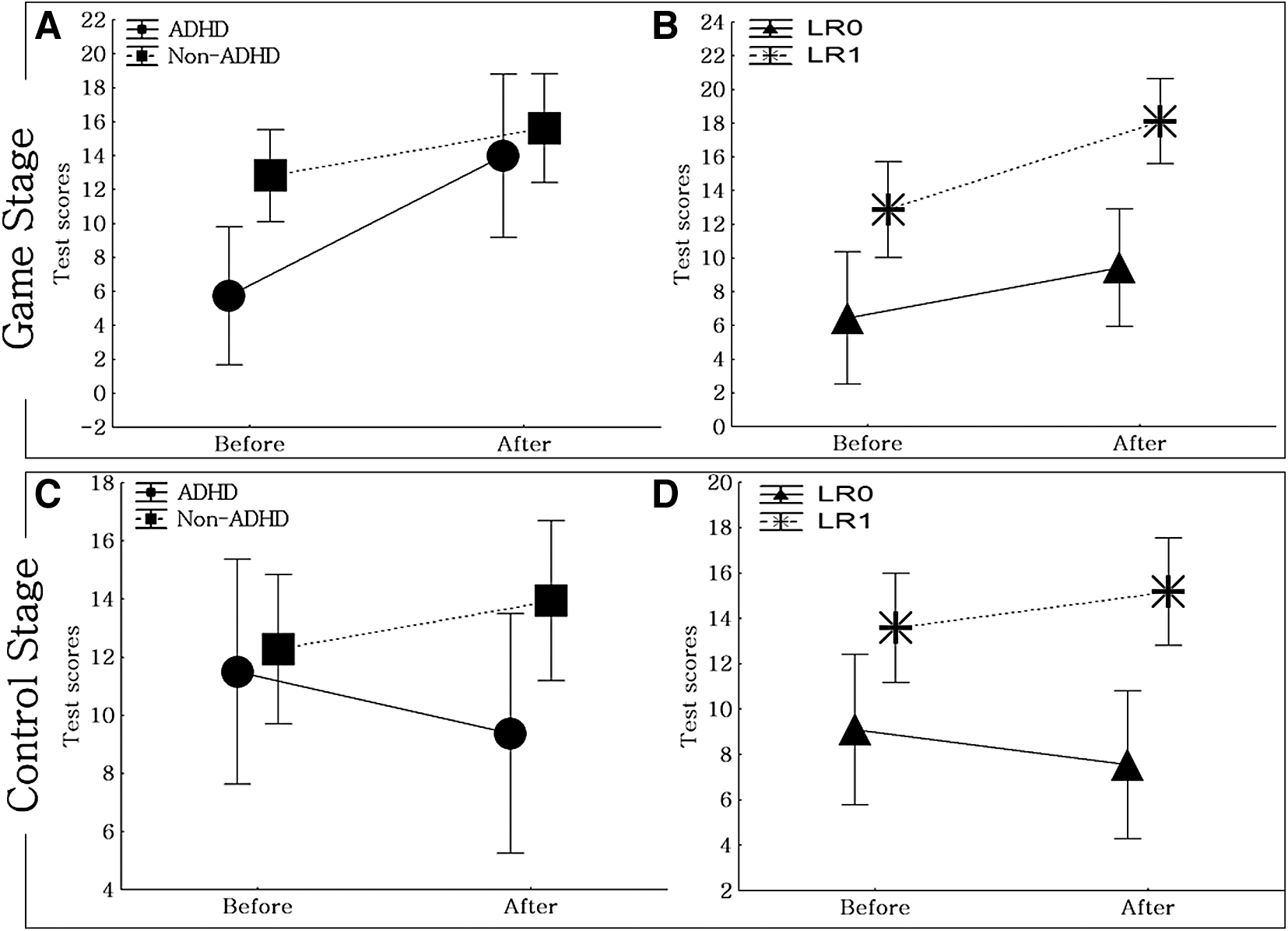
Comparisons of the changes in test scores between children with ADHD and without ADHD and between children with and without grade 1 letter recognition.
During the control round, children with ADHD showed a decrease in Korean language ability, whereas children without ADHD showed an increase (F = 5.51, P = 0.03) (Fig. 4). During the control round, children with grade 1 Korean letter recognition showed a greater increase in Korean language ability than children without. However, the difference was not statistically significant (F = 3.79, P = 0.06).
Discussion
In this study, Russian immigrant children said they used more than 80% of the game content. More than 80% of the children were satisfied with digital game-based Korean education through Wise-Ax. The game greatly improved their Korean language ability compared with the traditional Korean language classes. In the game round, ADHD scale scores could predict greater improvements in Korean language ability. Children with ADHD showed a greater score increase in the Korean language ability test compared with children without ADHD in the game round.
Comparisons of the changes in Korean abilities between the game and control rounds
The scores of the Korean tests during the game round greatly increased compared with the control round. This indicates that digital game-based Korean education, such as Wise-Ax, would be effective for Russian immigrant students. These results suggest that digital game-based language learning may enhance children's education.5–8
In digital game-based learning in the context of a second language, tools such as digital games can help students obtain procedural knowledge. 5 With the elements of competition and reward, digital games have the potential to engage learners and encourage foreign language interactions.6,8,29,30 McGregor et al 30 reported that participants who played a serious game of word mastery could master more words per minute compared with individuals who did not play it. Similarly, Mayer 29 declared that, compared with other media, serious games were more effective in helping children learn science, mathematics, and a second language.
Interestingly, the age and education level of children could not predict improvements in Korean language ability. This result can be associated with minimized variance in participant characteristics, such as learners' education levels and instructor bias, in digital game-based language learning. 5 Studies have suggested that digital game-based language learning increases the effect of education while minimizing the differences in education levels between students and reducing instructor bias.12,31 Teaching task participation has become a significant topic in the field of second-language education in terms of fostering process-focused syllabi and devising communicative tasks to enhance learners' real language use. 32 The digital education game Wise-Ax may be effective in second-language Korean education for Russian students with the merits of task participation.
Comparison of the changes in test scores between children with and without ADHD
In the game round, ADHD scale scores could predict greater improvements in Korean language ability. Children with ADHD showed a greater increase in scores in the Korean ability test compared with children without ADHD in the game round. Digital game-based learning incorporates educational content or learning principles into digital games to engage learners. 33 Unexpected and repeated encounters with new challenges and curiosity could provide additional motivation to interact with educational material through gaming. 34 Children with ADHD have increased novelty-seeking traits, 35 which is associated with new challenges and curiosity. 36 Children with ADHD could hyperfocus on new challenges and stimulation. 37
Altogether, digital game-based learning may satisfy the novelty-seeking and curiosity of children with ADHD. This similarity could improve language education in this population compared with traditional language education.
Suggestions for effective pedagogy from current findings
In the current study, Russian immigrant children showed a high level of satisfaction with digital game-based Korean education as well as greater improvement in Korean language ability compared with the traditional Korean language classes. We suggest that game-based learning could lead to an interest and effective language learning in foreign children. Darlington and Bell suggested that effective pedagogy would be associated with students' curiosity and interests. 38 This interest consisted of learning from others, control, personal endeavors, puzzles, modeling, and exploring science. 39 Second, during the game round, children with ADHD showed greater improvement in Korean language ability compared with children without ADHD. As mentioned in previous studies,7,9–11 digital game-based learning could provide effective educational practice and tools for children with ADHD.
Limitations
There are several limitations to the current study. First, the results cannot be generalized due to the small number of participants. In addition, the participants were all of Russian nationality. Second, because the test for Korean ability was limited to word recognition and Korean writing, the Korean ability of children could not be assessed in detail. Finally, because the research team wrote the questions regarding satisfaction of game-based learning, the results could not be gathered openly and impartially. Future studies should consider various countries and impartial assessment tools for a larger number of children.
Conclusion
The digital game for Korean language education for Russian immigrants, Wise-Ax, could improve the Korean language abilities of Russian immigrant children. Moreover, the effectiveness was more prominent in Russian immigrant children with ADHD than in those without ADHD.
Footnotes
Acknowledgments
We would like to extend special thanks to the Korean Game Culture Foundation, Seungmin Leah Han, Yugay Kseniya, and Yugay Tatyana. Seungmin Leah Han suggested a digital game-based Korean learning program for foreign students. Yugay Kseniya and Yugay Tatyana helped the Russian students learn Korean through Russian interpretation.
Authors' Contributions
Principal investigators: D.H.H. and S.M.K.; responsible for the game design: D.H.H., S.M.K., and J.S.K.; development of the study design: D.H.H., H.J.K., J.S.K., and S.Y.K.; and data collection: S.Y.K., J.S.K., and H.J.K.
Author Disclosure Statement
No competing financial interests exist.
Funding Information
This study was supported by Nexon Co., Ltd. (NEXON-CAU2021001) and Yungjin Pharm. Co., Ltd. (Yungjin-CAU2021003).