




Abstract
Background:
The use of modern board games has been growing past years in education, research, and mental health attendance. Often one professional selects games by his/her criteria depending on his/her objective with them. We evaluated the cognitive processes inherent to each modern board game to obtain a consensus of the cognitive profile of each. We explain how to choose the most suitable board games in future interventions.
Materials and Methods:
Fifteen education, mental health, and neuroscience research professionals with board games experience participated in an online assessment of 27 modern board games. Experts received a virtual neuroeducation formation and played the games selection for further analysis. Participants answered a Likert scale about 12 cognitive processes activated with each game.
Results:
All modern board games obtained a high level of agreement (intraclass correlation [ICC] > 0.75). Besides, most cognitive processes reached a high agreement, except for cognitive flexibility and problem-solving (moderate range: 0.5 > ICC > 0.75). Differentiated cognitive profiles have been obtained for each game, some of which could work on more than one cognitive domain at a time. Finally, initial evidence about which board game mechanisms activate with cognitive domain was found.
Conclusion:
To conclude, this expert consensus methodology became a useful tool for assessing the cognitive profile behind modern board and card games. The results obtained may facilitate the choice of games to be used in future studies depending on the objective cognitive domain to be trained under a criterion based on the observations of a group of experts and not just the researcher's individual criteria.
Introduction
Board and card games are characterized by presenting a fixed set of rules that limit the number of pieces on a board, the number of positions for such pieces, and the number of possible moves. 1 Modern board games (created after 1950 by recognized authors) are more aesthetic and were designed with more innovative and varied mechanisms than traditional board games.2–4 Besides, some light modern board games (also known as “fillers” by gamers) rely on one specific cognitive process resembling assessment tools commonly used in neuropsychological assessment. 5 In addition, it is supposed that board games benefit certain psychological processes 6 by enhancing brain activity. 7
Recent studies have showed that cognitive interventions based on modern board games are effective in maintaining cognitive health in older people.8–12 In general population but also in clinical cases, some other studies have shown that executive functioning may be improved using these games in children.5,13,14 Specifically, Vita-Barrull et al. 5 found that it is possible to transfer the effects of cognitive training to how executive functions are applied to the real world, decreasing executive dysfunctions and increasing the cognitive health of children. In addition, some studies have shown that modern board games may also be useful in decreasing psychopathological symptoms14,15 and improving social functioning in psychiatric patients.15,16
However, past interventions had an important limitation. All the studies mentioned above have used modern board games without being sure that the games selected properly activated the cognitive and emotional processes intended to work. How the authors selected those games but not others remains usually unknown. In professional settings, the selection of games in mental health interventions is based on the researchers' individual criteria according to their knowledge of the processes that are supposed to be inherent in these games. It is often performed by one unique professional, with his/her own bias.
For all the above, it is considered that a multidisciplinary expert consensus with experience in the professional use of modern board games for educational and mental health purposes can lead to a systematic and consensual analysis of the games to guide future cognitive interventions. In the present study, we also performed an exploratory analysis about the associations between board game mechanisms and the cognitive profile of the games to show one possible application of the methodology of expert consensus.
Materials and Methods
Overview
The present research used a methodology based on experts' opinions. However, this methodology depends entirely on the professional experience and formation of each member. 17 In the present study, professional experience was controlled by inviting reputed people in the field of board games, education, and mental health in Spain. Regarding the formation on the cognitive processes, we designed a methodology to minimize the subjective bias. Methodology included in the Conectar Jugando project approved by the Ethics Committee of the Arnau de Vilanova Hospital in Lleida (CEIC-2371).
Participants
Fourteen experts with experience in using modern board games as a tool of intervention participated in this expert consensus. Experts were recruited between December 2019 and January 2020 from community associations, public schools, private mental health clinics, and a neuropsychology research group in Spain. The average age of all experts was 41 years (standard deviation [SD] = 9.71, 64.29% women), with an average working experience of 14 years (SD = 10.03) in education, mental health, and/or research, and an average working experience in playful methodologies of 7 years (SD = 8.38). Three co-authors of this article (N.V.-B., N.G., and J.M.-H.) participated as coordinators of the expert consensus without participating in the systematic evaluation of the games. The only compensation the experts received was the games analyzed themselves.
Procedure
Step 1: Selection of modern board and card games and the experts for the consensus
Coordinators of the expert consensus selected 27 modern board and card games (according to the definition by Sousa and Bernardo 2 ) commercialized by a Spanish board game editorial. The selection was performed by convenience sampling, based on past studies about cognitive interventions with modern board games, 5 but broaden the number of games to use them for future research. Two co-authors of this article (N.V.-B. and J.M.-H.) selected three games per cognitive process according to their experience with those games.
So, the selected games were (see Supplementary Table S1 for descriptions and theoretical allocation in the main cognitive domain) as follows: Alles Tomate!, 18 Barnyard Buddies, 19 Bee Alert, 20 Blurble, 21 Brain Connect, 22 Catch the Match, 23 Chakra, 24 CLACK!, 25 Connect the Thoughts, 26 Dice Academy, 27 Halli Galli, 28 Kaleidos Junior, 29 Layers, 30 Le Roi Sommeil, 31 Look Around, 32 Magic Mandala, 33 Magic Fold, 34 Monster Match, 35 Ohanami, 36 Pickomino, 37 Piraten Kapern, 38 Saboteur, 39 Sherlock Express, 40 Shrimp, 41 Speed Cups, 42 Streams, 43 and Super Taki. 44 The members of the committee were invited to participate as a convenience sample too.
Step 2: Expert's formation and play the game’ selection
The experts were trained in executive functions and associated cognitive processes so that they all started from the same concepts before the game's assessment. Their training was evaluated through tests and video activities developed by the project coordination team (Supplementary Material). Once the training phase was completed, the experts received the 27 selected games. They had to play at least three times each game for its correct evaluation.
Step 3: Modern board games assessment by experts
The experts evaluated the degree to which the games activated 12 cognitive processes using an online questionnaire created ad hoc. According to the scientific literature,45–48 the cognitive domains were as follows: verbal working memory, visuospatial working memory, verbal short-term memory, visuospatial short-term memory, inhibition, cognitive flexibility, planning, reasoning, problem-solving, affective decision-making, processing speed, and verbal fluency (see definitions in Table 1 and in which mental health problems they are affected).
Definitions of the Executive Functions Assessed and Deficiencies Found in Different Mental Health Problems
ADHD, attention-deficit and hyperactivity disorder; EF, executive functions; MCI, mild cognitive impairment; PTSD, post-traumatic stress disorder.
Each cognitive process was assessed using a 4-point Likert scale (0 = None, 1 = Low, 2 = Moderate, 3 = High), and each score had to be accompanied by a justification from the expert.
Step 4: Agreement analysis and elaboration of the cognitive profile of the games
Finally, we analyzed the degree of agreement between the experts in their evaluations of the games and cognitive processes. We obtained the cognitive profiles of each modern board and card game.
Statistical analysis
First, to take into account the subjective bias of each expert, we also analyzed rater agreement on cognitive functions and modern board and card games using the intraclass correlation (ICC). An expert consensus about the cognitive processes presents in different play actions of a virtual game 49 used two criteria to assess experts' agreement. We used the most restrictive criterion that considers ICCs lower than 0.5 as low reliability, ICCs between 0.5 and 0.75 as moderate, ICCs between 0.75 and 0.9 as good, and ICCs higher than 0.9 as excellent reliability. 50 Second, we analyzed the median scores of all the experts for each game in each cognitive process.
This procedure helped us to find which game should be better to train each cognitive process. We also wanted to know whether the initial selection of games (with the criteria/intuition of two authors of the present study) agreed on the decision by the experts committee. So, we calculated the percentage of agreement between the theoretical main process active for selecting each game (Supplementary Material) and the two most important cognitive processes because of the expert consensus. Finally, we performed the Mann–Whitney U test to analyze whether specific board game mechanisms differed or not in concrete cognitive domains. We calculated the Cohen's d effect size. 51
Results
Experts' agreement in modern board and card games
We obtained ICCs indicative of excellent reliability in all modern board and card games (from Look Around and Streams ICC = 0.91 to Bee Alert ICC = 0.97). We found two exceptions: Kaleidos Junior (ICC = 0.89) and Pickomino (ICC = 0.89). The ICCs were interpreted as good reliability (see all the results in Table 2).
Average Measure Intraclass Correlation Coefficients of Each Modern Board or Card Game and for Each Cognitive Domain
Experts' agreement in cognitive domains
ICCs for each cognitive domain can be seen in Table 3. ICCs showed moderate reliability in cognitive flexibility (ICC = 0.51) and problem-solving (ICC = 0.74). We obtained ICCs indicative of good reliability in all types of memory processes (from verbal short-term memory ICC = 0.76 to visuospatial short-term memory ICC = 0.88) and reasoning (ICC = 0.84). Excellent reliability was obtained in the remaining cognitive domains (from inhibition ICC = 0.91 to verbal fluency ICC = 0.99).
Medians and Interquartile Ranges of the Cognitive Domains Assessed in Modern Board and Card Games' Selection
Matching: match between the criteria for preselecting the games with the final median from the committee.
IR, interquartile range; M, median; N, no; STM: short-term memory; WM, working memory; Y, yes.
Cognitive profiles of the selected games
Table 3 shows medians (M) and interquartile ranges (IRs) that selection of games obtained in each cognitive domain analyzed. To maximize higher activation and lower discrepancies between experts, we decided that the best games for each cognitive domain were those with the highest median and the lowest IR.
According to this criterion, the best games for each cognitive domain analyzed were as follows: Alles Tomate! (M = 2.5, IR = 3) for verbal working memory; Kaleidos Junior (M = 1.5, IR = 3) for verbal short-term memory; Bee Alert and Le Roi Sommeil (both M = 3, IR = 1) for visuospatial working and short-term memory; Halli Galli and Shrimp (both M = 3, IR = 1) for inhibition; Magic Fold, Shrimp, and Super Taki (all of them M = 3, IR = 1) for cognitive flexibility; Brain Connect, Chakra, and Saboteur (all of them M = 3, IR = 0) for planning; Brain Connect (M = 2.5, IR = 1) for reasoning; Magic Fold and Saboteur (both M = 2, IR = 1) for problem-solving; Saboteur and Pickomino (both M = 3, IR = 1) for affective decision-making; Connect the Thoughts, CLACK!, Halli Galli, Kaleidos Junior, Monster Match, Catch the Match, Barnyard Buddies, Sherlock Express, Shrimp, and Speed Cups (all of them M = 3, IR = 0) for processing speed; and Blurble, Dice Academy, and Look Around (all of them M = 3, IR = 0) for verbal fluency. Some modern board and card games obtained high scores in all types of executive functions (Fig. 1).
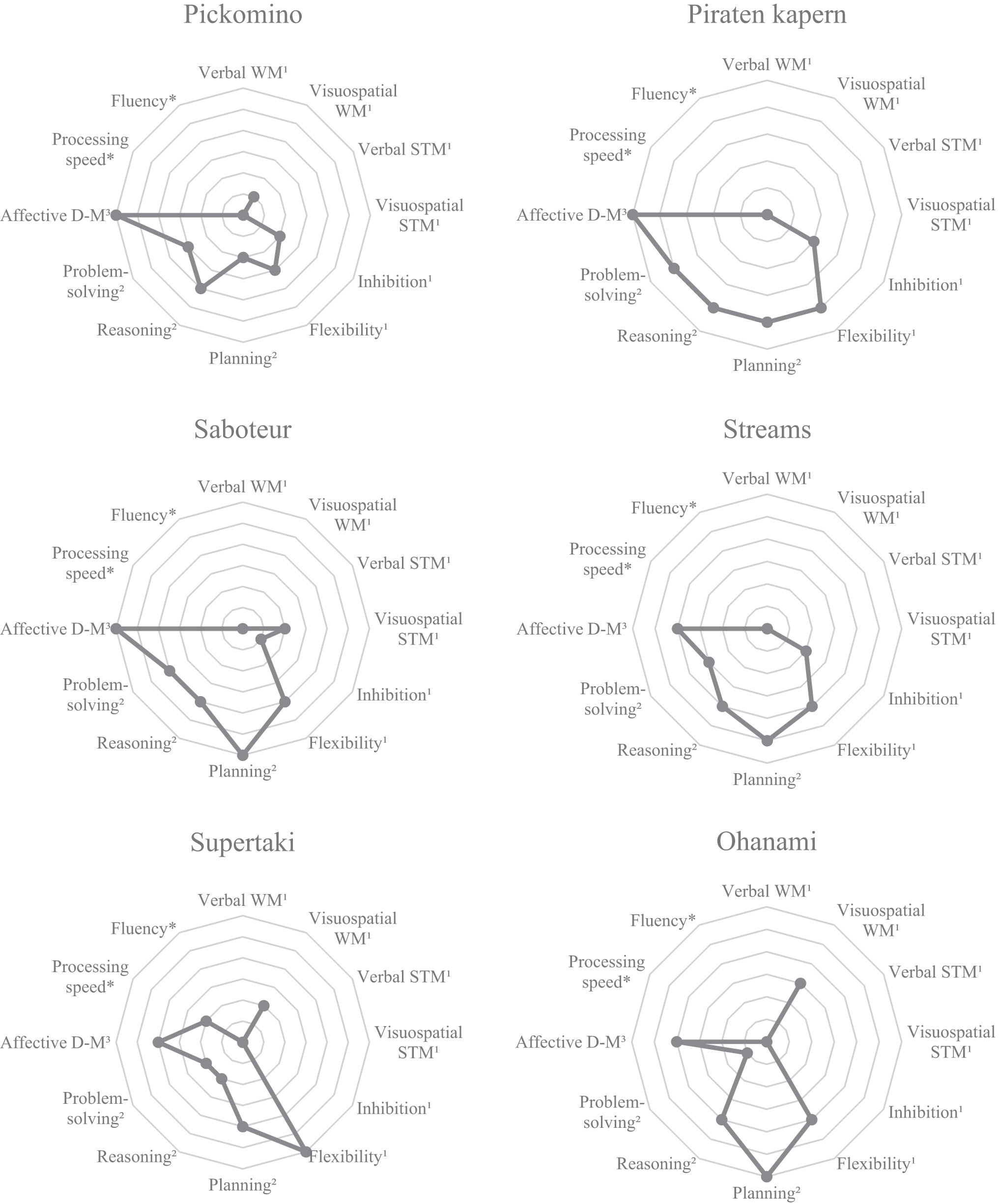
Radial plots of the cognitive profiles from some multidomain board and card games. 1 = Basic Cool Executive Functions; 2 = Complex Cool Executive Functions; 3 = Hot Executive Functions; *Other related cognitive domains. Affective D-M, affective decision-making; STM, short-term memory; WM, working memory.
Percentage of agreement between expert consensus and initial selection of the games per cognitive domain
When the games were analyzed for selecting them before the experts committee, we suspected that most of the games required processing speed because of their mechanisms. We suspected that several games activated processing speed but also another cognitive domain to win the game. So, only three games were previously selected as activating processing speed because it was suspected that processing speed was the only cognitive domain implied when playing (Supplementary Material). Thus, we analyzed the data considering an agreement between preselection analysis and experts' consensus when the initial cognitive domain coincided with the first or the second cognitive domain according to expert consensus. The percentage of agreement was 74.1% (N = 20 games). The discrepancies are shown in Table 3.
Board game mechanisms and differences in cognitive domains
As Sousa et al. 52 suggested, the study of game elements, such as game mechanisms, and their relation to the goals we must use in a game, is a key objective to better understand how games can be applied for specific purposes. Game mechanisms could be defined as those characteristics of the game that imply players interacting according to the games rules to generate game (and cognitive) dynamics.52,53 The games analyzed by the experts committee accounted a total of 23 different game mechanisms. To test whether the game mechanisms differed in the cognitive domains activated according to expert consensus, we focused only on mechanisms that were present in, at least, three games. The results are shown in Table 4. To sum up, all the mechanisms except for pattern building were associated with at least one cognitive domain. All the results must be interpreted in the same way. Games with that mechanism activated more a concrete cognitive domain, according to expert consensus.
Differences in Cognitive Domains Between Games with Specific Mechanisms
N = number of games with that mechanism. U = U of Mann–Whitney test. d = Cohen's D statistic. 0 < d < 0.20 = null effect; 0.20 < d < 0.50 = small effect; 0.50 < d < 0.80 = intermediate effect; d > 0.80 = large effect. Significance level: *= p < .05; **= p < .01; ***= p < .001. Total number of games = 27. According to the Board Game Geek 65 and Engelstein and Shalev, 53 the mechanisms are defined as Memory (“Hidden, trackable information whose tracking gives players an advantage”), pattern building (“Players must configure game components in sophisticated patterns in order to score or trigger actions”), set collection (“The value of items is dependent on being part of a set”), pattern recognition (“Players must recognize a known or emergent pattern created by the game components to gain objectives or win the game). This could for instance involve markers, typically with a color or symbol, placed to certain locations on a board, or relative to the other markers, forming an abstract or meaningful pattern, requiring deductive reasoning by players to determine its significance,” real time (“There are no turns. Players play as quickly as possible, subject to certain constraints, until the game or phase is completed”), lose a turn (“A player who ‘Loses a Turn’ must skip their next opportunity for a turn, and will go to the next round, or the next time their turn arises”).
Discussion
Modern board and card games are increasingly accompanied by educational labels, even therapeutic in some cases (to improve mental health outcomes), on their cognitive, emotional, and social benefits. However, few studies have been performed to confirm these statements.12,13,54–56 Usually, the first issue when researching or applying board games is how to select them. How we decide that a particular game activates a specific cognitive/emotional process? Professionals usually trust in their own knowledge, deciding only with one opinion, their own. We propose an initial solution in the present study. Multiple people deciding minimizes subjective bias and increases the likelihood of making better decisions. When making choices about mental health questions (and in other fields, such as in education), clinical/individual decisions are usually worse than actuarial/scientific judgments.57,58 So, for approximating to an actuarial perspective, we designed a methodology of expert consensus.
The first step was assessing the consistency of the experts rating each concept (cognitive process in our case) and game. 59 Following the standard procedure,59,60 we found that most of the processes achieved a good level of reliability. In fact, Hallgren 60 proposed that, for maximizing inter-rater reliability: (i) all the sample (of games in our case) should be rated by all the experts; (ii) the system of ratings should be Likert-type scale; (iii) the assessment should not have any restriction of range (what we achieved by selected very different games that were suspected to activate very different cognitive processes); (iv) a considerable amount of training should be done to the experts to homogenize their criteria. We overcomed these issues in the present study, so we can be confident that the cognitive processes were analyzed in a homogeneous way, minimizing the subjective and initial background bias of the experts.
Visser and Swank 61 pointed that a committee of experts with only open discussions will facilitate how members of the group often feel a pressure to conform. This issue was not present in the present study because experts rated the games independently and without sharing information among them. In addition, we propose a statistical procedure to finally select the games according to the cognitive profile by checking the median as central tendency statistic and the IR for measuring the variability. 62 An IR of 0 means that there is no variability in the middle of the data. 62 Thus, deciding which game we choose to intervene in a cognitive process should require the higher median (3 in our Likert scale) and the lower IR possible (0).
As shown in Table 4 and summed up in the Results section, several games could be chosen maximizing these criteria. For better understanding how an expert consensus methodology could be useful, we analyzed the percentage of agreement between the hypothetical cognitive domain of each game before the analysis and the results of the expert consensus. The moderate coincidence between both highlights the limitation of single decisions favoring the expert committee methodology. The present results are in line with past studies that showed that the expert method is valuable in selecting playful methodologies to be used in prevention and intervention procedures.17,63,64
As an exploratory procedure, we analyzed whether specific game mechanisms differed in the amount of activation of each cognitive domain according to the analysis by the experts committee. Some results could be considered as obvious. Games with the real-time mechanism (with all the players playing at the same time53,65) activated more the processing speed cognitive domain than games without it. However, other results are more surprising. According to the Board Game Geek, 65 the pattern recognition mechanism should activate the reasoning cognitive domain, but our results showed no significant difference in reasoning.
On the contrary, games with pattern recognition activated more basic executive functions, such as cognitive flexibility and inhibition. This result could be in line with Diamond 45 proposal of separating executive functions in basic and complex. Following the suggestion by Sousa et al. 52 , an expert consensus methodology could help us knowing better how game mechanisms are linked to psychological outcomes, such as cognitive domains. As far as we know, this is the first time that any study analyzes the associations between game mechanisms and cognitive domains. We encourage scientific studies in this line.
Limitations
The present research is not an experimental design, so it makes a low contribution to the level of evidence66,67 in the association between game mechanisms and cognitive processes. The present research gave us the first evidence about the relation between game mechanisms (and playing the game itself) with cognitive processes. But it is necessary to support these results with quantitative data from correlational and experimental studies that allow us to know the relationship between these games' execution and the player's performance in neuropsychological tasks that evaluate these cognitive processes. These types of studies have been used in serious videogames with good results. 68 However, the expert consensus is the much faster methodology to begin deciding how to select games without relying in the opinion of one only person, and it is the easiest methodology for professional settings.
The board games were selected according to past studies, but also broadening their number and variety to apply them to future interventions. However, the selection was intentional, nonrandom, and with no other criteria than the subjective opinion of two authors of the present study. A better procedure should be the one proposed by Sousa et al. 52 However, the present study was developed before Sousa et al.'s proposal. Future studies should take into consideration their flowchart, 52 focusing on Board Game Geek 65 stats.
Conclusion
To sum up, the present study proposed a methodology for selecting board games according to the cognitive process that are intended to activate. According to the present study, in professional and in research settings, several steps must be performed to select a game: (i) educate all the experts in the cognitive processes that they must analyze; (ii) make experts play at least three times to have enough experience with the game; (iii) use a well-validated rating scale (Likert-type); (iv) before analyzing medians, focus on the reliability of experts regarding the cognitive processes; (v) select the game with the higher median and lower IR; (vi) finally, consider other factors such as number of players, enjoyment of the game, and specific mechanism (using Board Game Geek ratings such as Sousa et al.'s 52 proposal).
The present methodology opens the doors to study the associations between game mechanisms and cognitive domains. Considering that several mental health conditions show deficits in the cognitive processes investigated in the present study (Table 1), selecting suitable games for each cognitive domain is one of the most important decisions when performing game-based interventions. Furthermore, future studies should include other elements to improve the playability of the games. For example, Sato and de Haan 69 experienced different ways of explaining the rules. This is a critical topic for populations with cognitive deficits, where players would have even more problems understanding how to play the game. How to adapt the game to populations with different characteristics is another topic derived from present and past research.
Footnotes
Authors' Contributions
N.V.-B.: She was the grant holder of the Industrial Doctorate. She designed the project and executed it. She also wrote the article and was implied in all the tasks to develop the project. She also reviewed and approved the final version of the article. J.M.-L.: He led the study design and the data analyses. He also reviewed and approved the final version of the article. N.G.: She coordinated the committee as an expert in the field. She also reviewed and approved the final version of the article. M.M.: She helped in writing and reviewing the article. J.M.-H.: He coordinated the committee and all the research. He helped in the writing of the final version of the article. Conectar Jugando Experts Committe: they assessed all the games and reviewed the final version of the article.
Acknowledgments
We express our gratitude to all the people and associations (Afim21, REDES, Asociación de Juegos de Mesa Chinchimonete) implied in the present research. The members of the Conectar Jugando Experts Committee are: Antonio Garrido, Guadalupe Domínguez, Iria Cabezas, Jaume March-Llanes, Justi González, Laura Bel, Manuel Parra, Marcos González, María Jesús Campos, Marisa Rodríguez, Rebeca Vázquez, Roger Montanera, Sara Arias, and Verónica Estrada-Plana.
Author Disclosure Statement
This work is part of an Industrial Doctorate with Mercurio Distribuciones supported by the Plan of Industrial Doctorates of the Secretariat of Universities and Research of the Department of Business and Knowledge of the Generalitat de Catalunya, the Comissionat per a Universitats i Recerca del DIUE. We received financial and resource support from Mercurio Distribuciones (board and card games editorial). Mercurio Distribuciones provided the board and card games to all the authors. However, Mercurio Distribuciones had no role in study design, data collection, analysis, decision to publish, or article preparation. No competing financial interests exist.
Funding Information
This work was supported by the Plan of Industrial Doctorates of the Secretariat of Universities and Research of the Department of Business and Knowledge of the Generalitat de Catalunya, the Comissionat per a Universitats i Recerca del DIUE, by the Agència de Gestió d'Ajuts Universitaris i de Recerca de la Generalitat de Catalunya (2017SGR1577), the Center for Biomedical Research Network on Mental Health (CIBERSAM), Instituto de Salud Carlos III, and the Spanish Ministry of Science, Innovation and Universities (MICIU/FEDER; project RTI2018-099800-B-I00).

References
Supplementary Material
Please find the following supplemental material available below.
For Open Access articles published under a Creative Commons License, all supplemental material carries the same license as the article it is associated with.
For non-Open Access articles published, all supplemental material carries a non-exclusive license, and permission requests for re-use of supplemental material or any part of supplemental material shall be sent directly to the copyright owner as specified in the copyright notice associated with the article.
