




Abstract
Objective:
To present the design, development, and pilot testing of Connections, an empirically derived cooperative card game intervention to reduce loneliness and enhance connection.
Materials and Methods:
Theory and empirical evidence from domains such as self-disclosure, interpersonal closeness, and serious games informed the design of this game. Iterative design was used to develop the intervention, followed by feasibility and preliminary efficacy pilot testing.
Results:
Pilot testing showed that participants felt confident playing the game and found Connections to be enjoyable, interesting, and helpful in building connections with others, and would recommend the game to others. Preliminary evaluation found statistically significant benefits across multiple domains after playing the game. Participants reported decreases in loneliness, depressed mood, and anxiousness (ps < 0.02). Additionally, participants reported increases in looking forward to forming new connections with others in the future, the degree to which they felt like opening up and talking to others, and the amount they felt like they had in common with others (ps < 0.05).
Conclusion:
Pilot testing of Connections demonstrated feasibility and preliminary impact among a community sample. Future development plans include minor revisions to the game instructions followed by more rigorous testing of the feasibility, usability, and efficacy of Connections among various settings and populations, with large samples and controlled trials.
Introduction
Humans are social beings and have a fundamental need to feel connected to others. Evolutionarily, social connection is imperative for humans to survive and thrive.1,2 Loneliness—the subjective, negative psychological state of feeling alone—occurs when the need to feel socially connected is not met. 3 Feelings of loneliness can occur whether physically alone or surrounded by people; thus, it is distinct from social isolation. Even in today's digitally connected world, loneliness remains prevalent. 4 Research has revealed that chronic or prolonged loneliness has been linked to adverse health outcomes, including cardiovascular disease,5,6 cognitive decline, 7 the progression of Alzheimer's disease, 8 worsened mental health, 9 and higher rates of all-cause mortality.10–12 Considering the deleterious effects that loneliness has on health, interventions targeted at reducing loneliness and increasing social connection are needed. Moreover, interventions aimed at preventing chronic loneliness may help enhance positive outcomes and prevent later health challenges.
Although there have been several published reviews examining the efficacy of loneliness interventions (e.g., Refs.13–21 ), study findings are often inconclusive or not generalizable (i.e., interventions limited to one population). As such, it is not clear what approach and content for interventions is most effective. For example, some reviews conclude that interventions delivered in group settings were most effective,16–18 whereas one study found that the delivery of intervention (group or individual) was unrelated to the success of the intervention. 20 Furthermore, most studies focus on older adults; 22 only two reviews of which included studies outside the ages of older adulthood,21,22 and only one focused on youth. 20 Additional efforts to quantitatively synthesize this diverse literature exist, including a meta-analysis on loneliness interventions for individuals of all ages and not specific to a particular population or intervention type. 21 In this study, interventions that specifically addressed maladaptive social cognitions (i.e., included cognitive behavioral therapy or psychological reframing) reported larger mean effect sizes than all other intervention types. A more recent meta-analysis on interventions to improve social connections found similar results and reported that interventions focused on managing maladaptive attributional biases appear the most effective at increasing perceived quality of social connections. 23 These findings generally support the view that loneliness can likely be influenced by a shift in social cognition. Unfortunately, these meta-analyses (and most narrative reviews) found that many of the referenced studies on loneliness intervention lacked experimental rigor and a theoretical basis for intervention design. We thus posit that there is a need for theory-driven loneliness interventions appropriate for (and accessible to) a diverse target audience (e.g., age, occupation, relationship status). This article describes the development and initial evaluation of a theory-driven loneliness intervention, a cooperative card game called Connections.
Game Development and Design
Serious games and card games
Given that loneliness can be reinforced or ameliorated by social interactions, interventions that increase interpersonal connectedness have the potential to alter self-and-other perceptions and prevent or decrease loneliness.21,24 Our approach to addressing loneliness was to develop a cooperative card game called Connections that may be used as a preventative measure or intervention for loneliness. One advantage of using an interactive card game is the potential to help individuals without the significant barriers to access or the stigma often associated with traditional therapy. Games offer opportunities for social interaction and learning.
“Serious games” are games that do not have entertainment as their primary purpose but rather target learning that can generalize to and improve real-life outcomes.25,26 Although serious games are often computer-based, “serious play” can be implemented in many game formats (e.g., board games, card games, role-playing). As loneliness is partly rooted in dissatisfaction with social connections, we wanted to promote serious play where two individuals can connect “in-person.” The card game format was chosen because card games are familiar, portable, easily accessible, and low cost for the general population. Although conversational prompt games exist for dyads in relationships, we are unaware of any card game intervention tailored to individuals experiencing loneliness.
Theoretical framework of Connections
The development of Connections was inspired by research on self-disclosure and interpersonal closeness. Self-disclosure with another person that is escalating, reciprocal, and personalistic increases interpersonal closeness.27–32 When individuals talk about themselves in a personal way with one another—and when this conversation gradually deepens in subject matter and intimacy—a feeling of closeness is produced. This is partly due to the perspective-taking that occurs during self-disclosure, which leads to positive perceptions of the other person and the interaction. 27 This positive outlook could alter the experience of loneliness as it is partly driven and maintained by negative interpretations of social interactions and beliefs about others.33,34
Although research on self-disclosure and interpersonal closeness is commonly applied to strengthening existing relationships (e.g., romantic couples 35 ), it can also generate a feeling of closeness with others outside of relationships. For example, cooperative tasks (e.g., Closeness Generating Procedure; 28 Relationship Closeness Induction Task 36 ) have been shown to foster temporary interpersonal closeness between two strangers by having them participate in semi-structured, meaningful interactions that escalate in intensity.
We used this past research as the initial conceptual framework for developing Connections. However, we also wanted to design our gameplay to include other processes that would facilitate game enjoyment, enhance or elicit a general feeling of connection between self and others, and promote variety and replay-value. Our intervention is designed to apply to a broad population and facilitate feelings of connection between any two players. Our goal is that players will be left with an overall feeling of more positive expectations for meaningful social connection and that this feeling will persist and generalize to their overall perception about forming social connections in the future, thus decreasing feelings of loneliness. Toward this end, we identified five domains related to loneliness and interpersonal closeness that resulted in five card categories (Fig. 1): self-disclosure, commonalities, retrospection, future self, and (shared) activity.
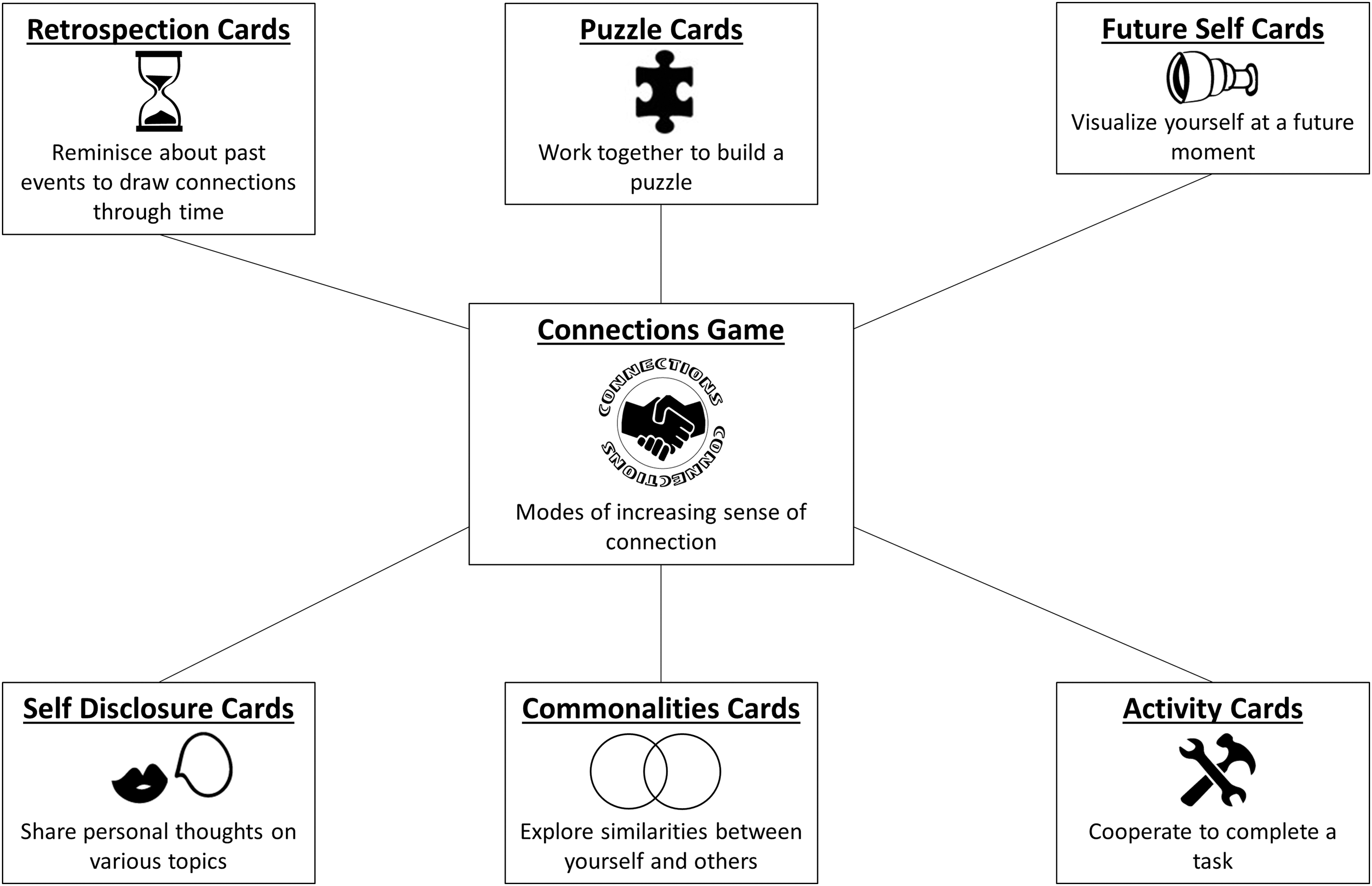
Modes of increasing sense of connection.
Iterative design and playtesting are critical steps in the game design process.37,38 Such methodologies provide multiple opportunities to collect data during the design process through repeated testing, focusing on gameplay and content (and less focus on intended outcomes). We used this structured approach throughout the development of Connections. During the first stage of development, game content was conceptualized, created, and reviewed through an iterative process among the study team, as described below.
Development stage 1
Developing content
Once the theoretical framework and card categories were finalized, the research team generated a wide range of initial content for the cards. First, existing literature and studies were reviewed by our diverse research team for ideas, topics, and activities. That would be engaging and acceptable to generate a list of potential card content. This collaborative effort continued with the research team providing iterative feedback for the first complete draft of card content by splitting the research team into pairs to play the entire list of card content, recording insights and feedback along the way, for each card. Once the entire team reviewed the first draft of card content, all feedback was compiled and reviewed. Feedback included comments regarding simple errors (e.g., typographical mistakes), clarity, and appropriateness of card topic. The team then collaborated to edit card content and remove or add cards when deemed necessary; this continued until consensus was achieved.
Next, to facilitate a gradually increasing level of personal disclosure and engagement, card content was broadly sorted according to the perceived degree of disclosure and engagement required by each card response. This was achieved by sorting the cards into three decks (low, medium, and high levels of personal disclosures/engagement). This sorting process continued until a consensus emerged among the research team that the cards were appropriately placed in three (increasingly personal) levels of decks encompassing each gameplay category (self-disclosure, commonalities, retrospection, future self, and activity), which occurred after a total of 15 iterations (see Table 1 for card content examples by deck level). After this, the research team began exploring gameplay procedures. Based on previous evidence identifying aspects of serious game design that can promote engagement and positive outcomes, we included components of competition, gameplay rules, challenges, and fantasy. 39
Card Content Examples by Deck Level
Levels 1–3 increase in intimacy level.
Competition
Serious games generally include competition to motivate players and make learning fun. 39 As Connections is meant to inspire togetherness, however, it uses cooperative rather than directly competitive gameplay. The design shifts competition to players collaboratively acting to do their part in achieving a shared goal and to do their personal best at playing the game. Prior work has documented that cooperative design in serious games does not undermine benefit and has been adopted in multiple domains, including encouraging social and motivational inclusion of at-risk students 40 and teaching college students about the process of urban planning. 41
Fantasy/imagination
Elements of fantasy are present in most serious games to include motivation and excitement throughout gameplay. 39 In Connections, the card category “future self” is considered a fantastical element because these cards prompt players to imagine aspects of their best selves in the future. Using “future self” as a category allowed us to incorporate fantasy in the game and allowed us to enhance personal relevance (whereas overly fantastical elements might impede the intended generalization to everyday life). Furthermore, writing about a positive future self has been utilized as an effective intervention in prior work.42,43
Gameplay rules
For Connections, the design goal was for new cards to be discovered each time the game is played, making the game more appealing, enjoyable, and increase replay-value. When developing the gameplay mechanism for Connections, game design principles were considered by examining existing commercially available card games. Fundamental gameplay rules were considered for Connections, including the number of times a player can draw or pass a card, the physical setup of the cards, the rewards and consequences throughout the game, and how the game begins and ends. The research team collaboratively wrote and edited gameplay rules through iterative writing, reviewing, testing, and editing during the second stage of game development.
Incorporating challenges in the game design
Challenges in serious games should be designed to fulfill learning goals. 39 Connections presents two types of potential challenges relevant to forming social connections. First, players may find some card prompts challenging to answer due to inexperience in thinking about certain topics or a lack of self-disclosure skills or confidence. We did not include potentially controversial topics in the game (e.g., religion, politics) that could potentially lead to disagreement or conflict. Second, a collaborative interactive goal (a culminating puzzle activity) was added to provide a sense of closure to the game ending. Throughout the game, after completing each deck, players collect puzzle pieces—as such, they collaboratively work toward building something that will be better understood at the end of the game. The first stage of game development ended in a basic, fully playable draft version of the game used for playtesting.
Development stage 2
The first round of gameplay testing was conducted among the research team and subsequently expanded to have each research team member play with an acquaintance. Written feedback was collected and synthesized to inform the iterative refinement of Connections in the following targeted domains: (1) Card content (Do players find the discussion topics appropriate? Do players feel comfortable discussing the topics? Are there any grammar/spelling typos?); (2) Ease of gameplay (Do the rules need to be refined?); (3) Duration of gameplay (Do players feel it is too short or too long?); (4) Overall enjoyment of the game (Is the game fun and re-playable?). Qualitative feedback from players was generally positive. Overall, results indicated that card content was appropriate and interesting. Critical feedback focused on minor content or procedural issues.
For example, it was noted that some of the card content wording could be clarified, and a few typographical errors were found. Novel feedback on processes unrelated to content was also received; notably, several players reported that reading the instructions and setting up the game collaboratively with the other player served as a good “warm-up” and a chance to become comfortable with the other player. Some players reported that portions of the written rules were confusing and that additional clarification would be helpful (e.g., which player should start). All players reported feeling satisfied with the duration of gameplay and how the game concluded. Most individuals reported enjoying the game and indicated that they would play again. The research team then revised gameplay and clarified the rules and instructions based on this round of feedback.
Development stage 3
The research team again reviewed all aspects of the game to ensure that playtesting feedback was fully integrated. Finally, the team designed graphics for the cards and an instruction manual for formal printing. This resulted in the final version of the game, described as follows:
Connections is a cooperative card game for two players that takes ∼1 hour to play. The objective of Connections is for two players to work together to openly answer questions posed on cards from several decks. As players progress through each deck, the cards become more personal. Topics on cards encourage insight and thoughtful conversations, with the intention of helping players feel more connected. As each deck is completed, players are awarded puzzle pieces and work toward completing a puzzle together at the end of the game. Each player's goal is to cooperatively move through the card decks, gain puzzle pieces, and complete the puzzle.
The final card count of the game included 157 cards, divided into 5 decks (3 decks of prompts, the final activity deck, and a puzzle piece deck; see Fig. 2 for the final Connections game setup and Fig. 3 for an example of gameplay).
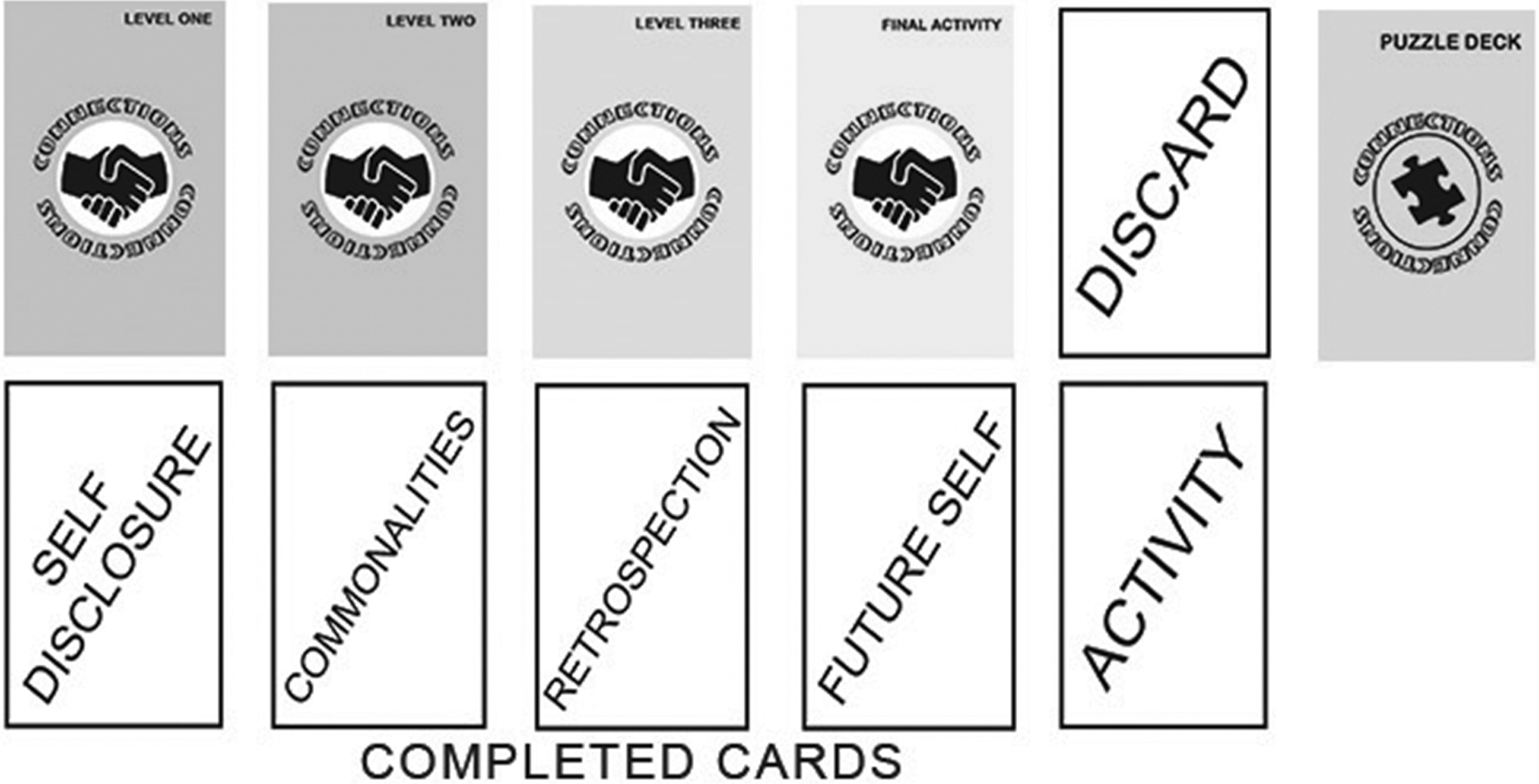
Connections game setup.
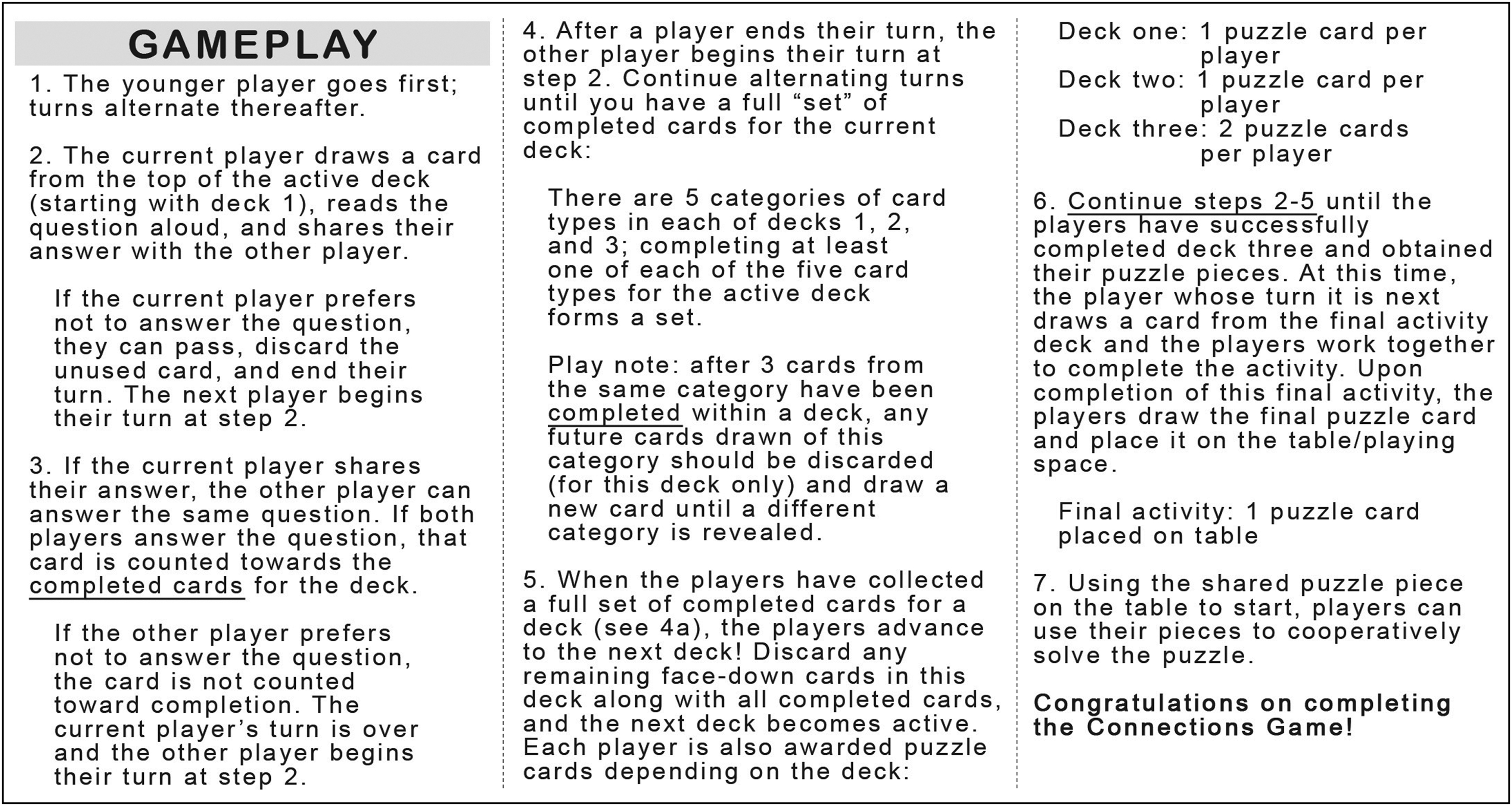
Example of gameplay (instructions).
Feasibility and Preliminary Testing
Methods
The finalized printed version of Connections was pilot tested among a convenience community sample of generally healthy, English-speaking adults (older than 18 years) to determine feasibility, acceptability, and preliminary indicators of efficacy. The study was approved by the Pennsylvania State University Institutional Review Board. Participation involved one 90-minute in-person visit where individuals provided written informed consent and were randomly assigned to play the game with another person they did not already know. Demographic information was collected, as well as pre–post measures assessing initial psychosocial impact and general acceptability.
Trait loneliness was assessed at baseline with an established loneliness scale, 44 which consisted of three items regarding general frequency of lonely feelings on a 1 (hardly ever or never) to 3 (often) scale (sum score used; reliability was α = 0.71). Psychosocial states were assessed at baseline and following the conclusion of the gameplay with face-valid single items (e.g., “How lonely do you feel right now?”) with responses ranging from 1 (not at all) to 5 (very much). Research assistants tracked gameplay metrics (e.g., duration of gameplay, rates of completion, any gameplay issues) and were available to assist with rule comprehension or gameplay progression. Finally, participants were asked to rate aspects of acceptability (domains based on prior work and theory45,46) on a 1–5 Likert-type scale (e.g., 1 [not enjoyable] to 5 [very enjoyable]).
Results
A convenience sample of 30 individuals (18–76 years old) from the local community participated, playing as 15 dyads, in pilot testing Connections; participants had low levels of general (trait) loneliness (Table 2). All participant dyads successfully completed the game within the 90-minute time frame. Feasibility and acceptability results reflect strong success, with the card game being highly rated across several dimensions (Table 3). Participants reported statistically significant increases (from pre- to post-gameplay; paired t-tests) in the amount they looked forward to forming new connections with others in the future, the amount they felt like opening up and talking to others, and the amount they felt like they had in common with others (p's < 0.05; Table 3), and statistically significant decreases in loneliness, depressed mood, and anxiousness (p's ≤ 0.02). Open-ended feedback was also collected, which was largely positive; one common minor concern indicated that the instructions regarding the quantity of cards to play for each deck could be clarified.
Participant Characteristics (N = 30)
SD, standard deviation.
Acceptability Ratings and Preliminary Efficacy of Pilot Testing
Bold values indicate statistically significant result P < 0.05. P-values adjusted for multiple tests using false discovery rate.
Overall Discussion and Future Directions
This study aimed to develop a novel theory and evidence-informed loneliness intervention applicable to a wide range of individuals. Through the process of iterative design and playtesting, we developed a cooperative card game called Connections, which is designed to be appropriate for most ages (∼12+ years) and the general public. The game was seen as highly engaging and enjoyable by play testers. Qualitative feedback and pilot testing results provided very strong positive preliminary indicators that the game was effective at promoting connection with the other player and reducing loneliness (in a single-group pre–post design using a convenience community sample with relatively low levels of loneliness).
Having completed development and establishing preliminary feasibility, acceptability, and positive short-term indicators for efficacy, we intend to continue refining and evaluating this intervention (e.g., revisions for gameplay clarity). Although our preliminary findings show that Connections produced medium to large effect size estimates on immediate outcomes, a well-powered randomized controlled trial with a longer term follow-up is needed to rule out the impact of simple demand characteristics on effect size estimates and to evaluate durability of benefits. For example, Connections could be contrasted with assignment to play other card games of similar format and gameplay (i.e., matched for playing a game/time/general interactions, but lacking the intervention content of Connections). We also aim to recruit more diverse samples of individuals to provide feedback on the game and integrate their feedback into future iterations. Ultimately, it will be essential to evaluate the impact of Connections on loneliness and well-being in a large sample of individuals with higher levels of loneliness.
We also plan to adapt/tailor Connections to specific subsamples of people and test alternative delivery formats. For example, additional cards (“expansion packs”) that provide content tailored to specific subgroups (e.g., older adults, veterans, adolescents) will be designed to shuffle into the original Connections game easily and the original gameplay rules would still apply. We are also considering adapting the game to be delivered digitally to enhance reach (e.g., online or smartphone app). However, conceptual issues must be considered in this case, such as the necessity for in-person interactions versus “ersatz” interactions via digital methods. These concepts must be carefully evaluated as the intervention continues development and adaptation.
Conclusions
Loneliness is prevalent, and its effects on health are detrimental, yet we have few options for broad-based preventive or treatment options. Our goal was to develop an innovative, theoretically informed card game to facilitate feelings of connection with other individuals and reduce loneliness. It is a preventative approach for individuals at risk for developing severe loneliness and an attempt to disrupt the process of loneliness for those currently experiencing loneliness. This intervention has the potential to be easily scaled-up and disseminated in a variety of settings. Randomized controlled trials are in development to formally evaluate the game's effectiveness in various settings and among various populations.
Footnotes
Acknowledgments
We would like to thank the following research assistants who helped us test the Connections game during development: Allison Burd, Grace Harris, Laura Guay, Selma Paul, Mariana Espinosa, Andrew Gellar, Jenna DeMuth, Ann White, Jillian Barton, Charlotte Harris, Camryn Freeland, Hailey Paolercio, and Taylor Haddad. The authors are also grateful for the participants for their time and for sharing their experiences during pilot testing.
Authors' Contributions
J.M.S. conceived the study, designed the game and evaluation framework, contributed to article writing, and provided overall oversight. K.V.B. contributed to game development and rules, led game development, contributed to play testing and pilot testing, and wrote the first draft of the article with the support of J.M.S. J.A.J. assisted with game development and contributed to pilot testing and revising the article. S.N. assisted with game development and article revision. J.N. contributed to conceptual frameworks and assisted in revising the article. The corresponding author confirms that all listed authors meet authorship criteria and that no others meeting the criteria have been omitted.
Disclaimer
Content is solely the responsibility of the authors.
Author Disclosure Statement
No competing financial interests exist.
Funding Information
K.V.B. was in part supported by the National Institute on Aging Grant T32 AG049676 to the Pennsylvania State University.