




Abstract
Background:
College students are particularly susceptible to developing mental health problems. Gamification can be a powerful teaching strategy to favor motivation and behavioral changes for the improvement of psychological well-being.
Purpose:
To analyze the effect of a 14-week gamification-based physical education teaching program on psychological well-being of college students.
Materials and Methods:
A total of 112 college students (21.22 ± 2.55 years) were recruited and assigned to a gamification-based group or a control group. The intervention group participated in a gamification-based program under the framework of “STAR WARS” science fiction sage. Participants from this group used a mobile app with a countdown timer and the way for them to gain lifetime was by doing physical activity (PA) and formative challenges. The control group did not experience the gamification approach itself as their classes were based on traditional methodology. They were asked to maintain their usual lifestyle and were not required to do PA. Emotional intelligence, personal initiative, entrepreneurial attitude, resilience, and self-efficacy were self-reported.
Results:
The gamification-based group showed a significantly higher improvement of emotional intelligence (P ≤ 0.006), personal initiative (P ≤ 0.033), entrepreneurial attitude (P < 0.001), resilience (P = 0.002), and self-efficacy (P < 0.001), compared with the control group. Overall effect sizes were of medium magnitude for emotional intelligence and personal initiative, large magnitude for entrepreneurial attitude, and small magnitude for resilience and self-efficacy.
Conclusion:
Gamification and the use of mobile apps may become powerful teaching strategies to motivate college students toward healthier lifestyle behaviors that have psychological well-being benefits.
Introduction
The transit to adulthood (i.e., from 19 to 24 years old) has been considered a key phase to promote healthier lifestyles. 1 College students are particularly susceptible to developing mental health problems and not meeting physical activity (PA) guidelines.2,3 This may be due to that during the university stage of education, students experience important lifestyle changes (e.g., more academic stress, more academic pressure, longer sedentary times, insufficient sleep, or lack of motivation to PA practice) that may lead to the acquisition of unhealthy habits.4,5 All this makes the university stage a key phase for teachers to motivate students toward healthier lifestyle behaviors that lead to psychological well-being.
Particularly, being more active has a great potential to improve quality of life, with documented benefits on self-esteem, mood, depression, resilience, and happiness.6–9 Different studies have demonstrated that those individuals who are physically active present more pleasure-activated feelings, also associated with a reduction in the probability of long-term unhappiness.7,10,11 Despite the well-known benefits of PA, one in four adults (28%) are insufficiently active worldwide, 12 that is, they do not meet the health-related PA guidelines established by the World Health Organization 13 : at least 150 minutes of moderate PA per week or 75 minutes of vigorous PA. It is therefore needed to promote initiatives toward more physically active and healthier lifestyles.
Both physically active and inactive behaviors are determined by multiple factors, including cognitive variables such as self-regulation or intrinsic motivation.14,15 Teaching strategies that seek for intrinsic motivation, enjoyment, and satisfaction of students have been related to healthier lifestyles. 16 In this context, a powerful way of motivating students is through gamification, that is, the application of game-based elements in nongaming contexts such as the educational setting.17,18 Thus, any gamification project must be designed based on a narrative that could be inspired by any theme (e.g., futuristic, detective) or fiction (e.g., STAR WARS, Harry Potter), and must focus on students as the protagonists of the narrative.19,20
The narrative supports the 10 different pillars of gamification that have been recently proposed. 21 Some of these gamification pillars are as follows: a transcendental objective, missions and challenges, or taking care of details. 21 Furthermore, any gamification-based project must be designed using some of the 40 triggers proposed elsewhere, 21 such as alliance and avatars, all of this with the purpose of making the course and learning motivational and exciting for students. The narrative in gamification is crucial to establish connections between the educational and fictional worlds (e.g., to travel between galaxies in STAR WARS, the students or padawans must run/cycle a number of days and hours)
Some other aspects that are also important to consider when designing a gamification project in education are as follows: to captivate students; to favor immersion of the students in the adventure; to create an exciting purpose for students; to adapt the grade of difficulty of the formative challenges to all students' competences; to act as a guide teacher; and to take care of small details. 20 A systematic review showed that different interventions built around mobile apps have shown the gamification's potential for the improvement of mental health. 22 In these interventions, the use of gamification favored healthier lifestyles and benefited aspects such as self-confidence, self-efficacy, overall well-being, or personal growth of the general adult population.22–26 Although the trend is positive, research on the effect of gamification on psychological well-being is very scarce in the educational context, especially in the university stage of education.
Gamification can be a powerful teaching strategy to favor motivation and behavioral changes for the improvement of psychological well-being and for empowering students to gain more control over their emotional well-being. 27 Therefore, the aim of this study was to analyze the effects of a 14-week gamification-based teaching program, based on a “STAR WARS” narrative, on emotional intelligence, personal initiative, entrepreneurial attitude, and self-efficacy of college students from the degree in Physical Education and Sport Sciences.
Materials and Methods
Study design and participants
The “STAR WARS: The first Jedi” program is a quasiexperimental trial composed of two arms: an intervention group and a control group. A total of 112 college students (21.22 ± 2.55 years old; 74% males) were recruited as sample of convenience for the present study. The recruitment process was performed through an academic course from the degree in Physical Education and Sport Sciences at the University of Granada (Granada, Spain). The 112 college students who were recruited for the present study enrolled, before this study, in the same academic course (“Fundamentals of Physical Education and Sport”) and were asked to choose between two different course groups according to their schedule preferences at the time of enrolling. Both groups, as they belonged to the same course, followed the same syllabus and, therefore, had the same formative aim: to know how to plan and design in Physical Education as future teachers.
One of these natural course groups formed the gamification-based physical education intervention group (N = 56, 20.69 ± 1.41 years old; 71% males) and participated in the “STAR WARS: The first Jedi” teaching experience. The other course group constituted the control group (N = 56, 21.75 ± 3.25 years old; 77% males), which followed a traditional teaching methodology. Two different teachers were randomly assigned to each course group. One of the teachers monitored the gamification-based program and the other one monitored the control group.
Description of the purpose and characteristics of the study were given to all participants and written informed consent was provided by them before participation. The Human Research Ethics Committee of the University of Granada approved the study protocol (Approval No. 421/CEIH/2017).
The “STAR WARS: The first Jedi” gamification-based program
The “STAR WARS: The first Jedi” gamification-based program was designed to fight back the generalized lack of motivation among students,28,29 and to improve their psychological quality of life by educating students in active lifestyles. This program was based on a gamification strategy as an educational prequel of the legendary “STAR WARS” saga to make the students the real protagonists of their education, favoring therefore their participation and motivation toward healthier lifestyle behaviors.
Under the narrative of “STAR WARS,” students belonging to the intervention group played the role of padawans, that is, apprentices recruited by the Jedi Council (i.e., former students, already Physical Education teachers, who collaborated punctually to enrich the experience) with the aim of becoming Jedi Masters (i.e., future Physical Education teachers, promoters of active lifestyles). The padawans were asked to develop their skills and potential (i.e., to complete several creative, formative, and physical challenges) to be able to join the Rebel Alliance on their aim of freeing Jedi Master Yoda and the galaxy from the clutches of the Galactic Empire. The narrative started with Master Guidoogway (role played by the teacher), an old friend of Yoda, recruiting all padawans and installing a mobile app on their phones.
The ad hoc app has been described in detail elsewhere,30,31 and was designed and developed by an engineer specifically for the present “STAR WARS” gamification adventure including its fictional and graphical details. The app included a countdown timer used to determine how well the padawans were able to administrate their lifetime and develop their Jedi Master training (as future Physical Education teachers). When the counter reached 0 in any of the padawans’ app, it meant that they had succumbed to the dark side of the Force (representing the apathy, comfort, and conformism in the educational system) over the bright side of the Force (the passion, compromise, and creativity in the educational system). The countdown counter was also used by the teacher to evaluate the students as follows: the lifetime remaining for each student at the end of the adventure was linked to an academic grade/mark (from 0 to 10). Therefore, during the 14 weeks that lasted the program, the padawans had to manage their time properly and complete all formative and PA challenges required by the Jedi Council to become Jedi Masters.
The gamification strategy was used herein as a motivational resource to encourage college students toward a change to healthier lifestyles, that is, to become those whom “the Force is strong with.” To achieve this, all padawans were asked to do interplanetary trips with the aim of raising the awareness of other planets about the thread of the dark side and the necessity to build a healthier planet. These interplanetary trips could be done by running or cycling 3–5 days/week at least 150 min/week (in case of moderate intensity), or 75 min/week (in case of vigorous) to meet the PA guidelines. 13 To monitor and control the PA challenges performed, all students were asked to upload their daily PA registers into the Runtastic app (www.runtastic.com). This app includes a real-time GPS tracking of activities, and there is evidence on its validity to record distances of activities such as running or cycling. 32
In order for the students to demonstrate their activities performed, the app included an “Interplanetary trips” section where they could upload their Runtastic registers into the app. Also, to determine the intensity of the activity performed by the students, we used the information provided by the app on the duration of the activity and the pace kept by the user. As previously stablished, 33 we considered a running pace of >5–8.4 min/km and cycling pace of >16–25.6 km/h as the thresholds indicative of meeting PA intensity guidelines. For those padawans who had done 3–5 valid interplanetary trips (i.e., 3–5 valid PA registers into the app) at the end of the week, Master Guidoogway (the teacher) awarded them with a lifetime bonus of 2 days and a half that was summed up to their countdown timer.
Students also increased their level of midiclorianos that was used to modify the students' rank. Therefore, all students were able to check their rank (i.e., Padawan, Jedi Knight, Commander of the Rebel Alliance, and Jedi Master) in the app based on their midiclorianos level and the number of PA and learning challenges overcome. Only the top 10 Jedi Masters of the ranking would have a protagonist role on the final battle against the Galactic Empire (last session of the program consisting in an escape room).
Students used the ad hoc app to manage and choose among different formative and PA challenges oriented to improve their training and become future Jedi. In the app they could check the individual ranking that was based on their midiclorianos level and the rank of each of them based on the learning and physical challenges overcome. To progress in the ranking (e.g., from Commander of the Rebel Alliance to Jedi Master), apart from gaining midclorianos, they also had to gain experience points -XP-. Some of the different activities they could choose in the app to gain points were as follows: to follow Jedi Masters (i.e., people with an experienced background in education) in Twitter, to buy “groceries” (i.e., to show evidence of their formative challenges accomplishment that represented the “food” they were getting to “feed” themselves), and to do interplanetary travels as we explained before.
The control group was formed by college students from the same course as the participants from the gamification-based group, but they participated in a traditional teaching methodology course group. The control group was asked to maintain their usual lifestyle for the 14-week duration of the program.
Outcome measurements
Emotional intelligence
Emotional intelligence was measured by the Spanish adaptation for adults of the Trait Meta-Mood Scale (TMMS).34,35 This is a 24-item widely used self-report that includes 3 emotional intelligence dimensions (8 items each)34–36 : attention to emotions (i.e., ability to identify and recognize one's own feelings), emotional clarity (i.e., ability to clearly understand, comprehend, and distinguish one's own feelings), and emotional regulation (i.e., ability to control one's own positive and negative emotions). A 5-point Likert scale is used to respond to the 24 items, ranging from 1 (“Totally disagree”) to 5 (“Totally agree”). The final scores range from 8 to 40 for each dimension. Higher scores were indicative of higher emotional intelligence.
The Spanish version of the TMMS has shown adequate internal consistency (Cronbach's alpha values of 0.90, 0.90, and 0.84, respectively, for attention, clarity and regulation), appropriate test–retest reliability (correlation coefficients of 0.66, 0.70, and 0.83, respectively, for attention, clarity, and regulation), and validity.34,37
Personal initiative
The Spanish scale for measuring personal initiative in the educational field (EMIPAE) was used. 37 This instrument evaluates the following three different dimensions of personal initiative: proactivity and prosocial behavior (i.e., ability to detect problems and opportunities beforehand, and develop strategies to respond adequately to them); persistence (i.e., ability to pursue the achievement of someone's own goals, regardless of the difficulties); and self-starting (i.e., ability to take the initiative and to decide to make something in an autonomous way).38,39
Overall, the EMIPAE comprises 17 items, and a 5-point Likert scale, ranging from 1 (“Totally disagree”) to 5 (“Totally agree”), is used to respond to each item. The final scores range from 8 to 40 for proactivity, from 4 to 20 for persistence, and from 5 to 25 for self-starting. The higher the score, the higher the personal initiative. Adequate internal consistency (Cronbach's alpha values of 0.72, 0.73, and 0.57, respectively, for proactivity, persistence, and self-starting), reliability, and validity have been reported in young adults. 37
Entrepreneurial attitude
The scale of entrepreneurial attitude 40 is a one-dimensional Spanish scale that evaluates entrepreneurial attitude based on conceptual considerations made on proactivity, pursuit of efficiency, disposition toward excellence, confidence in success, and resilience.41,42 The scale comprises 15 items, which are responded on a 4-point Likert scale ranging from 1 (“Totally disagree”) to 4 (“Totally agree”), giving a final score ranging from 15 to 60. A higher final score indicates higher entrepreneurial attitude. The measure displayed adequate psychometric properties with an internal consistency of 0.92.37,40
Resilience
Resilience was evaluated using the 10-item Connor–Davidson Resilience Scale (CD-RISC 10). 43 A Spanish adaption of this questionnaire was used, designed as a Likert-type additive scale with 5 response options ranging from 0 (“Never”) to 4 (“Almost always”). 44 A final resilience score was calculated as the sum of the responses obtained on each item (ranging from 0 to 40), and the highest scores indicated the highest level of resilience. The Spanish version of the 10-item CD-RISC showed good psychometric properties (Cronbach's alpha value of 0.85 and test–retest intraclass correlation coefficient of 0.71) in young adults. 44
Self-efficacy
A Spanish adaptation 45 of the 4-item General Self-Efficacy Scale 46 was used to evaluate self-efficacy (i.e., the ability to manage and control a range of stressful situations effectively). The adapted version comprised 10 items, and a 10-point Likert scale ranging from 1 (“Totally disagree”) to 10 (“Totally agree”) is used to respond to each item. A final score of self-efficacy is calculated ranging from 10 to 100 (higher score, higher self-efficacy). The instrument reported adequate internal consistency (α = 0.87) and external validity.37,45
Statistical analyses
Means and standard deviations (SDs) were used to present characteristics of the study sample, and frequencies and percentages for sex. Baseline differences between the intervention group and control group were analyzed using one-way analysis of variance for continuous variables. Chi-squared test was used to analyze between-group baseline differences for categorical variables.
Analysis of covariance (ANCOVA) was used to analyze the effects of the “STAR WARS: The first Jedi” program on psychological well-being outcomes (i.e., emotional intelligence, personal initiative, entrepreneurial attitude, resilience, and self-efficacy). ANCOVA models included postintervention outcomes as dependent variables, group (i.e., intervention vs. control) as fixed factor, and baseline variables as covariates. The ANCOVAs were performed and are presented for both raw and z-score variables. The computation of z-scores for each psychological well-being outcome at baseline was performed as follows: (individual raw value at baseline − baseline mean)/baseline SD; and for each outcome at postintervention (i.e., also called z-score of change) as follows: (postintervention individual raw value − baseline mean)/baseline SD.
The use of z-scores to report and quantify the effects of an intervention (by using z-score of change) has been previously done in a major randomized controlled trial,47,48 and has two main advantages: (1) allows comparisons across outcomes of a different nature; and (2) the postintervention z-score (or z-score of change) represents the standardized effect size by informing about how many SDs a postintervention outcome changes with respect to this outcome at baseline. 47 For example, a z-score value of 0.42 in entrepreneurial attitude for the intervention group means that the entrepreneurial attitude is 0.42 SDs higher at postintervention than it was at baseline for this specific group. Therefore, we based on standard cut points previously proposed to interpret the z-scores as effect sizes (i.e., 0.2, 0.5, and 0.8 respectively, as small, medium, and large effect sizes). 47
A P < 0.05 was set to indicate significant effects of the “STAR WARS: The first Jedi” program although we also corrected for multiple comparisons 49 to test whether the effects remained significant after this correction. Statistical analyses were performed using SPSS software (version 25.0; IBM Corporation) and graphs were designed using Prism (version 7.0; GraphPad, San Diego, CA).
Results
Descriptive baseline characteristics of the study sample and the significant baseline differences between the intervention and control groups are shown in Table 1.
Descriptive Baseline Characteristics of the Participants of the “STAR WARS: The First Jedi” Program
Values are expressed as means ± SDs, unless otherwise indicated. Minimum and maximum scores for each outcome are presented between brackets [].
CD-RISC, Connor–Davidson Resilience Scale; EMIPAE, Escala para la Medición de la Iniciativa Personal en el Ámbito Educativo [Scale for Measuring Personal Initiative in the Educational Field]; SD, standard deviation; TMMS, Trait Meta-Mood Scale.
The “STAR WARS: The first Jedi” program had a significantly positive effect on all psychological well-being outcomes analyzed in the present study (all P ≤ 0.018; Fig. 1 and Table 2). More concretely, emotional intelligence improved significantly more in the intervention group than in the control group in its following three dimensions: attention (0.61 SDs, intervention vs. control difference improvement, P < 0.001), clarity (0.50 SDs, P < 0.001), and regulation (0.35 SDs, P = 0.006). The effect size of the program on attention and clarity was of medium magnitude, while for regulation was of small magnitude. Personal initiative also increased in the intervention group significantly more than in the control group in its following three dimensions: proactivity (0.75 SDs, P < 0.001), persistence (0.35 SDs, P = 0.033), and self-starting (0.57 SDs, P < 0.001).
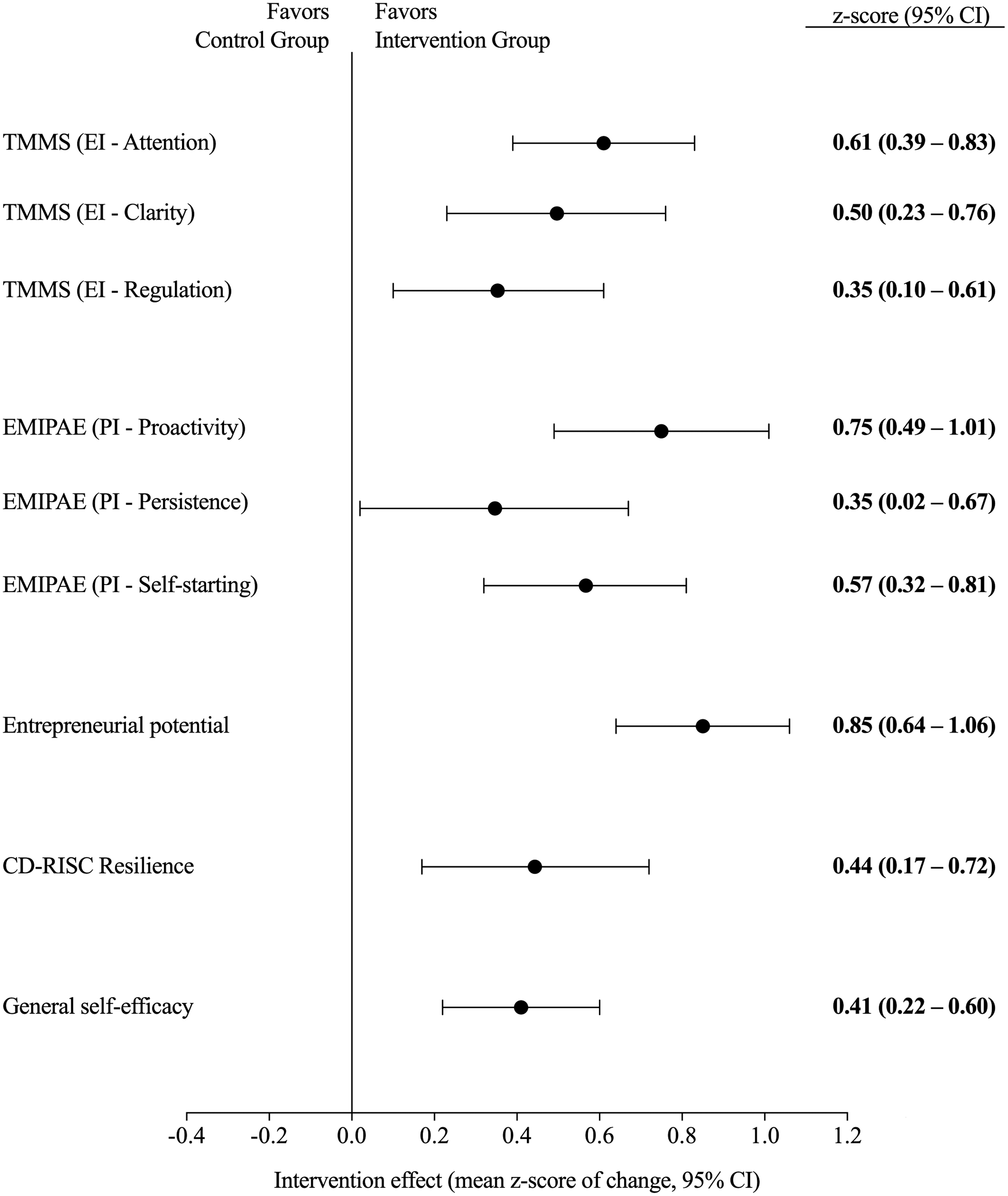
Effects of the “STAR WARS: The first Jedi” program on psychological well-being outcomes. The ANCOVA to test the effect of the “STAR WARS: The first Jedi” program on the z-score postintervention outcomes were adjusted for the outcome of interest at baseline. The between-group differences (intervention vs. control) in z-score values of change (i.e., differential change of each postexercise outcome with respect to the baseline mean and standard deviation) are represented by “spaceships” (i.e., black dots). For example, the between-group difference of 0.61 z-score of change observed in Attention scale means that the postintervention Attention value is 0.61 standard deviations higher for the intervention group than for the control group with respect to the baseline values. Bars of the “spaceships” represent 95% CI. Bold font indicates significant effect at P < 0.05 (or by the 95% CI not including zero). Correction for multiple comparisons was performed following the Benjamini and Hochberg method (q < 0.05). 50 ANCOVA, analyses of covariance; CD-RISC, Connor–Davidson Resilience Scale; CI, confidence intervals; EI, emotional intelligence; EMIPAE, Escala para la Medición de la Iniciativa Personal en el Ámbito Educativo [Scale for Measuring Personal Initiative in the Educational Field]; PI, personal initiative; TMMS, Trait Meta-Mood Scale.
Effects of the “STAR WARS: The First Jedi” Program on Raw and z-Score Postintervention (i.e., z-Score of Change from Baseline) Psychological Well-Being Outcomes
ANCOVA was used to test the effect of the “STAR WARS: The first Jedi” program on psychological outcomes. ANCOVA included the postintervention outcomes as dependent variables, group (i.e., intervention vs. control) as a fixed factor, and baseline outcomes as covariates. Bold font indicates significant effect at P < 0.05 (or by the 95% CI not including zero). Correction for multiple comparisons was performed following the Benjamini and Hochberg method (q < 0.05). 50 z-Score data show how many SDs have the postintervention values changed with respect to the mean and SD at baseline. For example, the between-group difference of 0.61 z-score of change observed in Attention scale means that the postintervention Attention is 0.61 SDs higher for the intervention group than for the control group with respect to the baseline means and SDs. Minimum and maximum raw scores for each outcome are presented between brackets [].
ANCOVA, analysis of covariance; CI, confidence interval.
Effect sizes were of large, small, and medium magnitude, respectively, for these three dimensions. The largest effect size of the “STAR WARS: The first Jedi” program was observed on the entrepreneurial attitude, with the intervention group presenting a significantly higher improvement from baseline to postintervention of 0.85 SDs (P < 0.001) compared with the control group. Small effect sizes were observed on resilience and self-efficacy, with the intervention group significantly improving 0.44 and 0.41 SDs, respectively, more than the control group (P ≤ 0.002). All the effects observed persisted after multiple comparisons correction using the Benjamini and Hochberg method. 49
Discussion
Our findings demonstrate the potential of gamification to promote healthier lifestyle behaviors in Physical Education by showing a positive effect of the “STAR WARS: The first Jedi” gamification-based program on psychological well-being of college students. Concretely, participants from the gamification-based program, which included the use of a game-based mobile app and other important aspects such as the narrative, missions, levels, or rankings, improved their emotional intelligence, personal initiative, entrepreneurial attitude, resilience, and self-efficacy significantly more than the control group. These positive findings support the implementation of gamification in Physical Education to encourage students toward more active and healthier lifestyles with evidenced benefits, not only in physical outcomes31,50 but also on psychological well-being.
Furthermore, we believe that college students with a degree in Physical Education and Sport Sciences, who will be future Physical Education teachers, can implement motivational and innovative teaching strategies as the one used herein, once they have benefited themselves from a gamification-based experience.
The power of gamification evidenced in the recent years has increased the number of investigations aiming to analyze its transformative potential for the promotion of well-being among individuals.22,51,52 One of the key elements that any gamification-based intervention carried out in the educational context should include is the “enjoyment,” as it is an important motivator that favors participants' affective commitment. 53 Enjoyment is closely related to intrinsic motivation.54,55 Both can be triggered by gamification and have a consequent impact on the time that students spend, for example, on the tasks assigned by the teacher, 56 that is, doing interplanetary trips to meet PA recommendations in the present study. Enjoyment and intrinsic motivation can be powered and supported using a gamification-based narrative. 57
This was clearly evidenced in our study as participants from the “STAR WARS: The first Jedi” group, in comparison with the control group, showed one of the largest effect sizes on the proactivity behavior scale (0.75 SDs, P < 0.001) that included items directly related to intrinsic motivation such as: “I usually participate actively in the classroom, even though I am not awarded in exchange,” or “Doing this course will help me achieve my personal goals.” In the present study, the use of a narrative that was built around the science fiction saga of “STAR WARS,” favored enjoyment and intrinsic motivation among students, therefore facilitating students' predisposition toward behavioral changes that derived in psychological well-being benefits. Our findings are supportive of the power of a narrative in gamification and confirm previous works that considered it a key element to build meaningful experiences.19,58
The benefits of gamification on psychological well-being presented herein may be driven by the cognitive engagement adopted by the students. The students' cognitive engagement has previously been associated with a higher psychological involvement in learning activities, and is a strong predictor of the effectiveness of interventions aiming to benefit mental health. 56 Including gamification-based elements that encourage cognitive engagement significantly increase emotional intelligence in adolescents. 59 Our study extends previous findings in adolescents by including a sample of college students as well as gamification-based elements such as a science fiction narrative based on “STAR WARS,” a ranking, a role game, a game-based mobile app, decision-making challenges, and team working, all together with beneficial effects on several scales of emotional intelligence.
The number of studies in the university context focused on the effects of gamification on psychological well-being is limited. However, our findings showing a beneficial effect of gamification on multiple psychological well-being aspects of college students agree with previous research in the general population. For instance, a previous investigation in young adults showed significant improvements of the gamification group in the emotions relative to showing interest, inspiration, and involvement, in comparison with a control group. 56 Another study with participants from the university and from a company showed that an online intervention built on the basis of game elements increased happiness, fun, and enjoyment. 25 Using technology through a multimodal online well-being intervention showed that the connection among participants and the compromise taken with the program increased the psychological well-being of participants. 60
In the present study, we also implemented a mobile app under the narrative of “STAR WARS” supported by previous investigations that demonstrated that the use of certain PA-related mobile apps increases motivation toward healthier lifestyles.61,62 Also, to fight back the “lack of time” as one of the main barriers to practice PA reported by college students,5,63 the app used herein included a countdown timer to favor that students gave to their “time” the value it has for living. For instance, students were able to check their lifetime's countdown at any moment and decide to practice more PA or to do any formative/learning challenge, for example, to gain time that was directly summed up to their countdown.
With our gamification-based program and the implementation of a mobile app that included ranks, scores, PA challenges, etc., we confirm that interactive digital devices can be valuable tools for the implementation of gamification and for encouraging behavioral changes, helping to increase PA levels that derive in psychological well-being benefits. 64
Several limitations and strengths must be acknowledged from the study presented herein. Among the most important limitations, we consider the use of a quasiexperimental design, which hampers natural randomization of participants. We were limited by a sample of convenience and a relatively small sample size that limited the statistical power. We also acknowledge the lack of an objective measurement of participants' PA (e.g., use of accelerometers) during the program and call for its inclusion in future studies. Among the most important strengths of this study, we consider the fact that this is, to the best of our knowledge, the first one investigating the effects of a gamification-based teaching program under a narrative of “STAR WARS” on psychological well-being in the university context. Another strength is the inclusion of a large battery of psychological well-being that allowed the measurement of multidimensional aspects: emotional intelligence, personal initiative, entrepreneurial attitude, resilience, and self-efficacy.
Conclusion
A gamification-based teaching program has a beneficial effect on different psychological well-being aspects of college students. The implementation of game-based elements (e.g., ranks, scores) under a narrative of “STAR WARS” and through a game-based mobile app favored motivation of students toward healthier lifestyles, deriving in benefits on emotional intelligence, personal initiative, entrepreneurial attitude, resilience, and self-efficacy. Innovative teaching strategies such as gamification can favor motivation and compromise in educative programs and, consequently, benefit psychological health. In the educational setting, teachers should be instructed and formed in the gamification technique as its potential to benefit motivation and health aspects is becoming evident. Furthermore, future scientific studies should use gamification and well-constructed narratives to engage students and increase immersion, favoring therefore intrinsic motivation toward changing any lifestyle behavior.
Footnotes
Acknowledgments
We are very thankful to all the college students who participated in this study. We are also grateful to Alvaro Fernandez-Alonso Araluce for designing and developing the mobile app.
Authors' Contributions
C.N.-M.: study design, study implementation, drafting, and critical revision. J.M.-G.: study design, data analysis, data interpretation, and critical revision. I.J.P.-L.: study design, study implementation, and critical revision. All the authors were accountable for the final version of the article.
Author Disclosure Statement
No competing financial interests exist.
Funding Information
No funding was received for this article.