




Abstract
Background:
Physical training to improve balance in the elderly has shown excellent results, but maintaining consistent participation in such programs is challenging.
Objective:
To address this, a laterolateral balance simulation game controlled by a biaxial force platform was developed to support balance rehabilitation and encourage regular training.
Method:
The game was created using the Unity engine, with 3D models designed in Blender, including the “Relaxed Man Character” asset for the avatar. The player’s objective is to maintain balance on a virtual board supported by a cylinder, controlled via the biaxial force platform. Validation involved structural tests, usability testing (System Usability Scale), and a pilot test with 10 healthy young volunteers. Statistical analysis was conducted using the Shapiro–Wilk and t-Student tests (P < 0.05) in Jamovi software.
Results:
Results indicated that the game performed as expected, and the usability test yielded an excellent score (81.5 points) from experts. The pilot test revealed that individualized calibration allowed for personalized training, with volunteers’ scores improving by 17.6% in the second session of day 1, 26% in the first session of day 2, and 8.5% in the second session of day 2.
Conclusion:
The balance simulation effectively replicated the foot pressure movements needed to control an avatar on a virtual board. This personalized approach made the game accessible and easy to use for players. Future work will involve testing the game with the target elderly population, increasing the number of sessions, and analyzing muscle activation to fully determine the game’s impact.
Introduction
Balance is essential for carrying out daily activities that involve movement and changing position, this control of posture and balance is maintained by biological sensors (neurons) linked to the central nervous system and the absence or deficiency of this system can lead to falls. 1 Injuries and trauma caused by falls are a serious public health problem, 2 mainly due to the increase in life expectancy of a population and consequently an increase in chronic degenerative diseases. 3
In Brazil, the Unified Health System (System Usability Scale [SUS]) dealt with approximately 70% of cases of hospitalizations linked to falls in the elderly, registering an increase of 66% in this type of occurrence between 1996 and 2012. 4 SUS’s annual expenditure on elderly fractures exceeded $70 million reais. Therefore, this investment could be used in prevention therapies. 5
Prevention strategies are cheaper and usually less labor-intensive compared with treatment. Prevention can occur through pharmacological therapies and/or alternative therapies, such as physiotherapy and physical training. 6 Physical training can increase the amount of type II fast-twitch muscle fibers, responsible for motor stability, therefore helping to reduce the risk of falls. 7
Physical training to prevent balance in the elderly has brought excellent results; however, it is difficult to maintain the treatment and presence of this population in a constant training program. 8 This may occur because elderly people lose interest due to the monotony of activities, lack of variety in exercises, or because they do not notice immediate improvements in their physical condition. 9 Finally, a lack of personalization in training to meet individual needs and preferences can leave seniors not feeling adequately engaged or challenged. 8
To make these activities pleasurable and motivating, technological resources were used to encourage the patient to undergo training. 10 Technology is present in everything that is currently used, so adding the use of technological resources to mobilize the patient to training can increase the patient’s immersion and consequently provide a reduction in training dropouts. 9
The use of a force platform is an example of technology to encourage patients to train. First, the force platform can assess the postural stability of the elderly, identifying imbalances and weaknesses that may predispose to falls. 11 In addition, the platform provides immediate feedback on performance during the exercises, this feedback is crucial to correct postures and techniques in real time. 12 It also allows monitoring of progress over time, showing concrete improvements in training and allowing adjustments to the exercise program as necessary. 9
In this sense, the use of electronic games (exergames) and technological devices (virtual reality), to assist in physical training, have become common in clinics and laboratories, 12 as well as the use of force platforms for balance training and rehabilitation. 11 Several studies use adapted commercial platforms or create their own prototypes for research development. 11
Thus, a system capable of quantifying balance values through a computerized game that helps immerse the patient and meets balance training procedures can bring benefits during a patient’s rehabilitation, reducing treatment time and increasing effectiveness of training, as well as quantifying the progression of balance training in elderly people. 11
Therefore, the purpose of this article was to develop a computer game for dynamic balance training in elderly individuals, using a biaxial force platform. In addition, to perform validation tests and a pilot test with 10 healthy young volunteers to evaluate the functionality and stability of the integration of the game and the platform.
Materials and Methods
Tools
The Unity graphical interface tool v. 2019.2, and the 3D modeler Blender v.2.79, were used in the development of the game. The avatar was made using the asset “Relaxed Man Character,” and the algorithm was developed with Visual Studio, using C# language.
To control the game, a biaxial force plate with stepper motors and a rectangular base was used. The force plate was divided into a right side and a left side, in each side there were load cells attached to it. The processing of the load cells and the control of the stepper motor were done by microcontrollers. 13 The biaxial force plate is surrounded by a tubular structure that had, in front of it, a screen for viewing the game, also, the structure had a safety belt for the user (Fig. 1). 13

Side photo of the biaxial force plate.
Development
The game mechanics was based on a balance board trainer, where the player’s action is to keep an avatar balanced on a board that is on a cylinder, the cylinder then changes position, changing the center of gravity (Fig. 2). To control the movements of the avatar, the player should shift the body mass position on the force plate, either right or left, according to the cylinder position. Scoring is done in an increasing manner based on time, but if the avatar falls off the board the player loses 100 points.
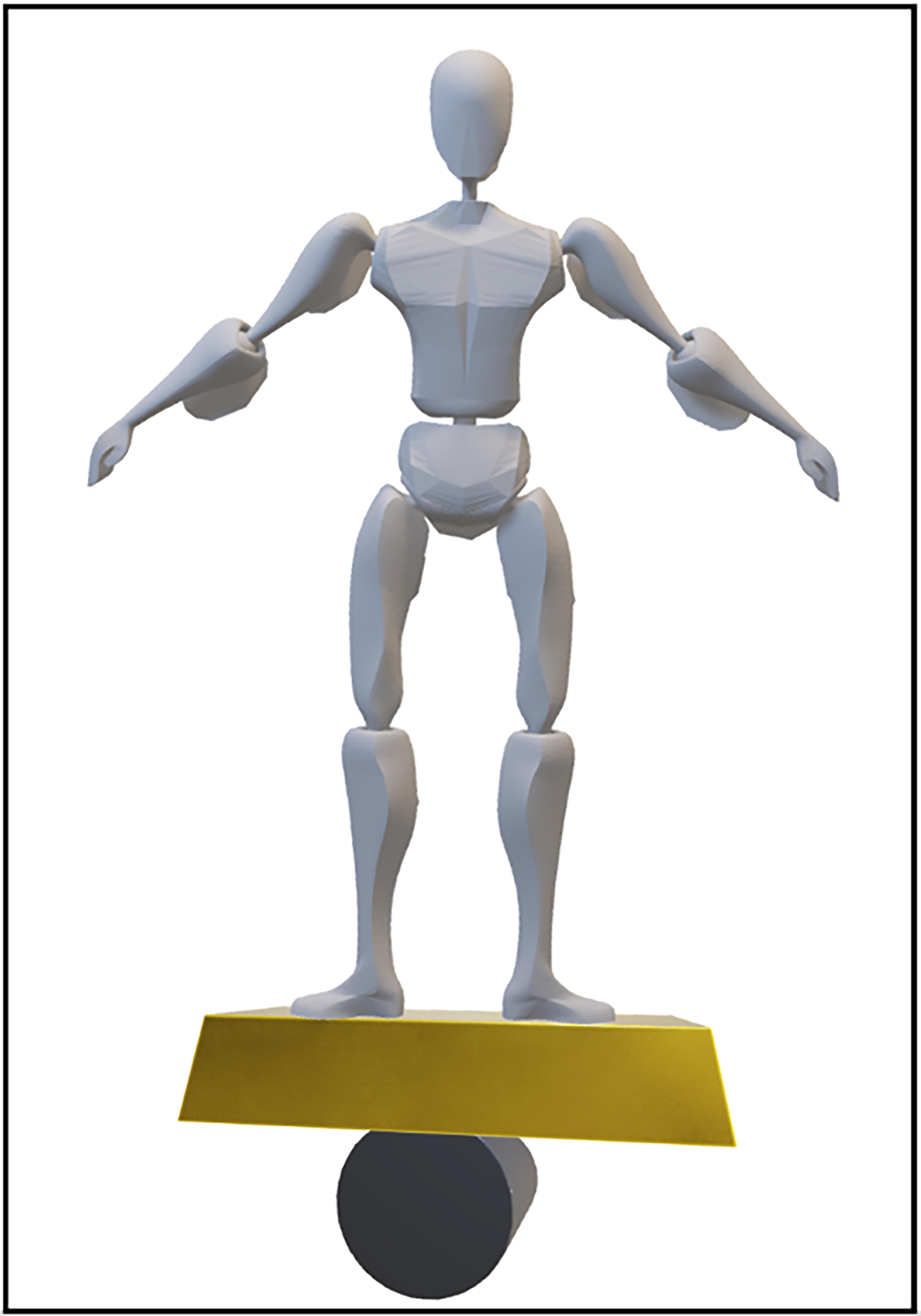
Game mechanics idea.
During the game, the cylinder moves to a random position under the board, then the player must shift the body mass accordingly to the position of the cylinder and keep the avatar from falling. To determine the movements of the board, the game uses the data of the biaxial force plate’s load cells and calculates the momentum on the right (1) and left (2) sides.
Where:
Mr = momentum on the right side;
Ml = momentum on the left side;
Dr = distance between the cylinder and the right side of the board;
Dl = distance between the cylinder and the left side of the board;
Fr = sum of the four load cells on the right side of the biaxial force plate; and
Fl = sum of the four load cells on the left side of the biaxial force plate.
Then, the board moves accordingly to Mr and Ml. In this way, if Mr is higher, the board tilts to the right. If the Ml is higher, the board tilts to the left. Finally, if they are the same, the board remains still.
To avoid inconsistencies between players with different weights, a calibrations system was developed, in which the player must remain for 10 seconds on the biaxial force plate in three positions: bipodal, left monopodal, and right monopodal. With the data collected during the calibration, the game creates a scale with the minimum and maximum values of each player, which are used to control the avatar during the game.
To make the avatar movement more realistic, the values calculated by equations 1 and 2 were multiplied by a multiplication factor, which can be changed accordingly.
Artifacts
Some artifacts were produced during the game’s development. Using the principles of software engineering, a document was generated, exhibiting 3 Unified Modeling Language (UML) diagrams (Fig. 3).
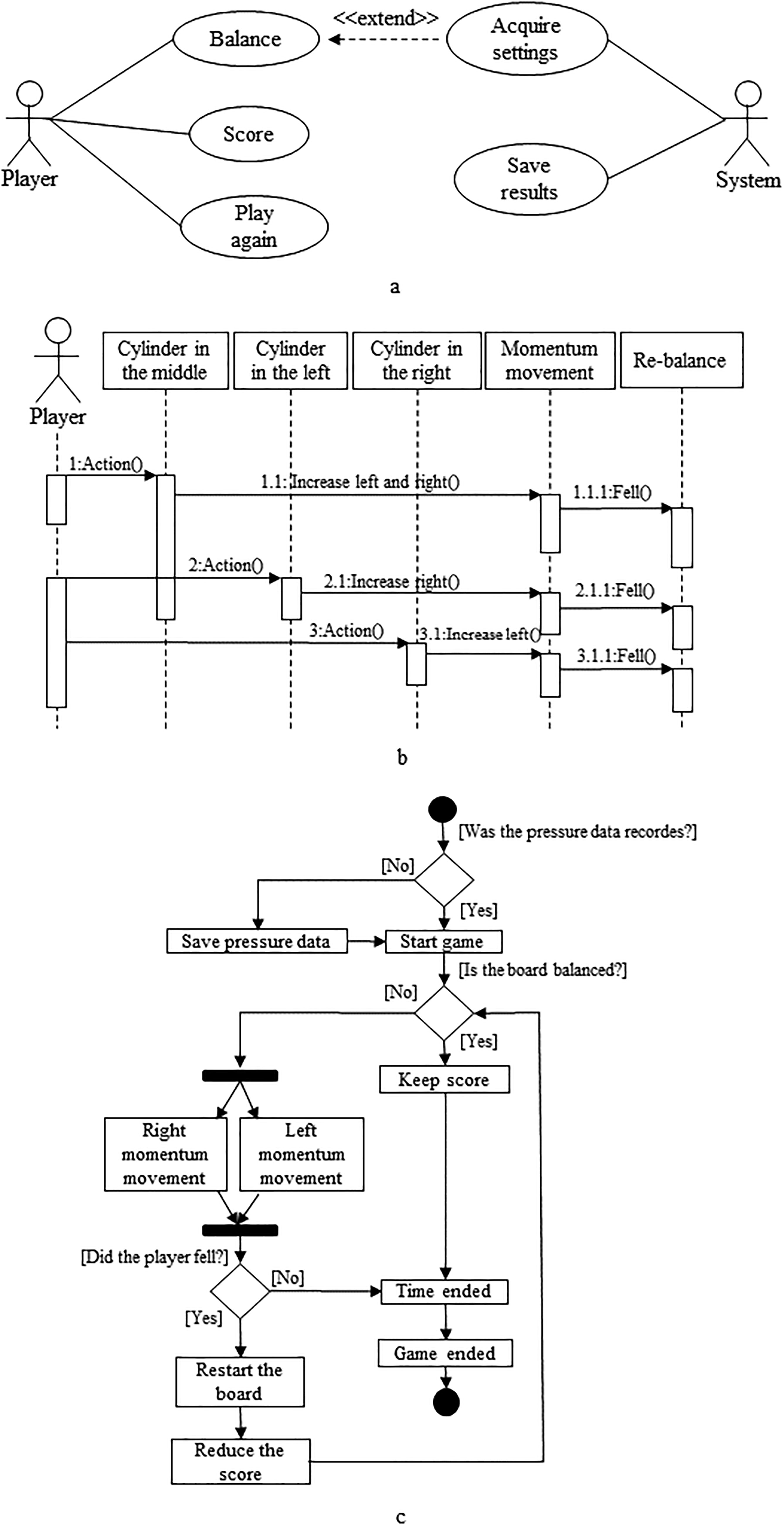
UML diagrams.
Tests
To evaluate the efficiency of the game structure, a structural test was performed using the path testing method. This method followed the system requirements, determining input commands and evaluating their respective outputs. For example, when tilting the platform to the right, the response of the avatar in the game was observed to verify whether it would correctly tilt to the right.
Next, a usability test was performed using the System Usability Scale (SUS). Ten information technology experts with experience in games evaluated the usability of the game by answering a questionnaire with 10 questions related to the game. To answer the questions, the experts played the game for 3 minutes, trying to keep the avatar balanced for as long as possible. The cylinder movement speed was set to 80% and the multiplication factor was adjusted to 1.4, to better simulate reality. After the test was completed, the experts filled out the usability scale (Table 1) using a Likert scale from 1 (strongly disagree) to 5 (strongly agree).
Scale Usability System Questionnaire
Pilot test volunteers
The pilot test was applied to 10 healthy young adult volunteers from the University of Mogi das Cruzes. Inclusion criteria were individuals over 18 years of age, who were students at the University of Mogi das Cruzes, and who had signed the free and informed consent form. Individuals with any musculoskeletal alteration in the lower limbs, with neurological alterations, and with labyrinthitis were excluded.
With the authorization of the physiotherapy supervisor and the Center for Technological Research (NPT), as well as the approval of the Ethics Committee of the University of Mogi das Cruzes (CAAE: 33400220.3.0000.5497), volunteers were screened according to the inclusion and exclusion criteria.
First of all, the aims and the steps of the test were explained to the volunteer. If they agreed to participate, the free and informed consent form was signed. The test was performed in the LAVITA laboratory, located on the NPT. The volunteers attended on the day and time previously scheduled.
The test protocol was applied twice, with an interval of 7 days between them. During the test (training sessions), the volunteers played two matches of 5 minutes each, with an interval of 5 minutes between them. In the first match, the cylinder’s speed was set to 20%, and the change time was set to 0.3 seconds. In the second match, the cylinder’s speed was set to 40%, and the change time was set to 0.15 seconds. At the end of each match, the score obtained was collected as a result measure.
Data analysis
Regarding the analysis of the SUS usability test, the questionnaire applied follows a specific logic, in which half of the statements are formulated in a positive manner and the other half in a negative manner. For items 1, 3, 5, 7, and 9, the score is calculated by subtracting 1 from the position marked on the scale by the participant. For items 2, 4, 6, 8, and 10, the score is obtained by subtracting the position marked from 5. The sum of the scores is then multiplied by 2.5 to determine the overall SUS score. After calculating the value for each evaluator, the average of the results is used to determine a final acceptability score. To assess the consistency and correlation of the SUS questionnaire, as well as the agreement between experts, Cronbach’s alpha scale was used, which verifies the reliability and coherence of the responses provided by the experts.
To analyze the pilot test data, the scores of each volunteer were used. From there, a percentage analysis of each session was performed in comparison with the first, to assess whether there was an increase in scores throughout the sessions. Then, the Shapiro–Wilk test was applied to verify the normality of the responses. If normality is confirmed, the parametric t-Student test (P < 0.05) will be applied to verify whether there is a statistically significant difference between the sessions. If the data do not suggest a normal distribution, the nonparametric Wilcoxon test will be applied. For this statistical analysis, the Jamovi software was used.
Results
The game was developed with two distinct interfaces: one dedicated to configurations and calibrations (Fig. 4a), and another dedicated to gameplay (Fig. 4b). The configuration and calibration screens are initially presented to the player, allowing the player to change the game duration, the cylinder movement speed, and the cylinder movement start time. The gameplay screen displays the player’s name, mass, score, avatar, and balance board trainer.

Game developed.
The result of the structural test showed that the algorithm matched the expected outputs of each path. After analyzing the experts’ responses, the final score of the SUS usability test was 81.5 points, which corresponds to excellent. Using the alpha Cronbach scale and the intraclass correlation coefficient, the final score was 0.85 for both, which is considered a strong marker for the veracity of the responses received across multiple conditions, observers, or time points.
The pilot test was applied to 10 volunteers with a mean age and standard deviation of 21.7 ± 1.25 years and body weight of 65.5 ± 16.8 kg, 60% were females and 40% were males, the tests were carried out over 2 days, in two sessions lasting 5 minutes each. The game score was accumulated as the player kept the avatar balanced on the platform. If the avatar fell, 100 points were subtracted. Thus, negative scores indicated that the volunteer fell more times than he or she managed to balance himself or herself. To make these results easier to visualize, the scores were adjusted to positive values, setting the lowest value recorded among the volunteers to zero (Table 2).
Pilot Test Result
Bold values indicate significance value of 0.05.
The average of each session was calculated (Fig. 5) and, from this, a percentage analysis was performed comparing each session with the first session of day 1. It was observed that the volunteers’ scores increased by 17.6% in the second session of day 1, 26% in the first session of day 2, and 8.5% in the second session of day 2 (Table 3).
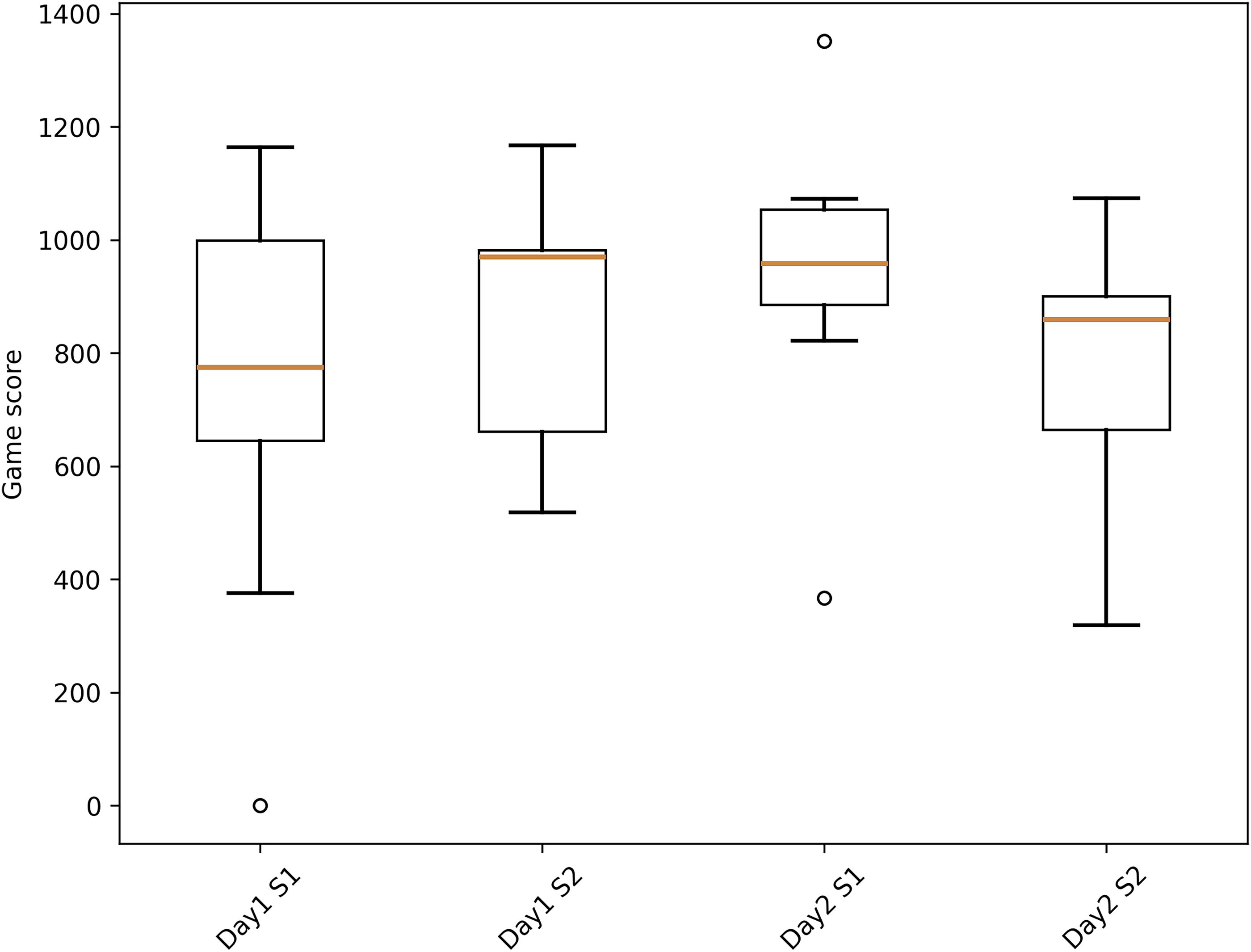
Statistical result of the pilot test.
Percentage of Each Session’s Score Compared with the First Session on Day 1, t-Student of Each Session Compared with the First Session on Day 1
Then, to verify the normality of the data, the Shapiro–Wilk test was applied, which confirmed normality with P > 0.05 for all results. After this, the analysis was performed using t-Student to verify whether there is a statistically significant difference between the sessions (S) in relation to the first session (S1) of day 1. It was observed that the P value was >0.05 in all comparisons: 0.314 between S1 of day 1 and S2 of day 1, 0.094 between S1 of day 1 and S1 of day 2, and 0.603 between S1 of day 1 and S2 of day 2. Therefore, the null hypothesis was not rejected, indicating that there is not enough evidence to state that there is a significant difference between the results. It is concluded that there is no statistically significant difference between the compared sessions.
Discussion
This article presents the development and validation results of a computer game for dynamic balance training in elderly individuals, using a biaxial force platform.
The development of the game obeyed the principle of efficiency in software, avoiding programming logic that requires great processing. The structural test demonstrates that the shortest path possible is being used by de algorithm. In his study, Li et al. 14 describe the importance of avoiding high processing loads within the algorithms, facilitating the use of the hardware, which, in this study, the information is coming from the Arduino to the computer.
The integration of reality between the movements of the player and the response of the avatar proved to be extremely satisfactory when it was added a correction factor of 1.4. Xing and Zhang 15 also used a similar technique in their study with electromyography, to be able to adapt the signal received and convert it into a signal capable of controlling a robot.
The pressure exerted by the feet on the load cells of the biaxial force plate activates receptors located on the sole of the foot, which directly interfere with the body balance, by acting on the information that was sent to the vestibular, visual, and proprioceptive system. 16 Thus, it is possible to consider the foot as an instrument of great importance in maintaining balance. 17
Therefore, the main emphasis of the balance training is on the feet, just as the main objective of the developed game is on the displacement of the body mass position on the biaxial force plate. Tannous et al. 18 also used 3D technology in games for the rehabilitation of patients with motor difficulties, reaching the conclusion that the use of techniques that involve assistive technologies brings a very big improvement for the patient. Also, Kliem and Wiemeyer 19 compared the traditional training and games. They found that games can be a strong ally, especially in the prevention of pathologies.
An advantage the game developed in this study has over other games developed for other research is the calibration system, where the activation of the biaxial force plate’s load cells can be acquired on bipodal and monopodal positions. Allowing the algorithm to create a special scale for each player, that can be used to calculate the force exerted by the avatar on the balance board, is a great advantage, allowing the game to be played by any type of population.
Since the calibration will always be based on the player’s own data. Gerling et al. 20 reports that the use of game technologies with elderly population, for example, is quite reduced due to the fact that they have difficulty using a game developed for a general population, this was also reported by Chartomatsidis and Goumopoulos. 21 Other games require many adaptations for certain populations, for example, children who have some sort of clinical pathology, can find it very difficult to adapt to some games. 22
The SUS test result indicates that the game was rated by experts as excellent, with an intuitive interface, stable performance, intuitive mechanics, and capable of retaining users. As mentioned above, the target audience was the elderly population, so it is important for the game to be easy to use and fun, in the study of Macedo and Pereira, 23 it was verified how important it is for the target audience when a tool is developed specific for them, making them feel important.
The pilot test with volunteers allowed to simulate the use of the game developed for balance exercises. Although the t-Student did not identify statistically significant differences between the results, the percentage analysis of the scores revealed an increase of 17.6% in S2 on day 1 and an increase of 26% in S1 on day 2. These increases can be attributed to the volunteer’s lack of experience in the game. After the first session, the volunteers may have increased their understanding of the movements needed to get a better score, improving their performance. 24
However, this percentage decreased in S2 on day 2 (8.5%), which suggests a case of fatigue of the volunteers, considering that each session was performed with an interval of only 5 minutes. In the literature, there are studies that suggest 30-minute intervals for muscle recovery, 25 while others indicate that only 1 minute of recovery is sufficient when the exercise does not cause muscle failure. 26 Since muscle activation was not quantified in this study, it is not possible to determine the level of muscle stress caused by the activity of this pilot test.
Previous studies have shown that elderly people have a greater loss of torque during muscle contractions and have a decrease in fibers and motor units, making the muscles more susceptible to fatigue. 27 Thus, if young people experience fatigue after 5 minutes of rest, it is likely that elderly people need longer intervals. However, to confirm this, tests with larger samples will be needed in the future.
The pilot test conducted with 10 volunteers showed an increase in the game’s score; however, there are not enough data to statistically prove this increase. Studies indicate that two to three 40-minute sessions per week for 8 weeks may be necessary to observe statistically significant changes in the results. 28 Therefore, a longer test period with a larger number of volunteers may be necessary to determine the full effect of the developed game, in addition to including a group of elderly people for future tests.
Conclusions
In conclusion, the game developed has an algorithm that requires low hardware processing, besides being considered fun and easy to use by experts. It is also important to mention that calibration allows the use of any individual who can climb the biaxial force plate, as the algorithm uses the baseline data from the calibration process.
Tests with experts indicated excellent usability of the game, with an intuitive and easy-to-understand interface, capable of entertaining and engaging the target audience, composed of elderly people.
In the pilot test carried out with healthy young people, the game demonstrated an accurate response to the volunteers’ movements. In addition, it was possible to monitor the progress of the participants throughout the sessions through the scores. However, longer tests may be necessary to more clearly assess the long-term effects of the developed game.
Therefore, for future work, it is recommended to test the game with the target population, increasing the number of sessions, the duration of each session, and the follow-up period. In addition, it is important to include the analysis of the players’ muscle activation to determine the full impact of the game.
Footnotes
Author Disclosure Statement
No competing financial interests exist.
Funding Information
This research was funded by the Coordenação de Aperfeiçoamento de Pessoal de Nível Superior (Finance Code 001) and the Fundação de Amparo à Pesquisa do Estado de São Paulo (#2017/16292-1).