




Abstract
Objective:
Nursing students are among the groups where gamification applications are used effectively and frequently in educational technologies. This study aimed to adapt the Gameful Experience Scale (GAMEX) to the Turkish language and test its validity and reliability.
Materials and Methods:
The study was conducted with 620 nursing students studying an undergraduate nursing program between March and May, 2023. Data were collected using a personal information form and GAMEX—Turkish Form.
Results:
The validity and reliability of the five-factor structure scale with 27 items were confirmed. In confirmatory factor analysis, all factor loads were found to be >0.56. The fit indexes of the scale were χ2/df = 2.8, goodnessof-fit index = 0.90, comparative fit index = 0.94, and root mean square error of approximation = 0.55. Cronbach’s alpha coefficient of the overall scale was 0.89.
Conclusion:
As a result of this study, the Turkish version of GAMEX was found to be a valid and reliable tool that can be used to evaluate the game experience in nursing students’ training.
Introduction
Gamification is a concept that was first used in 2008 and does not date back very far. 1 Although it failed to draw the desired attention during its initial period, it has become a concept that has grown rapidly all over the world in recent years and has gained popularity with the advancement of digital technologies today.2,3
The most generic and comprehensive expression of the gamification concept is “the use of game play elements in circumstances outside the game context to increase the user experience and its attractiveness for the user.”4,5 Gamification applications, also described as game-based learning, can be adapted to almost every occasion in the educational process as well as in digital environments. Especially the change in the learning styles of today’s Generation G, which has grown with computer and internet technologies, and the need to actively use gamification applications in almost every field has become inevitable in recent years.3,6,7
The gamification method, one of the most popular and used approaches in fields such as teaching education, business administration, and marketing, has begun to be used frequently in the field of nursing education in recent years.8–11 It is very important to develop clinical practice skills in the education and training processes of nursing for reasons such as the high number of risky practices compared with other disciplines and the permanent damage that can result from any incorrect practice. One of the factors that enable the emergence and rapid development of the gamification method is the opportunity that it affords for more practice.12,13 Also, recent studies in nursing education emphasize the significance of rapid feedback to students during and after practice and the necessity of using experience-based learning.14,15 A wide variety of gamification applications are also used in nursing education. Role play, escape rooms, card games, simulations, videogames, and digital web-based games are some of them.12,16,17
The experiences of each participant in the gamification method can differ from each other. 18 When the elements in the gamification model used to describe the gamification approach are carefully reviewed, it is seen that different game methods and types respond differently to individuals who play the game.19,20
Eppman et al., developed a very comprehensive “Gameful Experience Scale (GAMEX)” in 2018 to determine different experiences related to game playing. 18 Márquez-Hernández et al., adapted the scale to Spanish culture in the field of nursing in 2019 and found that the scale was valid and reliable. 20 However, gamification is an issue that needs to be further studied due to its varying cultural characteristics, such as language, emotional expression, sharing, and giving feedback. Accordingly, this validity and reliability study aims to assess the experiences of nursing students, a group in which gamification applications are used effectively and frequently in today’s educational technology, regarding the gamification method in Turkish culture.
Materials and Methods
Design and participants
This study was carried out in methodological design to evaluate the psychometric properties of the Turkish version of GAMEX. The population of the study consisted of 1501 nursing students attending the nursing undergraduate programs of two public universities and one private university in Istanbul in the 2022–2023 academic year.
The validity and reliability studies of the scale emphasize that the sample size should be 20 times the number of scale items in studies where more advanced techniques such as factor analysis will be used.21,22 In the study, 627 people who met the inclusion criteria were reached. Seven forms, including incomplete data were excluded from the study. The sample consisted of 620 people. The test–retest was conducted on 56 participants with a time interval of 2 weeks (15 days). The inclusion criteria for the study are as follows:
Being enrolled in the nursing undergraduate program Being able to follow the instructions of the research and understand and answer the questions Holding an experience in learning through gamification
Instruments
Procedure
The data of the GAMEX were collected from students who volunteered to participate in the study between 1 March and 10 May 2023. Students who agreed to participate in this study took the form. They filled it out at a time convenient for them outside of class hours, and resting areas within the school. It took approximately 10–15 minutes for the participants to fill out the form. The participants then handed over the forms to the researcher. Participants were given the necessary information and instructions on how to complete the form before the data collection. In addition, if participants had any questions about the data collection form, they were carefully answered.
Ethical Considerations
First, permission was taken from the authors, who developed the scale, to translate the English version of the form into Turkish and to analyze its validity and reliability. Before data collection, approval was obtained from the Istanbul University Social and Humanities Ethics Committee (Date: 31.01.2023 Number: 1607785). Before the application, the researcher informed the participants by thoroughly explicating the purpose of the study, and then asked them to sign the “Informed Consent Form” that was prepared in line with the Declaration of Helsinki, and their written consent was obtained.
Data Analyses
IBM SPSS Statistics 25 and SPSS AMOS 26 programs were used for statistical analyses of the data. Skewness and Kurtosis (+1.5) were used to assess whether or not the data were normally distributed. The data were analyzed by descriptive statistical methods. The validity of the scale was assessed by EFA and CFA and the reliability of the scale was analyzed by Cronbach’s alpha and Pearson’s correlation analysis.
Results
Characteristics of the participants
There were 620 nursing students participating in the research and 79.4% of them were female with a mean age of 20.66 ± 1.92 years. Among the participants, 30.3% were students in the first year, 27.9% were students in the second year, 26.8% were students in the third year, and 15% were students in the fourth year, and their Cumulative Grade Point Average (CGPA) was 2.99 ± 0.48. It was found that 67.6% of the students had participated in educational gaming during their education; 64.4% of the students had participated in digital games, 59.4% in role-playing activities, 47% in simulation applications, and 11.9% in puzzle applications. It was determined that 95.9% of the students who had participated in educational gaming stated that the games they had played had increased their level of knowledge, 83.1% stated that they had positively influenced their attitudes, and 78.3% stated that they had positively influenced their behavior.
In addition, 86.3% of the participants stated that they liked to play games in daily life outside of education. When the frequency of students who liked to play games in daily life was analyzed, it was found that 29.5% of them played games every day, 40.4% once or twice a week, 7.7% of them played games three to four times a week, 19.4% of them played games once or twice a month, and 3% of them played games once a year. Moreover, 80.7% of the students used a telephone, 51.6% of them used a computer/tablet, and 17% of them used a game console as a game-playing tool. When the purposes for playing games were analyzed, it was observed that 84.3% of the students played games for fun, 62.1% of them played games for spending leisure time, 30.7% of them played games for socializing, and 26.9% of them played games for learning. When the types of games played by the participants were analyzed, it was found that 46.5% of them played strategy games, 45.2% played puzzle games, 40.7% played group games, 34.4% played action–adventure games, 33.8% played racing games, 31.6% played board games, 28% played educational games, 23.9% played sports games, 23.2% played simulation games, 21.7% played survival games, 16.4% played FPS-shooting games, and 14.4% played fighting games.
Validity process
Language and content validity
First, written permission was obtained from the author of the original scale for the Turkish validity and reliability of the scale. Then, language validity was started based on the principles of the International Commission on Intercultural Relations and the adaptation process of the World Health Organization self-report scales. 26 The back-translation method was used in the language validation of the scale. After an expert in the field, four academics who are native Turkish translated the English scale items into Turkish. After translation, each scale item was evaluated in terms of meaning, concept, language, and contextual differences, and a common decision was taken. Afterward, a Turkish Language and Literature teacher checked the Turkish form and an English teacher translated it back into English. After the language equivalence of the scale was verified, validity and reliability analyses were conducted.
A total of 12 academicians who specialized in the field of nursing assessed the Turkish scale form obtained after translation for its linguistic and content validity. The experts were asked to assess the comprehensibility of each item according to the Davis technique and whether or not each item had a comprehensible, proper, correct, explicit, and clear expression, on a scale of 1–4 points. Afterward, the number of experts who chose option (3) or (4) during the assessment of each item was divided by the total number of experts, and the content validity index (CVI) for that item was obtained. The CVI values ranged between 0.833 and 1.000. The CVI value for the overall scale was found to be “excellent” with a value of 0.972. It was observed that the scale items were appropriate for language and content validity with the obtained CVI values.
Construct validity
EFA and CFA were conducted to determine the construct validity of the GAMEX.
EFA
Factor construct validity was used to determine the validity of the GAMEX. According to the KMO value and Bartlett’s test values (KMO = 0.929; P < 0.001) before exploratory and confirmatory factor validity, it was determined that the sample size was sufficient. The KMO value is expected to be above 0.70 for factor analysis. A KMO value of <0.50 indicates that the sample size lacks the desired level for validity analysis. 27
The results of EFA conducted to determine the subscales of the assessment tool showed that there were five factors in the assessment tool, and this structure accounted for 67.72% of the total variance of the assessment tool. The exploratory factor analysis of this study revealed that the first factor accounted for 17.58% of the total variance, the second factor accounted for 15.71% of the total variance, the third factor accounted for 14.60% of the total variance, the fourth factor accounted for 10.16% of the total variance, and the fifth factor accounted for 9.66% of the total variance. The factor load of the scale ranged from 0.56 to 0.92. The first of the five subscales formed by the results of the factor analysis is “Enjoyment” (original items 1, 2, 3, 4, 5, and 6); the second is “Absorption” (original items 7, 8, 9, 10, 11, and 12); the third is “Creative Thinking and Activation” (original items 13, 14, 15, 16, 17, 19, and 20); the fourth is “Absence of negative affect” (original items 18, 21, 22, and 23); and the fifth is “Dominance” (original items 24, 25, 26, and 27) (Table 1).
Factor Loads of Scale after Exploratory Factor Analysis
CFA
The CFA tests the structure that came out after the exploratory factor analysis, and the statistical significance of the correlation between the factors and the related items is tested. The confirmatory factor analysis revealed that the outcome of the structural equation model of the scale was significant (P < 0.001) and 27 items and five subscales of the scale were correlated with the scale structure. The model was improved to determine the variables that reduced the fit and to generate new covariances for those with high covariance among the residual values. Then, when the fit index was calculated again, it was observed that the accepted values for the fit indices were met. Figure 1 shows the path diagram of the factors (subscales) obtained after confirmatory factor analysis and the factor loads between the related items.
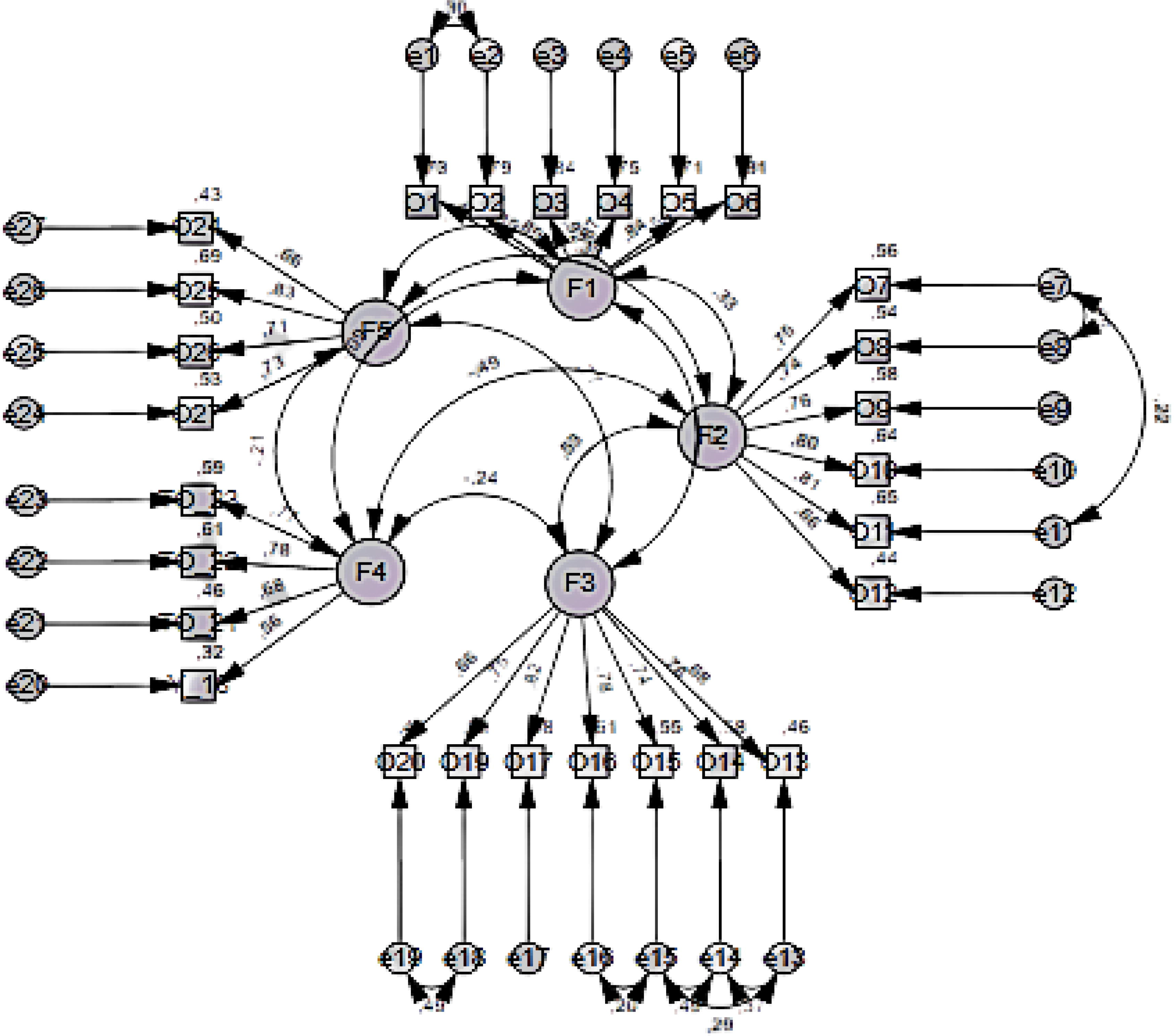
Factor loadings between the subscales and the items of the scale.
After the exploratory factor analysis, confirmatory factor analysis is done to determine whether the structure in the original study fits the sample to which the scale is applied. 24 The Chi-Square goodness-of-fit test, goodness-of-fit index (GFI), root mean square error of approximation (RMSEA), comparative fit index (CFI), and adjusted goodness-of-fit index (AGFI) are analyzed to assess the model’s fitness (Esin 2018). The fit index values were RMSEA = 0.55, GFI = 0.90, AGFI = 0.88, CFI = 0.94, and χ2/df = 2.8, which were found to be at an acceptable fitness level. These results showed that the construct validity of the model was achieved (Table 2).
Fit Index Values of Confirmatory Factor Analysis
root mean square error of approximation.
goodness-of-fit index.
adjusted goodness-of-fit index.
comparative fit index.
Chi‐Square fit test.
degree of freedom.
Reliability process
Internal consistency (Cronbach’s alpha and item-total score correlation), and time-dependent invariance methods were used for the reliability analysis.
Internal consistency
The reliability of the GAMEX, consisting of a total of 27 items, was assessed using item-total score correlation, test–retest correlation, and Cronbach’s alpha coefficient. The minimum value of the items should be 0.30 for the item-total test correlation to be sufficient. 22 The item-total score correlation values of the participant’s responses to the scale items were analyzed and it was found that there were four items below 0.30. When these items were removed from the scale separately, the internal consistency coefficients (Cronbach’s alpha) showed little deviation from the general internal consistency coefficient of 0.89. Therefore, it was decided to proceed with the analyses without omitting any item. The item-total score correlations of the scale ranged between r = −0.14 and r = 0.70 (Table 3).
Item-Total Statistics of the Scale
The internal consistency coefficient of the scale was found to be of very good value at 0.89, and the assessment tool was highly reliable. The Cronbach’s alpha internal consistency coefficients for the subscales were 0.91 for “Enjoyment,” 0.88 for “Absorption,” 0.87 for “Creative thinking and activation,” 0.78 for “Absence of negative affect,” and 0.81 for “Dominance.” Moreover, the mean scores of the total assessment tool and its subscales were analyzed. It was determined that the total mean score of the scale was 91.27 ± 14.03, the mean score of the “Enjoyment” subscale was 22.85 ± 4.24, the mean score of the “Absorption” subscale was 14.89 ± 5.41, the mean score of the “Creative thinking and activation” subscale was 24.00 ± 5.60, the mean score of the “Absence of negative affect” subscale was15.63 ± 3.31, and the mean score of the “Dominance” subscale was 13.89 ± 3.14 (Table 4).
Cronbach’s α Values and Mean Values of the Scale and Subscales
SD: standard deviation.
Test–retest reliability
The scale was applied again after 2 weeks (15 days) to 56 participants to analyze the test–retest reliability of the scale.
The time invariance of the scale was assessed by test–retest correlation. Test–retest correlations were found to be statistically significant for the total scale (r = 0.70) positively and at a high level, for the “Absorption,” “Creative thinking and Activation,” “Dominance,” and “Absence of negative affect” subscales positively and at a moderate level (r = 0.55; 0.63; 0.63; 0.52), and for the “Enjoyment” subscale positively and at a high level (r = 0.76) (P < 0.001).
Discussion
This study was conducted to determine the validity and reliability of the Turkish version of the GAMEX among nursing students by adapting it cross-culturally. Since there is no assessment tool for nursing students’ gameful experience in Turkey, this study is required for this culture. Moreover, there is only one study on the adaptation and validation of the scale in a different culture and language among nursing students. 20
After English–Turkish and Turkish–English translations to ensure the linguistic equivalence of the Turkish form of the GAMEX scale, the scale was decided to be comprehensible and applicable to the Turkish population, and the next steps were taken.
During the content analysis of the scale, 12 experts in the field of nursing assessed the items in the Turkish form using the Davis Technique, and after the assessment, some corrections were made in some expressions based on the recommendations of the experts. The CVI values of the scale items ranged between 0.833 and 1.000, and the CVI value obtained for the overall scale was found to be excellent at 0.972. When the literature was reviewed, it was observed that scale items with a value higher than 0.800 were appropriate for content validity, and those with a value of 0.900 and above were excellent.24–26 In this context, the average CVI coefficient of the Turkish form of the GAMEX scale showed that the content validity was quite good.
Before the exploratory factor analysis of the Turkish form of the scale, KMO and Bartlett’s tests of Sphericity should be run to determine whether the data are normally distributed, the sampling adequacy value, and the effect of sample size on the assessment results. This study showed that the KMO value was higher than 0.50 and Bartlett’s test of Sphericity showed a significant difference, indicating that the study sample was sufficient and fit for exploratory factor analysis.25,26,28,29
The 6-factor model of the scale was not supported, and the 5-factor model was validated. This result is not similar to the original data 18 or the validity study conducted in a different language. 20 The subscales of the original scale, “Creative thinking” and “Activation” were merged into “Creative thinking and Activation” and formed a single subscale in this study. The difference between the results of Eppman et al., 18 and Márquez-Hernández et al. 20 suggests that it may be correlated with language and sociocultural characteristics. In scale adaptation studies, cultural differences may cause changes in the number of items, subdimensions, and subdimensions in which the items are located. In this study, in which two separate subdimensions were combined, it is thought that the characteristics of Turkish culture and language were effective.22,24 Also, item 18 (while playing the game, I felt jittery), included in the “Activation” subscale in the original version of the scale, did not fit in this subscale in this study and was shifted to the “Absence of negative affect” subscale. This result was considered to be correlated with cultural characteristics. In Turkish culture, it is very difficult for individuals to express their emotions without hiding them. Especially when negative emotions are felt, avoidance behavior can be exhibited instead of expressing them. Therefore, it can be considered that item 18, involving the expression of negative emotion, is treated similarly to items 21, 22, and 23, involving the expression of negative emotion and students do not express their negative emotions due to cultural characteristics.
After the exploratory factor analysis, confirmatory factor analysis is done to determine whether or not the structure in the original study fits the sample to which the scale is applied. 24 The Chi-Square goodness-of-fit test, GFI, RMSEA, CFI, and AGFI are analyzed to assess the model’s fitness in the analysis. 24 In the study, it was found that the fit index values were at an acceptable level of fit. The values on the original version of the scale were at an acceptable level, similar to this study. This result showed that the factor structure of the Turkish form of the scale was similar to the original form structure.
Cronbach’s alpha analysis is used in Likert-type scales to determine the internal consistency of the data obtained from the scale. 25 A Cronbach’s alpha coefficient indicating internal consistency of <0.40 means that the scale is not reliable; a coefficient ranging from 0.40<α < 0.60 means that the scale has low reliability; a coefficient ranging from 0.60<α < 0.80 means that the scale is reliable; and a coefficient ranging from 0.80<α < 1.00 means that the scale is highly reliable. 28 This study revealed that Cronbach’s alpha coefficient of the scale was at a high level of 0.89. The Cronbach’s alpha value of the original version of the study was 0.85, and the Cronbach’s alpha value of the other validity study was 0.89. In this context, it was observed that the study showed a parallel with the other two studies.18,20
The same test is run on the same sample group at certain time intervals to determine the reliability of the scale against time. Although there is no definite information about the time that should elapse between the two tests, it is reported that it would be appropriate to apply the test at intervals of either two to three weeks or four to six weeks. 24 The correlations between the scores obtained after the test determine the time invariance of the test. The correlation coefficient is required to be at least 0.70 in time invariance. 23 In this study, it was found that the coefficients of the subscales of the Turkish form of the scale, which was applied at 2-week intervals, ranged between 0.52 and 0.76, the total coefficient was 0.70, and there was a significant correlation in all subscales, and the total score. The retest value of the scale in different cultures and languages was found to be 0.89 and showed a significant correlation. In this context, the significant correlation result of this study showed a parallel with the other adaptation study. 20
Another important finding in determining internal consistency is the item-total score correlation. A high item-total score correlation improves the reliability of that item, while a low correlation coefficient reduces reliability.24,29,30 The literature states that scale items with factor loads <0.30 should be removed.31,32 As stated before, the item total correlation coefficients of 4 items, namely items 18, 21, 22, and 23 in the original version of the scale, were found to be slightly below 0.30 in this study. Therefore, four items were removed from the scale separately, and the total item correlation was analyzed again. Based on the results of the assessment, it was observed that there were no significant changes in the factor loads of the items, even when the items were removed. Therefore, it was determined that the factor loads of the scale, with 27 items, varied between −0.14 and 0.70. Concordantly, Cronbach’s alpha coefficients, test–retest reliability, and item-total scale correlation coefficients of the scale showed that the internal consistency of the Turkish version of the scale was at a good level and the scale was a valid and reliable assessment tool.
Strengths and Limitations of the Study
The study is important as it is the first study to assess the experiences of nursing students in gamification applications, which have come out due to the change and development of learning methods in education–teaching processes, one of the important aspects of today, and to test the validity and reliability of the scale in Turkish. The limitations of the study are that the discussion is limited due to the lack of studies on this topic and nursing students from a single metropolitan region were included despite the large sample group.
Conclusion
According to the results of the data of this study, it was determined that the Turkish version of the GAMEX, consisting of 27 items and 5 subscales, was a valid and reliable scale to assess the gameful experience of nursing students in their education. This result is highly significant, as the scale is the first of its kind to assess the gameful experience of nursing students in the national arena and one of the few studies in the international arena. Accurate assessment of the gameful experiences of the students would enable a better understanding of the concept of gamification in the education and training process. In addition, the ability to assess the gamification experience would guide students to correct and improve their learning outcomes obtained from the gameful experience. Therefore, it is recommended to conduct new studies on the psychometric properties and conceptual structure of the scale in different languages and cultures.
Footnotes
Authors’ Contributions
T.Ç.İ.: Conceptualization, Methodology, Writing—Original Draft. G.Ş.B.: Formal analysis, and Writing—Review and Editing. O.İ., E.M.: Methodology and Investigation. All authors read and approved the final article.
Author Disclosure Statement
No competing financial interests exist.
Funding Information
The authors received no financial support for the research, authorship, and/or publication of this article.