




Abstract
Objective:
This study assesses the impact of single-player and multiplayer exergaming modes on improving exercise intentions, reduction of fear of falling, and emotional well-being among older adults, primarily from low socioeconomic status (SES) backgrounds—a group often underrepresented in exergame research.
Method:
We engaged 48 participants, primarily from low-SES communities in Singapore for a 4-week community-based exergaming intervention. Participants were divided into four groups as follows: (1) conventional exercise alone, (2) exergames alone, (3) exergames with a health coach, and (4) exergames with a peer. Using two-way repeated-measures ANOVA, we analyzed the effects of these interventions.
Results:
The findings revealed that all exergaming modes positively influenced exercise intentions, fear of falling, and emotional well-being to varying extents. Notably, exergaming with a health coach significantly improved participants’ exercise intentions and emotional well-being, underscoring the value of expert guidance in motivating and supporting older adults in adopting healthier lifestyles. Exergaming with a peer was most effective in reducing fear of falling, highlighting the importance of social support and peer interaction in addressing physical health concerns among this population.
Conclusion:
This study emphasizes the potential of tailored exergame interventions incorporating various social interactions to improve health outcomes for older adults, contributing to more inclusive health promotion strategies.
Introduction
Exercise games (exergames) have gained significant attention from health researchers for their potential to enhance the physical and mental health of older adults.1,2 By combining videogame elements with physical activity, ranging from movement and dancing to simulating sports actions, and incorporating advanced technologies like motion sensors or virtual reality to monitor movements, exergames provide a novel, enjoyable, and engaging approach to health promotion.3,4 Gamification elements in exergames, such as earning badges or points, make exercise routines more diverse and appealing, potentially leading to improved exercise adherence and enhanced health outcomes. 5 Studies also highlight the psychological benefits of exergaming among older adults, including improvements in self-perception and emotional satisfaction derived from achieving in-game goals, contributing to improved emotional well-being.1,6,7 Furthermore, exergames provide opportunities for social interaction, whether through multiplayer options or engagement within online communities, which may alleviate feelings of isolation and loneliness. 8
Despite the increase in research on exergaming for physical and mental health, there remains a dearth of studies focusing on older adults with low socioeconomic status (SES). This gap necessitates attention, given that this population encounters barriers, including restricted access to technology, diminished digital literacy, and a higher prevalence of health and mobility impairments.9,10 These barriers have led to low SES older adults being underrepresented in exergames studies, potentially exacerbating health inequalities. 11 The benefits of exergames are particularly relevant for low SES older adults, who often face a higher prevalence of physical ailments and greater stress because of economic instability and other social determinants of health. While research on exergames for low SES older adults is limited, broader research on digital health technologies suggests that exergames may have great potential to improve their physical and mental health. For example, a study of a digital literacy program in Singapore showed significant postintervention improvements in self-reported digital literacy, loneliness, and social connectedness among low-SES participants. 12 Such findings could inform the development of targeted health promotion programs and policies that leverage technology to reach and benefit underserved communities. The inclusion of low SES older adults in exergaming interventions is imperative to prevent the emergence of “one-size-fits-all” health solutions that may exclude this population who need to be well-served by technology.
Therefore, this study examines the effectiveness of community-engaged exergame interventions in improving the physical and mental health outcomes of older adults. Specifically, we investigate the impact of different exergaming modes—playing alone, with a health coach, or with a peer—on (1) exercise intentions, (2) fear of falling, and (3) emotional well-being. Drawing from the self-determination theory (SDT), 13 the study focuses particularly on relatedness motivation, which posits that fostering a sense of connection with others significantly boosts the motivation to engage in health-promoting behaviors. 13 By exploring various modes of exergaming, including individual play, assistance from health coaches, and peer-supported activities, this research examines how these interventions can be tailored to enhance the physical and emotional well-being of underserved populations given their unique challenges faced by them (limited access, higher fall-risk, poor emotional well-being).14–16
Literature Review
Single versus collaborative gameplay
Exergames, which may incorporate both single and collaborative gameplay, can potentially vary in their impacts on older adults. Single-player gameplay emphasizes personal fitness goals within a noncompetitive, socially independent context, offering an individualized exercise experience devoid of the potential stressors associated with competition or direct social interaction. 17 This mode is particularly suitable for individuals who prefer autonomy in their exercise routines or who may feel discomfort in group settings, enhancing comfort and engagement through privacy. 17 However, low-SES older adults may benefit more from opportunities for social interaction, which are more readily available in collaborative exergames than in single-play modes.
According to SDT, the need for relatedness, which emphasizes the importance of feeling connected and belonging to a social milieu, 13 plays an important role in motivating behaviors that contribute to well-being. When the need for relatedness is satisfied, individuals are more likely to internalize and value behaviors that are encouraged within their social environments. Collaborative exergaming inherently satisfies the need for relatedness by facilitating social connections and interactions, which can be particularly beneficial for low-SES older adults who might otherwise face social isolation and emotional challenges. Thus, collaborative gameplay may foster more internalized motivation for exercise, leading to sustained engagement and improved health outcomes. For example, one study demonstrated that engaging in gameplay with another player was highly effective, simultaneously boosting enjoyment, future motivation, and physical intensity. 18 Moreover, groups often demonstrate higher compliance with shared goals like exercise, deriving physical and mental satisfaction from these social interactions.17,19 This aspect is important for older adults who might have limited social engagement opportunities.
This study examines two collaborative modes as follows: playing with a health coach and with a peer. Health coaches are professionals skilled in setting and achieving health goals, possessing expertise in exercise and health management. 20 Interacting with a health coach offers expert guidance in exergame play. In addition, the sense of approval and support from a health coach can increase motivation for individuals to consistently participate and put forth their best effort. 21 Prior studies have underlined the effectiveness of health coaches in aiding low-SES populations, creating a positive social atmosphere conducive to achieving health goals. 22 In contrast, playing exergames with peers represents another effective collaborative approach. Unlike more hierarchical communication forms, such as professional or doctor–patient interactions, peer collaboration provides an egalitarian communication style. 7 Exercising with peers, who may share similar life experiences or health challenges, promotes empathy and mutual support. This approach facilitates learning and motivation through observation and creates an empathetic and supportive environment. 23 Emotional support from peers is characterized by understanding and empathy, fostering a sense of community and belonging, which is important for exercise motivation and positive health outcomes. Based on these considerations, this study posed the following research question (RQ):
Methods
Study design
This study used a 2 (changes over time: pretest vs. post-test) × 4 (play groups: conventional exercise group vs. play exergames alone vs. play exergames with a health coach vs. play exergames with a peer) mixed factorial design in Singapore. We collaborated with local communities to recruit older adults from lower SES groups. The field experiment was conducted from November 2022 to February 2023. After informed consent, participants completed a pretest questionnaire and were assigned to one of four groups as follows: (1) conventional exercise (N = 11), (2) exergames alone (N = 10), (3) exergames with a health coach (N = 10), and (4) exergames with a peer (N = 20). The intervention was conducted weekly, with a post-test survey in the fourth week. Three participants withdrew, resulting in 48 completing the study. Figure 1 illustrates the process.
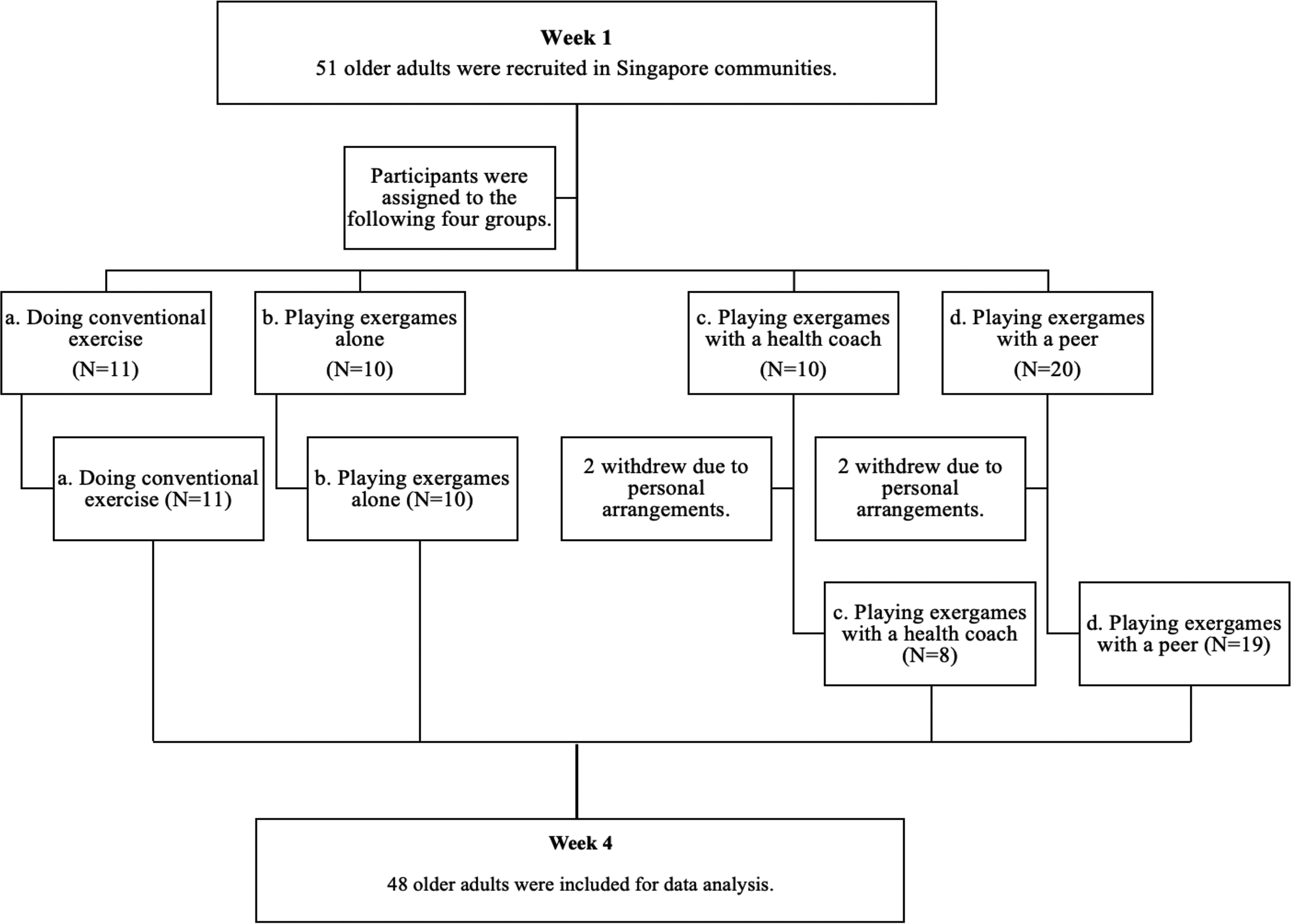
The schematic overview of the field experiment process.
Intervention
The intervention comprised one comparison group (conventional exercise) and three exergames groups, with each session lasting 30 minutes, once a week for 4 weeks. The conventional exercise group performed the “7 Easy Exercises” designed by the Singapore Health Promotion Board to enhance muscle strength and power in older adults, emphasizing upper and lower limb strength and flexibility. 24 We selected the following three exergames from Kinect that aligned with these physical objectives: (1) Fruit Ninja, enhancing upper limb agility and reflexes through virtual fruit slicing motions; (2) Piano Steps, focusing on lower limb strength and balance through piano-playing foot motions; and (3) Arctic Punch, targeting upper limb power through virtual ice-breaking arm movements. Health coaches from the local community were selected based on their enthusiasm for promoting active living among older adults. They participated in two comprehensive health coaching workshops to guide participants through the exergames, ensuring engagement and safety. Their contribution was important, providing consistent and personalized coaching throughout the four-week experiment.
Participants
Participants were recruited primarily from low-SES groups, using a focused one-to-one outreach approach within the Singaporean community. Table 1 shows the demographics of the 48 older adults (aged 60–85 years, median 71 years, standard deviation [SD] = 6.68) who completed the 4-week experiment. The gender distribution was 83.33% female (n = 40) and 16.67% male (n = 8). Most participants were from lower SES backgrounds, with 83.33% (n = 40) of the older adults in our sample having a monthly income below S$2000 and 85.42% (n = 41) having an education level of secondary school or below.
Demographics of Participants (N = 48)
SD, standard deviation.
Measurements and data analysis
Table 2 presents the study’s following dependent variables: intentions to exercise, fear of falling, and emotional well-being, along with their corresponding mean scores, SD, and Cronbach’s alpha. The Shapiro–Wilk test confirmed that the dependent variables were normally distributed (P > 0.05). We conducted a two-way repeated-measures ANOVA to assess the effects of the following: (1) the mode of exergame engagement (conventional exercise alone, playing exergames alone, playing exergames with a health coach, and playing exergames with a peer) as a between-participants factor, and (2) time (preintervention and postintervention) as a within-participants factor, on these dependent variables. A bootstrapping analysis with 2000 resamples was used to enhance reliability and address potential violations of ANOVA assumptions, generating bias-corrected and accelerated 95% confidence intervals (CIs) for the effect sizes.
Measurement Items
Results
The correlation matrix (Table 3) showed a significant positive relationship between fear of falling and emotional well-being at baseline (r = 0.35, P < 0.01), suggesting that proactive engagement with fall-related risks may contribute to a sense of preparedness and thus better emotional well-being. Postintervention, a significant correlation was maintained between intention to exercise and fear of falling (r = 0.43, P < 0.01), reflecting that those who fear falling are more likely to increase their intentions to exercise. The absence of significant correlations involving emotional well-being postintervention indicates that the initial relationships did not persist. Detailed results of the two-way repeated-measures ANOVA and post hoc comparisons are presented in Tables 4 and 5, respectively.
Correlation of the Intention to Exercise, Fear of Falling, and Emotional Well-Being
P < 0.05.
P < 0.01.
Repeated ANOVA Results of Four Groups
P < 0.05.
P < 0.001.
Post Hoc Results of the Repeated ANOVA
All P values reported are Bonferroni-corrected for multiple comparisons.
P < 0.05.
P < 0.005.
CI, confidence interval; LL, lower limit; SE, standard error; UL, upper limit.
Effects of different modes of exergames on intention to exercise
The repeated-measures ANOVA indicated no main effect for the mode of exergaming on exercise intention (F(3, 44) = 1.01, P = 0.40;
Effects of different modes of exergames on fear of falling
For fear of falling, no significant main effect was observed for exergaming mode (F(3, 44) = 1.01, P = 0.54;
Effects of different modes of exergames on emotional well-being
No significant main effect of exergaming mode was found for emotional well-being (F(3, 44) = 0.71, P = 0.55;
Discussion
This study examined the impact of different exergaming modes on enhancing exercise intentions, reducing the fear of falling, and improving emotional well-being in a sample of predominantly older adults from lower SES backgrounds. The findings indicated that exergames, especially when played in collaborative settings, offer more substantial benefits than conventional exercises. Playing exergames with a health coach led to significant improvements in exercise intentions and emotional well-being, whereas playing exergames with a peer proved to be particularly effective in reducing the fear of falling. These insights underscore the importance of interactive and social approaches in tailoring exergaming interventions to address specific health concerns for older adults from lower SES backgrounds.
Participants in the exergaming groups demonstrated increased exercise intentions, decreased fear of falling, and improved emotional well-being compared with the conventional exercise group. These findings are consistent with existing literature, which suggests that exergames are more engaging and enjoyable than traditional forms of exercise, leading to better adherence and improved health outcomes.2,8 The psychological benefits provided by exergames, such as a sense of achievement, enjoyment, and social interaction, are crucial in motivating older adults to exercise and derive pleasure from the activity. 7 This enhanced motivation and enjoyment likely contribute to their improved exercise intentions and emotional well-being. In contrast, a decline in exercise intention was observed in the conventional exercise group. This could be attributed to the repetitive and physically demanding nature of traditional exercises, coupled with a lack of immediate, perceivable health benefits. 28 Furthermore, the absence of social and interactive elements in conventional exercises may have played a role in diminishing motivation and interest. 29
Our examination of collaborative participation in exergames yielded insightful findings. Interacting with a health coach significantly increased participants’ intention to exercise and their emotional well-being. Health coaches who provide professional guidance proved crucial in building confidence among participants, many of whom lack access to specialized health information. 21 This guidance extends beyond education, as it instills a sense of recognition and connection to a more informed health community. 24 This interaction is not merely instructional but empowering, significantly elevating participants’ well-being.
The impact of playing exergames with peers also emerged as an important aspect of our study. This mode was particularly effective in reducing the fear of falling among older adults. Engaging with peers allowed participants to observe others in their age group successfully participating in physical activities, providing social comparison and reassurance.8,17 This peer-based interaction, characterized by its egalitarian communication nature, created a supportive and empathetic environment. 30 The shared experiences and strategies among peers proved to be both relatable and comforting, significantly reducing anxieties related to falling. 31 This finding is especially important, considering the psychological barriers that often impede physical activity among older adults. The peer-led approach in exergames thus represents a vital tool in mitigating these fears and encouraging more active lifestyles in this group.
Theoretical and practical implications
Theoretically, our study enhances the exergaming literature by examining the impact of diverse participation modes, specifically interactions with health coaches and peers, on the health outcomes of older adults. Our findings deepen the understanding of how different types of social interactions in exergames can influence key health behaviors and outcomes, such as exercise intentions, fear of falling, and emotional well-being. Practically, our results suggest that exergaming interventions fostering social support networks and offering tailored training for older adults could be effective in improving their health outcomes. We emphasize the value of integrating trained health coaches into these programs, as they can effectively guide and support participants in adopting health technologies and improving their overall well-being. In addition, the role of peer support is highlighted for enhancing behavioral confidence and motivation among older adults, suggesting that interventions promoting social interaction and peer-to-peer learning could be highly beneficial for this population. Future research could explore how these findings may apply or differ across various socioeconomic groups, potentially contributing to the development of more inclusive and effective exergaming interventions.
Limitations
While our study provides valuable insights, some limitations should be considered. Our sample had a higher proportion of female participants and primarily consisted of individuals from lower-income groups, which may influence the generalizability of our findings. Future research could benefit from exploring these interventions with a more diverse participant pool, including a more balanced gender representation and individuals from various socioeconomic backgrounds. This would help to understand how exergaming benefits may vary across different demographic groups. In addition, the study design focused on comparing different exercise modalities rather than including a nonexercise control group. Incorporating a nonexercise control group in future studies could provide further insights into the effectiveness of exergaming interventions.
Conclusion
This study highlights the potential benefits of exergaming, particularly when played with a health coach or peer, for older adults. Our findings underscore the value of interactive and social approaches in exercise interventions for this population. While acknowledging the need for further research with diverse populations, this study contributes to our understanding of how technology-based interventions might promote health and well-being among older adults. Future studies can build on these findings to explore tailored exergaming interventions, potentially contributing to reducing health disparities through innovative, engaging exercise solutions.
Authors’ Contributions
H.B.: Conceptualized the study, managed field interventions, data collection and analysis, and oversaw manuscript preparation and publication. Dr. S.G.S.P. and Dr. N.B.S.: Guided the data collection and analysis. B.T.P.P.: Managed field interventions, contributed to the intervention design, and facilitated community communication. S.M.S.S.: Assisted with data collection and provided guidance on exergames usage. Dr. Y.L.T. and Dr. E.W.J.L.: Provided supervision throughout the research and guided the study direction, as well as manuscript editing.
Author Disclosure Statement
No competing financial interests exist.
Footnotes
Funding Information
This work was supported by the National Research Foundation, Prime Minister’s Office, Singapore, under its Campus for Research Excellence and Technological Enterprise (CREATE) programme through the Intra-CREATE Seed Collaboration Grant (NRF2021-ITS009-0012). It was also supported by the Tsao Fund (022477-00001) at Nanyang Technological University, Singapore.