




Abstract
Objective:
To evaluate the effects of a 4-week “BikeRacer-Multitasking” computer-based training program on various outcomes, such as multitasking ability, and performance in complex situations on a bicycle exercise course, in comparison with two active control groups.
Materials and Methods:
Randomized controlled study including 56 participants aged 65 years or older. The intervention group (IG) performed 4 weeks of training with the BikeRacer-Multitasking computer game, in which two tasks had to be carried out at the same time: steering a bicycle on a given path, reacting to a target stimulus as quickly as possible, and ignoring three further distractor stimuli. The first control group (CG1) trained with a version of the BikeRacer game without the multitasking component, and the second control group (CG2) played Sudoku. All three groups performed questionnaire-based psychometric performance tests and tasks on a real-life bicycle exercise course twice, before and after the intervention.
Results:
Processing speed improved significantly over time in all three groups. Selective attention (correct answers) significantly improved in the IG and CG1, but not in CG2 (P = 0.022 for the interaction). Multitasking ability and divided attention significantly improved in IG, decreased in CG1, and showed no change in CG2 (P = 0.005 for the interaction). All three groups showed significantly better performances in some of the multitasking components in the bicycle course after the training compared with before (no significant group interaction).
Conclusion:
BikeRacer-Multitasking game increased the multitasking ability of senior cyclists as well as their performance in complex situations of a bicycle exercise course.
Introduction
Physical activity, including active forms of mobility such as walking, riding a bicycle, or using pedelecs or e-bikes, is key to preventing and managing major chronic diseases in older people and helps preserve physical function and mobility. It can also prevent or delay the onset of major disabilities and frailty and increase quality of life.1–4 However, the proportion of older people fulfilling the recommendations for physical activity remains small.2,5–7
The bicycle is a healthy, environmentally sustainable, and easily accessible mode of transport, which is typically well liked by older people. Psychosocial factors such as low self-efficacy, low perceived benefits, or perceived barriers are associated with lower bicycle usage in older adults. 8 But especially fear of traffic, fear of collision with motor vehicles, and fear of other road users disregarding the rules of the road, as well as perceived stigmatization of older cyclists, are factors that reduce the use of bicycles or e-bikes by older people. 9
Indeed, safety concerns regarding older citizens using bicycles or e-bikes have been raised as an important public health issue. Older cyclists contribute to a high number of head injuries and fatalities. Risk factors associated with increased injuries in older adults riding bicycles include poor vision, reduced muscle strength and balance, and declining cognition. Measures recommended to increase safety among older bicycle users include wearing protective gear like helmets, avoiding riding in areas with high traffic, and choosing an appropriate bicycle. 10
Participating in road traffic requires a broad set of cognitive functions such as attention, perceptual processes, and various motor actions and becomes increasingly challenging with higher age. This is a result of declining neurophysiological resources, 11 such as attentional control, 12 and often leads to safety errors. 13 One of the most important neuropsychological resources needed in road traffic, especially in cycling, is multitasking, which describes the ability to handle different tasks simultaneously, because different information channels have to be considered at the same time in road traffic. It has been shown in previous studies that cognitive control, especially multitasking, can be trained in older adults using video game training.14,15 The effect of such training can be maintained for multiple years. 16
The aim of this study was to evaluate the effects of the computer-based training “BikeRacer-Multitasking” on the performance of bicycle riders aged 65 years or older.
Materials and Methods
The study was a randomized controlled trial with one intervention group (IG), who performed the BikeRacer-Multitasking training, and two active control groups: control group 1 (CG1) used a simple version of the computer-based bike training program without the multitasking component, and control group 2 (CG2) played Sudoku. All participants were examined before the intervention (t0) and 4 weeks after the initial examination (t1) with questionnaires, a test battery of psychological performance tests, and tasks on a bicycle exercise course.
Participants
Participants were recruited via advertisements in target-group-specific magazines and via the in-house database at Academy for Ageing Research at Haus der Barmherzigkeit. Inclusion criteria were being aged 65 years or older and being able to ride a bicycle. The first 69 persons who answered the call were randomly allocated to IG, CG1, or CG2. All participants signed an informed consent form, which was sent to them by mail prior to the study.
Intervention and control groups
The participants were asked to perform their given tasks for 4 weeks, three times per week, with at least one day in between the training units. The tasks were done at home. Participants were instructed to document the day and time of their training. No data on their performance in completing the tasks were recorded, as the assessment of possible intervention effects relied on other evaluation methods, as described below.
Intervention group: BikeRacer-Multitasking training program
The BikeRacer-Multitasking training program is a computer game that was specifically developed to be used by the IG of this study. The participants had to manage two tasks at the same time: steering a bicycle on a given path shown on the screen and reacting to a target stimulus as quickly as possible while ignoring three distractor stimuli. The participants had to respond to one of the following target stimuli: blue square, yellow triangle, green cross, and red circle, which appeared on the screen. The target stimulus was randomly selected; the other three were the distractor stimuli, to which the participants should not react. If the response to the target stimulus was correct within the specified time, this was confirmed by a tick appearing on the screen. When leaving the track, a prompt to return to the track was displayed. One round lasted 3 minutes, during which target stimuli and distractor stimuli were displayed. At the end of the game, the display showed how often and for how long the track was left, how many of the target stimuli were responded to correctly, and how many of the distractor stimuli were responded to incorrectly. The game always started with the easy difficulty level for bike speed and stimulus duration. The level of difficulty adapted to the performance of the users, challenging them constantly without under- or over-challenging them. Each training session consisted of 12 rounds (i.e., 36 minutes of playing time). Screenshots of various game situations are depicted in Figure 1.
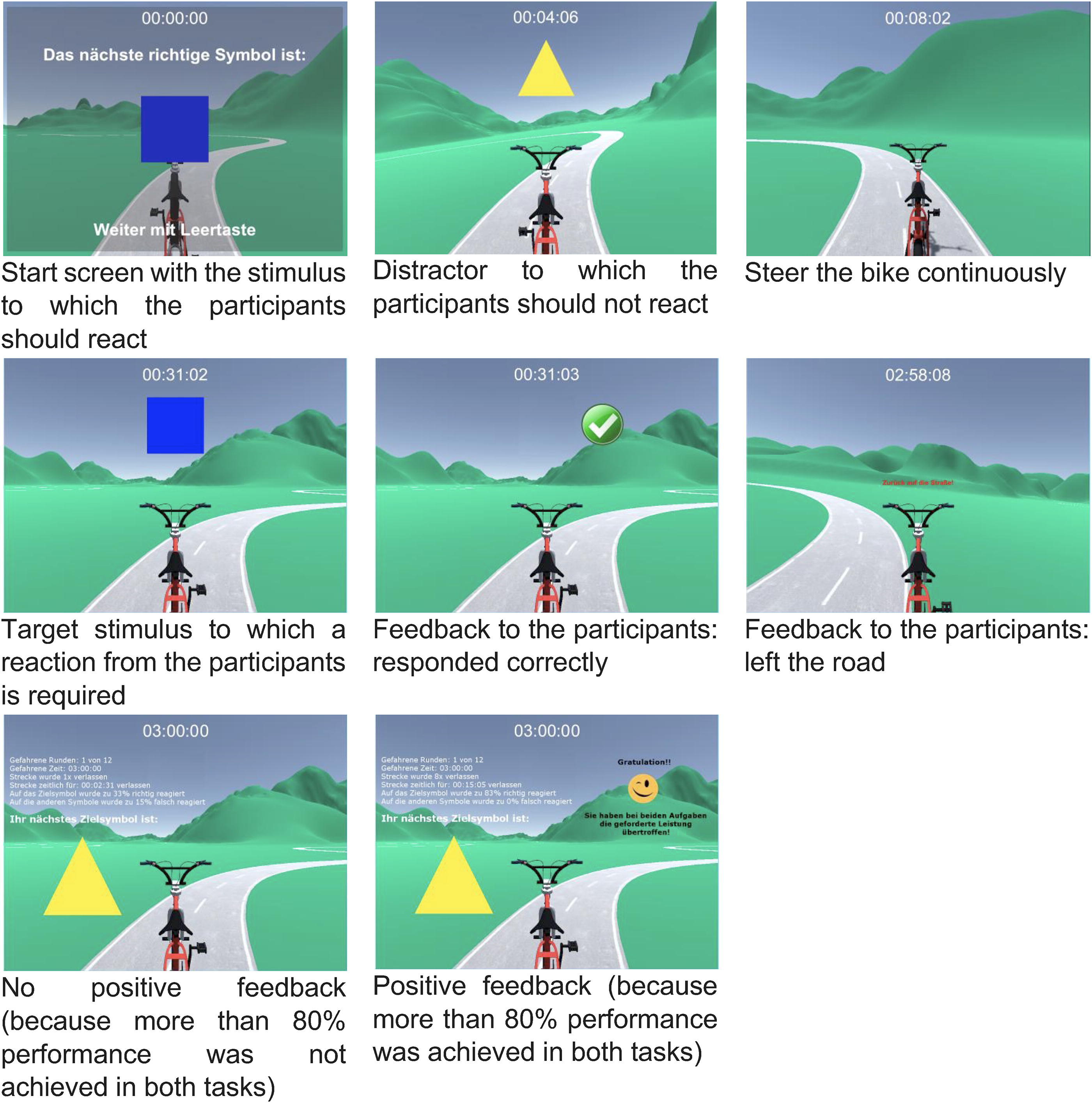
Screenshots of various game situations of the BikeRacer-Multitasking computer-based training program.
Control group 1: Bicycle game
The first active control group (CG1) played the same game as the IG, steering a bicycle on a given path, but without reacting to stimuli. Thus, selective attention was trained, but not multitasking.
Control group 2: Sudoku
The second active control group (CG2) was instructed to play Sudoku for 40 minutes each session, either on a computer or as a paper–pencil variant, depending on individual preferences.
Evaluation of intervention effects
All participants were evaluated at baseline (t0) and after completing the 4-week training period (t1) with a comprehensive performance assessment. This assessment consisted of standardized questionnaire- and computer-based psychometric performance tests, self-made questionnaires, and different practical tasks on a bicycle exercise course. The tests lasted 1.5–2 hours per participant.
Standardized psychometric tests
The psychometric evaluation included pen-and-paper tests and computer-based assessments. Table 1 provides an overview of all the tests that were used and their procedures.
Description of the Standardized Psychometric Tests Utilized for the Pre- and Postintervention Evaluation

d′ is the difference between the z-transformed relative number of correct hits and false alarms.
Calculated via the formula:
#Correct, number of correct reactions/answers; #wrong, number of wrong reactions/answers.
Working memory and processing speed were examined with a repeating numbers test and a number-symbol test, respectively, which are subtests of the geronto-psychological test inventory “Nürnberger-Alters-Inventar” (NAI). The NAI was developed to determine cognitive functions in older adults and is often used to assess age-dependent cognitive decline in the target group. 17 For working memory, the NAI repeating numbers test was used. Participants had to repeat a series of numbers of different lengths forwards (length of the number series from three to nine numbers) and backwards (from two to eight numbers). The maximum achievable point value for this task was 17. To assess processing speed, the NAI number-symbol test was used, where the number of certain symbols that were correctly assigned to defined numbers within 90 seconds was reported. Short-term memory was assessed with the number memory subtest of the Arnold Kohlmann memory test, a user-friendly and time-efficient test that was developed in the 1950s, primarily for measuring dementia symptoms.18,19 In this test, 10 two-digit numbers were read out to the participants once, which were then to be reproduced immediately in any order. The number of correctly remembered numbers was reported.
Selective attention, that is, the ability to voluntarily turn to relevant stimuli, to grasp them selectively, and to carry out a desired action, was determined with the computer-based Cognitrone test. This test is a subtest of the “Wiener Testsystem” (WTS) and is often used in traffic psychology to assess roadworthiness. 20 Multitasking ability and divided attention were assessed with a WTS subtest for perception and attention functions, the WAFG (“Wahrnehmungs- und Aufmerksamkeitsfunktionen: geteilte Aufmerksamkeit”). 21 The sum of correct reactions and the sum of wrong reactions were reported. For analysis of this test, the sensitivity measure d′ was calculated as the difference between the z-transformed relative frequencies of hits and false alarms (d′ = z[p(hit)] − z[p(false alarm)]). 22 A larger d′ means better performance. Reflexivity and impulsivity were assessed with a WTS subtest that compares surface sizes and was originally part of an assessment of working postures. 23 The test value for reflexivity/impulsivity was calculated with the following formula: 10,000 × (20 − number of wrong answers) + 100 × number of correct answers + number of no decision. A higher value indicates higher reflectivity/impulsivity.
Self-made questionnaires
Subjective sense of security as well as the acceptance of the trainings were evaluated with self-made questionnaires, in which 12 or 9 items, respectively, could be answered with a four-point Likert scale. Additionally, sociodemographic variables and frequency of riding a bicycle within the 4 weeks prior to inclusion were recorded.
Bicycle exercise course
To assess whether potential improvements in attention and multitasking from the intervention translate to actual traffic scenarios, participants completed practical exercises on a bicycle. The exercises were performed on an outdoor cycling practice area, run by a traffic club, where real-life conditions for bicycling could be simulated without the dangers of a real-road traffic. The participants could bring their own bicycle or lend one from the club. Before the start of the bike course, the height of the handlebars and the saddle was adjusted to the individual needs of the participants, and a suitable bike helmet was selected. The bike course included the following traffic situations: (1) turn off the bicycle path onto a main road: look over the shoulder and make the correct hand signal; (2) change lanes to avoid a construction site: look over the shoulder and make the correct hand signal; (3) roundabout: enter the roundabout correctly and make the appropriate hand signal when exiting; (4) stop sign: stop in front of a stop sign, make sure that there is no cross traffic; and (5) give way sign: make hand signal to give priority. An observation log was created to record the traffic behavior of the participants. A sum score of the frequency of hand signals given correctly (max. 4) and entering the roundabout correctly (max. 1) was computed and is presented (everything correctly gives a score of 5).
A total of five laps were completed: (1) The first lap was a practice lap to familiarize the participants with the course. The participants were instructed to drive through the route while observing the traffic signs and traffic rules. Speed was not recorded for this lap. (2) In the second lap, the participants were instructed to drive through the route while again observing the traffic signs and traffic rules. This time, the behavior of the participants was logged, and the lap time recorded. After crossing the finish line, the participants were asked which traffic signs were the last three they passed. Laps 3–5 served to test the attention and multitasking ability of the subjects. For this purpose, target and distraction stimuli were added to the bicycle course. These stimuli were placed on the right or left side of the road in the form of small two-colored wooden plaques that were specially made for this course. The participants had to respond to the target stimuli by ringing the bell (e.g., to all red stimuli) but should ignore all other color stimuli. In total (laps 3–5), 25 target stimuli were given to which the participants had to respond with ringing the bell, and the number of correct ringing was reported. (3) In lap 3, the participants were instructed to ring the bicycle bell once for each target stimulus (i.e., for each color). The ringing was recorded with a voice recorder. The color of the target stimuli changed from lap to lap. (4) For the fourth lap, the participants were given another task in addition to riding the bicycle and ringing the bell following the target stimulus: arithmetic problems were played back via a voice recorder mounted on the handlebars of the bicycle. The arithmetic tasks were to be solved, and the results pronounced loudly and clearly. The answers were recorded via a second voice recorder which was strapped in a small pouch under the test person’s chin. The calculations were given to everyone at the same pace, so people who took longer to finish the lap also received more arithmetic problems. Therefore, a coefficient was calculated that was standardized to the lap time (performance per unit time p/t = [1 − number of incorrectly solved tasks/number of tasks completed]/lap time). (5) In addition to driving through the course and ringing the bell for target stimuli, the last round included a memory task: word list learning and retrieving from the German version of the test battery of the “consortium to establish a registry for Alzheimer’s disease” (CERAD).24,25 Words from the memory test were played back on the voice recorder mounted on the bicycle’s handlebars. Each participant was given 10 words to remember within a period of 40 seconds, and the task was to memorize the words as well as possible. Immediately after crossing the finish line, they were asked to recall any words they had remembered, and the number of correctly remembered words was reported.
Statistical analysis
Potential differences in baseline characteristics of the three groups were assessed using the Kruskal–Wallis test. The effect of the intervention was analyzed using analyses of variance (ANOVA) for repeated measures with the twofold repeated measure factor “time” (t0/t1) and the threefold group factor (IG, CG1, CG2). If the prerequisites for an ANOVA were not met (e.g., because the interval scale level was not reached or there was no normal distribution [Shapiro–Wilk test]), the Wilcoxon signed-rank test was applied. P values <0.05 were considered significant.
Results
Of the 69 persons who initially agreed to participate, 1 did not show up to the baseline examination, and 5 did not participate in the follow-up examinations. Of the remaining 63 persons, 7 were excluded: 5 because they were statistical outliers in the WAFG multitasking test (more than 2 standard deviations below the mean), 1 person forgot the screen glasses for the examination and therefore could not participate in one of the computer-based psychometric tests, and 1 person was excluded because less than two-thirds of the training units were performed. Therefore, 56 persons were included in the analysis: 19 in the IG and CG1, respectively, and 18 in the CG2. As shown in Table 2, essential sociodemographic characteristics and variables related to traffic utilization did not differ between the three study groups.
Comparison of Characteristics Between the Groups
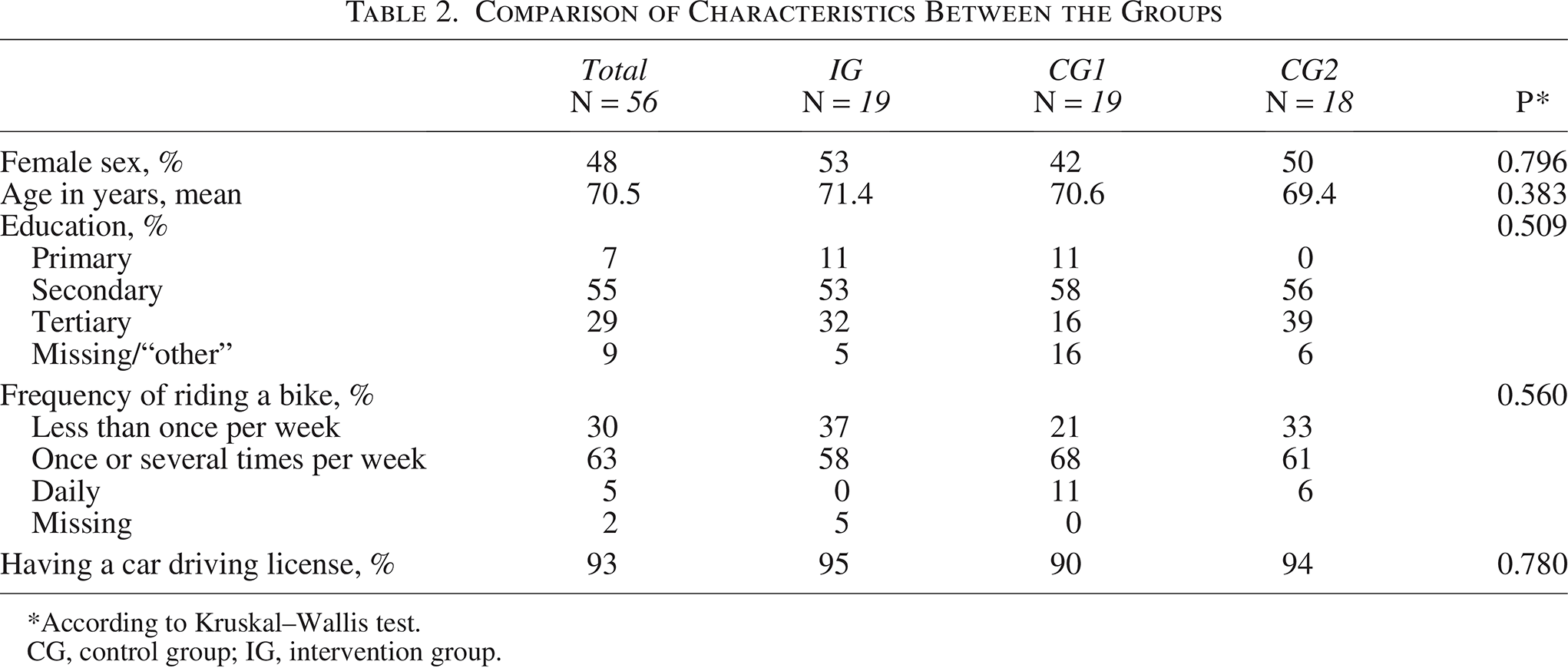
According to Kruskal–Wallis test.
CG, control group; IG, intervention group.
Table 3 shows the results of the psychometric tests before and after training in the respective groups. Working memory did not change between t0 and t1, nor was there a difference between the groups. Processing speed improved significantly over time in all three groups; however, there was no difference between the groups. Short-term memory significantly decreased in CG2, but there was no change in the other groups. Selective attention (correct answers) significantly improved in the IG and CG1, but not in CG2. Additionally, according to the ANOVA, there was a significant interaction between time and groups for this test. The analysis for the sum of incorrect reactions for selective attention did not show any significant results. Multitasking ability and divided attention, as measured via the WAFG, significantly improved in the IG and significantly deteriorated in CG1 but showed no change in CG2. For this parameter, the interaction between time and group was significant. Reflexivity/impulsivity did not change significantly in any group.
Comparison of Questionnaire Test Results at Baseline and After 4 Weeks of Training in the Three Groups
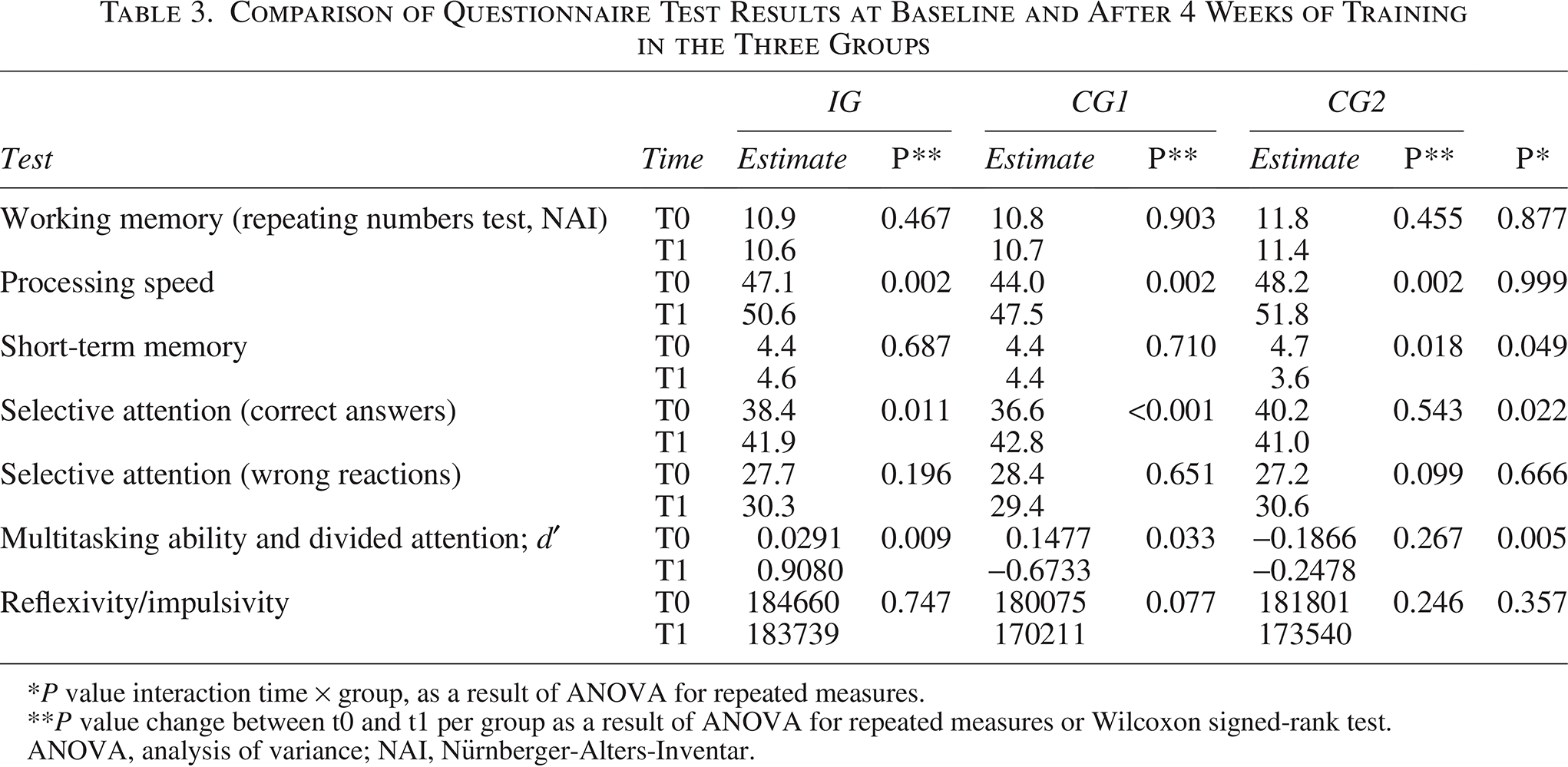
P value interaction time × group, as a result of ANOVA for repeated measures.
P value change between t0 and t1 per group as a result of ANOVA for repeated measures or Wilcoxon signed-rank test.
ANOVA, analysis of variance; NAI, Nürnberger-Alters-Inventar.
In Table 4, the results of the practical bicycle exercise course are depicted. All groups completed round 2 significantly faster than the following rounds, in which, in addition to cycling (primary task), a secondary (ringing the bike bell as a reaction to target stimuli) or tertiary task (mental arithmetic in lap 4 or remembering words in lap 5) had to be carried out. In lap 2, there was no significant difference in lap times between t0 and t1. In lap 3, lap times were significantly better in IG and CG1 at t1 compared with t0; in lap 4, all three groups had better lap times at t1 compared with t0; and in lap 5, only the IG had significantly better lap times at t1 compared with t0. The frequency of giving the correct hand signs and correctly entering the roundabout did not change significantly for any of the groups. There was no significant difference between the groups in their ability to remember the last three traffic signs. However, CG2 showed a significant drop in performance. There was no significant difference between the groups nor in the comparison of the two time points for ringing the bell after the target stimuli in any of the three laps measured (laps 3–5). The ability to solve arithmetic problems in lap 4 improved equally in all three groups. All groups significantly improved their performance in the word memory task in lap 5, after the intervention.
Comparison of Bicycle Exercise Course Results at Baseline and After 4 Weeks of Training in the Three Groups
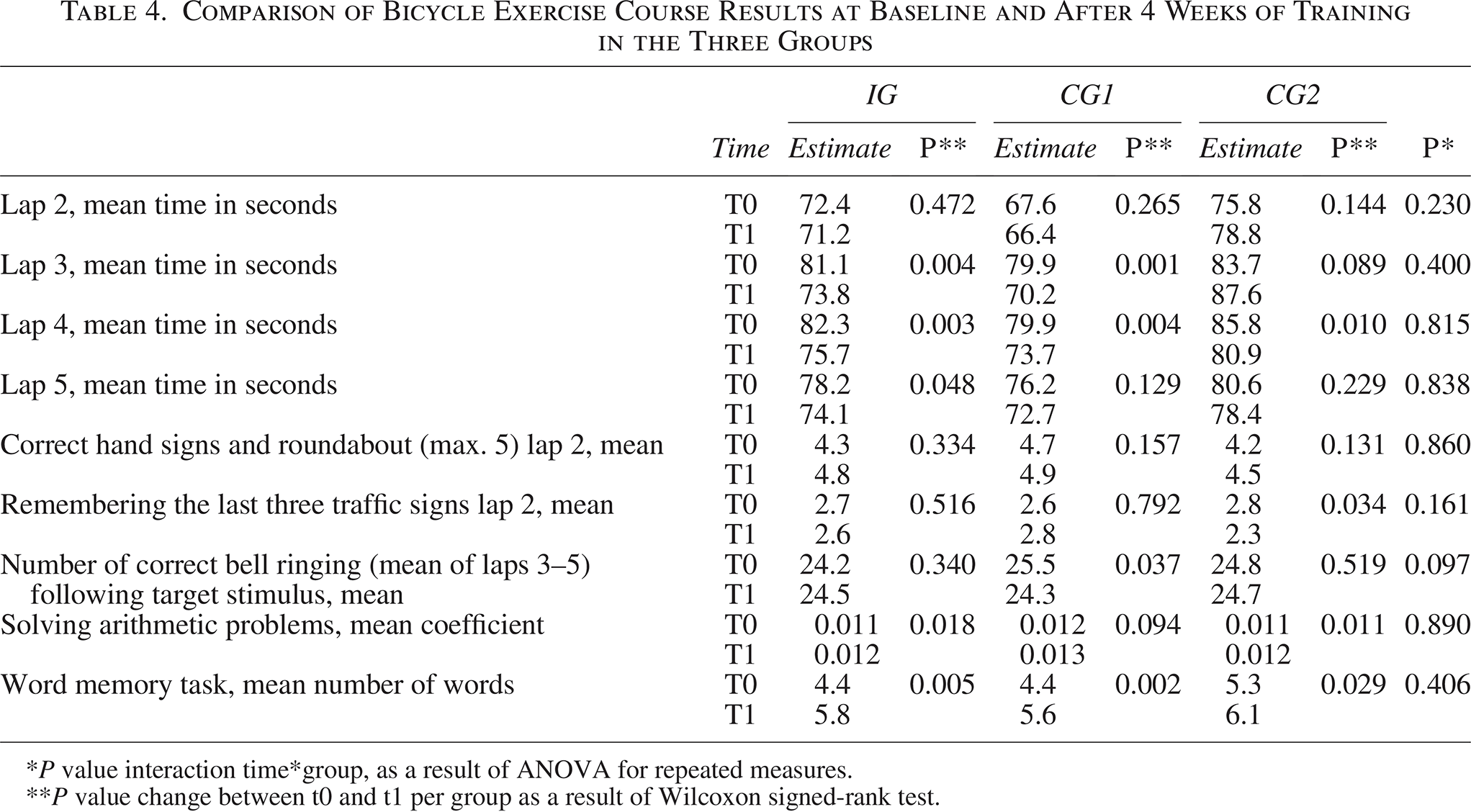
P value interaction time*group, as a result of ANOVA for repeated measures.
P value change between t0 and t1 per group as a result of Wilcoxon signed-rank test.
The analysis of the subjective sense of security showed that there was neither a baseline difference between the groups, that is, the groups did not differ in any of the 12 questions, nor was there a change in the assessment per group over time. Regarding acceptance of the training, significant group differences were found. Playing Sudoku (CG2) achieved the highest level of acceptance, closely followed by the BikeRacer-Multitasking training (IG). Training with the bicycle game (CG1), in which only the bike had to be steered, was fun for most, but the majority of participants could not imagine continuing to play it voluntarily and considered it rather boring.
Discussion
Our study showed that 4 weeks of training with a computer-based multitasking training program in which two tasks had to be carried out at the same time (steering a bicycle on a given path and reacting to the correct stimuli as quickly as possible) had effects on various outcomes, in comparison with two different active control groups, while other outcomes were not affected.
The results of the psychometric performance tests showed a complex picture. Multitasking ability and divided attention, as measured via the WAFG, significantly improved for the IG, but not for the two control groups. This confirms that 4 weeks of BikeRacer-Multitasking training (about 7.5 hours in total) was effective in enhancing the multitasking ability of the participants. Selective attention was improved by training with the BikeRacer-Multitasking program and the bicycle game without multitasking exercises, but not by Sudoku. From this, it can be derived that training that requires sustained visual attention is suitable for improving selective attention. However, this improvement in selective attention is not enough to enhance divided attention, where one has to concentrate on several things at the same time. Sustained attention training without a multitasking component, as practiced in the bicycle game played by CG1, even seems to worsen the ability to divide attention. A potential explanation for this could be that such targeted training may lead to difficulties in detaching from a stimulus that is the focus of attention and that the reaction to two stimuli presented simultaneously is made more difficult. Both the BikeRacer-Multitasking training program and the bicycle game adapt to the individual level of performance, thus continuously challenging the user and demanding visual attention. In contrast, Sudoku does not require continuous visual attention, but mainly a good working memory. It is therefore not surprising that neither the divided nor the selective attention performance was improved by means of Sudoku training.
All three groups improved in processing speed, and no change was measurable in any of the groups in the reflexivity/impulsivity test. This indicates that the improvement of the IG in the multitasking ability and divided attention test (WAFG) was indeed caused by an improved multitasking capability and not merely by improving processing speed. The increased processing speed in all three groups is therefore very likely a learning effect that is independent of the respective training.
The overall performances in the tasks on the practical bicycle exercise course show that the examined sample consisted of very agile and capable seniors (despite an average age of 70.5 years). In addition to the primary task, that is, cycling, in lap 2, the vast majority of participants correctly gave all required hand signals, correctly entered the roundabout, and correctly remembered the last three traffic signs they had passed. In laps 3, 4, and 5, in which, in addition to the primary task, the secondary task was to react to the target stimuli by ringing the bell, the participants reacted correctly to almost all of the 25 stimuli. However, this also means that performance improvements were hardly possible in the variables mentioned, as the so-called ceiling effect occurred. The two laps with tertiary tasks were therefore very important: In both tertiary tasks, all groups improved significantly after the training. This result becomes especially interesting when the lap times, which can be understood as performance in the primary task, are considered. Compared with lap 2, in which no secondary or tertiary task had to be carried out, the lap times in the rounds with secondary (lap 3) and tertiary tasks (laps 4 and 5) were significantly longer. Here, it is clearly shown that the performance in the primary task, measured by the lap time, was reduced by the processing of the additional tasks. Comparing the t0 and t1 surveys, the lap times for lap 2 did not change for any of the groups, but they did for laps 3 and 4, where all groups became faster. This is probably a practice effect that allowed all groups to complete the primary task faster. However, the tertiary task of lap 5 seems to have been particularly demanding—although CG1 and CG2 managed to remember more words when compared with t0, the lap times of these two groups stagnated. Only the IG managed to improve on both the tertiary task and the primary task by completing the course significantly faster.
Cycling is an important health resource, especially for older people. Every perceived improvement in road safety for cyclists—whether on its own or as a result of elevated self-confidence and self-efficacy—increases the likelihood that the bike will actually be used for active transport. This is because fear of road traffic and associated psychosocial factors are barriers to riding bicycles in older people.8,9
Reductions in neurological functions, which, as our study has shown, can be mitigated by multitasking training, lead to a higher risk in (physically active) road traffic. On the contrary, however, it is precisely physical training,26,27 and thus also physical activity such as cycling28,29 that can counteract the neuropsychological decline. It is therefore conceivable that in the long term, not only multitasking training per se but also the resulting increased safety in road traffic, the possibly greater use of active traffic methods, and the physical activity associated with it, which trains muscular, coordinative, and cognitive abilities at the same time,28,30 synergistically lead to even more roadworthiness.
Strengths of the study include the fact that it was a randomized controlled trial with two active control groups. The most important limitation is that the effects were recorded only once, about a week after the training. Therefore, this study cannot provide any information about the sustainability of improvements or about whether the ceiling effects that were found for certain measures are stable over time. However, since the training was similar to the one used in the study by Anguera et al., 14 in which effects were still present some years after the training, 16 longer-term effects are conceivable. Another limitation is that the evaluation was carried out under controlled circumstances and not in real life. Transfer of the conclusions to an actual setting with real dangers of road traffic is therefore limited. Furthermore, the study population was a convenience sample, recruited via a newspaper. This restricts the generalizability of the results to the general population.
Conclusions
This study showed that the BikeRacer-Multitasking training effectively leads to an improvement in multitasking ability in persons aged 65 years and older, and it improves performance in complex situations on the bicycle exercise course. Applied to road traffic, it can be assumed that in situations that require a high level of divided attention, more attention resources are available for the primary task (cycling) through the training, which means that critical situations can be mastered better.
Authors’ Contributions
J.P.: Conceptualization (equal), data curation (lead), formal analysis (equal), investigation (lead), methodology (lead), and writing—review and editing (equal). T.E.D.: Formal analysis (supporting) and writing—original draft (lead). C.F.: Formal analysis (equal) and writing—review and editing (equal). C.G.: Conceptualization (equal), supervision (lead), and writing—review and editing (equal).
Footnotes
Acknowledgments
The authors are grateful to Daliah Kubik and Markus Weninger for their help with the preparations and measurements, the team of the Center for Applied Game Studies at the Danube University for Continuing Education Krems for the technical and graphical implementation of the BikeRacer game, and the team of the cycling practice area of the Austrian Car, Motor and Cyclist Association (ARBÖ) for their help in preparing and carrying out the bicycle exercise course.
Author Disclosure Statement
The authors report no conflicts of interest.
Funding Information
The work was partly financed by the Austrian Road Safety Fund of the Federal Ministry of Transport, Innovation and Technology (Österreichischer Verkehrssicherheitsfonds im Bundesministerium für Verkehr, Innovation und Technologie), Reference # 199.916.