




Abstract
Virtual reality (VR) exercise aims to offer positive affective and sensory experiences through an immersive experience rich in audiovisual stimuli. Notwithstanding, there is a paucity of large sample size studies comparing the acute effects of VR exercise compared with a matched exercise performed in a non-VR environment. The study compared the acute effects of a VR exercise session versus a matched non-VR exercise session in effect, pleasure, enjoyment, perceived exertion, and heart rate. This is a crossover randomized clinical trial. The time, difficulty, and exercise type of the non-VR exercise were matched to VR exercise. Before and immediately after each session, participants responded to the Borg’s Perceived Exertion Scale, the Feeling Scale and the Felt Arousal Scale, and the Physical Activity Enjoyment Scale. The analyses were conducted with Generalized Linear Models, Wilcoxon’s, and T-test for paired samples. A total of 83 adults (40 females) aged 35.46 years were included in the study. Participants in the VR condition had a greater increase in affect (mean change difference = 0.95, 95% confidence interval [CI] = 0.83–1.06, P < 0.001), arousal (mean change difference = 0.37, 95% CI = 0.23–9.50, P < 0.001). The pleasure and enjoyment median after the VR session were higher. In conclusion, the immersive VR exercise was more strenuous, but resulted in a better affective response, greater pleasure, and enjoyment.
Introduction
Physical inactivity is responsible for 8% of deaths by noncommunicable diseases around the world. 1 Although global efforts have been made to increase physical activity levels globally, they have been shown to be insufficient, and the insufficiently active population seems to have increased in most countries in recent decades. 2
Physical inactivity is a multifactorial behavior, and one of the main contributors is the lack of interest or motivation for exercise practice. 3 The adoption or not of a behavior, such as physical activity, is a decision that, according to the Affective–Reflective Theory (ART) of physical activity and exercise, depends on the agreement or alignment between cognitive processes (reflective system) and negative memories about the practice generated by unpleasant affective experiences. 4 In this way, engagement in physical activity and exercise are influenced by affective evaluation, which refers to the attribution of positive value (pleasurable) or negative value (unpleasant) to determined stimulus. 4
Immersive virtual reality (VR) technologies create an interactive environment rich in audiovisual stimuli designed to promote pleasant experiences. 5 In this sense, the interaction of the user with the virtual environment occurs through glasses equipped with body movement sensors, real-time graphics, and an advanced interface, in addition to sound effects, which allows the user to have a “real” experience in the virtual world. 6
The extant literature supports the notion that exercising in immersive VR elicits to a more pleasant experience compared with non-VR exercise; however, there is some discussion on how VR affects the perceived exertion. Some literature suggests that exercising using immersive VR technology leads to a more pleasant affective experience and higher arousal compared with non-VR exercise without significant differences in heart rate (HR) and perceived exertion, 7 whereas another evidence suggested that the VR exercise elicited a most pleasant and enjoyable experience than non-VR, but with a lower perceived effort probably because of the relief of the fatigue symptoms caused by the pleasurable stimulus. 8 Nonetheless, some other evidence shows that the same positive effects in pleasure and effect can be carried with higher rates of perceived exertion.9–11 While there is some agreement that exercising using immersive VR technology is associated with a more pleasant and enjoyable experience, there is some discussion about whether the VR exercise modifies the perceived effort. Further, the extant studies were conducted with sample sizes of 129, 166, and 1710 individuals. Small sample-sized studies are at high risk of small study effects bias,11,12 increasing the risk of exaggerated effect sizes estimate for all outcomes. In this regard, a large sample size trial be able to more precisely estimate the effects of immersive VR on affect, enjoyment, and perceived effort.
Given the aforementioned, we conducted this study, a large sample size, randomized controlled trial aiming to compare the affective response, pleasure, enjoyment, perceived exertion, and HR between an acute session of immersive VR exercise compared with matched non-VR exercise in a large sample. The hypotheses of the present study are (1) exercise in VR induces more positive affective response, increasing positive valence and arousal, compared with outside VR exercise; (2) the VR exercise increases enjoyment compared with non-VR; and (3) an increase in the perceived exertion in non-immersion exercise.
Methods
Study design
This is a randomized crossover trial, with pre and post-test assessment in each of the sessions interspersed with a washout period. The study is registered with REBEC under the number RBR-4m5fmyg. The study follows the CONSORT guideline for crossover trials. 12
Participants
The participants were recruited through community through flyers and social media and evaluated in the Center for Physical Education and Sports of the Federal University of Santa Maria. Adults aged 18 to 65 years, with no contraindications to vigorous exercise as determined by Physical Activity Readiness Questionnaire (PAR-Q) 13 and who agreed to participate in the study by signing the informed consent were included. Individuals with physical incapacities or taking beta blocker medications were excluded from the study. There was no restriction regarding the participant’s level of physical activity at baseline.
Procedures
The intervention comprises two identical exercise sessions, one in immersive VR and the matched exercise protocol in non-VR. The exercises performed used the same guided movements, in the same pace and lasted for the same duration. The sessions were performed on the same day, with an interval of 20–40 minutes, depending on the time needed to return participant’s HR to resting values. The order of execution of the sessions was randomized through randomization.com. All the participants wore Polar HR monitors throughout the evaluation protocol in VR or non-VR exercises to provide a measure of HR.
First, participants remained sit for 10 to 15 minutes for resting HR assessment. Following the participants performed pre-intervention assessments, including sociodemographic questionnaire and the Physical Activity Enjoyment Scale (PACES). After that, the participants were asked about affective statement, through The Feeling Scale and The Felt Arousal Scale, as about perceived exertion in rest. Right before performing the exercise. With exception of sociodemographic questionnaire and PACES, all the assessment tools were repeated after the exercise.
Exercise sessions
Before starting, the participants were requested to choose the type of exercise (high intensity interval training [HIIT], box, or dance) and the difficulty level (low, medium, and high). The game in general involves low amplitude movements and does not require movements such as running and jumping. The HIIT modality involved movements as squats associated with upper limb movements. Box consisted of common movements of practice as jab, straight, hook and cross, alternating with squats and changing bases of support. The dance consisted of rhythmic movements involving upper and lower limbs. In each modality, a virtual coach guided the exercises and the participant had to follow the coach, performing the movements in the same pace. According to the difficulty level, the pace increased during the session. All modalities implicate sound stimulation from the own game. Participants completed two sessions of exercise with the same duration and modality in immersive VR and non-VR. The duration of each session varied from 12 minutes in mode beginner, 10 minutes in mode intermediary, and 8 minutes in mode advanced. The gameplay can be seen in Supplementary Data S1, in Supplementary Figures S2, Figures S3, Figures S4, and Figures S5.
The equipment used at VR session was the Oculus Quest 2 (Meta Inc., USA), advanced all-in-one VR with just a headset and controllers. The equipment used can be seen in the Supplementary Figure S6. The game the session was conducted in was
Outcomes
The outcomes analyzed were affective response, arousal, perceived exertion, enjoyment and HR. The affect and exertion were assessed in four points (before and after each session for VR and non-VR exercise). Enjoyment was measured after each exercise session. Sociodemographic and participant characteristics were collected at baseline.
Affective response was assessed using The Feeling Scale proposed by Hardy and Rejescki. 14 This is a one question scale about how the individual is feeling at the moment. The answers range from −5 (very bad) to + 5 (very good).
Arousal was examined using The Felt Arousal Scale, consisting of one question about the perception of arousal or energy at the moment. The answer ranges for 6 (high arousal) to 1 (low arousal). 15
To assess the enjoyment, we used the Physical Activity Enjoyment Scale (PACES) after every exercise session. This tool consists of 18 items, with a 1 to 7 scale for each item. Values of each item are summed, the maximum score is 126 points and the minimum 18 points, the higher the score, the greater the pleasure for the activity Supplementary Data S1. 16
The Borg’s perceived exertion scale, ranging 6 to 20, was applied to estimate the level of effort after the exercise. A minor score (6) indicates a minimum effort and a larger score (20) a maximum effort. This scale has verbal anchors at the points 6 (Very, very light), 8 (Very light), 10 (Fairly light), 13 (Somewhat hard), 15 (Hard), 18 (Very hard) and 20 (Maximum exertion). 17
To ascertain objective energy expenditure, HR was utilized. The HR was evaluated during all the evaluation using a Polar HR monitor. The rest HR was taken before each session and the mean HR during the exercise was used as a quantitative measure to estimate the effort over the exercise. Besides, the percentage of reserve HR reached was calculated from maximal HR aiming to match the intensity of exercise between VR and non-VR conditions.
Statistical analysis
The categorical variables were described by frequencies and percentages and the continuous one in mean or median and standard deviation or interquartile range. The sample size required for this study was calculated using the study of Wang et al. 18 The calculation was done using the following parameters: f = 0.15, a power = 95%, two-tailed test, number of groups = 2, number of measurements = 4, and correlations of measurements = 0.65 reaching a minimum number of participants of 70. We then inflated the sample size by 15% in case of dropouts or missing data. Therefore, the estimated sample to be recruited in 80 participants. A model of generalized estimating equations was performed to analyze the time variance of affective response, arousal, and perceived exertion and the time*condition interactions. In case of significant differences, a Bonferroni post hoc test was used. A P < 0.05 was assumed as statistically significant. Effects sizes were calculated using Hedges g to find out the magnitude of the difference between conditions. 19 A Wilcoxon test was applied to compare the enjoyment before and after the exercise session because the normality assumptions were violated (enjoyment kurtosis was high than 11 and skewness less than −3). A t test was applied to compare the percentages of Heart Rate Reserve (HRR) between conditions. Carry-over effects were tested using one-way ANOVA, comparing pre-test values of the outcomes between the two randomized orders. The tests were selected given the non-parametric distribution of variables. Statistical analyses were conducted using the software SPSS version 20.0.
Results
Sample
Eighty-three volunteers participated the study. The mean age was 35.46 (±10.52) years, BMI 26.06 (±3.47), 48.2% of the sample were females, 92.8% White and 6.02% smokers. All participants performed the two sessions, and no side effects were observed during the study. Other characteristics are described in Table 1.
Sample Characteristics
Data are presented as median and standard deviation (SD) or number (percentage), except IPAQ data, which are presented as median and interquartile range.
BMI, body mass index; HIIT, high-intensity interval training; IPAQ, International Physical Activity Questionnaire; kg, kilogram; m, meters; min, minutes.
Affective and arousal
There was a large effect size in affect, g = 0.97 (95% confidence interval [CI]: 0.65 to 1.29, P < 0.001) favoring VR, comparing the change from pre to post. The between condition mean change difference, from pre to post, was of 0.95 (95% CI = 0.65 to 1.24, P < 0.001). The mean change in affect, from pre to post, was of 0.62 (95% CI = 0.14 to 1.10, P = 0.004) points following the VR session, but there was no significant change following the non-VR session –0.32 (95% CI = −0.88 to 0.23, P = 0.744).
There was a moderate effect size greater arousal (Hedges g = 0.46, 95% CI: 0.21 to 1.22, P = 0.005) favoring VR. The between condition mean change difference, from pre to post, was of 0.37 (95% CI = 0.12 to 0.61, P = 0.003) points. The arousal mean change was of 2.03 (95% CI = 1.56 to 2.50, P < 0.001) points following the VR session and of 1.67 (95% CI: 1.26 to 2.08, P < 0.001) following the non-VR session. Figure 1 graphically represents the change at the affective response (represented by valence) and arousal at both VR and non-VR sessions according to the circumplex model. 20 The two conditions had started at dimension “low arousal e positive valence” and passed to “high arousal and positive valence” dimension.
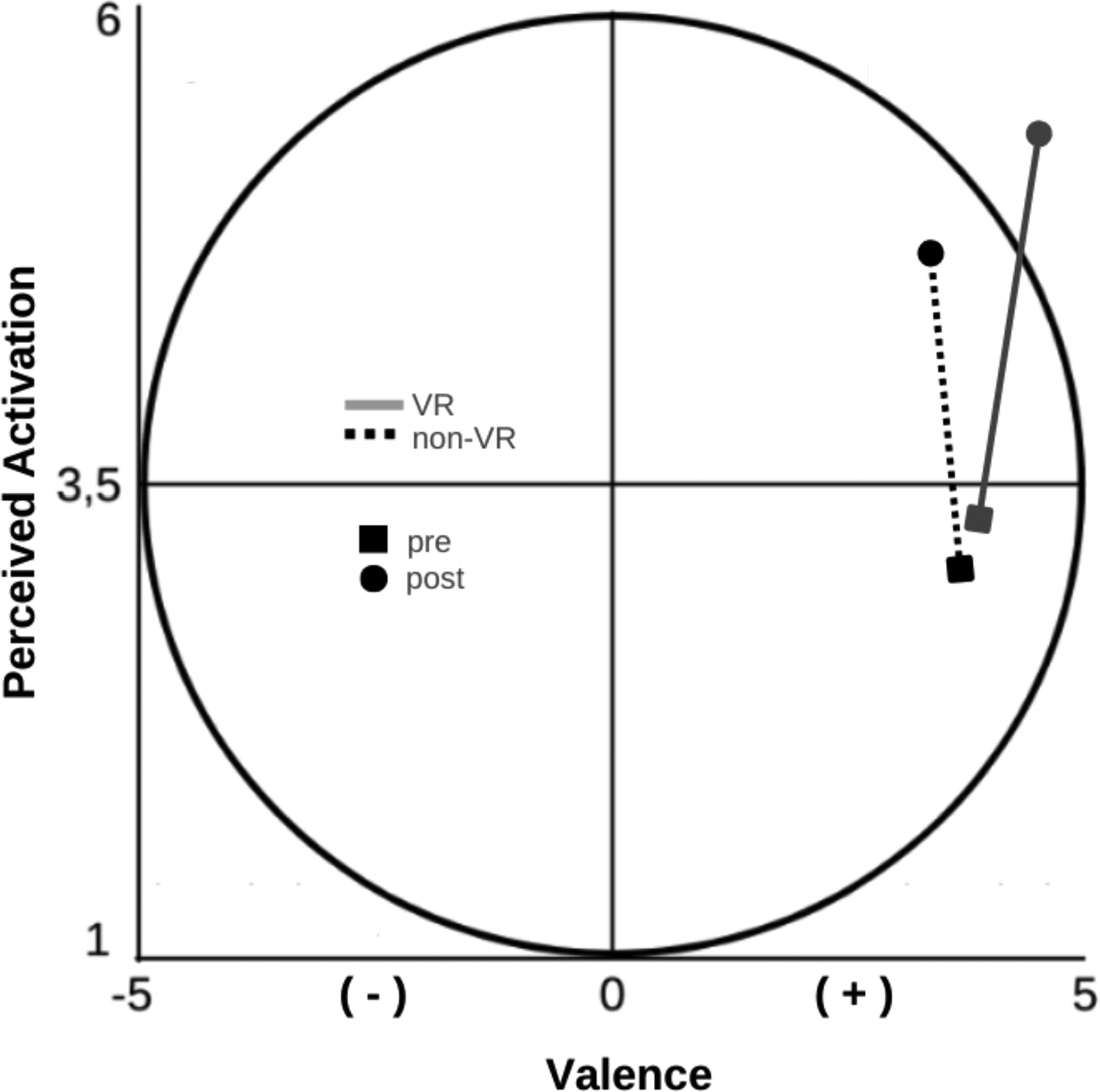
The circumplex model of affect. Significant group × time interaction for affective valence (P < 0.001) and perceived arousal (P = 0.003).
Perceived exertion
The perceived effort increased 6.89 (95% CI = 6.01 to 7.77, P < 0.001) and 5.57 (95% CI = 4.77 to 6.6, P < 0.001) points following VR and non-VR sessions, respectively. The between condition mean change difference was of 0.99 (95% CI = 0.41 to 1.56, P = 0.001) points in the Borg scale, representing a moderate effect size (Hedges g = 0.67, 95% CI = 0.38 to 1.00, P < 0.001). These results are present in Figure 2.
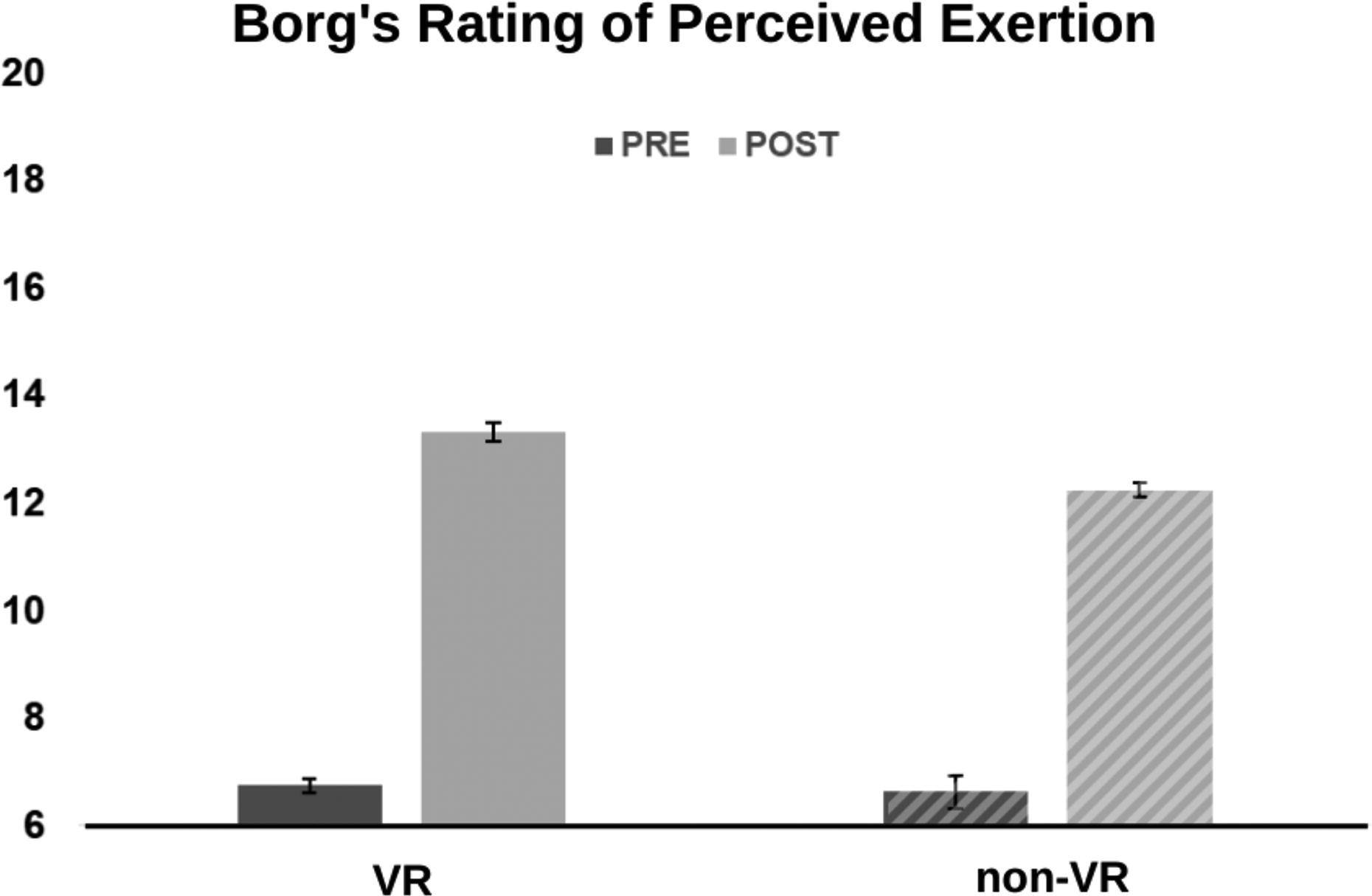
Ratings of perceived exertion measured via Borg’s Scale (6–20), pre and post exercises in virtual reality, and for non-virtual reality. Significant group × time interaction (P = 0.001). Data are presented in mean and SD. SD, standard deviation.
Enjoyment (PACES)
The PACES scores were higher following the VR session (median = 120, IR = 16), compared with non-VR (median = 103, IR = 27). The difference between conditions was significant (P < 0.001). Median values are present at Figure 3.
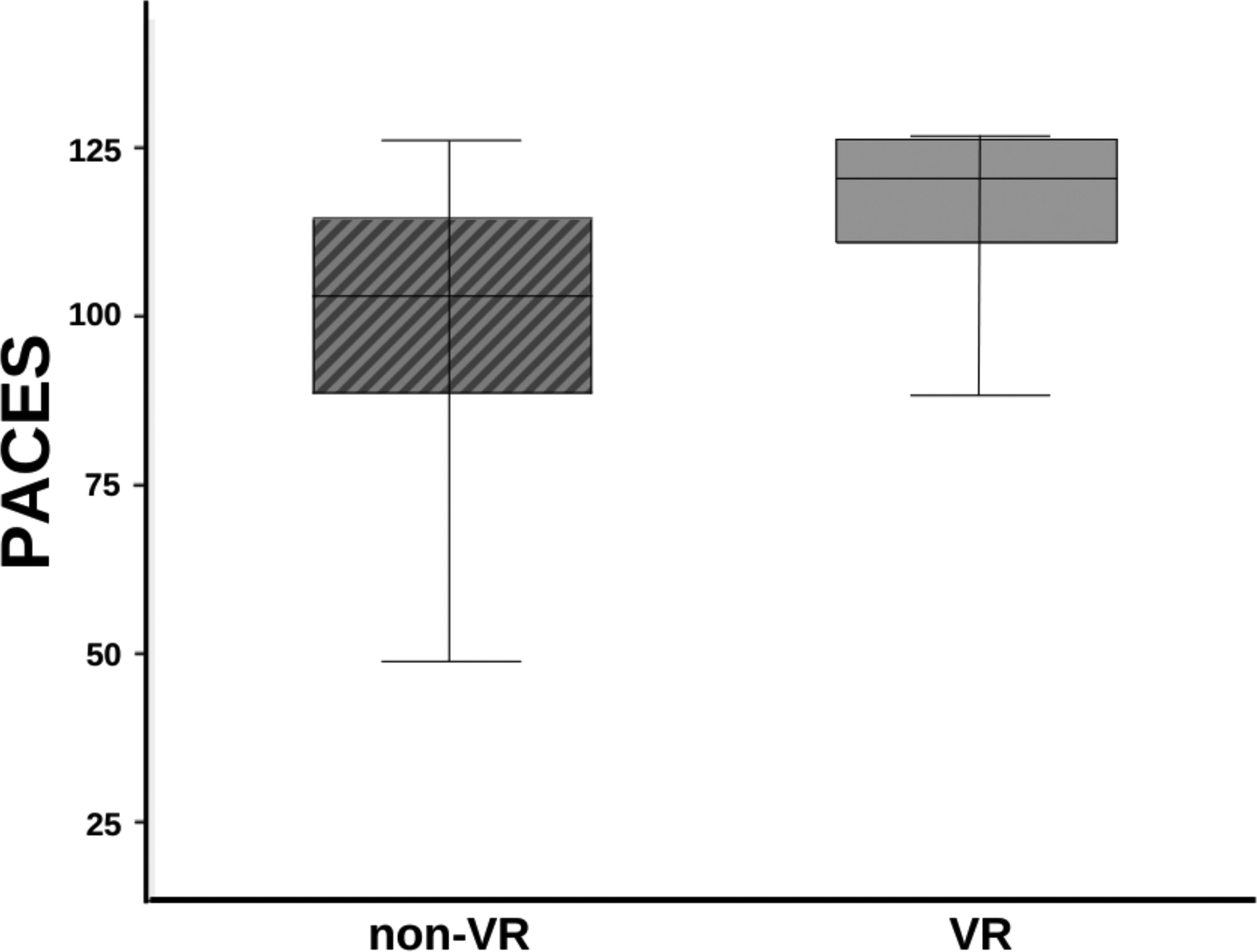
Box plot of exercise enjoyment measured via PACES (median, 25th, and 75th percentile) post nonvirtual reality and virtual reality exercises conditions. Significant condition × time interaction (P < 0.001).
Heart rate reserve
The mean values of average HRR are present in Figure 4. In VR condition, the average HRR reached 54.62% (±18.26) of HRR in comparison with 46.98% (±17.57) of non-VR condition. The difference between conditions was significant (P < 0.001). Although statistically significant, these ranges are within the moderate intensity range. 21

Average heart rate during exercise. Significant group × time interaction (P < 0.001). Data are presented in mean and standard deviation.
Discussion
The present study evaluated the effects of an immersive VR exercise session compared with a non-VR exercise session in affect, arousal, pleasure and enjoyment, perceived exertion, and mean HR during the exercise. The immersive VR exercise provided a more positive affective response, higher arousal, more pleasure and enjoyment when compared with non-VR exercise. Furthermore, perceived exertion and HR were higher post exercise in VR compared with non-VR.
The results found supports the notion that immersive VR it is capable of providing a pleasant experience, eliciting a greater arousal and a positive affective valence. These findings are in line with the previous literature. 22 However, the VR session also resulted in higher perceived exertion and HR compared with non-VR. This finding concurs with previous studies that shows that exercising in immersive VR reduces the perceived effort. 7 This difference may be explained by the fact that participants perceived VR as more strenuous, and the HR was 10% higher in the VR exercise, demonstrating that the participants were more engaged and did a higher effort in VR exercise compared with a matched session. Even, the percentages of HRR achieved were higher in VR session, with significant difference between conditions. Despite that both match the American College Sports Medicine 21 range for a moderate intensity exercise (40%–59% of HRR).
Taken together, the study findings support the notion that immersive VR can provide a more pleasant experience even in higher exercise intensities. The findings that VR exercise provides a more pleasant experience are potentially explained by the capacity of immersive VR to dissociate the attention of inherently unpleasant interoceptive sensations associated to exercise through the combination of audio and video stimulus, possibly saturating the sensory channels with exteroceptive stimulation. 8 This is supported by the current findings where the participants perceived the VR condition more strenuous than the non-VR condition, even though, they reported to have a more pleasant and joyful experience.
According to the previous literature, the audiovisual stimulation would attenuate the increase in oxygenation of the right dorsolateral prefrontal cortex, by reducing processes of affection regulation prefrontal. 4 The dorsolateral prefrontal cortex is an area involved in cognitive control and selective attention, including situations in which the individuals try, spontaneously or deliberately, divert the focus of negative affective stimuli. 23
In addition, the more pleasant affective response may be explained due to the broad utilization of cognitive resources as: haptic feedback, wide field-of-view, full real-time motion capture and high resolution, 22 and reward during activity. 24 These issues can help reduce the stress by creating a freedom sensation to the participant 25 and allow for greater sense of presence, which seems to be a mediator between immersion and enjoyment. 26
Studies indicate that VR exercise has the potential to positively impact psychological outcomes compared with traditional exercise. 27 In addition, enjoyable sports games encouraged competition and motivation to achieve higher scores, potentially activating the brain’s reward system and increasing dopamine production. 27
It is important to note that both VR and non-VR exercises elicited positive valence affective responses; however, the non-VR group revealed a smaller effective response after exercise when compared with the baseline. This is important because it is plausible that VR may help to provide a pleasant feeling during exercise at moderate to high intensities, 28 becoming an alternative to promote moderate and vigorous physical activity. Although the results demonstrate that immersive VR exercise is pleasant and joyful, long-term intervention studies need to investigate the adherence to this modality. The findings underscore that VR games can engage players in physical activities with high levels of enjoyment, emphasizing the importance of satisfying players’ needs to promote motivation and enjoyment during exercise in VR environments. 28
The current study has some strengths. First, this is, to the best of our knowledge, the largest study comparing the acute effects of exercising in VR versus the same exercise protocol without VR. Second, the crossover design allows the comparison of the subjects with themselves, reducing variability and improving estimation of treatment effect. 29 However, the present study has some limitations. First, the non-VR exercise was performed with the evaluator’s guidance through a projected video, and despite of being matched, in relation to the execution time and exercise movements, our protocol may not replicate the context of exercises performed in real life. Second, the results were only evaluated at two moments (pre and post), which prevents the evaluation of these variable behaviors over time. Third, the assessment was self-reported, which may cause recall and social desirability bias. Four, we did not consider the influence of equipment weight in HR variation between VR and non-VR conditions.
Conclusion
Our findings demonstrated that immersive VR exercise yielded a more positive affective response, more enjoyment, and arousal compared with non-VR exercise, even resulting in a higher perceived effort.
Footnotes
Acknowledgment
B.S. is an advisor to FitXR and holds equity. B.S. has received advisory/consultancy fees for unrelated work from ASICS. The authors thank FitXR for funding this study.
Authors’ Contributions
J.A.T., E.B., and V.D. were responsible by participants’ recruitment assessment, data collection, data management and analyses, and writing article text. F.B.S. was involved in protocol design, data analyses, overall supervision, and study coordination. B.S. was involved in protocol design and writing editing. All the authors read and reviewed the article and agree with its final version.
Author Disclosure Statement
FitXR funded the study; however, this study design, conduction, and the data analyses and interpretation were performed independently by the research team. FitXR had no involvement in any of the abovementioned processes.
Funding Information
F.S. is partly funded by Coordenação de Aperfeiçoamento de Pessoal de Ensino Superior (CAPES) grant 0001.

References
Supplementary Material
Please find the following supplemental material available below.
For Open Access articles published under a Creative Commons License, all supplemental material carries the same license as the article it is associated with.
For non-Open Access articles published, all supplemental material carries a non-exclusive license, and permission requests for re-use of supplemental material or any part of supplemental material shall be sent directly to the copyright owner as specified in the copyright notice associated with the article.
