




Abstract
Objective:
Language learning through computer games has been suggested to enhance language abilities compared with traditional learning methods. Training in language skills may also improve self-control and reduce problematic behaviors in children and adolescents. We hypothesized that computer game-based language training could be more effective than classical language instruction. Furthermore, we propose that the enhanced language skills obtained through computer game language training could correspond with improvements in problematic behaviors within this group.
Materials and Methods:
This was an 8-week crossover trial consisting of 4 weeks of gaming rounds and 4 weeks of control rounds for two groups. Wise-Ax English is a casual digital game developed for English vocabulary education targeting Korean children. The game incorporates 500 English words selected from a pool designated by the Korean Ministry of Education. The study included 38 Korean students. At the 4-week and 8-week marks, all students were assessed with English competency tests.
Results:
Over 80% of the participants expressed satisfaction with the digital game-based English education, noting significant improvements in their English abilities compared with those achieved using traditional English classes. During the gaming rounds, children with problematic behaviors demonstrated improvement in test scores relative to their peers without such behaviors.
Conclusion:
The educational game Wise-Ax English can effectively enhance English language skills among Korean elementary school students. Notably, the effectiveness of Wise-Ax English was more pronounced in students exhibiting higher levels of problematic behavior and anxiety.
Introduction
Delinquent behavior and low self-regulation are widely recognized as key factors that undermine students’ academic achievement.1,2 Students exhibiting problematic behaviors such as delinquency often struggle to adapt to classroom environments, which results in them falling behind academically. 3 These challenges are particularly pronounced in language learning, where subjects such as English require sustained concentration, emotional regulation, and focus—areas where these students often face difficulty. Consequently, students with problematic behaviors often perform poorly in tasks such as vocabulary acquisition and reading comprehension.4–6
In recent years, digital game-based learning (DGBL) has emerged as an innovative approach to language education. Unlike traditional learning methods, digital games offer fun, immersion, and interaction, which can provide positive learning experiences. 7 This method may be especially beneficial for students with problematic behaviors. For instance, digital games can offer structured and immediate feedback, which enables students to experience a sense of achievement, thereby fostering motivation to continue learning.8,9 This sense of accomplishment, which is often absent in conventional classroom settings, can enhance students’ self-efficacy and boost their engagement with learning tasks.10,11
Previous studies support these ideas. A survey of 3600 U.S. children and adolescents found that behavioral problems are frequently associated with anxiety, learning difficulties, and distractibility. These factors are often reported by teachers and negatively affect academic performance. 12 School-based studies have also demonstrated a clear association between academic achievement and delinquent behaviors such as truancy, suspensions, and expulsions.13,14 Moreover, research has consistently shown that academic grades inversely correlate with delinquent behavior, meaning that lower academic and cognitive performance increases the likelihood of delinquency.15–17
Given these correlations, DGBL offers a promising alternative for addressing both academic underachievement and behavioral problems in the classroom. This study aims to test the hypothesis that DGBL can improve English language skills while also mitigating problematic behaviors in schoolchildren, particularly those with behavioral issues.
Literature Review
Delinquent behavior and academic achievement
Research has established a strong link between delinquent behavior and poor academic achievement. For example, Harrison et al. 12 found that behavioral problems such as anxiety, distractibility, and learning issues are frequently reported by teachers and are strongly associated with lower academic outcomes. In addition, school-based studies highlight that delinquent behaviors, including truancy, suspensions, and expulsions, are inversely related to academic performance.13,14 Beaver et al. 15 and Schwartz et al. 16 further supported this by demonstrating that low academic and cognitive scores are strong predictors of increased delinquent behavior risk.
Self-regulation, academic success, and delinquent behavior
Self-regulation, particularly the ability to delay gratification, is linked to better cognitive skills, academic achievement, and lower levels of delinquent behavior. 18 Studies have shown that children and adolescents with low self-control are more likely to face academic challenges, which, in turn, increase their risk of engaging in problematic behaviors. 19 In addition, Snow 6 highlighted the connection between low language skills and behavioral problems, suggesting that improving language ability may also help mitigate these issues.
Language skills and problematic behaviors
The relationship between language skills and problematic behaviors is well documented. Qi et al. 20 discovered that preschool children with limited language skills are more prone to behavioral issues. Furthermore, Gennara et al. 18 found that poor language skills could predict low self-control, both cross-sectionally and longitudinally, in adolescents. Research by Bulotsky-Shearer et al. 21 further showed that problematic behavior negatively impacts peer interactions, which subsequently influences academic outcomes. In addition, Hopkins and Clegg 22 found that young people involved in youth justice services with language difficulties exhibit significantly lower literacy abilities, which may contribute to their engagement in problematic behaviors.
DGBL in language education
DGBL has garnered attention for its ability to enhance cognitive learning outcomes, skill acquisition, and behavioral change. 23 Weng and Chiu 24 and Wouters and van Oostendorp 25 conducted a meta-analysis that demonstrated the effectiveness of digital learning tools in improving language proficiency, especially when combined with interactive elements such as immersion and goal achievement. Digital games provide a fun and engaging alternative to traditional learning methods, which is particularly beneficial for students with problematic behaviors who may find it difficult to concentrate or engage with conventional methods. Anderson et al. 26 and Kim et al. 27 found that game-based learning improved language proficiency more effectively than traditional methods, especially in foreign language education.
The role of motivation and enjoyment in game-based learning
Studies have consistently shown that motivation and enjoyment play critical roles in the success of DGBL. Prensky 28 highlighted that interactive and enjoyable elements are crucial for maintaining student engagement. Similarly, Perrotta et al. 29 emphasized the importance of student-centered learning and interactive entertainment in driving better academic outcomes. Recent research by Kazu and Kuvvetli 30 demonstrated that DGBL not only aids in vocabulary acquisition but also fosters a deeper engagement with the learning material.
DGBL and problematic behaviors
Several studies have investigated the relationship between digital games and the improvement of problematic behaviors. Beidel et al. 31 found that virtual environments and serious games could help reduce social anxiety in children, leading to better academic and social outcomes. Su 32 further suggested that game-based learning reduces cognitive load and learning anxiety, which may be particularly beneficial for students with behavioral issues. By creating a structured and interactive learning environment, DGBL may help redirect students with problematic behaviors toward more positive academic engagement. 33
Hypothesis
We hypothesized that computer game-based language training would be more effective than traditional language instruction for students with behavioral issues. In addition, we surmised that enhanced language skills would correspond with improvements in problematic behaviors among children undergoing computer game language training.
Methods
Participants
This study included 38 Korean students from two grades—third and fourth—at Wonkok Elementary School in Ansung, South Korea. Group 1 consisted of 18 third-grade students, while group 2 comprised 20 fourth-grade students. The participants—21 boys and 17 girls—had a mean age of 9.5 ± 0.6 years. All students were native Korean speakers.
Written informed consent was obtained in Korean from all students and their parents. The research protocol was approved by the relevant institutional review board (IRB number: 2107-020-470).
Game for Korean Vocabulary Education, Wise-Ax English
For the development of Wise-Ax English, two elementary school teachers selected approximately 500 words from the essential English word pool designated by the Korean Ministry of Education. These words are considered essential for elementary-level English learners. In alignment with Korea’s English curriculum, the 500 words were categorized into four proficiency levels. 34 Each proficiency level contained between 100 and 140 words, and each word was presented multiple times within its level to aid in the learning process.
Wise-Ax English is an educational game aimed at enhancing English vocabulary through engaging and interactive play. The game features 500 stages, organized into four levels, each comprising 100–140 stages. It is optimized for Android tablet computers, specifically for the 10.1-inch Galaxy Tab 4 (Suwon, Republic of Korea).
The gameplay involves a woodcutter character who chops wood, with a horizontal bar moving back and forth at the bottom of the tablet screen. The objective is to press a button when the bar aligns with the red zone, known as the hitting zone, prompting the woodcutter to cut the wood. A successful cut within the allotted time presents the player with a selection of English words to choose from. Concurrently, a question appears at the center of the screen, offering a clue about a specific word. Players have 2 minutes to identify and select the correct word from the options provided. Once the correct word is selected, its proper pronunciation is played. Each correct answer rewards the player with in-game currency termed “game gold.” After 10 successful word selections, the player advances to the next stage. Completion of all stages in a level results in the game increasing in complexity and advancing the player to the next level. This gaming structure is designed to actively engage players with English vocabulary, enhancing both their comprehension and pronunciation skills (Fig. 1).
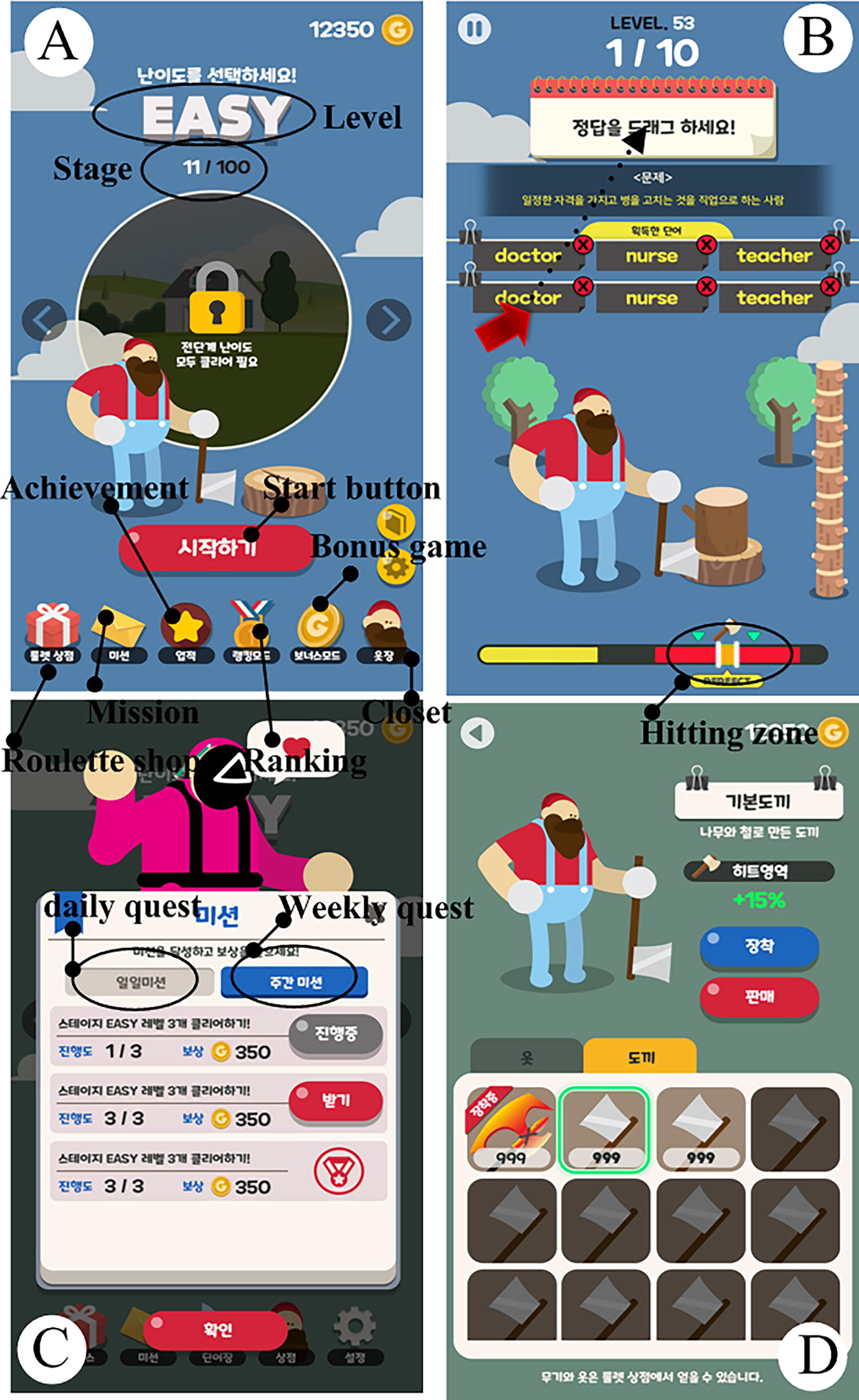
Wise-Ax English: Educational game for English learning.
Wise-Ax English features several interactive sections within its main interface: the Achievement Board, Roulette Shop, Missions, Vocabulary Library, and Closet. The Roulette Shop allows players to redeem gold coins for various items such as t-shirts, pants, and axes to outfit the woodcutter avatar. Acquired items are stored in the Closet section. The Missions feature provides a series of daily and weekly challenges for players to complete. The Vocabulary Library displays the collection of words that the player has mastered throughout the game (Fig. 1).
Study procedure, English ability test, and scales for clinical status, language learning competencies, and game satisfaction
The study used a crossover design with game and control rounds. All participants underwent psychological evaluations and basic English proficiency tests administered by instructors. In addition, teachers assessed students’ concentration and English vocabulary competencies using an attention rating scale and a vocabulary test, respectively.
During the initial 4-week phase, group 1, with 18 students, received a 30-minute English textbook lesson followed by a 10-minute session of the Wise-Ax English game. Group 2, composed of 20 students, participated in a 40-minute textbook-based English class and acted as the control group. This schedule was followed for 5 days per week. During the next 4-week phase, the groups switched activities, with group 1 undertaking the control round and group 2 engaging in the game round, also for 5 days each week.
English proficiency was assessed at both the 4-week and 8-week intervals using a 30-question test designed to measure vocabulary improvement (Fig. 2).
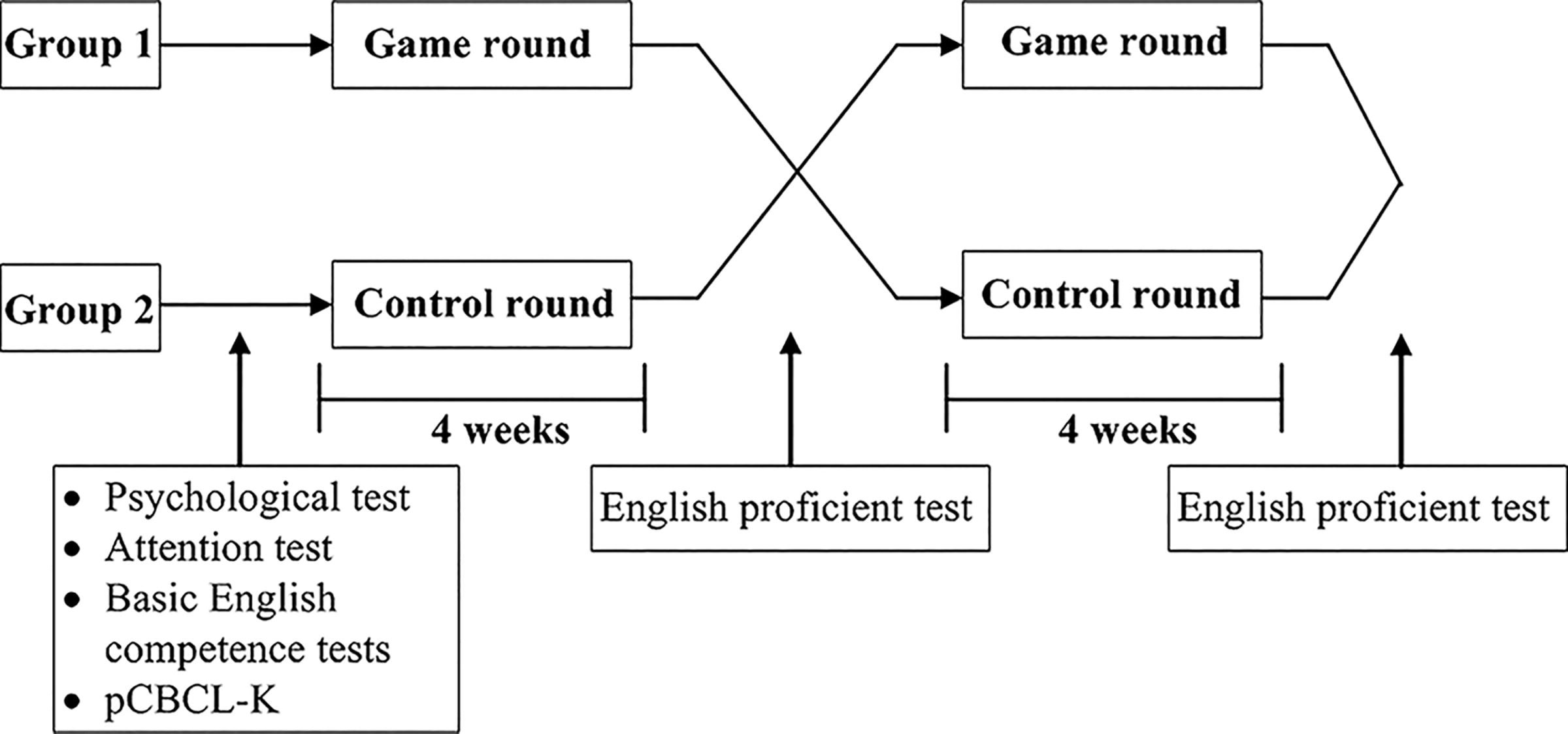
Study schedule.
The psychological well-being of the students was assessed using a suite of validated instruments. The Center for Epidemiological Studies Depression Scale for Children (CES-DC) is a 20-item self-report scale designed to measure depressive symptoms in children aged 6–17 years, with each item rated on a 4-point Likert scale from 0 (very rare) to 3 (very frequently). 35 This scale has demonstrated good internal consistency (Cronbach’s α = 0.89), and a score of 15 or higher may indicate clinical depression. 36
For behavioral issues, the Korean Child Behavior Checklist-Teacher Version (KCBCL-Teacher) was employed. The KCBCL is a teacher-reported screening tool for children and adolescents aged 6–18 years.37,38 It consists of 119 items with subcategories, showing a range of internal consistency (Cronbach’s α from 0.62 to 0.86). 39 For this study, 13 items specifically addressing delinquent behavior were selected to assess the children’s problematic behaviors in school. Lee et al. 38 suggested that these delinquency-related categories could predict oppositional defiant disorder in children.
The “State” subscale of the State-Trait Anxiety Inventory for Children-State (STAIC-S) is a 20-item self-report scale that assesses state and trait anxiety in children, rated on a 3-point Likert scale from 1 (hardly ever) to 3 (very often).40,41 The STAIC-S has good internal consistency (Cronbach’s α = 0.89). Total scores are interpreted as follows: 41–44 for mild anxiety, 45–48 for moderate anxiety, and 49 or higher for severe anxiety.
The Korean Attention Deficit Hyperactivity Disorder Rating Scale-Teacher Version (K-ARS) was used to measure teacher-reported attention levels in children. Originally developed by DuPaul et al. 42 and subsequently validated by Kim, So, and colleagues, 43 the K-ARS encompasses two dimensions: inattention and hyperactivity. Each dimension contains nine items rated on a 4-point Likert scale ranging from 0 (never true) to 3 (very true). A cut-off value of 19 or more is indicative of ADHD. The scale has shown good internal consistency, with a Cronbach’s alpha between 0.77 and 0.87.
The basic English competencies of the children were assessed using the Manual of the Korean Education Broadcasting System Basic Academic Ability Assessment (https://www.ebs.co.kr/free/commentary/elementary/course/16844).
To evaluate satisfaction with Wise-Ax English, a series of six questionnaires was administered, covering different facets of the game experience:
1. To what extent did you utilize the game contents while playing?
2. Did you find Wise-Ax English easy to engage with?
3. Did Wise-Ax English provide an enjoyable experience?
4. Did Wise-Ax English contribute positively to your English studies?
5. Would you be interested in seeing similar games like Wise-Ax English developed for other subjects?
6. Would you be willing to recommend Wise-Ax English to your friends as a tool for learning English?
Participants provided their responses on a 10-point Likert scale, ranging from 1 (very unsatisfactory) to 10 (very satisfactory).
Statistics
Demographic, psychological, and language proficiency data, as well as game level and stage accomplishments for groups 1 and 2, were compared using the Mann–Whitney U test and the chi-square test. Variations in English proficiency between groups 1 and 2 were analyzed using repeated measures analysis of variance (ANOVA). Post hoc examination of English test score changes from phase 1 to phase 2, as well as from phase 2 to phase 3, employed the Wilcoxon signed-rank test. Differences in English proficiency improvement across the total game round versus the total control round were again compared using repeated measures ANOVA.
Linear regression analysis was conducted to identify factors predicting improved English proficiency. Independent variables included sex, age, K-ARS-teacher scores, CES-DC scores, the problem behavior category of the KCBCL, and game stages, with the dependent variable being the improvement in English proficiency. “Improvement in English ability” was defined as any instance wherein the score on a subsequent test exceeded that of the preceding test.
Children scoring above 6 points (for boys) and 5 points (for girls) on the KCBCL-delinquent subcategory were categorized as “children with problematic behaviors.” 44 Differences in English proficiency changes between children with and without delinquent behaviors were assessed using repeated measures ANOVA, adjusting for baseline English competencies and game-stage involvement.
All statistical procedures were carried out using SPSS Statistics for Windows, version 24 (IBM Corp., Armonk, NY). P values <0.05 were considered statistically significant.
Results
Demographic characteristics, psychological status, and English competency
The sex ratio and psychological status were similar between group 1 and group 2. Group 1, composed entirely of third-graders, had a mean age of 9.1 ± 0.2 years, while group 2, consisting entirely of fourth-graders, had a mean age of 9.9 ± 0.3 years. Group 2 demonstrated higher basic competency in English than group 1.
Among the 38 children, 11 (6 boys and 5 girls) were identified as having problematic behaviors.
Gameplay statistics and game satisfaction
On average, the children progressed to stage 224.5 ± 37.5, with stages ranging from 143 to 309 and a mean level of 2.5 ± 0.5 (ranging from level 2 to level 3). Group 2 reached higher game stages and levels than group 1 (Table 1).
Demographic, Psychological, and School Learning Characteristics
*Statistically significant, p < 0.05
CES-DC, Center for Epidemiological Studies Depression Scale for Children; K-ARS, Korean Attention Deficit Hyperactivity Disorder Rating Scale; KCBCL, Korean version of the Child Behavior Checklist-teacher’s version; STAIC-S, the “State” subscale of the State-Trait Anxiety Inventory for Children-State.
The means and standard deviations for game interaction were as follows: Children used approximately 83 ± 9.7% of the game content (Q1); the ease of engagement with the game (Q2) scored a mean of 8.0 ± 0.9, while enjoyment (Q3) and the educational value for learning English (Q4) scored 8.2 ± 1.1 and 8.5 ± 1.1, respectively. Interest in similar educational games for other subjects (Q5) scored 8.4 ± 0.9, and the likelihood of recommending the game (Q6) scored 8.2 ± 0.8.
Predictive factors for improvements in English test scores
Across all rounds, English competency and game stage were predictors of improvement in English test scores. Specifically, in the game round, a higher level of problematic behavior, increased anxiety, and advanced game stages were predictive of English test score improvement. Conversely, in the control round, only a higher grade level predicted English test score enhancement (Table 2).
Linear Regression Analysis
Dependent variable: changes in English test scores.
P < 0.05.
P < 0.01.
E-comp, Basic English competency; G-stage, game stage; pCBCL-K, problem behavior scores of the Korean Child Behavior Checklist-teacher’s report.
Comparison of changes in English test scores in the game and control rounds
In both groups, English test scores increased significantly during the game round compared to the control round (F = 15.17, P < 0.001). In group 1, English test scores rose during the game round (z = 2.91, P < 0.01), but there was no significant change during the control round (z = 1.81, P = 0.08). For group 2, there was no significant variation in English test scores during the control round (z = 0.51, P = 0.61), but a significant increase was observed during the game round (z = 2.25, P = 0.02) (Fig. 3).

Comparison of English test score changes in game and control rounds.
Comparison of English test score changes between children with and without problematic behaviors
Between the rounds, there was no significant disparity in test score changes between children with and without problematic behaviors (F = 2.66, P = 0.11). However, during the game round, children with problematic behaviors exhibited a greater increase in test scores compared to their counterparts without problematic behaviors (F = 10.02, P = 0.003). In the control round, a significant difference emerged in test score changes: children without problematic behaviors showed an increase in scores (z = 1.99, P = 0.04), while scores for children with problematic behaviors decreased (z = 2.01, P = 0.04) (Fig. 4).
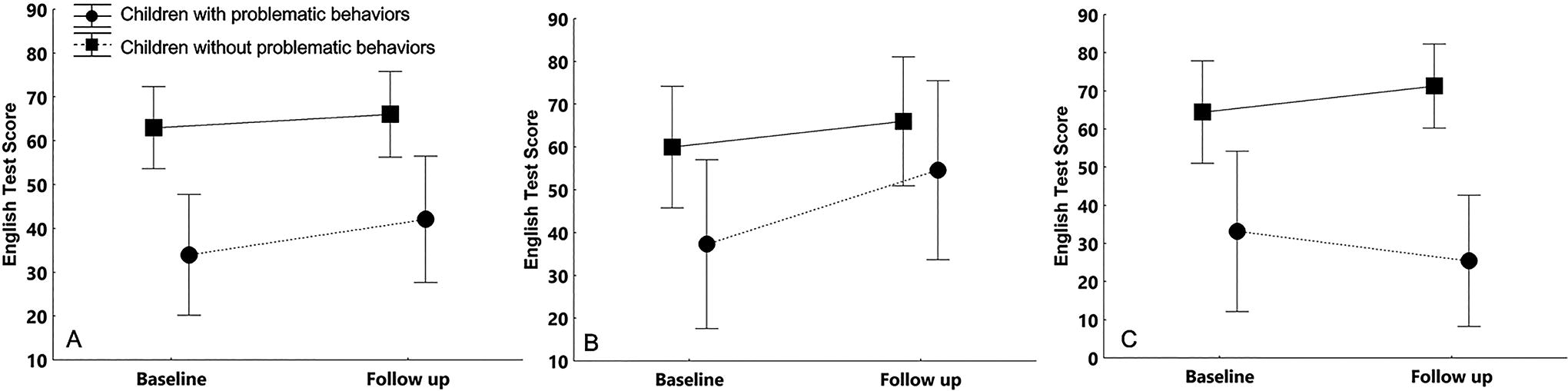
Comparison of test score changes between children with and without problematic behaviors.
Discussion
The effectiveness of Wise-Ax English for Korean elementary school students
This study’s findings indicate that the educational game Wise-Ax English is effective in improving English abilities among Korean elementary school students. Notably, the game’s efficacy seems more pronounced in students exhibiting higher levels of problematic behavior and anxiety.
Children who engaged with Wise-Ax English expressed high satisfaction with the program, corroborating its effectiveness. Fourth-grade students achieved higher stages and levels within the game compared to third-graders, reflecting a gradation in difficulty that aligns with the school curriculum. The game satisfaction survey revealed high ratings, with children scoring all six items at 8 points or above on a 10-point scale, suggesting that the game’s difficulty level aligns well with the students’ academic levels.
Moreover, English test scores during the game rounds showed significant improvement over the control rounds across all student groups. This pattern is consistent with previous research involving Russian immigrant children, where DGBL enhanced Korean language proficiency more effectively than traditional teaching methods. 27
The impact of DGBL can be assessed through formative evaluation in natural settings or through summative evaluation within experimental designs. 45 The success of the current educational game aligns with outcomes from summative evaluation. Several studies employing summative assessment have affirmed the effectiveness of DGBL. For instance, Frolli et al. 46 observed positive outcomes in learning Italian as a second language among Ukrainian children using game-based methods. Similarly, Kazu and Kuvvetli 30 recognized the benefits of digital games for acquiring English vocabulary.
The dynamics of enhanced motivation for learning through digital game-based methods have been outlined by various scholars, highlighting elements such as interactive entertainment, 47 student-centered learning approaches, 48 competitive activities, and established rules and goals.49,50 In addition, the effectiveness of such learning strategies has been linked to enjoyment, immersion, and the achievement of goals.24,51 In the satisfaction survey of the current study, students reported higher scores on items related to interaction, learning approaches, enjoyment, and goal achievement.
Associations among Wise-Ax English efficacy, problematic behavior, and anxiety
In the present study, improvements in English proficiency were associated with English competency and game-stage progression. Notably, higher levels of problematic behavior and anxiety, along with game stage, were linked to greater improvements in English ability during the game stage. Specifically, children with problematic behaviors demonstrated increased English test scores during the game round, while their scores declined in the control round.
Several studies have shown that the success of DGBL in children and adolescents is associated with factors such as social interaction, metacognition, and social anxiety.25,31,52,53 Su 32 indicated that educational approaches incorporating gamification engineering software could boost motivation and reduce cognitive load and learning anxiety.
Beidel et al. 31 found that treatments using virtual reality and serious games can effectively reduce social anxiety in children. A meta-analytical review suggested that computer games can create complex learning environments that enhance social interaction abilities and integrate metacognitive strategies, leading to better academic achievements and increased engagement in learning activities.25,52,53
DGBL provides a flexible approach that caters to diverse learners, allowing them to transcend the constraints of traditional learning methods. 33 Serious games may also prompt adolescents to adopt positive attitudes towards academic tasks, especially if they are immersed in the gaming context, which fosters strong self-regulation.33,54 As positive attitudes correlate with superior academic performance, it is plausible that DGBL can direct students with problematic behaviors towards more constructive engagement in learning and academic pursuits than conventional educational methods. 55
Limitations
There were limitations to the current study. First, the small sample size restricts the generalizability of the results. In addition, the DGBL implemented was of the augmentation type, supplementing traditional classroom activities; hence, the isolated effects of the English learning game were not exclusively examined. Second, the assessment of English abilities was confined to word recognition and English writing. Future research should consider employing standalone English educational games and structural English assessment tools with larger sample sizes.
Conclusions
This study confirmed that the educational digital game Wise-Ax English had a highly positive impact on Korean students, particularly those exhibiting problematic behaviors and anxiety. Students expressed high satisfaction with Wise-Ax English in terms of content usage, enjoyment, educational value, and likelihood of recommending it to peers, contributing to an increase in students’ learning motivation. Moreover, the English proficiency test results showed a significant improvement in student performance, with the effect being especially pronounced among students with problematic behaviors and anxiety. This indicates that game-based learning may be more effective than traditional educational methods in enhancing students’ language abilities.
Key Findings Summary
Wise-Ax English generated high satisfaction among Korean students, and those who used the game showed significant improvements in their English test scores.
In particular, students with problematic behaviors and anxiety achieved greater success through DGBL than through traditional learning methods.
Implications
This study suggests that DGBL could be an effective language education tool for students exhibiting problematic behaviors. In particular, the immediate feedback and sense of achievement provided by the game stimulate learning motivation, reducing obstacles such as attention deficits or anxiety during the learning process. As students with problematic behaviors often struggle with traditional learning methods, introducing digital games as a tailored educational tool for these students could yield even more meaningful results.
In addition, DGBL provides a positive emotional environment for students with issues such as anxiety and attention deficits, contributing to both academic achievement and improved self-regulation. Thus, DGBL can be widely applied to various students facing learning difficulties, offering an effective alternative that complements traditional educational methods.
These results provide a solid basis for further integration of digital game-based learning into educational program development and policy formulation. Specifically, the study highlights the potential of digital learning tools to effectively maximize adolescents’ learning motivation and achievement.
Footnotes
Acknowledgment
We would like to extend a special thanks to the Korean Game Culture Foundation and Nexon Co., Ltd.
Authors’ Contributions
Principal investigator: D.H.H. and J.S.K.; responsible for the game design: D.H.H., S.M.K., and J.S.K.; development of the study design: D.H.H., S.H., and J.S.K.; data collection: J.S.K. and S.Y.K.
Authors Disclosure Statement
No competing financial interests exist for any of the authors.
Funding Information
This study was supported by a grant from the Korea Health Technology R&D Project through the Korea Health Industry Development Institute (KHIDI), funded by the Ministry of Health & Welfare, Republic of Korea (grant number: