




Abstract

This article discusses the business practices of gaming promoters in Macau casinos. Gaming promoters operate as marketing agents for casinos and VIP rooms. These junket operators 1 are primarily responsible for recruiting and servicing players, granting gaming credit, and collecting gaming debts. The present study seeks to develop a better understanding of gaming promoters and their VIP room operations. It begins with the norms and mores of Macau junkets in casinos. The discussion then moves to junkets' credit arrangements and debt collection practices, as well as the deposit‐taking activity in VIP rooms. Proportionality in junket regulation is also proposed to supervise small and large gaming promoters.
1. Introduction
Macau operates a licensing system for gaming promoters in casinos. The Gaming Inspection and Coordination Bureau (DICJ) serves as the principal regulator to govern the city's gaming industry and supervises the junket licensees in casinos. “Gaming promoter” is defined as “agents for the promotion of games of chance in casinos who carry out their activity by granting facilities to players, particularly regarding transportation, accommodation, dining and entertainment, receiving a commission or other remuneration paid by a concessionaire.” 2 Administrative Regulation No. 6/2002 3 is the main legal instrument for regulating junkets and their activity in casinos. As of the latest DICJ release (January 2018), Macau has 109 gaming promoters licensed to promote VIP gaming business in casinos. 4
Junkets have historically maintained strong relationships with their patrons. Specifically, gaming promoters can trace their origin to the gambler recruitment activity in the 1930s, and it was not until 2002 that formal regulations on junkets were introduced. 5 Despite the government's efforts to promote Macau as a major tourist destination, 6 most casino sub/concessionaires 7 still capitalize on junkets and their associates to source and recruit players to gamble in Macau. In particular, the casino game Baccarat 8 offered in VIP rooms accounts for at least half of the city's gross casino revenue. 9 Table 1 illustrates the total gross casino revenue in Macau and the gross revenue generated in VIP rooms from 2008 to 2017.
Gross Casino Revenue and VIP Room Revenue from 2008 to 2018
Source: Data are compiled by the author from the Macau Gaming Inspection and Coordination Bureau's (DICJ's) online sources (2008–June 2018).
Note: Unit: MOP million. The exchange rate from MOP to USD is approximately 8 to 1.
2. General Operations of Gaming Promoters
2.1. Concept of “rolling”
“Rolling” is a key concept in understanding the operations of VIP rooms. It is thus necessary to expound on rolling (“dead chip program”) before delving into the mores of junkets. Dead chips 10 are promotional casino chips that cannot be redeemed for cash or regular casino chips (“cash chips,” which can be converted into cash). Dead chips can only be wagered (“washed”) through casino play, and winning bets are paid with cash chips. In practice, casinos used dead chips to track VIP wagering volume for purposes of calculating commissions payable to gaming promoters (or casinos' self‐directed patrons), and the total amount of dead chips wagered and lost by players is called rolling chip volume. To earn their commissions, junkets regularly seek a patron's permission to exchange (“roll”) their cash chips into dead chips for further wagering throughout the gaming session.
2.2. Role of gaming promoters
Gaming promoters organize casino‐based tourism by recruiting players to gamble in VIP rooms. A gaming promoter generally assumes a wide variety of roles in casinos: marketing agent, travel agent, dead chip dealer/chip roller, credit grantor, and debt collector. These diverse roles indicate the dynamic nature of junket activity in casinos, and a series of coordinated actions is adopted by junkets to accompany and finance their patrons. When substantial players are identified, the targets will be invited to visit Macau with complimentary travel and hotel arrangements. After these sought‐after players are directed to the VIP gaming rooms, junkets will sell dead chips to the players for cash or on credit. Furthermore, junkets frequently grant credit to players and “roll” chips during casino play, and they will also act as debt collectors when players fail to settle the credit accounts in casinos. In addition to these casino marketing roles, some junkets and their associates apparently assist their patrons with cross‐border money arrangements. 11
2.3. VIP room system
VIP room operations are common industry practice in Macau casinos. 12 VIP rooms are exclusive gaming facilities designed for patrons who are able and willing to participate in the high‐stakes casino games (“VIP players”). The inception of VIP rooms dates back to the 1980s, when the then‐casino monopoly STDM invited trusted third parties to manage private gaming salons. VIP rooms have since been popular among privacy‐concerned players. While junkets are not technically operating the VIP rooms and have no control over the gaming operations, 13 some large‐scale gaming promoters are virtually casino co‐operators running their designated VIP play areas. These gaming salons are housed with junkets' casino cages and floor staff, separate from their associated casinos.
The sui generis VIP room system has never received any formal recognition under Macau's existing regulatory framework. A VIP room is merely a private contract formed by the industry participants. Junkets must first register and enter into a gaming promotion contract with their casinos before engaging in any junket activity. According to Administrative Regulation No. 6/2002, this junket contract must explicitly state “the terms in which gaming promoters can operate in casinos, particularly if there is allocation of their own space,” 14 and such provision serves as the legal basis for the establishment of VIP rooms in casinos. 15 As of June 2018, there are over 200 gaming areas designated for VIP play across Macau casinos. 16
Macau authorities also separate the designated areas for special gaming or players from the mass‐market casino floors. 17 The table games operations in VIP rooms are especially distinguished for tax purposes, and gaming tables are divided into two taxation categories: gaming tables and VIP gaming tables. Each gaming table in a VIP room is taxed at MOP 300,000 (USD 37,500) per year, whereas the annual tax for a gaming table housed in the mass floor is MOP 150,000 (USD 18,750).
2.4. Remuneration models for gaming promoters
Junket licensees are remunerated by casinos for the gaming promotion services rendered. Remuneration is defined as “any bonuses, gifts, services or other advantages of monetary value that are offered or provided to gaming promoters by the concessionaires or sub‐concessionaires … shall be considered to be of remunerative value.” 18 In addition, there is a regulatory limit on junket commissions capped at 1.25 percent of the total amount bet by VIP players. 19 Under this administrative decision, a junket is entitled to receive no more than $12,500 on the sales of $1 million in dead chips.
Macau casinos offer two remuneration models for junkets based on rolling chip volume or net win. 20 The first remuneration model allows junkets to receive commissions on the basis of an agreed percentage of rolling chip volume. Under this volume‐based structure, junkets will be remunerated with no more than 1.25 percent of the total amount of dead chips purchased by their patrons. Win/loss split basis is the second method to remunerate junkets in casinos. Gaming promoters can receive (bear) an agreed percentage of the net win (loss) for their VIP room operations, and casino sub/concessionaires generally offer junkets at least 40 percent of the net win (loss) generated in VIP rooms. 21
Both remuneration models require junkets to undertake minimum monthly rolling chip volume in their dedicated VIP rooms. The selection of both models depends on the financial capability of each junket. It is estimated that the win/loss split basis accounts for around 80 percent of Macau's VIP gaming business, and the remaining 20 percent comes from pure dead chip sales. 22 Despite the variation, both remuneration methods are subject to the above‐mentioned maximum commission rate currently set at “1.25 percent of the total amount bet (net rolling), regardless of the respective calculation basis.” 23
There is a possible combination of both remuneration models in practice. A junket‐associated company disclosed in a securities filing that its VIP room principally received 42.5 percent of the net win and 0.045 percent of its monthly rolling chip volume as expense allowance, which could only be used to pay for the hotel facilities. 24 In addition, the remuneration method agreed upon by casinos and junkets must be specified in their gaming promotion contract, 25 and this negotiated commission structure is also subject to the regulator's scrutiny.
2.5. Collaborators
Gaming promoters generally have a large network of collaborators to recruit VIP players. 26 Collaborators operate as self‐employed individuals under the leadership of junket licensees and these subordinate agents are tasked with sourcing players and selling dead chips in exchange for commissions from their immediate junket leaders. According to the DICJ (August 2018), there are 5,698 registered collaborators working for junket licensees in casinos. 27 The myriad of collaborators are considered associates of gaming promoters; nevertheless, these sub‐junkets are unlicensed and not directly overseen by the DICJ. Notwithstanding the foregoing, gaming promoters are under a duty to supervise their collaborators on a day‐to‐day basis, and the use of these sub‐junkets must be registered with and approved by the regulator prior to the collaboration. Furthermore, gaming promoters are jointly and severally liable for any junket activity or non‐compliance committed by their collaborators. 28
3. Gaming Promoter's Roles as Credit Grantor and Debt Collector
3.1. Importance of gaming credit to Macau casinos
Junkets and their associates historically serve as a source of credit for VIP players. While Macau has no foreign exchange controls, 29 strict currency and exchange control policies are applied in mainland China. Particularly, Chinese citizens and foreigners can carry no more than RMB 20,000 or USD 5,000 in cash when leaving and entering the Chinese border, 30 and that deters Chinese VIP players from carrying a large amount of money to gamble in Macau casinos. It is thus common practice for junkets to grant credit to their patrons for gaming, apart from other possible money arrangements. 31
Gaming credit is an integral component of VIP room operations. Despite the lack of information on the origin of credit play in Macau casinos, the emergence of myriad chip rollers in the late 1970s is considered to be a crucial factor precipitating the wider use of credit in VIP rooms. 32 Before gaming credit was authorized in 2004, junkets and their associates used to operate as “loan sharks” for players and engage in extralegal debt collection activity. 33 Such practices were subject to the penalty of usury under Law No. 8/96/M, which regulates the crime of illegal gambling. 34 With the passage of Law No. 5/2004, casino sub/concessionaires and gaming promoters are allowed to grant credit to their patrons for gaming, and the resultant debts are fully enforceable in Macau courts.
3.2. Gaming credit arrangements inside VIP rooms
Gaming promoters are allowed to arrange credit facilities for their patrons at their sole discretion. In practice, a junket first purchases or borrows 35 dead chips at discount from their immediate superior, i.e., a larger junket, VIP room, or casino. After a junket has secured the dead chips, they will resell the chips to their patrons at face value. Such purchases are usually made without immediate payment, and patrons are required to sign a “casino marker,” which is a written document that evidences an extension of credit to a patron by the concerned gaming promoter or casino. Having obtained the dead chips on credit, patrons will be accompanied for VIP gaming.
VIP players are often financed by junkets in Macau casinos. Gaming promoters grant credit to their patrons based on knowledge of the players, their financial background, and credit history. These credit facilities are practically interest‐free loans from junkets for the first two weeks, and default payment may be charged after the grace period. 36 Figure 1 illustrates the basic format of a casino marker used in Macau's VIP rooms, and gaming promoters are entitled to charge an annual interest rate of 48 percent 37 on the outstanding debts after the 15‐day grace period.
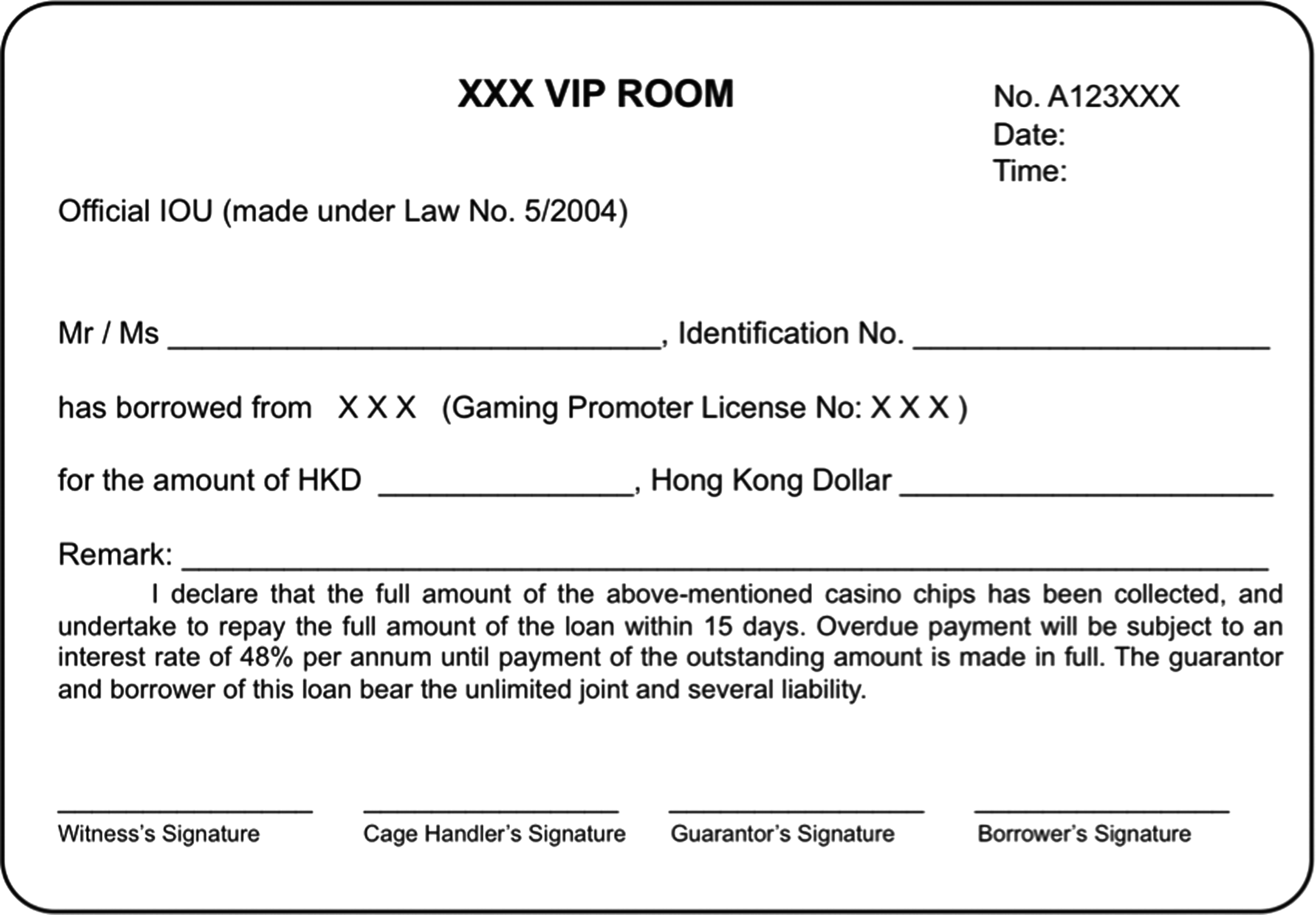
The basic format of a casino marker used in Macau's VIP rooms.
The credit arrangements for VIP players are always involved in the context of “rolling.” As junkets are essentially remunerated by the rolling chip volume, dead chip dealing and credit granting are not a one‐time event. Junkets will act as both chip rollers and credit grantors to players during casino play. More sales will be made with the players by rolling their cash chips into dead chips. When players have lost all their dead chips (“wash out”) alongside the cash chips, junkets will provide the players with more credit to purchase dead chips. These multiple sale and credit transactions recur frequently until the end of the gaming session.
3.3. Debt collection practices outside casinos
The ability to collect gaming debts is germane to the continued operation of VIP rooms. Law No. 5/2004 specifies that the granting of gaming credit generates civil obligations, 38 and gaming debts can be judicially enforced in the court of law. Junkets' role as debt collectors ensues upon the end of a gaming session. Gaming promoters will seek to secure payment from players who have won and are willing to repay the previously‐borrowed dead chips, and the gaming debts will be discharged inside the VIP rooms. For those who fail to settle the outstanding accounts, junkets will subsequently attempt to collect the debts outside the casinos.
Actual debt collection practices vary from junket to junket. 39 Though mostly non‐standardized systems, gaming promoters nevertheless formulate their own collection procedures by continuous contact and legal process. At first, patrons will be issued with a series of payment reminders, and these communications may include telephone calls and written correspondence. Junkets will then try to establish direct contact with their patrons if there is still no payment or response. Gaming promoters will resort to court action to recover the credit in the event that all attempts to contact the concerned debtors have failed. In addition to these legitimate steps, it has been reported that some junkets and their associates may, through the use of an outside collection agency, exert extralegal means from suasion to coercion. 40
The debt recovery is further complicated when players are from China. Collecting debts across the border also entails legal considerations of China's public policy and national laws. Particularly, the Chinese government basically prohibits all forms of gambling, and gaming debts incurred in Macau casinos cannot be enforced through court action due to public interest concerns. 41 Moreover, it is illegal for anyone to operate, practice, or promote gambling in China. Junkets and their associates collecting gaming debts there are subject to criminal offense punishable by a maximum of three years imprisonment. 42 As a result, when Chinese patrons in debt leave Macau, junkets might expose themselves to the risks of debt default or criminal offense, or even both.
3.4. Attempt to name and shame the defaulters
The difficulty in collecting debts in China has prompted some junkets to disclose defaulters' information on the Internet. There were a few junket‐associated websites publishing their collaborators and patrons who defaulted on gaming debts. The website Wonderful World (美好世界), reportedly founded by several VIP room contractors in 2013, was the first of its kind to name and shame the delinquent debtors. 43 The now‐defunct website http://www.99world.com once listed hundreds of indebted individuals and their personal information, including debtors' full name, photo, birth year, place of origin, etc. Debtors' profiles and IOUs/casino markers could also be viewed on the website, along with their estimated default rate assessed by Wonderful World.
Such naming and shaming attempted to embarrass the defaulters into honoring the debt obligations. The alleged founder 44 of Wonderful World claimed that HKD 1 billion (USD 128 million) worth of bad debts had been recovered out of the HKD 6 billon uncollectable accounts listed on the website in 18 months. 45 However, Macau's gaming credit law requires junkets to maintain confidentiality of players' credit records. 46 Public distribution of debtors' information is also prohibited under Law No. 8/2005, which regulates the processing and protection of personal data in Macau. 47 Following a series of police investigations, Wonderful World was reported to cease operation in 2016. 48
The emergence of Wonderful World led to the making of a credit database. A centralized database of industry intelligence was proposed to launch in 2017 by the Macau Association of Gaming and Entertainment Promoters, 49 a local trade body that represents the interests of junkets and their associates. This members‐only platform aims to maintain a database of individuals who have delinquent debts, while protecting the industry's proprietary information. Nonetheless, the implementation of this project has been suspended since March 2018 due to its failure to meet the city's privacy laws. The trade body also indicates that they will continue to work closely with the authorities to resolve the legal dilemma. 50
4. Deposit‐Taking Activity and Regulatory Responses
4.1. Deposit‐taking activity in VIP rooms
Gaming promoters require significant working capital to fund their day‐to‐day operations. It was not uncommon for VIP rooms to raise additional funds by offering individuals above‐market interest rates for their cash deposits. These depositors, composed mainly of collaborators and players, were considered as “investors” of VIP rooms, and they were entitled to receive an interest rate of one to two percent per month on money deposited with the junkets. However, such ill‐defined activity of taking deposits from the public was already in violation of Macau's financial regulations.
There has also been uncertainty over the national policies in China. The country's anti‐corruption campaign since 2013 has discouraged Chinese VIP players from visiting Macau casinos. With gaming revenue peaking in 2013–2014 (see Table 1), junkets witnessed a surge in bad debts among Chinese players, 51 and only 20 to 30 percent of gaming debts could be collected in 2015. 52 Moreover, VIP rooms saw a number of internal theft cases. In 2014, a self‐styled VIP room shareholder named Huang Shan allegedly absconded with the money collected from his “investors,” who were reportedly offered an interest rate of 2.5 percent per month. 53
4.2. “Dore” incident
An internal cage theft occurred in a VIP room at Wynn Macau in September 2015. Specifically, a cage manager of a VIP room operated by Dore Entertainment (“Dore”) was accused of embezzling the junket's funds for personal use. Following this alleged embezzlement, some depositors or “investors” claimed that Dore had rejected their withdrawal of deposits placed with the VIP room. Dore also released a statement claiming its “former cage manager Mimi Chow allegedly used her power to conduct unauthorized actions without the company's knowledge … Due to the seriousness of this event which involved fraud, the group has filed a police report.” 54 According to Macau's Judiciary Police, there were 50 victims involved in this theft and the amount stolen was at least HKD 530 million (USD 68 million). 55 A similar incident occurred at L'Arc Macau, 56 where a senior executive of a VIP room was suspected of defrauding HKD 99.7 million (USD 12.8 million).
Details surrounding these internal thefts remain unclear. 57 Four depositors respectively filed charges against Dore and Wynn Macau, demanding a total of HKD 64 million (USD 8.2 million) repayment. In April of 2018, the Court of First Instance (TJB) ordered that Dore had to return HKD 6 million (USD 769,000) plus interest to one claimant who managed to provide the deposit receipt of casino chips, whereas the claims of the other three depositors were dismissed for lack of proof. Furthermore, Wynn Macau was absolved of its responsibility for this internal theft at Dore. Administrative Regulation No. 6/2002 requires a casino sub/concessionaire to be jointly and severally liable for the gaming promotion activity undertaken by its junkets. 58 Nevertheless, the court held that Dore's junket activity was not entirely subject to Wynn's orders and no entrusted relationship (relação de comissão) existed between Wynn and Dore. The TJB also ruled that the claimants' act of depositing cash with Dore did not necessarily qualify as part of the gaming promotion activity, stating that it was not proven that the concerned deposits were in connection with gaming, and junket regulations were thus not applicable to these cases. 59
4.3. Regulatory responses
The lack of proper internal controls led to certain insider thefts in VIP rooms. Regulatory and compliance demands for junkets and their associates have been strengthened in the wake of the above‐mentioned cage thefts. In particular, the “Dore” incident triggered protests by its “investors” and aroused public concern over the opaque nature of VIP room operations. To address this conspicuous cage theft, the DICJ released a statement emphasizing that “only pre‐authorized credit institutions are allowed to receive deposits from the public and illegal receipt of such deposits constitutes criminal offense” under the Financial System Act of Macau. 60
The “Dore” incident has resulted in a significant shift in the regulation of gaming promoters. The number of junket licensees had been commensurate with the growth of the gaming market in Macau. The supervision of gaming promoters has been enhanced after the cage theft, and the DICJ has since limited the number of junket participants in casinos. 61 A total of 109 gaming promoters are licensed in 2018, down from the 2013 peak of 235 junket licensees (see Table 2). Moreover, the regulator has introduced a series of instructions and guidelines for junkets to further improve their accounting procedures, internal controls, and anti‐money laundering compliance. Monthly accounting reports are also required to be submitted to the DICJ for review. There have been ongoing DICJ inspections, spot checks, and training sessions to ensure junkets' full compliance with the regulatory requirements.
Number of Gaming Promoters in Macau Casinos from 2008 to 2018
Source: Data are compiled by the author from the Macau Gaming Inspection and Coordination Bureau's (DICJ's) official releases (2008–2018).
Macau authorities are also set to revise the junket‐specific regulations. The DICJ notes in the Dore statement that three key areas are to be enhanced. 62 First, the regulator will strengthen the financial stability of gaming promoters by raising the guarantee deposit, capital requirements, and accounting standards. Another focus is to study the possibility of wider information disclosure for junkets and their associates. As for the third regulatory effort, the DICJ will ensure the suitability of gaming promoters, especially senior executives who are in charge of finance and accounting.
5. Summary and Conclusion
The business practices of gaming promoters are discussed in this research article. A gaming promoter may assume various roles in Macau casinos, ranging from recruiting players and financing their casino play to operating VIP rooms. Junkets are remunerated on the basis of rolling chip volume or net win, and both methods are subject to an upper limit of 1.25 percent of the total amount bet. Gaming promoters also work with a myriad of collaborators to source VIP players and sell dead chips. Moreover, the legislation of gaming credit ensures the legitimacy of credit play in casinos and the enforceability of gaming debts in Macau courts; however, junkets' role as credit grantors inevitably involves possible violation of the national laws in China, where gambling is prohibited. In view of this judicial inability, some junkets tried to recover the credit extended to their Chinese patrons through naming and shaming.
The deposit‐taking activity in VIP rooms also put junkets at risk for theft. The impact of the “Dore” incident is seen in the stricter regulation of gaming promoters and their junket operations. The DICJ has undertaken a series of regulatory efforts to strengthen the licensing and supervision of junkets. In addition to standardizing the accounting procedures for gaming promoters, the regulator has since issued supplementary instructions and guidelines to enforce the junket regulations. These initiatives have kept gaming promoters and their associates under stringent control and have stripped unsuitable parties of their junket licenses. However, the junkets' deep‐rooted business practices are apparently not in full compliance with the existing regulatory framework. The current piecemeal approach to the oversight of gaming promoters cannot address the complexity of the entire junket system, which often gives rise to misconduct issues and concerns of inadequate supervision.
The junket system in Macau is fraught with undesirable business practices. Effective supervision of gaming promoters demands a thorough and complete overhaul of the current one‐size‐fits‐all junket regulations. It is essential that Macau authorities review the regulatory environment for VIP room contractors, small‐scale gaming promoters, and a myriad of collaborators. The regulator should ensure the suitability and competence of gaming promoters and their associates who are in a position to influence junket operations inside and outside the casinos. Furthermore, proportionality needs to be recognized and applied in the regulation of small and large junkets. This research study recommends that gaming promoters of different sizes be regulated at levels proportional to their business size and financial strength, including capital structure, liquidity position, credit risk, rolling chip volume, remuneration method, the number of gaming tables allocated, and the number of VIP rooms in operation, etc. These proposed safeguards may have a negative short‐term impact on the VIP gaming business; nevertheless, it is hoped that a highly regulated control system for junkets and their associates will ultimately be beneficial to the long‐term sustainable development of the gaming industry in Macau.
Footnotes
Acknowledgments
The author is very grateful to Dr. Jorge A. F. Godinho, the editors, and anonymous reviewers for their valuable comments on an earlier draft of this article. All errors remain the author's responsibility.