




Abstract

I was hoping to offer something sleek and shiny for our first column about sports betting numbers. An eye-popping multibillion-dollar handle or bettors or the house winning big, leaving the other stewing as they contemplate ways to draw even or get back on top.
Instead, the numbers only showed the realization that, hopefully, like society, we're near the end of the COVID-19 tunnel. And with that, the normalization of the sports schedule compared to the disruptions that sizably impacted the 2019–20 and 2020–21 seasons.
Sports betting in May was a mixed bag. This is not terribly surprising considering the month lacks a singular marquee U.S.-based sporting event. The other prominent sport of legalized wagering—horse racing—took center stage to a degree with the first two legs of its Triple Crown: the Kentucky Derby and Preakness Stakes.
Phil Mickelson made the PGA Championship memorable by being the oldest golfer to win a major, but the event itself is still transitioning to being a springtime event after being “Glory's Last Shot” in the fall for so many years.
There was still plenty to bet on, of course. Handle spanning the 19 states and the District of Columbia where wagers are accepted climbed 0.4 percent from April to $3.72 billion. Those placing bets in May did slightly better than the previous month as the nationwide win rate for operators dipped from 7.19 percent to 6.86 percent.
A third of a percentage point is not all that noticeable, you may say. In some ways, you are right. The win rates for both months are not substantial deviations from the accepted standard industry rate of seven percent. But to go one step further, May's win rate ranks eighteenth—remarkably unremarkable—among the 36 months of the post-PASPA (Professional and Amateur Sports Protection Act) era.
However, it was enough to create a 4.2 percent dip in overall operator revenue to $255 million in May compared to $266.1 million in April. Because no two states tax revenue the same way, tax receipts fell only 1.2 percent to $39.4 million versus $39.8 million in April.
Jersey Strong
One aspect of sports betting that has stood out since the return of a full sports schedule has been New Jersey's ability to generate breathtaking monthly handle numbers, to the point it has replaced Nevada atop the post-PASPA mountain. The Garden State entered 2020 more than $2.5 billion behind the Silver State, but now leads by more than $570 million and is on the cusp of $16 billion worth of bets accepted.
In six of the last seven months, New Jersey has outpaced Nevada by $200 million or more—aided by remote registration, New York failing to offer mobile wagering, and Nevada requiring in-person registration for mobile access. In every month of 2021, at least 90 percent of New Jersey's handle has originated from mobile and online wagering, while Nevada topped out at 64.9 percent in April.
When presented in dollars, the numbers are starker: New Jersey's mobile handle of more than $3.77 billion dwarfs Nevada's overall handle of $2.78 billion (see Fig. 1).
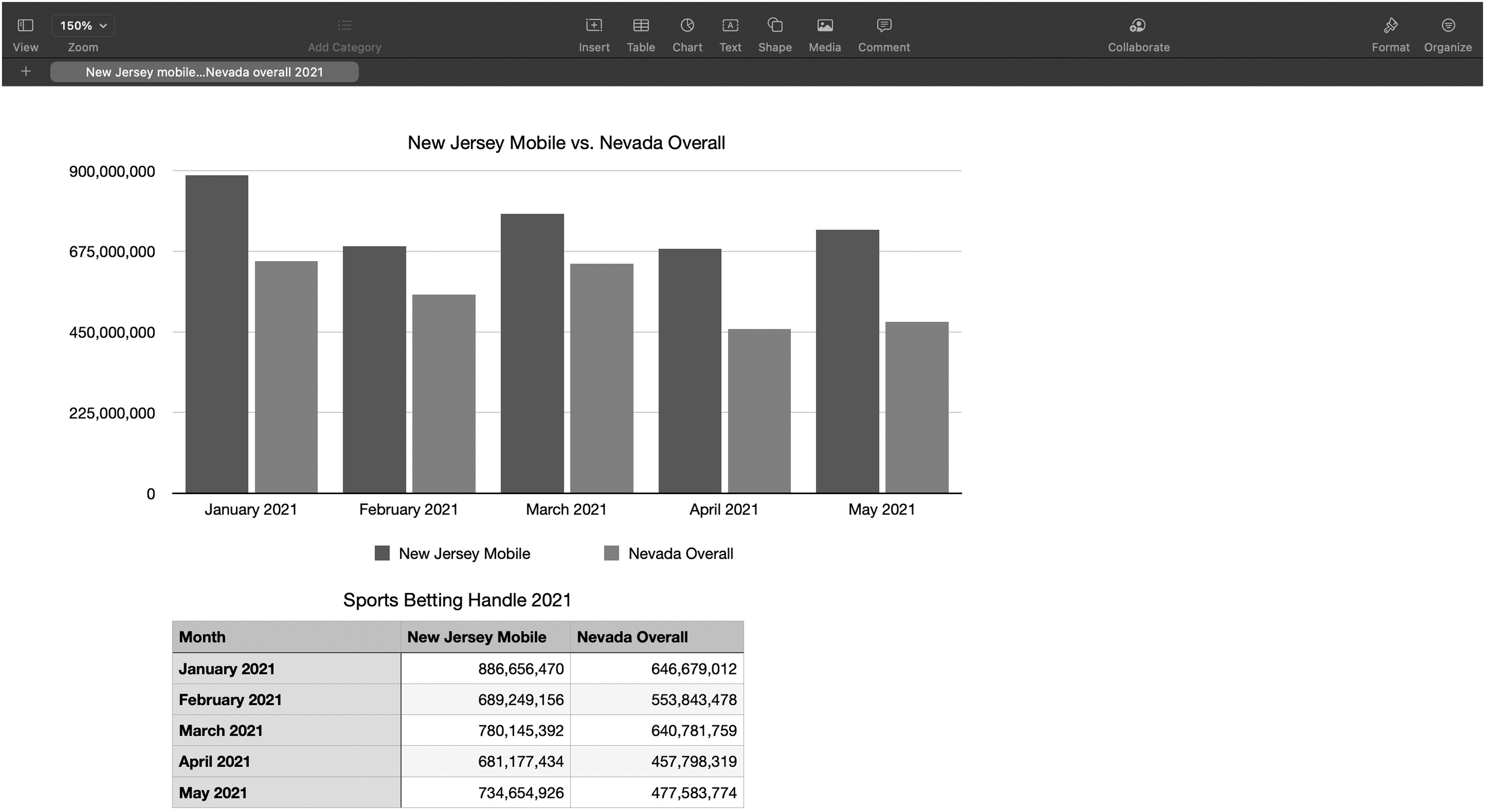
New Jersey vs. Nevada sports betting handle 2021.
As if New Jersey supplanting Nevada as the U.S.'s top sports betting market wasn't enough of a kick in the shin, even Illinois and Pennsylvania have experienced the rare thrill of finishing ahead of Nevada in monthly sports betting handle. In the case of the Land of Lincoln, it happened in April and May when Illinois ran its streak of months with at least one-half billion dollars in handle to five.
Despite not taking its first bets until March 2020 and its first mobile bets until June of last year, Illinois has quickly vaulted into the top four for all-time handle and lurks behind Nevada for second in 2021. That staying power, though, will be put to the test this summer as Illinois is now similar to Nevada in requiring in-person registration for access to mobile after having suspended it, via executive order, to allow remote access during the pandemic for nearly a full calendar year.
That means handle growth could prove more challenging in Illinois until football season, which is expected to be a key driver of sports betting handle nationwide. Also in Nevada's favor is its expected resurgence as a tourist destination, which will boost retail sports betting handle. There were signs of growth in that area in May, with retail wagering 11.8 percent higher month over month in May to $179.7 million.
Virginia Hits a Milestone and Saves the Day (Kind of)
Virginia became the fastest “new” state (read as ones not named Nevada, New Jersey, or Delaware) to reach $1 billion in handle, doing so in four months and 11 days from launch. If you're feeling nitpicky, Nevada did it in four months at the outset of the post-PASPA era, and the retail-first launch in Michigan took it out of the running for the “fastest to $1 billion” title.
Virginia became the eleventh state to reach $1 billion and the fifth this year to do so, joining Tennessee, Michigan, Iowa, and Mississippi. It is also one of eight states to clear $1 billion in handle in 2021. That group of New Jersey, Nevada, Illinois, Pennsylvania, Indiana, Michigan, Colorado, and Virginia has accounted for 86 percent of the overall handle in the U.S.
The newcomer also helped keep the revenue loss compared to April lower than what it could have been, as only four of the 20 states and jurisdictions reported month-over-month revenue gains.
May offered an odd trifecta of sorts as a higher win rate and less promotional play offset a dip in handle to create more gross gaming revenue and adjusted gaming revenue in Virginia. The operator hold jumped nearly two full percentage points in May to 10.22 percent, which meant gross gaming revenue jumped $3.7 million despite a 4.4 percent dip in handle from the previous month, and with less promotional play redeemed, adjusted gaming revenue jumped $4.3 million.
While that was not enough to offset the entire loss of another large-size market—Illinois' revenue fell more than $7 million as bettors knocked operator win rate there down almost a full percentage point on top of a 5.6 percent dip in handle—it helped mitigate the damage as operators cleared the quarter-billion-dollar mark for the seventh time in the last eight months.
Waiting on New York
Even without mobile sports betting, New York continues to draw national attention as it labors to launch it eventually. The Empire State's Request for Application process was unveiled late, putting more pressure on lawmakers and regulators to have something in place by the Super Bowl—the single-largest annual sports betting event in the U.S.—in early February.
For all of Gov. Andrew Cuomo's talk of how he expects $500 million in annual tax revenue from a fully mature mobile sports betting market, there was radio silence about how the state's current set-up of four upstate retail sportsbooks (out of sight and out of mind in relation to New York City) are performing, which may offer clues to whether such extrapolation was legitimate.
That silence turned out to be anything but golden. The New York State Gaming Commission does not release sports betting handle from those four venues, but a recently fulfilled Freedom of Information Law request revealed that the quartet has generated just shy of $245 million in handle since first accepting wagers in July 2019. It should be noted those books were closed for five months last year due to COVID-19.
To put that 18-month sum of wagering in perspective, consider neighboring New Jersey has cleared $500 million in handle—more than double New York's amount—on 13 occasions. New Jersey has not had a handle below $250 million in a month unaffected by COVID-19 since September 2018. Indiana, which has 80 percent of the population of New York City, has cleared $250 million in monthly handle six times in seven months from November through May (see Fig. 2).
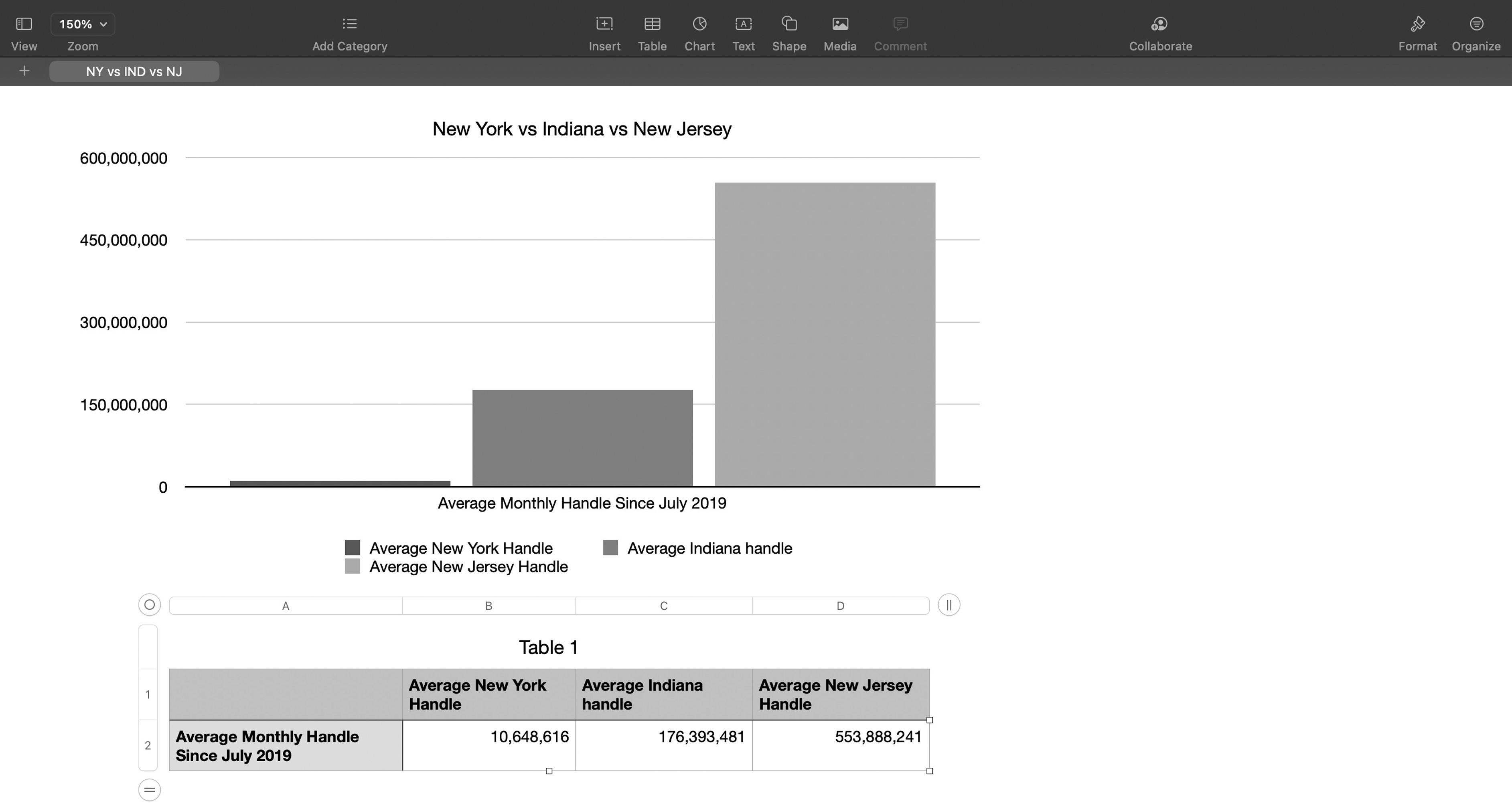
Average monthly handle for New York, Indiana, and New Jersey, since July 2019.
For a state where flexing its muscle in any economic aspect is second nature, it is jarring to see New York's cumulative handle sixteenth and in the bottom quarter of legal jurisdictions, edging out the District of Columbia and having barely 60 percent of the handle of Oregon, which is fifteenth at $405.2 million through May.
Eventually, though, New York will have its day. Much like New Jersey supplanted Nevada for the No. 1 spot, New York will ultimately eclipse its tri-state neighbor. It is just going to take more work and a little longer than initially expected.