




Abstract
ABSTRACT: Blind boxes are novel, gambling-like physical products that consumers can buy to obtain randomized content. In January 2022, non-binding, advisory compliance guidelines recommending certain best practices when marketing blind boxes for sale were published in Shanghai, China. The relevant provisions, which include consumer protection and harm minimization measures such as setting age limits; publishing probability disclosures; and implementing “pity mechanics” that guarantee that the consumer will receive the rarer content that they desire after making a predetermined number of purchases, are translated and commented upon. Blind boxes and other gambling-like products are identified to also be available for sale in other countries, including in the West, where they may legally constitute “gambling” under existing laws but remain unregulated and available for purchase by children. The similarities and differences between blind boxes and video game loot boxes are highlighted to show that a stronger case exists (in law) to regulate physical gambling-like products than video game loot boxes generally: secondary markets demonstrably exist for the randomized physical blind box content, which as a result possesses real-world monetary value, whilst, in contrast, most virtual video game loot box content cannot be transferred to other players and therefore cannot be exchanged for real-world money. The emerging popularity of gambling-like products and the increasing “gamblification” of the provision of products and services generally causes issues that require gambling law reform to address: enforcing existing gambling law that did not contemplate such widespread gamblification indiscriminately to regulate everything may be overregulation and may overburden gambling regulators. However, gambling regulators that have made, and continue to maintain, a conscious executive decision not to enforce the law against obvious contraventions are failing to address potential consumer harms and arguably acting ultra vires: regulators must therefore publicly justify their decision, so that “gambling-like products” may be properly scrutinized.
1. INTRODUCTION
The Shanghai Municipal Administration for Market Regulation (Shanghai AMR) of the People's Republic of China (PRC) published the Notice on the Issuance of the “Compliance Guidelines on Blind Box Business Activities in Shanghai” (the “Guidelines”) on January 14, 2022. 1 This consumer protection measure became effective within the Shanghai Municipality on the date of publication. 2 The Guidelines are advisory and non-binding and recommend certain best practices that would assist businesses with complying with prevailing laws and regulations (e.g., those concerned with consumer protection; children's civil capacity; and criminal offending generally) when offering blind boxes for sale. This is believed to be the world's first policy document that dealt specifically with blind boxes and attempted (quasi-)regulation to address potential harms.
This article (i) introduces the concept of “blind boxes,” which are novel, gambling-like products containing randomized content; (ii) translates and reflects on the Guidelines' compliance advice, in particular, the recommended harm minimization measures; (iii) identifies the availability of blind boxes in Western countries and also a number of other gambling-like products whose regulation might be forthcoming in the PRC and beyond; (iv) discusses the similarities and differences between physical real-life blind boxes and virtual video game loot boxes; (v) ponders how the Guidelines might inspire future loot box regulation that focuses on design aspects; (vi) highlights the wider relevance of the Guidelines to the regulation of gambling-like products more generally, which is an increasingly important but challenging policy issue given the “gamblification” 3 of many domains and how existing gambling laws, which did not contemplate this development, are now arguably “unfit for purpose” and need reform; and, finally, (vii) identifies the regulatory inaction of gambling regulators in many countries that has not been unexplained and appears to have been made executively without democratic input and wider scrutiny, in relation to many of these “gambling-like” products that in fact legally constitute “gambling” under the existing laws of many countries.
2. WHAT IS A BLIND BOX?
A blind box, or a “盲盒 [máng hé],” is colloquially understood as a product containing randomized rewards: the consumer of the product does not know exactly which potential reward they will receive until they finalize the purchase and “open” the product to reveal its content. For example, a blind box might contain a toy from a certain series, however, the box will only state that one of six potential toys can be randomly found within the box. The consumer must purchase the box “blindly” without knowing exactly which one of the six toys they will receive. Certain rarer toys, which are more sought-after and possess higher second-hand resale value, might appear less frequently than other toys. Consumers are reportedly motivated (a) to “chase” after the rarer toys (potentially to re-sell for a profit on the secondary market, whose presence and potential volatility the Guidelines acknowledge 4 ) or (b) to complete a collection of all available toy variations by opening multiple blind boxes, as identified by the Guidelines. 5 Blind boxes can be conceptualized as the physical real-world equivalent of video game loot boxes (although certain distinguishing features are noted below in Section 4.4.) and are arguably psychologically and structurally akin to gambling: 6 the consumer voluntarily invests money into a randomized process that produces results which might cause the consumer to gain or lose money. 7 Paragraph 2 of the Guidelines defines “blind box business activities” as those that are legally operated through the internet, physical storefronts, or automatic vending machines, etc., but those that do not inform consumers as to the purchased product's model or specification, or the purchased service's content or how it is to be provided, prior to the purchase being made. They instead require the consumer to participate in a random “draw” that decides what exact product or service they will obtain as part of the purchasing process. This broad definition reveals the wide variety of methods by which blind boxes might be sold (which means that they are easily accessible to potential consumers) and the potential variation in their content. Besides blind boxes containing plastic toy models or food items, more extreme examples of selling products through such a randomized process have been reported: the Sichuan Provincial Postal Administration responded to a case that received significant public interest where the blind boxes contained live animals intended to be household pets. 8
3. COMPLIANCE ADVICE
3.1. Content
The Guidelines advise businesses against the sale of illegal and dangerous products; those whose transportation, storage, or use requires specialist expertise; and live animals specifically through blind boxes. 9
3.2. Pricing
In addition, advice was given on the pricing of blind boxes: specifically, that the price of the blind box should be “basically equivalent” to the actual value of its content. 10 The cost of producing the “normal type” product and the “hidden type” product (here referring to the rarer potential rewards as compared to the more common rewards that can be obtained more frequently) “should not differ too widely.” 11 Further, when the same product is being sold using both the blind box method and normally (i.e., as a product on its own without involving the randomization process), the pricing of the blind box should not be higher than that of the product itself. 12 Finally, and perhaps most importantly, the price of a single blind box should not exceed ¥200 Renminbi (US$31.50; £23.00). 13
The blind box price cap recommended by the Guidelines is similar to maximum stake limits in gambling contexts 14 and might ensure that consumers do not lose too much money through each individual transaction. Further, this measure might also “break up” a spending spree by forcing consumers to take a certain amount of time between purchases and thereby encourage consumers to reconsider their purchasing decision. Such a cap appears wise given that the prices of blind boxes can be very high as the sales method expands into other domains beyond plastic toy models, such as luxury products: in January 2022, LVMH Moët Hennessy Louis Vuitton reportedly invested in a start-up, Heat, that offers “the world's only luxury streetwear” blind boxes for sale at prices ranging from $400 to $675 per box (although the business “guarantees” that the randomized contents' value will exceed $675 and $1200, respectively, so that consumers purportedly cannot “lose” money; however, it is unknown whether the consumers can indeed sell the contents on the secondary market for the advertised values). 15
3.3. Probability disclosures and opening results
The Guidelines state that the probabilities of obtaining rarer rewards and other key information must be “prominently published” so as to ensure that consumers are made aware of them prior to purchase, and that businesses should not manipulate the probabilities to induce spending. 16 Previous research has found that most legally required video game loot box probability disclosures in the PRC were not implemented by companies using methods that made them sufficiently prominent and accessible. 17 The Guidelines did not specify requirements as to how blind box probability disclosures should be “prominently” implemented and have again given companies discretion as to how to comply, which might mean that blind box probability disclosures will also similarly be suboptimal and difficult for consumers to find and understand. 18
The Guidelines also recommend that the design of the probability distribution and a complete record of all opening results should be retained for no less than three years, and businesses should actively track the opening results to ensure that the reward distribution is accurate. 19 Businesses also should not engage in “hunger marketing” by intentionally decreasing the probabilities of obtaining specific rewards (it is unclear whether this means that rare rewards should not be too rare, i.e., have too low of a probability of being obtained, or whether the probabilities should not be deceptively manipulated and reduced, contrary to the probability disclosure or other advertising materials). 20
3.4. Harm minimization technique: pity-timers
Minimizing harm, or rather “encouraging rational spending,” in relation to blind boxes was recognized by the Guidelines. 21 The specific recommendation was to implement so-called “bottom guarantee mechanics [保底机制],” known in English in video game contexts as “pity-timer” (or simply, “pity”) mechanics. 22 The Guidelines state that businesses should proactively offer consumers reasonable avenues to obtain the rarer rewards or a complete collection of all rewards in a certain series of blind boxes after the consumer either spends a predetermined amount of money on, or opens a predetermined number of blind boxes from, that particular series. 23 This is a recognition of the two potential motivations that consumers might have for purchasing and opening multiple blind boxes from any specific series.
This measure can also be understood as an implied maximum spending limit: the consumer would have no reason to spend in excess of the amount required to trigger the “pity-timer mechanic” and obtain all the rewards they desired. Such a pity mechanic would also effectively cap the monetary value of the rewards on the secondary market because if that value exceeds the cost of triggering the pity mechanic, it can be assumed that some consumers would decide to purchase more blind boxes to trigger it in order to resell for profit on the secondary market to meet that demand, thereby increasing supply and reducing the rewards' secondary market value (assuming that the blind box business does not engage in “hunger marketing” by implementing artificial scarcity and instead continues to sell the relevant blind boxes as long as there is demand).
3.5. Age limit
The Guidelines also address the purchase of blind boxes by minors. Specifically, blind boxes may not be sold to children under the age of eight, and they may not be sold to minors aged between eight and 18 unless the business verifies that consent has been obtained from their guardians (e.g., parents). 24
3.6. Gambling or gambling-like nature
Finally, the Guidelines recognize and permit the randomized nature of blind boxes that render them gambling-like, but explicitly delineate them from financial investments and traditional gambling activities. This is demonstrated firstly by how legally mandatory refund, return, and exchange policies of products in general may be disapplied in relation to blind boxes, if the consumers are sufficiently informed prior to purchase (inter alia, about the product's randomized nature). 25 This means that consumers cannot “undo” their purchasing decision if they were unsatisfied with the randomization result (similarly to how a gambler cannot “go back” on their bet when they lose, arguably because a gambler would never desire to “revert” a winning bet nor would a blind box purchaser who obtained the rarer contents). This can be perceived as the regulator's tacit endorsement of the legality of selling a random chance to obtain certain products and of gamblification in general (despite offering, and participation in, “gambling” widely defined being prohibited by criminal law in the PRC 26 ). Secondly, the Guidelines differentiate between blind boxes and financial investment products (despite blind box rewards having a secondary market where their resale value fluctuates) and between blind boxes and traditional gambling activities, such as lotteries, which may not be illegally organized in the guise of selling blind boxes. 27 These distinctions between financial investment products and traditional gambling on one hand, and quasi-gambling blind boxes on the other, appear minimal and, in any case, artificial. It remains to be seen what kinds of blind box implementation would be deemed as having “crossed the line” into “gambling” under PRC law.
4. WIDER SIGNIFICANCE OF THE BLIND BOX GUIDELINES
4.1. Presence of gambling-like product boxes in Western countries
The Guidelines explicitly dealt with the Chinese phenomenon of blind boxes. However, similar products are available for sale in physical storefronts in other countries, including in “the West,” as shown in Figure 1.
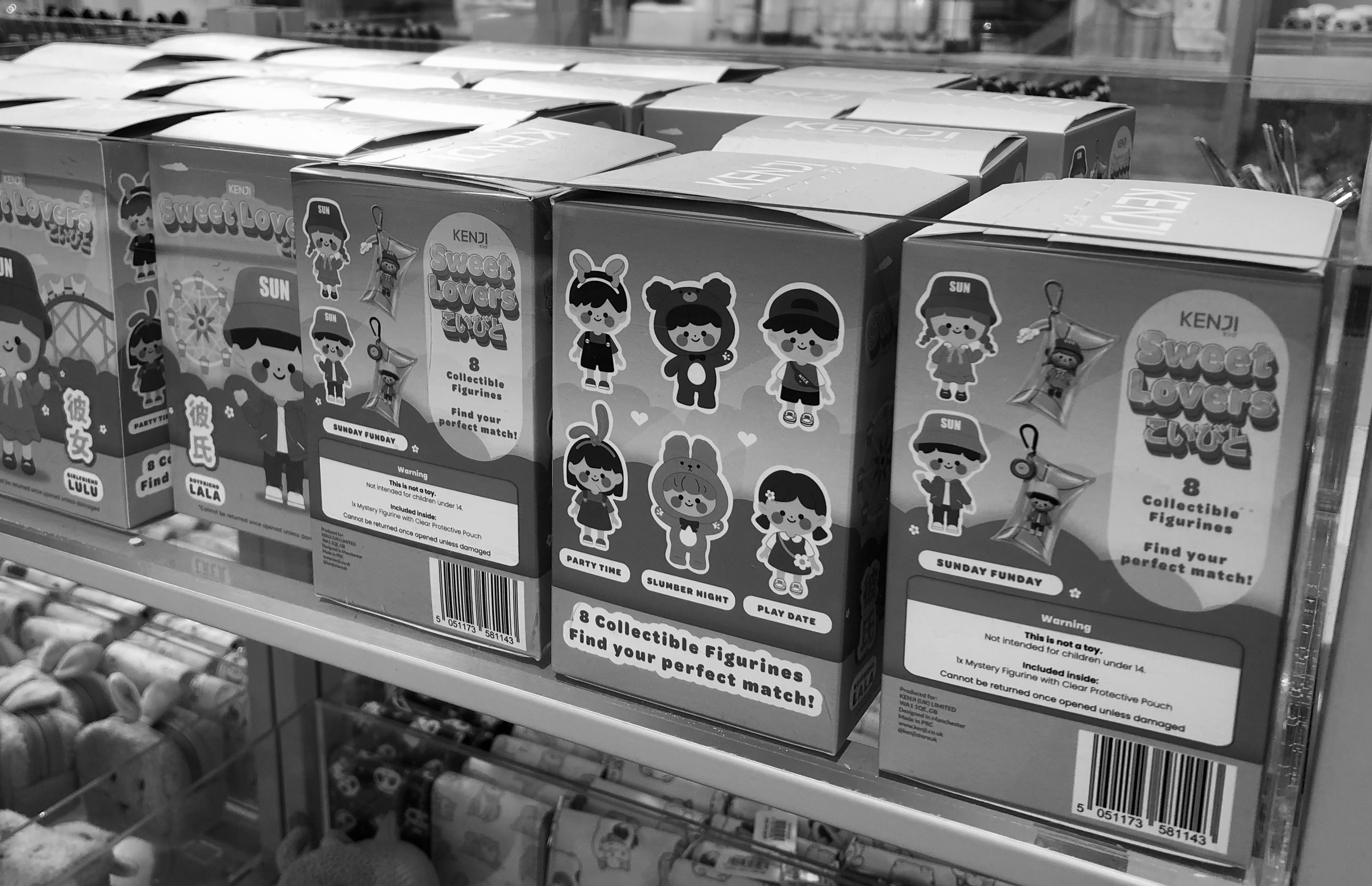
Blind box products purportedly “Designed in Manchester” and “Made in PRC” were available for purchase at the Arndale Centre in Manchester, England. The product displays a “Warning” stating:
Online options for purchasing such randomized boxes are also available through popular e-commerce platforms, such as eBay, as shown in Figure 2. Established businesses, e.g., Loot Crate and Bokksu, sell pop culture-related products and Japanese food items, respectively, in randomized boxes as well. However, these latter companies appear to operate on subscription-based models and therefore might not as strongly encourage multiple purchases by a consumer to obtain specific rare rewards, if the concept of rare rewards is even implemented. Further, it is not known whether consumers can “lose” money by buying subscription-based randomized boxes because their content often seems to be advertised as outvaluing the boxes' purchase price; regardless, the consumer does not know exactly what they will receive when they make the initial purchase.
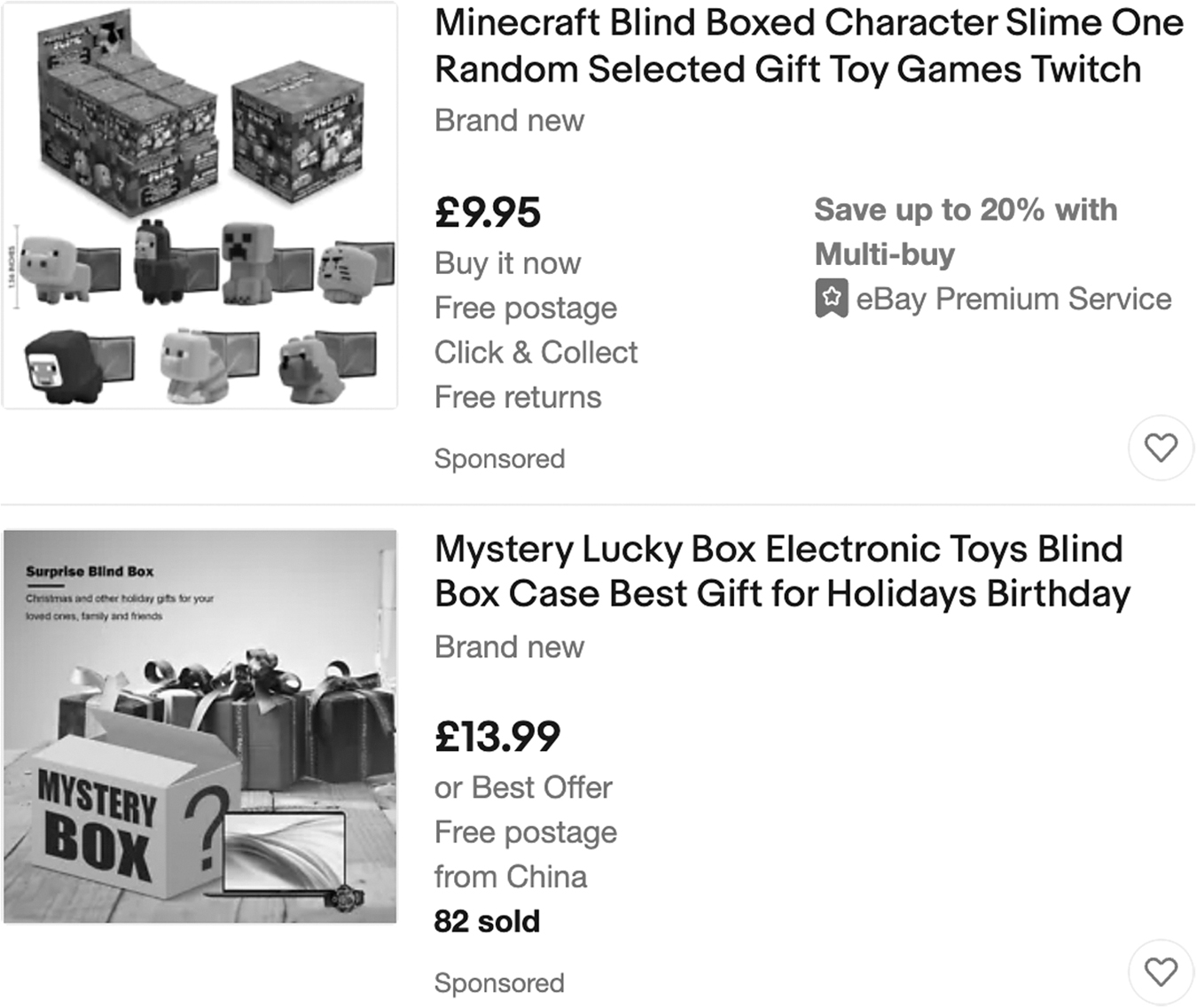
A screenshot of the blind box products that are available for sale on eBay: the top option is packaged by established businesses, whilst the bottom option is packaged by private sellers. © 2022 eBay
Besides formal blind box products packaged by known companies, private sellers also offer seemingly even more opaque “mystery boxes” on C2C (customer to customer) platforms, such as eBay and Etsy. 28 eBay technically forbids such products from being sold on its platform through its own policy (i.e., a form of self-regulation), which states “mystery items or listings that offer an opportunity to win an item by chance or contest are not allowed on eBay.” 29 However, a search on the platform reveals that privately-packaged blind boxes are also readily available for purchase, as shown in Figure 2. Some such products are even “sponsored,” meaning that eBay financially benefits by receiving an advertisement fee (which would be a percentage cut of the final sales price) if said products were purchased. 30 In contrast, Etsy has no rule against sellers listing blind boxes and so, unsurprisingly, a search reveals that such products are readily available for purchase, as shown in Figure 3. Evidently, blind boxes and similar products are widely available for sale to consumers in Western countries in-person and online. Therefore, the potential regulation of these products is relevant not just to the PRC but also more widely in a global context. Policymakers and gambling regulators in other countries might also wish to consider whether or not to regulate these products given their conceptual and psychological similarities with gambling and because they likely already legally constitute “gambling” under existing laws in many countries as explained below under Section 4.4. 31
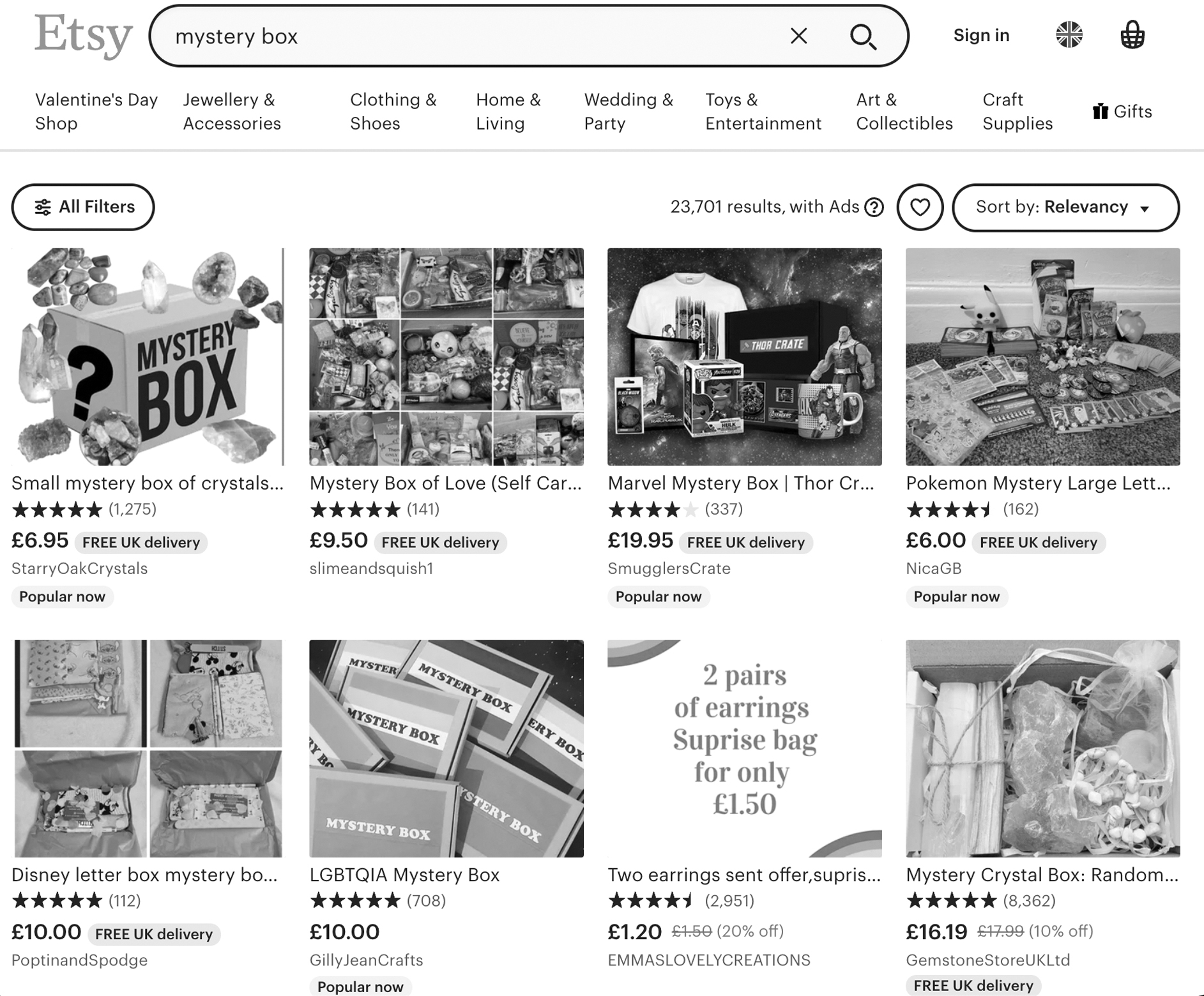
A screenshot of the blind box products that are available for sale on Etsy. © 2022 Etsy
4.2. Other gambling-like randomized sale methods (e.g., trading card booster packs)
Blind boxes were arguably inspired by gashapon or gachapon vending machines, popularized in Japan, which offer the consumer randomized products inside a capsule every time a purchase is made, as shown in Figure 4. The consumer can choose to purchase from a certain series of multiple potential products (by choosing to buy from a particular machine), but exactly which one reward from that series they receive is unknown to them prior to purchase and subsequently determined randomly.
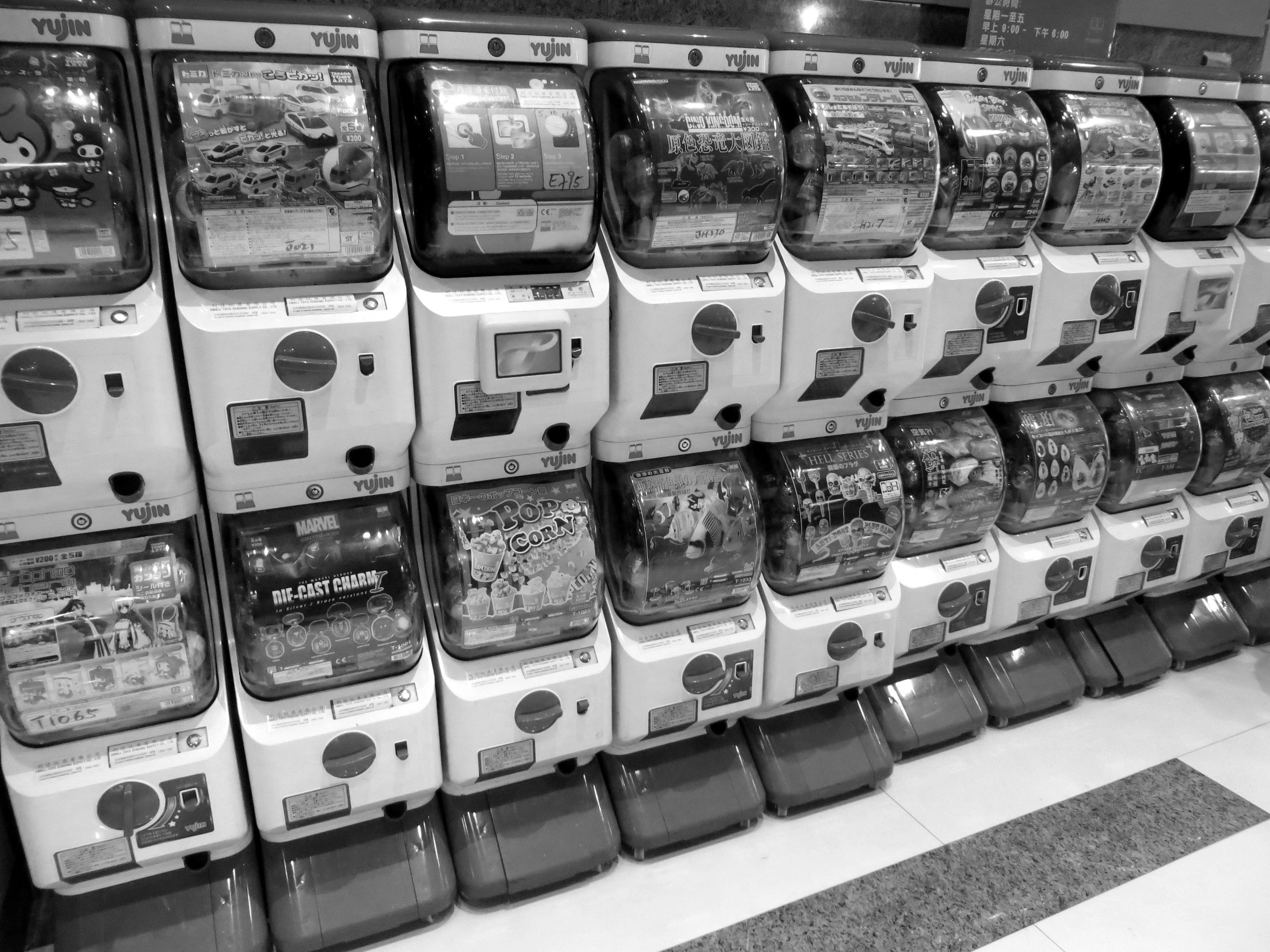
Gashapon Machines in Hong Kong, China. © 2012 Mk2010
Physical collectible or trading card games, such as Magic: The Gathering, 32 rely on selling sealed packs of randomized cards to monetize. Before buying and opening these “booster packs, ” the consumer does not know what cards they will receive. Competitively strong cards that are more valuable on the secondary market often appear less frequently than other cards, and many packs must be opened (including those containing cards that the consumer does not need or want 33 ) in order to obtain multiple copies of rare cards (which are required to build a strong deck of cards to play competitively).
Gashpon machines and collectible card packs are arguably conceptually and structurally similar to gambling, just like blind boxes. 34 However, despite being available for purchase for decades and potentially even legally constituting “gambling” (primarily because the existence of secondary markets for the opened contents gives them monetary value), 35 hitherto, there has been little policy or public interest in regulating these products, either as gambling or otherwise. These products do all fall within the definition of “blind boxes” set out in the Guidelines, which means that the PRC might be targeting these older gambling-like products with regulation in the foreseeable future. Policymakers and gambling regulators in other countries should also consider why these older gambling-like products have not been regulated despite likely contravening existing gambling laws and whether they should now be regulated.
4.3. Video game loot boxes
One other form of gambling-like products that has garnered significant public and policy interest in the PRC and beyond is that of video game loot boxes, which are digital blind boxes that players can purchase to obtain randomized in-game rewards. 36 Loot boxes have been specifically examined, or are presently being examined, by policymakers and regulators across the world: inter alia, the Belgian gambling regulator deems paid loot boxes to be gambling and has effectively banned them; 37 the Dutch gambling regulator deems paid loot boxes whose rewards can be transferred to other players and therefore possess real-world monetary value to be gambling 38 and has fined a video game company for implementing such mechanics without a gambling licence; 39 and the UK Government (amongst many others) is presently considering whether, and if so how, to regulate loot boxes. 40
In addition to being structurally and psychologically similar to gambling, 41 loot box purchasing has been linked to self-reported problem gambling severity in multiple studies of Western video game players: 42 specifically, on average, players self-reporting more problem gambling issues tend to spend more money on loot boxes. It is possible that the purchasing of blind boxes and other gambling-like products might be positively correlated with problem gambling (although, note that one study has found no link between the purchasing of physical collectible card packs with self-reported problem gambling 43 ). Therefore, blind boxes and other gambling-like products should be subject to further research to identify whether they might be potentially harmful to consumers and, based on those results, to decide whether they should be regulated either as gambling or through other means to ensure consumer protection, particularly in relation to vulnerable groups, such as children and people with potential problem gambling issues.
Finally, it should also be noted that the line between video game loot boxes and physical blind boxes is blurring as new gamblified products are introduced to the market. Physical Magic: The Gathering trading card booster packs are implemented digitally in Magic: The Gathering-based video games as loot boxes: the loot box implementations in Magic: The Gathering Arena (2018) arguably contravene Belgian law, 44 whilst those in Magic: The Gathering Online (2002) arguably contravene Belgian, Dutch and UK gambling laws. 45 In addition, the concepts and definitions of blind boxes and loot boxes are also blurring: NBA TOP SHOT is an “officially licensed product of the National Basketball Players Association” 46 that can be purchased to obtain randomized virtual NFTs (Non-Fungible Tokens) that can be sold on the secondary market and therefore possess real-world monetary value. 47 NBA TOP SHOT is therefore either a virtual blind box or a loot box without an accompanying video game within which the obtained rewards might be used. 48 A regulatory distinction between blind boxes and loot boxes will become increasingly more difficult to draw and to justify as these novel, virtual blind box products are invented and popularized.
4.4. Are blind boxes legally gambling? (In most countries, probably yes!)
Although blind boxes are practically physical video game loot boxes because of their randomized natures, blind boxes differ in one major way from the majority of loot boxes. This relates to whether the boxes' contents have real-world monetary value. 49 The randomized rewards of most video game loot boxes cannot be transferred outside of the in-game virtual economy and therefore cannot be sold to other players in exchange for fiat currency and do not possess real-world monetary value. 50 This is the basis by which the Dutch and the UK gambling regulators (but not the Belgian gambling regulator, which took an opposing view 51 ) decided that most video game loot boxes do not legally constitute gambling under existing law: 52 specifically, because their contents, i.e., the “prizes,” do not constitute “money or money's worth.” 53 Therefore, most paid loot boxes can be legally sold, 54 including to children, without any restrictions, which explains why loot boxes are highly prevalent in video games, particularly on mobile phone platforms. 55 However, unlike most video game loot boxes, all physical blind boxes have contents that can be freely sold to others in exchange for real-world money. This means that all blind box contents, i.e., “prizes” are “money's worth” and therefore all blind boxes constitute gambling under Dutch and UK law (and the laws of many other jurisdictions where gambling is similarly defined 56 ). Adopting this reasoning that was previously used by gambling regulators in relation to video game loot boxes, 57 NBA TOP SHOP and such products similarly should legally constitute “gambling” in many countries. Given that blind boxes legally constitute gambling under UK law, the age restriction self-imposed by the manufacturer and seller (which appears not to hold a gambling licence) to consumers aged 14 and above, as shown in Figure 1, is not sufficient. UK law criminalizes voluntary participation in “gambling” by “young people” aged between 16 and 18 (but not aged under 16). 58 Therefore, a young person aged between 16 and 18 who buys a blind box in the UK technically commits a criminal offence, although it appears highly unlikely that any prosecution will ensue for fairness reasons (e.g., abuse of process, given that the gambling regulator has not recognized such products as legally constituting gambling and has arguably given the impression that these products are lawful due to regulatory inaction).
Although irrelevant to the legal question of whether blind boxes constitute gambling (at least under UK law), it is also worth noting that the secondary markets for the contents of blind boxes (and those of other gambling-like products, e.g., trading card game booster packs), are highly active meaning that not only is it possible for blind box contents to be sold for real-world money, but there is also a substantial market demand for them. Indeed, the motivation for buying blind boxes (all of whose content can be sold for real-world money) and that for buying loot boxes 59 (only a small minority of whose content can be sold for real-world money) might well differ. More consumers might purchase blind boxes with the goal of trying to turn a profit through speculating on their contents' potentially volatile secondary market value, whilst the same could not be done in relation to the contents of most video game loot boxes (whose purchase are likely motivated by gameplay purposes). Although this remains subject to further research, if the above hypothesis is true, then the regulation of blind boxes as gambling is more justifiable than the regulation of most types of loot boxes as gambling.
As argued, blind boxes should constitute gambling under the existing laws of many jurisdictions, and the sale of which without a gambling licence likely contravenes criminal law. Regulators should enforce the law against contravening products to ensure that what the law says is applied in practice and not to give gambling-like (or rather certain newer forms of gambling) products an unspoken but unjustifiable immunity to regulation, which presently appears to be happening with certain video game loot boxes in certain countries (e.g., Electronic Art's loot boxes in its FIFA games being treated differently by individual regulators despite there being no practical variations between national laws 60 ). Given that the current state of non-regulation might be due to regulators lacking requisite knowledge, businesses offering blind boxes (and other gambling-like products) for sale ought to be mindful of potential enforcement actions by national gambling regulators and other law enforcement agencies as these products become more popular and more heavily scrutinized by the public.
5. INSPIRATIONS FROM THE BLIND BOX GUIDELINES APPLIED TO LOOT BOX REGULATION
Given the conceptual and structural similarities between blind boxes and loot boxes, the PRC blind box Guidelines can inform future loot box regulation in the PRC and other countries. Regulating the sale of loot boxes as gambling, e.g., an effective ban as adopted in Belgium, 61 is an oft suggested regulatory response. In most countries, such an approach would mean that children would have no opportunity to purchase loot boxes, and adults would only be able to purchase them within a tightly regulated industry (or also potentially not at all if adult gambling is not legalized in that jurisdiction). However, this restrictive approach risks overregulating: not all players are at risk of being harmed by loot boxes; indeed, most players likely will never be harmed by loot boxes. The Belgian ban has caused certain video games to be removed from that market, which deprived Belgian players of certain entertainment opportunities and negatively affected companies' commercial interests. In contrast, non-regulation of loot boxes, as presently practiced in the UK, risks exposing consumers to potential harms. 62 A more nuanced, middle-ground, design-based regulatory approach for loot boxes has previously been propounded by researchers in theory 63 and arguably partly adopted by the PRC through its loot box probability disclosure regulation. 64 The PRC blind box Guidelines suggested many “ethical” design-based approaches that are translatable to the loot box context and evinced that regulators are willing to consider and support these options as an alternative to an indiscriminate ban.
5.1. Age limits: delineating more groups
The Guidelines' approach to age limits on blind box purchasing breaks new ground by suggesting that young people of different ages should be treated differently: children under eight should not be allowed to purchase blind boxes, whilst young people between eight and 18 should have their guardian's permission before purchasing blind boxes (note also that the blind boxes found to be available for purchase in the UK state that they are “not intended for children under 14,” as shown in Figure 1). In the loot box context, a distinction has only been drawn between minors and adults in the academic literature and in policy documents (e.g., children should be banned from purchasing loot boxes whilst adults can purchase them without restrictions 65 ), but the minors' category can be further subdivided using existing age rating systems.
For example, loot boxes could be entirely prohibited from being implemented in video games deemed suitable for very young children (e.g., games rated E by the Entertainment Software Rating Board (ESRB) 66 (i.e., suitable for children aged under 10) and those rated 3 or 7 by Pan European Game Information (PEGI) 67 ). At the same time, loot boxes might be allowed for implementation in older children's games (e.g., games rated T by the ESRB (i.e., suitable for children aged 13 and up) and those rated 12 or 16 by PEGI 68 ) provided that certain consumer protection features are included, e.g., that the rare loot box content must alternatively be available for purchase directly and that it is guaranteed to be provided to the player after a certain predetermined, relatively low amount of money has been spent (i.e., a pity mechanic is implemented). Finally, loot boxes could be implemented in games deemed suitable for late adolescents and adults (e.g., games rated M by the ESRB (i.e., suitable for children aged 17 and up) and those rated 18 by PEGI 69 ) with fewer consumer protection restrictions. It might also be appropriate to consider creating a new classification for young adults, which differs from the general adult rating, that requires a higher degree of consumer protection to reflect that impulsivity as a trait continues to decrease throughout early adulthood and does not immediately diminish upon attaining the age of majority. 70
5.2. Probability disclosures
The Guidelines recommend that the probabilities of obtaining rarer contents are “prominently published.” This mirrors prior PRC regulation that requires companies implementing loot boxes to disclose probabilities 71 and industry self-regulation in Western countries that requires the same. 72 There has been no empirical research examining the effects of probability disclosures on loot box purchasing, besides one survey in which only 16.4% of loot box purchasing participants self-reported spending less money after seeing probability disclosures. However, the provision of such information is unlikely to be detrimental to consumers and would provide some transparency and fairness to the process. The Guidelines also suggest that records of blind box opening results should be subject to third-party auditing to enhance product quality. 73 Independent auditing and certification of loot box opening results would likely also increase consumer confidence: 74 companies that cooperate might see more players spending money with them, rather than with other companies. Countries besides the PRC should also consider requiring loot box probability disclosures by law, rather than rely solely on existing industry self-regulation (which was empirically proven to be less effective 75 ), to implement this consumer protection measure.
The blind box Guidelines also advise against “intentionally decreasing” the probabilities of obtaining rarer contents. 76 Although it is unclear exactly what this refers to, the two potential possibilities as they relate to loot boxes both deserve discussion. The Guidelines might be stating that the probabilities of obtaining rarer contents should not be too low: in the loot box context, probabilities of as low as 0.0008% have been identified, 77 meaning that players might have to buy a great number of loot boxes and spend substantial sums of money before obtaining the specific reward that they desire. Regulation could be imposed to set a minimum probability limit to reduce spending: for example, that even the rarest reward must have a probability of at least 5% of being obtained at all times. 78 The other interpretation of “intentionally decreasing” the probabilities of obtaining rarer contents is any manipulative actions that companies might take to change the probabilities of obtaining rare rewards to the consumer's detriment, 79 which some companies have been identified as doing. 80 Requiring probability disclosures (and assuming that companies will make them accurately) would help to reveal these deceptive practices and discourage companies from adopting them, as players are unlikely to support companies using such arguably predatory practices.
5.3. Pity-timer mechanics
Previous studies have identified pity-timer mechanics as being often implemented in the PRC (65.9%) 81 and Western video games (34.7%) containing loot boxes. 82 These mechanics seemingly provide players with some insurance and a better estimation of how much they would have to spend at most to obtain their desired reward, and so pity-timers have been recommended for wider adoption to video game companies by researchers. 83 The Guidelines represent one of the first instances where a regulator has recommended the adoption of a so-called “ethical game design” measure to minimise potential harms. This reflects that it is possible for regulators to recommend, or even require, specific safeguards to be implemented with loot boxes and other gambling-like products. A blanket ban is only one potential regulatory approach: more nuanced and targeted consumer protection measures might more effectively balance the interests of all stakeholders by promoting players' freedom to purchase loot boxes and video game companies' commercial interests, whilst also ensuring certain vulnerable players' consumer protection needs.
Notably, however, the Guidelines recommended the implementation of pity mechanics without reference to potential negative consequences. For example, it is true that pity-timers will guarantee a rare reward after 10 purchases, and this might help consumers to make less impulsive and more informed purchasing decisions. However, pity-timers could also potentially lead to overspending beyond what the consumer initially budgeted for. Consider the following: the consumer planned on making 10 purchases to obtain a rare reward, but if they already obtained a rare reward within the first two tries, then they might be tempted into making up to 10 further purchases (12 total) to obtain two rare rewards instead of one. Therefore, the presence of pity mechanics might encourage additional purchases in certain situations. How players interact with pity-timer mechanics, and whether that consumer experience differs across purchasing physical blind boxes and virtual loot boxes, should be addressed by further research: such questions are now particularly relevant because at least one regulator has already recommended the measure for adoption without empirical evidence of its potential benefits and harms.
6. CONCLUDING REMARKS: HOW TO REGULATE GAMBLIFICATION?
Blind boxes represent another example of the increasing gamblification of product and service offerings. These gambling-like products were not within policymakers' contemplation when the existing gambling laws of many countries were initially drafted. Gambling law could be applied to address the potential harms of some of these products (because the legal definitions of “gambling” are often broadly set out), but gambling regulators generally appear to have no interest in doing so or have not been able to respond to potential harms promptly. This reflects that existing gambling law is unwieldy and is unfit for purpose in terms of addressing the novel challenges posed by widespread gamblification and technological change. Increasing regulatory attention should be paid to these new gambling-like product offerings. However, some caution should be exercised when deciding whether or not to regulate them as gambling per se: not every product involving randomization necessarily must be regulated as gambling. 84 To do so indiscriminately might be overregulation because many product and service offerings would now come within the ambit of the wide legal definition of “gambling,” and to do so may indeed overburden gambling regulators that were originally intended only to address traditional gambling activities (e.g., lotteries, sports betting, and casino games).
Notwithstanding, the current state of non-regulation is also unsatisfactory in two regards: firstly, that potential harms are not receiving the regulation, research, and public attention they deserve (as detailed above) and, secondly, that this present situation was arrived at by an unexplained process that offends the rule of law. The broad drafting of existing gambling laws means that offering many of these gambling-like products without a gambling licence is undoubtedly technically illegal in many countries. Minimal or no regulation of gambling-like products might be a valid policy decision that some countries decide to make (e.g., for economic reasons or to reflect changing moral views on “gambling”); however, such a decision needs to be reached through a democratic, legislative process, rather than through gambling regulators executively deciding (without public consultation and possibly even without wider government involvement) not to enforce criminal law without any public explanation.
The current state of gambling (broadly defined) (un)regulation unfairly disadvantages the traditional gambling industry by heavily restricting how they might offer randomized sale processes to consumers because other industries are seemingly allowed to offer products and services involving randomization with fewer restrictions, if any at all. It must be questioned whether there is a sound basis for this distinction that has been drawn between traditional gambling and what this article has referred to as gambling-like products (but which are in fact both conceptually “gambling” in a colloquial sense and likely also legally “gambling,” as argued above). Perhaps based on an outdated view of the immorality of traditional gambling, that industry's commercial interests are being “discriminated” against. Consumers are also given the false impression that gambling-like products are not “gambling” and are not potentially harmful. This article does not seek to argue that traditional gambling should be deregulated, 85 but it and novel gambling-like practices should be scrutinized (if not regulated) to the same degree. The application of the law should be even-handed. This lack of uniformity is unnerving, particularly because it does not stem from a distinction being drawn by law properly through democratic legislative processes. Individual gambling regulators seemingly simply decided to make such artificial distinctions by not enforcing the law in some situations without publishing any explanation to clarify the law or their interpretations.
The gambling laws of many countries are in need of reform to address gamblification: the law on paper should state what the law is in practice, and this is presently not the case in relation to gambling-like products. In lieu of applying existing gambling laws and adopting an outright ban, regulating through design-based harm minimization measures (whose effectiveness further research should empirically assess) is likely to balance and maximize the interests of all stakeholders: businesses are allowed to continue their commercial exploitation but are required to do so only when some safeguards are applied, whilst consumers are allowed the freedom to purchase whatever product they desire but are guaranteed consumer protection.