




Abstract

Barring some sort of cataclysmic event, year-over-year figures for handle, revenue, and taxes when it comes to sports wagering in the United States will be significantly higher in 2022 compared to 2021. Some of that is due to the number of legal jurisdictions now conducting wagering. For most of 2021, that number was stuck on 20 before increasing to 26 over the last four months. For the first half of this year, that 26 number held steady.
In the case of state tax revenue, the amount generated in the first six months of the year exceeded all of 2021. New York can take credit for that—along with the eventual sizable increases in the other two categories—by entering the mobile marketplace and levying a 51% tax that sportsbook operators swallowed through gritted teeth. The price of entry into one of the “Holy Grail” states—Florida, Texas, and California being the others—was undeniably steep, yet no one could afford not to effort being among the first group of nine to take wagers in the Empire State.
But while those numbers spiral higher, there is a sense the revenue number is not making that climb as fast as handle. The win rate—the percentage the house keeps from the amount wagered—was 6.66% on gross revenue in the first half of 2022. Connections between sports wagering and Satan aside, that is below the industry standard of 7% but significantly lower than the cumulative 7.36% when going back to the first wagers accepted in May 2018 through the end of last year. Had it not been for May, when operators posted a 9.11% win rate on nearly $6.7 billion handle, the 2022 overall win rate would have been far lower. May's good month for the house lifted the national win rate nearly one-half of one percentage point higher. June saw the betting public again claim a victory of sorts by keeping the house barely above 6%, but it also raises a more interesting question—how much worse off would operators be if not for the parlay wagering that is now the predominantly means of generating revenue in most states?
To dig deeper into this idea, six states that provide both handle and revenue when it comes to parlays—New Jersey, Illinois, Nevada, Colorado, Oregon, and Mississippi—offer clues. There are two others, Louisiana and Indiana, that only provide one half of those sets of data. But the six that provide full sets are a useful cross-section of national jurisdictions and include one anomaly of sorts in Nevada, where parlay wagering lags far behind in popularity since sports betting there is more event-driven on the Las Vegas strip due to a higher percentage of in-person wagering versus mobile wagering (see Figs. 1 and 2).
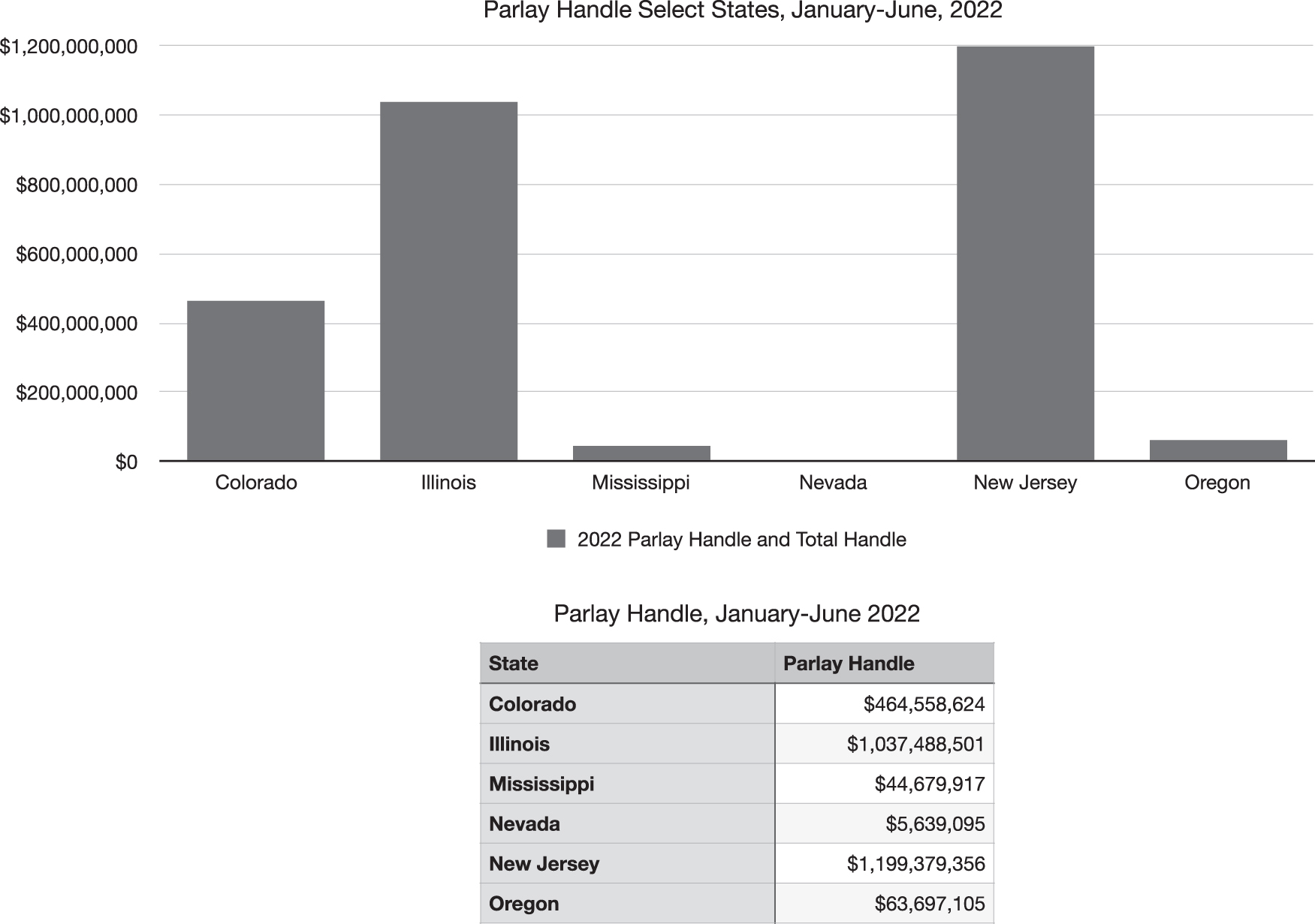
Parlay Handle Select States, January-June 2022. Parlay Handle, January-June 2022.

Total Handle Select States, January-June 2022. Total Handle, January-June 2022.
Four of the six states consistently rank in the top 10 of monthly national handle, with New Jersey, Illinois, and Nevada within the top four behind New York. Oregon also has a unique quality to it as sports wagering is run by the state-lottery, but DraftKings has been its official sportsbook since mid-January of this year. The sextet comprises a notable amount of the overall monthly national handle and revenue, ranging from 37.2% to 40.8% in the former and 31.4% to 34.7% in the latter. What becomes interesting is how much those states derive from parlay revenue as a percentage of their overall revenue and how their win rates from parlay wagers are significantly higher than their win rate for all wagering.
Parlay wagering, by its nature, will result in a higher win rate for operators than overall single-event wagering. While not akin to flipping a coin multiple times and having it land exclusively heads or tails, bettors need to win each and every “leg,” be it two, four, ten, or whatever amount decided to have a winning parlay. It is more difficult to win a parlay, but the payout is substantially higher, thus the appeal to bettors. It is common to see bettors and operators alike post plays of multiple-leg parlays on social media that seem as far-fetched to deliver as playing one line of quick pick in a national lottery. Indeed, that is sometimes the allure of a 12-leg parlay—to make a $1 wager that could pay out $10,000.
The volume of parlay handle has increased substantially with the introduction of the “same game parlay,” which allows bettors to bundle together wagers from one game. This is most popular during the NFL season when a bettor can pick a team to cover the point spread, the total amount of points scored (the over/under) and assorted player prop selections, such as the over/under on yards and/or scoring a touchdown. FanDuel was the first mover among sportsbooks, with others quickly following suit with their version of such offerings.
As seen in Figure 3, the win rate for parlays rarely falls below 10%, and sometimes can spike if an unexpected outcome takes place that ruins any one leg for a bettor. In this instance across the six states, the number of occurrences of the win rate above 20% (10) was greater than the occurrences below 10% (6). Nevada has the largest month-to-month swings due to its relatively low parlay handle—its $5.6 million handle spanning the first half of 2022 is less than the average amount wagered daily on parlays in New Jersey at $6.6 million.

Monthly Parlay Win Rates, Select States, and Combined. Month-by-Month Parlay Win Rates in 2022.
From those elevated win rates in most cases, comes an elevated share of parlay revenue within the overall revenue generated in those states. Nowhere is that more evident than New Jersey, where parlay revenue claimed by the house accounted for a whopping 62.1% of all revenue in the first six months of the year. The 15.99%-win rate on such bets was nearly treble the 5.34% overall rate.
As Figure 4 illustrates, Oregon and Illinois also had more than half its overall sports wagering revenue derive from parlays. Illinois taxes adjusted operator revenue at 15%, which means the receipts generated from exclusively parlay revenue—just shy of $26 million—is more than the total revenue generated in both Mississippi and Oregon. In the case of Illinois and New Jersey, it is notable the parlay revenue generated is nearly equal to the amount of total revenue generated by Nevada in the first six months of the year.

Parlay Revenue to Overall Revenue, Select States January-June 2022. Parlay Revenue to Overall Revenue, January-June 2022.
It is another example of how bettors view Las Vegas and the Silver State as a destination for single-event wagering—in-person parlay wagering is a more time-consuming process, and since most people are not going to take the time to register for the mobile sportsbook app at their venue of choice, it is easy to make a series of single bets than explain a multi-leg parlay and keep the queue moving. The other key takeaway is the parlay win rate in five of the six states being at least a two-times multiplier of the overall win rate (see Fig. 5). New Jersey's was previously noted with its parlay win rate nearly 3 times its overall one, but Nevada's is actually the highest in the group at 3.35 times its 4.42% overall win rate.

Parlay Win Rates to Overall Win Rates, Select States January-June 2022. Parlay Win Rates to Overall Win Rates and Multiplier, January-June 2022.
Mississippi, which does not permit statewide mobile wagering, had the highest parlay win rate at 18.75%, while Colorado bettors were the best performers in limiting the house to barely more than 12%. The Centennial State accounted for three of the six occasions a monthly parlay rate was below 10%, with one coming in February likely due to the Super Bowl. The success of the Stanley Cup champion Colorado Avalanche likely contributed to May's 6.78% hold there as it would seem possible many bettors there included the Avalanche among a bundle of division winners across single and multiple sports.
If the overall win rates for each state were applied to their respective parlay handles for the first six months of the year, the drop in revenue would be substantial given the spread of nearly 10% in parlay win rates (15.66%) to overall win rates (5.71%). The total of nearly $173.5 million is less than 40% of the actual $441 million collected by operators, and Illinois would supplant New Jersey for the revenue leader of the six, though with only $74.5 million to the Garden State's $64 million. Nevada would have contributed less than $250,000 to the parlay kitty while Mississippi and Oregon would have accounted for less than $10 million combined.
To put that lost revenue from just six states in perspective, the overall win rate for the first half of the year would have plunged to 6.09% without that $267.5 million. Therefore, it is no surprise that operators will continue to aggressively promote parlays with visions of large potential payouts. But a continual reliance on such wagers to generate revenue may prove to backfire if it comes at the expense of enhancing offerings across other wagering platforms within a sportsbook.