




Abstract
Sportsbooks across the United States enjoyed a record-setting September when it came to gross revenue thanks in large part to a spate of unexpected results in the first three weeks of the National Football League (NFL) season that confounded bettors. The house won single-event wagers at historic levels while the public's continued interest in parlays further played into operators' hands as win rates from those bets reached stratospheric highs.
With parity in sport comes chaos at the betting window.
One reason for the rampant popularity of the National Football League is that hope truly springs eternal every season. A team that struggled in a previous season can make personnel changes in both the front office and player personnel, and if the right combination is found, success can be had. Of the 14 teams that made the playoffs in 2020, only seven returned in 2021. The American Football Conference (AFC) champion Cincinnati Bengals had not been to the postseason since 2015 prior to their surprising run. The Arizona Cardinals ended a similar drought but were eliminated in the first round. Different endings aside, there is a path teams can logistically plot for their own timelines.
Improvement can accelerate based on relative strength of schedule. The NFL has a unique scheduling matrix: A team plays its divisional opponents home and away; its “peers” based on its finish from the previous season; one entire division from its conference, one division from the other conference, and one additional interconference contest following the introduction of the 17th regular-season game in 2021. For example, the 2022 schedule for the New York Jets, who went 4-13 and finished fourth in the AFC East in 2021, consisted of: Six games against AFC East opponents; two versus their fourth-place intraconference “peers” Denver and Jacksonville; four versus the AFC North for interdivision, intraconference play; four versus the NFC North for interconference play; and the NFC West's Seattle Seahawks as their 17th game.
The Jets had a busy offseason of player moves through both free agency and the draft, most notably using three first-round selections in the draft and addressed areas of key needs to further build a foundation to help further the growth of potential franchise and second-year quarterback Zach Wilson. This process of rebuilding, retooling, and refining takes place to varying degrees for all 32 teams. While the Jets had an uneven 1-2 start in September, they were 7-5 at the time of writing and in contention for a playoff berth. The tradeoff for having a 17th regular-season game was one less preseason game. This has forced teams to put a greater emphasis on efficiency and production in training camp—and most teams have adjusted by having “joint scrimmages” with other teams to help compensate.
It is rare to see starters play more than one quarter in preseason games, with player health and availability now at a greater premium. The flip side is most of those starters and star players now need longer to get into game rhythm and are doing so playing in meaningful contests. A fast start, therefore, could be all the difference between making and missing the postseason.
The mix of fan optimism coupled with increased uncertainty about player consistency and performance makes sports wagering early in the NFL season more challenging for the public. Additionally, the NFL is a primary driver of parlay wagering, and more specifically, same game parlay wagering. Prop bets on player yardage and player touchdowns are key components to both disciplines of parlay construction, and with the increased uncertainty in both player and team performance comes the potential for big swings in result towards either the house or the betting public. And for the month of September, the house won big—historically, big.
Year-over-year comparisons are not true ones as New York's entrance into the mobile wagering space has greatly skewed things. But even subtracting the Empire State's $145.6 million in mobile revenue and the $22 million generated in Kansas in its initial month of operations, September's total gross revenue still would have topped the previous record of $723.3 million established last November (see Fig. 1).
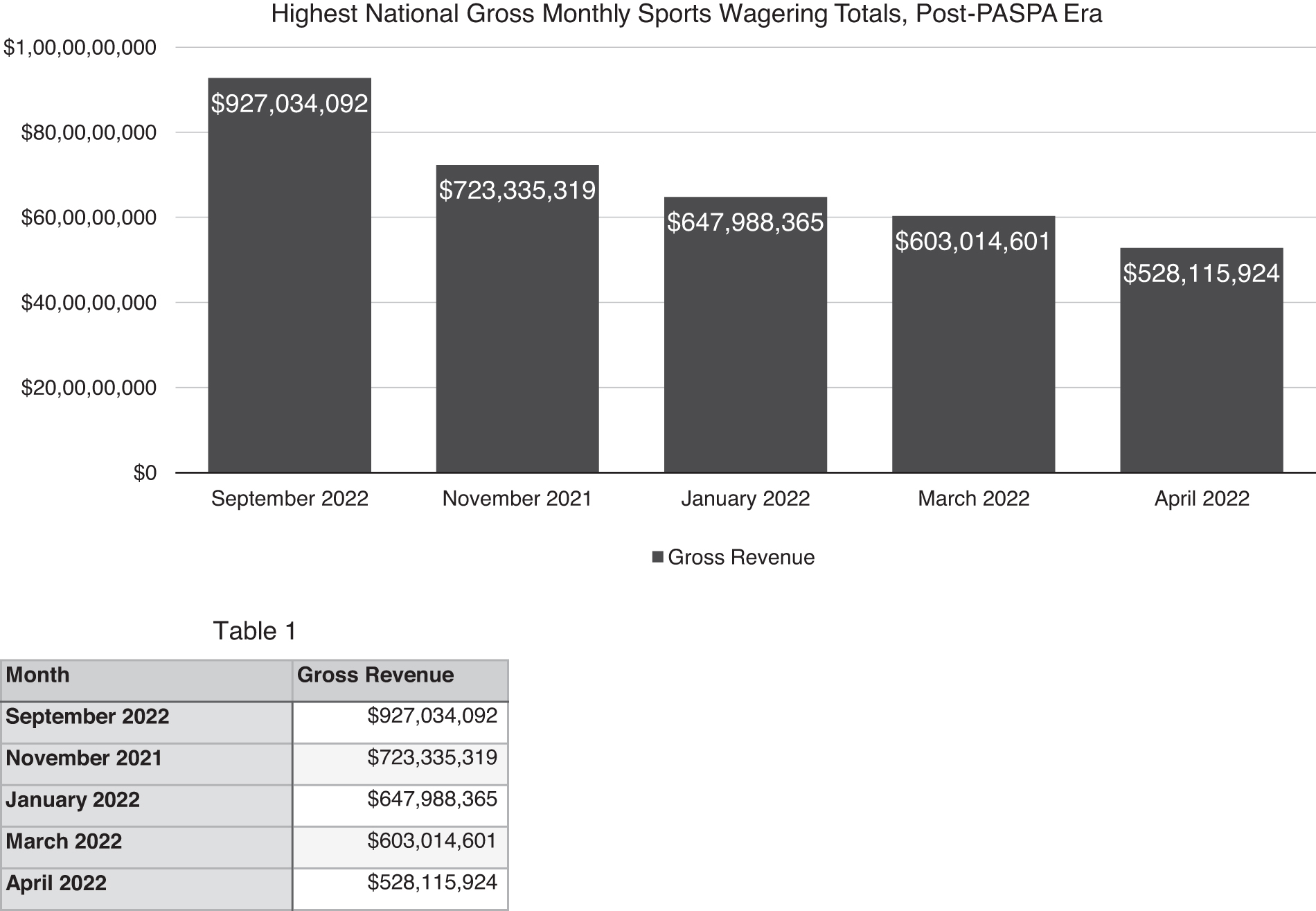
Highest national gross monthly sports wagering totals, post-PASPA era.
In Colorado, where NFL-specific figures are made available, the 11% win rate was an all-time, in-season high and resulted in operators collecting more than $16 million in gross revenue from $145.7 million handle. In states where numbers were broken down in more general terms by sport, some football holds were stratospheric. Mississippi had an all-time, in-season record for hold at 18.8%; and Nevada's 10.7% win rate marked the first double-digit hold during the season dating back to November 2020.
In documenting the first three weeks of the NFL season, there were multiple singular events that contributed to operator success. The season started with the reigning Super Bowl champion Los Angeles Rams losing at home to the Buffalo Bills, considered a title contender themselves. The San Francisco 49ers lost as road favorites in Chicago. The Dallas Cowboys, always a popular wagering draw, were stifled by Tampa Bay in a nationally televised prime-time game.
Week 2 saw similar upsets as the Cincinnati Bengals lost while the Baltimore Ravens and Cleveland Browns—both home favorites—squandered double-digit fourth-quarter leads. The chaos spread further in Week 3 as favorites went 4-11-1 against the spread and 6-10-0 straight up, highlighted by the Kansas City Chiefs, Los Angeles Chargers, and Buffalo Bills all losing. While the wins and losses were not going according to plan, a second avenue of unexpected outcomes became prevalent as the “under” for total points hit at a 62.5% clip the first three weeks of the season. The betting public's desire for offenses to shine and put up points was not being realized by teams as 25 of the first 48 games had combined totals of 40 or fewer points.
Bettors who made single-event wagers took their lumps, and those who opted to play parlays—where one wrong pick among multiple events results in a losing wager—took it on the chin even harder. A handful of states make parlay wagering statistics available, and as evidenced in Figure 2 (see Fig. 2), all six states reported parlay win rates in September being higher than their overall 2022 parlay win rates.
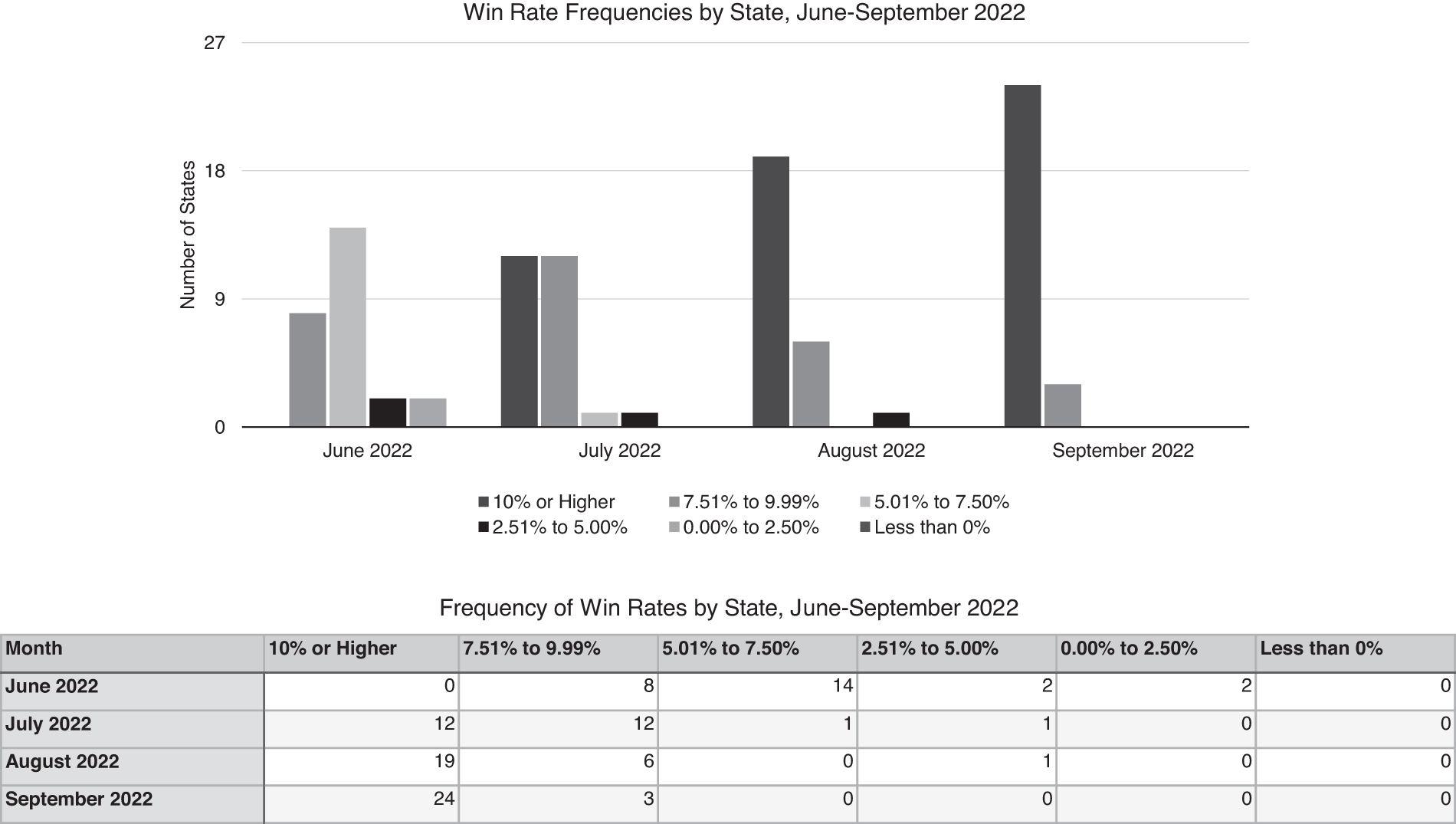
Win rate frequencies by state, June-September 2022.
That cross-section of states reported a combined total of nearly $520 million in parlay handle accounting for 6.5% of the $7.9 billion wagered overall nationally in September. The actual percentage of parlay handle as part of overall handle is undoubtedly higher considering four of the six states had parlay handle represent more than 20% of total handle, while a fifth had parlay wagers represent nearly 17%.
All that operator revenue led to nationwide win rates scorching past the industry standard of 7% and continuing a trend started in the summer in which operators have held the hammer. Amazingly, the lowest win rate of the 27 states and jurisdictions with commercial wagering was 9.3% in Nevada. That the Silver State being last is not a surprise—its 5.1% overall hold in the first 10 months of 2022 is the lowest in the U.S. by more than 1.5 percentage points—but it was also the first time in 13 months its hold surpassed the industry standard.
But it was New Jersey—which ranks 25th overall in win rate—as well as Nevada riding the tide of NFL results that lifted all operators (see Fig. 3). Twenty-four of 27 states had win rates of 10% or higher, raising the total of double-digit holds from July through September to 55—a 69.6% occurrence rate in 79 reports. By comparison, there were 40 such occasions in the 156 revenue reports in the first six months of the year, resulting in a 25.6% occurrence rate.
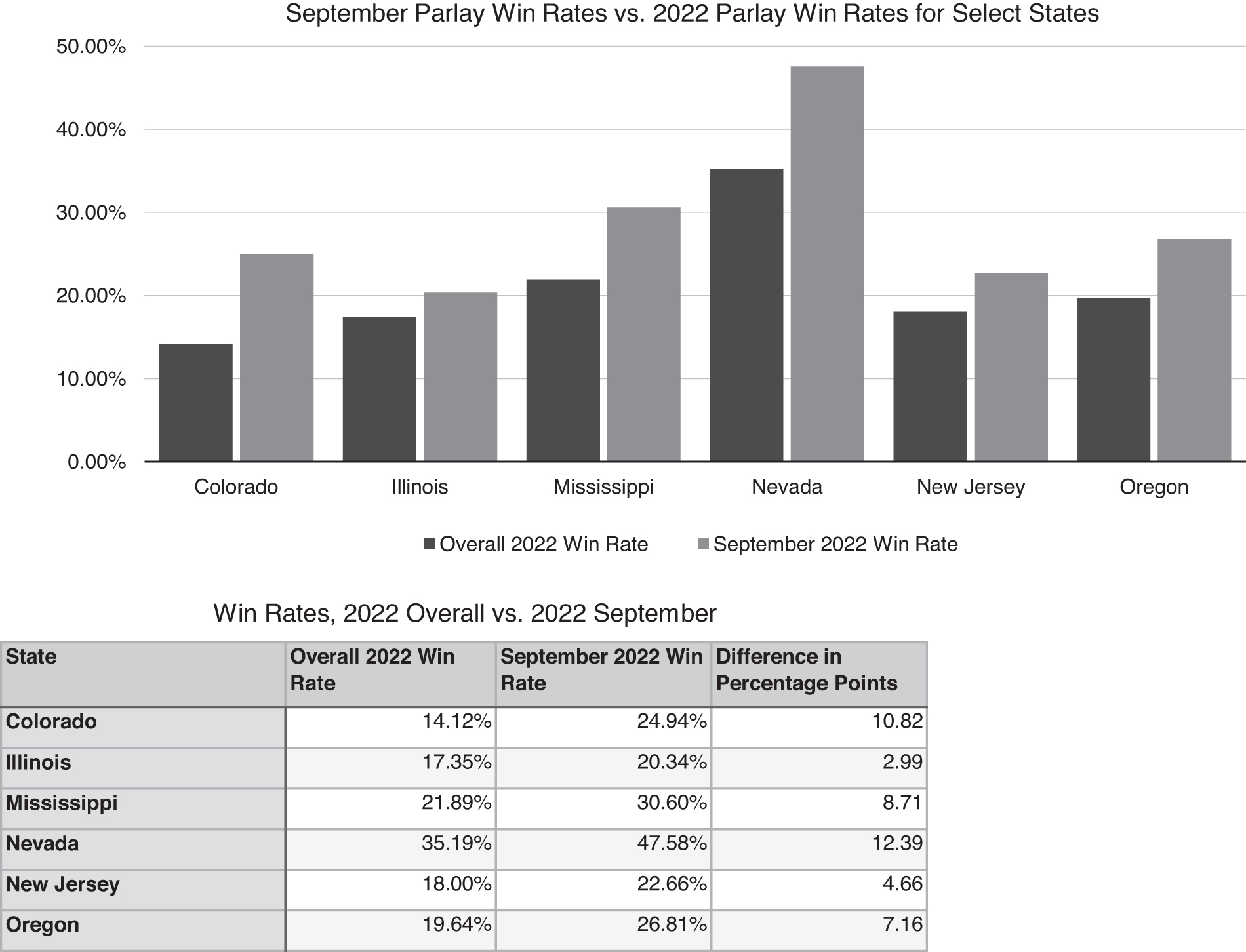
September parlay win rates vs. 2022 parlay win rates for select states.
September's nationwide hold of 11.7% narrowly missed the all-time mark of 11.71% from September 2018 by .031 percentage points while also easily clearing the 2022 high of 10.3% set the previous month. The rampant popularity of parlay wagering has contributed heavily to two of the five highest all-time monthly win rates (see Fig. 4) coming in back-to-back months after the previous occurrence came nearly three years prior.

All-time highest gross gaming revenue win rates in post-PASPA era.
There was one other group of winners from U.S. sports wagering in September, and that was state government. Total state taxes finished shy of $175 million for the month, easily outstripping the previous mark of $128.6 million set in January with New York's spectacular debut. Much like national handle totals, the Empire State has skewed nationwide state tax totals (see Fig. 5) to such a degree that the year-to-date total of more than $1.1 billion in overall receipts is more than double compared to 2021, and more than 50% of the all-time total in the post-PASPA era.

Highest monthly national state tax revenue totals, post-PASPA era.
Until bettors gain their bearings or perhaps bet wiser, it stands to reason there may soon be new industry standards when discussing operator win rates.