




Abstract
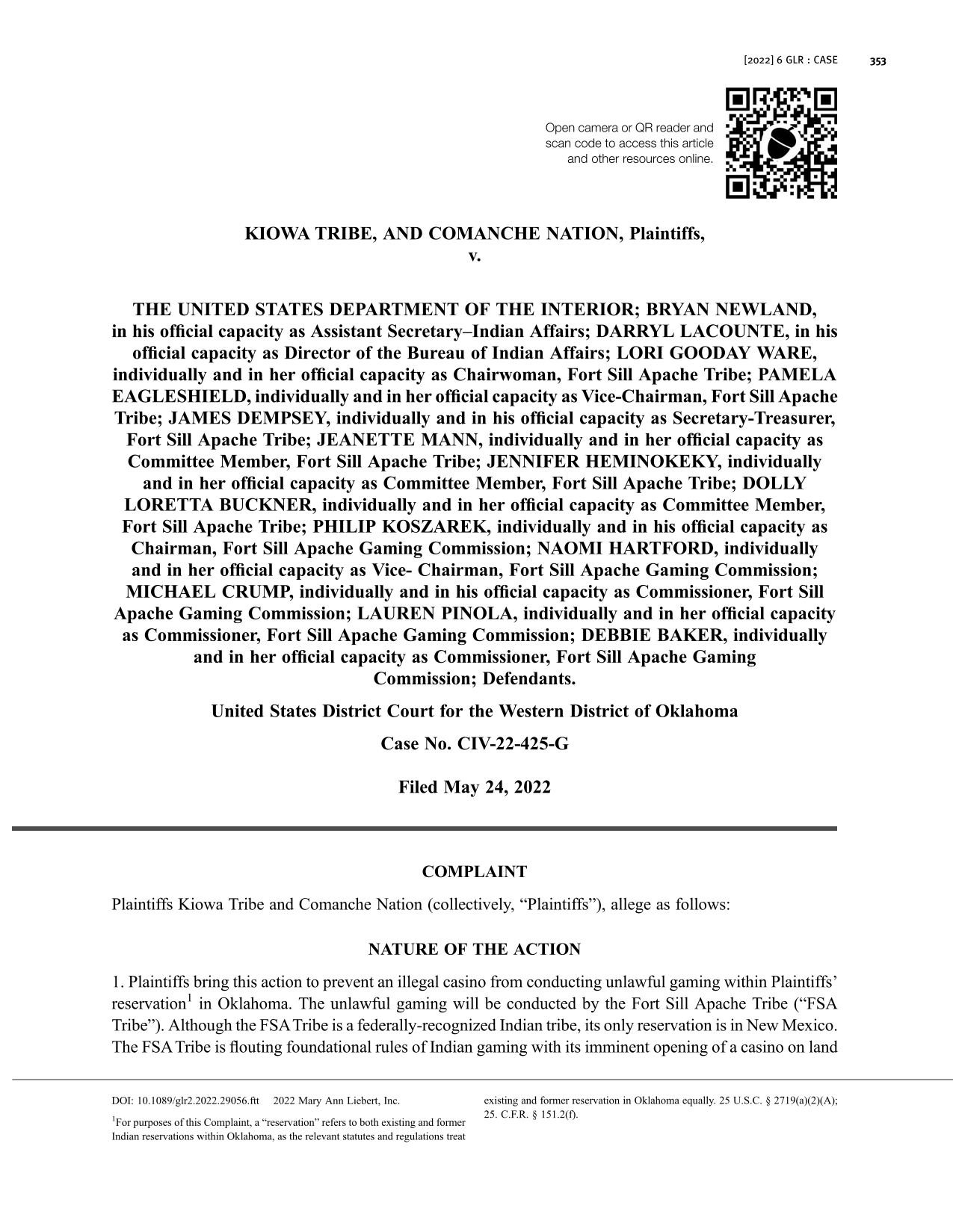
COMPLAINT
Plaintiffs Kiowa Tribe and Comanche Nation (collectively, “Plaintiffs”), allege as follows:
NATURE OF THE ACTION
1. Plaintiffs bring this action to prevent an illegal casino from conducting unlawful gaming within Plaintiffs' reservation1 in Oklahoma. The unlawful gaming will be conducted by the Fort Sill Apache Tribe (“FSA Tribe”). Although the FSA Tribe is a federally-recognized Indian tribe, its only reservation is in New Mexico. The FSA Tribe is flouting foundational rules of Indian gaming with its imminent opening of a casino on land that makes up Plaintiffs' reservation.2 The FSA Tribe intends to operate a casino on land over which it has no jurisdiction, in violation of the Indian Gaming Regulatory Act (“IGRA”), and to the detriment of the local tribes for which the reservation was established. Defendants in this action are officials of the FSA Tribe (“FSA Defendants”), against whom claims for declaratory and injunctive relief are asserted in their official capacities pursuant to the Ex Parte Young doctrine, as well as in their individual capacities. Additional Defendants are officials of the U.S. Department of the Interior (“Federal Defendants”), who erroneously transferred title of land within Plaintiffs' reservation to the FSA Tribe.
PARTIES
2. Plaintiff Kiowa Tribe is a federally-recognized Indian tribe with a reservation in southwestern Oklahoma. The Kiowa Tribe operates three casinos on its reservation, including the Kiowa Casino Verden in Verden, Oklahoma and the Kiowa Casino Carnegie in Carnegie, Oklahoma. The Kiowa Tribe is constructing a fourth casino in Hobart, Oklahoma. These casinos fund the Kiowa Tribe's government for the essential services provided to tribal members
3. Plaintiff Comanche Nation is a federally-recognized Indian tribe with a reservation in southwestern Oklahoma. The Comanche Nation operates six casinos on its reservation, including the Comanche Casino in Lawton, Oklahoma and the Spur Casino on Highway 62 north of Lawton, near the junction with I-44. The Comanche Nation is constructing a seventh casino in Cache, Oklahoma. These casinos fund the Comanche Nation's government for the essential services provided to tribal members.
4. The U.S. Department of the Interior is an executive department of the United States charged with federal oversight of Indian affairs and trust responsibilities to Indian tribes. The U.S. Department of the Interior is located at 1849 C Street NW, Washington, DC 20240.
5. Bryan Newland is the Assistant Secretary – Indian Affairs and is the official charged with discharging the duties of the Secretary of Interior concerning Indian Affairs. Assistant Secretary Newland's office is located at 1849 C Street NW, Washington, DC 20240.
6. Darryl LaCounte is the Director of the Bureau of Indian Affairs (“BIA”) and is the official charged with the day-to-day operations of Indian Services, Justice Services, Trust Services, and Field Operations. Director LaCounte's office is located at 1849 C Street NW, Washington, DC 20240.
7. Lori Gooday Ware is the Chairwoman of the Fort Sill Apache Tribe and is the official charged with supervising the affairs of the FSA Tribe and its business committee and performing duties associated with the office. Chairwoman Gooday Ware's office is located at 43187 US Highway 281, Apache, OK 73006.
8. Pamela Eagleshield is the Vice-Chairman of the Fort Sill Apache Tribe and is the official charged with representing the Chairman, and with supervising the affairs of the FSA Tribe and its business committee and performing duties associated with the office in the event the Chairman is absent or incapacitated. Vice-Chairman Eagleshield's office is located at 43187 US Highway 281, Apache, OK 73006.
9. James Dempsey is the Secretary-Treasurer of the Fort Sill Apache Tribe and is the official charged with keeping account of all proceedings and official records of the FSA Tribe and its business committee, as well as serving as the custodian of all funds in possession of the Tribe. Secretary-Treasurer Dempsey's office is located at 43187 US Highway 281, Apache, OK 73006.
10. Jeanette Mann is a Committee Member of the Fort Sill Apache Tribe Business Committee and is the official charged with (in relevant part) developing proposals relating to tribal claims, land acquisition, engage in negotiations, implement programs, and other duties as delegated assigned by resolution. Committee Member Mann's office is located at 43187 US Highway 281, Apache, OK 73006.
11. Jennifer Heminokeky is a Committee Member of the Fort Sill Apache Tribe and is the official charged with (in relevant part) developing proposals relating to tribal claims, land acquisition, engage in negotiations, implement programs, and other duties as delegated assigned by resolution. Committee Member Heminokeky's office is located at 43187 US Highway 281, Apache, OK 73006.
12. Philip Koszarek is the Chairman of the Fort Sill Apache Gaming Commission (“FSAGC”). The Fort Sill Apache Gaming Commission is the tribal entity charged with regulating the FSA Tribe's casino gaming pursuant to IGRA. Chairman Koszarek is charged with the responsibility to ensure compliance with federal and state laws. Chairman Koszarek's office is located at 221 SW C Ave., Lawton, OK 73501.
13. Naomi Hartford is the Vice-Chairman of the Fort Sill Apache Gaming Commission. Vice-Chairman Hartford is charged with ensuring compliance with federal and state gaming laws. Vice-Chairman Hartford's office is located at 221 SW C Ave., Lawton, OK 73501.
14. Michael Crump is the Commissioner of the Fort Sill Apache Gaming Commission. Commissioner Crump is charged with ensuring compliance with federal and state gaming laws. Commissioner Crump's office is located at 221 SW C Ave., Lawton, OK 73501.
15. Lauren Pinola is the Commissioner of the Fort Sill Apache Gaming Commission. Commissioner Pinola is charged with ensuring compliance with federal and state gaming laws. Commissioner Pinola's office is located at 221 SW C Ave., Lawton, OK 73501.
16. Debbie Baker is the Commissioner of the Fort Sill Apache Gaming Commission. Commissioner Baker is charged with ensuring compliance with federal and state gaming laws. Commissioner Baker's office is located at 221 SW C Ave., Lawton, OK 73501.
JURISDICTION AND VENUE
17. This Court has federal question jurisdiction over Plaintiffs' claims, pursuant to 28 U.S.C. §§ 1331, 1362 because the claims arise under: the Administrative Procedures Act, 5 U.S.C. §§ 701-706 (“APA”), the Indian Gaming Regulatory Act, 25 U.S.C. §§ 2710, 2719, and the Racketeering Influenced and Corrupt Organization (“RICO”), see 18 U.S.C. § 1964(a).
18. Venue is proper in this Court as to the Federal Defendants—U.S. Department of Interior, Bryan Newland, and Darryl LaCounte—because this is an action against officers and agencies of the United States, and a substantial portion of the events giving rise to this claim arise out of actions occurring in this District. 28 U.S.C. § 1391(e)(1).
19. Venue is also proper for FSA Defendants Lori Gooday Ware, Pamela Eagleshield, James Dempsey, Jeanette Mann, Jennifer Heminokeky, Dolly Loretta Buckner, Philip Koszarek, Naomi Hartford, Michael Crump, Lauren Pinola, and Debbie Baker because they can be found in this District and transact the affairs regarding the FSA Tribe's illegal casino in this District as that casino is located in this District. 18 U.S.C. § 1965(a); 28 U.S.C. § 1391(b)(2). On information and belief, the FSA Defendants also reside in this District. 28 U.S.C. § 1391(b)(1).
FACTUAL ALLEGATIONS
I. The creation and allotment of the KCA Reservation
20. In 1867, through the Treaty of Medicine Lodge, the United States set aside an Indian reservation for the Kiowa Tribe and Comanche Nation. Treaty with the Kiowa, Comanche, 1867, Oct. 21, 1867 (“First Treaty of Medicine Lodge”). This treaty specifically noted that other tribes of Indians could not be settled on the reservation without the agreement of the Kiowa Tribe and Comanche Nation. First Treaty of Medicine Lodge, Art. 2 (creating reservation for “the absolute and undisturbed use and occupation of” the Kiowa and Comanche and “for such other friendly tribes or individual Indians as, from time to time, they may be willing [] to admit among them”).
21. The Treaty of Medicine Lodge was signed by representatives of the Kiowa Tribe and Comanche Nation on October 21, 1867. Later that same day, the Kiowa Tribe and Comanche Nation signed a second treaty along with representatives of an Apache tribe that was then known as the Plains Apache or Kiowa-Apache. Treaty with the Kiowa, Comanche, Kiowa-Apache, 1867, Oct. 21, 1867 (“Second Treaty of Medicine Lodge”). Today, the Kiowa-Apache are known as the Apache Tribe of Oklahoma (“Apache Tribe”). In the Second Treaty, the Kiowa Tribe and Comanche Nation agreed for members of the Apache Tribe to reside on their reservation. Hence, the reservation became known as the Kiowa-Comanche-Apache Reservation, or “KCA Reservation.”
22. Notably, despite sharing an ethnic and linguistic bond, the Apache Tribe and FSA Tribe are two entirely different and distinct political entities with different and distinct histories and different and distinct membership. None of the Kiowa Tribe, Comanche Nation, or Apache Tribe have ever provided their consent for the FSA Tribe to share title to the KCA Reservation or general jurisdiction over Indian lands within the KCA Reservation.
23. In the late nineteenth and early twentieth centuries, the U.S. Government (“Government”) pursued an Indian affairs policy known as “allotment,” in which the Government took the lands on Indian reservations owned in severalty, granted small parcels (typically 160 acres) to individual Indians, and then granted the remaining land to non-Indian settlers. The Act to Provide for the Allotment of Lands in Severalty to Indians on the Various Reservations, 25 U.S.C. Ch. 9 (1887), known as the “Dawes Act,” provided for allotment of all Indian lands.
24. Over objections from tribal leaders, the Government began allotting the lands of the KCA Reservation and transferring unalloted land to non-Indian settlers. See Lone Wolf v. Hitchcock, 187 U.S. 533, 568 (1903).
25. When land was allotted to a Comanche person, it is referred to as an “original Comanche allotment” and considered by the Bureau of Indian Affairs (“BIA”) and Comanche Nation as within the jurisdiction of the Comanche Nation. Similarly, when land was allotted to a Kiowa person, it is referred to as an “original Kiowa allotment” and considered by the BIA and Kiowa Tribe as within the jurisdiction of the Kiowa Tribe. And, when land was allotted to a Kiowa-Apache person, it is referred to as an “original Apache allotment” and considered by the BIA and Apache Tribe as within the jurisdiction of the Apache Tribe.
26. Relevant here, one parcel land within the KCA Reservation boundaries, with the legal description of the NE1/4 of Section 33, Township 7 North, Range 11 West of the Indian Meridian, containing 160 acres, more or less, was allotted to George Tsalote (the “Tsalote Allotment”). George Tsalote was a member of the Kiowa Tribe, and therefore the Tsalote Allotment is an “original Kiowa allotment.” See
II. The FSA tribe's relocation to Oklahoma
26. In October 1871, an Executive Order carved 23,040 acres out of the KCA Reservation for use of an army base—known as Fort Sill.
27. In 1886, “hostile” Chiricahua Apaches (such as those affiliated with Geronimo) who refused to settle on a reservation in Arizona, and other Chiricahua Apaches from the San Carlos Reservation in Arizona, were imprisoned by the United States in St. Augustine, Florida.
28. The Chiricahua Apache are a separate and distinct group from the Apache Tribe. While the two groups share ethnic and linguistic ties, the historic territory of the Apache Tribe is the southern Great Plains in states including Texas, Oklahoma, Colorado, Kansas; whereas, the historic territory of the Chiricahua Apaches is in the mountains of the southwest in New Mexico, Arizona, and northern Mexico.
29. In 1887 and 1888, the Chiricahua Apache prisoners of war were transferred from St. Augustine, Florida to a barracks in Mobile, Alabama.
30. In 1894, these Chiricahua Apaches were transferred to Fort Sill where their imprisonment continued.
31. In about 1914, these Chiricahua Apaches were released from their imprisonment at Fort Sill and given a choice: return to their historic lands in Arizona or take allotments in Oklahoma within the KCA Reservation. Approximately 164 Chiricahua Apaches chose to return to reservations in Arizona and approximately 76 chose to take allotments in Oklahoma.
32. Those Chiricahua Apache who took allotments in Oklahoma (or their descendants) eventually received federal recognition as an Indian tribe—the FSA Tribe— in 1976.
III. Prior dispute affirms lack of jurisdiction of FSA tribe on KCA Reservation and leads to new reservation for FSA tribe in New Mexico
33. Although Chiricahua Apache took allotments on the KCA Reservation, none of the Kiowa Tribe, Comanche Nation, or Apache Tribe ever agreed that the FSA Tribe would share jurisdiction over the KCA Reservation. Nor did any act of Congress or executive action ever grant the FSA Tribe any jurisdiction over the KCA Reservation.
34. Allotments that remain in trust are Indian lands. See 18 U.S.C. § 1151 (defining Indian Country to include Indian allotments). As discussed above, within the KCA Reservation, allotments are considered to be within the jurisdiction of whichever of the three tribes the original allottee was a member.
35. In the early 1990s, a portion of an original Comanche allotment, known as the “Kerchee Allotment,” had been acquired by a Kiowa member in trust and used for bingo operations. In 1992 and 1993, the FSA Tribe sought to acquire the Kerchee Allotment in trust, and consistent with the allotment remaining within the jurisdiction of the Comanche Nation, the BIA notified the Comanche Nation, which objected.
36. In 1996, BIA erroneously issued an opinion that the FSA Tribe shared jurisdiction over the KCA Reservation with the Kiowa Tribe, Comanche Nation, and Apache Tribe. As a result, the FSA Tribe was able to acquire the Kerchee Allotment in 1999 without notice to, or consent of, the Comanche Nation.
37. Unbeknownst to the Comanche Nation, Kiowa Tribe, or Apache Tribe, the FSA Tribe also acquired, in 2001, the Tsalote Allotment in trust. None of the Comanche Nation, Kiowa Tribe, or Apache Tribe, were notified by BIA (or anyone else) of the FSA Tribe's application to acquire the Tsalote Allotment in trust. None of the Comanche Nation, Kiowa Tribe, or Apache Tribe, consented to the BIA's acquisition of the Tsalote Allotment for the FSA Tribe.
38. In 2005, the FSA Tribe submitted a tribal-state compact for approval to the U.S. Department of Interior, evincing an intent to conduct “Class III” gaming on the Kerchee Allotment. The Comanche Nation sued and this Court granted a preliminary injunction preventing approval of that compact by Interior. Comanche Nation v. United States, 393 F.Supp.2d 1196, 1202 (W.D. Okla. 2005).
39. Working through this Court, the parties settled that action. Comanche Nation v. United States, “Agreement of Compromise and Settlement Recitals,” No. CIV-05-328-F (May 8, 2007) (“Settlement”), attached as
40. On November 16, 2011, the Department of Interior took land into trust in New Mexico for the FSA Tribe and proclaimed that land to be Fort Sill Apache's Reservation pursuant to 25 U.S.C. § 467. Proclaiming Certain Lands as Reservation for the Fort Sill Apache Indian Tribe, Fed. Reg. 76, 228 (Nov. 28, 2011).
IV. The FSA's plans for an illegal casino on the Tsalote Allotment
41. With the Kerchee Allotment litigation settled, Plaintiffs believed that the dispute with the FSA Tribe was also settled. In Oklahoma, the FSA Tribe would conduct gaming on the Kerchee Allotment and
42. However, unbeknownst to Plaintiffs (or the Apache Tribe), the FSA Tribe had acquired the Tsalote Allotment in trust prior to the Settlement. The FSA Tribe's beneficial ownership of this parcel was not disclosed to Plaintiffs (or Apache Tribe) by the United States or FSA Tribe.
43. For years, the FSA Tribe held the Tsalote Allotment without conducting any gaming operations. In February 2022, the FSA Tribe announced on social media that it was constructing a casino, called the Warm Springs Casino (the “Casino”), on the Tsalote Allotment.
44. The Comanche Nation, Kiowa Tribe, and Kiowa Comanche Apache Intertribal Land Use Committee began investigating how the FSA Tribe could be constructing a casino on land that it did not own and could not be within its jurisdiction.
45. As a result of this investigation, Plaintiffs learned that the BIA had acquired the Tsalote Allotment in trust for the FSA Tribe on June 26, 2001.
46. Plaintiffs also learned that on September 18, 2020, the FSA Tribe submitted a letter to the National Indian Gaming Commission (“NIGC”) informing the NIGC of its intent to construct and open a new tribal gaming facility on Tsalote Allotment, and requesting a “60-day [e]xpedited [r]eview pursuant to 25 C.F.R. § 559.2(a)(1).”
47. Under applicable gaming regulations, the Chair of the NIGC was required to “respond to the tribe's request, either by granting or denying the tribe's request,” 25 C.F.R. § 559.2(a)(1), but (on information and belief) has not done so.
48. On April 26, 2022, the FSA Tribe announced that it was holding a job fair on May 3, 2022, to hire employees for the Warm Springs Casino. This job fair announcement includes positions such as slots manager or craps dealer, indicating that the Warm Springs Casino will likely offer “Class III” gaming, as defined by IGRA.
49. On April 27, 2022, the Kiowa Comanche Apache Intertribal Land Use Committee sent a letter to the NIGC, complaining of the Warm Springs Casino and requesting agency action, and supplemented that letter on April 28, 2022.
50. The NIGC acknowledged receipt of the letter, but has done nothing to stop or prevent the opening of the illegal Warm Springs Casino.
51. The opening of this illegal Casino is now imminent. On May 19, 2022, an interested member of the Comanche Nation visited the Tsalote Allotment and was informed that the Casino would open to the public on June 1, 2022.
V. The illegal warm springs casino will cause substantial and irreparable harm to plaintiffs and their members.
52. The Kiowa Tribe's government is dependent on revenues from the Kiowa's casinos. Approximately 60% of the Kiowa Tribe's annual budget for government programs and services is funded by profits from the Kiowa Tribe's casinos.
53. These government programs include providing important and essential services to tribal members such as: burial assistance for families that have lost loved ones; higher education payments for college students; fire management; and emergency housing assistance for the elderly.
54. Likewise, the Comanche Nation's government is dependent on revenues from the Comanche's own casinos. Approximately
55. These government programs include providing important and essential services to tribal members such as: an assisted living center for the elderly; transportation for the disabled; housing for low-income members; a youth shelter for abused and neglected children; law enforcement, prosecutor, and tribal court services to prevent and punish crimes committed within the Comanche jurisdiction; health services such as diabetes prevention, prescription assistance, optometry, and drug and alcohol dependency treatment; and many other programs.
56. The Tsalote Allotment and Warm Springs Casino are located at 15179 State Highway, Anadarko, OK 73005.
57. Due to this close proximity, the illegal competition from the Warm Springs Casino will divert revenue from the Plaintiffs' casinos, and reduce revenue available for government programs. Because the FSA Tribe is a federally recognized tribe, it cannot be liable for money damages due to sovereign immunity. Therefore, Plaintiffs will never be able to recoup the revenue lost if the Warm Springs Casino opens, despite the patent illegality of the Casino.
COUNT ONE
Declaration under the administrative procedures act that Tsalote Allotment is not owned by the FSA tribe (against the federal defendants).
58. Plaintiffs incorporate all preceding paragraphs by reference.
59. The First and Second Treaties of Medicine Lodge Creek reserved to the Kiowa Tribe, Comanche Nation, and Apache Tribe the KCA Reservation, and specifically provided that the reservation would be for their exclusive use and occupation unless the tribes consented to another tribe or tribes sharing the reservation. Congress has never abrogated this treaty-reserved right to consent or deny consent to sharing the KCA reservation with another tribe. None of these three tribes has since consented to share or admit upon the KCA Reservation the FSA Tribe or any other tribe.
60. The Tsalote Allotment was allotted from the KCA Reservation to a Kiowa. It was not one of the Kiowa, Comanche, or Apache allotments purchased by the United States for any of the Chiricahua Apache prisoners of war that elected to remain in Oklahoma in 1914.
61. Under the First and Second Treaties of Medicine Lodge Creek, and also under the BIA's land acquisition regulations, 25 C.F.R. § 151.8, transferring the Tsalote Allotment, or any portion thereof, to the FSA Tribe would require the consent of the Kiowa Tribe, Comanche Nation, and Apache Tribe. Under 25 C.F.R. § 151.8, notice was required to be provided to the Kiowa Tribe, Comanche Nation, and Apache Tribe of the FSA Tribe's application to acquire the Tsalote Allotment in trust.
62. An actual controversy exists between Plaintiffs and Federal Defendants in that Plaintiffs contend that the Federal Defendants lacked authority to approve the acquisition in trust of the Tsalote Allotment by the FSA Tribe without providing notice to, or obtaining the consent of, the Kiowa Tribe, Comanche Nation, or Apache Tribe.
63. The actions of the Federal Defendants in violation of the Treaties of Medicine Lodge and 25 C.F.R. § 151.8 were arbitrary, capricious, an abuse of discretion, and contrary to law in violation of the Administrative Procedures Act, 5 U.S.C. §§ 702 – 706.
64. The actions of the Federal Defendants further violate their trust obligations to at least the Kiowa Tribe by depriving it of land that it could acquire for economic development or other purposes.
65. Plaintiffs are entitled to a declaration that the Tsalote Allotment is not owned by the FSA Tribe.
COUNT TWO
Violation of the Indian Gaming Regulatory Act–declaratory judgment (against FSA defendants).
66. Plaintiffs incorporate all preceding paragraphs by reference.
67. IGRA was enacted in 1988 by Congress in order to create a federal scheme to comprehensively address gaming by Indian tribes. Indian Gaming Regulatory Act, Pl. 100-497, Oct. 17, 1988.
68. The location of Indian gaming was of particular concern to Congress in enacting IGRA. In particular, Congress wanted to address the concern that land would be acquired for gaming near large cities or towns, contrary to the desires of local governments.
69. Therefore, in enacting IGRA, Congress specifically addressed where Indian gaming may occur.
70. Under IGRA, an Indian tribe may engage in gaming only on “Indian lands” and only on the Indian lands within such tribe's jurisdiction. 25 U.S.C. § 2710(b) (concerning Class II gaming) (emphasis added); see also id. § 2710(d) (permitting Class III gaming on Indian lands only if authorized by an ordinance “adopted by the governing body of the Indian tribe having jurisdiction over such lands”).
71. In addition, Congress went one step further and specifically prohibited gaming on lands acquired after October 17, 1988 (the date of the Act), subject to certain exceptions that are not applicable here. 25 U.S.C. § 2719(a).
72. The location of Class III gaming in particular was also of particular concern in the tribal-state compact between the FSA Tribe and Oklahoma, which recites that the tribe may conduct Class III gaming only on its own Indian lands. A copy of this compact is attached hereto as
73. The Tsalote Allotment is Indian land under IGRA, but is not within the jurisdiction of the FSA Tribe. The Tsalote Allotment is an original Kiowa allotment. See
74. The FSA Tribe also acquired the Tsalote Allotment after October 17, 1988, does not meet an exception, and therefore the FSA Tribe has no authority under IGRA to conduct gaming there.
75. An actual controversy exists between Plaintiffs and FSA Defendants in that Plaintiffs contend that the FSA Tribe lacks authority to conduct gaming on the Tsalote Allotment.
76. Plaintiffs are entitled to a declaration that the FSA Tribe may not conduct gaming on the Tsalote Allotment.
COUNT THREE
Violation of Racketeer Influenced and Corrupt Organizations Act (against FSA defendants).
77. Plaintiffs incorporate all preceding paragraphs by reference.
THE ENTERPRISE
78. The FSA Tribe is an Enterprise as defined by 18 U.S.C. § 1961(4), that operates in and affects interstate commerce, with tribal operations and lands in New Mexico and Oklahoma. The Enterprise is a legal entity, a federally-recognized tribe, with a formalized organizational hierarchy set forth in the Tribe's constitution and other organizational documents. The Enterprise operates an existing casino in Lawton, Oklahoma that draws patrons from Texas.
79. The Enterprise has retained a construction firm in Minnesota to construct a new casino, the Warm Spring Casino. The Enterprise has advertised the Warm Springs Casino using interstate wires and on social media.
THE DEFENDANTS
80. Lori Gooday Ware, Pamela Eagleshield, James Dempsey, Jeanette Mann, Dolly Loretta Buckner, and Jennifer Heminokeky, were and are officers of the Enterprise, responsible for governing and directing the operations of the Enterprise and its subordinate entities.
81. The Fort Sill Apache Gaming Commission (“FSAGC”) is a subordinate legal entity of the Enterprise. The FSAGC is the tribal entity charged with operating the Enterprise's casino gaming pursuant to IGRA, and takes direction from the FSA Defendants and other Enterprise officials.
82. Phillip Kozarek is the Chairman of the Fort Sill Apache Gaming Commission charged with ensuring compliance with federal and state gaming laws.
83. Naomi Hartford is the Vice-Chairman of the Fort Sill Apache Gaming Commission charged with ensuring compliance with federal and state gaming laws.
84. Michael Crump is the Commissioner of the Fort Sill Apache Gaming Commission charged with ensuring compliance with federal and state gaming laws. Lauren Pinola is the Commissioner of the Fort Sill Apache Gaming Commission charged with ensuring compliance with federal and state gaming laws. Debbie Baker is the Commissioner of the Fort Sill Apache Gaming Commission.
85. The FSA Defendants are associated with the Enterprise in that, they serve as the Enterprise's and Tribe's Business Committee and Gaming Commissioners.
THE RACKETEERING CONSPIRACY
86. From about April 21, 2020, to present, the FSA Defendants are knowingly conspiring with each other to violate 18 U.S.C. § 1962(c), that is, to conduct and participate, directly and indirectly, in the affairs of the Enterprise which engages in, and activities of which affect, interstate commerce, through a pattern of racketeering activity consisting of:
a. Multiple acts of illegal gambling in violation of 18 U.S.C. §1955; and b. Multiple acts of money laundering in violation of 18 U.S.C. §§ 1956 and 1957.
87. It is part of the conspiracy that each FSA Defendant would commit at least two acts of racketeering activity in the conduct of the affairs of the Enterprise.
MANNER AND MEANS OF THE CONSPIRACY
88. The purpose of the Conspiracy is to enrich the Enterprise, the FSA Defendants and other FSA tribal members through the operation of an illegal gambling business that uses the profits to promote the Casino's operations and to enrich the Enterprise and tribal members.
A. Illegal gambling racketeering acts in violation 18 U.S.C. § 1955.
89. The FSA Defendants are conspiring to cause the Enterprise to open and operate an illegal gambling business, the Warm Springs Casino. Federal law does not permit Indian tribes, or individual Indians, to conduct gambling on tribal lands unless IGRA is followed. 18 U.S.C. § 1166; see generally 25 U.S.C. § 2710. If IGRA is not followed, then 18 U.S.C. § 1955 requires that state law be followed. See United States v. Gachot, 512 F.3d 1252, 1252, 1254 (10th Cir. 2008) (affirming conviction under § 1955 of Kiowa tribal member operating cockfighting on Indian land in Oklahoma); United States v. E.C. Invs., 77 F.3d 327, 330-31 (9th Cir. 1996) (holding that § 1955 applies to Indian tribe's casino, and the consultants operating that casino, where tribe had not complied with IGRA's requirements for Class III machines).
90. Because the Warm Springs Casino is not authorized under IGRA, it will be an “illegal gambling business” as defined in 18 U.S.C. § 1955.
91. The Warm Springs Casino will involve more than five persons who conduct, finance, manage, supervise, direct, and own the Casino. The Enterprise, which has over a hundred members, will own the Casino. The FSA Defendants will jointly conduct, manage, supervise, and direct the Warm Springs Casino operations, all in violation of state and federal law. For example, FSA Defendants caused the Enterprise to hold a job fair to hire dozens more persons to assist in conducting, managing, supervising, and directing gambling at the Warm Springs Casino.
92. Once opened, the Warm Springs Casino is intended to operate continuously for more than thirty days and generate more than $2,000 in gross revenue every day. Based on its size, the Warm Springs Casino is intended to have dozens of slot machines and will generate in excess of $2,000 in gross revenue each day it is open.
93. The FSA Defendants are causing the Enterprise to open and operate the Warm Springs Casino in violation of IGRA. As described above, an Indian tribe may engage in gaming only on “Indian lands” and only on the Indian lands within such tribe's jurisdiction. Because the FSA Defendants are causing the Enterprise to open and operate the Warm Springs Casino on land over which the Enterprise has no jurisdiction, the FSA Defendants are causing the Enterprise to violate IGRA.
94. The FSA Defendants are also causing the Enterprise to open and operate the Warm Springs Casino in violation of Oklahoma law. Commercial gambling, i.e. casino gambling in Oklahoma, is defined as “[o]perating or receiving all or part of the earnings of a gambling place.” O.S. § 21-982(A)(1). Commercial gambling is illegal in Oklahoma, and any person “found guilty of commercial gambling shall be guilty of a felony.” O.S. § 21-982(B). Further, any person “permitting premises to be used for commercial gambling shall be guilty of a misdemeanor.” O.S. § 21-983(B). And any person “dealing in gambling devices shall be guilty of a felony.” O.S. § 21-984(B).
95. The FSA Defendants also violate Oklahoma commercial gambling laws by “installing communications facilities knowing that they will be used principally for the purpose of transmitting information to be used in making or settling bets;” “disseminating gambling information.” O.S. §§ 21-1986, 21-1987. The FSA Defendants causing the Enterprise to open and operate the Warm Springs Casino is not only a violation of IGRA, but is also a violation of Oklahoma criminal law. There are exceptions, however for charitable gambling in Oklahoma, neither of which are met by FSA Defendants. Only licensed charitable gambling in Oklahoma is permitted for games such as bingo. See O.S. § 401 et seq. The FSA Tribe is not a charity and the Warm Springs Casino is not licensed for charitable gambling.
96. Title 3A of Oklahoma Statutes sets forth regulations for gambling at licensed horse tracks. Any person conducting horse racing may obtain a license from the Oklahoma Horse Racing Commission. O.S. § 3A-205.1. Licensed horse tracks may offer wagering on horse races. O.S. § 3A-205.6(A). No other form of gambling is permitted at horse tracks, and state-sponsored gambling is not permitted in places other than horse tracks. Id. Neither the FSA Tribe nor the Warm Springs Casino has a horse racing license from Oklahoma.
97. Because the FSA Defendants are causing the Enterprise to open the Casino in violation of federal and state law, the FSA Defendants are causing the Enterprise to violate 18 U.S.C § 1955, which states in relevant part:
(a) Whoever conducts, finances, manages, supervises, directs, or owns all or part of an illegal gambling business shall be fined under this title or imprisoned not more than five years, or both.
(b) As used in this section—
“illegal gambling business” means a gambling business which—
is a violation of the law of a State or political subdivision in which it is conducted;
i) involves five or more persons who conduct, finance, manage, supervise, direct, or own all or part of such business; and
ii) has been or remains in substantially continuous operation for a period in excess of thirty days or has a gross revenue of $2,000 in any single day.
….
“gambling” includes but is not limited to pool-selling, bookmaking, maintaining slot machines, roulette wheels or dice tables, and conducting lotteries, policy, bolita or numbers games, or selling chances therein.
98. As discussed above, gambling at the Warm Springs Casino will violate IGRA and Oklahoma state law, and thus in turn, violate 18 U.S.C. § 1955. For each day that the FSA Defendants cause the Enterprise to operate the Casino and receive profits from its operation, the FSA Defendants will be committing a separate violation of 18 U.S.C. § 1955.
B. Money laundering and racketeering acts in violation of 18 U.S.C. §§ 1956-1957.
99. The proceeds from the Casino's operations will be used to promote illegal gambling by funding the Casino's operations through payment of employee payroll, utilities, maintenance, and other operating expenses. Surplus proceeds of illegal gambling will be distributed to Tribal members in transactions involving more than $10,000 of illegal gambling proceeds.
100. Federal law prohibits engaging in financial transactions with the proceeds of some form of unlawful activity, including illegal gambling, knowing that that the proceeds are derived from unlawful activity, with the intent to promote the carrying on of illegal gambling. 18 U.S.C. § 1956(a)(1)(A). Federal law also prohibits knowingly engaging in or attempting to engage in a monetary transaction in criminal derived property of a value greater than $10,000 derived from illegal gambling. 18 U.S.C. § 1957(a).
101. FSA Defendants, by conspiring to cause the Enterprise to engage in financial and monetary transactions with the proceeds of illegal gambling, are conspiracy to engage in money laundering racketeering acts.
RICO REMEDIES
102. 18 U.S.C § 1964(a) expressly grants this Court jurisdiction to issue an injunction to prevent RICO violations, and therefore the Court has jurisdiction to prevent an illegal gambling business, such as the Warm Springs Casino, from opening its doors.
103. The opening and operation of the Warm Spring Casino has and will cause irreparable harm to Plaintiffs for which no remedies at law exist because they cannot recover damages from the FSA Tribe due to the tribe's sovereign immunity. As discussed above, the Warm Springs Casino would also divert customers away from Plaintiffs lawful casinos and cause Plaintiffs to lose the revenue it relies on to provide essential governmental services to their members.
104. At least the Kiowa Tribe has jurisdiction over the Tsalote Allotment, and the construction of an illegal casino on that site has deprived the Kiowa Tribe of revenue and the opportunity to use the Tsalote Allotment for its own purposes.
105. Plaintiffs are entitled to a declaration that the FSA Defendants have violated RICO by conspiring to open the Warm Springs Casino and injunctive relief preventing the opening and operation of the Warm Springs Casino, or any other gaming by the FSA Tribe on the Tsalote Allotment.
PRAYER FOR RELIEF
Plaintiffs respectfully request judgment against Defendants as follows:
A declaration that the FSA Tribe is not the owner of the Tsalote Allotment;
A declaration that the FSA Tribe cannot conduct Class II or Class III gaming on the Tsalote Allotment under IGRA;
A declaration that Class III gaming on the Tsalote Allotment will violate the FSA Tribe's tribal-state compact;
A declaration that gaming on the Tsalote Allotment by the FSA Tribe will be in violation of RICO;
Preliminary and permanent injunctive relief restraining and enjoining the FSA Defendants from operating a casino on the Tsalote Allotment;
Preliminary and permanent injunctive relief prohibiting gambling or gaming by the FSA Defendants on the Tsalote Allotment;
Awarding Comanche Nation its reasonable costs, including attorneys' fees, incurred in bringing this action; and
Granting such other and further relief as this Court deems just and proper.
May 24, 2022
Respectfully submitted,
Attorneys for Plaintiff Comanche Nation
Attorneys for Plaintiff Kiowa Tribe