




Abstract
This article discusses the lack of strict enforcement of online gambling regulations in the Chinese esports industry despite the establishment of relevant regulations. The lack of criminal or administrative penalties for online gambling related to esports is demonstrated through three examples in this article: Chinese esports teams accepting sponsorships from online gambling companies, the lack of punishment for Chinese esports players involved in match-fixing, and the failure to prosecute an esports tycoon for running an online gambling house. The article argues that online gambling companies use cultural reframing strategies to avoid monitoring systems and that the political and economic impact of esports in China may contribute to this lack of enforcement. This article sheds light on the potential implications of the lack of regulation of online gambling in the Chinese esports industry.
INTRODUCTION
Gambling in China has been illegal since the Communist Party came to power in 1949. 1 Although welfare and sports lotteries were introduced in China in 1987 and 1989, 2 respectively, land-based and online gambling remained illegal for all citizens. Further, the government has attempted to eliminate unlawful online gambling. In 2019, China launched a three-year campaign against illegal betting, codenamed “Operation Chain Break,” to prevent capital outflows. The crackdown focused on cross-border illicit gambling websites that hosted offshore and overseas land-based casinos. 3 As many as 25,000 people were arrested in China for illegal betting-related activities. By 2020, this number had increased to 110,000. 4
Despite these efforts, esports has emerged as a new online gambling arena that appears to be unregulated or ignored by the Chinese government. This study found that esports teams promote gambling websites, and esports players are involved in match-fixing and illegal gambling. However, the Chinese “anti-online gambling policies” are not applied. This study determines the reasons for this lack of consistency.
SIGNIFICANCE OF THE STUDY
Most studies on Chinese online gambling have focused on gamblers 5 , 6 , 7 and on the efforts made by the mainland Chinese government to eliminate illegal online gambling activities. 8 , 9 , 10 Yang et al. analyzed how owners or employees of illicit gambling websites approach mainland Chinese people, promote their websites, and transfer money from mainland China to their accounts. 11 Other scholars have investigated the difficulties faced by the Chinese government while dealing with illegal online gambling, 12 , 13 and have generally agreed that governmental attempts are being made under challenging conditions.
Studies 14 , 15 , 16 on esports in China have shown that the government prioritizes ideological control over economic benefits, which has led to restrictions on online gaming. Regulations on data protection in esports differ between the EU and China and have posed challenges for global regulation. Psychological research has indicated that ease of use and usefulness positively impact attitudes toward esports in China, whereas risk has a negative impact. The moderating effect of preventive regulatory focus on these relationships has also been examined. However, there is a lack of information on Chinese online gambling in esports.
As a video game player and an esports fan, the author noticed that some illegal online gambling events appear unregulated, although they are well known among Chinese players. The standards of punishment for online gambling appear to be different in some circumstances, and scholars have not yet documented this. This study examines this unexplored area.
METHODOLOGY
The author collected information on the topic of gambling and esports in China from various sources. Except for the court judgments, which were offered by a lawyer who is a friend of the author, all other informational sources are accessible through the Internet. The sources are as follows:
Documents from the Chinese government: Official documents and policy statements from the Chinese government were reviewed to understand the legal and regulatory frameworks surrounding the esports and gambling industries in China. Website news: News articles and reports from reputable websites were consulted to be updated on the latest developments and trends in the esports and gambling industries in China. Chinese game forums: Online forums and discussion boards related to Chinese esports and gaming communities were monitored to gain insights into the opinions and perspectives of players and fans regarding the issue of gambling and esports. Court judgments: Court rulings and decisions in gambling and esports cases in China were analyzed to understand how the legal system in China approaches this issue. Archives of papers on gambling and esports: Academic papers and studies on the topics of gambling and esports were identified and analyzed for a deeper understanding of the historical and cultural context of these industries in China. Video screenshots: Screenshots were taken from relevant videos and analyzed to support the findings and arguments in this article.
This study aimed to provide a comprehensive analysis of the sources of information on gambling and esports in China, accounting for various perspectives. Regardless of the various efforts to conduct a thorough examination, the fact that no study methodology can guarantee absolute comprehensiveness and exhaustiveness for its investigations must be acknowledged. This is because of the hardships related to accessing some informational sources, such as interviews with the gambling company or with players involved in match-fixing. Hence, the potential for some informational sources remaining undiscovered and unexplored is high. The author acknowledges this limitation and discloses it herein to maintain the transparency and rigor of this research methodology.
CHINESE ONLINE GAMBLING REGULATIONS
Gambling is very popular in Chinese communities worldwide. 17 However, since its establishment, the People's Republic of China (PRC) has placed significant controls on gambling. Article 303 of China's Criminal Law, announced in 1979, stated: “a person who, with a view of profit, assembles a crowd to engage in gambling, establishes a place for gambling or makes gambling their business shall be sentenced to fixed-term imprisonment of not more than three years, criminal detention, or public surveillance and concurrently be sentenced to a fine.” 18
To punish people for online gambling according to the law, the Opinions of the Supreme People's Court, the Supreme People's Procuratorate and the Ministry of Public Security on Several Issues Concerning the Application of Law in the Handling of Criminal Cases of Internet Gambling 19 were introduced, which include taking action for the following: “establishing a gambling website and accepting bets,” “establishing a gambling website and providing it for others to organize gambling,” “acting as an agent of a gambling website and accepting bets,” and “participating in the profit sharing of a gambling website.”
In 2020, to prevent capital outflow, penalize cross-border gambling and other criminal activities, and maintain the economic security and social stability of China, 20 the Supreme People's Court, Supreme People's Procuratorate, and Ministry of Public Security jointly formulated the Opinions on Several Issues Concerning the Handling of Cases Involving the Crime of Cross-border Gambling. They clarify that, for the purpose of making a profit, transmitting gambling videos and data by using an information network or communication terminal and organizing cross-border gambling activities for citizens of the PRC, under a range of circumstances, fall under the scope of “running a gambling house” in Article 303 of the Criminal Law. This includes participating in the profit sharing of a gambling website or application.
Individuals participating in a gambling activity face an administrative punishment, which means that it is against the law of the PRC on Penalties for Administration of Public Security. 21 Those who open a casino or profit from illegal gambling activities face criminal punishment.
Illegal gambling may account for a fifth or more of the total outflow based on the 2019 estimate by the People's Bank of China, that illegal-betting-related outflow is in the order of 1 trillion Chinese yuan (RMB) (USD 154 billion). 22 , 23 , 24 The rise of unregulated capital has led Chinese authorities to launch the “Operation Chain Break.” 25
THE RISE OF CHINESE ESPORTS
Electronic sports/esports is a global cultural phenomenon that has grown rapidly since the beginning of the new century. It attracts significant numbers of participants and spectators, mainly teenagers. With many integrated factors, this global culture is increasingly popular and profoundly influential. 26 The Chinese esports industry and video games market has grown markedly in recent years—from RMB 70.61 billion to RMB 182.6 billion in 2017 and 2020, respectively. 27 China remains the largest single-country market in the world, with USD 403.1 million in esports revenue in 2021. 28
Thus, China has dominated the market, and Chinese esports teams have achieved global success. Dota 2 and League of Legends are the two most popular esports games worldwide. Chinese Dota 2 teams achieved first place at the highest competition level (The International) three times (2012, 2014, and 2016), and the Chinese League of Legends teams also achieved first place at the highest competition level (S league) three times (2018, 2019, and 2021). The rise of Chinese esports quickly led to links between the illegal online gambling and esports markets, and to significant capital outflow from mainland China. This was recognized by gameplayers and esports watchers, but was not formally investigated by the Chinese government or scholars.
CHINESE ESPORTS AND ONLINE GAMBLING
Sponsorship of Chinese esports teams by gambling websites
Promotional events for gambling websites are illegal in China. In Hebei Province, the following recent case shows the consequence of such events: Lee used his company to send advertising messages to mainland Chinese gamblers for a gambling website in Manila and was arrested by the police in February 2022. 29 However, Chinese esports teams can officially accept sponsorship from gambling websites and display their logos on their uniforms.
The Chinese esports team PSG.LGD received sponsorship from Betway (Fig. 1), a prominent gambling website company. Betway was founded in 2006 by Super Group and provides worldwide online gambling services. PSG.LGD displays the logo of the company on the players uniforms and after their gaming IDs, ensuring its visibility to the game's audience (Fig. 2).
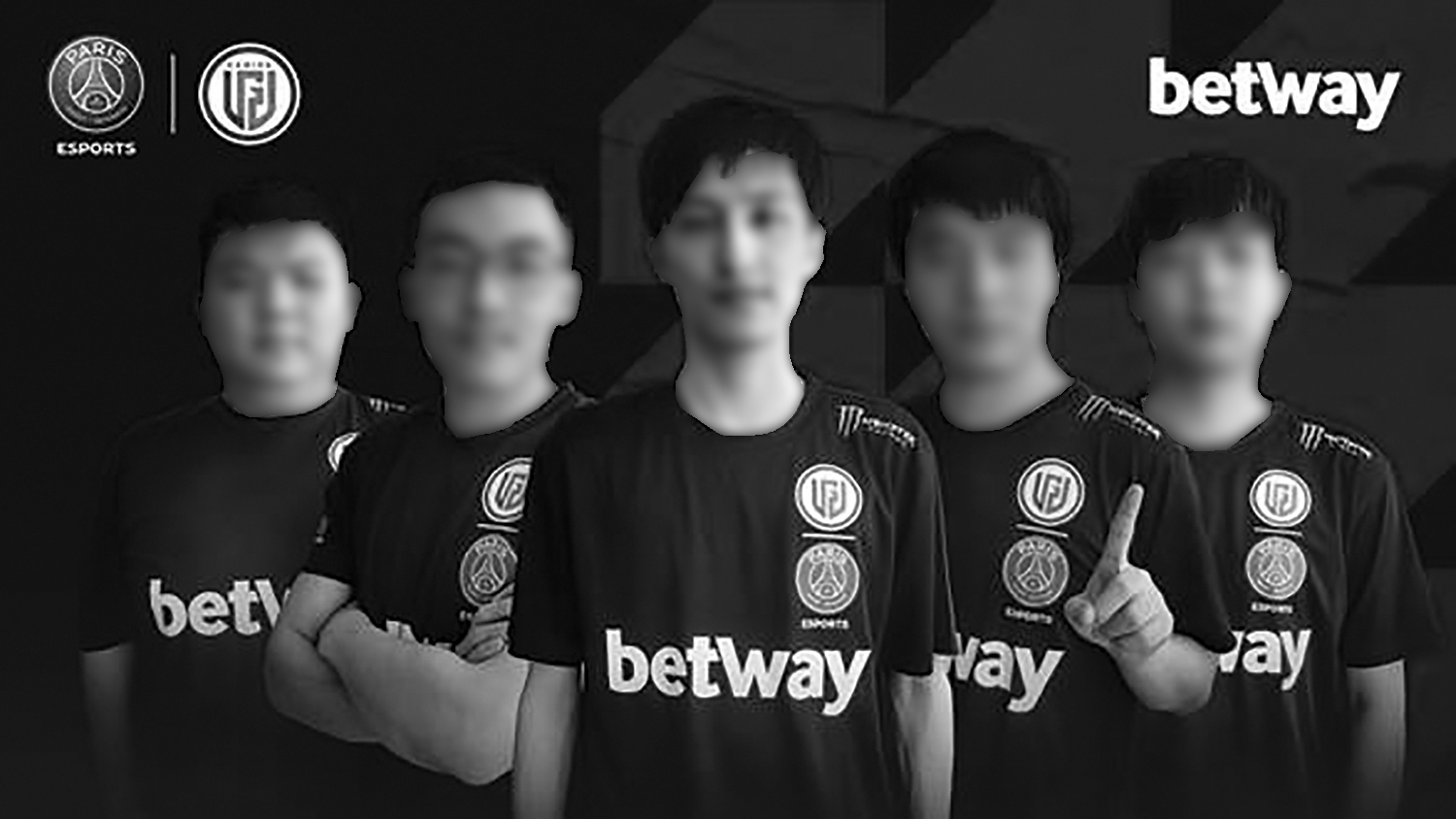
Chinese esports team PSG.LGD is sponsored by the gambling website Betway. 30 Photo credit: PSGLGD.

The Betway logo is visible next to each player's ID. Screenshot from the YouTube video TEAM SPIRIT vs. PSG.LGD-TI10 GRAND FINAL: THE INTERNATIONAL 10 DOTA 2.
Other Chinese esports teams are sponsored by such companies. For example, Invictus Gaming has been sponsored by Betway since 2018. 31 After Invictus Gaming won a match in the Chinese Dota 2 Pro League, the official Chinese Dota 2 broadcast showed a picture of the players in their uniforms, displaying the Betway logo (Fig. 3). Vici Gaming and Newbee were sponsored by gambling websites Uwin and Raybet. 32

The Betway logo displayed on the uniforms of the Invictus Gaming players on April 1, 2023. Screenshot from the Bilibili video, IG vs. PSG.LGD Chinese Dota 2 Pro League 2023. Photo credit: Invictus Gaming.
No regulation currently mandates that gambling websites cannot sponsor esports teams. However, Tencent, one of China's largest technology companies, has issued its 2018 Electronic Sports Standards, prohibiting the inclusion of any content related to illegal activities, including gambling (e.g., lottery or companies/services/products that incite/assist/promote gambling), on team clothing. Team members and event personnel cannot partake (directly or indirectly) in betting/gambling with regard to competition results. 33 Nevertheless, there is apparently a double standard, as both individual players and teams in esports are promoting online gambling companies, and neither have been prosecuted.
Lack of governmental punishment for match-fixing and illegal online gambling among esports players
On March 9, 2023, 46 notable Chinese Dota 2 players were banned: 21 were banned for life from any Valve or Perfect World tournaments, 13 received a two-year ban, and others received a one-year ban (Fig. 4). The only reason for the bans was provided as “esports integrity violations,” with no specific details disclosed. On this topic, a report describes that “speculation has been rife for years that the Chinese Dota 2 pro scene has been plagued with match-fixing, even at the top levels.” 34

Chinese Dota 2 players banned by Valve and Perfect World 35
Numerous other players were banned by Valve and Perfect World because of match-fixing, including Zeng Hongda (game ID, “faith”), the 2012 International Champion, alongside his team, and Yin Rui (game ID, “aq”), who was once called “the hope of Chinese Dota.” 36 These players only faced retribution for engaging in match-fixing from game companies and tournament organizers.
The popular League of Legends game has also been embroiled in match-fixing controversies. In 2022, LGD Gaming's Chen Bo (game ID, “Jay”) was banned for life from professional League of Legends events because of match-fixing and illegal organized betting involvement. 37 In 2021, TJ Sports, the operator of China's League of Legends esports, found three League of Legends Pro League (LPL) players and 38 staff members associated with League of Legends Development League (LDL) guilty of breaking anti-match-fixing rules pertaining to the LDL. 38 In 2022, another 28 members associated with the LDL were found guilty, causing a massive scandal (Tables 1 and 2).
League of Legends 2021 Scandal and Bans 77
League of Legends 2022 Scandal and Bans 78
All those involved in match-fixing were banned for periods ranging from three months to permanently. However, they did not face criminal punishment or administrative consequences from the Chinese government.
Compared with China, the punishment in South Korea for esports players who participate in match-fixing is more severe. For example, in South Korea's criminal law, players who engage in gambling may face a fine of up to 10 million won, and habitual offenders may face up to three years in prison or a fine of 20 million won. 39 Under the National Sports Promotion Act (Articles 26, 47, and 48), both gambling and match-fixing among players can result in up to five years of imprisonment and a fine, which cannot exceed 50 million won (approximately USD 40,000). 40 These laws underline South Korea's commitment to regulating gambling and maintaining sports integrity.
Lee Seung-Hyun (game, ID “Life”), a former professional StarCraft II player 41 who won the world championship multiple times, was found guilty of match-fixing by the Korean Esports Association (KeSPA). In 2016, KeSPA disclosed the investigations on “Life” for match-fixing, 42 and after three months, the Changwon Regional Prosecution Service's special investigations division issued a report confirming that “Life,” Jung “Bbyong” Woo-yong (another StarCraft II player), and 11 other financial backers and brokers were found guilty of fixing two matches during the KeSPA Cup. “Life” received a suspended prison sentence of 18 months and a fine of 70,000,000 won (approximately USD 62,000). 43 By contrast, although Chinese Criminal Law prohibits gambling, no action was taken by the government against those who were caught for match-fixing and illegal gambling.
VPGAME: The escape of an esports and online gambling tycoon
VPGAME is a famous mainland China online gambling platform owned and operated by LGD Gaming. Since its establishment in 2014, VPGAME has allowed users to bet on the outcomes of esports games using virtual currency. Initially, VPGAME operated using in-game items or skins, which are highly valued trading commodities in popular games such as Dota 2 and Counter-Strike: Global Offensive. 44 Later, users were enabled to use Alipay or WeChat Pay to change real currency (RMB) for “diamonds,” the virtual currency used on VPGAME's website. “Diamonds” and game skins can be used to bet on matches and can be converted easily into cash on VPGAME's website. Pan Jie (known as “Ruru”) was the biggest shareholder of VPGAME and LGD Gaming's founder, 45 and had a Weibo account with approximately 722,000 followers as of August 8, 2023.
Multiple sources reported that, in January 2023, the Chinese police raided VPGAME on suspicion of illegal gambling activities; over 20 board members were arrested or held for questioning as the authorities investigated whether VPGAME's business violated China's stringent anti-gambling laws. 46 Rumors from multiple Chinese forums claimed that Ruru pinned the blame on her younger brother, who was arrested and sent to prison. 47 , 48
The author gathered information on VPGAME from Chinese sources—including news, and official and judgment documents—to determine the facts of the situation, but there was hardly any useful information available. On November 30, 2021, Sohu, a Chinese news website, posted a story with the headline “Seven elite school students sentenced for providing technical support to esports gambling platform that pays out millions in monthly dividends,” 49 mentioning VPGAME as an esports gambling website. The defendants, Yang Jin and Feng Wei, reportedly established a company to provide technical support to the VPGAME esports platform and ensure its gambling profitability. From 2019 until the end of 2020, both suspects received monthly dividends ranging from RMB 1 to 3 million (commission rate of 25%). Recently, the Minhang Court in Shanghai sentenced the seven defendants to prison terms ranging from three months to four years, and faced fines on charges of operating a gambling house. 50 Although these students were arrested and VPGAME was referenced as a gambling website, it remains operative. 51 Following the clues in this news report, the author found the judgment documents of Shanghai Minhang Court on this case.
According to the judgment, the public prosecution alleged that, in February 2015, the defendants Jin and Wei established Shenzhen A Co., Ltd. In November 2018, after contacting Hangzhou B Co., Ltd. (hereinafter referred to as “Hangzhou B Company”) in advance, Jin and Wei signed a contract with Hangzhou B Company under the name Xi'an C Co., Ltd. (hereinafter referred to as “C Company”) to provide technical support such as gambling odds data, and they participated in the operation of a network gambling house through the VPGAME esports platform operated by Hangzhou B Company to facilitate gambling activities. In August 2019, Jin and Wei established Xi'an D Co., Ltd. (hereinafter referred to as “Xi'an D Company”), with defendant Zhang Tao serving as the legal representative, and Jin and Wei being responsible for the actual operation and management (with Jin holding 61.5% of the shares and Wei holding 38.5%). From September 2019 to the time of the case, Jin and Wei continued the aforementioned cooperation with Hangzhou B Company under the name Xi'an D Company. C Company and Xi'an D Company obtained profits by taking a percentage of that earned by Hangzhou B Company, ensuring that it reached the agreed profit rate in the contract. It was found that, from January 2019 to January 2021, the VPGAME esports platform received more than RMB 3 billion in total customer betting revenue, and C Company and Xi'an D Company earned over RMB 40 million from the profits. 52 Hangzhou B Company in this judgment represents Hangzhou Weipei Network Technology Company, as both VPGAME and LGD Gaming are brands of this company. 53
Although Jin and Wei provided only technical support to VPGAME, they were sentenced for “opening a gambling house.” Jin was sentenced to four years and three months in prison and a fine of RMB 300,000, and Wei to three years and 10 months and a fine of RMB 100,000. 54 The other five people involved were also sentenced to at least 11 months in prison and faced fines of RMB 10,000. However, B Company, the owner of VPGAME, could still access the gambling website (until the online gambling activity stopped in January 2021), and no shareholders were arrested/punished by the Chinese government. They did not face any criminal/administrative sanctions either. While the judgment indicates that VPGAME is considered an online gambling platform that received money from betting over two years, no related shareholder was pursued by the government. A public regulatory letter for the Shanghai Youjiu Game Company mentioned the situation of VPGAME and its parent company Hangzhou Weipei Network Technology Company, as Shanghai Youjiu held 10% of Hangzhou Weipei's shares. 55 The letter mentioned that on February 26, 2021, nine employees of Hangzhou Weipei were individually arrested on suspicion of operating a gambling house, while some employees were released on bail pending trial. Hangzhou Weipei and its major executives were not implicated, but the incident impacted the company's operations. As of the date of this announcement, its business had not fully returned to normal, and future adjustments were expected. 56 All the crimes were pinned on individual employees, and while VPGAME was considered an online gambling platform, the website remained accessible as of August 8, 2023.
DISCUSSION: WHY DOES THE CHINESE GOVERNMENT TURN A BLIND EYE TO ESPORTS ONLINE GAMBLING?
The cultural reframing strategy of an online gambling company
Goffman introduced the concept of cultural reframing in his book Frame Analysis: An Essay on the Organization of Experience. 57 The term “frame” refers to a set of meanings and expectations that shape our understanding of a situation or event. Cultural reframing involves changing the frame through which a situation is viewed in order to change its meaning and implications. Goffman argued that frames are culturally constructed and are influenced by a range of factors, including social norms, values, and beliefs. He suggested that individuals use frames to make sense of their experiences and navigate social situations. 58 Van Schendel and Abraham discussed how the cultural meanings of the movement of commodities and people can shift as they cross national borders with different policies and regulations. 59 They highlighted the intentional strategies of cultural reframing employed by actors to change the meaning of these movements. The authors provide an example of how some practices in the Netherlands, which are technically illegal, are not perceived as illicit by the population or law enforcement. Linguistic innovation is used to legitimize such practices. For instance, the Dutch language is gradually abandoning the specialized terms for illegal substances such as “narcotics,” “hallucinogens,” “drugs,” or “stimulants.” Instead, a general term, “genotmiddelen” (pleasure goods), is used, which refers to any substance that brings pleasure, including tea, beer, and tobacco. 60
Online gambling companies in China also use this strategy to conduct business. Betway, which sponsors LGD Gaming and Invictus Gaming, uses the word “必威电竞,” which translates as “BIWEI Esports,” to avoid using the word “gamble,” which is 赌 (Du) in Chinese. The betting action is reframed as “prediction.” Other online gambling companies use the same strategy: Raybet reframed itself as “雷竞技,” which is understood as “thunder competition,” and Uwinbet reframed itself as “U赢电竞,” which translated to “Uwin Esports.” This simple linguistic change allowed these gambling websites to advertise their businesses through video on the biggest Chinese video website, Bilibili, despite the latter's strong monitoring system (Figs. 5 and 6). VPGAME also claims that its website provides various services (e.g., matchmaking and esports match viewing). 61
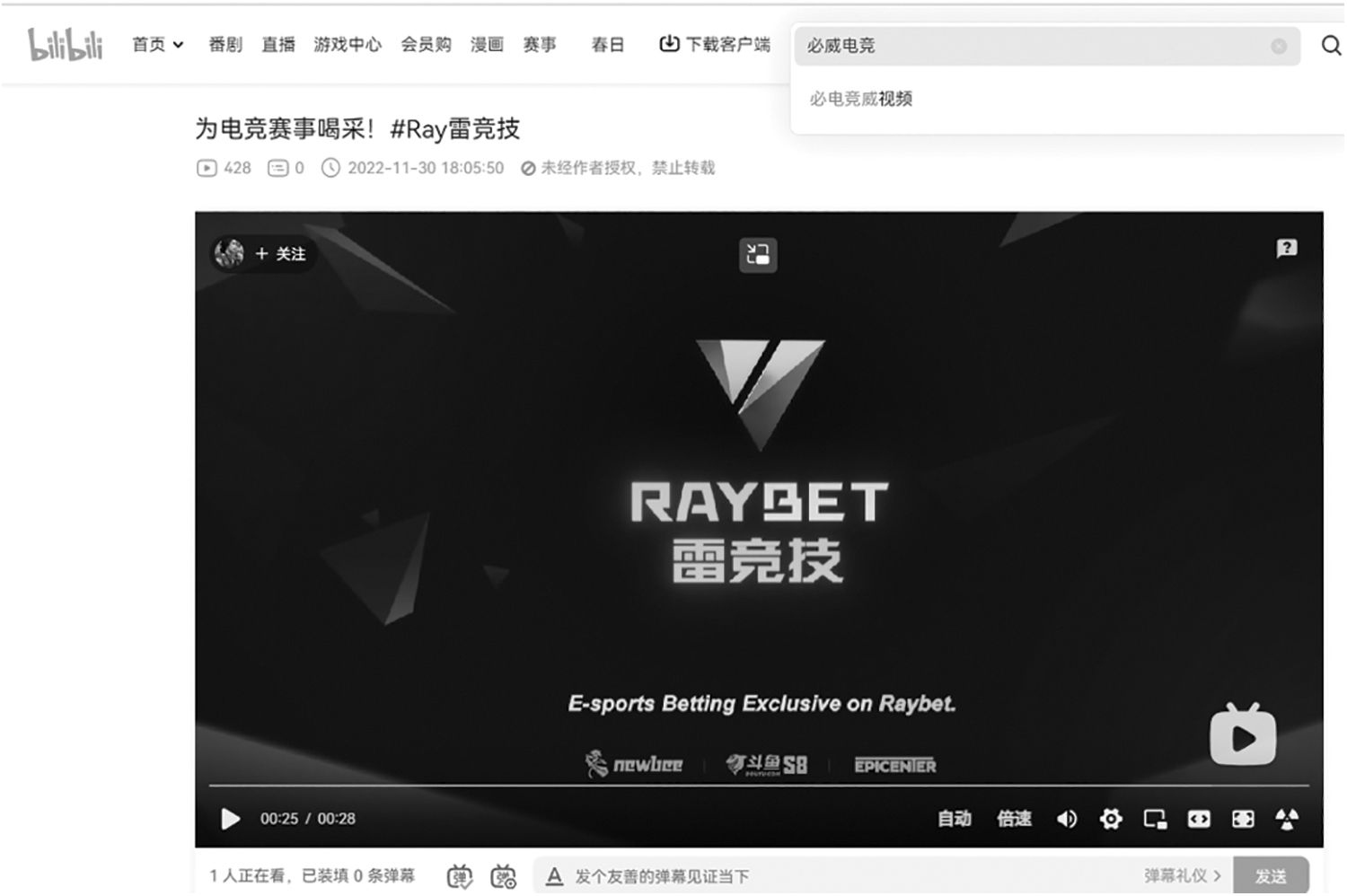
Raybet's advertisement on Bilibili 62

Uwin's advertisement on Bilibili 63
Importance of the esports industry to the Chinese government
Sports has become increasingly politicized in China, with the government using sports as a tool for promoting political agendas, shaping the national identity, and advancing the country's soft power. 64 China's pursuit of top-level performance in sports is aimed at building the country's image as a global power, both domestically and internationally. This was particularly evident during the 2008 Olympics in Beijing, wherein leading the Olympic medal table was seen as a way to reinforce the message that China is a superpower. 65
Accordingly, esports have recently gained the support of the Chinese government. Chinese esports teams achieved this by consistently wearing the national flag in public whenever they won a championship, especially in international competitions. This serves as a way for the teams to honor the country and is considered a mandatory part of the final award ceremony for the teams in relevant championships. Esports teams from other regions do not honor their countries though such gestures. For example, after Invictus Gaming (sponsored by Betway) and Newbee (sponsored by Raybet) won the biggest Dota 2 tournament (2012 and 2014, respectively), both teams displayed the Chinese national flag to the audience (Figs. 7 and 8). China Central Television (CCTV) also broadcast the news when the Chinese esports team won the championship. In 2018, the General Administration of Sport of China formed a national esports team that won two gold medals and one silver at the Jakarta Asian Games. 66

Invictus Gaming displays the Chinese national flag after winning The International in 2012. 67 Photo credit: Invictus Gaming and The International 2012 Dota 2 Championship.

Newbee displays the Chinese national flag after winning The International in 2014. 68 Photo credit: Newbee and The International 2014 Dota 2 Championship.
Local governments have also recognized esports as a thriving part of the cultural entrepreneurship industry and have implemented policies to facilitate the industry's transition from online to offline. The Shanghai government issued specific policies in 2018 to subsidize the introduction of international-level esports events/arenas, resulting in the successful hosting of Dota 2's The International 2019 and the League of Legends World Championship in October 2020. Guangzhou, Beijing, Chengdu, Xi'an, and Hainan have implemented esports industrial policies that align with their distinct urban characteristics. Further, China's esports industry will continue to expand and move from online to offline, sparking a new wave of industrial expansion. 69
Although VPGAME is an online gambling platform, its esports team, LGD Gaming, has a significant political and economic impact on China and the local government. However, LGD Gaming has not won the biggest Dota 2 tournament but only came in second twice (2018 and 2021). CCTV broadcast and cheered for LGD Gaming on behalf of the Chinese Communist Party in both instances, telling them to defend the honor of the nation on the esports field. LGD Gaming made a video in which they pledged their loyalty to the nation and vowed to fight for the honor of China. 70
LGD Gaming has a significant economic impact on the local government—Hangzhou City, Zhejiang Prefecture. Hangzhou launched a campaign to become “The City of Esports” (电竞之都). In June 2017, the China (Hangzhou) esports and “Digital Entertainment Town” officially settled in Xiacheng District. As the first esports and “Digital Entertainment Town” in the province, it is positioned as a leading area for the comprehensive development of the national and provincial esports industry, covering a planned area of five square kilometers. To accelerate the construction of the esports city and promote industrial development, Xiacheng District introduced “16 Measures for Esports Industry Support,” including the reduction of office and talent housing rental fees, and Internet fees for esports enterprises. In September 2019, the first “Summit Forum on Digital Economy and Esports Industry” was held in Xiaoshan, Hangzhou. Three esports projects signed contracts with the Xiaoshan E-sports Innovation Center, representing the official launch of Xiaoshan's esports industry. The structure of the esports industry in Xintang Street was officially implemented. 71 Hangzhou completed the construction of the China Hangzhou E-sports Center in 2022 to welcome the 19th Asian Games, which included esports. 72 LGD Gaming contributed financially to help Hangzhou reach the target of creating “The City of Esports.” In June 2018, LGD Gaming entered a partnership agreement with Allied Esports to construct an esports venue in Hangzhou, which will serve as LGD Gaming's home venue for the LPL, the top professional competition for the League of Legends in China. A section of LGD Gaming's management team relocated to the area. 73
The owner and CEO of VPGAME and LGD Gaming, Pan Jie, was elected as a member of the Chinese People's Political Consultative Conference in Gongshu District, Hangzhou, in 2019. 74 Instead of being investigated or arrested when VPGAME's online gambling platform was raided by the police in January 2021, Pan Jie was selected as an “Outstanding Esports Figure in the Yangtze River Delta Region 2019–2020” in July 2021. 75 She also attended the Fifth China E-sports Industry Conference on March 18, 2023, in Gongshu District, Hangzhou. The conference was co-hosted by the People's Government of Gongshu District, China Service Trade Association Digital Entertainment Professional Committee, China Real Estate Association Commercial Culture Tourism Real Estate Committee, and China Cultural Management Association E-sports Management Committee. LGD Gaming was invited to participate in the conference. 76 Generally, Chinese esports is closely linked to Chinese politics and local economies.
CONCLUSION
Although gambling remains illegal in China, the esports field has emerged as a new arena for online gambling, with esports teams and players promoting and engaging in illegal gambling and match-fixing. Surprisingly, the Chinese government's anti-online gambling policies do not apply to the esports industry. This is evident in the following actions: 1) accepting sponsorship for Chinese esports teams from online gambling companies; 2) not imposing criminal or administrative penalties on Chinese esports players implicated in match-fixing; and 3) not prosecuting an esports tycoon who clearly ran an online gambling house that was recognized thus by the Chinese government. The reasons proposed for the government's tacit support for esports online gambling were 1) the use by online gambling companies of cultural reframing strategies to avoid monitoring systems, and 2) the strong impact of esports in China, both in political and economic terms.
In exploring the intricate and frequently hidden realms of esports and online gambling in China, the author faced significant hurdles in securing interviews with Chinese officials and esports players engaged in online gambling. This was mainly because of the country's distinctive political landscape and the general perception of gambling as an unlawful activity. Specifically, the challenges lay in gaining access to those directly involved in gambling, and these limitations have surely limited the study's comprehensiveness. As a potential solution to this issue, it is suggested for scholars to attempt to create personal connections with the targets of the investigation. These relationships may allow for more valuable information about the topic of interest to be obtained, as establishing deeper connections with those involved may make them more willing to divulge their knowledge and personal experiences. This would then enable for a more profound and comprehensive understanding of issues related to gambling and esports in future studies. The article reports on a groundbreaking study in the field of Chinese gambling and esports, shedding light on a previously unexplored area that continues to operate even under the Chinese government's strict anti-gambling policies. It is the first work to identify the “gray zone,” referring to the online gambling activities related to esports in China. The findings of this study have significant implications for both the Chinese gambling and esports industries. It also represents an important contribution to the broader understanding of the complex relationship between Chinese gambling and esports.