




Abstract
This review article is among the first to examine the new junket regulations in the Macau gaming industry. Particular emphasis is on the legal and regulatory framework governing the junket activity of gaming promoters and their associates. The recent changes to Macau gaming laws have resulted in stronger licensing requirements for local junket participants and precipitated the collapse of the VIP room system in casinos. Furthermore, this article highlights the policy and managerial implications of the current junket environment for the gaming industry in Macau and possibly other regional gaming jurisdictions. The effects of the new legal environment for Macau junkets could also provide insights into the implementation of similar legislation in other jurisdictions.
Willy: I don't want a change! I want Swiss cheese. Why am I always being contradicted?
—Arthur Miller, Death of a Salesman
INTRODUCTION
Macau is one of the world's largest casino markets by gross gaming revenue. It has long been a common industry practice among local casinos to collaborate with third parties to promote the VIP gaming business. The late-1990s organized crime associated with VIP business primarily led to the liberalization of the gaming industry commenced in 2001. Macau has since experienced tremendous economic growth and witnessed the development of large-scale integrated resorts. Local casinos have, until recently, depended on gaming promoters to recruit and retain VIP players who participate in high-stakes table games (see Table 1). 1 However, junkets and their informal practices, ranging from deposit-taking activity in VIP rooms to debt collection outside casinos, have been a persistent issue affecting both the gaming industry and society at large.
Gross Gaming Revenue and VIP Business Revenue from 2011 – 2023
Source: Data are compiled by the authors from the gaming statistics released by the Gaming Inspection and Coordination Bureau (DICJ) (2011 – June 2023).
Note: The unit is MOP million. The exchange rate from MOP to USD is approximately 8 to 1.
Gaming promoters and their associates have been associated with undesirable business practices. Junket promoters typically act as marketing agents for casinos, responsible for recruiting, serving, and financing high-stakes players. Though the local junket system dates back to the gambler recruitment activity in the 1930s, junket operations have only been regulated since the local casino market was liberalized more than two decades ago. With the regulatory changes effected by the new gaming laws and 10-year casino concessions, Macau has taken significant steps to improve governance over all aspects of third-party involvement in casinos, effectively marking a definitive end to the long-standing tradition of VIP room operations.
Macau recently passed new gaming-specific legislation establishing bright-line rules for the junket activity in casinos. Specifically, Law No. 16/2022 was enacted in December 2022 to repeal and replace Administrative Regulation No. 6/2002, which used to supervise the junket activity in Macau casinos. 2 Regulatory control over the junket sector has been significantly strengthened in response to mounting concerns, including informal junket practices, third-party operated VIP rooms, and the compensation model for gaming promoters and their collaborators. Law No. 16/2022 stipulates various rules for junkets and their associates, such as entry requirements, suitability and financial requirements, obligations and joint liabilities, and penalties for violations and non-compliance. 3
A NEW REGULATORY FRAMEWORK FOR JUNKET OPERATIONS
Gaming promoter (junket promoter)
Macau operates a licensing system for gaming promoters in casinos. Gaming promoters (promotores de jogo) refer to companies engaged in the activity of promoting games of fortune (chance) in casinos. Gaming promotion activity is defined as “granting facilities to players, particularly regarding transportation, accommodation, dining and entertainment, receiving a commission paid by the concessionaires, with a view to promoting casino games.” 4 Gaming promoters are essentially salesmen, attempting to sell as many dead (non-cash) chips as possible in exchange for commissions from casinos. 5 Macau's new junket law differs from the past in that the Secretary for Economy and Finance is now empowered to oversee the issuance, renewal and cancellation of junket licenses. 6 Figure 1 depicts the regulatory relationship among gaming authorities, concessionaires (i.e., casino operators) and junket participants.
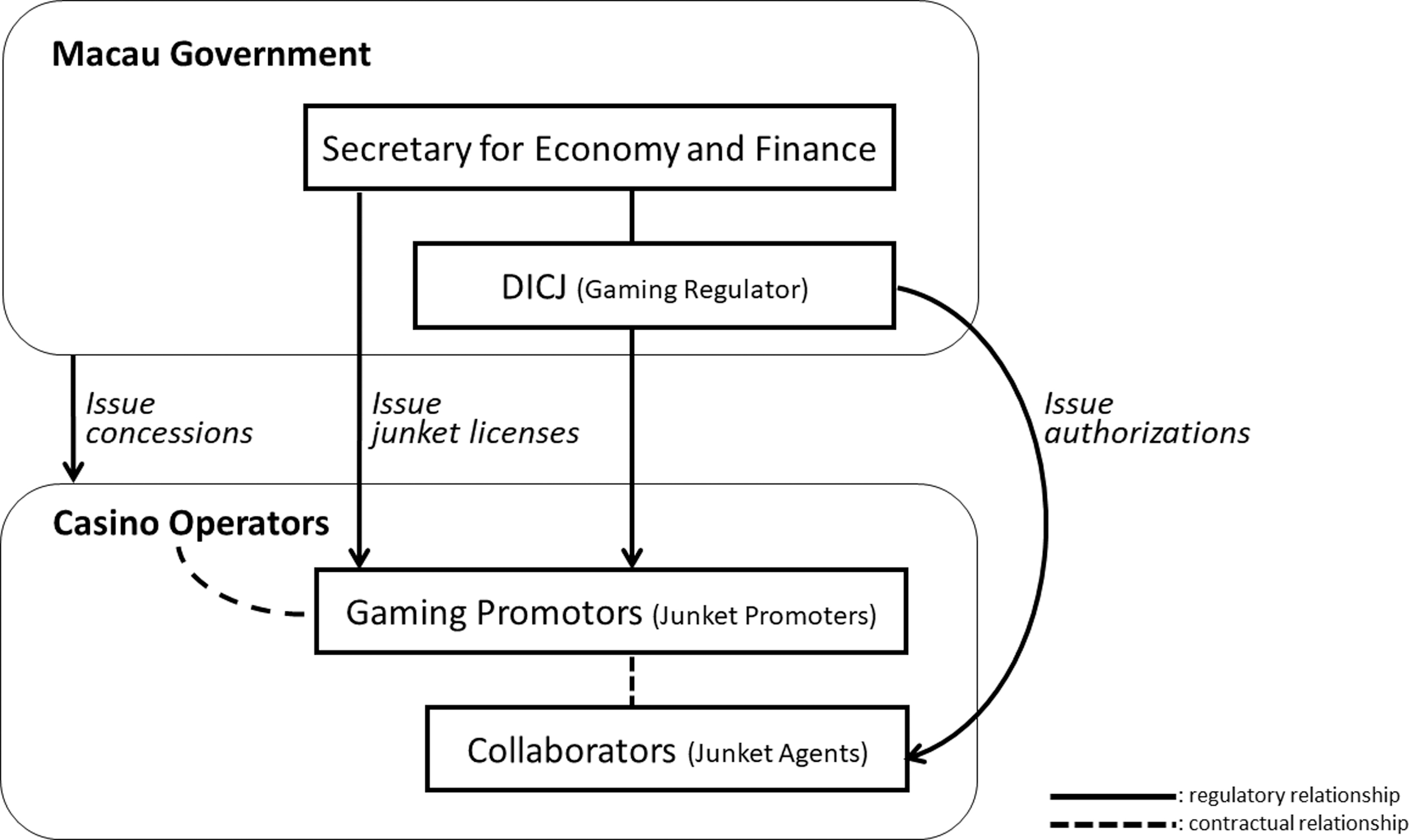
The relationship among gaming authorities, concessionaires (casino operators), gaming promoters and their collaborators in Macau casinos.
Gaming promoters are now prohibited from operating VIP rooms and sharing gaming revenue in light of the new junket regulations. The Gaming Inspection and Coordination Bureau (Direcção de Inspecção e Coordenação de Jogos, DICJ), as the gaming regulator in Macau, has the authority to assess the suitability of the specified employees and supervise the junket activity in casinos. To address the informal deposit-taking activity in the past, the new junket regulations prohibit gaming promoters from accepting deposits of casino chips and cash from others. Furthermore, the annual maximum number of gaming promoters in Macau and for each concessionaire might be capped, subject to the local gaming development policy and concessionaires' overall operating conditions. 7 The licensing of gaming promoters has been tightened under the new regulatory framework. As of the latest official release (January 2023), Macau has 36 gaming promoters licensed to carry out junket activity in casinos, down from the 2013 peak of 235 junket licensees. 8 Table 2 displays the variations in the number of gaming promoters in Macau casinos across various pivotal years.
Changes in the Number of Gaming Promoters in Macau Casinos Across Different Periods
Note: The original Law No. 16/2001 specified a maximum of three casino gaming concessions allowed. After the original concession contracts were modified in 2002, 2005 and 2006, the Macau government permitted the three concessionaires to enter into sub-concession contracts with other authorized entities, effectively increasing the number of casino operators to six (3+3).
Collaborators (junket agents)
Gaming promoters generally have an extensive network of self-employed agents. These subordinate agents under the leadership of their junket promoters are officially designated as “collaborators” (colaboradores). These junket agents refer to the natural persons selected by gaming promoters to assist in their junket activity, and collaborators must be authorized by the Director of the DICJ (see Figure 1). 9 Since collaborators are typically tasked with sourcing players and selling dead (non-cash) chips for remuneration (retribuição) from their junket leaders, a myriad of collaborators are generally considered associates of gaming promoters.
Law No. 16/2022 keeps collaborators under stringent regulation and supervision. Collaborators are now required to meet the suitability and financial capability requirements, as opposed to the previous gaming regulations. Though authorized collaborators can work with more than one gaming promoter, the DICJ can determine the annual maximum number of collaborators in casinos. 10 Furthermore, the new junket law specifically prohibits collaborators from extending gaming credit (casino markers) to players and taking deposits of casino chips and cash from others. 11 In addition to their directors and employees, junket licensees are jointly and severally liable for administrative fines and civil liabilities that arise from the junket activity carried out by their collaborators. 12
Investigation of personal and financial background
The new gaming laws specify that all industry participants are under the regulator's continuous monitoring and inspection. Gaming promoters and their collaborators must meet and maintain their personal suitability and financial capacity, and they are subject to ongoing reviews by the gaming authorities. Failure to make a required disclosure can result in the revocation of their respective permits. 13 Comprehensive probity checks are also imposed on any individuals who possess equity and/or economic interests in the operation of gaming promotion. Table 3 details the suitability and financial capacity requirements of gaming promoters and their collaborators in Macau casinos.
The Suitability and Financial Capacity Requirements for Gaming Promoters and Their Collaborators in Macau Casinos
Personal suitability
Any individuals involved in the gaming promotion operations must meet the suitability requirements contained within Law No. 16/2022. Specifically, gaming promoters and their collaborators are subject to the determination of suitability and must remain suitable during the exercise period of their activity or functions. 14 In making the suitability assessment on the relevant application, the gaming authorities will take into consideration the following factors: reputation, responsible business (professional) conduct, economic and financial conditions, source of funds, any inappropriate transactions with criminal groups, and previous criminal charges/convictions. 15 In addition to gaming promoters (companies), the suitability assessment applies to their shareholders, directors, and key employees.
Financial capacity
Gaming promoters and their collaborators must demonstrate sufficient financial capacity to carry out the junket activity in casinos. The key criteria in determining the financial capacity of these junket participants are as follows: economic and financial conditions of gaming promoters (and their shareholders) and collaborators, as well as that of their closely associated business entities. 16 In addition, cash/bank guarantees are required to be furnished by gaming promoters and collaborators. Junket promoters must provide a guarantee of MOP 1.5 million (USD 187,500) for their license, and the guarantee for collaborators is set at MOP 500,000 (USD 62,500). 17 The new junket law also mandates these junket participants to provide special guarantees when there is justified fear of inadequate financial capacity. 18 In addition, junket licenses can be denied due to bankruptcy or non-compliance of gaming promoters, as well as their shareholders, directors, and key employees. 19
The business form of gaming promoters
The new gaming control system has strengthened the junket licensing prerequisites with respect to business entity, capital and shareholdership. Law No. 16/2022 provides that gaming promoters must take the form of limited companies with corporate offices domiciled in Macau. In contrast to the previous practice, junket promoters taking the form of “individual entrepreneurs (natural persons)” are no longer accepted. 20 The minimum capital for junket companies has been raised to MOP 10 million (USD 1.25 million). The required capital must be paid up in cash upon incorporation, and the company's net worth (situação líquida) cannot be less than that amount during the license term. While the shareholders of junket companies must be natural persons with the capacity to exercise rights, the majority of shareholding (≥50%) in such companies must be held by Macau permanent residents aged 21 years or above. 21
Junket and collaborator contracts
Gaming promotion contracts must be concluded between casino concessionaires and their respective gaming promoters. Pursuant to Law No. 16/2022, junket contracts must specify “the terms and form of the activity by the gaming promoter, particularly if there is allocation of specific spaces”, and such arrangements must be expressed in the gaming promotion contract. 22 Unlike the previous regulations, the new junket law requires an exclusivity relationship between gaming promoters and concessionaires; consequently, a gaming promoter cannot concurrently be in business with more than one concessionaire. 23 Prior to their cooperation, gaming promotion contracts concluded between junkets and concessionaires are subject to review and approval by the territory's Secretary for Economy and Finance. 24 Likewise, collaboration contracts concluded between junket promoters and their collaborators are subject to the DICJ's approval. 25
Junket commissions
Casino concessionaires are now prohibited from sharing gaming revenue with other entities. Under the new gaming regulations, junket promoters can only be compensated on a commission basis. 26 Junket commissions are defined as “any advantages or gifts that are offered or provided, in Macau or abroad, directly or indirectly, to a gaming promoter by the concessionaire… are considered and calculated as commissions.” 27 In other words, anything received in exchange for the gaming promotion from casinos is considered commissions and therefore is taxable.
It is imperative to underscore that gaming promoters can only be remunerated on the basis of an agreed percentage of rolling chip volume. 28 Macau limits the junket commission rate to “1.25% of the net amount of the conversion of gaming chips (net rolling)”. Under this regulatory regime, gaming promoters can receive no more than $12,500 for every $1 million in dead (non-cash) chip sales. Effective from 2023, the Macau government has implemented a policy mandating gaming promoters to pay a 5% tax on their junket commissions. 29 This tax rule marks a notable departure from past policies that granted gaming promoters tax exemptions or relief programs. Similarly, junket promoters' remuneration payable to their collaborators cannot exceed the maximum limit of 1.25% of the net rolling. 30
Concessionaires as “front-line supervisors”
Macau adopts an on-site approach to overseeing the gaming operations in casinos. 31 In addition to the gaming inspectors deployed by the DICJ, the new gaming laws create special obligations for casino concessionaires to administer and supervise the overall gaming operations. 32 Concessionaires typically act as de facto “front-line supervisors” for any other authorized entities in their casinos. They are entrusted with a wide variety of responsibilities in supervising the day-to-day management of gaming promoters and other entities associated with them. Law No. 16/2001, as amended in 2022, specifies that concessionaires are responsible for monitoring and reporting junket activity in their casinos. 33 Among other things, concessionaires must provide the DICJ with a monthly report of their junkets' commission reports and collect withholding tax on the commission payments; commercial bookkeeping between concessionaires and gaming promoters must be updated regularly.
The duty of supervising junket activity in casinos is undertaken by concessionaires. Casinos must ensure gaming promoters and their associates are in full compliance with the applicable gaming laws and remain free from criminal activity. 34 Concessionaires are obligated to inform the DICJ of any facts that may affect the solvency of their gaming promoters, particularly if such junket promoters are named as defendants in civil proceedings or if they have entered into loan or financing contracts that exceed their solvency limits. 35 Moreover, casinos must report to the DICJ any information suggesting junket promoters are involved in criminal offenses and administrative infractions.
Law No. 16/2022 mandates that risk management plans for junket promoters must be developed to respond to possible risk incidents. 36 While taking preventive measures against any illegal behavior, concessionaires must have a mechanism for the continuous supervision of the gaming promoters and their collaborators, including their services and related financial behaviors. 37
DISCUSSION AND IMPLICATIONS
Junket sector: navigating the new regulatory landscape
The VIP junket business was once the key revenue driver for Macau casinos. Yet, the new junket law seeks to resolve the legacy issues of third-party involvement in casinos and delineate the roles of junket participants in the gaming industry. The Macau gaming industry is now subject to stricter regulation and oversight to protect against any improper influence. Gaming promoters are currently caught between a regulatory rock and a gloomy place. The new Macau gaming laws have strengthened the licensing of gaming promoters by raising the capital and guarantee requirements, and wider and more detailed disclosure is required for all industry participants, from gaming promoters to their associates (employees and collaborators).
Nevertheless, gaming authorities must keep abreast of the latest industry practices to prevent unscrupulous individuals from exploiting regulatory loopholes and gaming the system. The DICJ must stay informed about the inner workings of the junket system, as well as any industry trends and changes within the junket community. Proper monitoring and auditing mechanisms must be established to “follow the money”, ensuring regulatory controls are working as intended. Analyzing gaming records and financial flows through approaches such as more frequent unannounced on-site inspections and technological integration with in-house casino management systems can effectively preempt or uncover any illicit activities in casinos.
Junket practice: compensation and competition
Macau casinos historically offered two compensation models for junket promoters based on gaming revenue sharing or rolling chip volume. The revenue sharing (win/loss split) method used to be the most prevalent way to remunerate junket promoters in casinos, and junkets were entitled to receive (bear) at least 40% of the net win (loss) generated in their VIP rooms. With the prohibition of third-party involvement in gaming operations, the rolling chip-based commission program remains the only model to remunerate junket licensees. Under this volume-based structure, junket commission for gaming promoters was capped at 1.25% of the net rolling chip turnover. Despite not being allowed to share gaming revenue, junket promoters are not exposed to potential losses from the gaming operations. As a result, this might incentivize law-abiding junkets to focus on increasing rolling chip commissions by selling more dead chips to high-stakes players.
Gaming promoters also face “market cannibalization” in the local casino context. While the junket sector is in the process of recovery, concessionaires have been forging ahead to expand their self-directed VIP programs. Most loyalty programs consist of five or seven tiers, with increasing benefits and rewards offered at each tier. Macau casinos typically offer premium players a rebate ranging from 0.7% to 1.1% of their rolling chip purchase, alongside other complimentary privileges. Additionally, junket licensees are currently obligated to pay a 5% tax on their rolling chip commissions with no exemptions. The reintroduction of the 5% commission tax on gaming promoters could be interpreted as a sign that Macau is attempting to discourage the expansion of the junket business. This policy direction is also in line with the territory's current priority of developing the territory into a family-friendly and business-ready destination.
Gambler recruitment: Chinese policy considerations
In addition to the new gaming regulations, the local junket sector remains in the shadow of the national anti-gambling policies across the Chinese border. The systemic problem of junket operators and their collaborators has been their modus operandi and informal industry practice. In particular, gaming promoters and their gambler recruitment model are increasingly at odds with China's anti-gambling policies and the national positioning of Macau as a prime tourist destination. While seeking to maintain social and economic stability domestically, the recent amendment to China's criminal law that penalizes the organization of cross-border gambling trips has broader global implications. The penalization of junket trips has accentuated the irreversible divide between the national interest and the gambler recruitment model traditionally upheld by the junket community in Macau and across Asia.
The regulatory burden and operational risks facing Macau junkets and their associates are myriad and continue to grow. The new criminal offenses for organizing junket trips might have already disrupted the junket system and upended the long-running China-based gambler recruitment model, leading to a substantial decline in VIP business (see Table 1). This unpalatable conclusion suggests a profound shift in the industry's entire landscape, casting doubt on the future of gaming promoters. To maintain competitiveness in the market, gaming promoters and other industry stakeholders must be proactive and resilient in adapting to these changes and exploring other service areas that could align with the industry's gaming and non-gaming development.
Junket employees: pursuing new career paths
The Macau gaming industry once had 235 junket promoters and a multitude of VIP rooms spread throughout the local casinos. The collapse of the VIP room system has resulted in business closure and mass layoffs. 38 Individuals involved in VIP room operations have been among the most affected. Recent reports have shown that former junket employees are faced with various re-employment challenges, including significant income reduction, skills gaps, and stereotypes and biases against their previous junket experience. 39 While some former junket staff have successfully transitioned into diverse service positions within and outside the hospitality sector, others have encountered a period of unemployment.
Rebounding from career setbacks can undoubtedly be a challenging process for individuals with prior experience in VIP rooms. With the local government and casinos seeking to attract international visitors to the Chinese enclave, VIP room employees could turn this adversity into an advantage. Current and former junket employees with extensive customer service experience can leverage their expertise and resources to pursue new career opportunities in gaming and tourism-related industries. Furthermore, junket employees are advised to reskill and upskill themselves to stay market-competitive, particularly in the areas of bilingual communications, data-driven analytics, and customer relationship management (CRM) technologies.
Gaming promoters: current status and future prospects
Macau has consistently implemented multiple regulatory measures to strengthen the licensing and oversight of junket activity since the inception of gaming promoters (see Table 2). With the new gaming regulations and national regulatory actions, the local junket sector is facing a more challenging reality. Reports indicate that only a dozen or so gaming promoters have been in operation among the 36 junket licensees since the new casino concessions began in January 2023. 40 While gaming promoters are here to stay, their presence in casinos appears to contradict the prevailing trend. In contrast to the previous concession period, it is expected that junkets and their marketing role in casinos are expected to be gradually curtailed to a level similar to, or even lower than, their counterparts in Nevada and Singapore.
Junket promoters were once the center of gravity in the Macau gaming industry. Nevertheless, an amalgam of policy, regulatory and economic factors at the local, national and international levels are closely linked to the prospects of the sui generis junket system in Macau casinos. Gaming promoters and their collaborators must remain both compliant and competitive in an ever-increasing regulatory environment. Amid the challenging circumstances, it is apparent that some junket promoters have been gradually relocating their business operations, along with their players, to small-scale casinos in Southeast Asia. 41
Whether gaming promoters can withstand the current regulatory challenges and fully recover remains uncertain. On a positive note, all six concessionaires have either established formal partnerships or are in contemplation of accepting gaming promoters to access their VIP salons. 42 For instance, a gaming promoter has recently launched its rolling volume-based junket arrangements in a new in-house VIP club operated by a concessionaire. Though most clients were reportedly from China and Hong Kong, no casino markers would be issued for Chinese players. 43 Moreover, Macau and the six concessionaires are currently pitching the international gaming market to complement the local casino market. By leveraging the networks of junket promoters and their associates, concessionaires can effectively reach a diverse range of foreign patrons and expand their business opportunities beyond the Greater China region.