




Abstract
The return of the NFL (National Football League) season means sports wagering shifts into high gear across the United States in September, resulting in a national monthly all-time record for handle and a likely all-time record for operator gross revenue.
If ever there is a pedestrian month for sports wagering in the United States, it is August. The main event for wagering is Major League Baseball (MLB), a high-inventory yet sometimes mid-quality product with 15 games mostly every day as teams separate themselves into contenders and also-rans.
There are assorted blips of additional interest: The NFL preseason begins, which means bettors begin considering Super Bowl and playoff futures as well as player props of season yardage totals at skill positions. NASCAR (National Association for Stock Car Auto Racing) and the PGA (Professional Golfers' Association) Tour are niche-driven elements within the wagering ecosphere.
The U.S. has a domestic soccer league in the MLS (Major League Soccer)—which received a needed jolt of attention this summer with the arrival of Argentina superstar Lionel Messi to Inter Miami—but the start of the English Premier League season grabs the most headlines for soccer bettors as they considered Manchester City's ability to claim back-to-back trebles as reigning European champions.
August gives sportsbooks a collective breather nationwide. In terms of dollar figures and win rates, sportsbooks largely kept the year-long status quo: The nationwide hold for the month was just below 9.1%, the 14th consecutive month it was above the industry standard of 7%, and the ninth time in that span it was above 9%. Year-over-year handle increased 31% to more than $6.4 billion, but most of that rise originated from first-year markets Ohio and Massachusetts, as well as Maryland cycling through its maiden year of mobile wagering.
August is a time to ponder business strategy, which includes figuring out how to best attract existing and new bettors in September for the sport that truly moves the needle in the U.S. —the National Football League. That means promotions and plenty of them.
Yes, ongoing MLB play and the start of the college football season—including its “Week 0” in late August with a handful of games—provide added attention depending on the state's college fervor, but nothing moves the betting needle like Sundays.
The NFL has an engaged audience for two-thirds of the day if one starts with the first pre-game show at breakfast time to the final whistle of Sunday Night Football. Bettors are scouring social media in hopes of finding the tidbit of information from league insiders who can sway a bettor's choice of wager. The league's reach continues to grow with various streaming deals, and then of course, its pre-existing deals with major sportsbooks who are either official league partners or league-approved sportsbooks.
Determining just how much sportsbook operators offered in terms of promotions is a very inexact science. Let's start with the basic statement that no two state revenue reports are alike, which means no two states are alike.
For example, New York, New Jersey, and Illinois do not allow operators to deduct promotional play from their adjusted gross revenue and regulations in those states do not require state agencies to include those figures in their respective monthly reports. Michigan's monthly reports provide a gross revenue total and an adjusted gross revenue (AGR) total that allows a reader to determine a total amount of deductions—a combination of promotional play and the federal excise tax. That is also an inexact science because states that allow operators to carry over losses for multiple months impacts only one month's AGR.
A good portion of states, however, are specifying the amount of promotional play operators are providing bettors. Ohio is one of the largest markets that does not allow for promotional play to be deducted, yet the state's Casino Control Commission includes the amount in its monthly reports.
With the dust almost settled from September's reports (Kentucky has yet to provide its figures following its retail launch early in the month and a digital launch for the final three days), it all added up to a post-PASPA (Professional and Amateur Sports Protection Act) monthly record handle of more than $11.55 billion (please see Fig. 1 and Table 1).

That narrowly exceeded the previous record of $11.49 billion to start 2023 and marked the third time in the calendar year handle exceeded $11 billion. To be clear, this record was not possible without the contributions of Ohio and Massachusetts, as sportsbooks in the two “rookie” states accepted more than $1.2 billion worth of wagers between them.
And those states also took money away from more established markets in neighboring states. For example, Indiana saw only a 5.7% year-over-year growth in handle from September 2022 in part due to Ohio and Kentucky bettors being able to stay in state. New Hampshire had the largest decline in year-over-year handle in terms of dollars—down nearly $11.4 million from September 2022—and Rhode Island saw handle dip 9.7% as Massachusetts bettors no longer had to cross state lines to place bets.
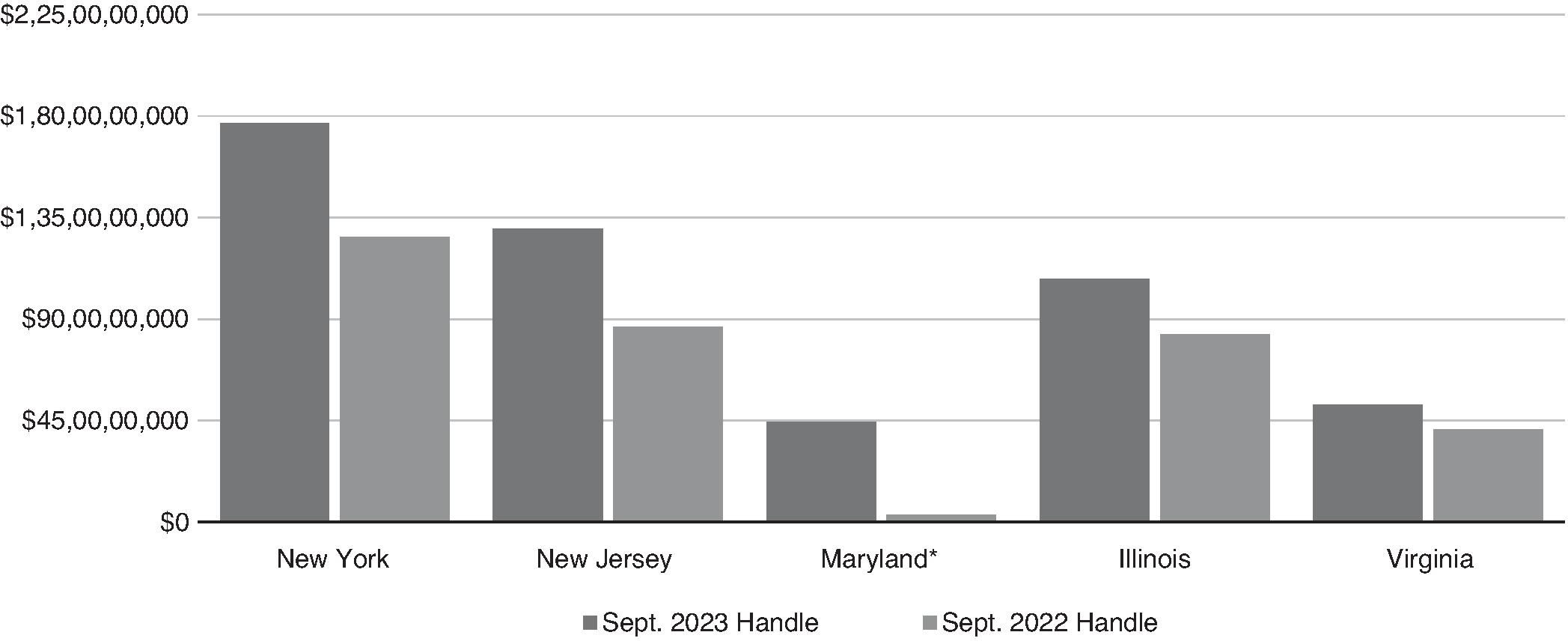
That cannibalization, however, was not universal. As Table 2 shows (please see Table 2), two sets of neighboring states were among the top five for increased year-over-year handles in terms of dollars. New York showed no signs of resting on its laurels as the nation's top sports betting market with a handle increase of nearly 40%, but New Jersey showed itself still capable of putting up a lofty number of its own as one of the pioneers of sports wagering. The near-$1.3 billion handle ranked third in all-time Garden State annals while surging almost 50% year-over-year.
September 2023 vs. September 2022 Sports Wagering Handles
Maryland made this list because it did not have mobile wagering in September 2022, but its digital presence had little impact on Virginia, with handle in the Old Dominion up 26.5% compared to the previous September while exceeding one-half billion dollars. When excluding Ohio and Massachusetts, 10 states had year-over-year handle increases of at least $70 million, making September's record amount a true group effort (please see Fig. 2).
Promotional offers made a notable contribution to the bottom line for handle and, eventually, operator revenue. Among states where promotional figures are exact (please see Fig. 3 and Table 3), the total for September reached $127.5 million, which comes in the form of free wagers, matching deposits, and other assorted goodies given to bettors.
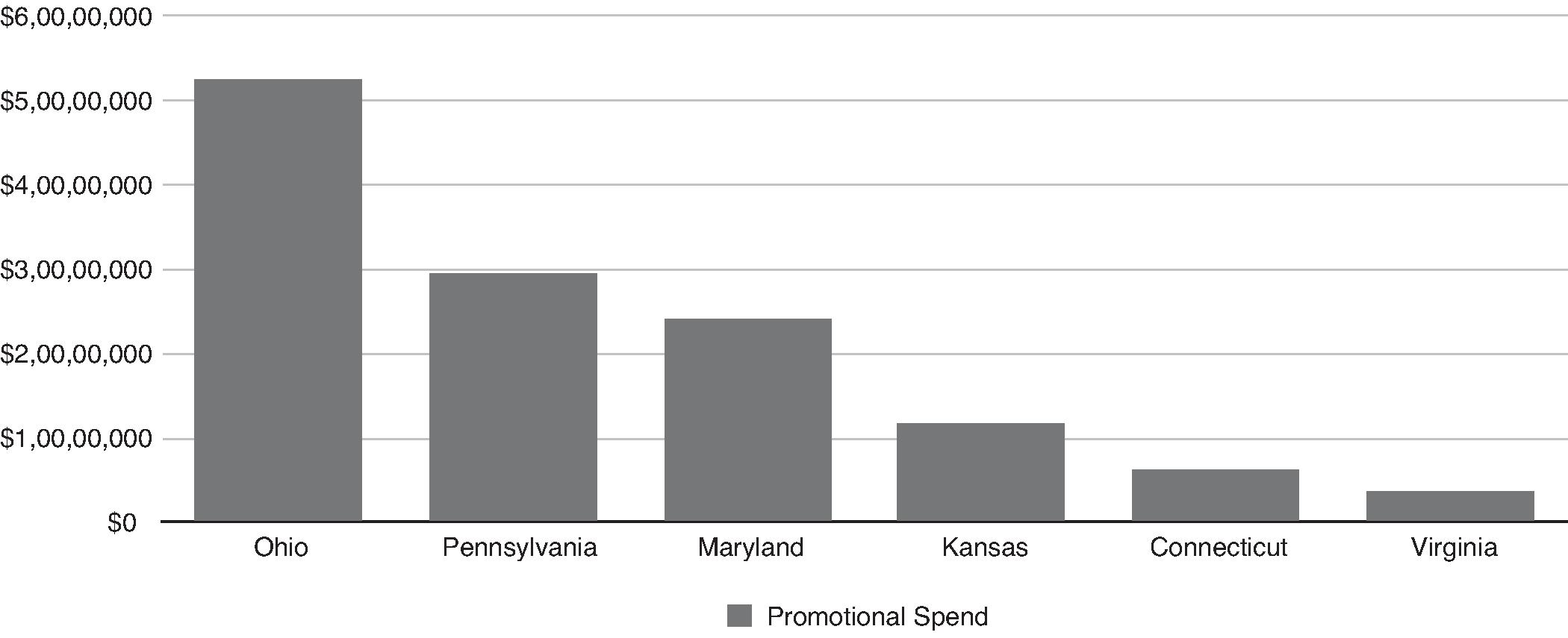
Remember this does not include promotional play reported in three of the nation's biggest markets in New York, New Jersey, and Illinois. Not all promotional play is in the form of free bets, but it is worth pointing out those six states alone provided promotional play equal to 11% of September's total national handle.
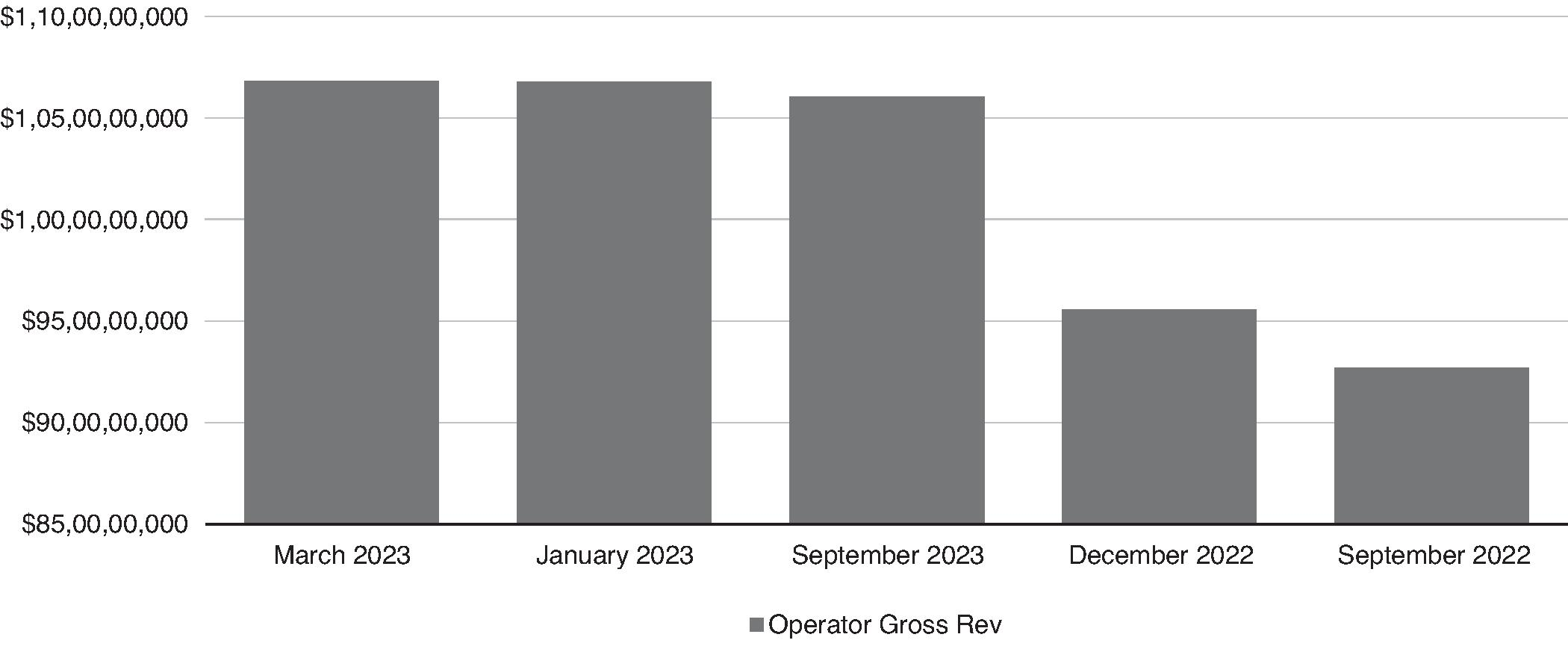
Promotional offers when deducted in markets where allowed contributed to a spread of close to $145.6 million between the $1.06 billion in gross revenue claimed by operators and the $915 million-plus in AGR eligible for taxation. While the gross revenue technically ranks third on the all-time monthly list as a known amount, it is all but certain September set an all-time national record.
That is because it is a near certainty mobile operators in Tennessee—where the Sports Wagering Council no longer publishes overall operator revenue figures following a change in taxation method to a percentage of the handle—claimed more than the $7.8 million needed to better March's record operator total of $1.068 billion (please see Fig. 4 and Table 4). Tennessee collected more than $7.7 million in taxes—and the corresponding revenue figure using the previous taxation method of 20% of AGR implies close to $38.6 million in taxable revenue.
Operator performance was again above-average based on the industry standard hold of 7%, but reality of the past year-plus means the hold of just above 9.5% was in line with the 9.4% hold attained through the first three quarters of the year on nearly $79 billion wagered. The old saying of “sometimes you have to spend money to make money,” certainly proved accurate for sportsbooks in September, which means more of the same likely took place in October when the NBA (National Basketball Association) and NHL (National Hockey League) were added into the mix.