




Abstract
Technologies that screen multiple single-nucleotide polymorphisms (SNPs) could be very valuable in predicting patients' susceptibilities to diseases or responses to therapeutic interventions. In this study, we developed a chip that can accurately detect four SNPs at same time. This chip is cost-effective and user-friendly because it uses a detection protocol analogous to dot blotting and does not require sophisticated instruments. To establish this chip, we designed and blotted onto a nylon membrane SNP-specific oligonucleotide probes for human angiotensinogen, cholesteryl ester transfer protein, and apolipoprotein E. This chip detected the corresponding SNPs harbored within the angiotensinogen, cholesteryl ester transfer protein, and apolipoprotein E sequences from 20 donors. Importantly, the SNPs detected by our chip matched exactly with the direct sequencing results, thereby highlighting the accuracy of this chip. In conclusion, our chip is a robust tool for multiple SNP screening and holds the potential to future refinement in detecting diseases-associating genes in patients.
Introduction
T
Currently, there are many techniques (polymerase chain reaction [PCR]-restriction fragment length polymorphism, direct sequencing, TaqMan genotyping, etc.) available for clinical use or research for SNP analysis (Shi, 2001; Aquilante et al., 2006; Mamotte, 2006); however, each of them has their own limitations. For example, PCR-restriction fragment length polymorphism is widely used in SNP genotyping, but it requires proper restriction endonucleases and can only type one SNP at a time. Therefore, PCR-restriction fragment length polymorphism is time-consuming and sometimes unattainable if missing suitable restriction endonucleases. Automated direct sequencing, although by far the most accurate way for SNP typing, is at the moment costly to perform for large sample size on a routine basis. Other techniques such as TaqMan genotyping, molecular beacons, and invader assay provide rapid SNP typing (Aquilante et al., 2006), but the use of fluorescent dyes and/or specialized instruments has rendered these techniques very expensive. Moreover, none of these methods can detect multiple SNPs in a single test. Lastly, companies such as Affymetrix and Genometrix have developed microarrays that screen multiple SNPs in one chip (Huber et al., 2002; Kennedy et al., 2003). These microarrays, designed for novel SNPs identification, are not appropriate for routine SNP typing for its operational costs. In conclusion, most SNP-analyzing methods are either costly or inconvenient to use and thus developing a simple SNP chip capable of simultaneously detecting multiple SNPs will aid in the general application of SNPs in clinical and research works.
To meet the increasing needs for SNP typing, we developed a cost-effective and easy-to-operate chip that can accurately detect four SNPs in a timely fashion. This chip can be further expanded to accommodate more probes such that more SNPs can be screened in one chip.
Materials and Methods
Subjects and DNA samples
A total of 20 donors without prior knowledge of their SNP types in genomic regions of angiotensinogen (AGT), cholesteryl ester transfer protein (CETP), and apolipoprotein E (APOE) were recruited in this study. The experimental procedures were reviewed and approved by the Internal Review Board of the Kaohsiung Medical University, and written consent forms were obtained from the donors prior collecting their blood samples.
Five milliliters of blood was drawn from the donors and their genomic DNA was immediately extracted from whole blood using a DNA extraction kit (Puregene Gentra System). Genomic DNA was suspended in deionized water and concentration was measured by spectrophotometry (Infinigen Biotechnology, Inc.). These DNA samples were used to amplify the SNP-containing genomic sequences of AGT, CETP, and APOE (Hixson and Vernier, 1990; Bettinaglio et al., 2002; Mohrschladt et al., 2005).
Multiplex PCR
PCR oligonucleotide primers (listed in Table 1) for AGT, CEPT, and APOE were designed using the Vector NTI (Invitrogen). Multiplex PCR, contained in a total of 20 μL reaction mixture of 60 ng genomic DNA, 10 μM of each multiplex PCR primer, 2.5 mM of each dNTP, and 2.5 units of Taq DNA polymerase (Biotools; B&M Labs), were performed in a programmable thermal cycler (PTC-100; MJ Research) using the following protocol: denaturing at 95°C for 30 s, annealing at 71°C for 6 s, and extension at 72°C for 30 s. A total of 30 cycles of PCR were performed for each DNA sample. The PCR products were checked and purified from 3% agarose gel electrophoresis by the QIAEX II Gel Extraction Kit (Qiagen, Inc.).
AGT, angiotensinogen; APOE, apolipoprotein E; CETP, cholesteryl ester transfer protein.
Digoxigenin-labeling of SNP-containing multiplex PCR product
Twenty microliters of multiplex PCR products was denatured at 95°C for 10 min and quickly chilled in ice. Then, denatured DNA was added to 3 μL Digoxigenin (DIG)-High Prime labeling mixture containing 1 U/μL Klenow polymerase (labeling grade), 1 mM of each dATP, dCTP, and dGTP, 0.65 mM of dTTP, 0.35 mM DIG-11-dUTP (alkali labile), and 5 × stabilized reaction buffer in 50% glycerol (Roche Diagnostics GmbH). The reaction mixture was incubated at 37°C for 8 h. Labeled DNA fragments were used in the subsequent hybridization experiments (see below).
Preparation of SNP chip
AGT/M235T, CETP/TaqI B, and APOE/E2, E3, and E4 were chosen as target SNPs (Hixson and Vernier, 1990; Bettinaglio et al., 2002; Mohrschladt et al., 2005). For each SNP, four oligonucleotide probes with lengths between 22 and 28 bp were designed and synthesized. The first and third probes were allele-specific oligonucleotides (ASO) (Boekholdt et al., 2005), each containing the known SNP allele. The second and fourth oligonucleotide probes were the quality-control probes, which contained an extra point mutation on ASO to ensure the stringency of the hybridization.
The design and preparation of the SNP chip was similar to our previous membrane array (Chen et al., 2005). Computer software Visual OMP3 (Oligonucleotide Modeling Platform; DNA Software) was used to design ASO (Boekholdt et al., 2005) probes for the targeted SNPs in AGT, CEPT, and APOE (Table 2). These probes were then synthesized by ScinoPharm Taiwan Ltd. and dissolved in deionized water to a concentration of 20 mM. For each spot contained, 50 μL of oligonucleotides, 1.5 mm apart from each other, was blotted on a Nytran SuperCharge membrane (Schleicher and Schuell BioScience) in triplicate (Fig. 1) by BioJet Plus 3000 nanoliter dispense system (BioDot). Finally, the nylon membrane was dried and crosslinked by ultraviolet. The resultant nylon membrane contained 16 oligonucleotide probes (Table 2) that can detect, in triplicate, all four SNPs at the same time.

The construction of single-nucleotide polymorphism (SNP) chip. Four oligonucleotide probes were designed for each SNP genotype (angiotensinogen [AGT] M235T
ASO contains the known SNP genotypes. The quality control contains a point mutation in ASO, to ensure the detection accuracy.
“□” indicates SNP genotype; superscript bold “m” indicates mutation site.
ASO, allele-specific oligonucleotide; SNP, single-nucleotide polymorphism.
Hybridization of SNP chip and data analysis
The SNP chip was prehybridized in ExpressHyb Hybridization Solution (BD Biosciences) at 48°C for 30 min before hybridization. All labeled DNA fragments were denatured by heating to 95°C for 5 min. The DIG-labeled SNP-specific library was added to the SNP chip containing the ExpressHyb Hybridization Solution to form the hybridization mixture and incubated at 48°C for 12 h in the TU-400 Orbital Shaker Incubator (Scilab Instruments Co.). After hybridization, the SNP chip was washed twice with wash I solution (0.4% sodium dodecyl sulfate and 0.5 × 3M, sodium chloride; 0.3M sodium citrate, pH7.0 (SSC) buffer were diluted with distilled water) at room temperature for 10 min, then washed twice with wash II solution (2 × SSC was diluted with distilled water) at 48°C for 20 min, and finally washed with wash III solution (DIG Wash and Block Buffer Set; Roche Diagnostics GmbH) at room temperature for 5 min. Following the washing process, the SNP chip was incubated with an alkaline phosphatase-conjugated anti-digoxigenin antibody (Roche Diagnostics GmbH) at 37°C for 1 h. After removing unbound antibodies by extensive washing, the chip was incubated in chromogen solution containing nitroblue-tetrazolium salt and 5-bromo-4-chloro-3-indolyl-phosphate (NBT/BCIP; Invitrogen Corp.) for 15 min for color development. The SNP chip was rinsed briefly, dried at 60°C, and then scanned by an optical scanner (Selko Epson Corp.). Homozygous and heterozygous SNP genotypes on the SNP chip were determined by the position of color development, which indicates the specific probes hybridized.
Direct sequencing of SNP genotypes
Sequencing analysis was performed to confirm the accuracy of SNP genotyping of AGT/M235T, CETP/TaqI B, and APOE/E2, E3, and E4 by SNP chip. The DNA samples from 20 donors were PCR amplified, purified by the QIAEX II Gel Extraction Kit (Qiagen, Inc.), and then subjected to commercial sequencing service provided by Protech Technology Enterprise Co., Ltd. (www.bio-protech.com.tw).
Results
Construction of SNP chip
We chose to analyze SNPs in the AGT (M235T: C allele encodes threonine and T allele encodes methionine at amino acid 235 position), CEPT (TaqI B: G allele at nucleotide 277 for B1 type; A allele for B2 type), and APOE (cysteine at both 112 and 158 for E2 allele; cysteine at 112 position and arginine at 158 position for E3 allele; arginine at both positions for E4 allele) genes in our chip (Table 3). These SNPs have been shown to associate with cardiovascular diseases (Katsuya et al., 1995; Wilson et al., 1996; Brousseau et al., 2002; Leshinsky-Silver et al., 2006). Figure 1 shows the layout of our SNP chip used in this study.
Underline indicates SNP genotype.
Using AGT (M235T) as an example, the first and third probes are ASOs (Boekholdt et al., 2005) with either T or C near the 3′ end of the probe. The second and fourth oligonucleotide probes are the quality-control probes, each containing a point mutation near the 5′ end (G → T) in the first and third probes, respectively (Fig. 1A and Table 2). Our results showed that these quality-control probes did not hybridize with the DNA sequences prepared from the donors (see below). The same principle was used to design SNP probes for CEPT (TaqI B) and APOE (E2, E3, and E4). Each probe was blotted in triplicate to assure the reproducibility of the chip.
Accuracy of the SNP chip
To avoid nonspecific binding of DNA to the SNP chip, we designed three sets of specific primers for AGT, CETP, and APOE genes (Table 1) to amplify SNP-containing DNA regions by multiplex PCR. Figure 2 shows that the gene-specific primer specifically amplified the SNP-containing regions of AGT (95 bp, lane 1), CEPT (157 bp, lane 2), and APOE (307 bp, lane 3), respectively. When mixing three sets of specific primers, multiplex PCR routinely amplified the three SNP-containing regions simultaneously (Fig. 2, lane 4).

Specific amplification of SNP-containing regions by multiplex polymerase chain reaction. Three sets of primers can specifically amplify the SNP-containing regions of AGT (lane 1, 95 bp), CEPT (lane 2, 157 bp), and APOE (lane 3, 307 bp), respectively. In addition, the three SNP-containing regions can be simultaneously amplified (lane 4) in the condition of mixing three sets of primers by multiplex polymerase chain reaction. M, DNA markers; N, negative control.
For SNP chip analysis, DIG-UTP-labeled SNP-containing fragments from each of 20 donors were hybridized to our SNP chip. After hybridization, we added alkaline phosphatase-conjugated anti-DIG antibodies to the hybridized chip. To observe antibody binding and hence the SNP typing, the chip was incubated with substrates for alkaline phosphatase for color development. Figure 3 shows representative hybridization results where specific detection of SNPs is indicated by the brown depositions of NBT/BCIP at the ASO positions, but not at the positions for quality-control probes. In subject 1 (right panel in Fig. 3A), the genotype of AGT (M235T) is C/C type, the genotype of CETP (TaqI B) is G/G, and the genotype of APOE (E2, E3, E4) is E3/E3 (TC/TC). In subject 2 (right panel in Fig. 3B), the genotype of AGT (M235T) is T/C, the genotype of CETP (TaqI B) is G/A, and the genotype of APOE (E2, E3, E4) is E2/E3 (TT/TC). In subject 3 (right panel in Fig. 3C), the genotypes of AGT, CETP, and APOE are C/C, G/A, and E3/E3 (TC/TC), respectively. Finally, in subject 4 (right panel in Fig. 3D), the genotype of AGT, CETP, and APOE are C/C, G/A, and E3/E4 (TC/CC), respectively.
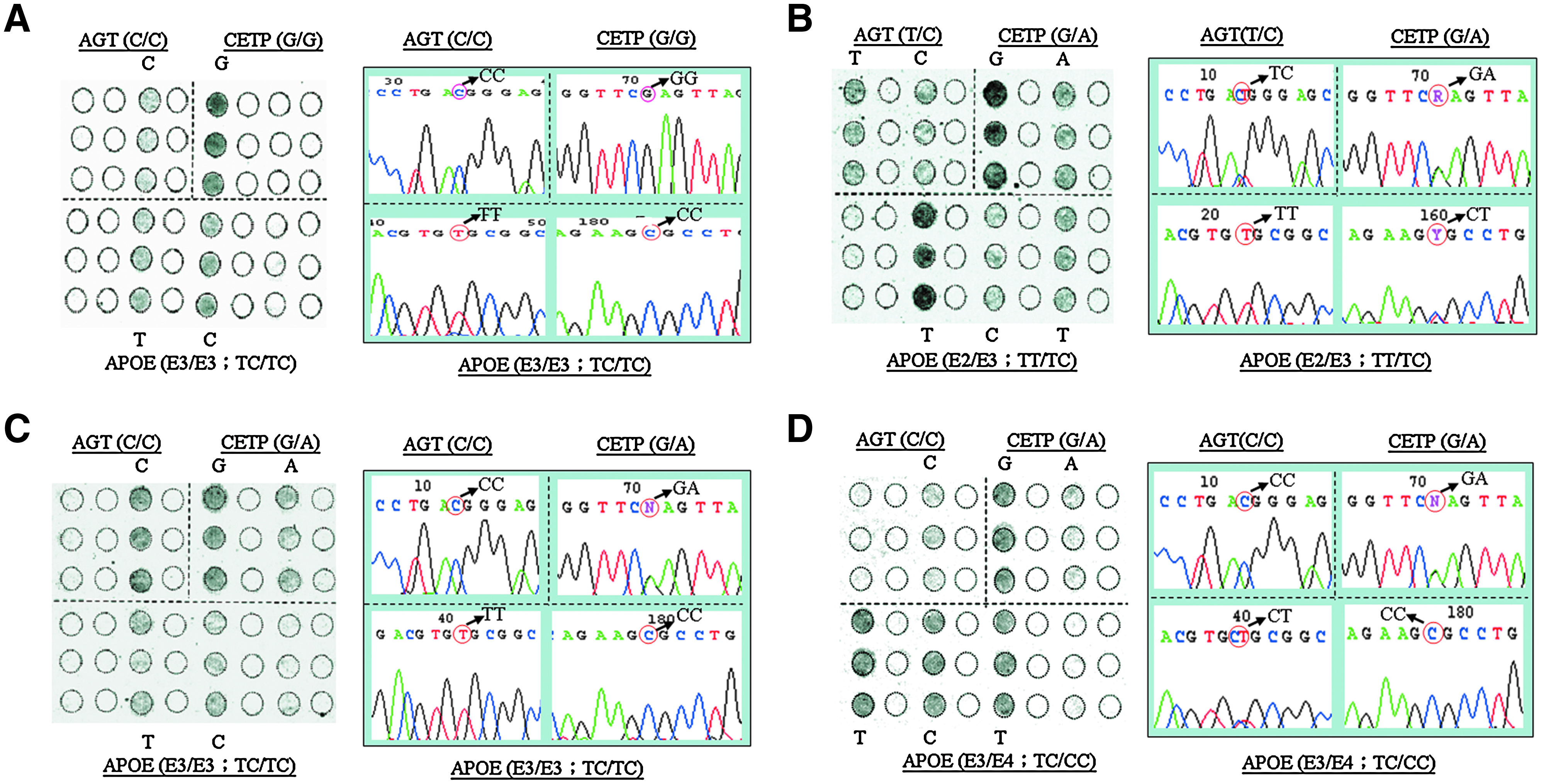
The SNP genotyping results by SNP chip and direct sequencing. The genotyping results of four SNPs in 20 individuals by the SNP chip were compared with the direct sequencing genotyping results. The genotypes analyzed by the SNP chip and direct sequencing are shown for case 1
To reassure the accuracy of genotyping detected in our SNP chip, direct sequencing of the SNP-containing regions were performed for each of the 20 donors. Our results indicate that the SNP typing by our chip matched exactly to that of direct sequencing for all 20 donors. Right panels in Figure 3 show the representative direct sequencing results in the corresponding SNP regions. These results altogether indicate that our SNP chip is a sensitive and accurate method to detect multiple SNPs in one assay.
Discussion
We report here the development of a chip-based method for simultaneous detection of multiple SNPs. All four chosen SNPs in three genes were routinely detected in 20 donors. SNPs detected by our SNP chip matched exactly with the direct sequencing results, indicating that this SNP chip is a sensitive and accurate tool for routine SNP screening.
Our SNP chip possesses several advantages over other SNP-typing technologies. First, it is cost-effective because it does not require intricate instruments and the costly fluorescent dyes, which imposes a heavy financial burden to research budgets and hinders their generalized usage in routine SNP typing. Second, our SNP chip can identify multiple disease-related SNPs simultaneously, a function that most SNP-typing technologies lack. Third, it is user-friendly as it uses a detection protocol analogous to dot blotting and does not require handling of sophisticated equipments. In other words, laboratory personnel with moderate training should find himself/herself proficient in performing this assay. These advantages altogether make this chip a robust and affordable method for routine SNP detection.
Few technical issues are noteworthy in designing the SNP chip. First, the probes blotted on a same chip should have similar melting temperatures. Similar melting temperatures aid in quick determination of the temperature that allow optimal hybridization between probes to labeled SNP-containing fragments while minimizing nonspecific binding of the fragments to the chip. We initially designed the ASO probes of the same length (20 bases) but with different melting temperatures; however, we found either weak signals with low background (too high hybridization temperature), or strong signals with high background (too low hybridization temperature), which made it difficult to discern true SNP from false-positive (data not shown). We solved this dilemma by redesigning a set of ASO probes of lengths between 22 and 28 bases that have similar melting temperatures. Our results showed that when hybridizations were performed at 48°C, our SNP chip generated SNP typing results that matched exactly to the direct sequencing results. Second, we examined the influence of the positioning of the SNP in the probes. We found that the sensitivity and accuracy of the SNP chip were best attained when the SNP sites are designed at either the 5′ or 3′ end but not in the middle of the probes (data not shown). These results highlight the importance of melting temperature and the positions of the SNP within the probes. These factors should be taken into consideration when designing and performing the SNP chip assay to ensure accurate and sensitive SNP typing.
SNP has been increasingly recognized in the studies of human diseases. It can aid in the identification of disease-causing genes in humans, especially after the completion of the HapMap project. In addition, the disease-associating SNPs can help to identify the individuals with high risk to the diseases so that preventive interventions can be taken even before the onset of clinical symptoms. Further, the use of SNPs in the field of “personalized medicine” has been discussed and purposed. As the biomedical community catalogs more SNPs within human genome and understands how SNPs associate with diseases, clinicians will be able to profile the genomic make-up of an individual based on his/her SNPs in the future. This profile, combined with the increasing knowledge on how genes interact with each other and with the environmental factors, can then help clinicians to predict drug responses, to make recommendations on diets/life styles, and thus design a tailor-made regimen for individual patients. A convenient and robust method to screen SNPs will expedite the realization of “personalized medicine.”
The usefulness of our SNP chip can be improved by two ways in the future. First, our chip can be expanded to accommodate more SNP probes that can screen susceptibilities to multiple diseases in one chip. To meet this end, the dimensions of the nylon membrane can be increased and the spacing between dots can be decreased. Thus, screening of SNPs by a single chip can provide prolific information to multiple diseases. Second, multiple SNPs that screen a polygenic disease can be constructed in a single chip. As many human diseases, such as cardiovascular diseases, are polygenic in etiology (Leshinsky-Silver et al., 2006), screening of multiple SNPs preferably in all the involved genes maybe needed to achieve the desired predictive power. In other words, different probes that screen each of the involved genes should provide more insightful information than SNPs. We screened SNPs in the genes of AGT, CETP, and APOE by our chip. These three genes have been shown to associate with cardiovascular diseases (Tall, 1995; Wilson et al., 1996; Boekholdt et al., 2005; Lanz et al., 2005; Borggreve et al., 2006; McCaskie et al., 2007; van Rijn et al., 2007); however, they likely do not cover the entire scope of the genes involved in the pathogenesis of cardiovascular diseases. Thus, our SNP can be expanded to accommodate more disease-associating SNPs in the future.
In conclusion, we described a cost-effective and user-friendly method that can screen multiple SNPs in a single chip. Our method is flexible and expandable and holds the potential for further refinement to meet the increasing need of SNP typing in research and clinical tasks.
Footnotes
Acknowledgments
This work was supported by the National Research Program for Genomic Medicine (NRPGM), National Science Council, Taipei, Taiwan (NSC97-3112-B-037-001, NSC96-2320-B-037-010-MY3), and the Department of Health (DOH99-TD-C-111-002). The National Sun Yat-Sen University-Kaohsiung Medical University Joint Research Center is also gratefully acknowledged.
Disclosure Statement
No financial conflicts of interest were declared.