




Abstract
Aim: A (CA)n repeat located in the 3′ UTR region of exon 29 of the NOS1 gene (encoding for neuronal nitric oxide synthase) has been shown to affect the size of mRNA. NOS1 mRNA is highly diverse, contributing to changes in transcript generation, degradation, processing, or subcellular targeting. In the present work, we analyzed allele frequencies of this (CA)n repeat in nine populations of the Mediterranean area and Middle Europe. We aimed at testing the presence of a north-south positive gradient of frequencies of ≤17 allele repeats, compatible with the hypothesis of positive selection suggested in two of our previous works, related to the past prevalence of malaria infection in Europe. Results: Results show significant negative correlations of latitude with frequencies of alleles S and genotypes S/S and S/L (p < 0.01). Conclusions: In conclusion, the north-south gradient of S alleles found in the present work would confirm our previous observation about the NOS1 gene, reinforcing the hypothesis of a selective action of malaria infection. This hypothesis is strengthened by the role of nitric oxide in the immunity system.
Introduction
N
A (CA)n repeat located in the 3′ UTR region of exon 29 of the NOS1 gene (encoding for nNOS) has been shown to affect the size of mRNA (Hall et al., 1994; Wang et al., 1999). NOS1 mRNA is highly diverse, contributing to changes in transcript generation, degradation, processing, or subcellular targeting (Grasemann et al., 2000).
In a recent work, we detected a high prevalence of alleles with 17 or less repeats in β-thalassemic carriers with regard to healthy controls in Corsica Island (Piras et al., 2009). Based on these results, we suggested that high frequencies of alleles with 16 and 17 repeats could be a consequence of past malarial endemicity. Moreover, an analysis of selective pressure in some Mediterranean populations (Piras et al., 2010), performed employing 17 STRs located in different genes including NOS1, revealed significant results for the (CA)n e29 repeat, in particular in the Morocco population, an area with high prevalence of endemic malaria and with actual risk (Hay et al., 2004). In this population, we found the highest frequencies of alleles ≤17 repeats with regard to other populations. From these results, we speculated a protective effect of alleles with ≤17 repeats against malaria infection, due to a selective pressure.
In the present work, we analyzed allele frequencies of populations already studied (Piras et al., 2010), another population of the Mediterranean area (Corsica), and two middle European populations (France and Germany). We aimed at testing the presence of a north-south positive gradient of frequencies of ≤17 allele repeats, compatible with hypothesis of positive selection, and stated the prevalence of past malaria infection correlated with climatic conditions (Pampana, 1969; Hay et al., 2004).
Materials and Methods
Samples from continental France (n = 73), Corsica island (France) (n = 97), and Germany (n = 48) were genotyped. Moreover, we reanalyzed data from our previous work (Piras et al., 2010) for Sardinia, (n = 90), Sicily (n = 47), Tuscany (n = 51) (Italy), Spain (n = 126), the Balearic Islands (Spain) (n = 62), and Morocco (n = 53) for a total of 647 individuals. The samples were constituted by unrelated individuals of both genders, born and resident in their countries of origin, as their relatives had been for at least three generations. Samples from Corsica (France) and the Balearic Islands (Spain) were separately analyzed from French and Spanish samples due to their genetic peculiarities (Calafell et al., 1996; Moral et al., 1996; Vona et al., 2003; Picornell et al., 2005; Falchi et al., 2006). The protocols and procedures used in this research were undertaken in compliance with the declaration of Helsinki. DNA was extracted with the standard phenol-chloroform technique, and polymerase chain reactions were carried out using fluorescent primers TGC AGG AAC TAG GCA CAA GC (Forward) and GAT CGA CAC ACT TGT GCA GG (reverse) in the following conditions: 1 min at 94°C, 1 min at 62°C, and 1 min at 72°C for 30 cycles, with a final extension at 72°C for 5 min. Polymerase chain reaction products were analyzed by an ABI 3730 DNA Analyzer (Applied Biosystems). Genotypes were identified using GENESCAN® and GENOTYPER® softwares (Applied Biosystems).
We tested Hardy-Weinberg equilibrium with a modified version of the Markov-chain random walk algorithm described in Guo and Thompson (1992). The analysis was performed with the software Arlequin 3.1 (Excoffier et al., 2005) using 10−5 steps of Markov-chain. p-Values were corrected for multiple testing at p < 0.00556 (5% level) (Rice, 1989). Allele, genotype frequencies, allelic richness, and gene diversity (Nei, 1987) were computed with Fstat 2.9.3.2 software (Goudet, 2002). To test differentiation among populations, we use RST (Slatkin, 1995), more suitable for markers that follow Stepwise Mutation Model as STRs markers (Ohta and Kimura, 1973). Computation was performed with Arlequin 3.1 using 10−4 permutations (Excoffier et al., 2005). p-Value was set at p < 0.00139 (5% level) after correction for multiple testing (Rice, 1989). Correlation among allele and genotype frequencies and geographical coordinates was evaluated with Pearson's correlation.
Results
Allele and genotype frequencies, gene diversity, allelic richness, and number of alleles are shown in Table 1. The alleles most represented were 17 and 18 repeats in all populations. Allele 17 ranges from 75.0% (Germany) to 97.2% (Morocco), whereas allele 18 ranges from 0.9% (Morocco) to 12.4% (Corsica). Gene diversity ranges from 0.056 (Morocco) to 0.397 (Balearic Islands). After Bonferroni correction (p < 0.00556 for 5% significance level), only the Spanish sample showed departure (5% level) from Hardy-Weinberg equilibrium due to a lower heterozygosity than expected. We grouped alleles into Shorts (S), including repeats with ≤17 units, and into Longs (L), including repeats with >17 units (Table 2), according to our previous work (Piras et al., 2009) and due to different functional role of alleles (Togashi et al., 1997; Grasemann et al., 2000). Frequencies of S alleles range from 97.2% in Morocco to 78.1% in France and Germany. The genotype most represented in all populations was S/S, ranging from 58.9% in France to 94.3% in Morocco. Heterozygous S/L ranged from 5.7% in Morocco to 38.4% for the French. Finally, genotype L/L has been detected only in five out of nine populations.
Alleles were named with number of repeats.
Differentiation and distances among populations were estimated with RST values, for a total of 36 pairwise comparisons. Results are shown in Table 3. After correction for multiple tests, 16.7% of pairwise comparisons were significant. The population that showed the highest number of significant pairwise comparisons was Continental France (50.0%).
p-Values after correction for multiple tests (Rice, 1989).
p < 0.00139.
p < 0.00028 and p < 0.00003 correspond to significance values at 1% and 0.1% levels after Bonferroni correction not found in evaluation of RST.
We evaluated the presence of correlation of allele and genotype frequencies with latitude and longitude employing Pearson's correlation. Results showed significant correlations of latitude with frequencies of alleles S, L and genotypes S/S and S/L. In particular, correlations with S and S/L were negative; and, consequently, correlations with L and S/L were positive (p < 0.01 in all cases). A geographical map with allele and genotype frequencies in populations analyzed is shown in Figure 1A and B.
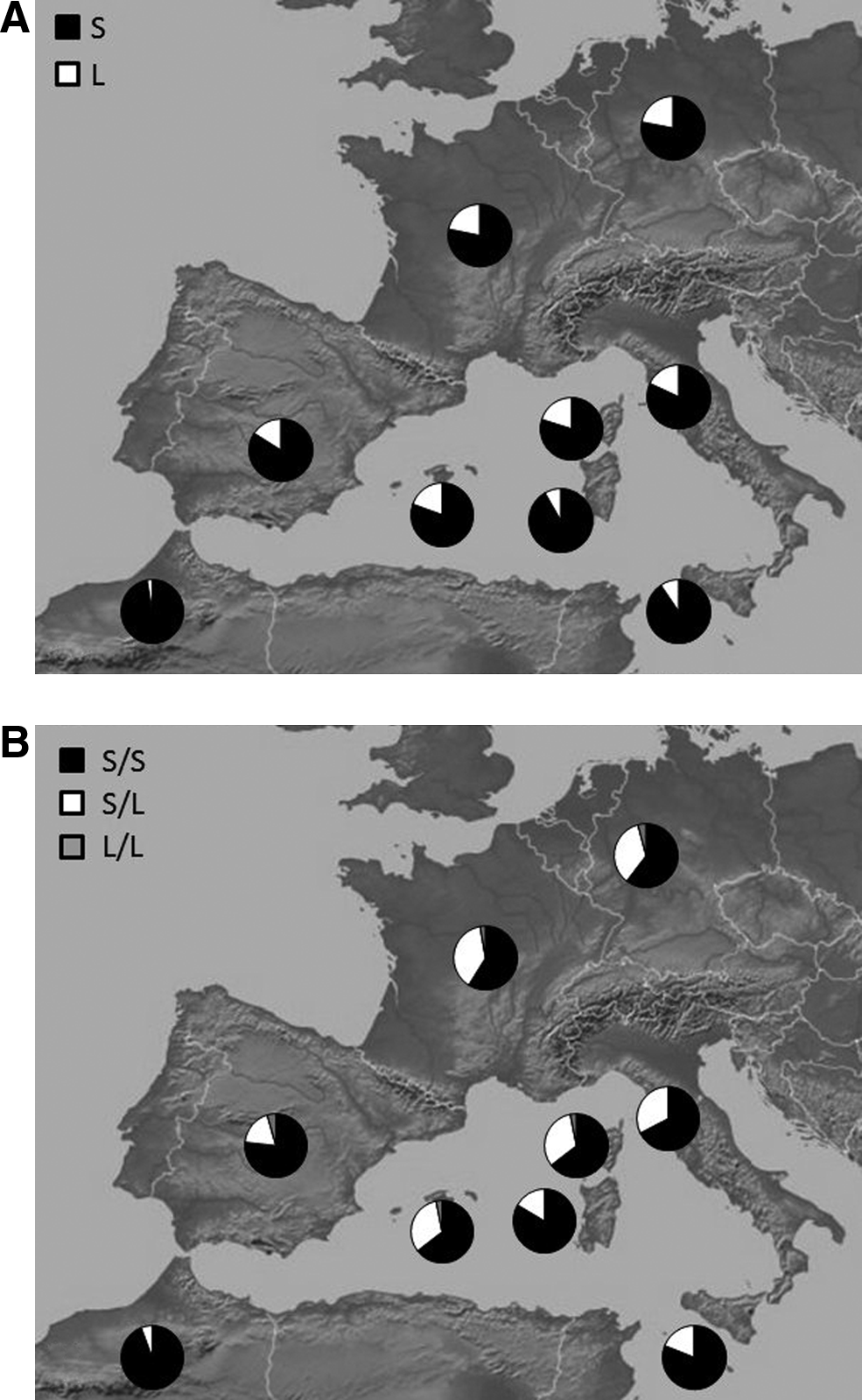
Allele and genotype frequencies in populations analyzed. (
Discussion
In this work, we analyze distribution of a (CA)n repeat located in exon 29 of NOS1 gene in nine populations of the Mediterranean and middle Europe area. In two recent works, we found suggestions of selective pressure exerted by malaria infection on this locus. First, we found high frequencies of alleles correlated with overproduction of NO (S alleles) in β-thalassemic carriers in Corsica (Piras et al., 2009); further, in an analysis of selective pressure in populations of the Mediterranean area performed on 17 STRs markers (Piras et al., 2010), we detected significant results for NOS1 (CA)n e29, in particular in Morocco, an area with high past malaria prevalence and actual high risk (Hay et al., 2004).
Results obtained in the present work seem to confirm these findings. A high correlation with latitude has been observed for the S allele and for genotype S/S, with the highest frequencies at the lowest latitudes (Fig. 1A and B). Considering past distribution of endemic malaria infection before eradication (Hay et al., 2004), we can observe in Europe an increasing incidence from northern to southern latitudes. Further, in some areas of Morocco, an actual risk of infection has been reported (Hay et al., 2004). Pooling these observations, we could hypothesize that selective pressure exerted by endemic malaria could have increased frequencies of S alleles and of S-carriers.
S alleles have been associated in previous works with NO over production and regulation of NOS2 gene expression (Togashi et al., 1997; Grasemann et al., 2000). NO has been shown to be involved in immunoregulation, and it is implicated in host nonspecific defense in infectious diseases such as malaria, toxoplasmosis, leishmaniosis, trypanosomosis, and schistosomosis (Rivero, 2006). Li et al. (2006) showed that NOS1-dependant NO production is required for clearance of Giardia lamblia intestinal parasite infection in mice. Several lines of evidence indicate that NO contributes to the host defense function through macrophages (Coleman, 2001).
In conclusion, the north-south gradient of S alleles found in the present work would confirm our previous observation about the NOS1 gene, reinforcing the hypothesis of a selective action of malaria and infection. This hypothesis is strengthened by the role of NO in the immune system.
Footnotes
Acknowledgment
This research was supported by the program INTERREG III (G.V. and L.V.).
Disclosure Statement
No competing financial interests exist.