




Abstract
The single-nucleotide polymorphisms (SNPs) of the Mina gene in animals are associated with the development of Th2-mediated diseases. However, there is no information whether the association occurs in humans. This case-control study aimed at examining the potential association of the SNP of the Mina gene with the development of asthma in Chinese Han children. The DNA genotypes and serum immunoglobulin E and interleukin-4 levels of 202 asthmatic patients and 191 nonasthmatic subjects were determined by matrix-assisted laser desorption ionization-time of flight mass spectrometry method and enzyme-linked immunosorbent assay, respectively. We found that the frequency of the T allele of rs4857304, but not rs832081, rs832078, rs9879532, and rs17374916, in the Mina gene in asthmatic patients was significantly higher than that of controls (p = 0.0199). Using a recessive model, we found that the percentage of patients with TT homozygous rs4857304 was significantly higher than that of controls (p = 0.0282, odds ratio=1.568, 95% confidence interval=1.048-2.346). Further, the mean levels of serum immunoglobulin E and interleukin-4 in the patients with TT genotype of rs4857304 were significantly higher than that of patients with the G allele (p = 0.000 and p = 0.03, respectively). Apparently, the T allele of rs4857304 of the Mina gene may be associated with increased risk for the development of asthma in Chinese Han children.
Introduction
The polygenic and phenotypic aberrations are the main immunological pathogenesis of atopy (Beltrani and Boguneiwicz, 2003). As a result, the increased expression levels of IL-4 and immunoglobulin E (IgE), a typical T helper type 2 (Th2) response, have been detected in atopic subjects. Th2-biased immune responses drive the pathogenic process of atopy, including asthma, which is one of the most common chronic airway disorders in children worldwide. The incidence and mortality of asthma are increasing, including in China (Chen, 2003). The prevalence of asthma in children reaches 4.63% in Southwest China (Chen, 2003) and about 80% of them are allergic responses to mite allergens. Many genetic factors are associated with the development of asthma (Li et al., 2008). However, the precise genetic factors contributing to the development of asthma in China are not fully understood.
Notably, the human Mina gene on chromosome 3q11.2 consists of 12 exons spanning 30 kb and encodes a Mina53 protein (Tsuneoka et al., 2002), which is mainly located in the nucleus and regulates the c-myc-related cell growth. C-myc is one of the most widely studied proto-oncogenes (Hoffman et al., 2002; Pelengaris et al., 2002). Previous studies of Mina53 centered on a variety of human cancer cells (Tsuneoka et al., 2004; Fukahori et al., 2007; Ishizaki et al., 2007). Recent studies have shown that Mina53 regulates the expression of IL-4 in T cells and is related to high susceptibility to Th2-driven diseases, such as asthma and leishmaniasis (Hemmers and Mowen, 2009; Okamoto et al., 2009). Interestingly, the effect of Mina53 on the expression of IL-4 is transcriptionally regulated by the regulatory polymorphisms of the Mina gene in mice (Okamoto et al., 2009). How the genetic variants of the Mina gene may regulate the susceptibility of humans, particularly for Chinese Han children, has never been explored.
We conducted a case-control study to investigate the association of single-nucleotide polymorphisms (SNPs) of the Mina gene with the development of atopic asthma in Chinese Han children in the southwest of China.
Materials and Methods
Study subjects
A total of 202 Chinese Han children with asthma were recruited from the outpatient service of the Children's Hospital of Chongqing Medical University from November 2009 to May 2010. Individual patients with asthma were diagnosed according to the guidelines of the global initiative for asthma (Bateman et al., 2008). The aeroallergens to which individual patients were allergic were determined by their typical medical history and positive skin prick tests (SPTs). Those patients displayed positive SPT to at least one allergen.
An additional 191 subjects who were inpatients in the same hospital were recruited as a control group. Patients who had nonserious bone fractures were recruited during the same period for controls. Individuals with asthmatic symptoms or history or who had other allergic diseases, such as rhinitis and eczema, or other symptoms or histories of pulmonary diseases or had first-degree relatives with a history of asthma or atopy were excluded. Those independent subjects who had cardiovascular or immunologic diseases were also excluded.
Written parental consent was obtained from each participating subject. The experimental protocol was approved by the Ethics Committees of the Children's Hospital of Chongqing Medical University.
Target polymorphisms of Mina gene in our study
The Tag SNPs were selected using the TAGGER program in Haploview version 4.0 software (Broad Institute of MIT and Harvard). The pairwise tagging approach (Barrett JC et al., 2005) with a cutoff r2 value of 0.8 was used based on the HapMap Phase II CHB (Han Chinese in Beijing, China) data. The SNPs with r2 value ≥0.8 were considered as Tag SNPs. In this study, six Tag SNPs of the Mina gene were selected. The rs accession numbers in the Mina gene were rs832081 (C/T), rs832078 (C/T), rs4857304 (G/T), rs9879532 (C/T), rs17374916 (A/G), and rs1532206 (A/G), respectively, which are available in the NCBI database (www.ncbi.nlm.nih.gov).
DNA extraction and genotyping
Peripheral venous blood samples (2 mL) were obtained from individual subjects and their genomic DNA was extracted using a DNA extraction kit, according to the manufacturer's instructions (Qiagen). Their serum samples were kept at −20°C for the measurement of serum total IgE and IL-4.
The specific primers for polymerase chain reaction (PCR) (Table 1) and single-base extension were designed using an assay designer software package (Sequenom). The SNP genotyping was performed by the massARRAY system using the matrix-assisted laser desorption ionization-time of flight mass spectrometry method (MALDI-TOF), according to the manufacturer's instructions (Sequenom). Briefly, the PCRs were performed in duplicate at 94°C for 15 min and subjected to 45 cycles of 94°C for 20 s, 56°C for 30 s, and 72°C for 1 min, followed by a final extension at 72°C for 3 min. After PCR amplification, the reactions were further extended at 37°C for 40 min and inactivated at 85°C for 5 min. After treatment with shrimp alkaline phosphatase, the single-base extension reactions were carried out. The genotyping of individual reactions was determined by MALDI-TOF. The genotype of individual samples was analyzed using the MassARRAY Typer software version 3.4 and monitored real time using the MassARRAY RT software version 3.0.0.4 (Sequenom).
Measurement of serum total IgE and IL-4
The levels of serum IgE and IL-4 were determined by enzyme-linked immunosorbent assay using human IgE kit, according to the manufacturer's instruction (BioCheck), and human IL-4 kit (4A Biotech). The detection limits of IL-4 were 7.8-500 pg/mL. All values were then transformed to log10 scale for analysis.
Skin prick tests
Individuals' responses to 13 common indoor inhalants (Solu prick SQ; ALK-Abello), namely Dermatophagoides pteronyssinus (Der p), Dermatophagoides farinae (Der f), Bromia tropicalis (Bro t), Canis familiaris, Felis domesticus, Blattella germanica, American cockroach, mould mix I, mould mix IV, Artemisia vulgaris, Ambrosia artemisifolia, Pollens IV, and Pollens I, were tested by SPT assays. Their responses to histamine (10 mg/mL) and saline were used as positive and negative controls, respectively. Individuals responding to any of the stimuli with a wheal diameter of 3 mm greater than the negative control were defined as positive (Kawasaki et al., 2008).
Statistical analysis
All polymorphisms were tested for Hardy-Weinberg equilibrium (HWE) using the χ2 test. A p-value of more than 0.001 was considered an HWE locus. Difference in the genotype and allele frequency between the patients and control groups was analyzed using the χ2 test. The genotype and allele frequencies were obtained by direct counting. The Haploview 4.0 (Kawasaki et al., 2008) was used for the development of the linkage disequilibrium (LD) blocks, and the D and r2 values were used to determine pairwise linkage (Barrett et al., 2005). Haplotypes were assembled using software, according to a standard expectation-maximization algorithm with a partition-ligation approach. Difference in the haplotype frequency between the patient and control groups was analyzed by the χ2 test.
Assuming a polymorphic site with two alleles a and b, homozygotes for the major allele (aa) and heterozygotes (ab) and homozygotes for the minor allele (bb) were coded to a continuous numeric variable (0, 1, and 2). A dominant model was used by comparing the genotypic group of aa + ab with bb, and the recessive model was defined as contrasting the genotypic groups of aa versus ab + bb (Yamada et al., 2002; Ma et al., 2005). All statistical analyses were performed using SPSS version 13.0 and Haploview 4.0 software. A p-value of <0.05 was considered statistically significant.
Results
Clinical characteristics of the patients and controls
To determine the potential association of the SNPs of the Mina gene with the susceptibility of Chinese Han children to asthma, a total of 202 asthmatic patients and 191 nonasthmatic subjects were recruited. There was no significant difference in the distribution of age and gender between the patients and controls (Table 2). Although there was no significant difference in the geometric mean levels of serum IgE between these two groups of children, the logarithmic mean levels of serum IgE in the patients were significantly higher than that of controls (p<0.0001).
p<0.0001 versus control.
IgE, immunoglobulin E.
Associations of the SNPs of the Mina gene with asthma
The genotype distributions of all six SNPs were in accordance with HWE in the patients and controls. Further analysis revealed that there was no significant difference in the distribution of genotype and allele frequencies of the rs17374916, rs832081, rs832078, rs9879532, and rs1532206 of the Mina gene between the patients and controls (Table 3). Notably, the frequency of TT genotype of the rs4857304 of the Mina gene in patients was higher, but not significant, than that of controls (p = 0.0587), whereas the frequency of T allele in patients was significantly higher than that of controls (p = 0.0199, odds ratio [OR]=1.477, 95% confidence interval [CI]=1.062-2.052). Apparently, the T allele in the rs4857304 of the Mina gene is associated with increased risk for the development of asthma in Chinese Han children.
p = 0.0199 versus control, odds ratio=1.477, 95% confidence interval=1.062-2.052.
A, adenine; C, cytosine; G, guanine; T, thymine.
Comparative analysis of the frequency of patients who were homozygous for the major allele with those who were homozygous and heterozygous for the minor allele
Because the rs832081 had only two genotypes (CC and CT), it was excluded from the analysis of dominant and recessive models. Using a recessive model, we found that the distribution of rs4857304 variants, but not the other four SNPs, was significantly different between the patients and controls. The frequency of children who were homozygous for the T major allele in asthmatic patients was significantly higher than that of controls (p = 0.0282 vs. control, OR=1.568, 95% CI=1.048-2.346). Using a dominant model, we found that there was no significant difference between the frequency of homozygous and heterozygous for the major alleles with heterozygous for the minor alleles of these five SNPs between the patients and controls.
Differences in the levels of serum IgE and IL-4 between the patients with the TT genotype and with the G allele of rs4857304
Next, we analyzed the levels of serum IgE and IL-4 in patients with the TT genotype and with the G allele of rs4857304. We found that the mean levels of serum total IgE and IL-4 in the patients with TT genotype were higher than that of patients with the G allele (p = 0.000 and p = 0.03, respectively; Table 4). Therefore, the TT genotype of the rs4857304 in the Mina gene was associated with higher levels of serum IgE and IL-4 in asthmatic patients.
IL-4, interleukin-4.
LD blocks and haplotype frequencies for the Mina polymorphisms in patients with asthma and controls
Further LD analysis revealed that four of the six SNPs we studied in the Mina displayed two haplotype blocks (with D=1.0; Fig. 1). The rs832078 and rs1532206 were located in block 1, whereas the rs17374916 and rs9879532 were in block 2. Further haplotype analysis showed no statistically significant difference between the asthmatic patients and controls among these haplotype blocks. Major haplotypes showing over 5% frequency in the patients and control are presented in Table 5.
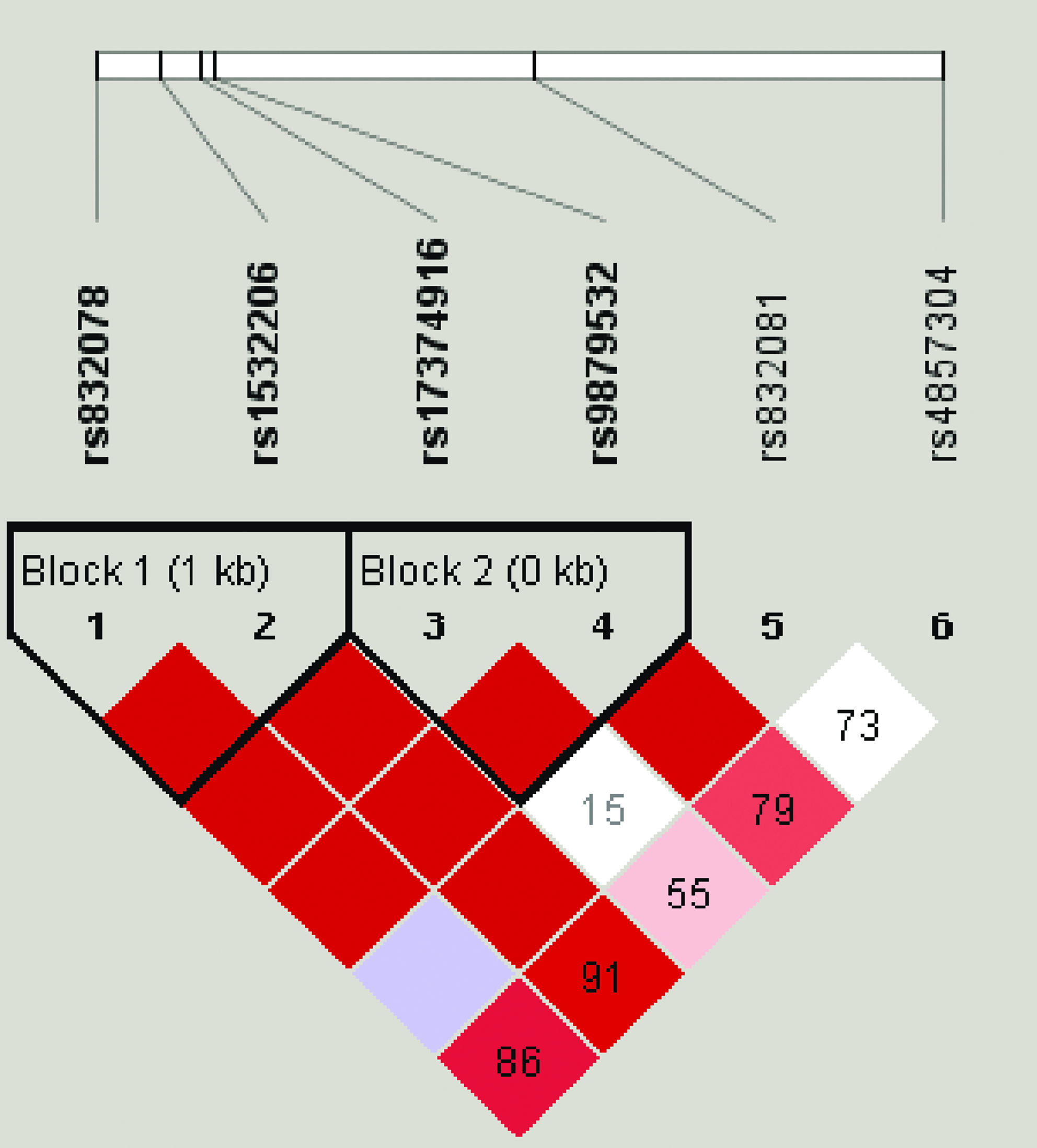
The distributions and locations of the polymorphisms in the chromosomal region. The names of rs numbers corresponding to their positions are indicated on top. The linkage disequilibrium blocks are defined by bold black lines. The different colors of the plots represent the varying degree of linkage. Red: r2=1; intermediate color: 0<r2<1; white: r2=0. Color images available online at www.liebertonline.com/gtmb.
Discussions
Previous studies on the Mina gene products including Mina53 and its mRNA have concentrated on human cancers (Pelengaris et al., 2002; Fukahori et al., 2007; Ishizaki et al., 2007). Notably, the polymorphisms of the Mina gene are associated with the regulation of Mina53 expression, and high levels of Mina53 are associated with low levels of IL-4 (Hemmers and Mowen, 2009; Okamoto et al., 2009). Given that IL-4 is a critical factor, contributing to the pathogenic process of asthma, we studied the potential association of the SNPs of the Mina gene with the development of asthma in Chinese Han children. We found that the distribution of the SNPs of rs4857304, but not rs832081, rs832078, rs9879532, and rs17374916, in the Mina gene was significantly different between asthmatic patients and control subjects. Further, the T allele frequency of the rs4857304 in asthmatic patients was significantly higher than that of controls (p = 0.0199, OR=1.477, 95% CI=1.062-2.052). More importantly, the levels of serum IgE and IL-4 in patients with TT genotype were significantly higher than that of those with G allele (p = 0.000), analyzed using a recessive model. These data suggest that the T allele of rs4857304 of the Mina gene is associated with increased risk for the development of asthma in Chinese Han children. Apparently, the T allele of rs4857304 of the Mina gene may be used as a potential biomarker for the diagnosis of asthma.
Our findings extend previous observations that the mutations on chromosomes 3q21 (Haagerup et al., 2002), 5q31-q33 (Haagerup et al., 2002), and 7p14-p15 (Laitinen et al., 2001) and some SNPs in the IL-4, IL-5, and IL-13 genes are associated with increased susceptibility of individuals to asthma in different populations (Shirakawa et al., 2000; Kasaian and Miller, 2008). These, together with different T-cell populations, such as Th17 (Schmidt-Weber et al., 2007), Treg (Robinson, 2009), and Th9 (Soroosh and Doherty, 2009), support the notion that many genetic factors contribute to the development of asthma, which is regulated by several types of T cells. Given that the TT genotype of rs4857304 of the Mina gene was associated with increased levels of serum IgE and IL-4 in asthmatic patients, it is possible that this SNP may upregulate the expression of IL-4 and promote allergen-specific Th2-dependent B-cell activation and IgE production in those patients. Conceivably, the TT genotype of rs4857304 of the Mina gene may be used as a biomarker for the predisposition of asthma in Chinese Han Children.
A previous study of a mouse model reveals that the SNPs in the first exon of the Mina gene regulate the expression of IL-4 (Okamoto et al., 2009). In this study, we obtained these SNPs located in introns and we found that two constructed LD blocks did not form a risk haplotype for the development of asthma in this population. We recognized that our study had a limitation of a relative small size of sample in one ethnic group. We are interested in further determining the association of the T allele of rs4857304 of the Mina gene with increased risk for the development of asthma in a bigger population with multiple ethnic backgrounds and examining the possible mechanisms by which the T allele of rs4857304 of the Mina gene regulates the expression of Mina53 and asthma-related cytokines in Chinese.
In summary, our data suggest that the T allele of rs4857304 of the Mina gene is associated with an increased risk for the development of asthma and the TT genotype of rs4857304 of the Mina gene in asthmatic patients is related to high levels of serum IgE and IL-4 in Chinese Han children. If further confirmed, our findings suggest that the T allele and TT genotype may be used as a genetic marker for the predisposition of asthma in Chinese Han children.
Footnotes
Disclosure Statement
All authors of this article have no conflicts of interest including financial and personal relationships and no potential conflicts with each other, other individuals, and organizations.