




Abstract
Carboxylesterase 1 (CES1) is involved in the metabolic activation of a variety of prodrugs into active derivatives and plays an important role in pharmacokinetics and pharmacodynamics. A single-nucleotide polymorphism, A(-816)C, of the CES1A2 gene has been shown to enhance transcription efficiency and increase enzyme activity. The aim of this study was to develop an easy method to detect this polymorphism. For this we used the mutation-sensitive molecular switch method to investigate the polymorphism distribution in the Chinese Han and Yao populations. The method was well validated by direct sequencing. In 204 Han individuals, the percentages of the distribution of CES1A2 A(-816)C genotypes are AA 58.33% (n=119), AC 35.78% (n=73), and CC 5.88% (n=12). The genotype frequencies are AA 47.76% (n=96), AC 42.79% (n=86), and CC 9.45% (n=19) in 201 Yaos. The frequency of the mutant C allele in the Yao population is significantly higher than that in the Han population (30.85% vs. 23.77%, p=0.0239). The method can be easily used for the detection of the single-nucleotide polymorphism in CES1A2, and we found that there is a marked difference in mutant C allele between Chinese Han and Yao populations, suggesting individual and ethnic differences of CES1 drug metabolism between these two populations.
Introduction
A number of variants have been reported, even though their functional consequences remain unknown (Marsh et al., 2004). A report (Geshi et al., 2005) suggested that the single-nucleotide polymorphism (SNP) in the promoter region of CES1A2, A(-816)C, was associated with increased transcription efficiency and enhanced antihypertensive response to the ACE inhibitor prodrug, Imidapril. The CES1A2 promoter region was sequenced in 105 Japanese hypertensive subjects; altogether, 10 SNPs and 1 insertion/deletion were identified, among which 7 SNPs and 1 insertion/deletion residing between -62 and -32 were in almost complete linkage disequilibrium. The minor and major haplotypes had allele frequencies of 22% and 74%, respectively. The minor haplotype possessed two putative Sp1-binding sites, whereas the major haplotype did not have any Sp1-binding site. The minor haplotype had a higher transcription rate and Sp1 binding activities than the major haplotype. The A(-816)C polymorphism was in high linkage disequilibrium with these haplotypes (D′=0.92, r2=0.85) and well agreed with the efficacy of Imidapril medication. These results suggest that the Sp1-binding site variation in the CES1A2 promoter is functional and the A(-816)C polymorphism can serve as a marker for functional polymorphisms for pharmacogenetic studies of CES1-activated drugs (Yoshimura et al., 2008).
In the present study, we established a simple and economical assay that is available to any laboratory and first investigated the polymorphism distribution in the Chinese Han and Yao populations.
Material and Methods
Subjects
A total of 405 unrelated Chinese healthy subjects, including 204 Chinese Han individuals in Jiangsu Province and 201 Chinese Yao subjects in Yunnan Province, were recruited from the first affiliated hospital of Soochow University and the First Affiliated Hospital of Kunming Medical College, respectively. We collected 1 mL venous blood to extract DNA. The study protocol was conducted in accordance with the Declaration of Helsinki and approved by the Ethics Committee of the First Affiliated Hospital of Soochow University.
Genotyping
Primer Premier 5 was used to design the primers for CES1A2 A(-816)C (rs3785161). Allele-specific primers targeting wild type and mutant type and a common reverse primer were designed with 3′ terminal phosphorothioate (PS) modification. Sequences for the primers were mutational forward primer 5′-CACATTGCCTTGACATCAPSCPSC-3′, normal forward primer 5′-CACATTGCCTTGACATCAPSCPSA-3′, and common reverse primer 5′-TACCCTCTTTCATCAAACCAPSAPST-3′.
DNA was extracted using the Wizard Genomic DNA purification kit (Promega). Amplification by polymerase chain reaction (PCR) of the genomic DNA of each sample includes two reactions: one with normal and common primers (normal specific), and the other with mutational and common primers (mutant specific). PCR was performed in a total volume of 25 μL. Each reaction mixture contained 20 ng of genomic DNA, 2.5 μL of 10×Pfu buffer with MgSO4, 0.2 μM dNTP, 0.4 μM of each primer, and 0.375 U Pfu polymerase. Conditions for PCR were an initial period of 3 min at 95°C, followed by five cycles of 30 s at 94°C, 30 s at 65°C, and 50 s at 72°C, then 10 cycles of 30 s at 94°C, 30 s at 60°C, and 50 s at 72°C, next 25 cycles of 30 s at 94°C, 30 s at 57°C, and 50 s at 72°C, and a final extension time of 10 min at 72°C. PCR amplification products were separated on 1.5% agarose gel containing GelRed and visualized under ultraviolet illumination.
Direct sequencing
To validate the method, detection of the SNP was carried out by direct sequencing of the PCR products with forward primer 5′-CAGCAGCTTGTAAATGACAG-3′ and reverse primer 5′-TACCCTCTTTCATCAAACCAPSAPST-3′. The PCR was carried out in a 50 μL reaction mixture containing 40 ng of genomic DNA, 5 μL of 10×Pfu buffer with MgSO4, 0.4 μM dNTP, 0.8 μM of each primer, and 0.75 U Pfu polymerase. Direct sequencing of the PCR products was performed by the BioSune Biology Company.
Statistical analysis
Genotype and allele frequencies were directly calculated, and Hardy-Weinberg equilibrium was subsequently tested using the chi-square test. Significant difference in frequency distribution was assessed using the chi-square test. p-Value less than 0.05 was considered statistically significant.
Results
As shown in Figure 1, the mutational homozygote, heterozygote, and wild-type homozygote of CES1A2 A(-816)C were amplified, respectively. They were ascertained by direct sequencing; the mutated point is indicated by an arrow. Twenty samples were selected to direct sequence and there is perfect correspondence between the two methods in the 20 samples.
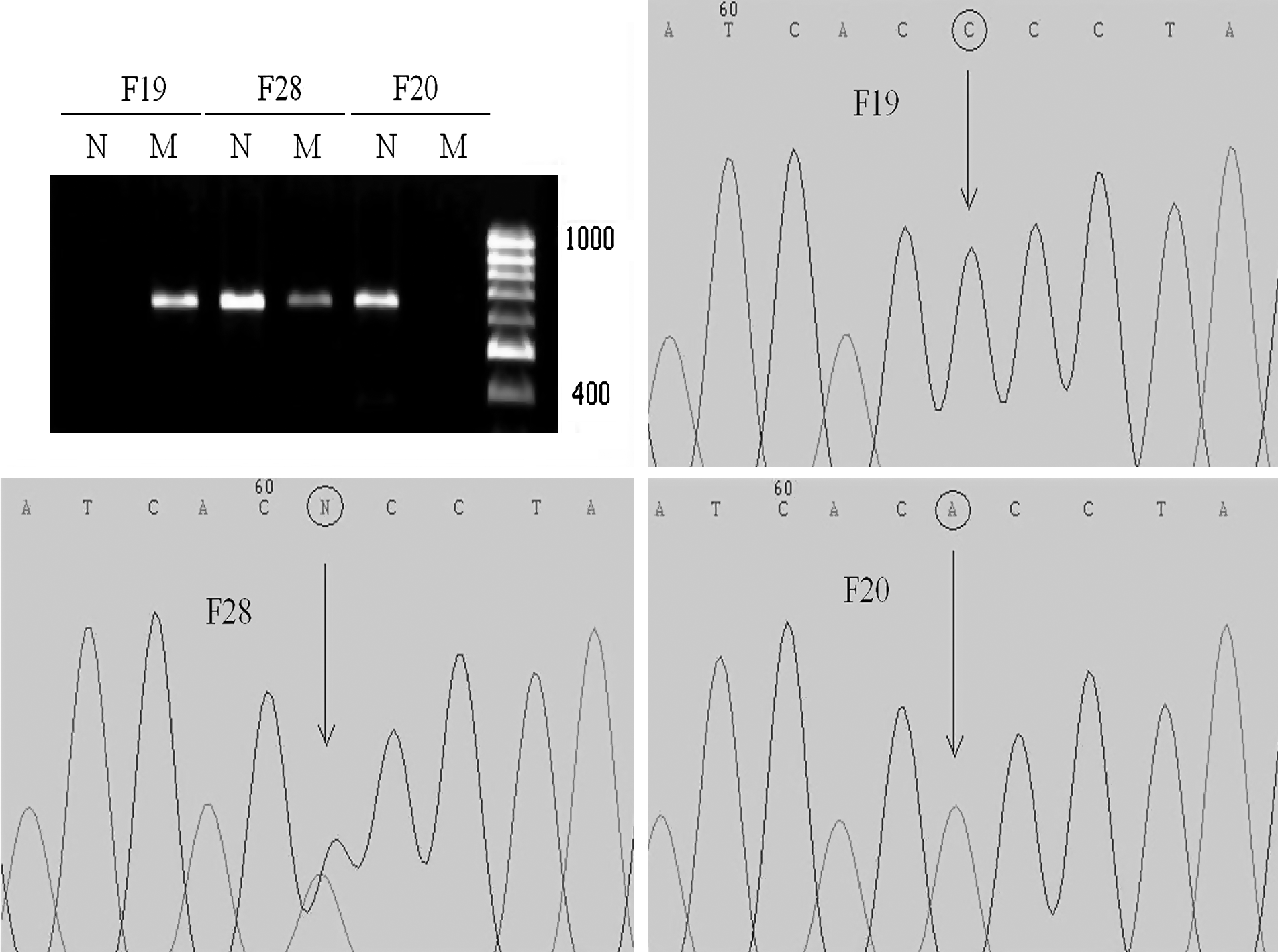
GelRed-stained 1.5% agarose gel of proofreading polymerase chain reaction products and the direct-sequencing maps. In each sample pair, the N reaction is on the left and M reaction is on the right. F19 is homozygous mutant, F20 is homozygous normal, and F28 is heterozygous, and they were ascertained by direct sequencing. Mutated point is indicated by an arrow. N, normal specific; M, mutant specific.
The frequencies of genotypes and alleles in the two ethnic populations are summarized in Table 1. The genotype distributions are 58.33% for AA genotype (n=119), 35.78% for AC genotype (n=73), and 5.88% for CC genotype (n=12) in the Han population. The Yao population are AA 47.76% (n=96), AC 42.79% (n=86), and CC 9.45% (n=19). The allelic frequencies of the A and C alleles are 76.23% and 23.77% in the Han population and 69.15% and 30.85% in the Yao population, respectively. They are in Hardy-Weinberg equilibrium (p=0.8561 in Hans, p=0.9672 in Yaos).
p=0.0239, compared with Chinese Han population by chi-square test.
The allelic frequencies of CES1A2 A(-816)C are significantly different between the Han and Yao populations. The frequency of the C allele in the Yao population is significantly higher than that in the Han population (30.85% vs. 23.77%, p=0.0239).
Discussion
The mutation-sensitive molecular switch was established in Yang et al. (2005). This method allows for the direct analysis of any locus of interest and is thus generally applicable to any inherited disease provided sufficient sequence data are available. The 3' terminal PS-modified primers in combination with exo+ polymerase such as Pfu constituted a mutation-sensitive molecular on/off switch, which allows perfectly matched primers to be extended but not mismatched primers. So we can discriminate the genotype according to the existence of a corresponding band.
The compatibility of the mutation-sensitive molecular switch with traditional gel electrophoresis in SNP analysis makes this assay attractive. The assay only needs normal instruments and available reagents. We tried to use this method to establish polymorphism analysis of the CES1A2 gene. Our result (Fig. 1) demonstrated that we could easily discriminate the genotypes from the picture of gel electrophoresis, and the genotypes were well validated by direct sequencing. In the present experiments, we first designed allele-specific primers and established a rapid, cost-effective, and easy-to-use method to detect CES1A2 A(-816)C.
The distribution of A(-816)C polymorphism in CES1A2 was evaluated in a sample of 405 healthy Chinese subjects, representative of the Han population in Jiangsu Province and the Yao population in Yunnan Province. The results show (Table 1) that the frequency of mutant C allele in the Yao population is significantly higher than that in the Han population (30.85% vs. 23.77%, p=0.0239). The results indicate that there is ethnic difference for CES1A2 A(-816)C, and the difference potentially influences the efficacy of CES1-dependent drugs. It was reported that in the group of Japanese hypertensive patients, the A(-816)C SNP genotype distributions were 61.0% for the AA genotype (n=64), 28.6% for the AC genotype (n=30), and 10.5% for the CC genotype (n=11). The frequencies of the A and C alleles were 75.2% and 24.8%, respectively. In the present study, the frequency of CC genotype for Japanese hypertensive patients was higher than in the Han population and the frequency of the mutant C allele was similar to the values in the Han population (24.76% vs. 23.77%), but relatively lower than in the Yao population (24.76% vs. 30.85%). Whether the differences arise from ethnicity or hypertension need to be further investigated. However, the results indicate that the difference in the different groups might potentially affect the efficacy of the CES1-dependent drugs.
CES1 is thought to mainly function in drug metabolism and detoxification of harmful chemicals. Metabolic problems lead to numerous failures in clinical therapy. Variations in drug-metabolizing enzyme genes can contribute to adverse drug reaction and increased sensitivity/resistance to drug treatment. Our results show that there is a difference in the mutant C allele between the two ethnicities. The SNP may serve as a good candidate for investigating the interindividual and interethnic differences in the efficacy of CES1 metabolism of drugs, such as Imidapril, Oseltamivir, Clopidogrel, and CPT-11 (Shi et al., 2006; Tang et al., 2006; Tanimoto et al., 2007; Yang et al., 2009). The SNP was associated with increased transcription efficiency and enhanced antihypertensive response to the ACE inhibitor prodrug, Imidapril. Whether this SNP affects the therapeutic efficacy of other drugs must be further studied.
In summary, we established a simple and cost-effective method to detect the SNP and observed that the frequency of the A(-816)C SNP in CES1A2 gene is different between the Chinese Han and Yao populations. These results suggest that disease susceptibilities and drug responses associated with enzyme activities of CES1 may vary in the diverse ethnic populations in mainland China.
Footnotes
Acknowledgment
This study was supported by JSWSF (clinical pharmacy research grant number: P200959).
Disclosure Statement
No competing financial interests exist.