




Abstract
The KRAS pathway and studies evaluating KRAS as a prognostic marker in colorectal cancer are discussed along with advances in KRAS gene mutation testing. Highly sensitive real-time polymerase chain reaction (PCR) methods were developed for this purpose. We examined the applicability of direct sequencing and two real-time PCR methods in the diagnosis of KRAS mutations. We used real-time PCR and direct sequencing-based methods to determine applicability of these KRAS mutation tests in 64 colorectal cancers. The two DNA samples found to be mutation positive by real-time PCR were analyzed again after diluting 100-fold. The results were the same. When we applied the same strategy for the direct sequencing, even a 10-fold dilution did not show the mutations. Therefore, we found that sequencing may not be informative when there are only a few mutant cells in the tumor. KRAS mutation screening on formalin-fixed, paraffin-embedded DNA is very efficient with real-time PCR methods in comparison to direct sequencing. The development and adoption of guidelines for KRAS mutation testing are crucial for success.
Introduction
I
Activating mutations in members of the Ras family either inhibit the GTPase activity of the enzyme or render it insensitive to activation by GTPase activating proteins (GAPs), resulting in accumulation of the active GTP-bound conformation of the enzyme (Scheffzek et al., 1997; Schubbert et al., 2007).
Materials and Methods
KRAS mutation testing was performed in 64 adenocarcinomas of the colon (n=47) and the rectum (n=17). The mean age was 57 years (24-85 years) and the series included 30 (47%) women. Presence of at least 15% tumor cells in the tissue was verified by a pathologist. KRAS mutation testing was carried out as part of standard care, all patients provided informed consent for testing, and the study was conducted according to the Helsinki declaration. Our laboratory has carried out required validation testing and received accreditation by Ludwig Maximilian University, Germany, for KRAS testing.
DNA isolation
DNA was extracted from formalin-fixed, paraffin-embedded tumor tissue using the Qiamp DNA FFPE tissue kit (Qiagen, Hilsen, Germany) according to the manufacturer's recommendations. Concentration (ng/μL) and absorbance (A260/280 ratio) were measured in a UV spectrophotometer (BioPhotometer; Eppendorf, Hamburg, Germany). After the isolation of genomic DNA, 50 ng/μL DNA was used for PCRs.
Dideoxy-sequencing for KRAS exon 2 (coding exon 1)
Exon 2 of the KRAS was amplified from isolated genomic DNA using the Fermentas Dreamtaq DNA polymerase (Fermentas GmbH, St. Leon-Rot, Germany). PCR products (300 bp) were always visualized on agarose gels and archived prior to sequencing. Forward and reverse sequencing was performed in a 15 μL reaction mixture with the Big Dye Terminator kit v.3.1 (Applied Biosystems, Foster City, CA). Sequences were visualized upon capillary electrophoresis in an ABI3130xl genetic analyzer, initially called with the Sequencing Analysis software and further analyzed with the SeqScape software v2.5 (Applied Biosystems).
Therascreen KRAS kit (DxS-KRAS)
This system (DxS Ltd., Manchester, United Kingdom) uses Scorpion primers specifically designed to recognize the mutated sites (amplification refractory mutation screening) with high efficiency and specificity. The DxS-KRAS kit has been approved as an IVD device by the European Medicines Agency for the identification and typing of the seven most common KRAS mutations. Samples were run in 25 μL reaction mixtures in the LightCycler 480 real-time PCR system described earlier. The threshold for analysis was manually set in the middle of the DNA control amplification curve, separately for each run, according to the manufacturer's instructions, and dCt values were obtained for (mutant target curve Ct)−(DNA control curve Ct).
Entrogen KRAS mutation analysis kit
This system (Entrogen, Tarzana, CA) uses allele-specific primers specifically designed to recognize the mutant variants of the gene with high efficiency and specificity. The assay also amplifies an endogenous control gene to ensure that sufficient amount of DNA is available for amplification. The Entrogen KRAS mutation analysis kit has been approved as an IVD device and used for typing of the 11 most common KRAS mutations in codons 12, 13, and 61. Samples were run in 25 μL reaction mixtures in the Corbett RT-3000 real-time PCR system described earlier. The threshold for analysis was manually set in the middle of the DNA control amplification curve, separately for each run, according to the manufacturer's instructions. Template controls and the standards provided by the manufacturer were used in each run.
Results
KRAS mutations were identified in 38 of 64 (59%) CRCs. The mutation spectrum revealed the expected codon 12 and 13 mutations, with p.Gly12Asp, p.Gly13Asp, and p.Gly12Ala being the most commonly found as shown in Table 1. There was no mutation in codon 61. In all samples, amplification of single PCR targets for sequencing was successful. However, sequencing was not always informative in two cases (Fig. 1). Entrogen was mainly employed here to validate the results obtained with DxS in samples wherein sequencing was noninformative (Fig. 2).

Result of the direct sequencing of KRAS. Exon 2 c.38G>A corresponding to the p.Gly13Asp mutation confirmed with both real-time polymerase chain reaction (PCR) methods. When the amount of DNA was reduced to 10 ng, unlike the real-time PCR methods, direct sequencing was not able to detect the mutation.
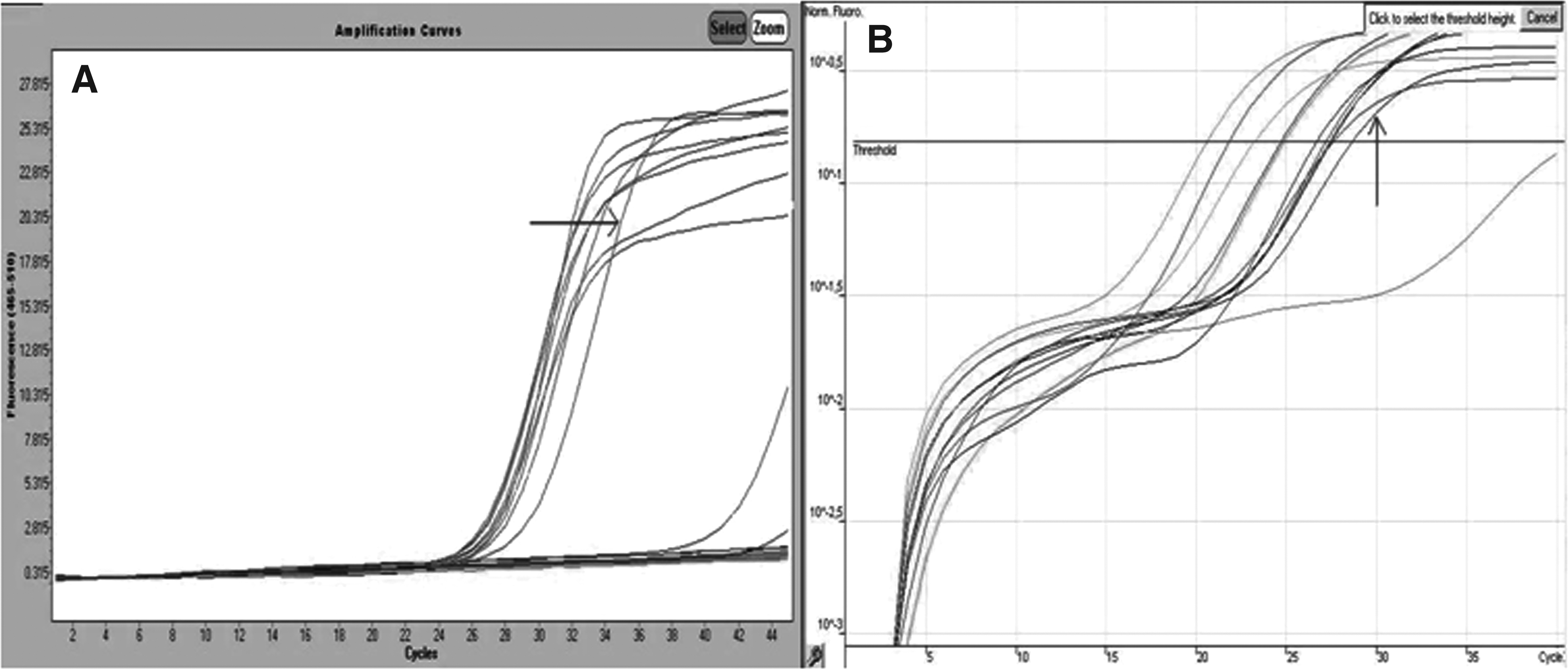
Result of the real-time PCR for KRAS. Exon 2 c.38G>A corresponding to the p.Gly13Asp mutation:
Discussion
The discovery of activating mutations in the KRAS has enabled the rapid adoption of individualized treatment regimens for mCRC patients. The results of this study suggest that KRAS mutation testing by commercial kits is accurate and generally in close agreement with results of direct sequencing. Direct sequencing remains the gold standard, but the procedure is relatively complicated and sensitivity is lower than that of other methods. It is recommended that the lower detection limit of mutant signal should be set at 25%-30% of tumor cells for dideoxy sequencing (van Krieken et al., 2008). Pyrosequencing has been shown to have a higher sensitivity than dideoxy sequencing (Ogino et al., 2003). However, it may be difficult for pyrosequencer use to widely spread because of the relatively shorter reading length of nucleotides (up to 40-50 bp). The sensitivity of each assay also depends on the quality of the sample examined. Many clinical studies relied on FFPE samples. In such cases, the DNA might be chemically affected by fixation, so that the reaction efficiency is influenced by fixation conditions. However, we detected mutant allele diluted 100-fold with wild-type allele for real-time PCRs. In two cases, we were not able to detect mutant allele diluted 10-fold with wild-type allele for direct sequencing (Table 2). Consistent with our results, according to some studies (Kotoula et al., 2009; Kobunai et al., 2010; Laosinchai-Wolf et al., 2011), KRAS mutation detection with Q-PCR methods appears as the ideal approach. Because these methods are easily applicable and highly efficient, it is expected that their use will dramatically spread.
ARMS, amplification refractory mutation screening; PCR, polymerase chain reaction.
As a result, a number of tests for KRAS mutations are available, the majority of which are laboratory based. Direct sequencing analysis is capable of detecting all possible mutations in exons 2 and 3 of KRAS but may lack sensitivity compared with other methods. However, we found that KRAS mutation screening with both real-time PCR tests is more efficient than direct sequencing in identifying mutations in FFPE DNA samples. The development and adoption of guidelines for KRAS mutation testing are crucial for success.
Footnotes
Acknowledgment
The authors thank Bahar Kiremitci for her great technical assistance.
Disclosure Statement
None of the authors has possible conflicts of interest, sources of financial support, corporate involvement, patent holdings, etc.