




Abstract
Cytochrome c oxidase encoded by multiple mitochondrial genes (COXI, COXII, and COXIII) and nuclear genes is an essential component of the mitochondrial respiratory chain that catalyzes the reduction of molecular oxygen by reduced cytochrome c. Subunits COXI and COXII of cytochrome c oxidase are known to play the most essential role in proton pumping and electron transfer. In this study we screened the somatic mitochondrial COXI gene of infertile men suffering from asthenospermia (n=34) in comparison to normozoospermic infertile men (n=32) and fertile men (n=100) from the Tunisian population. A novel homoplasmic missense mitochondrial mutation (m.6375A>G) was found in 5 asthenospermic patients (14%) but not in any of normozoospermic infertile men and fertile men. This mutation substituting the isoleucine at position 158 to valine in a highly conserved amino acid induces a reduction of the hydropathy index (from +1.920 to +0.239) and a decrease of the protein 3D structure number (from 50 to 26) as shown by PolyPhen bioinformatic program.
Introduction
Reduced sperm motility or asthenospermia is one of the major causes of male infertility just next to reduced count or oligospermia (Gavella and Lipovac, 1992; Cummins et al., 1994; Kao et al., 1995; Ankel-Simons and Cummins, 1996; Lestienne et al., 1997; Kao et al., 1998; Ruiz-Pesini et al., 2000; St. John et al., 2000; Spiropoulos et al., 2002a). In the female genital tract, sperms travel through mucus-filled cervix to reach up to the site of fertilization by active flagellar movements, the energy for which is provided by sperm mitochondria (Folgero et al., 1993; St. John et al., 2000).
In mammals, mitochondria are localized in the midpiece of spermatozoa, and deliver adenosine triphosphate (ATP), which is mainly used to give flagellar propulsion. They contain about 100 copies of a covalently closed 16,569-base-pair DNA molecule (Anderson et al., 1981) encoding for 13 out of the 83 subunits of the respiratory chain complex (Anderson et al., 1981). Human mtDNA is compact (intronless) and lacks the protection of histones or DNA-binding proteins (Shoffner and Wallace, 1994). It replicates rapidly without efficient proofreading and DNA repair mechanisms (Fukunaga and Yielding, 1979; Yakes and van Houton, 1997), and thus has a mutation rate 10-100 times higher than that of nuclear DNA. Also, lack of an efficient repair system in mitochondria (Bogenhagen, 1999) and abnormal mitochondrial metabolism may accelerate the rate of mitochondrial DNA mutation (Lightowlers et al., 1997).
Cytochrome c oxidase (or complex IV) is an essential component of the respiratory chain that catalyzes the reduction of molecular oxygen by reduced cytochrome c. It is composed of 13 subunits (Bohm et al., 2006). The 3 largest subunits are encoded by mtDNA (COXI, COXII, and COXIII), and the remaining 10 subunits are coded by nuclear DNA and are thought to modify or stabilize the complex (Shoubridge et al., 2001). Although the core-forming subunits COXI and COXII contain the prosthetic groups and are known to play the most essential role in proton pumping and electron transfer, the function of COXIII remains unknown, but it has been suggested that it may play a structural or regulatory role (Brunori et al., 1987; Haltia et al., 1989).
In this study, the mtDNA sequencing of COXI gene revealed a novel missense homoplasmic mutation at nucleotide 6375 (m.6375A>G) in 14% of Tunisian asthenospermic infertile patients but not in normospermic and in fertile men. This A-to-G transition converted a highly conserved isoleucine at position 158 in the polypeptide to valine and the in silico analysis using the bioinformatics software “PolyPhen” showed that this mutation induces a reduction of the hydropathy index from +1.920 to +0.239, and of the protein 3D structure number from 50 to 26.
Materials and Methods
Patients and samples
The genetic analysis was performed on DNA extracted from blood samples of 66 Tunisian male partners of infertile couples who were referred to our Lab (at Faculty of Medicine, Sfax, Tunisia) for an andrological investigation. They were assessed for semen analysis according to World Health Organization recommendations (World Health Organization, 1992). Sperm count revealed normal sperm concentration (normozoospermia) in 32 patients and asthenospermia (total progressive motility <50% with total normal morphology) in 34 patients. All subjects gave an informed consent for molecular analysis of their blood samples. Patients having Y chromosome microdeletions and abnormal karyotype were excluded from the study. As control group, we included 100 fertile and healthy men who fathered at least one child.
Methods
DNA extraction
Total DNA was extracted from peripheral blood using standard phenol chloroform procedures (Lewin and Stewart-Haynes, 1992).
Mutational analysis of the mitochondrial COXI gene
The mitochondrial COXI gene and the flanking regions were amplified using a thermal cycler GeneAmp PCR System 9700 (Applied Biosystems) in a final volume of 50 μL using 200 ng DNA, 8 pmol of each primer, 2 mM magnesium chloride, 500 μM désoxyribonucléotides (dNTP), 1× polymerase chain reaction (PCR) buffer, and 2 units Taq DNA polymerase. The conditions for PCR amplification were as follows: initial denaturation at 95°C for 5 min followed by 35 cycles of denaturation (94°C, 1 min), annealing (56.5°C, 1 min), extension (72°C, 1 min), and a final extension at 72°C for 5 min.
Sequencing
After PCR amplification, direct sequencing of PCR products was performed with the ABI Prism BigDye Terminator Cycle Sequencing Ready Reaction Kit (ABI PRISM/PE Biosystems), and the products were resolved on ABI PRISM. The blast homology searches were performed using the programs available at the National Center for Biotechnology Information Web site (http://www.ncbi.nlm.nih.gov/Blastp) in comparison with the updated consensus Cambridge Sequence (GenBank accession No. NC_012920) (Andrews et al., 1999).
The sequence alignment and the pathogenicity prediction
The sequence alignment of the mitochondrial cytochrome oxidase subunit I was performed using the ClustalW program (http://bioinfo.hku.hk/services/analyseq/cgi-bin/clustalw_in.pl).
The assessment of the possible impact of an amino acid substitution on the 3D protein structure and the possible effect of the mtDNA change on protein function were performed using PolyPhen (http://coot.embl.de/PolyPhen/) (Sunyaev et al., 2001).
Results
The sequencing of COXI gene mtDNA and the flanking regions in asthenospermic and normospermic patients revealed the absence of known mutations. However, we detected a novel missense homoplasmic mitochondrial mutation at nucleotide 6375 (m.6375A>G) (Fig. 1) in 5 asthenospermic patients (14%). This mutation was absent in normospermic patients and in controls, suggesting that it could be associated to the asthenospermia. This A-to-G transition converted the isoleucine at position 158 to valine (Fig. 2).
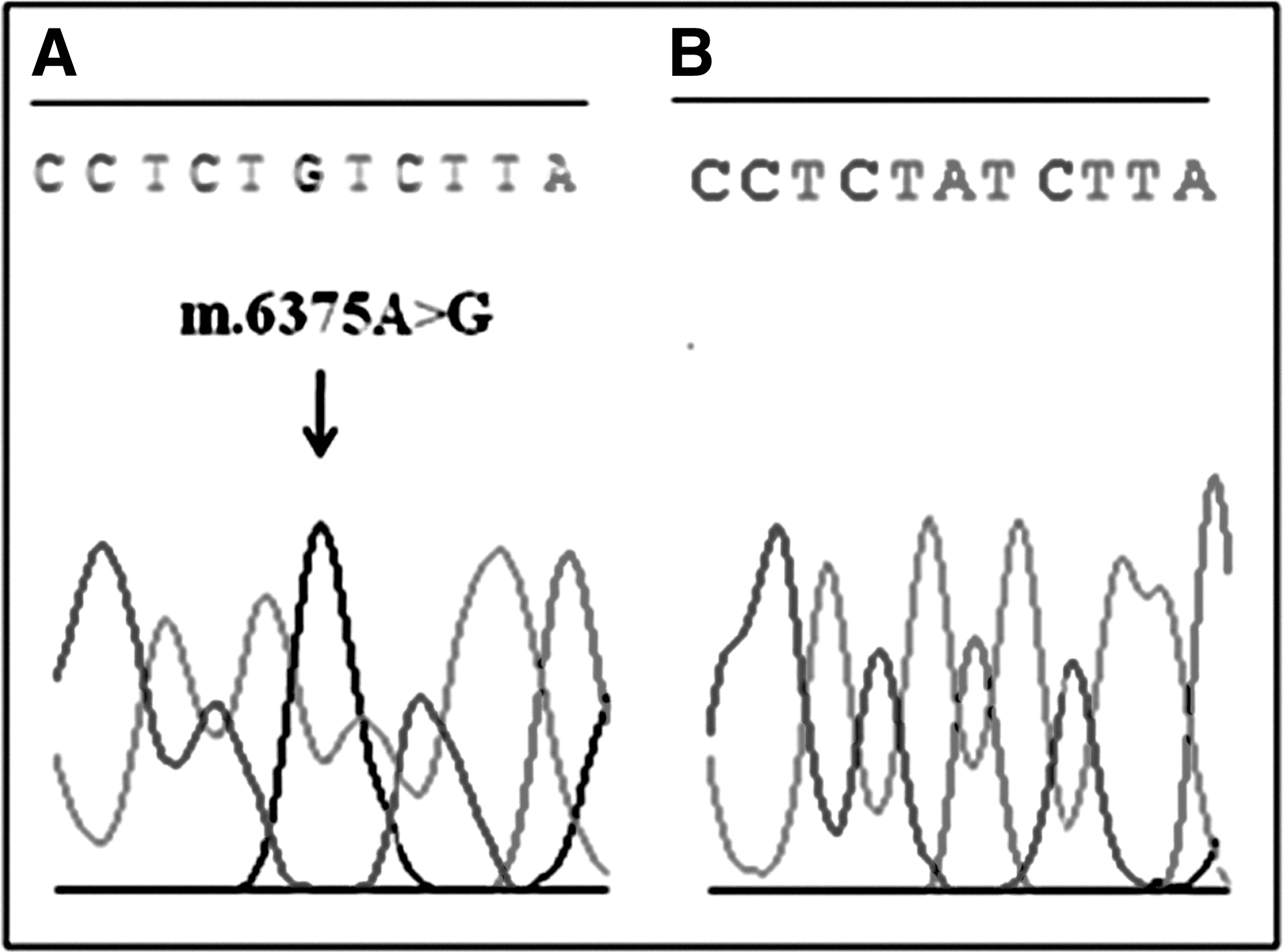
Sequence chromatograms showing the presence of the m.6375A>G mutation in the mitochondrial COXI gene in the 5 asthenospermic patients
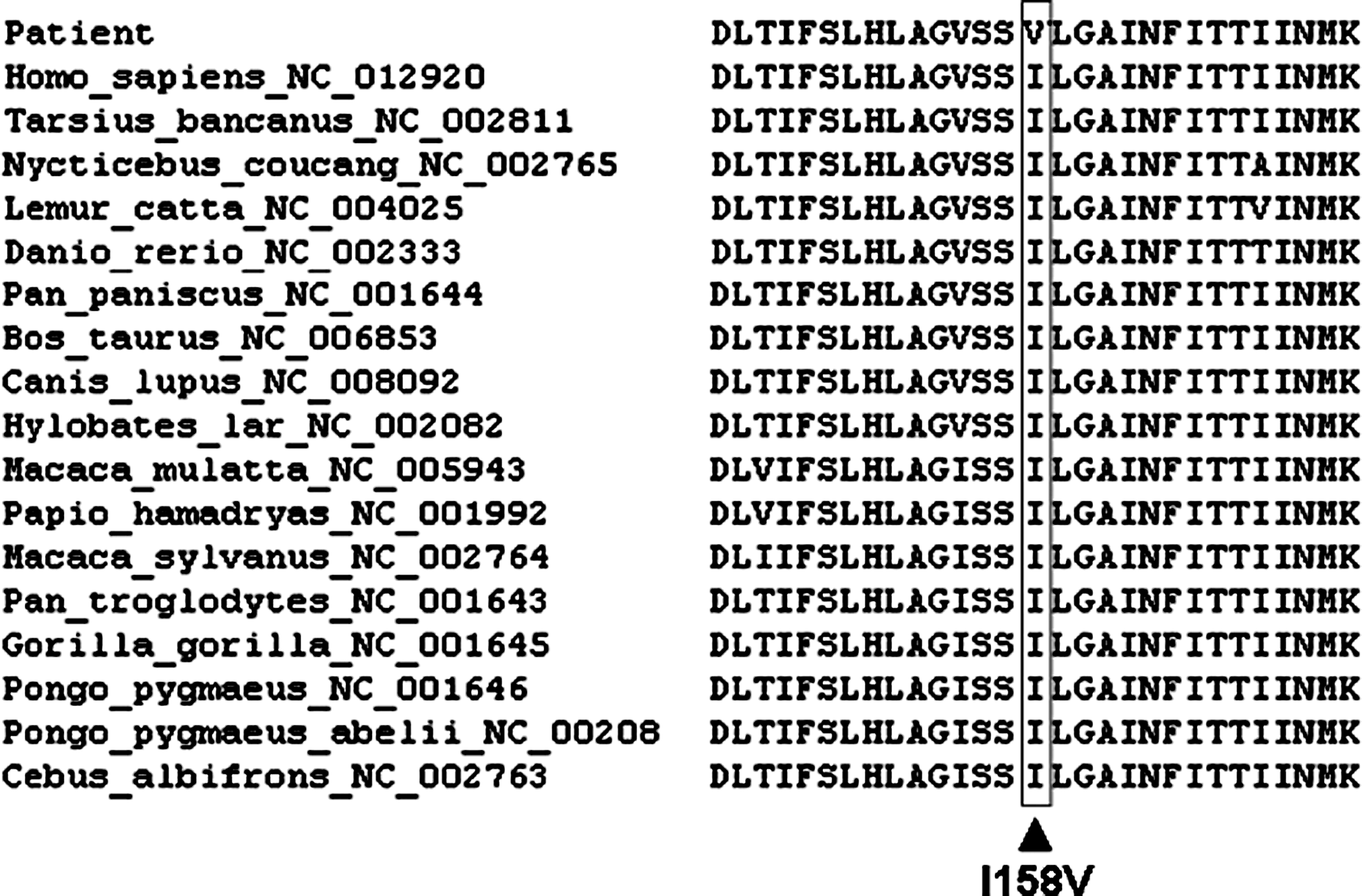
Alignment of the COXI protein in different species showing the conservation of the amino acid 158; the mutated amino acid is framed.
This A-to-G transition converted a highly conserved isoleucine at position 158 in the polypeptide to valine (Fig. 3). The sequence variant is located in the transmembrane functional domain of COXI. It changes a highly conserved isoleucine amino acid to valine and may affect the electron transfer from reduced cytochrome c to molecular oxygen. When we used “PolyPhen” bioinformatics software, we found that the m.6375A>G mutation located in the transmembrane functional domain of COXI (Fig. 3) induces a reduction of the hydropathy index from +1.920 to +0.239, and a decrease of the 3D structure number in the protein from 50 to 26 (Fig. 4), which may affect the interaction of COXI protein with the other cytochrome c oxidase subunits. Indeed, COXI and COXII subunits form the functional core of complex IV (the cytochrome c oxidase) in respiratory chain and are directly involved in electron transfer.
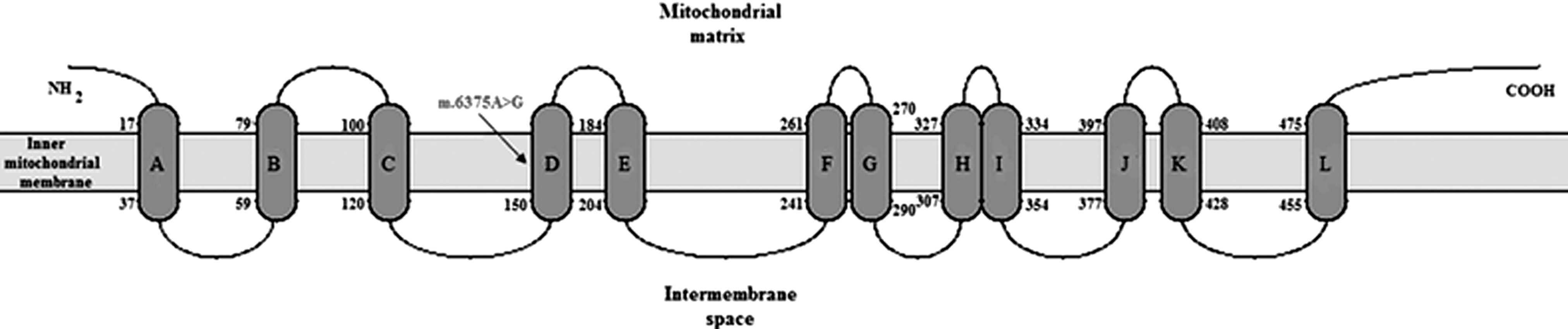
Predicted transmembrane structures of human MT-CoxI protein and location of m.6375A>G mutation by the TopPred program (http://bioweb.pasteur.fr/seqanal/interfaces/toppred.html).

Results of the PolyPhen analysis predicting the possible impact of the I158V substitution on 3D COXI structure.
Discussion
In recent years, male infertility has increased in the industrialized countries due to a decline in sperm counts and defective sperm function, including abnormalities of flagellar movement (Mortimer et al., 1986; Aitken et al., 1989). Since the bioenergetic function of mitochondria is crucial for sperm motility, any quantitative or qualitative aberrations in mtDNA affect the cellular functioning of the spermatozoa. In fact, it has been shown that mtDNA rearrangements in sperm, such as mtDNA point mutations, mtDNA single-nucleotide polymorphisms, and mtDNA haplogroups, are associated with poor sperm motility (Ruiz-Pesini et al., 2000; Holyoake et al., 2001; Kumar and Sangeetha, 2009).
In addition, male infertility has been reported in patients suffering from typical mtDNA diseases, involving point mutations or multiple deletions of mtDNA (Sampson et al., 2001).
Most studies had focused on the investigation of mtDNA in male infertility, by screening sperm mtDNA (Kao et al., 1995; Selvi Rani et al., 2006; Kumar et al., 2007; Kumar et al., 2009). Only few mutations were reported and it was suggested that these mutations in spermatozoa could be pathogenic or common mtDNA variants that only affect male fertility because mtDNA is maternally inherited.
In the present study, we investigated blood mtDNA and screened COXI gene in infertile and fertile men and showed the presence of an undescribed missense mutation (m.375A>G) in 5 asthenospermic patients (14%) and not in normospermic patients and in fertile men, suggesting that it could be associated with asthenospermia and would affect transfer of electrons from reduced cytochrome c to molecular oxygen. To determine the implication of this mutation in the impairment of sperm motility, we should screen sperm DNA from asthenospermic and nonasthenospermic infertile patients and compare the frequency of this mutation between the two groups of patients.
In the literature, Thangaraj et al. (2003) reported 3 missense mutations (m.6344T>C, m.6771A>G, and m.7309T>A) in COXI and COXII in an oligoasthenoteratospemic infertile men. In another study, Selvi Rani et al. (2006) reported a novel missense mutation (C11994T) in ND4 gene in all studied oligoasthenozoospermic patients (n=34), but not in fertile men (n=150). In contrast, Pereira et al. (2008) reported the absence of the m.11994C>T mutation in their oligoasthenozoospermic infertile patients, suggesting that such a mutation may be specific to the studied population. Another study correlated high levels of mutant mtDNA with low sperm motility in men who had inherited the A3243G mtDNA mutation in tRNA leucine from their mother (Spiropoulos et al., 2002a). Holyoake et al. (2001) have found the 2 most common substitutions at 9055 and 11719 in men with a significantly higher frequency of reduced sperm motility (MT-ATP6 and ND4, respectively).
The undescribed missense mutation (m.6375A>G) found in the present study in 5 asthenospermic patients (14%) substitutes a highly conserved isoleucine for valine at the 158th amino acid in the transmembrane functional domain of the protein. In addition, PolyPhen showed that the hydropathy index changed from +1.920 to +0.239, and the number of structures of the 3D protein decreased from 50 to 26. This led us to suggest that these changes may affect the interaction of the COXI protein with the other subunits.
Conclusion
In conclusion, we reported in this study an undescribed homoplasmic missense mtDNA mutation (m.6375A>G) in COXI gene in asthenozoospermic infertile patients and we suggest that this mutation may affect electron transfer from reduced cytochrome c to molecular oxygen in mitochondria.
Footnotes
Acknowledgments
The authors thank the patients for their cooperation in the present study. This work was supported by the Tunisian Ministry of Higher Education, Scientific Research and Technology. We extend our thanks to Mr. Hafedh Béjaoui, Coordinator of the English Unit at the Sfax Faculty of Science, for having proofread this article.
Author Disclosure Statement
No competing financial interests exist.