




Abstract
Objective: The purpose of this research was to attempt a preliminary study of noninvasive prenatal diagnosis of Down syndrome in Southwest Chinese gravidas by using the plasma placental RNA allelic ratio. Methods: The genotypes of the single-nucleotide polymorphisms (SNPs) located in the transcribed regions of the gene PLAC4 were detected in population samples collected in Southwest China by using polymerase chain reaction-restriction fragment length polymorphism, and SNPs with a higher heterozygosity were selected. Mass spectrometer analysis was adopted, and cases with the heterozygous SNPs on PLAC4 mRNA in maternal plasma were selected from 29 pregnancies with a euploid fetus and from 21 pregnancies with a trisomy-21 fetus, and then their RNA-SNP allelic ratios were further determined for noninvasive prenatal diagnosis of Down syndrome. Results: Of all 50 singleton pregnancies, 37 gravidas were found with at least one heterozygous SNP on PLAC4 mRNA in maternal plasma. Among them, 13 pregnancies with a trisomy-21 fetus were detected by the analysis of the RNA-SNP allelic ratio. Conclusion: The plasma placental RNA allelic ratio can be used for noninvasive prenatal diagnosis of Down syndrome, if SNPs on PLAC4 mRNA in maternal plasma are heterozygous.
Introduction
D
The discovery of cell-free fetal nucleic acids in maternal circulation opens a new window for noninvasive prenatal diagnosis, which has been moved into the application of testing fetal genetic disorders (Lo et al., 1997; Lo and Chiu, 2007). Cell-free fetal nucleic acids in maternal blood include the fragments of cell-free fetal DNA (cff DNA) and cell-free fetal RNA (cff RNA), which can be both detected in all three trimesters of pregnancy (Puszyk et al., 2008). Recently, several methods for noninvasive prenatal diagnosis of chromosomal aneuploidy have been reported that made use of cell-free fetal nucleic acids in maternal plasma (Lo et al., 2007a, 2007b; Fan et al., 2008; Tsui et al., 2010). They can bring out results as quick as in 1 or 2 days, and fulfill the expectation of rapidness and safety. Plasma placental RNA allelic ratio is a method that relies on cff RNA for chromosomal aneuploidy detection (Lo et al., 2007b).
Plasma placental RNA allelic ratio is a method of using allelic ratios of placental-specific mRNA in maternal plasma to detect fetal chromosomal aneuploidy, which makes use of the genetic single-nucleotide polymorphism (SNP) in certain populations. Such as in detecting fetal trisomy 21, a specific placental-derived mRNA transcribed from chromosome 21, PLAC4 mRNA (Kido et al., 1993), which can be detected in the plasma of women in all three trimesters of pregnancy, but will be cleared from maternal plasma within 24 h after delivery, was identified as deriving from fetus (Lo et al., 2007b). Then, for a fetus with a transcribed heterozygous SNP locus of PLAC4, the relative dosage of chromosome 21 can be found out by determining the ratio between two alleles of this heterozygous SNP on PLAC4 mRNA in maternal plasma. The allelic ratio was expected to be 1:1 in a euploid fetus, but 2:1 or 1:2 in a trisomy-21 fetus. It has been reported that the diagnostic sensitivity and specificity can reach 100% and 89.7%, respectively (Tsui et al., 2010).
Since different SNPs existed possibly in different nationalities with the same gene, we set our goal to find the SNPs' heterozygous condition of PLAC4 in a Southwest Chinese population, and to explore the possibility of noninvasive prenatal diagnosis of DS for gravidas in this area by the method of plasma placental RNA allelic ratio. So, we first detected the genotypes of 10 SNPs located in the transcribed regions of the gene PLAC4 in Southwest Chinese populations and selected three SNPs with a higher heterozygosity. Then, by performing genotyping and ratio determination of these three SNPs on maternal plasma mRNA, we explored noninvasive prenatal detection of fetal trisomy 21.
Materials and Methods
Subject enrollment
This study was approved by the Medical Ethics Committees of the West China Second University Hospital, Sichuan University. All patients recruited for this study were born in Southwest China. Informed consent was obtained from each patient before the blood draw. About 5 mL of peripheral blood was collected, respectively, from every one of 100 unrelated donors for genotyping SNPs of the transcribed regions of the gene PLAC4; these donors included 60% of women and 40% of men. Fifty singleton pregnancies at 22-24 weeks of gestation were recruited for our study, including 21 pregnancies that carried a trisomy fetus and 29 pregnancies carried a euploid fetus. About 12 mL of maternal peripheral blood was collected after a fetal karyotype was confirmed. Five maternal peripheral blood samples after 24 h of delivery were also collected to detect the clearance of PLAC4 mRNA in maternal plasma.
Sample processing
Genomic DNA was extracted from peripheral blood cells of 100 unrelated donors by using the RelaxGene Blood DNA System (TIANGEN), according to the manufacturer's instructions.
The collected maternal blood sample was immediately centrifuged at 1600 g for 10 min at 4°C. Plasma was transferred to clean microcentrifuge tubes and recentrifuged at 16,000 g for 10 min at 4°C to remove residual cells. Then, the supernatant was, respectively, distributed into microcentrifuges of 1.5 mL. Every microcentrifuge included 0.3 mL of plasma and 0.9 mL of the TRIzol LS reagent (Invitrogen), and was stored at −80°C. When maternal plasma RNA was being extracted, 240 μL of chloroform was added into the 1.2 mL of the plasma and TRIzol LS mixture, and centrifuged at 12,000 g for 15 min at 4°C. The aqueous phase was transferred to a new tube, and 345 μL of 100% ethanol was added too. Then, the mixture was processed with the RNeasy mini kit (Qiagen), according to the manufacturer's protocol. DNase 1 treatment was performed before the first wash step. The total RNA was eluted with 40 μL of RNase-free water.
SNP genotyping
Ten SNPs were selected from the transcribed regions of the PLAC4 gene according to their heterozygosity-sorting order, and then genotyped by using a polymerase chain reaction-restriction fragment length polymorphism (PCR-RFLP) assay. The details are shown in Table 1.
SNP, single-nucleotide polymorphism; dbSNP, database of SNP.
PCRs were performed in a 25-μL volume containing 2.5 μL of 10× PCR buffer, 1 mM of MgCl2, 10 pmol of forward and reverse primer, 0.2 mM of dNTPs, 2.5 U of Taq DNA polymerase (TaKaRa), and 100 ng of genomic DNA template. PCR conditions were initially denatured for 5 min at 94°C; followed by 35 cycles of 45 s at 94°C, 30 s at 55°C, and 1 min at 72°C; and with a final extension for 7 min at 72°C. Amplification was verified by running 3 μL of PCR product on a 2% agarose gel containing gelview and UV visualization. Then, each PCR product was digested for 16 h, respectively, according to every restriction enzyme's recommended protocol for digestion. About 10 μL of the digested reaction was run on a 3% agarose gel containing gelview, and gels were photographed. Genotypes were assigned by band patterns. Three SNPs with a higher heterozygosity were chosen.
Plasma placental RNA allelic ratio analysis for noninvasive prenatal diagnosis of DS
After analyzing the results of PCR-RFLP, we chose three SNPs with a higher heterozygosity, which were rs7844, PLAC4-41471145, and PLAC4-41476236. Then, we performed genotyping and ratio determination of these three SNPs on maternal plasma mRNA of those 50 pregnant women by matrix-assisted laser desorption and an ionization time-of-flight (MALDI-TOF) mass spectrometer. The steps consisted of reverse transcription (RT)-PCR amplification and base extension as well as analysis of the extension products by a mass spectrometer. Sequences of the oligonucleotides used in these reactions are shown in Tables 2a and b.
The bold fonts indicate the 10-mer tags. The tags can distinguish the unused PCR primers from the extension products in the mass spectrometer analysis.
The bold fonts indicate the extended dNTPs. According to the extension direction of these primers, for rs7844, the base matched to C or G located in sense strand was extended, so the allele genotypes of the extension products should be G/G or G/C; for PLAC4-41471145, the base matched to G or A located in the sense strand was extended, so the allele genotypes of the extension products should be C/C or C/T; for PLAC4-41476236, the extended base was located in the sense strand, so the allele genotypes of the extension products should still be C/C or C/T.
RT-PCR amplification: PLAC4 mRNA of those 50 pregnant maternal plasma was amplified by one-step RT-PCR using the respective primers of the three SNPs. The reaction was set up using the Quant One Step RT-PCR Kit (TIANGEN) in a reaction volume of 100 μL, which contained 10 μL of 10× RT-PCR buffer, 400 μM of dNTPs, 20 μL of 5× RT-PCR enhancer, 1 μL of RNasin, 0.125 U/μL of Hotmaster Taq polymerase, 1.0 μL of Quant RTase, 600 nM of forward and reverse primer, 40 μL of maternal plasma RNA template, and a sufficient quantum of RNase-free ddH2O. The reaction was initiated at 50°C for 2 min, followed by reverse transcription at 50°C for 30 min, denaturation at 94°C for 5 min, and 45 cycles of PCR at 94°C for 45 s, 55°C for 30 s, and 65°C for 1 min, and a final extension at 65°C for 10 min. The reaction without reverse transcription was also set up to eliminate the false-positive result by DNA contamination. The reaction of samples after 24 h of delivery was also set up to confirm the clearance of PLAC4 mRNA in maternal plasma.
Base extension and analysis: Base extension and analysis of RNA-SNP of all samples were performed in a 384-well reaction plate. About 5 μL of the RT-PCR product was subjected to shrimp alkaline phosphatase (SAP) treatment to prevent the influences of remaining dNTPs in the subsequent primer extension. About 0.17 μL of 10× SAP buffer (Sequenom), 0.3 U of SAP enzyme (Sequenom), and 1.53 μL of ddH2O were added in every well of the RT-PCR product. The reaction was incubated at 37°C for 40 min, followed by inactivation at 85°C for 5 min.
For primer extension, to every well was added 2 μL of iPlex reaction containing 0.2 μL of 10× iPlex buffer (Sequenom), 0.2 μL of iPlex Termination mix (Sequenom), 0.804 μL of primers, 0.041 μL of iPlex enzyme (Sequenom), and 0.755 μL of ddH2O. Extension conditions were 94°C for 35 s; followed by 5 cycles of 52°C for 5 s and 80°C for 5 s; then followed by 40 cycles of 94°C for 5 s, 52°C for 5 s, and 80°C for 5 s; and with a final extension at 72°C for 3 min. The extension products were cleaned up with Clean Resin (Sequenom) to remove salts, and then a MALDI-TOF mass spectrometer analysis was performed on a MassARRAY compact System (Sequenom). When analyzed, a homozygous SNP showed only one peak, but a heterozygous SNP showed two different peaks (Fig. 1). The peak area of the base extension product corresponding to the allele was taken as the relative amount of the SNP allele.
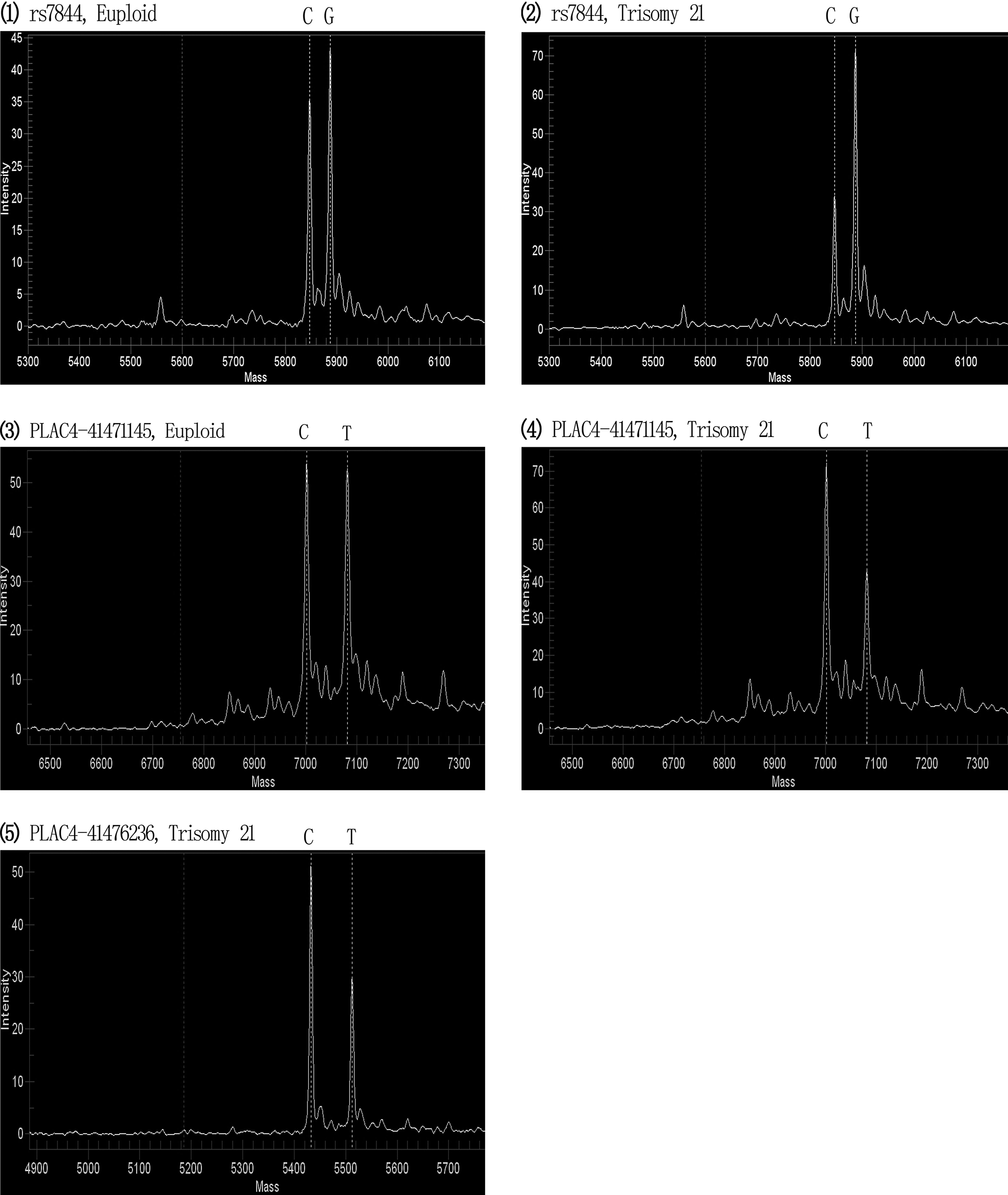
Mass spectrometer tracing the RNA-SNP allelic ratio determination of the maternal plasma samples with the mRNA heterozygote. The molecular weights of the base extension products (shown as sharp peaks) were depicted by x-axis, whereas the intensity in arbitrary units was depicted by y-axis.
Statistical analysis and GenBank accession
Statistical analysis was performed with SPSS 16 software (SPSS, Inc.). All our assays were designed from the reference sequence of PLAC4, according to the GenBank Accession, NM_182832.
Results
The analysis of the results of PCR-RFLP revealed three SNPs with a higher heterozygosity in the transcribed regions of the gene PLAC4, and every SNP had only two kinds of allelic genotypes, including one kind of heterozygote and one kind of homozygote. The heterozygosity of every SNP, respectively, was rs7844, 25%; PLAC4-41471145, 48%; and PLAC4-41476236, 21%. An expected population coverage of 69% by the heterozygotes of these three SNPs was calculated [1-(1-25%)(1-48%)(1-21%)≈69%]. Then, we detected the genotype distribution of these three SNPs on PLAC4 mRNA in maternal plasma. Every SNP also had two kinds of allelic genotypes, and the type of heterozygote or homozygote was also, respectively, similar to that in DNA. The heterozygosity of every mRNA-SNP, respectively, was rs7844, 28%; PLAC4-41471145, 36%; and PLAC4-41476236, 10%. In 50 singleton pregnancies, the total amount of heterozygotes of these three mRNA-SNPs was 37, so an exact population coverage of 74% can be achieved in our experimental design (37/50=74%).
The allelic ratio analysis of the 37 heterozygous RNA-SNPs was performed, and the detail results are shown in Figures 1 and 2 For rs7844 samples, the RNA-SNP ratios were calculated using the relative amount of the higher-mass allele dividing the relative amount of the lower-mass allele. All five trisomy-21 samples showed a lower allelic ratio and deviated from the euploid group (Fig. 2). For PLAC4-41471145 samples, the RNA-SNP ratios were calculated by using the relative amount of the lower-mass allele dividing the relative amount of the higher-mass allele. All eight trisomy-21 samples showed a lower allelic ratio and deviated from the euploid group (Fig. 2). For PLAC4-41476236, since samples with heterozygous SNP were only detected in trisomy-21 cases, the comparative analysis cannot be conducted. Since all five trisomy-21 samples with a heterozygous rs7844 SNP and all eight trisomy-21 samples with a heterozygous PLAC4-41471145 SNP were diagnosed to be T21 pregnancies, but not euploid pregnancies, the data from the analysis of these two SNPs offered a diagnostic sensitivity of 100%.
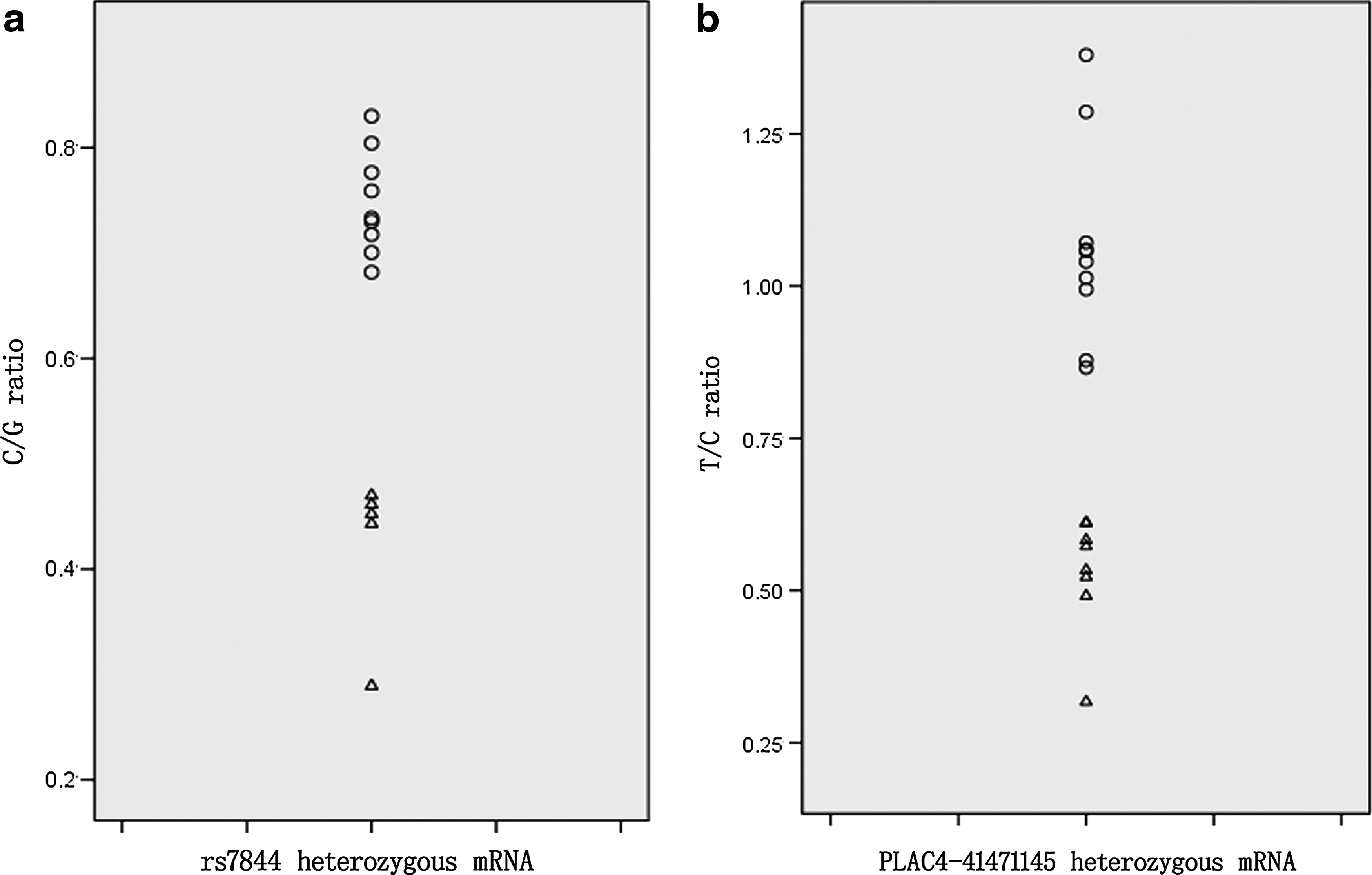
RNA-SNP allelic ratios of maternal plasma samples from euploid and trisomy-21 pregnancies. Δ, Trisomy 21; ◯, Euploid.
Discussion
It has become an important research goal to discover markers that are specific to the fetus in maternal blood for noninvasive prenatal diagnosis of DS. Discovering epigenetic markers of cff DNA is a preferential choice (Old et al., 2007), but these markers may differ in different individuals and change during gestation (Puszyk et al., 2008). cff RNA could serve as another resource for choice of markers. PLAC4 mRNA, a chromosome-21 transcript, which rapidly disappears from maternal circulation after delivery and cannot be detected in the plasma of nonpregnant women, should be a virtual preference for fetal-specific makers (Lo et al., 2007b). Lo et al. (2007b) definitively confirmed the fetal origin of PLAC4 mRNA molecules in maternal plasma and applied it to investigation of noninvasive prenatal detection of DS for detection of the PLAC4 RNA-SNP ratio in maternal plasma. In their article, only one SNP rs8130833 was used to determinate the RNA-SNP allelic ratio. We adopted their method of RNA-SNP allelic ratio determination, but chose other three SNPs (rs7844, PLAC4-41471145, and PLAC4-41476236) in the transcribed regions of the gene PLAC4, to assess the accessible application of this technique to noninvasive prenatal diagnosis of DS in Southwest China.
Since only the heterozygous fetus with PLAC4 mRNA SNPs can be detected using this method, it is indispensable for RNA-SNP allelic ratio testing that there should be surely enough samples with heterozygous SNPs. The reason we investigated the genotypes of SNPs located in the transcribed regions of the gene PLAC4 was to find out as many as possible heterozygous SNPs and SNPs with a higher heterozygosity, so as to offer as many as possible samples for testing.
We found three SNPs with a higher heterozygosity from our detection of the transcribed regions of the gene PLAC4 for populations in Southwest China. The heterozygosity of PLAC4-41476236 was similar to that in GenBank, but the heterozygosities of rs7844 and PLAC4-41471145 were detected as different from those in GenBank. This suggested that there may be a specific distribution characteristic for SNPs located in the transcribed regions of the gene PLAC4 in Southwest Chinese populations. Since our sample size was not big enough, we should be cautious in interpreting the results as a generalized result for populations in Southwest China.
We then detected the genotype distribution of these three SNPs on maternal plasma mRNA for those 50 pregnant women. Since no case with a euploid fetus was detected to have a heterozygous SNP of PLAC4-41476236, we carried out only the mRNA-SNP allelic ratio analysis of maternal plasma samples with heterozygous SNPs of rs7844 and PLAC4-41471145. The analysis results from two SNPs indicated a diagnostic sensitivity of 100%, offering a significant accuracy for noninvasive prenatal diagnosis of DS.
The heterozygous genotyping results of three mRNA-SNPs in maternal plasma reached population coverage of 74%. We believed that higher population coverage can be reached if more SNPs of the transcribed regions of the gene PLAC4 were detected. In these 37 heterozygous samples, there were 18 pregnancies carrying a trisomy-21 fetus, but we could not perform the mRNA-SNP allelic ratio analysis of all these 18 cases. In 18 cases with DS, five T21 pregnancies of rs7844 and eight T21 pregnancies of PLAC4-41471145 can be diagnosed from their respective euploid reference range, but for the cases with heterozygous SNP of PLAC4-41476236, since no pregnancies with a euploid fetus were detected, a reference range used in group comparison was nonexistent, and therefore the allelic ratio analysis cannot be performed even though five pregnancies with a trisomy-21 fetus were detected. So, only 13 samples were analyzed (5 T21 pregnancies of rs7844 and 8 T21 pregnancies of PLAC4-41471145). In reality, the reference range of euploid pregnancies is essential for the application of this method. For every heterozygous SNP, trisomy-21 pregnancies cannot be diagnosed until the reference range of euploid pregnancies is provided, and there must be more samples of euploid pregnancies than those of trisomy-21 pregnancies. For the foreseeable future, the establishment of the reference range of euploid pregnancies may be a promising aspect for noninvasive prenatal diagnosis of DS using the plasma placental RNA allelic ratio.
Footnotes
Acknowledgments
This work was supported by the National Science Foundation of China grants (30973461, 30772323, and 30571942); the National Key Technology R&D Program in the 11th Five Year Plan of China: Prenatal Screening and Diagnosis for Common Genetic Disorders (No: 2006BAI05A10); and the Program for Changjiang Scholars and Innovative Research Team in University, Ministry of Education (Item No. IRT0935), to H. Wang, S. Liu, and D. Mu.
Author Disclosure Statement
The authors have no conflicts of interest to disclose.