




Abstract
Two polymorphisms in the methylenetetrahydrofolate reductase (MTHFR) gene, C677T and A1298C, were hypothesized to decrease the risk of acute lymphoblastic leukemia (ALL). Studies examining the associations between these two polymorphisms and ALL susceptibility drew inconsistent results. To obtain a reliable conclusion in a Chinese population, we carried out a meta-analysis. In total, 11 studies on C677T polymorphism (1597 cases and 2295 controls) and 10 studies on A1298C polymorphism (1553 cases and 2224 controls) were included in the meta-analysis. We found a significant association between the 677T variant and reduced ALL risk in Chinese children (Dominant model: odds ratio [ORFE]=0.73, 95% confidence interval [CI]: 0.63-0.86, p<0.01). Heterogeneity between the studies in the children subgroup was weak and vanished after excluding one study deviating from HWE in the control group (p>0.1). In the adult subgroup, there was no significant association between the C677T variant and ALL risk (Dominant model: ORRE=0.88, 95% CI: 0.45-1.72, p=0.72). Significant heterogeneity was found in the adult subgroup in all the genetic model tests (p<0.1). The A1298C polymorphism had an effect on ALL risk neither in adults (Dominant model: ORFE=0.95, 95% CI: 0.71-1.27, p=0.72) nor in children (Dominant model: ORFE=1.02, 95% CI: 0.87-1.21, p=0.77). No significant heterogeneity between studies on A1298C polymorphism was found in the meta-analysis (p>0.1). The results showed that there was a protective effect of the MTHFR C677T variant on ALL risk in Chinese children.
Introduction
A large literature examined the associations between C677T and A1298C and ALL susceptibility. However, there were inconsistent results. Several meta-analyses were carried out to resolve these discrepancies in the last few years (Wang et al., 2010b; Tong et al., 2011; Yan et al., 2012; Zintzaras et al., 2012). For the A1298C variant, there were mainly negative results found in these meta-analyses. For the C677T variant, these meta-analyses yield relatively consistent results in Caucasians (Whites), but not in Asians. Among them, Yan et al. (2012) reported a protective effect of the 677T polymorphism in Asian children. It was inconsistent with the study by Zintzaras et al. (2012), which claimed no significant effect of C677T variant on ALL risk in East Asians. A meta-analysis provided data on the whole population of Asians, including both children and adults, also denied a significant role of C677T polymorphism in Asians (Tong et al., 2011).
The discrepancy in conclusions might be caused by different grouping criteria. To our knowledge, ethnicity and lifestyle are different among populations in Asian countries. The Asian population (Tong et al., 2011), thereby, is not a strict concept in the genetic study (Zintzaras et al., 2012). It might be more reasonable to include only Chinese and Koreans in the East Asian subgroup (Wang et al., 2010b). At the same time, language bias might also contribute to this discrepancy, as there were different databases and language limitations used in these studies. Furthermore, using different genetic models in these meta-analyses was also one of the reasons for the conflicting results in Asians.
As there were plenty of studies on the Chinese population published in recent years, we carried out a meta-analysis to provide more information on the subject. We endeavored to include all the studies on MTHFR C677T, A1298C, and ALL susceptibility in the Chinese population, without any restriction on language, to decrease language bias and publication bias as much as possible.
Methods
Selection criteria and identification of studies
PUBMED, EMBASE, China Science and Technology journal database, Chinese Biomedicine database (CBM), China National Knowledge Infrastructure platform (CNKI), and Wanfang database were searched using the following search terms: methylenetetrahydrofolate reductase or MTHFR; ALL; polymorphism or genetic variant; and China or Chinese, without any restriction on language. The latest searches were undertaken on Feb 28, 2012. All the references cited in the eligible studies were reviewed to identify additional publications.
All the case-control studies providing valid data on the association between the MTHFR polymorphism (C677T or A1298C) and ALL risk in Chinese were included in the meta-analysis. When multiple articles reported on the same population, we used the most recent one or the one with the largest number of participants only.
Data collection
Two authors extracted the following data from the included studies independently: first author's name, year of publication, participant demographics (age and sex), genotype distribution, leukemia characteristics. Discrepancies were resolved by discussion, when necessary, adjudicated by a third reviewer.
Statistical analysis
The meta-analysis examined the overall association of the MTHFR C677T or A1298C polymorphisms with the risk of ALL in Chinese by odds ratio (OR) with corresponding 95% confidence intervals (CIs) under allele contrast, dominant model, recessive model, additive model, and heterozygote versus wild-type homozygous (CT vs. CC or AC vs. AA) (Zintzaras and Lau, 2008; Tong et al., 2011). Stratification analysis was carried out by age (adults or children).The presence of heterogeneity between studies was assessed using Cochran's Q statistic (Zintzaras and Ioannidis, 2005). p<0.10 indicated significant heterogeneity between studies; then the degree of heterogeneity was quantified with I2 metric [I2=(Q-d.f.)/Q], I2>30% suggesting evidence for heterogeneity (Higgins and Thompson, 2002). If the studies were not statistically heterogeneous, the pooled OR was estimated using the fixed-effects model (Mantel-Haenszel). Alternatively, the pooled OR was estimated using the random-effects model (DerSimonian Laird)(Zintzaras et al., 2006). Potential publication bias was evaluated using the Egger's regression test and the Begg-Mazumdar test (p<0.10 indicating statistically significant)(Macaskill et al., 2001). Hardy-Weinberg equilibrium (HWE) in the control group for all studies was evaluated using the Pearson's χ2 test. Sensitivity analysis was carried out by excluding specific studies with controls not in HWE (Trikalinos et al., 2006). The influence of individual study was evaluated by estimating the pooled ORs in the absence of each study (Wang et al., 2010a). All the p-values were two-sided, p<0.05 indicating significant unless otherwise stated, and all analyses were performed with Stata software (version 10.0; Stata Corporation, College Station, TX).
Results
Eligible studies
Ten eligible published articles providing data on the relationship between MTHFR C677T, A1298C, and ALL in Chinese population were included in the meta-analysis. The studies were published between 2004 and 2011. Nine articles dealt with both C677T and A1298C, and one dealt with C677T only (Yu, 2010). One article (Yang et al., 2011) provided data on adults and children, respectively. There were 11 studies on C677T and 10 studies on A1298C, accordingly. Among them, three studies (Zhang, 2007; Lv et al., 2010; Yang et al., 2011) dealt with adult ALL patients, and seven dealt with pediatric patients (Jiang et al., 2004; Yu, 2004; Tong et al., 2010; Yeoh et al., 2010; Yu, 2010; Yang et al., 2011; Lv et al., 2011), one study included a mixed population of adult and pediatric patients (Liu et al., 2008). All the included studies, except for that by Jiang et al. (2004), described the diagnostic criteria, according to morphologic and immunophenotypic analysis. Controls were age and gender matched with ALL patients in all the included studies. No study-mentioned genotyping was performed under blind conditions. The control groups were either hospital outpatients without history of malignant diseases or community healthy controls. Genotype distributions among the controls of all studies were in agreement with HWE, except that by Jiang et al. (2004). Detailed information of the included studies is available in Table 1.
A, data on adult population; C, data on children population; HWE, Hardy-Weinberg equilibrium; MAF, minor allele frequency among controls; ALL, acute lymphoblastic leukemia.
C677T polymorphism and ALL risk
In total, there were 11 studies on the C677T polymorphism included in the meta-analysis, containing 1597 ALL cases and 2295 controls. The mean T allele frequency among Chinese was 0.42. The pooled results showed that the protective role of 677T in Chinese population was weak (Dominant model: ORRE=0.77, 95% CI: 0.61-0.97, p=0.03; CT vs. CC: ORRE=0.76, 95% CI: 0.59-0.96, p=0.03). The marginally significant association disappeared in the sensitivity analysis after exclusion of one study deviating from HWE in the control group (Dominant model: ORRE=0.80, 95% CI: 0.64-1.01, p=0.056; CT vs. CC: ORRE=0.79, 95% CI: 0.62-1.00, p=0.053). Significant heterogeneity existed between the studies (Table 2 and Fig. 1). However, significant results were observed in the children subgroup, with the protective effect of 677T polymorphism found in all the genetic model tests except in the recessive model test (Dominant model: ORFE=0.73, 95% CI: 0.63-0.86, p<0.01; Recessive model: ORFE=0.86, 95% CI: 0.70-1.06, p=0.16). Exclusion of one study with controls deviating from HWE in the sensitivity study brought about no significant change in the children's subgroup. Moreover, heterogeneity between the studies in the children group was weak (p=0.065 in allele contrast and p=0.097 in CT vs. CC comparison), and vanished after excluding one study (Jiang et al., 2004) deviating from HWE in the control group (p>0.1 in all the genetic model tests). In subgroup analysis on adults, no significant association was observed in any genetic model test. Significant heterogeneity was found in the adult subgroup in all the genetic model tests. The results of the individual study influence suggested that there was no single study exhibiting excessive study influence. Significant publication bias was detected neither in the Egger's regression test (p=0.237) nor in the Begg-Mazumdar test (p=0.213).
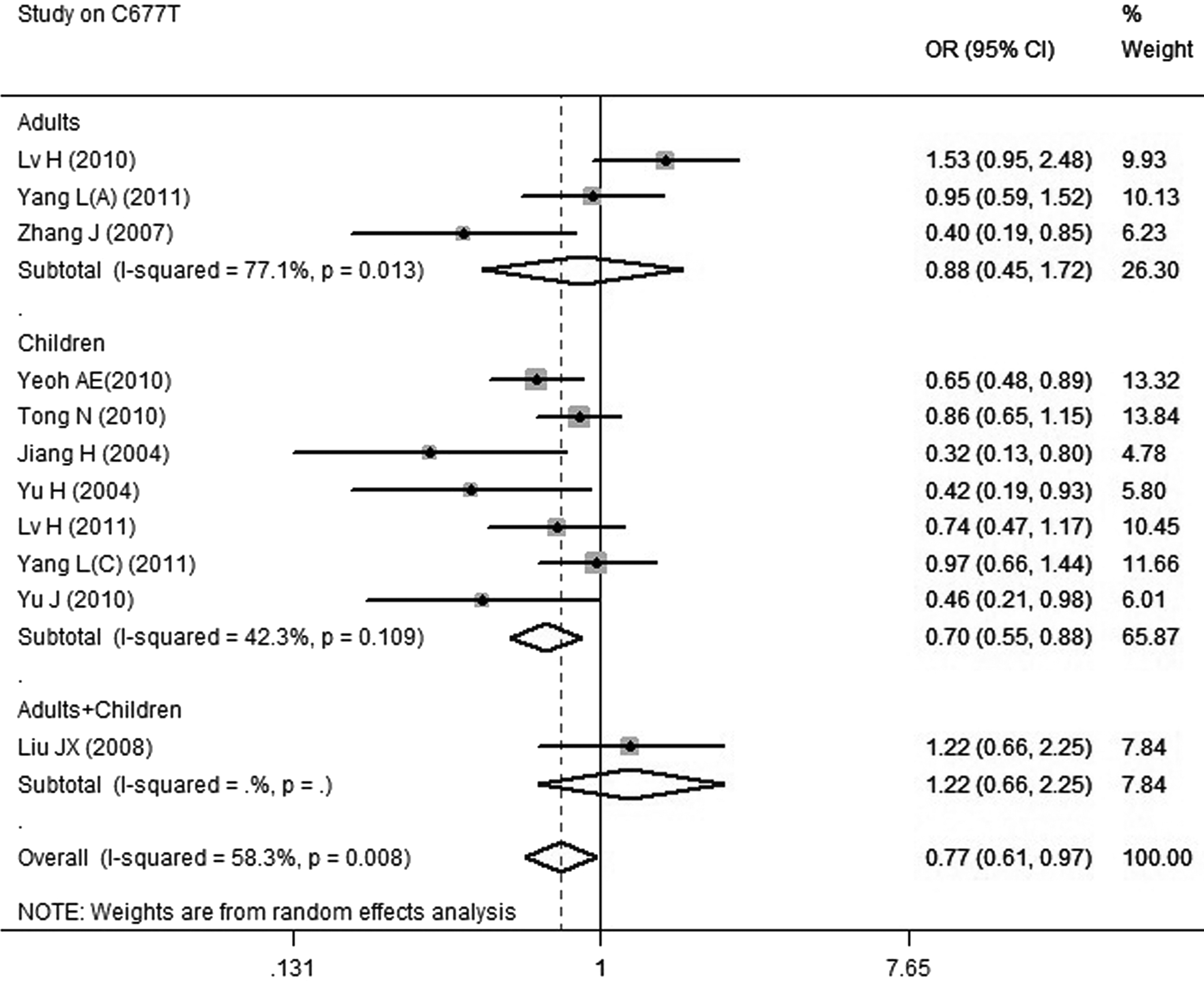
Odds ratio (OR) estimates with the corresponding 95% confidence intervals [CIS] for the dominant model test of MTHFR C677T polymorphism and the risk of ALL in Chinese. A, data on adults; C, data on children.
All, all of the studies meet the inclusion criteria.
Q test is to estimate heterogeneity between studies, p<0.10 indicates significant heterogeneity.
OR, odds ratio.
A1298C polymorphism and ALL risk
Considering the A1298C variant, there were 10 studies on this polymorphism included in the meta-analysis, containing 1553 ALL cases and 2224 controls. The mean C allele frequency among the Chinese was 0.19. No significant association between the A1298C variant and ALL susceptibility was found in any genetic model test in the Chinese population (Dominant model: ORFE=0.98, 95% CI: 0.86-1.13, p=0.81). Similar results were obtained in adults (Dominant model: ORFE=0.95, 95% CI: 0.71-1.27, p=0.72) and children (Dominant model: ORFE=1.02, 95% CI: 0.87-1.21, p=0.77) subgroup analysis. More importantly, heterogeneity among studies on the Chinese population was not significant in all genetic contrasts in all the study subgroups (Table 3 and Fig. 2). The removal of any one study did not result in a movement of the point estimate outside the 95% CIs. The results suggested that there was no single study, which exhibited an excessive study influence. There was no significant publication bias detected by formal statistics (Begg's test, p=0.93; Egger's test, p=0.85).
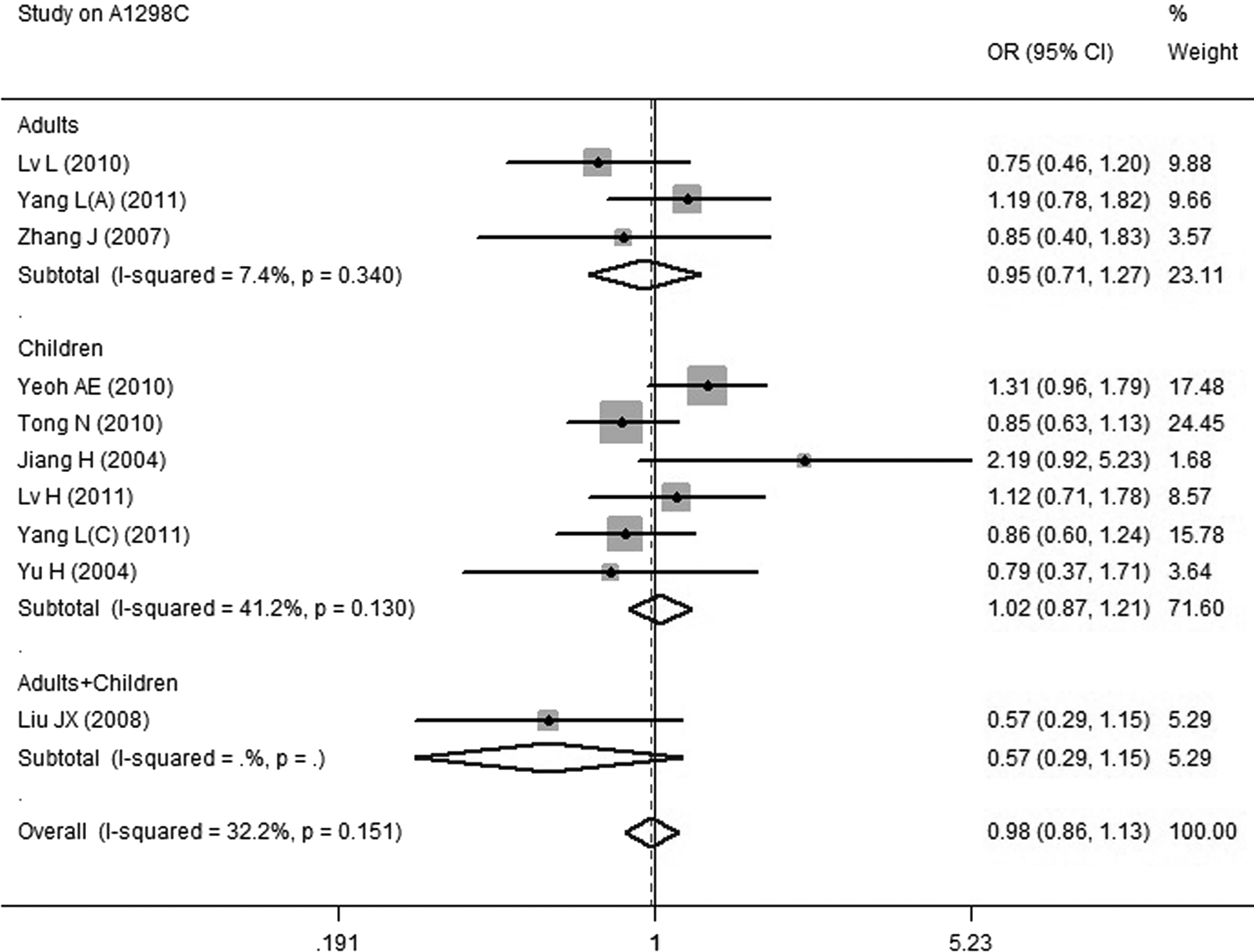
OR estimates with the corresponding 95% CIS for the dominant model test of MTHFR A1298C polymorphism and the risk of ALL in Chinese. A, data on adults; C, data on children.
All=all of the studies meet the inclusion criteria.
Q test is to estimate heterogeneity between studies, p<0.10 indicates significant heterogeneity.
Discussion
Our meta-analysis summarized all the available data on the association between MTHFR C677T and A1298C polymorphism and ALL risk in the Chinese population. The results showed a protective effect of C677T variant on ALL risk in Chinese children. There might be a similar effect of the C677T polymorphism on ALL risk in children population with different genetic background, especially in Caucasians and Chinese. Environmental factors played an import role in the C677T polymorphism effect on ALL risk. The protective effect of MTHFR polymorphisms against ALL might be influenced by folate state in vivo. When the folate intake is deficient, both DNA methylation and thymidylate synthesis may be impaired in patients with MTHFR polymorphisms, leading to carcinogenesis (Sadananda et al., 2010). That might be one of the reasons for no significant association found in the ethnicity other than Caucasians and Asians (Yan et al., 2012).
Considering the effect of MTHFR C677T polymorphism on adult ALL risk, our result was different from previous meta-analyses. Pereira et al. (2006) found that the C677T polymorphism was related to a decreased risk of adult ALL (Recessive model: OR=0.45, 95% CI: 0.26-0.77; n=3). Tong et al. (2011) reported a significantly reduced risk of adult ALL in a dominant model comparison (OR=0.89, 95%CI: 0.80-0.98; n=4). There was no association between the variant and ALL risk in adults observed in any genetic model test in our study. These results of meta-analysis in the adult subgroup were not stable owing to the limited number of studies included and significant heterogeneity among these studies. Therefore, the existing evidence was insufficient to confirm or deny the role of C677T variant in adults. A series of differences existed between children's and adult's ALL. Compared to adults, children were in a period of rapid cell division and growth and had a higher folate requirement. At the same time, they were not exposed to many environmentally carcinogenic factors, and might be influenced more by diet- and genetic-related etiology factors (Koppen et al., 2010). These differences might contribute to the different results between children and adults. It was easy to understand the protective effect of 677T was more obvious in children in our study. Of course, there were only a few studies on adult ALL, a more confirmed meta-analysis result requires more studies on this age group.
There was no significant association between the A1298C variant and ALL susceptibility in the Chinese population found in our study. Reviewing the meta-analyses published so far, with the increasing number of studies included, there were mainly insignificant results reported on A1298C, except by Tong et al. (2011) who reported an increased ALL risk in children in the comparison of 1298CA versus the AA genotype (n=16). It was noteworthy that the significant effect of A1298C polymorphism was not a stable result. We have pooled all the studies in English language journals evaluating A1298C and ALL risk published from 1999 through 2011 (n=29) and found no significant result in any age subgroup (children ALL n=22; adult ALL n=5) or ethnicity subgroup (Caucasian n=12; East Asian n=7) (data not shown). Therefore, comprehensively analyzing these results, we tended to consider there was no significant effect of the A1298C polymorphism on ALL risk. Compared to the C677T polymorphism, the A1298C polymorphism contributed less effect on enzyme activity reduction (Friedman et al., 1999; Weisberg et al., 2001), which might not be powerful enough to affect ALL susceptibility.
Our meta-analysis carried out on studies in a single ethnicity and provided more information on the association between MTHFR polymorphisms and ALL susceptibility. The results indicated that there was a protective effect of theC677T polymorphism on children's ALL risk and this protective role was similar in different ethnicities, especially between the Caucasians and Chinese. The pooled results did not support a significant effect of the C677T polymorphism on adult ALL risk. However, the reliability of results on adults in our meta-analysis, as well as the previous meta-analysis, was limited by the few studies included and significant heterogeneity existing between these studies. Thus, more large and well-designed studies on adult ALL were needed. Moreover, the association between MTHFR polymorphisms and ALL risk was influenced by the gene-gene and gene-environment interactions. Most of the studies included in our meta-analysis did not provide the relevant information. We therefore appeal for further studies providing more information on gene-gene and gene-environment interactions.
Footnotes
Author Disclosure Statement
None declared.