




Abstract
TLR2 and TLR4 genetic variation has been investigated among the Saudis with the aim of gaining further insight into the evolutionary history of the Arabian Peninsula. Two polymorphisms located in the TLR2 gene (Pro631His and Arg753Gln, rs5743704 and rs5743708, respectively), and two (Asp299Gly and Thr399Ile, rs4986790 and rs4986791, respectively), located in the TLR4 gene have been genotyped in 201 unrelated individuals from Saudi Arabia. While the G allele has been fixed in the Arg753Gln (g.2477 G>A) polymorphism, Pro631His (g.2111 C>A) show remarkable frequencies, a polymorphism that until now has been reported exclusively among European populations. The two TLR4 markers analyzed showed moderate frequencies (ranging from 4% to 5%). Considering the reported protective role of these polymorphisms against malaria, the data suggest that the regional variation at these gene loci could have been shaped by both evolutionary infection pressure and bidirectional human migrations in the past. The population admixture may be due to the existence of gene flow from Sub-Saharan Africa and the Levant to the Arabian Peninsula.
Introduction
T
Toll-like Receptors (TLRs) play an important role in the recognition of components of pathogens and subsequent activation of the innate immune response, which then leads to development of adaptive immune responses (Aderem and Ulevitch, 2000; Medzhitov and Janeway, 2000). Genetic variability in TLRs was shown to result in differences in cytokine responses, and as a result modulates susceptibility to infectious and inflammatory diseases (Schröder and Schumann, 2005). Moreover, the underlying nucleotide variation within species is compatible with purifying selection, driven by pathogens (Wlasiuk and Nachman, 2010). These data have been supported by systematic analyses of the evolutionary dynamics of TLRs in humans, including data demonstrating that TLR4 and the TLR1/2/6/10 cluster are under evolutionary pressure, especially in European populations (Ferrer-Admetlla et al., 2008; Barreiro et al., 2009). These data are strengthened by a recent study identifying positive selection for several TLR receptors in both African and European populations (Casals et al., 2011).
The immunological effects of TLRs, in addition to their variable prevalence in various human populations, have permitted the use of the polymorphisms in these genes to reconstruct the evolutionary history and impact of infections in human populations during history. TLR4 is one of the best-studied pattern recognition receptors (PRRs), and the distribution of TLR4 polymorphisms varies between different populations. One of the mechanisms responsible for these differences are the protective effects of the TLR4 299Gly allele against mortality due to Plasmodium falciparum cerebral malaria in Africa, explaining the high prevalence of this TLR4 allele (Ferwerda et al., 2007). On the other hand, the deleterious effects of the 299Gly allele on the severity of Gram-negative sepsis prevented its fixation in Africa and negatively selected it in Europe and Asia (Ferwerda et al., 2007).
These studies demonstrate the potential of the studies investigating TLR polymorphisms in deciphering evolutionary history related to infectious pressure in various populations. Very little has been done to assess TLR polymorphisms in the Arabian Peninsula, a crucial cross road in the history of human migrations. In this study, we have assessed TLR2 and TLR4 polymorphisms in individuals for the Arabian Peninsula, and we related it to other human populations.
Materials and Methods
Study population
201 blood samples were collected from unrelated Saudi individuals representing the major five geographical regions of Saudi Arabia, Central (n=134), Eastern (n=12), Northern (n=5), Southern (n=21), and Western (n=29). Informed consent was given from all participants after explaining the full study. All participants were of Saudi ethnicity and this was established in three phases: (1) individuals with Saudi national identity cards, (2) family and tribal name, which is an indication of the province they came from, and (3) talking to the participants and asking more questions about the family ancestry. The study population was representative of the general population and was selected randomly regardless of health status.
DNA extraction and genotyping analysis
Blood samples (5 mL) were drawn in ethylenediaminetetraacetic acid (EDTA) tubes. Tubes were centrifuged at 5500 rpm/min for 5 min and the buffy layer was used for DNA extraction using the Illustra blood genomic Prep Mini Spin Kit (GE Healthcare, Buckinghamshire, United Kingdom) and stored at −20°C in aliquots until further use. The genotyping for single nucleotide polymorphism (SNP) rs5743704 (g.2111 C>A; Pro631His) and for SNP rs5743708 (g.2477 G>A; Arg753Gln) in the TLR2 gene was performed with a TaqMan SNP assay with the 7300 ABI real-time PCR system (Applied Biosystems, Foster City, CA) in 96-well plates. Similarly, the genotyping for SNP rs4986790 (g.1187 A>G; Asp299Gly) and SNP rs4986791 (g.14143 C>T; Thr399IIe) in the TLR4 gene was determined. Data analysis was performed based on the distribution of genotypes using ARLIQUIN software version 3.0 (Excoffier et al., 2005). As the sequence of events in Arabia cannot be fully understood without considering the global patterns, the data of TLR4 and TLR2 polymorphisms among Saudi were compared with those of previously published data from Iran, Israel, Sudan, Cameroon, Tanzania, the Netherlands, Greece, Romania, and Germany (Ferwerda et al., 2007; Ioana et al., 2012).
Results
Table 1 shows the genotype and allele frequencies for SNPs at the TLR2 and TLR4 genes. SNP rs5743704 is polymorphic in Saudi Arabia, being the minimum allele frequency (MAF), 2.5% for the A allele, while the allele G at the SNP rs5743708 was found to be fixed. It is important to note that the A allele of SNP rs5743704 had been exclusively reported in European populations (Ioana et al., 2012). The rs4986790 SNP show the highest heterozygous rate, with a MAF of 5.7% in the Saudi Arabs; followed by the other TLR4 SNP, rs4986791, with a MAF of 4.3%.
SNP, single nucleotide polymorphism.
Table 2 shows the haplotype frequencies for the SNPs analyzed in the present study, indicating that the four possible haplotypes for the TLR4 gene are present in the Saudis; the wild homozygous is the most prevalent haplotype. In the TLR2 locus, only two haplotypes are present; the homozygous wild type is the most prevalent one (96%).
The Saudi population does not show significant differences with Israeli Arabs, Tanzanian, and Romanians. Differences were shown between Saudis and Iranians, Sudanese, Cameroonians, Dutch, Greeks, and Germans. The distribution of the TLR4 haplotypes among the Saudi population compared to Sub-Saharan Africans, Europeans, Israeli Arabs, and Iranians is shown in Figure 1.
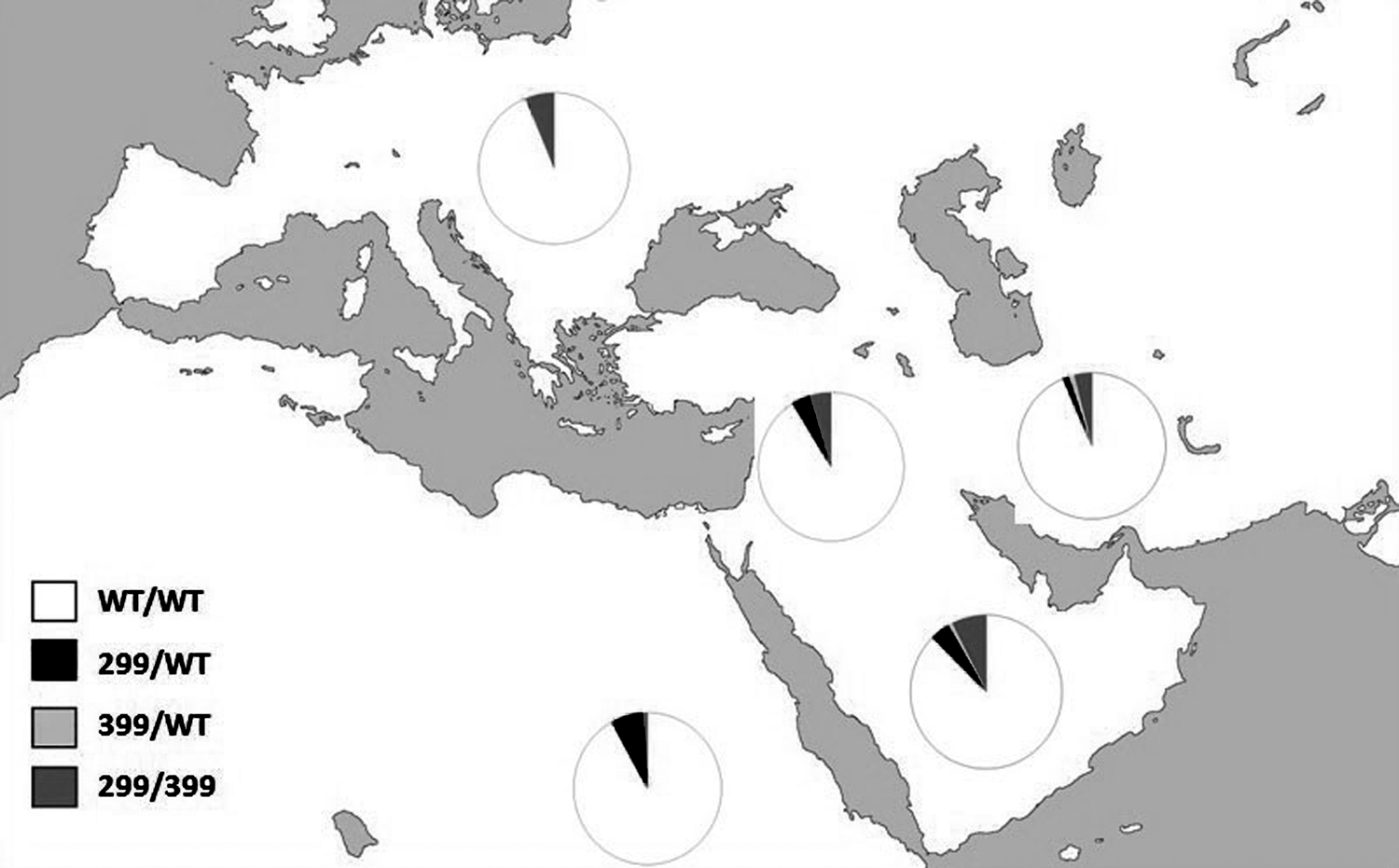
Distribution of the TLR4 haplotypes in Sub-Saharan African, European, Israeli, and Iranian populations, according to Ferwerda et al., 2007 and Ioana et al., 2011, compared to Saudi population of present study. Circles indicate allele frequencies.
Discussion
Haplotype frequencies of TLR4 among Saudis showed an amalgamated pattern of Thr399Ile, Asp299Gly, and Asp299Gly/Thr399Ile; the frequency of the Thr399Ile polymorphism is the highest and similar to its occurrence in Israel, Iran, and Europe, while the Asp299Gly polymorphism has a lower frequency yet comparable to its incidence in Sub-Sahara Africa, Israel, and Iran (Ferwerda et al., 2007).
Similarity between the frequencies of the rs4986790 polymorphism among sub-Saharan African and Saudi populations may reflect the combined action of ancient human bidirectional migrations occurring between Africa and Arabia through the Red Sea, and the constant evolutionary pressure exerted by malaria in the Arabian Peninsula. The gene flow between Africa and Arabia during different events of human history has been demonstrated by genetic and paleo-anthropological studies (Kivisild et al., 2004). The extensive gene flow between Africa and Arabia resulted in the Arabization of North/East Africa and the considerable migration of East African haplogroups into Arabia (Richards et al., 2003).
On the other hand, malaria has been known to be endemic in many regions in Saudi Arabia; the highest incidence of malaria was shown in the southwestern part of the country, where the transmission of malaria parasites occurs throughout the year (Bin Dajem et al., 2011). The distribution of malaria infection in Saudi Arabia may explain the remarkable frequencies of the TLR4 Asp299Gly polymorphism, as it has a protective role against malaria infection (Mockenhaupt et al., 2006). The highest frequency of this polymorphism was found among sub-Saharan African populations as the result of the high incidence of malaria in the continent (Ferwerda et al., 2007). A recent study in experimental leishmaniasis reveals a significant concordance between TLR4 mutations (rs4986790 and rs4986791) with an outcome of Cutaneous leishmaniasis (CL) (Ajdary et al., 2011), which may provide an evidence that the two polymorphisms of the TLR4 gene may lead to the increased susceptibility to CL, and severity of infection by Leishmania major. CL is one of the major endemic diseases in Saudi Arabia, especially in the semiarid agricultural areas and oases in the central and eastern regions, where the rodent reservoir and the sand flies prevail (Choi and Lerner, 2001).
The Saudi population showed a similar frequency pattern observed in the Israeli population for the TLR4 polymorphisms (Ferwerda et al., 2007). This result supports the historical affinities between Arabs and Jews, as both Arabs and Jews belong to the Semitic branch of the Afro-Asiatic family. The TLR4 rs4986791 polymorphism could have been brought to Arabia as the result of the Holocene agriculturalists expansion from the Levant as suggested by the Y-chromosome (Abu-Amero et al., 2009) and the TLR polymorphisms. Recent linguistic studies propose an origin of Semitic language in the Levant around 5,700 years ago (ya), and consequent influx in Yemen and East Africa through Arabia 2,800 years ago (Kitchen et al., 2009). Haplogroup Y-J1e data suggest an exodus of the Neolithic farmers and pastoralist from the Fertile Crescent into the arid area of Arabia (Chiaroni et al., 2010).
The two analyzed polymorphisms at the TLR2 gene have been earlier reported to be present in Indo-European populations, but not in populations from Africa or East-Asia (Ioana et al., 2012). The presence of the variant A at SNP rs5743704 in the Arabian population suggests a possible origin of this mutation in the Levant, from where it may have been brought during late gene flow. The possibility that this mutation is reminiscent of the initial human migration from East Africa to the Arabian Peninsula is remote, as it has been found neither in the original populations in Africa, or in East Asian populations. TLR2 polymorphisms have been associated with susceptibility to bacterial infections and tuberculosis (Ogus et al., 2004), and they could contribute to the pattern of susceptibility to these infections in the Arabian populations.
In conclusion, in the present study, we report for the first time the pattern of TLR2 and TLR4 polymorphisms in the Arabian Peninsula. The presence of a distinctive pattern of genetic variation in these genes sheds light on an important aspect of evolutionary history of this population in relation to the local infectious pressures, and may, partly, explain susceptibility to modern infectious and inflammatory diseases in the Arabian Peninsula.
Footnotes
Acknowledgments
This study was, partly, supported by a grant of the Dutch Young Academy (DJA) to M.G.N. and H.Y.H.
Author Disclosure Statement
No competing financial interests exist.