




Abstract
Introduction: The first regulatory rulings by the U.S. Food and Drug Administration on direct-to-consumer (DTC) genetic testing services are expected soon. As the process of regulating these and other genetic tests moves ahead, it is important to understand the preferences of DTC genetic testing customers about the regulation of these products. Methods: An online survey of customers of three DTC genetic testing companies was conducted 2-8 months after they had received their results. Participants were asked about the importance of regulating the companies selling DTC genetic tests. Results: Most of the 1,046 respondents responded that it would be important to have a nongovernmental (84%) or governmental agency (73%) monitor DTC companies' claims to ensure the consistency with scientific evidence. However, 66% also felt that it was important that DTC tests be available without governmental oversight. Nearly, all customers favored a policy to ensure that insurers and law enforcement officials could not access their information. Discussion: Although many DTC customers want access to genetic testing services without restrictions imposed by the government regulation, most also favor an organization operating alongside DTC companies that will ensure that the claims made by the companies are consistent with sound scientific evidence. This seeming contradiction may indicate that DTC customers want to ensure that they have unfettered access to high-quality information. Additionally, policies to help ensure privacy of data would be welcomed by customers, despite relatively high confidence in the companies.
Introduction
D
Complex questions remain about whether and how to regulate the heterogeneous DTC genetic testing industry. Some companies selling DTC genetic tests have argued that their tests are not intended to be diagnostic, that they only provide information to consumers, and thus should not be subject to regulation by the U. S. Food and Drug Administration (FDA) (Baker, 2012). However, scientific and medical communities' concerns about variable clinical utility, the difficulty that customers and their providers may have interpreting the tests, and the unclear scientific basis of some health-related marketing claims caught the attention of numerous U.S. regulatory agencies, including the FDA, the Federal Trade Commission (FTC), the Centers for Disease Control (CDC), and the U. S. Government Accountability Office (GAO) (Vorhaus, 2011; Mullard, 2012). In 2010, DTC tests were the subject of a congressional hearing and a GAO report (Kutz, 2010; Kolor et al., 2012). The FDA issued warning letters to 23 DTC genetic testing companies stating that their testing service met the definition of a device and thus was subject to FDA regulation (23andMe, 2012). Since then, the industry has continued to evolve and operate in a static, and ambiguous, regulatory environment. Some companies have reacted to the increased scrutiny by ceasing to offer their tests DTC, and requiring involvement of a physician. Others have continued their DTC practices.
In July of 2012, the DTC company 23andMe filed an application for FDA clearance of seven health-related tests, with plans to submit applications for many more of the 244 conditions and traits included in their Personal Genome Service (23andMe, 2012; Baker, 2012). This action was praised by the members of the healthcare community and the DTC industry, because FDA evaluation and clearance of tests related to specific phenotypes offered by 23andMe would begin to provide clearer guidance about the need and criteria for regulation and how companies whose tests do not meet these criteria should respond (Mullard, 2012). It is hoped that closer cooperation between DTC companies, governmental agencies, and nongovernmental and professional organizations will lead to clear standards for scientific accuracy, clinical validity, and marketing that can be applied across the industry.
As the process of regulation for these and other genetic tests evolves, it is important to understand the views of DTC genetic testing customers about regulation of the DTC industry. We surveyed random samples of customers of three DTC genetic testing companies at one time point, 2-8 months after they had received their results. In this descriptive report, we describe customers' responses to questions about regulation.
Methods
Survey instrument
Officials at Navigenics, 23andMe, and deCODEme agreed to offer a survey to random samples of customers receiving genetic risk profiles. Four main provisions of the survey were decided upon. The identities of a company's customers would not be revealed to study staff or to the other test companies. The survey would not ask about specific results returned to participants. The data would be analyzed and reported in aggregate only; direct comparisons among the three companies would not be made. Finally, the number of invitees and participants from the individual companies would remain undisclosed, to avoid revealing proprietary information about an individual company's customer volume.
A 167-item online survey, qualified by the Johns Hopkins University Institutional Review Board as exempt (NA_00023396), was designed so the majority of questions were applicable to customers of all three companies. Survey topics included questions about motivations for testing, opinions about the test results, and the importance of regulating the companies selling DTC genetic tests. The companies had the opportunity to review and comment on the survey and to approve the final version. The Web-based survey instrument was programmed and administered by the online survey research firm Knowledge Networks (KN). KN provided a unique hyperlink and password for each invitee. An online pilot study was conducted among 20 customers from 23andMe and deCODEme. The survey instrument was then edited and checked for logic, length, vocabulary, and reading level and fielded in January 2010.
Selection and recruitment of participants
The staff at Navigenics, 23andMe, and deCODEme sent email invitations to random samples of their customers who had purchased a genetic risk profile for medical conditions and received their results 6-28 weeks before the date invitations were sent. Eligible customers resided in the United States, were over the age of 18, had logged in to view their result report, and had purchased the risk report themselves or received it as a gift from a friend or family member. People who received the report from their employer, as a part of research or as a gift of the DTC company or company staff, were excluded.
Respondents to invitations emailed by the companies were screened to confirm their eligibility. Eligible customers were given the survey and had 4 weeks from the date of the invitation to complete it. After 2 weeks, KN emailed the study staff a list of the unique links corresponding to those who had either participated or actively opted out of participation. Using this list, the companies could identify and send a reminder email to nonparticipants who had not opted out. Participants received a $10.00 Amazon.com gift certificate as compensation for their time.
Statistical analysis
Descriptive analyses summarized the demographics and attitudes of the survey population. Logistic regression was conducted using SUDAAN Software, version 11.0, to perform an exploratory analysis of relationships between customers' attitudes on regulation, and demographic factors and beliefs about privacy and the value of their DTC test results.
Results
As reported previously, 3,167 DTC customers were invited to participate in the online survey; 1,163 (37%) responded to the invitation; and 1,046 (33%) were eligible and completed the survey (Kaufman et al., 2012). Respondents were ineligible if they received the test through a promotion or were related to an employee of one of the three companies (n=50); if they resided outside the United States (n=21); if they purchased only ancestry testing (n=15); if they received the test from their employer (n=13), a research study or other source (n=14); or if they had not yet viewed their results (n=4). The majority of respondents paid for the test themselves (87%), whereas the remaining 13% received the test as a gift from a family member or friend. Data on the demographics of the nonresponders were not available.
White non-Hispanics, older adults, individuals with higher household incomes, and people with postgraduate education were over-represented in this survey sample when compared the U.S. adult population (Table 1).
DTC, direct-to-consumer; PI, Pacific Islander; AI/AN, American Indian/Alaskan Native.
Attitudes about governmental oversight
When asked about the importance of having a nongovernmental group, like Consumer Reports or the Better Business Bureau, monitor the claims that companies like [the DTC company used] make about their services to ensure that they are consistent with scientific evidence, 84% of DTC customers indicated that such oversight was either very important (45%) or somewhat important (39%). Similarly, 73% of respondents indicated that having a governmental agency, like the Federal Trade Commission, monitor the claims made by DTC companies was very (34%) or somewhat (39%) important. However, two-thirds of respondents (66%) also indicated that it was very (36%) or somewhat important (30%) that services like those provided by [the DTC company used] be available without governmental oversight.
Attitudes about governmental protections
When asked about other types of protections provided by the government, 96% of respondents stated that it was very (87%) or somewhat (9%) important that it be illegal for insurers and employers to get their information, and 89% indicated that it was very (74%) or somewhat (15%) important that it be illegal for law enforcement to get their information.
Relationships between attitudes about DTC testing and preferences for regulation
In an exploratory analysis, we examined whether opinions about government oversight and protection were related to demographic factors, as well as attitudes about the value of the DTC test and privacy protections afforded by the company. A total of 84% agreed (55%) or strongly agreed (29%) with the statement “I feel like the value of the information and services were worth the cost of the test,” whereas 16% disagreed (14%) or strongly disagreed (2%) with that statement.
Opinions about the value of the test were related to the attitudes about governmental oversight. Adjusting for age, education, household income, sex, and race and ethnic group, people who disagreed with the statement that the test was worth the cost were significantly more likely to support both nongovernmental (p=0.004) and governmental (p=0.001) monitoring of company claims to ensure their accuracy, and were less likely to agree that DTC services should be available without government oversight (p=0.01) (Fig. 1). Customers with higher levels of education were also significantly less likely to say that the companies should be allowed to operate without oversight (p=0.001). Demographic variables listed above were not related to the attitudes about oversight.
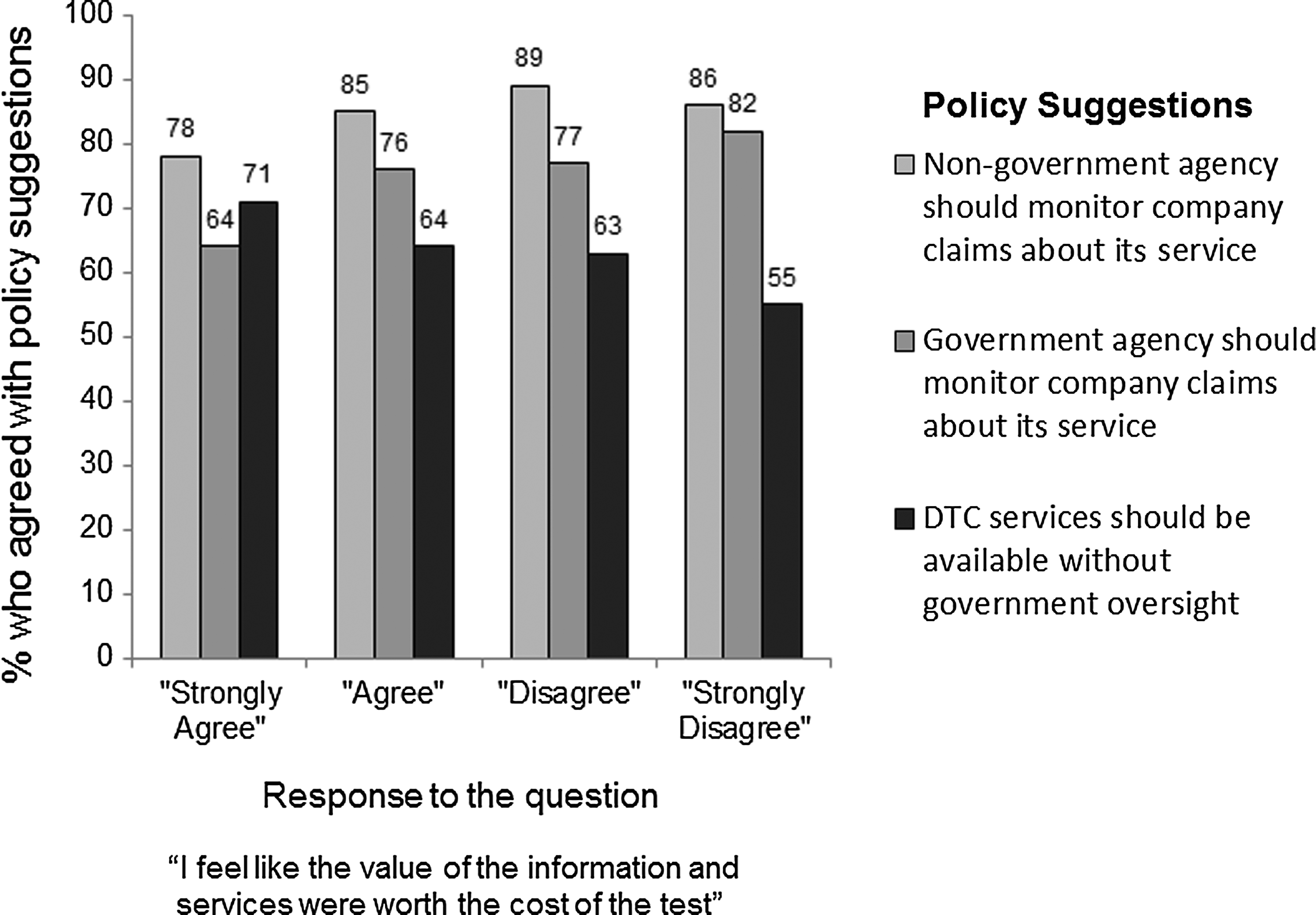
Relationship between the attitudes about the value of the direct-to-consumer (DTC) service and support for three policy suggestions related to DTC genetic testing among DTC customers (n=1,046).
Almost all (96%) customers agreed (71%) or strongly agreed (25%) with the statement “In thinking about [the company's] service, I am confident my privacy has been protected.” Additionally, compared to the information in their medical record, 36% thought that the privacy of their genetic and personal health information collected by the company was better protected; 4% thought that the data were less protected; 38% thought that the protections were similar; and 23% were unsure of the comparison. However, responses to these questions about privacy were unrelated to customers' attitudes about laws prohibiting insurers and law enforcement from accessing their results. For example, 96% of those who felt their DTC data were more protected than medical data felt that it was important to prohibit insurers access, compared with 98% of those who felt that their results were not as well protected as their medical information (p=0.39 adjusted for age, education, insurance status, income, sex, race, and ethnic group).
Discussion
Our data show that two-thirds of the DTC customers surveyed believed that DTC testing services should be available for purchase without government oversight, indicating that DTC customers want to be able not only access genetic testing services without going through a healthcare provider but also without restrictions imposed by government regulation. These results are not surprising given the larger, ongoing societal shift from a traditional, physician-centered healthcare model to one that centers on the empowered patient-consumer. However, we also observed that a lower level of satisfaction with the value of DTC results (as measured by responses on whether the cost was justified) was associated with positive responses toward regulation, suggesting that collecting additional details about some customers' experiences might inform the need for specific areas of oversight.
Despite the majority's disapproval for government oversight that might hinder access to DTC tests, a large majority of DTC customers also favor having an independent ally, either in government or elsewhere, that is minding the store, operating alongside DTC companies to ensure that the claims made by the DTC companies are consistent with sound scientific evidence. This finding suggests that DTC customers purchasing genetic testing products behave like consumers in many other markets that want be assured that they are getting what they are told they are paying for.
Majority disapproval for broad oversight may seem to contradict the strong majority's approval for oversight of the claims made by DTC companies. However, these opinions are not necessarily in conflict with one another. One possible explanation stemming directly from the wording of the questions is that most customers do not want the government to get in the way of people accessing these data, but would welcome help ascertaining that the services being offered are what the companies claim. Seeking organizational help to ensure that the quality and integrity of the data does not necessarily conflict with the requirement that accesses to these services remain unhindered.
More respondents appear to prefer that a non-governmental agency fulfill the role of a watchdog (84%), but most (73%) respondents would also support a government agency providing the oversight. It is unclear whether the federal government or other organizations will step in to evaluate specific tests and the evidence behind the genotype-phenotype associations being reported. Although this type of function and transparency is one of the goals of the Genetic Testing Registry (National Library of Medicine, 2012), the Registry is still early in its own development and currently does not include major DTC companies. Ongoing efforts to develop comprehensive, publicly available databases of clinically relevant genetic variants and their associated phenotypes might play a role. However, most existing databases of this nature are complex and have not been designed for the use by consumers or general practitioners.
Finally, DTC customers we surveyed overwhelmingly supported the laws to prevent insurers and employers (96%) and law enforcement (89%) from obtaining an individual's DTC test results. These responses echo the results of a survey of the general public about participation in genetic research, where 93% and 84%, respectively, said that it would be important that it be illegal for insurers and law enforcement officials to get their study information (Kaufman et al., 2009). This preference was independent of customers' opinions about how well the companies protected their privacy. Generally speaking, DTC companies tend to test for single-nucleotide polymorphisms, rather than the short tandem repeats that would be necessary to provide law enforcement with a match to the FBI's Combined DNA Index System. Law enforcement officials could seek information on the phenotype or ancestry markers to compare to evidence if there was a reason to believe that a person of interest was participating in DTC testing. However, we are unaware of any such instances occurring.
One major limitation of this study is that due to the parameters of the survey, we only asked a small number of questions about policy preference questions. A large number of other detailed questions could provide more insight into specific areas where policy or guidance might help DTC consumers. Another limitation is that the survey was conducted with relatively early adopters of this test who had high levels of income and education. Neither those using DTC services nor the survey respondents are representative of the general U.S. adult population. Moreover, as the price of DTC testing has decreased 5-10-fold since the time these customers purchased their tests, this study population may no longer be representative of the demographics of current DTC customers. With that said, little demographic variation was observed in the opinions reported here (data not shown), suggesting that the data may be generalizable.
The FDA's review of 23andMe's application will likely benefit all stakeholders involved in the ongoing debate about regulating DTC genetic testing. Clearance by FDA could provide the industry with its first glimpse of the regulatory standards about the level of evidence required by the FDA to health-related claims. Further, clearance will begin to assure customers and healthcare providers that the tests have been vetted by a trusted government agency. It will also create new questions about how 23andMe, the FDA, and other DTC vendors should treat the hundreds of other DTC tests that have not been submitted to FDA. It is likely that this initial decision will mark a significant point, but not an endpoint, in a process between regulators, the industry, and the healthcare community to develop and ensure high, sensible standards for consumer genetic testing. As new and more complex types of genetic information become available, it may be worth considering the studies to understand the experiences of consumers and patients to inform the iterative process of developing these guidelines.
Footnotes
Acknowledgment
This work was supported by the National Human Genome Research Institute, grants R21-HG004865 and R01-HG005092.
Author Disclosure Statement
No competing financial interests exist.