




Abstract
Background: The p53 tumor suppressor gene Arg72Pro polymorphism has been associated with esophageal cancer. However, the results were not consistent. Herein, this meta-analysis was performed to estimate the association between p53 Arg72Pro polymorphism and esophageal cancer. Methods: Electronic search of PubMed was conducted to select studies. Studies containing available genotype frequencies of Arg72Pro were chosen, and pooled odds ratio (OR) with 95% confidence interval (CI) was used to assess the association. Results: The final meta-analysis included 14 published studies with 4184 esophageal cancer cases and 7308 controls. The results suggested that the variant genotype was associated with the esophageal cancer risk in additive model (Pro vs. Arg: OR=1.146, 95% CI: 1.016-1.293, p=0.027) and in recessive model (Pro/Pro vs. Arg/Arg+Arg/Pro: OR=1.258, 95% CI: 1.021-1.551, p=0.031). In the stratified analysis by ethnicity, the data suggested that the increased esophageal cancer risk associated with p53 Arg72Pro polymorphism was more evident in the Asian group. The symmetric funnel plot, the Egger's test (p>0.05) and the Begg's test (p>0.05) suggested the lack of publication bias. Conclusion: This meta-analysis suggests that p53 codon 72 polymorphism contributes to esophageal cancer risk, especially in Asians. To validate this association, further studies with more participants worldwide are needed to examine association between this polymorphism and esophageal cancer.
Introduction
The p53 tumor suppressor gene is at the crossroads of a network of cellular pathways, including DNA repair, chromosomal segregation, cell cycle checkpoints and apoptosis (Bennett et al., 1999). p53 is a stress response protein that functions primarily as a tetrameric transcription activator, it can bind tightly to specific DNA sequences in response to a variety of cellular insults, including DNA damage, hypoxia, oncogene activation and other signals (Levine and Oren, 2009). Activated p53 suppresses carcinogenesis mainly through the induction of cell cycle arrest, senescence and apoptosis in damaged cells (Brady and Attardi, 2010). When a mutation occurs in the gene, p53 may not only lose its normal tumor suppressive ability, but also gain oncogenic activities of its own, which can actively contribute to various aspects of tumor progression (Brosh and Rotter, 2009). p53 is commonly mutated in all kinds of human tumors; more than half of human cancers harbor mutations in the p53 gene (Greenblatt et al., 1994; Hollstein et al., 1994; Bennett et al., 1999). The p53 tumor suppressor gene (TP53; GenBank NM_000546.2) contains 11 exons, is located on chromosome 17p13 and encodes a 53-kDa nuclear phosphoprotein. The majority of p53 mutations are missense mutations, occurring mainly in the DNA binding domain of the protein (Cho et al., 1994). A common polymorphism occurs at codon 72 of exon 4 in the transactivation domain of the protein, where either CCC encodes proline or CGC encodes arginine (Thomas et al., 1999). And the Arg72Pro polymorphism has been shown to be associated with an increased risk of cancer (Kawajiri et al., 1993; Weston et al., 1994; Murata et al., 1996; Storey et al., 1998; Wang et al., 1999).
A number of studies have been conducted to investigate the potential association between p53 Arg72Pro polymorphism and esophageal cancer in humans. However, the results were inconsistent. Therefore, we conducted a meta-analysis to assess the association between the p53 Arg72Pro polymorphism and the risk of esophageal cancer.
Materials and Methods
Publication search
PubMed was searched using the terms “p53”, “polymorphism” and “esophageal cancer” (last search updated in December 2012). Case-control studies containing available genotype frequencies of Arg72Pro were chosen. Additional studies were identified by a manual search from the references of original studies.
Statistic analysis
For the control group of each study, the observed genotype frequencies of the p53 codon 72 polymorphism were assessed for Hardy-Weinberg equilibrium using the χ2 test. The strength of association between codon 72 polymorphism of p53 gene and esophageal cancer was assessed by calculating crude odds ratios (ORs) with 95% confidence intervals (CIs). The pooled ORs were performed for dominant model (Pro/Pro+Pro/Arg vs. Arg/Arg), recessive model (Pro/Pro vs. Pro/Arg+Arg/Arg) and additive genetic model (Pro vs. Arg), respectively. Heterogeneity assumption was checked by a chi-square based Q-test. A significant Q-statistic (p<0.05) indicated heterogeneity across studies. The summary OR estimate of each study was calculated by the fixed-effects model if there was not significant heterogeneity. Otherwise, the random-effects model was employed (Mantel and Haenszel, 1959; DerSimonian and Laird, 1986). The potential for publication bias was examined by a Begg's test (funnel plot method) and Egger's linear regression test (p<0.05 considered representative of statistical significance) (Egger et al., 1997). All statistical analysis were performed with Stata software (version9.0; Stata Corporation, College Station, TX).
Results
Eligible studies
Sixteen studies (Lee et al., 2000; Peixoto Guimaraes et al., 2001; Hamajima et al., 2002; Li et al., 2002; Zhang et al., 2002; Hu et al., 2003; Vos et al., 2003; Zhang et al., 2003; Hong et al., 2005; Cai et al., 2006; Cao et al., 2007; Shao et al., 2008; Yang et al., 2008; Canova et al., 2009; Liu et al., 2010; Piao et al., 2011) were initially identified after reviewing records from the literature search. Among these studies, the study by Yang et al. (2008) was excluded since the genotype distribution of the controls deviated from HWE. In addition, the study by Shao et al. (2008) was also excluded because they contained data which overlapped with the study by Hong et al. (2005). Finally, fourteen studies eligible for p53 Arg72Pro polymorphism (4184 cases and 7308 controls) were included in this meta-analysis. The characteristics of fourteen eligible case-control studies are summarized in Table 1.
p-Value for Hardy-Weinberg equilibrium in control group.
PCR-RFLP, polymerase chain reaction restriction fragment length polymorphism; PCR-CTPP, polymerase chain reaction with confronting two-pair primers; SSCP, single-strand conformation polymorphism; APEX, arrayed primer extension.
Meta-analysis
The results of the association between the p53 codon 72 polymorphism and esophageal cancer and the heterogeneity test are shown in Table 2. Since between-study heterogeneity was observed, the random-effects model was used to estimate the association between the p53 genotypes and esophageal cancer risk. Compared with the Arg allele, the Pro allele for p53 Arg72Pro was associated with a significantly increased risk of esophageal cancer (Pro vs. Arg: OR=1.146, 95% CI: 1.106-1.293, p=0.027) (Fig. 1). We also found significant effects in the recessive genetic model (Pro/Pro vs. Arg/Arg+Arg/Pro: OR=1.258, 95% CI: 1.021-1.551, p=0.031) (Fig. 2). We further performed stratified analysis by ethnicity. We found that the increased esophageal cancer risk associated with p53 Arg72Pro polymorphism was more evident in the Asian group in the additive model (Pro vs. Arg: OR=1.194, 95% CI: 1.031-1.384, p=0.018) and in the recessive model (Pro/Pro vs. Arg/Arg+Arg/Pro: OR=1.371, 95% CI: 1.080-1.740, p=0.009). (Figs. 1 and 2).
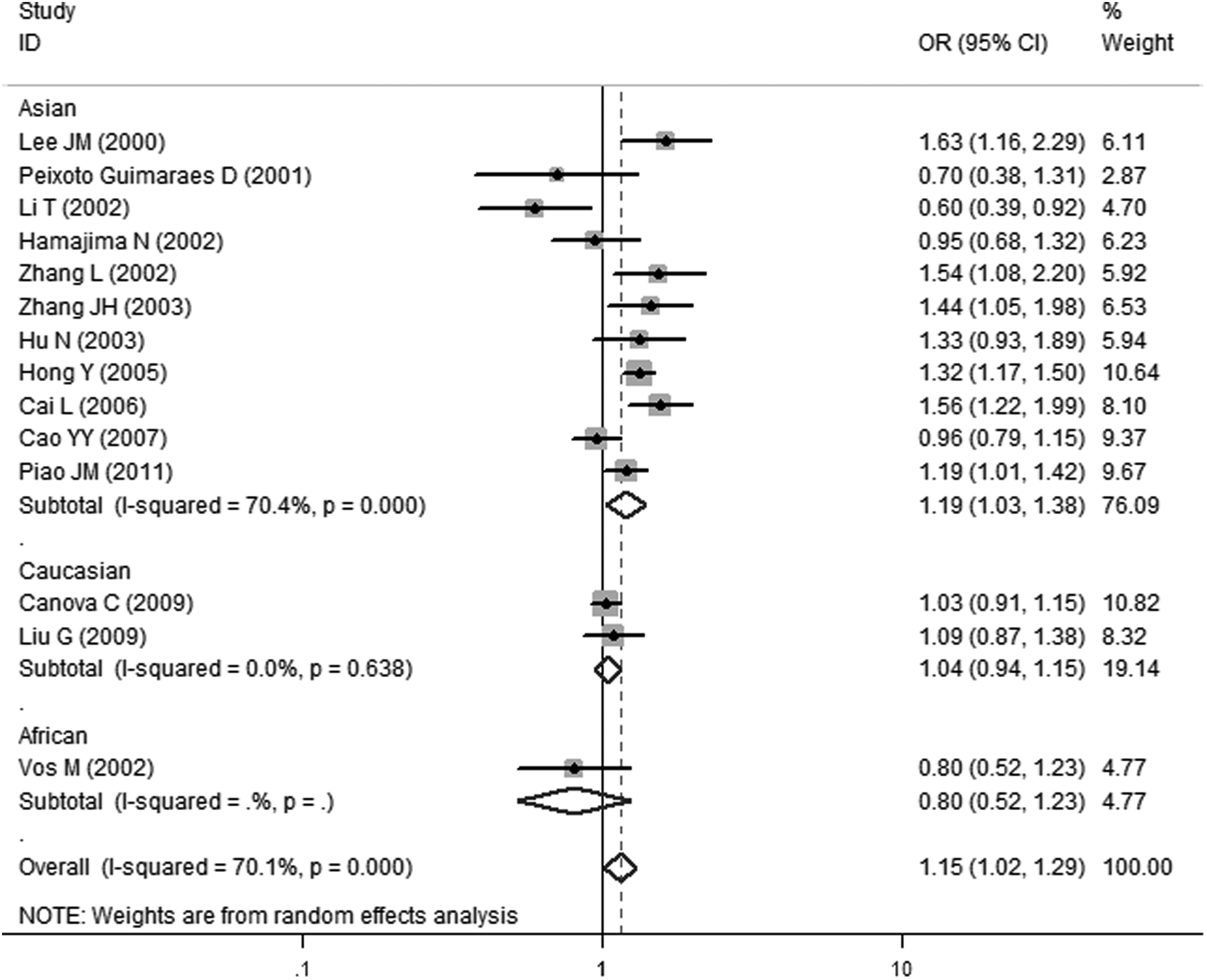
Forest plot of odds ratios (ORs) of esophageal cancer for p53 Pro allele when compared to the Arg allele (additive model). The squares and horizontal lines correspond to the study-specific OR and 95% confidence interval (CI). The area of the squares reflects the study-specific weight. The diamond represents the pooled OR and 95% CI.

Forest plot of ORs of esophageal cancer for p53 Pro/Pro genotype when compared to the Arg allele carriers (Pro/Arg+Arg/Arg) (recessive model). The squares and horizontal lines correspond to the study-specific OR and 95% CI. The area of the squares reflects the study-specific weight. The diamond represents the pooled OR and 95% CI.
Publication bias
The Funnel plot, Egger's test and the Begg's test were done to estimate the publication bias of literatures. The results of the Egger's test (p>0.05) and the Begg's test (p>0.05) provided statistical evidence for funnel plot symmetry in Asian and Caucasian subgroups (Table 2).
Discussion
Esophageal cancer, which is prevalent in China and some other parts of the world, is a complex disease likely resulting from polymorphisms of multiple interacting genes and gene-environment interactions. The genes related to the esophageal cancer may contribute to the major genetic pathways, including DNA damage repair and cell-cycle control pathways. Recently, p53 gene variants in the etiology of cancers have drawn increasing attention. Some studies have attempted to discover a possible association between the p53 Arg72Pro polymorphism and the risk of esophageal cancer. But the role of p53 Arg72Pro polymorphism in esophageal cancer has been controversial. Some studies suggest that the Pro allele or the Arg allele of p53 codon 72 polymorphism had a significant effect on the risk of esophageal cancer (Lee et al., 2000; Zhang et al., 2002; Zhang et al., 2003; Hong et al., 2005; Cai et al., 2006). On the contrary, the other studies did not demonstrate any significant difference in the prevalence of the p53 Arg72Pro genotype between esophageal cancer patients and controls, indicating an insignificant association between this polymorphism and esophageal cancer risk in Chinese, Japanese, and Caucasians (Peixoto Guimaraes et al., 2001; Hamajima et al., 2002; Liu et al., 2010). This meta-analysis reveals a significant association between p53 codon 72 polymorphism and esophageal cancer risk, especially in Asian subjects. Arg72Pro of p53 gene is a common coding polymorphism that results in either proline (Pro) or arginine (Arg) at the 72nd amino-acid position of p53 protein. Significant ethnic differences were found in the codon 72 polymorphism. The Pro72 allele frequency increases in populations close to the equator, which suggests that the Pro72 allele frequency is closely linked to latitude (Sjalander et al., 1995). There is a tight association between cold winter temperature and p53 Arg72 in Eastern Asia that suggests causative selection (Shi et al., 2009). Besides small sample size, the heterogeneity in ethnicity may be one major reason for the controversy. Moreover, as showed in Table 1, the studies selected have not used the same technique for detecting the polymorphism, which may contribute to the variation in this meta-analysis.
The p53 tumor suppressor gene is mutated in diverse types of human cancers, underlining its central role in the host's defense against malignancy (Hollstein et al., 1991). Depending on the nature of the genetic insult and physiologic stimuli, wild-type p53 induces either growth arrest or apoptosis (Giaccia and Kastan, 1998). The Arg72Pro polymorphism occurs in the proline-rich domain of p53, which is required for its ability to fully induce apoptosis (Sakamuro et al., 1997). And some studies suggest that expression of the Pro72 form of p53 results in a higher level of G1 arrest than the Arg72 form, while the Arg72 form of p53 is significantly more efficient than the Pro72 form at inducing apoptosis (Dumont et al., 2003; Pim and Banks, 2004; Sullivan et al., 2004; Bergamaschi et al., 2006). Besides, a number of DNA tumor virus oncoproteins also target p53, including HPV E6 protein, which interacts with and degrades p53 through the ubiquitin pathway (Walker and Levine, 1996). A study has shown that the E6 proteins were able to target p53Arg more efficiently than p53Pro for ubiquitin-mediated degradation (Thomas et al., 1999). However, esophageal carcinogenesis is a complex multifactorial process, and the genetic factors in the etiology of esophageal cancer are still relatively unknown. Large genetic screenings can be useful for elucidating the molecular pathogenesis of esophageal cancer.
In conclusion, this meta-analysis suggests the p53 Arg72Pro polymorphism may be associated with the risk of esophageal cancer. In this meta-analysis, most studies were from Asian populations. Future well designed large studies might be necessary to validate this association in different populations incorporated with environmental factors in the susceptibility of esophageal cancer.
Footnotes
Acknowledgments
This work was financially supported by the National Science Foundation of China (No. 81101547, 30960152, 31170735), and the Planned Science and Technology Project of Yunnan Province (2009CA012, 2011DH011).
Author Disclosure Statement
No competing financial interests exist.