




Abstract
Background and Aims: Published data on the associations between interleukin-4 receptor (IL-4R) gene polymorphisms (Q551R, I50V) and rheumatoid arthritis (RA) risk are controversial. To quantitatively evaluate the relationships, a meta-analysis was performed. Methods: Studies were identified from the databases of PubMed, MEDLINE, Chinese Biomedical Literature Database, and Chinese National Knowledge Infrastructure, with the last report up to June 2012. The effect summary odds ratio (OR) and 95% confidence interval (CI) were obtained. Results: A total of six separate comparisons involving 2173 patients and 1892 controls were included to assess the association of IL-4R gene Q551R polymorphism and RA susceptibility. Overall, no significantly elevated RA risk was found in the meta-analysis. The pooled OR for the minor R allele was 0.942 (95% CI: 0.848-1.047, p=0.268) in patients with RA. After stratification by ethnicity, there was still no significant association detected in the European population (OR=0.979, 95% CI: 0.875-1.094). As for I50V polymorphism, there were four comparisons involving 1653 patients and 1584 controls in this meta-analysis. The pooled OR for the V allele was 1.104 (95% CI: 1.001-1.217) in RA, the V allele of the IL-4R gene I50V variant might be a risk factor for RA. However, the relationship between the V allele of IL-4R gene I50V polymorphism and rheumatoid factor positive in patients with RA was not identified through a minor meta-analysis, including four independent relevant comparisons. Conclusions: This meta-analysis indicates that the I50V polymorphism of IL-4R gene may confer susceptibility to RA; up to now, there is still not enough evidence to reveal the association of the IL-4R gene Q551R polymorphism with RA risk.
Introduction
As small proteins secreted by cells mostly after activation, cytokines can jointly play key roles in the regulation of systemic inflammation, local tissue damage, and immunomodulation. A central feature of RA is a relative imbalance in proinflammatory and anti-inflammatory cytokines. Cytokines also play a critical role in the pathogenesis of RA (John et al., 1998). Interleukin-4 (IL-4) and its receptor (IL-4R) have been proved to be associated with the development of RA, since diminished production of IL-4 is believed to contribute to the characteristic Th1-mediated autoimmune rheumatoid inflammation (Skapenko et al., 2003). Furthermore, a variety of immune disorders, including RA disease, can be induced by an imbalance in the Th1:Th2 ratio in the adaptive immune response. As a B-cell stimulating factor, IL-4 is the first B-cell growth factor discovered, and it mainly promotes proliferation of T cells and contributes to production of antibodies by B cells. Pleiotropic activities of IL-4 are mediated by its specific receptor IL-4R at the surface of the target cell to play a role in the immune system. IL-4R represents a complex transmembrane receptor composed of two subunits, the common γ chain shared by several interleukin receptors, can amplify the signal transduced by the IL-4Rα, a 140-kDa high-affinity binding chain. The α chain binds IL-4 and mediates its effect through kinases of the Janus family attached to the intracellular domain (Nelms et al., 1999).
The IL4R gene is located at the short arm of chromosome 16p12.1. To date, seven single-nucleotide polymorphism (SNP) sites have been identified in the coding region of the gene (Kruse et al., 1999). Two of these SNPs, Q551R (rs1801275) and I50V (rs1805010), are nonsynonymous (Mitsuyasu et al., 1999) and are suggested to be associated with various autoimmune diseases, such as asthma and atopy (Sandford et al., 2000; Hytönen et al., 2004), connective tissue disease (Youn et al., 2000), and Crohn's disease (Aithal et al., 2001).
Recently, studies have evaluated the associations of the IL-4R gene polymorphisms (Q551R, I50V) with RA in different ethnic groups (Genevay et al., 2002; Prots et al., 2006; Suppiah et al., 2006; Moreno et al., 2007; Marinou et al., 2008; Hussein et al., 2012). However, the results are inconsistent. Therefore, in the present study, we performed an exhaustive meta-analysis to comprehensively assess the association of IL-4R gene Q551R, I50V polymorphisms and RA risk. Additionally, several studies on the association between the IL-4R gene I50V variant and rheumatoid factor (RF) in RA patients have been performed (Prots et al., 2006; Moreno et al., 2007; Marinou et al., 2008; Hussein et al., 2012), but the results are still disputable. Thus, a minor meta-analysis was also conducted to draw a valuable conclusion on this relationship.
Materials and Methods
Literature search
All studies examining the association of IL-4R gene Q551R, I50V polymorphisms (rs1801275, rs1805010) with RA were fully considered and carefully selected. Studies were identified from the databases of PubMed, MEDLINE, Chinese Biomedical Literature Database, and Chinese National Knowledge Infrastructure, with the last report up to June 2012. The following keywords were used for searching: “interleukin-4 receptor,” “IL-4R,” “polymorphism,” “rheumatoid arthritis,” and “RA.” Studies published in English and Chinese were all considered to be included and had to be in accordance with the following criteria: (1) study must be used an unrelated case-control design, familial studies were excluded as their linkage considerations; (2) available allele frequency or genotype distribution data for comparison; (3) sufficient published data for estimating an odds ratio (OR) with 95% confidence interval (CI); (4) genotype distribution of the control group must be in Hardy-Weinberg equilibrium (HWE).
Data extraction
Two investigators (H.P. and M.Z.) independently assessed all potentially relevant studies with the inclusion criteria. The collected data comprised the name of the first author, journal, and publication year, country of origin, ethnicity of the study population, numbers of cases and controls, demographics, matching criteria, allelic frequencies, and genotype distribution of IL-4R gene polymorphisms (Q551R, I50V).
Statistical analyses
Allelic frequencies of IL-4R polymorphisms (Q551R, I50V) from the respective study were determined by the allele counting method. The chi-square test was used to assess the HWE of genotypes in the control group of each study.
We examined the contrast of the allelic effect of R (minor allele) versus Q (common allele) and V versus I; subsequently, the contrast of RR+QR versus QQ, VV+IV versus II (dominant effect) genotypes as well as the contrast of RR versus QR+QQ, VV versus IV+II (recessive effect) genotypes were also conducted. The presence of heterogeneity between studies was evaluated with the Q- and I2-statistics (Petitti, 1994). Heterogeneity was considered significant for p<0.10. I2=100%×(Q−df)/Q (Higgins and Thompson, 2002), I2 values of 25%, 50%, and 75% were defined as low, moderate, and high estimates, respectively. If p-value of the heterogeneity Q-statistic was less than 0.10, the random effects model was used for meta-analysis, otherwise, we used a fixed effects model.
The pooled estimate of risk OR was obtained using the Mantel-Haenszel method in the fixed effects model (Mantel and Haenszel, 1959), while using the DerSimonian and Laid method in the random effects model (DerSimonian and Laird, 1986). And the Z-test was used to determine the pooled OR with the significance set at p<0.05. In addition, to clearly assess the ethnicity-specific effect, analyses by ethnic subgroups were subsequently performed.
Evaluation of publication bias
Publication bias was investigated with the funnel plot, in which, the standard error of log (OR) of each study was plotted against its OR. An asymmetric plot suggested possible publication bias. Funnel plot asymmetry was assessed by the method of the Egger's linear regression test, which used a linear regression approach to measure the funnel plot asymmetry on the natural logarithm scale of the OR (Egger et al., 1997).
Statistical analyses were carried out using the Stata software package version 11.0 (Stata Corporation, College Station, TX). All the p-values were two sided. A p-value of<0.05 was taken as statistically significant.
Results
Literature search and characteristics of eligible studies
A total of 107 potentially relevant articles were identified after an initial search from the selected electronic databases, of which, six reports (Genevay et al., 2002; Prots et al., 2006; Suppiah et al., 2006; Moreno et al., 2007; Marinou et al., 2008; Hussein et al., 2012) were eligible for inclusion. Figure 1 shows the literature selection process. Characteristics (first author's name, publication year, country of origin, demographic characteristics of case and control, etc.) of each study are described in Table 1. The distributions of the genotype and allele of IL-4R gene Q551R, I50V polymorphisms in each case-control study are respectively shown in Tables 2 and 3, and the p-values of HWE testing for the genotypic distribution of the control groups are also showed.

Flow diagram of the study selection process. IL-4R, interleukin-4 receptor; RA, rheumatoid arthritis.
IL-4R, interleukin-4 receptor; RA, rheumatoid arthritis; PCR, polymerase chain reaction.
HWE, Hardy-Weinberg equilibrium.
Association between IL-4R gene Q551R polymorphism and RA risk
Six studies (Genevay et al., 2002; Prots et al., 2006; Suppiah et al., 2006; Moreno et al., 2007; Marinou et al., 2008; Hussein et al., 2012) with a total of 2173 cases and 1892 controls explored the association between the IL-4R gene Q551R polymorphism and RA susceptibility. Meta-analysis showed that there was no significant association of the R allele with RA risk in all subjects (OR=0.942, 95% CI: 0.848-1.047) (Table 4). After stratification by ethnicity, there was still no significant association detected in the European population (OR=0.979, 95% CI: 0.875-1.094) (Table 4).
OR, odds ratio; vs., versus; CI, confidence interval; F, fixed effects model.
Meta-analysis of the RR+QR versus QQ and RR versus QR+QQ genotypes indicated similar results to the R allele analysis (Table 4). The overall ORs for RR+QR and RR were 0.951 (95% CI: 0.837-1.080) and 0.839 (95% CI: 0.636-1.108), respectively (Table 4). Subgroup analysis of Europeans still failed to find any marked association of the IL-4R gene Q551R polymorphism and RA susceptibility in all genetic models.
Association between IL-4R gene I50V polymorphism and RA risk
A total of four studies (Prots et al., 2006; Moreno et al., 2007; Marinou et al., 2008; Hussein et al., 2012), including 1653 RA patients and 1584 controls, were available for meta-analysis on the IL-4R gene I50V polymorphism and RA susceptibility. Meta-analysis of the V allele and VV+IV genotypes revealed significant associations with RA. And the overall ORs were 1.104 (95% CI: 1.001-1.217) and 1.269 (95% CI: 1.091-1.477), respectively (Fig. 2, Table 4). Although no association of V allele and RA was detected in a subgroup of European Caucasians, in a dominant model, contrast of VV+IV versus II genotypes, the relationship was marked (OR=1.207, 95% CI: 1.027-1.418) (Fig. 2, Table 4).
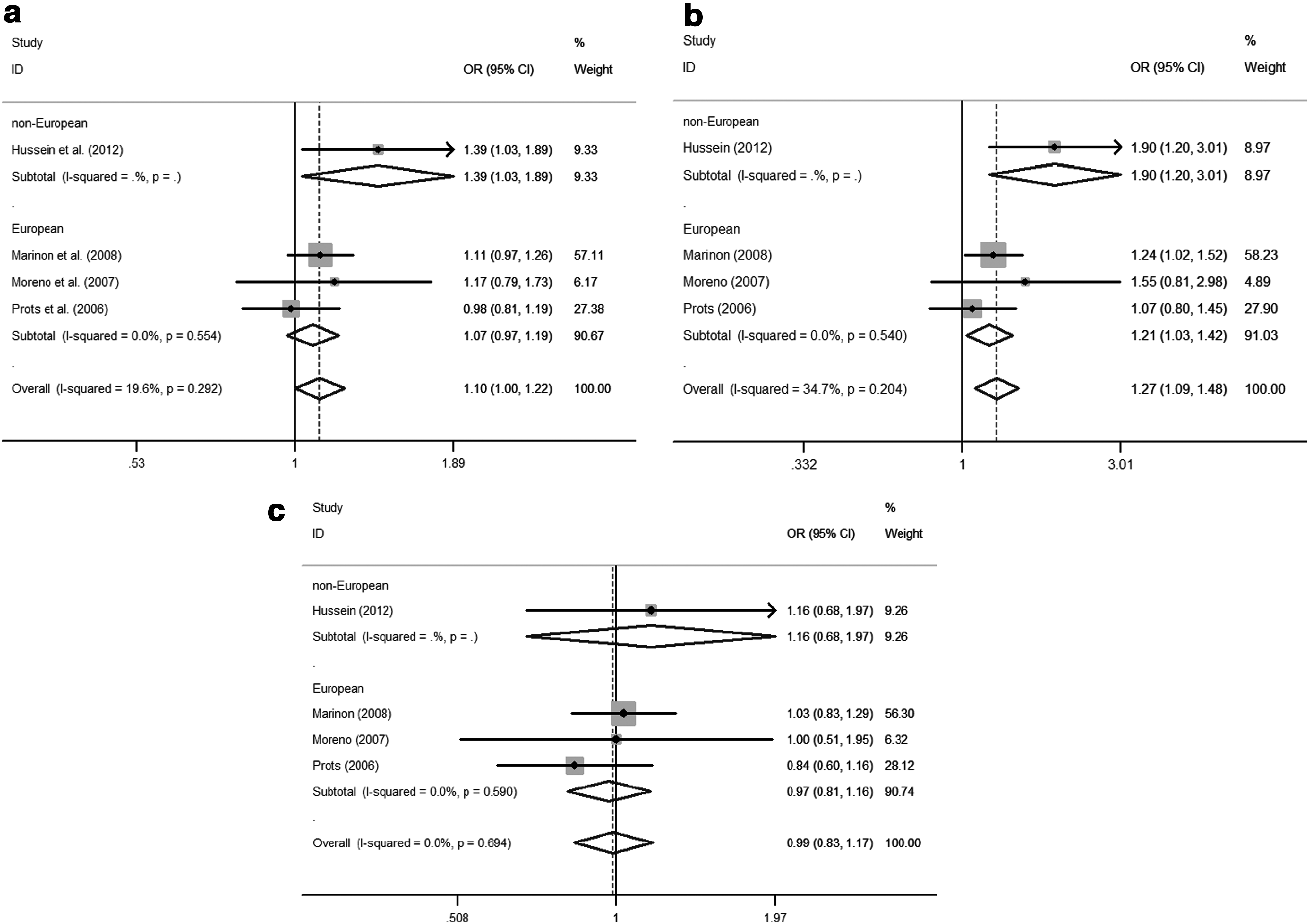
Forest plots for meta-analyses of European and overall populations on the association of IL-4R gene I50V polymorphisms and RA susceptibility. Significant associations were detected in the overall allelic contrast and the genotypic dominant model (VV+IV vs. II) in overall and European populations.
Association between IL-4R gene I50V polymorphism and RF positive in RA patients
Totally, four studies (Prots et al., 2006; Moreno et al., 2007; Marinou et al., 2008; Hussein et al., 2012) that assessed the relationship between the IL-4R gene I50V polymorphism and RF were included in the meta-analysis. Due to the insufficient data of genotypes in two studies (Moreno et al., 2007; Hussein et al., 2012), contrast of genotypes (dominant or recessive model) was not performed. Since significant heterogeneity was observed across studies, we conducted analyses using the random effects model. Regretfully, we did not detect any associations between the V allele of IL-4R gene I50V polymorphism and RF positive in RA patients of the overall or European population. The overall ORs were 1.129 (95% CI: 0.657-1.941) and 0.880 (95% CI: 0.530-1.462), respectively (Table 5).
NA, not available; RF, rheumatoid factor.
Heterogeneity and publication bias
The p-values of the Q-test and I2-statistics for heterogeneity are all described in Table 4. No significant between-study heterogeneity was observed in the meta-analysis of overall or subgroups when we explored the associations between IL-4R gene polymorphisms (Q551R, I50V) and RA risk. However, there was high heterogeneity (p<0.001, I2=87.7%) between studies in analysis for the V allele of IL-4R gene I50V variant and RF positive. When studies of an Egyptian and Spanish population by Hussein et al. (2012) and Moreno et al. (2007) were excluded, the heterogeneity was not identified (p=0.602, I2=0.0%), indicating that these two studies may contribute to the heterogeneity. Nevertheless, excluding these studies did not materially affect our result.
The funnel plot and Egger's test were performed to access publication bias. No obvious publication bias was shown in the results (Table 6).
Discussion
RA is one of the most heterogeneous complex autoimmune diseases. It is well recognized that there is individual susceptibility to autoimmune diseases even with the same environmental exposure. Host factors, including polymorphisms of genes involved in the pathogenesis of autoimmune diseases, may contribute to this difference. Therefore, genetic susceptibility to RA has been a research focus in the scientific community.
The IL-4Rα chain is responsible for IL-4 binding, transduction of the signal into the cell, and cellular response. Previous studies have suggested that the I variant of IL-4R gene I50V polymorphism of the extracellular domain could significantly upregulate the receptor response to IL-4, increase cell proliferation, and IgE production (Mitsuyasu et al., 1998; Bukhari et al., 2002). It has been proved that the anti-inflammatory effect of IL-4 is more pronounced in the presence of mutant variants of the gene of IL-4Rα chain (IL-4R gene Q551R variant) (Sandford et al., 2000; Shirakawa et al., 2000). These results indicate that I and R alleles are protective for RA. Since the first case-control study for the association between IL-4R gene Q551R polymorphisms and RA was reported in a Swiss population (Genevay et al., 2002), five studies have been undertaken to replicate the association (Prots et al., 2006; Suppiah et al., 2006; Moreno et al., 2007; Marinou et al., 2008; Hussein et al., 2012), what is more, the relation of IL-4R gene I50V polymorphisms and RA have been explored by four studies (Prots et al., 2006; Moreno et al., 2007; Marinou et al., 2008; Hussein et al., 2012). However, these results are inconclusive.
Meta-analysis is a means of augmenting the effective sample size through the pooling of data from individual association studies and enhancing the statistical power of the analysis for the estimation of genetic effects (Peng et al., 2012). In the current study, we did a meta-analysis to estimate the relationships between IL-4R gene Q551R, I50V polymorphisms and the susceptibility to RA. In the meta-analysis, the data of the overall and European subgroups showed that the IL-4R gene Q551R polymorphism may not be an RA susceptibility gene across populations. The pooled ORs for the R allele in the overall and European populations were 0.942 (95% CI: 0.848-1.047) and 0.979 (95% CI: 0.875-1.094). A marked association between IL-4R gene I50V polymorphisms and RA risk was finally detected in the overall and European populations, which was consistent with the previous studies (Mitsuyasu et al., 1998; Bukhari et al., 2002).
In addition, there are several studies investigating the association of IL-4R gene Q551R, I50V variants and clinical features in RA patients, but in different populations, these reveal enormous variability. For example, Prots et al. (2006) reported an association of these genetic polymorphisms with the rapid development of erosions and a diminished responsiveness to IL-4 by CD4+ T cells in German patients with RA, whereas Marinou et al. (2008) failed to support such associations in an English population. In Egyptian RA patients, Hussein et al. (2012) found that subjects with the VV genotype of IL-4R gene I50V were significantly more likely to have erosive arthropathy (OR=2.6, 95% CI: 1.1-6.1). The distinction between the effects of the IL-4R gene Q551R, I50V polymorphisms on the risk for several manifestations of RA in different studies may result from genetic heterogeneity, size of the studied groups, and different exposure of the populations to environmental factors. What is more, since the diagnostic standard of some clinical characteristics for RA in different places are not all the same, due to the high heterogeneity, it is hard to use a method of meta-analysis to assess these associations. We only conducted a meta-analysis based on the data from the previous four studies (Prots et al., 2006; Moreno et al., 2007; Marinou et al., 2008; Hussein et al., 2012) to evaluate the association of the V allele of IL-4R gene I50V variant and RF positive in RA patients. Finally, no marked relationship was detected in our current study. Whereas the result may be possibly affected by the high heterogeneity between studies (p<0.001, I2=87.7%), it can be explained by differences in patient populations (e.g., age and year from onset, female proportion, and disease severity).
This study is the first meta-analysis to assess the associations between IL-4R gene Q551R, I50V polymorphisms with the risk of RA. Nevertheless, several limitations of this study should be discussed. First, the number of total samples in the meta-analysis is not large, especially in the analysis performed to evaluate the relations of I50V variant and RA or RF positive. Furthermore, we only conducted a meta-analysis for the European population, because of the data limitation of the studies in other ethnic groups. Therefore, more studies stratified by ethnicity are still needed in future research. Second, significant between-study heterogeneity was identified in the meta-analysis on the relationship of IL-4R gene I50V polymorphisms with RF in RA patients. However, the heterogeneity had no substantial influence on the overall effect according to the results of the sensitivity analysis. Third, as the limitation of the genotypes data in two studies, genetic models (dominant and recessive model) in the meta-analysis for IL-4R I50V and RF were not performed. Fourth, our literature searching depended on English and Chinese, language bias might be considered.
In conclusion, the present study suggests that the IL-4R gene I50V polymorphism might contribute to the susceptibility to RA. However, there is still not enough evidence to indicate the association of the Q551R variant and the development of RA or V allele of IL-4R gene I50V polymorphisms and RF. To reach a definitive conclusion, further gene-gene and gene-environment interaction studies based on a larger sample size and stratified by ethnicity are still needed.
Footnotes
Acknowledgments
This work was partly supported by grants from the key program of the National Natural Science Foundation of China (30830089) and the Anhui Provincial Natural Science Foundation (11040606M183).
Author Disclosure Statement
The authors declare that there are no conflicts of interest.