




Abstract
Context: Increasing scientific evidence suggests that human equilibrative nucleoside transporter 1 (hENT1) may be a powerful predictor of survival in patients with pancreatic cancer treated with adjuvant gemcitabine-based chemotherapy after operative resection, but many existing studies have yielded inconclusive results. Objective: This meta-analysis aims to assess the prognostic role of hENT1 in predicting survival in patients with pancreatic cancer treated with gemcitabine. Methods: An extensive literature search for relevant studies was conducted on PubMed, Embase, Web of Science, Cochrane Library, and CBM databases from their inception through May 1, 2013. This meta-analysis was performed using the STATA 12.0 software. The crude hazard ratio (HR) with 95% confidence interval (CI) was calculated. Results: Eleven clinical studies were included in this meta-analysis with a total of 851 pancreatic cancer patients, including 478 patients in the high hENT1 expression group and 373 patients in the low hENT1 expression group. Our meta-analysis revealed that high hENT1 expression was associated with improved overall survival (OS) of pancreatic cancer patients (HR=2.61, 95% CI=2.02-3.34). Pancreatic cancer patients with high hENT1 expression also had a longer disease-free survival (DFS) than those with low hENT1 expression (HR=2.62, 95% CI=1.94-3.54). Further, high hENT1 mRNA showed significant association with improved OS and DFS of pancreatic cancer patients (HR=2.65, 95% CI=1.75-4.00; HR=3.29, 95% CI=1.85-5.84; respectively). Conclusion: In conclusion, our meta-analysis suggests that high hENT1 expression may be associated with improved OS and DFS of pancreatic cancer patients treated with gemcitabine. Detection of hENT1 expression may be a promising biomarker for gemcitabine response and prognosis in pancreatic cancer patients.
Introduction
P
The human equilibrative nucleoside transporter 1 (hENT1) protein is the major route for transporting gemcitabine into cells (Garcia-Manteiga et al., 2003; Fujita et al., 2010). It has been recently reported that hENT1 is predictive marker of response to adjuvant chemoradiation with gemcitabine (Garcia-Manteiga et al., 2003; Marechal et al., 2009; Voutsadakis, 2011). In vitro studies also showed that high hENT1 gene expression was significantly associated with increased chemosensitivity to gemcitabine (Mori et al., 2007; Michalski et al., 2008). Several previous studies have indicated that high hENT1 protein/mRNA expression was associated with increased overall survival (OS) and disease-free survival (DFS) (Farrell et al., 2009; Marechal et al., 2012; Morinaga et al., 2012). However, there are also some contradictory data in the literature concerning the prognostic value of hENT1 in predicting gemcitabine chemosensitivity for pancreatic cancer patients (Fujita et al., 2010). The controversial findings are probably related to the effects from interacting with other genes, environmental effects on gene expression, different detection methods, sample sizes, and study design. Therefore, we performed a meta-analysis of all eligible studies to provide insights into the prognostic role of hENT1 in predicting survival in patients with pancreatic cancer treated with gemcitabine.
Materials and Methods
Search strategy
An extensive literature search for relevant studies was conducted on PubMed, Embase, Web of Science, Cochrane Library, and CBM databases from their inception through May 1, 2013. We used the following keywords and MeSH terms: (“equilibrative nucleoside transport proteins” or “equilibrative nucleoside transportor” or “ENT” or “hENT” or “SLC29”) and (“pancreatic cancer” or “pancreatic neoplasm” or “pancreatic tumor” or “pancreatic carcinoma” or “pancreatic carcinogenesis”), and (“gemcitabine” or “GEM” or “deoxycytidine analog”). There were no language restrictions. Manual search of reference lists from potentially relevant articles was also performed to identify other potential studies.
Selection criteria
To be included in the meta-analysis, these studies must meet the following criteria: (1) clinical studies focused on the prognostic role of hENT1 in predicting survival in patients with pancreatic cancer treated with gemcitabine; (2) the minimum number of cases in the included studies should be greater than 20; (3) all patients diagnosed with pancreatic cancer were confirmed through histopathologic examinations; (4) published data on DFS and OS estimates were sufficient. Studies were excluded if they did not meet all of the inclusion criteria. If more than one study by the same author using the same case series were published, either the study with the largest sample size or the most recent publication was included. Any disagreements were resolved through discussions and subsequent consensus.
Data extraction
Two authors independently extracted data from eligible studies using a standardized form. The following information were collected: surname of first author, year of publication, source of publication, country of origin, ethnicity, language of publication, study design, total number of cases, pathological subtype, and detection method of hENT1 expression. In cases of conflicting evaluations, disagreements on inconsistent data from the eligible studies were resolved through discussions and careful reexaminations of the full text by the authors.
Quality assessment
The quality of the included studies was independently assessed by two authors (C.M.Y. and J.L.) based on the Newcastle-Ottawa Scale (NOS) criteria for the assessment of the quality of nonrandomized studies (Stang, 2010). The NOS criteria use a “star” rating system to judge the methodological quality, which was based on three perspectives of the study: selection, comparability, and outcome. Scores ranged from 0 stars (worst) to 9 stars (best); a score equal to or greater than 7 indicates a generally good methodological quality. Disagreements on the quality assessment of the included studies were resolved through a comprehensive reassessment by the authors.
Statistical analysis
Crude hazard ratio (HR) with 95% confidence interval (CI) was calculated under a fixed or random effect model. The significance of the pooled estimate was determined using the Z test. We estimated the degree of heterogeneity among studies using Cochran's Q-statistic, which is considered significant at p<0.05 (Jackson et al., 2012). The I2 test was also conducted to quantify heterogeneity (ranges from 0 to 100%) (Biggerstaff and Jackson, 2008). The random-effect model (DerSimonian Laird method) was conducted when there exists a significant Q-test with p<0.05 or I2>50%. When there was no statistical heterogeneity, we used the fixed-effects model (Mantel-Haenszel method). To explore potential sources of heterogeneity, subgroup analyses were performed based on ethnicity, treatment regimen, and type of hENT1 expression. To evaluate the influence of single studies on the overall estimate, we conducted a sensitivity analysis by omitting each study in turn to assess the quality and consistency of the results. To investigate whether publication bias might have affected the validity of the estimates, funnel plots were constructed. The symmetry of the funnel plots was further evaluated by Egger's linear regression test (Peters et al., 2006). All tests were two-sided with a p-value of <0.05 being considered statistically significant. All analyses were calculated using the STATA software, version 12.0 (Stata Corp, College Station, TX).
Results
Baseline characteristics of included studies
A total of 57 articles relevant to the searched keywords were initially identified. Of these articles, 23 were excluded after a review of their titles and key words; then, abstracts and full texts were reviewed, and another 23 articles were excluded. Eleven clinical studies met our inclusion criteria for this meta-analysis (Spratlin et al., 2004; Giovannetti et al., 2006; Farrell et al., 2009; Marechal et al., 2009, 2012; Fujita et al., 2010; Kim et al., 2011a; Kondo et al., 2012; Morinaga et al., 2012; Murata et al., 2012; Nakagawa et al., 2013). The flow chart of the study selection process is shown in Figure 1. Publication years of the eligible studies ranged from 2004 to 2013. A total of 851 pancreatic cancer patients were involved in this meta-analysis, including 478 patients in the high hENT1 expression group and 373 patients in the low hENT1 expression group. Overall, six studies were conducted in Caucasian populations, and the other five studies in Asian populations. Detetion methods include immunohistochemistry and quantitative reverse transcription-polymerase chain reaction. The characteristics and methodological quality of the included studies are summarized in Table 1.

Flowchart of the literature search and study selection.
hENT1, human equilibrative nucleoside transporter 1; GEM, gemcitabine; qRT-PCR, quantitative reverse transcription-polymerase chain reaction; OS, overall survival; DFS, disease-free survival; NOS, the Newcastle-Ottawa Scale.
Quantitative data synthesis
A summary of the meta-analysis findings for the role of the expression of hENT1 in predicting survival of pancreatic cancer patients treated with gemcitabine is provided in Table 2. Since heterogeneity obviously existed, which could be a result of differences in ethnicity, treatment regimen, and type of hENT1 expression, the random effects model was conducted. The meta-analysis results revealed that high hENT1 expression was associated with improved OS of pancreatic cancer patients (HR=2.54, 95% CI=1.98-3.10, p<0.001) (Fig. 2). Pancreatic cancer patients with high hENT1 expression also had a longer DFS than those with low hENT1 expression (HR=2.71, 95% CI=1.92-3.50, p<0.001) (Fig. 3).
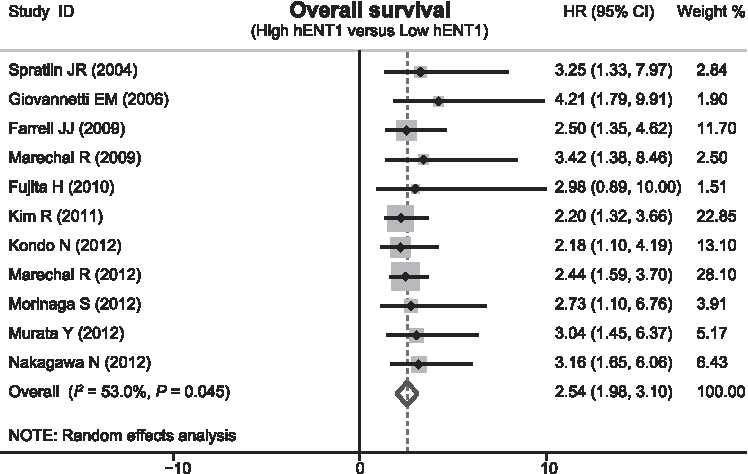
Forest plots for the associations between the human equilibrative nucleoside transporter 1 (hENT1) expression and overall survival (OS) in pancreatic cancer patients who received gemcitabine. The squares and horizontal lines correspond to the study specific hazard ratio (HR) and 95% confidence interval (95% CI). The area of the squares reflects the weight. The diamond represents the summary HR and 95% CI.
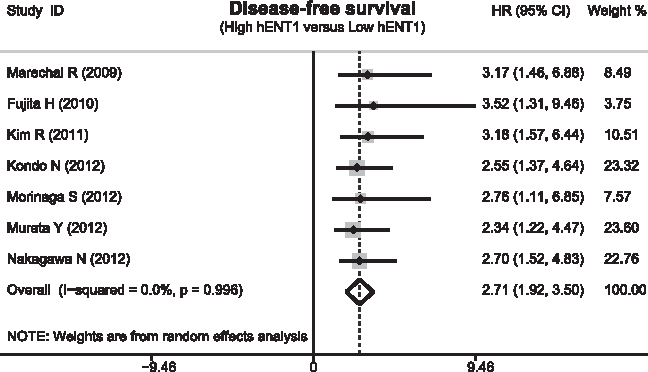
Forest plots for the associations between the hENT1 expression and disease-free survival (DFS) in pancreatic cancer patients who received gemcitabine. The squares and horizontal lines correspond to the study-specific HR and 95% CI. The area of the squares reflects the weight. The diamond represents the summary HR and 95% CI.
HR, hazard ratio; 95% CI, 95% confidence interval.
Subgroup analysis by ethnicity indicated that high hENT1 expression may improve OS and DFS of pancreatic cancer patients among Caucasian and Asian populations (all p<0.05). Further subgroup analysis by treatment regimen and type of hENT1 expression also showed significant associations between high hENT1 expression and improved OS and DFS of pancreatic cancer patients in each subgroup (as shown in Table 2).
Evaluation of heterogeneity and publication bias
Sensitivity analysis was also performed to assess the influence of each individual study on the pooled HR by omitting each individual studies in turn to assess the quality and consistency of the results. The analysis results suggested that no individual studies significantly affected the pooled HRs. Funnel plots and Egger's linear regression test were used to assess potential publication bias in the included studies. The shapes of the funnel plots did not reveal any evidence of obvious asymmetry (Fig. 4). Egger's test also did not display strong statistical evidence for publication bias (all p>0.05).
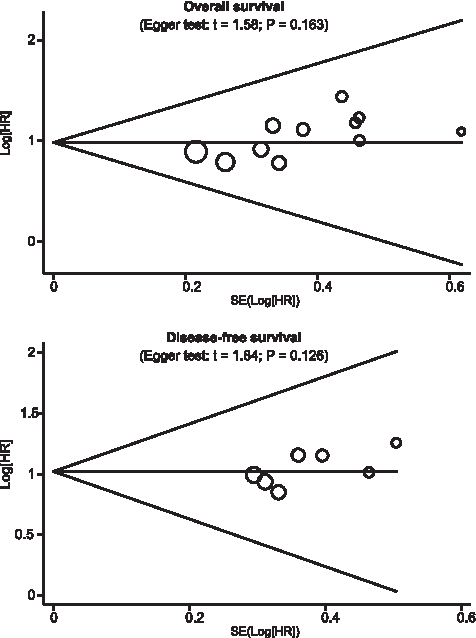
Funnel plots of the meta-analysis show the pooled HR estimates of the prognostic role of the hENT1 expression in predicting survival of pancreatic cancer patients who received gemcitabine. Each point represents a separate study for the indicated association. Log[HR], natural logarithm of HR. Horizontal line, mean magnitude of the effect. Note: Funnel plot with pseudo 95% confidence limits was used.
Discussion
Pancreatic cancer is one of the most lethal human cancers with an overall 5-year survival rate of less than 5% (Li et al., 2004; Neoptolemos et al., 2010). However, during the last decade, few successes have been archived in the treatment of pancreatic cancer (Choi et al., 2012).The most successful agent for pancreatic cancer treatment is gemcitabine, although the overall effect in terms of patient survival remains very poor (Kovacevic et al., 2011). Cellular uptake of the anticancer drug gemcitabine is mainly mediated by hENT1 (Robins et al., 2010). It has been hypothesized that deficiency of the hENT1 transporter may contribute to clinical gemcitabine resistance (Lai et al., 2008). Increasingly strong evidence suggests hENT1 is a prognostic biomarker in gemcitabine-treated pancreatic cancer, and may well be a predictive biomarker of gemcitabine efficacy (Spratlin et al., 2004; Murata et al., 2012). There is a compelling biological rationale for using the expression level of hENT1 to predict gemcitabine chemosensitivity and prognosis of pancreatic cancer patients.
Our meta-analysis suggested that high hENT1 expression was associated with improved OS and DFS of pancreatic cancer patients treated with gemcitabine-based regimens. These results indicated that the efficacy of adjuvant chemoradiation with gemcitabine is associated with the expression level of hENT1, which is consistent with previous studies. Farrell et al. (2009) reported that hENT1 protein expression was associated with increased DFS and OS in pancreatic cancer patients who received gemcitabine, but not in those who received 5-fluorouracil (5-FU). Murata et al. (2012) demonstrated that the 1- and 3-year OS rates were significantly greater in the high hENT1 expression group than in the low hENT1 expression group. Other previous studies also indicated that the hENT1 expression was a significant and independent prognostic factor for OS (Marechal et al., 2012; Morinaga et al., 2012) In the current study, we also performed subgroup analyses based on ethnicity, treatment regimen, and type of hENT1 expression to further evaluate the prognostic value of hENT1 expression for survival in pancreatic cancer patients who received gemcitabine. The results strongly suggested that detection of hENT1 expression may be a promising biomarker for gemcitabine response and prognosis in pancreatic cancer patients.
Indeed, other than gemcitabine-based regimens, there do exist several other methods that have significant anticancer effects on pancreatic cancer (Conroy et al., 2011; Seufferlein, 2013). However, without knowledge of genetic background of certain disease, chemotherapy administered to patients may affect drug efficacy (Borbath et al., 2012). For example, 5-FU, S-1 (TS-1), capecitabine, irinotecan, and 6-mercaptopurine are current therapeutic options (Giovannetti et al., 2006; Tempero et al., 2011). Among them, 5-FU, previous experiment results had shown that 5-FU might lead to an increase in cell surface hENT1, which could potentially augment drug efficacy (Nakata et al., 2010). Although concurrent treatment or gemcitabine prior to 5-FU rarely existed, pancreatic cancer cell pretreatment lines in vitro and in vivo with 5-FU were usually adopted to strengthen the effects of single-agent gemcitabine treatment (Nakahira et al., 2008). In addition, treatment with S-1 resulted in hENT1 upregulation at the mRNA level, and thus S-1 was more convenient and helps improvement of median survival time in pancreatic cancer (Ueno et al., 2011; Song et al., 2013). Another drug, capecitabine, had shown activity in combination with gemcitabine in locally advanced or metastatic pancreatic cancer patients with regard to the assessment of hENT1 (Pliarchopoulou and Pectasides, 2009). Nevertheless, evidence for other biomarkers is limited by a small number of publications investigating these markers; hence, we do not present a further meta-analysis on the above treatment options.
Our meta-analysis has several limitations that should be acknowledged. The first major limitation is the relatively small sample size of this meta-analysis, which may not have sufficient statistical power in estimating the prognostic role of hENT1 expression in pancreatic cancer. Therefore, more studies with larger sample size are still needed. On the other hand, as a type of a retrospective study, a meta-analysis of summary data from previously published studies may encounter recall or selection bias, thereby possibly influencing the reliability of the results. Most important of all, the lack of access to all the data from the original studies limited further evaluations of the potential values of hENT1 expression. However, despite these statistical limitations, our study is the first comprehensive meta-analysis of all eligible studies concerning the prognostic role of hENT1 expression in predicting survival in patients with pancreatic cancer treated with gemcitabine.
In conclusion, our meta-analysis indicates that high hENT1 expression may be associated with improved OS and DFS of pancreatic cancer patients treated with gemcitabine. Detection of hENT1 expression may be a promising biomarker for gemcitabine response and prognosis in pancreatic cancer patients. However, due to the limitations mentioned above, further detailed studies are still required to confirm our findings.
Footnotes
Acknowledgments
We would like to acknowledge the helpful comments on this article received from reviewers. We thank all our colleagues working in the Department of Minimally Invasive Surgery, The First Affiliated Hospital of Liaoning Medical University. The work was funded by the Youth Science and Technology Foundation of The First Affiliated Hospital of Liaoning Medical University (FY2012-2013).
Author Disclosure Statement
No competing financial interests exist.