




Abstract
Aims:
Current scientific evidence suggests that the apolipoprotein E epsilon4 (APOE4) allele may be associated with a good prognosis for patients with traumatic brain injury (TBI); however, many existing studies have yielded inconclusive results. This meta-analysis aims to obtain a more precise estimation of the association between APOE4 allele and prognosis of TBI patients.
Methods:
A literature search of PubMed, Embase, Web of Science, Cochrane Library, CISCOM, CINAHL, Google Scholar, CNKI and CBM databases was conducted for articles published before July 1st, 2013. Crude odds ratios (OR) with 95% confidence intervals (CI) were calculated. Results: Thirteen cohort studies were included with a total of 662 TBI patients with APOE4 (+) and 1614 TBI patients with APOE4 (−). The meta-analysis results revealed that the APOE4 allele was associated with a poor prognosis in TBI patients (OR=0.68, 95% CI: 0.48-0.96, p=0.027). Subgroup analysis by ethnicity indicated that TBI patients with APOE4 (+) had a worse prognosis than those with APOE4 (−) in Asian populations (OR=0.46, 95% CI: 0.21-0.99, p=0.046), but not in Caucasian populations (OR=0.75, 95% CI: 0.53-1.08, p=0.120). A further subgroup analysis by TBI grade showed that the APOE4 allele was associated with poor prognosis in severe TBI patients (OR=0.43, 95% CI: 0.21-0.87, p=0.020). However, there was no evidence for any association between the APOE4 allele and poor prognosis in patients with other grades of TBI (all p>0.05). Conclusion: The current meta-analysis indicates that the APOE4 allele may be associated with a poor prognosis in severe TBI patients and in Asian populations. The APOE4 allele may be used as a biomarker in predicting the prognosis of TBI patients.
Introduction
T
APOE, a multifunctional 299-amino-acid protein, is the principal lipoprotein found in the brain and cerebrospinal fluid (CSF) (Hatters et al., 2006; Christensen et al., 2011). APOE is thought to be responsible for the transportation of lipids within the brain, for maintaining the overall structural integrity of microtubules within neurons, and for assisting with neural transmission (Graham et al., 1999; Nathoo et al., 2003b); thus, it has an effect on the immunological response to cerebral trauma. Over the past decades, clinical evidence has suggested that APOE may play an important role in transporting lipids from astrocytes to injured neurons in the central nervous system and redistributing lipids to regenerate axons and Schwann cells in peripheral nerve injuries (Li et al., 2010; Hauser et al., 2011; Mahley and Huang, 2012). This evidence has revealed that APOE may play an isoform-specific role in determining the initial response and the subsequent development of acute brain injuries.
The human APOE gene consists of four exons and is located in a cluster of other apolipoprotein genes on chromosome 19q13.2 (Bekris et al., 2010; Cervantes et al., 2011). Until now, three common APOE gene polymorphisms, ɛ2, ɛ3, and ɛ4 have been identified as potential candidates for influencing the outcome of TBI (Xue et al., 2012); of these, the APOE epsilon4 (APOE4) polymorphism has received the most attention. Many studies have been conducted to investigate the potential association between the APOE4 allele and the clinical outcomes of TBI patients; however, the results have been controversial. Some case-control studies observed a significant association between the APOE4 allele and good prognoses for TBI patients (Teasdale et al., 1997; Chiang et al., 2003; Ost et al., 2008), while other studies failed to prove such an association (Friedman et al., 1999; Gu et al., 2007; Willemse-van Son et al., 2008). These inconsistent findings may be caused by limited sample sizes in the corresponding investigations, from which inferences are difficult to generalize, or by the inadequate statistical power of genetic studies of complex traits, such as age, ethnicity, gender, grade of TBI, and research methodology. In view of this, we performed a meta-analysis of all eligible studies to determine the relationship between the APOE4 allele and TBI prognosis. Understanding this relationship is potentially useful for early TBI identification and treatment.
Materials and Methods
Search strategy
An extensive literature search was conducted in PubMed, Embase, Web of Science, Cochrane Library, CISCOM, CINAHL, Google Scholar, CNKI and CBM databases for relevant studies published up until July 1st, 2013. We used the following keywords and MeSH terms: [“genetic polymorphism” or “single nucleotide polymorphism” or “polymorphism” or “SNP” or “mutation” or “variation” or “variant”] and [“traumatic brain injury” or “head injury” or “cerebral injury”] and [“apolipoprotein E” or “APOE” or “epsilon4” or “APOE4”]. A manual search of reference lists for potentially relevant articles was also performed to identify additional potential studies.
Selection criteria
To be included in this meta-analysis, studies must meet the following criteria: (1) the type of study is a clinical case-control of cohort study; (2) the study focuses on the association between the APOE4 allele and the prognosis of TBI patients; (3) all patients were diagnosed with TBI; (4) the study provides sufficient information to extract allele frequencies; and (5) the publication is in English or Chinese. No language restrictions were used. Studies were excluded if they did not meet all of the inclusion criteria. If more than one study by the same author was published using the same case series, either the study with the largest sample size or with the most recent publication was included. All disagreements were resolved through discussions and subsequent consensus.
Data extraction
Two authors independently extracted data from eligible studies using a standardized form. The following information was collected: surname of first author, year of publication, source of publication, country of origin, ethnicity, language of publication, study type, total number of subjects, source of subjects, clinical subtype, detection method of SNP, and allele frequencies. In cases of conflicting evaluations, disagreements were resolved through discussions and careful reexaminations of the full text by the authors.
Quality assessment
The quality of the included studies was independently assessed by two authors based on the Newcastle-Ottawa Scale (NOS) (Stang, 2010). The NOS criteria use a “star” rating system to judge a study's methodological quality, which is evaluated based on three aspects: selection, comparability, and exposure. Scores ranged from 0 stars (worst) to 9 stars (best); a score equal to or greater than 7 indicates a generally good methodological quality. Disagreements over the NOS scores of the included studies were resolved through a comprehensive reassessment by the authors.
Statistical analysis
The crude odds ratios (OR) with 95% confidence intervals (CI) were calculated. The significance of the pooled OR was determined using the Z test. We estimated the degree of heterogeneity among the studies using Cochran's Q-statistic, which is considered significant at p<0.05 (Zintzaras and Ioannidis, 2005). The I2 test was also conducted to quantify heterogeneity (ranges from 0% to 100%) (Ioannidis et al., 2008). The random-effect model (DerSimonian Laird method) was conducted in cases of significant heterogeneity, which was determined by a Q-test with p<0.05 or I2>50%. When there was no statistical heterogeneity, we used the fixed-effects model (Mantel-Haenszel method). To explore potential sources of heterogeneity, subgroup analyses were performed based on ethnicity and TBI grade. To evaluate the influence of single studies on the overall estimate, we conducted a sensitivity analysis by omitting each study in turn to assess the quality and consistency of the results. To investigate whether publication bias might have affected the validity of the estimates, funnel plots were constructed. The symmetry of the funnel plots was further evaluated by Egger's linear regression test (Peters et al., 2006). All tests were two-sided with a p-value of<0.05 being considered statistically significant. All analyses were calculated using the STATA software, version 12.0 (Stata Corp., College Station, TX).
Results
Baseline characteristics of included studies
A total of 106 articles relevant to the searched keywords were initially identified. Of these articles, 49 were excluded after a review of their titles and abstracts; full texts and data integrity were then reviewed and another 44 articles were excluded. Thirteen case-control studies met the inclusion criteria for this meta-analysis (Sorbi et al., 1995; Teasdale et al., 1997; Friedman et al., 1999; Chiang et al., 2003; Millar et al., 2003; Nathoo et al., 2003a; Teasdale et al., 2005; Gu et al., 2007; Jiang et al., 2008; Ost et al., 2008; Willemse-van Son et al., 2008; Lo et al., 2009; Pruthi et al., 2010). Publication years of the eligible studies ranged from 1995 to 2010. The flow chart of the study selection process is shown in Figure 1. The distribution of the number of topic-related literatures in the electronic database during the last decade is shown in Figure 2. A total of 2276 subjects were involved in this meta-analysis, including 662 TBI patients with APOE4 (+) and 1614 TBI patients with APOE4 (−). Of the 13 studies, four were conducted in Asian populations and the other nine were conducted in Caucasian populations. The classical polymerase chain reaction (PCR)-restriction fragment length polymorphism method was performed in twelve studies, while the solid-phase PCR was only performed in one study. The characteristics and methodological quality of the included studies are summarized in Table 1.

Flowchart of the literature search and study selection process. Thirteen cohort studies were included in this meta-analysis.
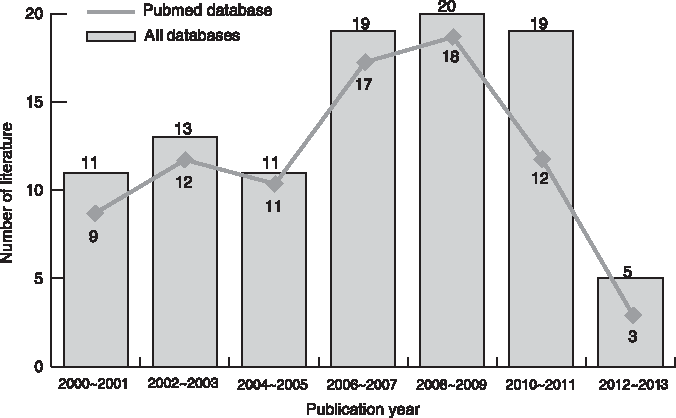
The distribution of the number of topic-related studies in the electronic database during the last decade.
Ref, reference; APOE4, apolipoprotein E epsilon4; TBI, traumatic brain injury; NOS, Newcastle-Ottawa Scale; PCR-RFLP, polymerase chain reaction-restriction fragment length polymorphism; SP-PCR, solid-phase PCR.
Quantitative data synthesis
Since there was heterogeneity among the studies, which could be a result of differences in ethnicity and TBI grade, the random effects model was conducted. The meta-analysis results revealed that the APOE4 allele was associated with poor prognosis in TBI patients (OR=0.68, 95% CI: 0.48-0.96, p=0.027) (Fig. 3). Subgroup analysis by ethnicity indicated that TBI patients with APOE4 (+) had a worse prognosis than those with APOE4 (−) in Asian populations (OR=0.46, 95% CI: 0.21-0.99, p=0.046), but not in Caucasian populations (OR=0.75, 95% CI: 0.53-1.08, p=0.120) (Fig. 4). Further subgroup analysis by TBI grade showed that the APOE4 allele was associated with poor prognosis in severe TBI patients (OR=0.43, 95% CI: 0.21-0.87, p=0.020) (Fig. 5). However, there was no evidence for any association between APOE4 allele and poor prognosis in TBI patients with other grades (all p>0.05).

Forest plots for the association between the APOE4 allele and the prognosis of TBI patients under the random effects model. APOE4, apolipoprotein E epsilon4; TBI, traumatic brain injury.
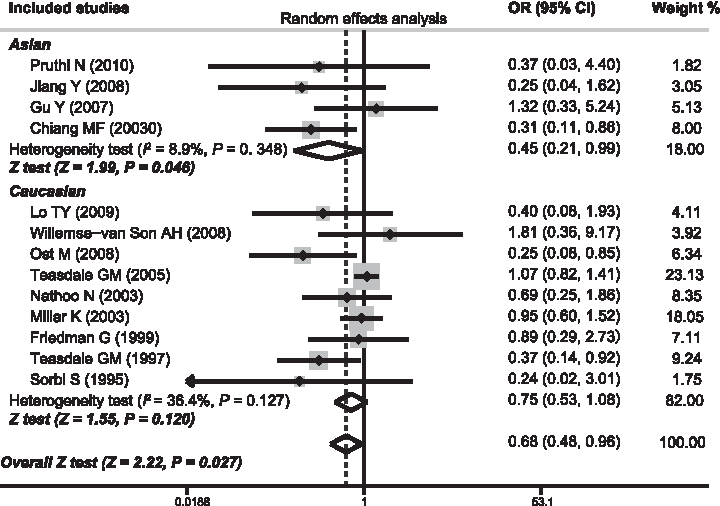
Subgroup analysis by ethnicity for the association between APOE4 allele and prognosis of TBI patients under the random effects model.

Subgroup analysis by TBI grade for the association between APOE4 allele and prognosis of TBI patients under the random effects model.
Meta-regression and sensitivity analyses
Univariate and multivariate meta-regression analyses were used to explore possible sources of heterogeneity. The results show that TBI grade may be the main source of heterogeneity (as shown in Table 2). Sensitivity analysis was performed to assess the influence of each individual study on the pooled ORs by omitting each individual in turn. The analysis results suggested that no individual study significantly affected the pooled OR, indicating statistically robust results (Fig. 6).

Sensitivity analyses for the associations between the APOE4 allele and the prognosis of TBI patients. Results were computed by omitting each study in turn. Meta-analysis random-effects estimates (exponential form) were used. The two ends of the dotted lines represent the 95% confidence interval.
SE, standard error; 95% CI=95% confidence interval; LL, lower limit; UL, upper limit.
Publication bias evaluation
Begger's funnel plots and Egger's linear regression test were used to assess potential publication bias in the included studies. The shapes of the funnel plots did not reveal any evidence of obvious asymmetry (Fig. 7). Egger's test also did not display strong statistical evidence for publication bias (t=1.27, p=0.230).

Begger's funnel plot for the associations between the APOE4 allele and prognosis of TBI patients. Each point represents a separate study for the indicated association. Horizontal line, mean magnitude of the effect. Log[OR], natural logarithm of odds ratio; SE, standard error.
Discussion
APOE, a key class of lipoproteins found in the brain and CSF, functions as a mediator of cholesterol and lipid transport in cell maintenance and growth (Maysinger et al., 2008). APOE is believed to play an important role in the repair and regeneration of neurologic damage by modulating the recycling of cellular membrane components from damaged neurons (Sun and Jiang, 2008). The human APOE gene is located on chromosome 19q13.2, which contains four exons and three introns with an approximate length of 3.7 kb (Bekris et al., 2010; Cervantes et al., 2011). The APOE protein is presented in three major isoforms, namely apoE2, apoE3, and apoE4, which have frequencies in the general population of 7%, 78%, and 15% respectively (Cun et al., 2010). Ever since the discovery of a correlation between the APOE gene polymorphisms and late-onset Alzheimer's disease in 1995 by Mayeux et al. (1995), the importance attached to APOE in neurodegenerative diseases has markedly increased (Martins et al., 1995; Langlois et al., 2005). Further, its potential association with TBI has been postulated and recently has attracted more and more interest. TBI is a severe public health problem and epidemic that lacks public awareness (Langlois et al., 2005). TBI is the leading cause of mortality and morbidity worldwide among individuals under the age of 45 (Werner and Engelhard, 2007). The occurrence of TBI has been reported in various incidents: 28% of falls, 20% of motor vehicle accidents, 19% of being struck by object, and 11% of assaults (Langlois et al., 2005). Patients with TBI could suffer multiple neurologic consequences such as headaches, movement disorders, seizures, visual defects, and sleep disorders. Even mild brain injuries can result in persistent neurobehavioral impairments (Messe et al., 2011). The possible link between the APOE gene polymorphism and clinical outcomes of TBI patients was originally postulated more than a decade ago (Nicoll et al., 1995). Nicoll et al. have found that the APOE4 allele may increase the genetic risk of TBI. Further, the presence of the APOE4 allele in patients with TBI has been closely correlated with prolonged hospitalization, longer consciousness loss, higher rates of fatality, enhanced hematoma and contusion, and increased potential for post-traumatic seizures (Sorbi et al., 1995; Friedman et al., 1999; Liaquat et al., 2002; Chiang et al., 2003; Diaz-Arrastia et al., 2003; Smith et al., 2006). Recently, accumulated studies and experiments have also confirmed the strong association between the APOE4 allele and the prognosis of TBI patients (Teasdale et al., 1997; Chiang et al., 2003; Ost et al., 2008), while other studies insisted that no association exists between them (Friedman et al., 1999; Gu et al., 2007; Willemse-van Son et al., 2008). In the present study, we performed a meta-analysis of all eligible case-control studies to determine the association between the APOE4 allele and the prognosis of TBI patients, which may be potentially important for TBI early identification and treatment.
In this meta-analysis, 13 independent cohort studies were included with a total of 662 TBI patients with APOE4 (+) and 1614 TBI patients with APOE4 (−). When all eligible studies were pooled into the meta-analysis, results showed that the APOE4 allele was associated with a poor prognosis in TBI patients, indicating that the APOE4 allele may be a good biomarker for predicting the poor prognosis of TBI patients. Some studies have also demonstrated that the APOE4 allele probably is associated with a more positive prognosis for TBI patients (Teasdale et al., 1997; Chiang et al., 2003; Ost et al., 2008). The apparent discrepancy may be explained by subgroup analysis by ethnicity, which shows a significant association between the APOE4 allele and a worse prognosis for TBI patients in Asian populations but not in Caucasian populations, suggesting that ethnic differences may be a determining factor for the effects of the APOE4 allele on the prognosis of TBI patients. Although the exact mechanism of the observed ethnic differences is not clear, a potential explanation might be that ethnicity is an important demographic variable contributing to the development and progression of TBI. Therefore, more large-scale investigations are required. Our findings are consistent with previous studies that suggested the APOE4 allele may be associated with a poor prognosis for TBI patients and may be useful as a biomarker in predicting the prognosis of TBI patients.
In interpreting our current meta-analysis results, some limitations need to be addressed. First, the sample size is still relatively small and thus may not provide sufficient statistical power to estimate the correlation between the APOE4 allele and the prognosis of TBI patients. Therefore, more studies with larger sample sizes are needed to provide a more accurate statistical analysis. Second, as a retrospective study, a meta-analysis may encounter recall or selection bias, possibly influencing the reliability of our results (Stroup et al., 2000). Third, our lack of access to the original data from the included studies limited further evaluation of potential interactions between other factors and their effects on the prognosis of TBI patients. Finally, although all cases and controls of each study were well defined with similar inclusion criteria, there may be other factors that were not taken into account and might have influenced our results.
In conclusion, this meta-analysis provides strong evidence that the APOE4 allele may be associated with poor prognosis of severe TBI patients, especially in Asian populations. Thus, the APOE4 allele may be used as a biomarker in predicting the prognosis of TBI patients. Based on the limitations mentioned above, detailed studies are still needed to confirm our findings. Further studies are still needed to warrant and validate the association between the APOE4 allele with other gene polymorphisms and the clinical outcome of TBI patients.
Footnotes
Acknowledgments
We would like to acknowledge the helpful comments on this article received from our reviewers. The work is funded by the army medical science and technology major projects during the 12th Five Year Plan (AWS11J008).
Author Disclosure Statement
We declare that we have no conflicts of interest.