




Abstract
Objective: We conducted the present meta-analysis to investigate whether single-nucleotide polymorphisms (SNPs) in the SUMO1 gene contribute to the risk of nonsyndromic cleft lip with or without palate (NSCL/P). Method: The Web of Science (1945-2013), the Cochrane Library Database (Issue 12, 2013), PubMed (1966-2013), EMBASE (1980-2013), CINAHL (1982-2013), and the Chinese Biomedical Database (CBM) (1982-2013) were searched without language restrictions. Meta-analysis was performed with the use of the STATA statistical software. Results: Six studies with a total of 1381 NSCL/P patients and 2054 control subjects were included. Twenty-seven functional polymorphisms in the SUMO1 gene were assessed. Our results indicated that SUMO1 genetic polymorphisms were correlated with an increased risk of NSCL/P. Subgroup analysis by the SNP type indicated that 4 functional polymorphisms (rs12470401 T>C, rs16838917 A>G, rs12470529 A>G, and rs7572505 A>G) in the SUMO1 gene might be strongly correlated with NSCL/P risk. Furthermore, ethnicity-stratified analysis demonstrated that SUMO1 genetic polymorphisms were closely related to an increased risk of NSCL/P among both Asians and Caucasians. Conclusion: Our findings provide empirical evidence that SUMO1 genetic polymorphisms might be strongly involved in the etiology of NSCL/P, especially for rs12470401 T>C, rs16838917 A>G, rs12470529 A>G, and rs7572505 A>G polymorphisms.
Introduction
C
The small ubiquitin-like modifier 1 (SUMO-1) is a critical member of the ubiquitin-related protein family, which acts as an important part of a posttranslational modification system by binding to intracellular target proteins (de Assis et al., 2011). As a matter of fact, the posttranslational modification called SUMOylation is demonstrated to be an important regulator of protein function in numerous biological events (Geoffroy and Hay, 2009; Wilkinson and Henley, 2010). It is noteworthy that SUMO1 has also been suggested to be implicated in a variety of cellular processes, including nuclear transport, transcriptional regulation, apoptosis, and protein stability (Wilkinson et al., 2010; Chang et al., 2011). In the clinic, SUMO1 is showed to be expressed in the upper lip, primary palate, and medial edge epithelia of the secondary palate; and functional studies on SUMO1 have also provided support for its role in craniofacial development (Alkuraya et al., 2006). In addition, SUMO1 also modulates the function of the T-box transcription factor TBX22, whose mutation has been postulated to be closely correlated with the X-linked cleft palate and ankyloglossia (de Assis et al., 2011); moreover, SUMOylation is necessary for normal TBX22 transcriptional repressor activity during craniofacial development (Andreou et al., 2007). Consequently, it is conceivable that genetic variants in the SUMO1 gene, which have significant effects on the expression and function of SUMO1, may be possibly associated with susceptibility to NSCL/P (Jia et al., 2010). The human SUMO1 gene is located on chromosome 2p33, consists of five exons and four introns, and spans ∼12 kb (Garcia-Hoyos et al., 2004). It was frequently reported that patients with NSCL/P always carried a balanced translocation, which disrupted the SUMO1 gene, and more importantly, SUMO1 haploinsufficiency was shown to be the major cause that contributes to the progression and development of NSCL/P (Alkuraya et al., 2006). In recent decades, several functional polymorphisms in the SUMO1 gene such as rs6761234 T>C, rs12470401 C>T, rs7599810 T>C, and rs6435133 G>T have been identified in relevant studies on NSCL/P (Song et al., 2008; Jia et al., 2011b). Many human studies supported that SUMO1 genetic polymorphisms may play crucial roles in the pathogenesis of NSCL/P (de Assis et al., 2011; Jia et al., 2011b), but other studies have also illustrated inconsistent results (Carta et al., 2012; Guo et al., 2012). Therefore, we conducted the updated meta-analysis to determine whether genetic polymorphisms in the SUMO1 genes may contribute to the risk of NSCL/P.
Materials and Methods
Literature search and selection criteria
The Web of Science (1945-2013), the Cochrane Library Database (Issue 12, 2013), PubMed (1966-2013), EMBASE (1980-2013), CINAHL (1982-2013), and the Chinese Biomedical Database (CBM) (1982-2013) were searched without language restrictions. We used the following keywords and MeSH terms in conjunction with a highly sensitive search strategy: (“genetic polymorphism” or “single nucleotide polymorphism” or “polymorphism” or “SNP” or “mutation” or “variation” or “variant”) and (“SUMO-1 protein” or “small ubiquitin-related modifier 1” or “SUMO-1” or “SUMO1” or “gap-modifying protein 1” or “SMT3C” or “GMP1”) and (“cleft lip” or “cleft palate” or “non-syndromic oral clefts” or “non-syndromic cleft lip and palate” or “NSCLP” or “nonsyndromic cleft lip with or without palate” or “NSCL/P”). A manual search of reference lists from the relevant articles was conducted to find further potential articles.
The following criteria were used to determine eligibility for including studies: (1) the study must focus on the associations between SUMO1 genetic polymorphisms and the risk of NSCL/P; (2) all patients should meet the diagnostic criteria for NSCL/P; (3) the genotype frequencies of healthy controls should not deviate from the Hardy-Weinberg equilibrium (HWE); and (4) the study must supply sufficient information on the genotype frequencies of SUMO1 genetic polymorphisms. Articles that did not meet the inclusion criteria were excluded. When authors published several studies using the same subjects, either the most recent or largest sample size publication was included.
Data extraction and methodological assessment
Two authors used a standardized form to extract the following data from included studies: language of publication, publication year of article, the first author's surname, geographical location, design of study, total number of cases, sample size, the source of the subjects, genotype frequencies, genotyping method, etc. Methodological quality was assessed, respectively, by two observers using the Newcastle-Ottawa Scale (NOS) criteria (Stang, 2010). Three aspects were included in the NOS criteria: (1) subject selection: 0-4; (2) comparability of subject: 0-2; and (3) clinical outcome: 0-3. NOS scores range from 0 to 9 with scores ≥7 indicating good quality.
Statistical analysis
Meta-analysis was performed using the STATA statistical software (Version 12.0; Stata Corporation, College Station, TX). We calculated odds ratio (OR) and its 95% confidence interval (95% CI) to estimate the associations between SUMO1 genetic polymorphisms and the risk of NSCL/P. The Z test was used to estimate the statistical significance of pooled ORs. Heterogeneity among studies was estimated by the Cochran's Q-statistic and I2 tests (Zintzaras and Ioannidis, 2005a). If the Q-test showed a p<0.05 or I2 test exhibited >50%, which indicate significant heterogeneity, the random-effects model was used. Otherwise, the fixed-effects model was used (Zintzaras and Ioannidis, 2005b). We also explored potential sources of heterogeneity by conducting subgroup analyses. To evaluate the influence of single studies on the overall estimate, a sensitivity analysis was employed. Funnel plots and Egger's linear regression test were applied to investigate publication bias (Peters et al., 2006).
Results
Characteristics of included studies
Initially, our search strategy identified 44 articles. We reviewed the titles and abstracts of all articles and excluded 19 articles. After systematically reviewing the remaining full texts, we excluded another 17 articles. In addition, one study was excluded due to lack of data integrity (Fig. 1). Finally, six independent case-control studies containing a total of 1381 patients with NSCL/P and 2054 healthy controls were in line with our inclusion criteria for qualitative data analysis (Song et al., 2008; Mostowska et al., 2010; de Assis et al., 2011; Jia et al., 2011b; Carta et al., 2012; Guo et al., 2012). The publication years of eligible studies range from 2008 to 2012. Figure 2 shows the distribution of the number of topic-related literature in electronic databases over the last decade. Overall, three studies were carried out among Caucasians, and the other three studies among Asians. Four genotyping methods were performed in the included studies, including the classical polymerase chain reaction-restriction fragment length polymorphism (PCR-RFLP), direct sequencing, MassArray, and TaqMan array methods. Twenty-seven functional polymorphisms in the SUMO1 gene were carefully assessed. Genotype frequencies of controls were all in HWE (all p>0.05). The characteristics and methodological quality of the six eligible studies are extracted and summarized in Table 1.
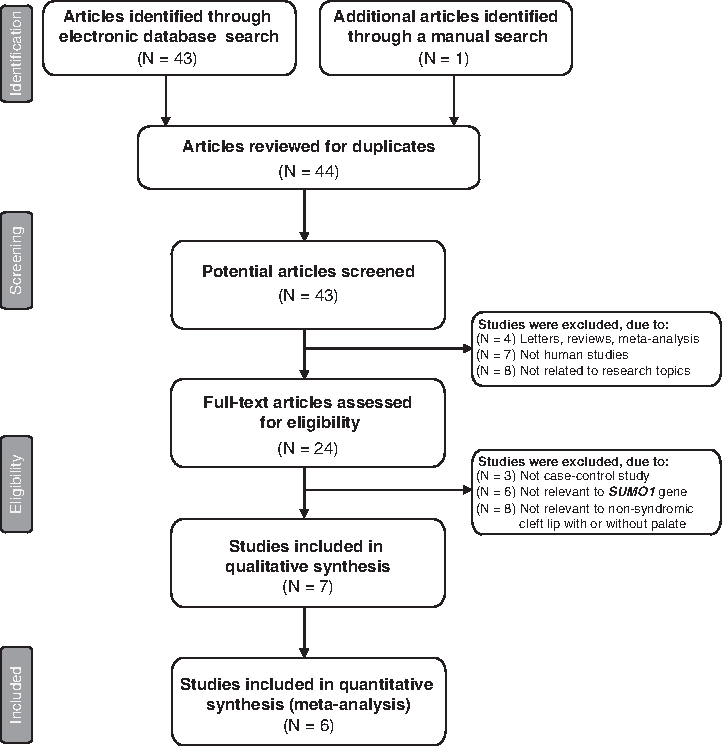
Flowchart of literature search and study selection. Six case-control studies were included in this meta-analysis.

Distribution of the number of topic-related articles in the electronic database over the last decade.
F, female; M, male; PCR-RFLP, polymerase chain reaction-restriction fragment length polymorphism; NOS, Newcastle-Ottawa Scale; SNP, single-nucleotide polymorphism.
Quantitative data synthesis
In Table 2, we summarized the results of meta-analysis for the relationships between SUMO1 genetic polymorphisms and the risk of NSCL/P. Our findings suggested that SUMO1 genetic polymorphism was correlated with increased risk of NSCL/P (all p<0.005) (Fig. 3). We also undertook subgroup analyses to evaluate the influence of potential factors on individuals' risk of NSCL/P. A subgroup analysis by single-nucleotide polymorphism (SNP) type demonstrated that four common polymorphisms (rs12470401 T>C, rs16838917 A>G, rs12470529 A>G, and rs7572505 A>G) in the SUMO1 gene were positively correlated with the risk of NSCL/P (Fig. 4). Ethnicity-stratified analysis demonstrated that SUMO1 genetic polymorphisms were closely related to the increased risk of NSCL/P among both Asians and Caucasians in the majority of the subgroups (all p<0.005). Furthermore, stratified analysis by the genotyping method suggested that genetic polymorphisms in the SUMO1 gene were closely linked to the pathogenesis of NSCL/P in the MassArray subgroup (all p<0.05), while no associations were detected in the PCR-RFLP, direct sequencing, and TaqMan array subgroups (all p>0.05).
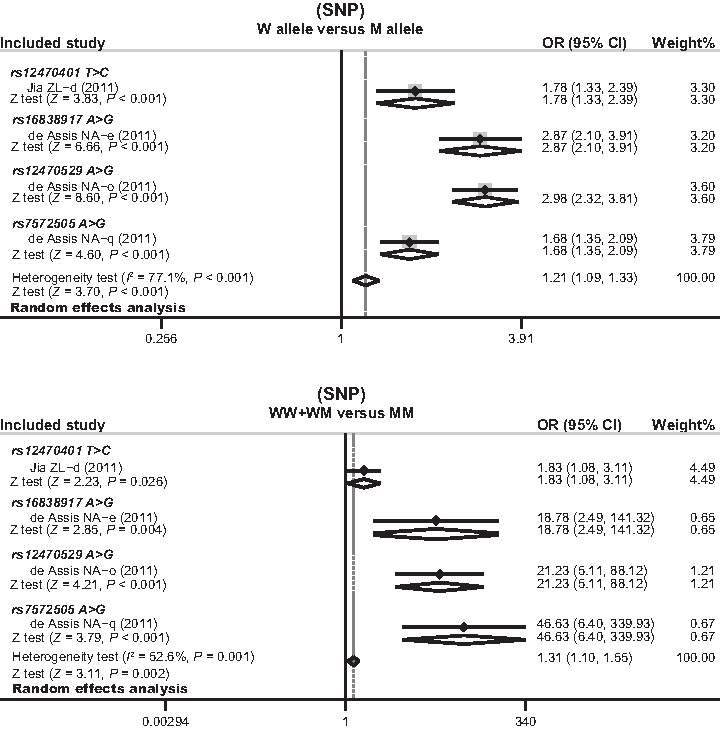
Forest plots for the relationships between SUMO1 genetic polymorphisms and nonsyndromic cleft lip with or without palate risk under the allele and dominant models. 95% CI, 95% confidence interval; M, mutant allele; MM, mutant homozygote; OR, odds ratio; SNP, single-nucleotide polymorphism; W, wild allele; WM, heterozygote; WW, wild homozygote.
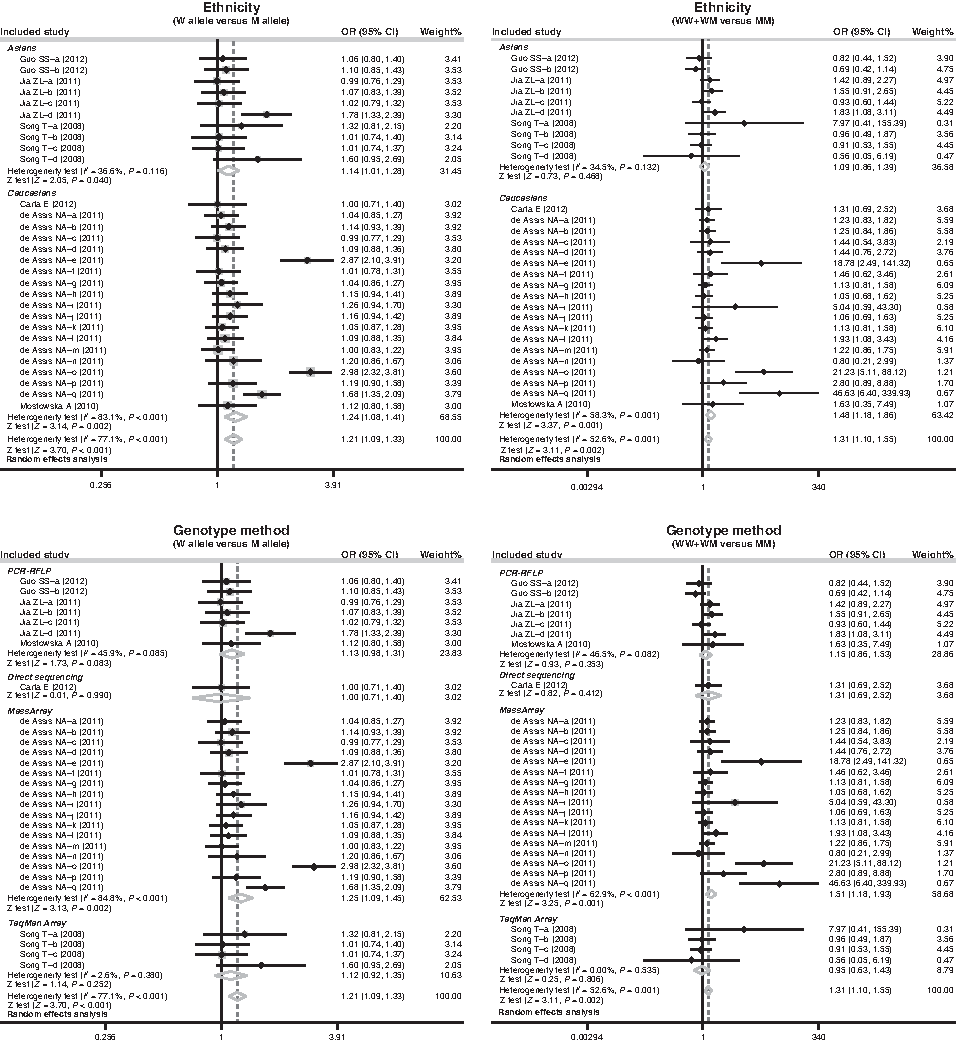
Subgroup analyses by the ethnicity and genotyping method for the relationships between SUMO1 genetic polymorphisms and nonsyndromic cleft lip with or without palate risk under the allele and dominant models.
95% CI, 95% confidence interval; M, mutant allele; MM, mutant homozygote; NSCL/P, nonsyndromic cleft lip with or without palate; OR, odds ratio; W, wild allele; WM, heterozygote; WW, wild homozygote.
A sensitivity analysis was carried out to assess the effect of each individual study on the pooled estimates by omitting individual studies. The results suggested that no single study could affect the pooled ORs (Fig. 5). Funnel plots demonstrated no evidence of obvious asymmetry (Fig. 6). Egger's test also did not illustrate strong statistical evidence of publication bias (W allele vs. M allele: t=1.14; p=0.265; WW+WM vs. MM: t=3.45; p=0.002; respectively).

Sensitivity analysis for the relationships between SUMO1 genetic polymorphisms and nonsyndromic cleft lip with or without palate risk under the allele and dominant models.
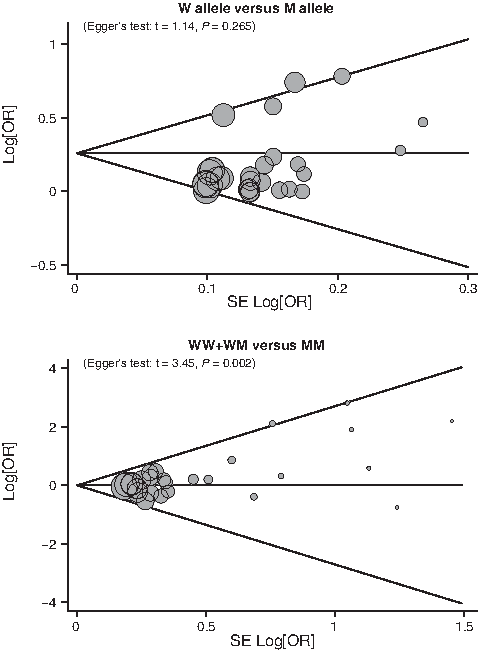
Funnel plot of publication biases on the relationships between SUMO1 genetic polymorphisms and nonsyndromic cleft lip with or without palate risk under the allele and dominant models.
Discussion
In the present meta-analysis, we aimed to evaluate the potential relationship between genetic polymorphisms in the SUMO1 gene and the risk of NSCL/P. Our findings show that SUMO1 genetic polymorphisms were significantly associated with the occurrence of NSCL/P, suggesting that SUMO1 genetic polymorphisms may be considered as important candidates in predicting the risk of NSCL/P. Although several lines of evidence suggested that SUMO1 was a strong candidate gene for orofacial clefting, the exact mechanism by which SUMO1 genetic polymorphisms may result in the development of NSCL/P is still unclear (Alkuraya et al., 2006). Generally, as a posttranslational modifier of a series of intracellular proteins, SUMO1 has been demonstrated to function significantly in the modulation of chromatin structure at multiple levels, influencing gene expression and maintaining genome integrity through a variety of mechanisms (Cubenas-Potts and Matunis, 2013). In addition, SUMO1 is also involved in the regulation of DNA repair and control of ion channels, as well as the mediation of intracellular pathways (Bergink and Jentsch, 2009). Moreover, SUMOylation was documented to be a key function modification for several transcription factors that are known to play important roles in lip and palate development, such as msh homeobox 1 (MSX1) and TBX22 (Carta et al., 2012). To be specific, MSX1 has been indicated to be correlated with the limb pattern formation, craniofacial development; and the T-box transcription factor TBX22 is responsible for the X-linked cleft palate and ankyloglossia (Suzuki et al., 2004; de Assis et al., 2011). There were also convincing evidence indicating that genetic variants in the MSX1 and TBX22 genes may be connected with the pathogenesis of NSCL/P (Andreou et al., 2007; Cardoso et al., 2013). We therefore hypothesized that SUMO1 genetic polymorphisms, related to the functional alternation of MSX1 and TBX22, may contribute to the progression and development of NSCL/P. Our results are in accordance with a former research, which showed that SUMO1 genetic polymorphisms may be related to NSCL/P risk in several populations, which may provide a better understanding of the etiological role of the SUMO1 gene in NSCL/P incidence (Jia et al., 2011b). Jia et al. (2011b) concluded in their study that C/C genotype at rs12470401 was overtransmitted from parents to affected progeny with a significantly increased risk of NSCL/P.
Further stratified analyses were carefully undertaken based on ethnicity and the genotype method while the possibility of existing obvious heterogeneity, which may negatively affect the results of our association study, was taken into consideration. The findings of stratified analysis based on ethnicity showed that SUMO1 genetic polymorphisms were strongly linked to an increased risk of NSCL/P among both Asians and Caucasians, revealing that no ethnic difference existed in the pathogenesis of NSCL/P. In conclusion, our results are in line with the previous hypothesis that SUMO1 genetic polymorphisms may be a dominant risk factor in the pathogenesis of NSCL/P, suggesting that these polymorphisms may serve as novel and reliable molecular markers useful for the early diagnosis and therapy of NSCL/P.
A number of limitations existing in the current meta-analysis should be addressed. One of the most important limitations is that our results did not possess sufficient statistical power to evaluate the association between SUMO1 genetic polymorphisms and NSCL/P risk because of the small number of studies. Since the sample size of some included studies were small, our meta-analysis might induce fairly wide confidence intervals, which restrain our confidence in drawing conclusions. A second limitation of our meta-analysis is the fact that the meta-analysis belongs to retrospective studies that may result in subject selection bias and, consequently, the results may not be reliable enough. Third, our meta-analysis failed to acquire original data from the included studies, which may restrict further evaluation of the possible impact of SUMO1 genetic polymorphisms on the development of NSCL/P. Although our study has several limitations, this is the first meta-analysis with regard to the correlation between SUMO1 genetic polymorphisms and the pathogenesis of NSCL/P. More importantly, we conducted a literature search strategy with high sensitivity for electronic databases. A manual search of the reference lists from the relevant articles was also conducted to identify other potential articles. The selection process of eligible articles was on the basis of strict inclusion and exclusion criteria. Besides, pooling of information from individual studies is founded on rigorous statistical analysis.
In summary, our findings provide empirical evidence that SUMO1 genetic polymorphisms might be strongly involved in the etiology of NSCL/P, especially for rs12470401 T>C, rs16838917 A>G, rs12470529 A>G, and rs7572505 A>G polymorphisms. However, due to the limitations acknowledged above, a larger sample-size research with more detailed and reliable data is necessary to achieve a more profound and representative statistical analysis.
Footnotes
Acknowledgments
The authors would like to acknowledge the reviewers for their helpful comments on this article.
Author Disclosure Statement
The authors have declared that no competing financial interests exist.