




Abstract
Objective: Protofibrils of alpha-synuclein mediate neuronal cell death and propagate Parkinson's disease (PD). In this study, we investigated the relationship between the rs3822086 C>T polymorphism located in the fourth intron of the alpha-synuclein (SNCA) gene and susceptibility to PD in a Chinese Han population. Methods: 146 PD patients and 144 sex- and age-matched healthy individuals (control group) were selected for this study. The SNCA rs3822086 polymorphism was examined in all 300 study subjects by polymerase chain reaction-restriction fragment length polymorphism (PCR-RFLP) analysis. Results: The genotype and allele frequencies of the SNCA rs3822086 polymorphism showed significant differences between the PD group and control group (TT: 25.3% vs. 18.8%, p=0.035; CT+TT: 77.4% vs. 66.0%, p=0.031; T allele: 51.4% vs. 42.4%, p=0.030; respectively). Stratified analyses based on gender indicated that male PD patients exhibited higher genotype and allele frequencies of the SNCA rs3822086 polymorphism compared to healthy male controls (TT: 26.7% vs. 13.2%, p=0.011; CC+CT: 73.3% vs. 86.8%, p=0.024; T allele: 51.2% vs. 37.9%, p=0.012; respectively). Age-stratified analyses indicated that the genotype and allele frequencies of the SNCA rs3822086 polymorphism were significantly higher in PD patients older than 60 years in comparison to healthy controls (TT: 32.2% vs. 20.5%, p=0.014; CT+TT: 77.0% vs. 60.2%, p=0.017; T allele: 54.6% vs. 40.3%, p=0.008; respectively). Conclusion: Our findings demonstrate that the SNCA rs3822086 C>T polymorphism correlates with increased susceptibility to PD among the Chinese Han population.
Introduction
P
Resting tremor, bradykinesia, muscular rigidity, and postural instability are the primary clinical symptoms of PD, often accompanied by nonmotor symptoms such as cognitive impairment, autonomic insufficiency, and sleep disorders (Zimprich et al., 2011; Coppede, 2012). The etiology of PD involves both environmental and genetic factors. The environmental factors include occupational exposure (pesticide, organic solvents, metals, or magnetic fields), rural living, farming occupation, well-water and coffee drinking, and lifestyle factors (smoking and drinking) (Wirdefeldt et al., 2011; Van Maele-Fabry et al., 2012). In contrast, mutations in specific genes are tightly associated with PD, and the major genes influencing PD progression are DJ-1 and ATP13A2, alpha-synuclein (SNCA), parkin (PRKN), PTEN-induced putative kinase 1 (PINK1), and leucine-rich repeat kinase 2 (LRRK2) (Hardy, 2010; Nuytemans et al., 2010; Martin et al., 2011). Recent evidence suggests that genetic polymorphisms in some of these genes may substantially elevate the risk of PD (Edwards et al., 2010; Mata et al., 2010; Guo et al., 2014).
SNCA is a synaptic protein expressed abundantly in the human brain, comprising 1% of total cytosolic protein, and its dysfunction is implicated in several neurodegenerative diseases, including PD (Cheng et al., 2011; Luk and Lee, 2014). The SNCA gene, located on chromosome 4q21-23, contains six exons and encodes the 140-amino acid α-synuclein protein (Norris et al., 2004; Parsian et al., 2007). During acquisition-associated synaptic rearrangement, SNCA is specifically upregulated in the presynaptic termini in the brain and functions as a microtubule-associated protein through its interactions with tubulin (Liu et al., 2013). SNCA also functions as a molecular chaperone for the assembly of synaptic core complexes (Cheng et al., 2011). In particular, SNCA binds both synaptobrevin-2 through the C-terminus domain and the phospholipids in the plasma membrane through the N-terminus domain and plays an important role in the synaptic activity (Diao et al., 2013).
SNCA accumulates in Lewy bodies (LB), and LB is one of the main pathological features of PD (de Boni et al., 2011; Ubeda-Banon et al., 2012). In addition, examination of cerebrospinal fluid revealed that SNCA levels are significantly decreased in PD patients (UK Parkinson's Disease Consortium et al., 2011; Wang et al., 2012). The central role of SNCA in PD pathogenesis is further supported by its abnormal functioning in both the rare familial form and the common sporadic form of PD (Guo et al., 2014). A previous study from Japan identified four single-nucleotide polymorphisms (SNPs) (rs4698412, rs4538475rs, 11931532, and rs12645693) on chromosome 4p15 as novel susceptibility loci linked to PD development (Miyake et al., 2012a). In particular, two polymorphisms in the SNCA gene, rs356220 and rs2736990, dramatically increased the risk of PD in the Caucasian population (Miyake et al., 2012b; Guo et al., 2014). SNPs located in the 3′ untranslated region (UTR) and 3′ downstream of the SNCA gene have also been linked to a significantly increased risk of developing PD (de Mena et al., 2010; Yuferov et al., 2010; Cardo et al., 2014). In the present study, we examined the relationship between SNCA rs3822086 C>T polymorphism and the risk of PD in the Chinese Han population.
Materials and Methods
Ethical issues
The present study was approved by the Ethics Committee of Affiliated Hospital of Youjiang Medical University for Nationalities. All study procedures conformed to the International Ethical Guidelines for Biomedical Research involving human subjects (Council for International Organizations of Medical Sciences, 2002). All subjects participating in this study provided written informed consent.
Subjects
This study enrolled 146 PD patients admitted to the Department of Neurology, Affiliated Hospital of Youjiang Medical University for Nationalities between January 2010 and December 2013. All patients belonged to the Chinese Han population. The eligible patients were confirmed for the disease using the established diagnostic criteria for PD (Brooks, 2012). The 146 PD patients consisted of 86 males and 60 females, with a mean age of 66.2±11.6 (range, 34-91). Study inclusion criteria were as follows: (1) patients with bradykinesia as a major symptom and one of three symptoms of myotonia, static tremor, or postural instability; (2) patients without orthostatic hypotension, extraocular muscle paralysis, pyramidal damage, cerebellar symptoms, and muscle atrophy. Exclusion criteria were as follows: (1) patients with a history of head injury or encephalitis; (2) use of antipsychotic medications to treat symptoms; (3) computed tomography (CT) scanning showed obstructive hydrocephalus or intracranial tumors; (4) patients with severe dementia exhibiting memory, language, and behavior disorders. Within the same duration, 144 sex- and age-matched healthy individuals, referred to the medical center, served as the control group. Subjects in the control group received neurological examination and mini-mental status examination (Hendry et al., 2015), and those with PD or dementia were not included in the current study design. The control group consisted of 91 males and 53 females, with a mean age of 66.7±12.9 years (range, 34-93). Data from all subjects were collected in detail using a standard data collection form.
Genomic DNA extraction and genotyping
Peripheral blood samples (5 mL) were collected in duplicate from PD patients and healthy controls through venipuncture under the fasting condition early morning. The collected blood was placed in tubes containing EDTA as an anticoagulant and centrifuged at 2700 rpm for 10 min at room temperature. The collected supernatant was stored at −80°C until further use. Genomic DNA was isolated f whole blood using the DNA Extraction Kit (SK8224; Sangon Biotech). The isolated genomic DNA was further purified using the Wizard Genomic DNA Purification Kit® (Promega) following the manufacturer's instructions. Laboratory personnel were blinded to the case-control status of the subjects. The SNCA rs3822086 C>T polymorphism in all subjects was analyzed by the polymerase chain reaction-restriction fragment length polymorphism (PCR-RFLP) method. Primer sequences for SNCA rs3822086 C>T were as follows: sense primer, 5′-TTTGGGAAAGGTGGGACA-3′; antisense primer, 5′-CAAGAACTCAGTCTATGGGAAAG-3′. PCR amplification was performed in a total volume of 25 μL containing the following: 500 ng DNA template, 1.0 μL sense primer, 1.0 μL antisense primer, 12.5 μL 2× Premix Taq, volume to 25 μL with ddH2O. PCR conditions were as follows: predenaturing at 95°C for 5 min, denaturing at 94°C for 30 s, annealing at 58°C for 30 s, and extension at 72°C for 30 s. A total of 40 cycles were performed. Next, 5 μL of the final PCR product was analyzed by agarose gel electrophoresis with 2% ethidium bromide to analyze the results recorded by UV photography. In addition, the PCR products were digested overnight with RsaI at 37°C for SNCA rs3822086 genotype and separated on 2% agarose with ethidium bromide staining. The digested PCR products showed three fragments, as predicted. To confirm genotyping results, randomly selected PCR samples were sequenced by DNA sequencing.
Statistical analyses
Continuous variables with normal distribution are expressed as a mean±standard deviation (SD), discontinuous variables are expressed as a median value (interquartile range), and categorical data were displayed as frequency counts. The t-test was used for parametric testing of continuous data between the groups. Gene counting was employed to estimate genotype/allele frequencies, and departure from the Hardy-Weinberg equilibrium of the SNCA rs3822086 genotypes was detected separately in controls and PD patients (www.pharmgat.org/IIPGA2/Bioinformatics/exacthweform). The comparisons of genotype distribution and allele frequencies were performed using the chi-square test. The odds ratio and 95% confidence interval were applied to represent the degree of relative risk calculated in a logistic regression model. The SPSS version 17.0 statistical software was used to perform statistical analyses. A value of p<0.05 was considered as statistically significant.
Results
Baseline characteristics comparison
Our results indicated no statistically significant difference in age or gender between the PD group and control group (both p>0.05). Furthermore, we also did not detect any measurable differences in the age of onset of PD based on gender within the two groups (both p>0.05, Table 1). These results showed that the two groups were comparable at baseline.
PD, Parkinson's disease; M, male; F, female.
DNA sequencing analysis
As shown in Figure 1, three genotypes in SNCA rs3822086 C>T polymorphism were detected, including the homozygous TT genotype appearing as a single band (495 bp), the homozygous CC genotype displaying two bands (281, 204 bp), and the heterozygous CT genotype exhibiting three bands (495, 281, and 204 bp, respectively). The forward sequence of PCR product of SNCA rs3822086 polymorphism is shown in Figure 2.
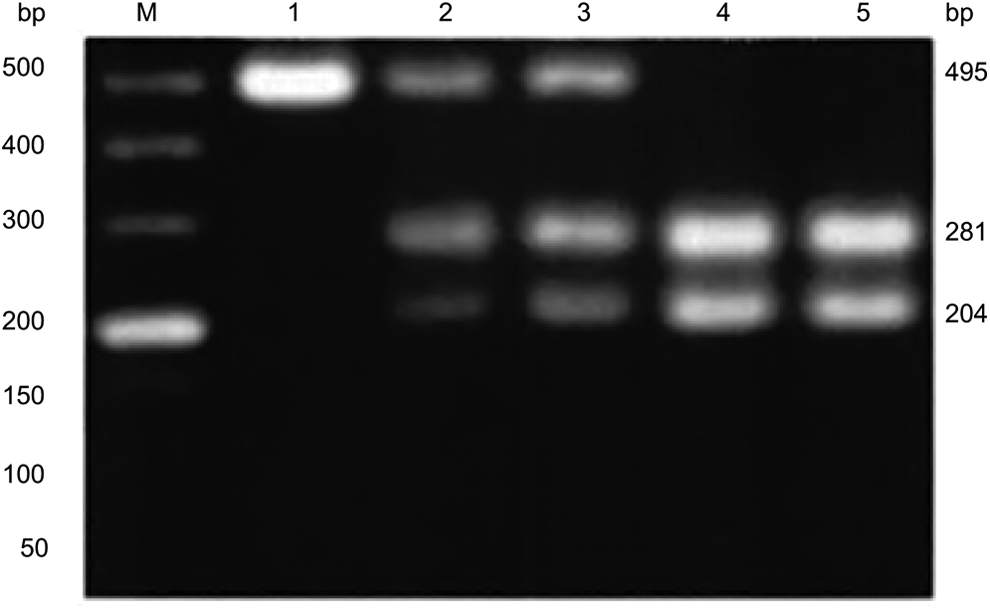
Agarose gel electrophoresis of the polymerase chain reaction (PCR) products of SNCA rs3822086 polymorphism. M, marker; 1, TT genotype; 2-3, CT genotype; 4-5, CC genotype.
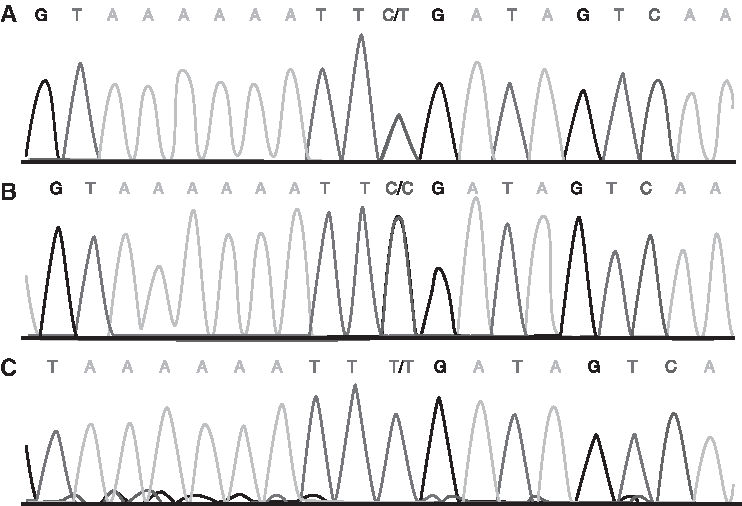
The forward sequence of the PCR product of SNCA rs3822086 polymorphism.
Genotype frequency of SNCA rs3822086 polymorphism
The genotype frequency of the selected SNP conformed to the Hardy-Weinberg equilibrium (p>0.05), indicating that the selected sample was representative of the population. As shown in Table 2, the genotype and allele frequencies of SNCA rs3822086 polymorphism showed significant differences between the PD group and control group (TT: 25.3% vs. 18.8%, p=0.035; CT+TT: 77.4% vs. 66.0%, p=0.031; T allele: 51.4% vs. 42.4%, p=0.030; respectively).
SNCA, synuclein, alpha (non A4 component of amyloid precursor); OR, odds ratio; 95%CI, 95% confidence interval.
Comparison of different genotypes in gender stratification
Gender-stratified analysis indicated that male PD patients exhibited higher genotype and allele frequencies of SNCA rs3822086 polymorphism compared to healthy male controls (TT: 26.7% vs. 13.2%, p=0.011; CC+CT: 73.3% vs. 86.8%, p=0.024; T allele: 51.2% vs. 37.9%, p=0.012; respectively). However, female subjects did not show such differences between the two groups (all p>0.05) (as shown in Table 3).
Comparison of different genotypes in age stratification
As shown in Table 4, age-stratified analysis indicated in subjects older than 60 years, the PD patients displayed higher genotype and allele frequencies of SNCA rs3822086 polymorphism compared to healthy controls (TT: 32.2% vs. 20.5%, p=0.014; CT+TT: 77.0% vs. 60.2%, p=0.017; T allele: 54.6% vs. 40.3%, p=0.008; respectively). However, no significant differences were observed between PD patients and healthy controls when subjects younger than 60 years were considered (all p>0.05). Furthermore, gender- and age-stratified analyses indicated no differences in the genotype frequencies and allele distribution of SNCA rs3822086 among the PD patients (all p>0.05, Fig. 3).
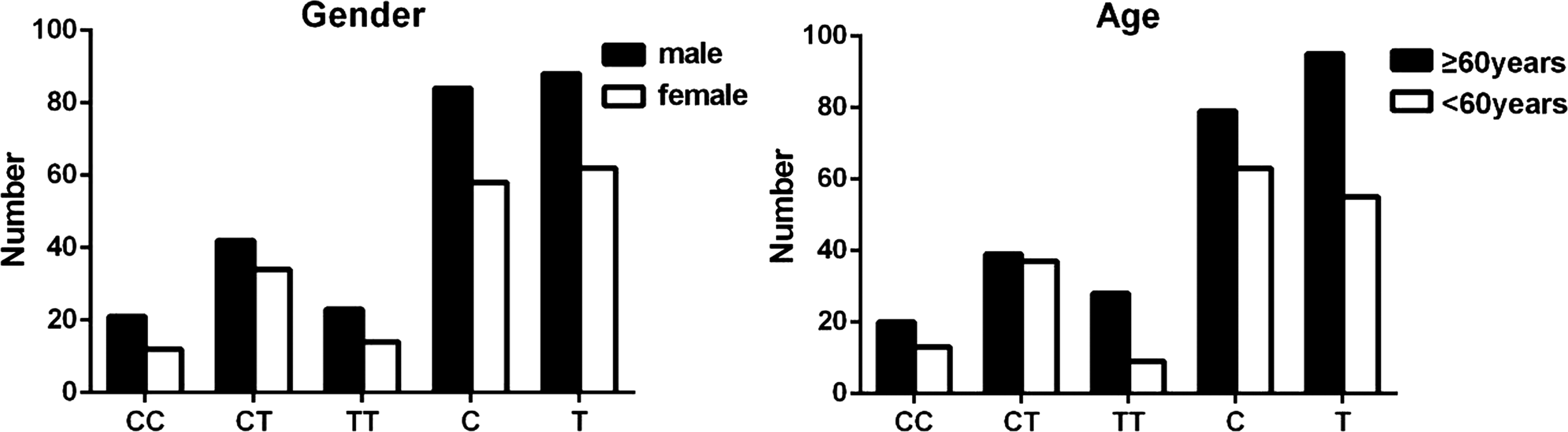
The genotype and allele frequencies of rs3822086 polymorphism in SNCA gene of patients with Parkinson's disease of different gender and age.
Discussion
The major findings of this study revealed that genotype and allele frequencies of SNCA rs3822086 polymorphism in PD patients were significantly higher than the healthy controls, indicating that SNCA rs3822086 C>T polymorphism may confer susceptibility to PD in the Chinese Han population. SNCA is a major component of LB and influences the pathogenesis of both the rare familial PD form and the common idiopathic PD (Mata et al., 2010; Guo et al., 2014). More specifically, the key feature influencing PD pathogenesis, that is, the aggregation of SNCA, is influenced by genetic factors, chronic exposure of environmental factors, endogenous peroxide activity, and other related gene mutations that cause functional defects in the ubiquitin-proteasome pathway (Pasanen et al., 2014).
Interestingly, the extracellular level of SNCA is closely associated with PD progression and is an important biomarker for PD diagnosis (Miyake et al., 2012a; Cardo et al., 2014; Malek et al., 2014). A previous case-control study from Germany concluded that rs3822086 SNP is linked to PD risk and exhibits gender difference (Mueller et al., 2005). In agreement with these previous findings, our study also showed that SNCA rs3822086 polymorphism dramatically increased the risk of PD. As a potential mechanism, we propose that polymorphisms in the promoter region, introns, and in the UTR of the SNCA transcript determine the increased or decreased risk of early-onset and late-onset PD. In support of this, DNA mutations have been detected that display significant differences based on race, region, groups, and individual genomes (Gao and Hong, 2011).
Stratified analysis based on gender and age revealed that, in subjects older than 60 years, the male PD patients displayed higher genotype and allele frequencies of SNCA rs3822086 polymorphism compared to healthy controls, implying that this SNP might serve as a potential biomarker for PD susceptibility, especially in male PD patients older than 60 years. SNCA levels in the cerebrospinal fluid and saliva of PD patients were also significantly decreased, compared to healthy individuals and AD patients, and these correlated with the score obtained from the Unified Parkinson's Disease Rating Scale (UPDRS) (Sutherland et al., 2007; Chang et al., 2011). The rs3822086 polymorphism is located in the fourth intron of the SNCA gene and does not lead to an alteration in the amino acid sequence of the SNCA protein.
However, intronic sequences are known to protect against RNA degradation by stabilizing the pre-mRNA transcript in the nucleus, resulting in increased accumulation of mature mRNA in the cytoplasm and elevated translation to synthesize the SNCA protein (Al-Chalabi et al., 2009; Yan et al., 2010). In patients older than 65 years of age, PD diagnosis was achieved with a higher sensitivity and specificity when the SNCA concentration in the cerebrospinal fluid was above the threshold value of 0.5 ng/mL (Mata et al., 2010). In addition, the difference between males in the two groups observed in this study and others may be related to occupational exposure to toxins, unhealthy lifestyles (smoking or drinking), and a more common head trauma in men from sports activities, apart from the genetic factors located on the X chromosome (Taylor et al., 2007).
In conclusion, our findings provide significant preliminary evidence that SNCA rs3822086 C>T polymorphism increased susceptibility to PD in the Chinese Han population, especially in male PD patients older than 60 years of age. However, due to the relatively small patient size in our study, our results should be confirmed by larger studies.
Footnotes
Acknowledgment
We acknowledge the reviewers for their helpful comments on this article.
Author Disclosure Statement
No competing financial interests exist.