




Abstract
Background: Varicocele is an abnormal enlargement of the pampiniform venous plexus in the scrotum. Varicocele is the most common cause of secondary male infertility. Nitric oxide (NO), which has a role on varicocele pathophysiology, is synthesized by endothelial nitric oxide synthase gene (NOS3). Objective: In our study, we aimed to explain the relationship between varicocele, three common NOS3 polymorphisms (T-786C, G894T, 4b/a), and NOS3 mRNA expression levels. Methods: We investigated NOS3 T-786C, G894T, and 4b/a polymorphisms in 102 patients with varicocele and 100 healthy controls. Twenty-four patients and 17 controls were chosen for expression studies based on polymorphism subgroupings. Subgroup 1 includes patients who have no minor allele polymorphisms, and subgroups 2, 3, and 4 have T-786C, G894T, and 4b/a polymorphisms, respectively. Results: The 4b/a polymorphism demonstrated significantly elevated levels in both allele and genotype analysis in the control group compared to the patient group. The G894T polymorphism was statistically elevated for genotypic frequencies in the patient group compared to the control group, but this finding did not extend to allelic frequencies. There were no statistically significant differences in either the allelic or genotypic frequencies between patients and control groups for the T-786C polymorphism. When patient and control expression levels were compared without considering the subgroups, the NOS3 expression level was found to be statistically higher in the patient group. There were no statistically significant differences in the patient and control group expression levels when stratified by subgroup, nor was there any effect of the polymorphisms under study on expression levels. Conclusions: The 4b/a polymorphism may have a protective effect for varicocelem and G894T polymorphism may contribute to varicocele occurrence by lowering the level of NO. The higher NOS3 expression levels in the patient group may be a kind of dilator compensatory mechanism to protect vascular anatomy in varicocele.
Introduction
T
Nitric oxide (NO), released continuously from the vascular endothelium, is an important mediator in the regulation of vascular tone. NO is also involved in biological processes such as neurotransmission (nonadrenergic noncholinergic pathways), killing of tumor cells, and inflammatory and immunological responses. NO is synthesized from L-arginine by the catalytic activity of the three isoforms of nitric oxide synthase (NOS). These three isoforms consist of neuronal NOS, endothelial NOS (eNOS), and inducible NOS (iNOS) (Knowles and Moncada, 1994). After the release of NO from endothelin, which is also defined as endothelial-derived relaxing factor, relaxation of smooth muscle cells and vascular dilatation occur (Bolotina et al., 1994; Geller and Billiar, 1998; Aladağ et al., 2000; Malinski, 2000).
The endothelial nitric oxide synthase gene (NOS3), which is located at 7q35-36, contains approximately 21 kb of genomic DNA and consists of 26 exons. NOS3 mRNA, which has 4052 nucleotides, is expressed in endothelial cells. The molecular weight of eNOS enzyme is 133 kDa and it contains 1203 amino acids (Fish and Marsden, 2006).
The eNOS is the most effective NOS type in the cardiovascular system. The expression of NOS3 increases in response to vessel wall stress and this causes NO release, which is providing vascular relaxation. If NO cannot be released sufficiently, it causes endothelial dysfunction and contributes to the hypertension and development of other cardiovascular diseases. There are studies about the relationship between cardiovascular disease and NOS3 polymorphisms (Lacchini et al., 2010).
NOS3 polymorphisms were studied in many vascular, inflammatory, neurological, and oncological diseases (Eroz et al., 2014). The most common polymorphisms of NOS3 are T-786C (rs2070744, major allele is T) at the promoter region, G894T (rs1799983, major allele is G) in exon 7, and 4b/a (wild-type allele “b” had 420 bp band, five copies of 27 bp tandem repeats and polymorphic allele “a” had 393 bp band, four copies of 27 bp tandem repeats) in intron 4. Approximately, a 50% decrease in the eNOS transcriptional activity is seen in people carrying the C allele of T-786C. This effect is believed to be due to the binding of transcription repressor protein to the promoter with higher affinity in the presence of the C allele (Nakayama et al., 1999; Miyamoto et al., 2000). Intron 4b/a polymorphism regulates the expression of eNOS by the si-RNA. In individuals carrying five repeat regions, the endothelial cells reproduce more si-RNA and this causes a negative feedback effect. Lower eNOS expression is observed in individuals carrying five repeat regions when compared with individuals carrying four repeat regions (Zhang et al., 2008a, 2008b). In G894T polymorphism, which is located in exon 7, amino acid glutamate (Glu) is synthesized instead of aspartate (Asp). Lower endogenous NO production is observed in individuals carrying T allele. This polymorphism affects the activity and the amount of eNOS in caveolae and NO production (Tanus-Santos et al., 2002; Godfrey et al., 2007; Joshi et al., 2007).
In infertile patients with varicocele, high levels of NO in seminal plasma and NOS activity have been detected when compared with the control group. Negative correlation was observed between NO levels and sperm motility, and also between concentration and morphology. It has also contributed to the regulation of testicular blood flow. The sources of locally synthesized NO in the testis are iNOS and eNOS. It is known that NO is important for vascular tonus and its quantity is increased in the dilated spermatic vein (Aksoy et al., 2000; Shiraishi and Naito, 2007; Xu et al., 2008).
In our study, we aim to search the association between the most common three polymorphisms of NOS3 (T-786C, G894T, 4b/a) with varicocele and NOS3 mRNA expression. According to the results, we intended to make a contribution to the etiology of varicocele, which is one of the preventable causes of infertility.
Materials and Methods
Patient selection
The study was approved by the Medical Ethics Committee of Ataturk University and all subjects provided informed consent. In this study, the patients who had been diagnosed with grade 1, grade 2, grade 3 varicocele with examination and/or scrotal Doppler ultrasound were included. The patient group consisted of 102 individuals aged between 18 and 65 years. For the control group, 100 healthy individuals aged between 18 and 57 years without varicocele were selected.
Genotype determination
Genomic DNA was extracted from blood samples by the QIAamp DNA Blood Mini Kit (Qiagen) protocols; extracted DNA was quantified by a spectrophotometer (MaestroNano; Maestrogen) and stored at approximately −20°C until analysis.
For eNOS intron 4 VNTR polymorphism (4b/a), genotypes were determined by PCR amplification using the primers 5′- AGGCCCTATGGTAGTGCCTTT-3′ (forward) and 5′-TCTC TTAGTGCTGTGGTCAC-3′ (reverse) (Metabion) and Taq PCR Master Mix Kit (Qiagen). Amplification conditions were denaturation at 94°C for 3 min, followed by 35 amplification cycles of 1 min denaturation at 94°C, 1 min annealing at 61°C, 1 min extension at 72°C, and final extension of 10 min at 72°C. The PCR product was assessed on 3% agarose gel electrophoresis.
Genotypes were determined by real-time PCR with Type-it Fast SNP Probe PCR Kit (Qiagen) (rs1799983) for eNOS G894T polymorphism, snpsig Real-time PCR Genotyping Kit (rs2070744) (PrimerDesign) for eNOS T-786C polymorphism, and Precision 2× qPCR MasterMix Mini Kit (PrimerDesign). Amplification conditions for rs1799983 and rs2070744 were denaturation at 95°C for 5 min, followed by 40 amplification cycles of 15 s at 95°C, 30 s at 60°C, for rs2070744 denaturation at 95°C for 8 min, followed by 10 amplification cycles of 10 s at 95°C, 60 s at 60°C, and then 40 amplification cycles of 10 s at 95°C, 60 s at 68°C.
Expression studies
Total RNA was extracted from blood samples by using the QIAamp RNA Blood Mini Kit (Qiagen) according to the protocols. Total extracted RNA was quantified by a spectrophotometer (MaestroNano; Maestrogen) and stored at approximately −80°C. cDNA synthesis from total RNA was catalyzed by the RT2 HT First Strand Kit (Qiagen) protocol and stored at approximately −20°C. The expression of the target gene, eNOS and the housekeeping gene (beta-actin) was analyzed with RT2 qPCR Primer Assay (beta-actin/eNOS) (SABiosciences) and RT2 SYBR Green FAST Mastermix protocols by LightCycler® 480 Real-Time PCR (Roche Diagnostics). Amplification cycles were performed at 95°C for 10 min, followed by 45 cycles of 15 s at 95°C, 1 min at 60°C, and 15 s at 60°C. Relative expression values of eNOS/beta-actin and also melting curve analysis were performed by LightCycler 480 Real-Time PCR (Roche Diagnostics).
Statistical analysis
Statistical analysis was performed using SPSS v20 (IBM Corp.) program. The results were evaluated at a confidence interval of 95% and statistical significance of p < 0.05. The data were checked if distributed normally by the Kolmogorov-Smirnov test. The normally distributed data were analyzed by Student's t-test. The Mann-Whitney U Test was used for not normally distributed data. For comparing categorical parameters, the χ2 test and for multiple comparing, the ANOVA test were used.
Results
Clinical features
In our study, grade 1, grade 2, grade 3 varicocele patients and healthy controls without varicocele were included. The patient group consisted of 102 individuals aged between 18 and 65 years. The control group was composed of 100 healthy individuals aged between 18 and 57 years (Table 1).
n, number of subjects; FSH, follicle-stimulating hormone; LH, luteinizing hormone.
There were 1 grade 1, 62 grade 2, and 49 grade 3 varicocele patients. Seventy-four of the patients had varicocele on the left side, 3 on the right side, and 25 of the patients had bilateral varicocele.
Polymorphisms
When the patient and control groups were compared for intron 4 VNTR polymorphism, polymorphic genotype (aa+ab) was found statistically meaningful (p = 0.037). When compared for allelic level, an allele ratio was statistically significant (p = 0.013) (Table 2).
When the patient and control groups were compared for G894T polymorphism, there was no statistically significant difference for GG, GT, and TT genotypes (p = 0.096). When compared for polymorphic genotype (GT+TT), there was statistically significant difference (p = 0.042). There was statistically no significant difference for G and T alleles between the patient and control groups (p = 0.168) (Table 2).
There was statistically no significant difference for TT, TC, CC, and polymorphic (TC+CC) genotypes of T-786C polymorphism between the patient and control group (p = 0.304, for polymorphic genotype, p = 0.780). When patient and control groups were compared, there was statistically no significant difference between the T and C alleles (p = 0.321) (Table 2). The allele distribution for intron 4 VNTR, G894T, and T-786C polymorphisms in the patient and control groups is shown in Figure 1.
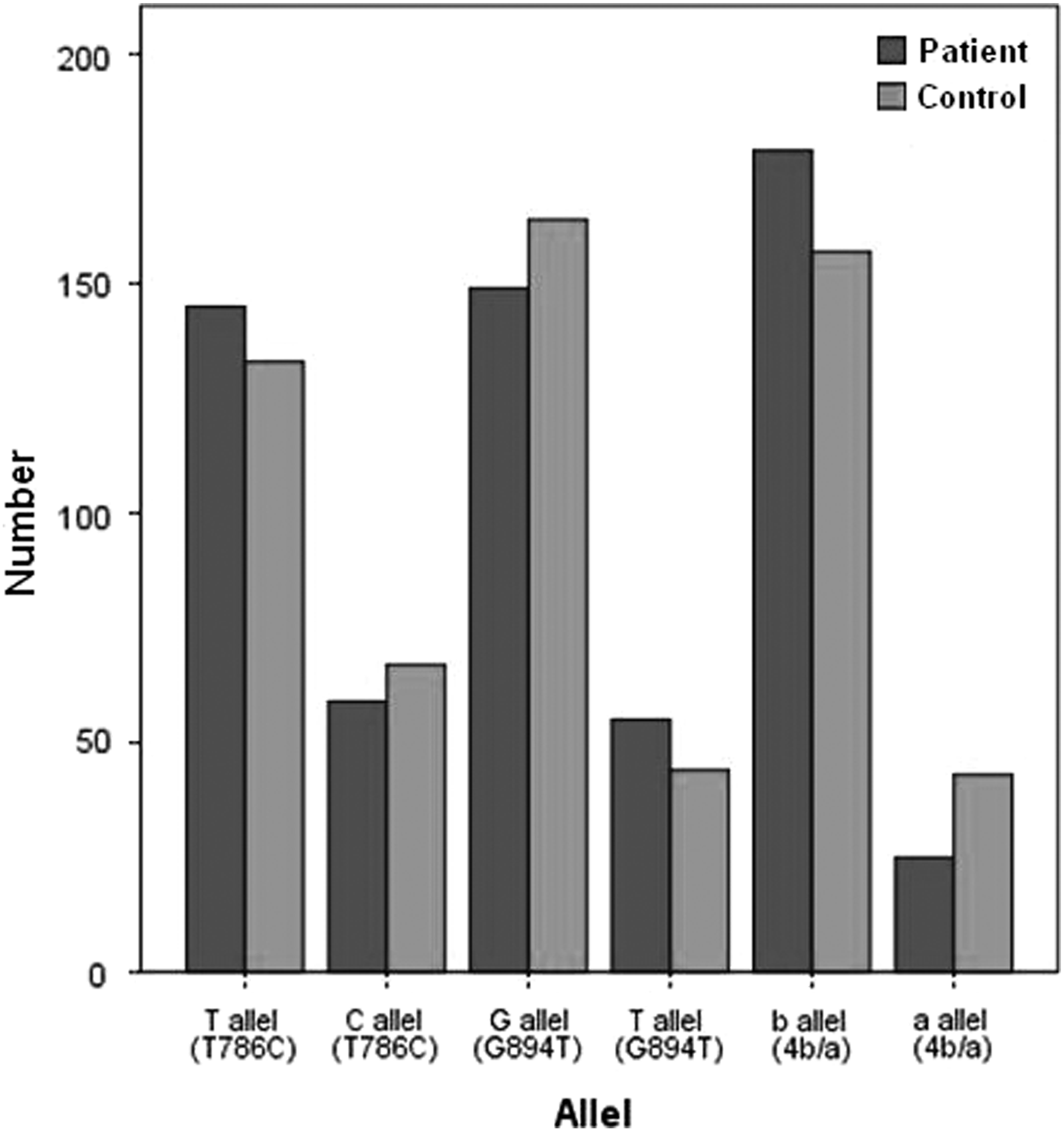
The allelic distribution of polymorphisms.
eNOS gene (NOS3) expressions
For expression studies, 24 and 17 subjects were chosen from the patient and control groups, respectively. Subgroups have been created according to the polymorphisms. There were four subgroups: subjects who were carrying none of the three polymorphisms (wild type), only carrying the G894T polymorphism, only carrying the T-786C polymorphism, and only carrying the 4b/a polymorphism. Without considering the subgroups, when NOS3 expression levels were compared between the patient and control groups, statistically significant differences were found (p = 0.026) (Fig. 2).
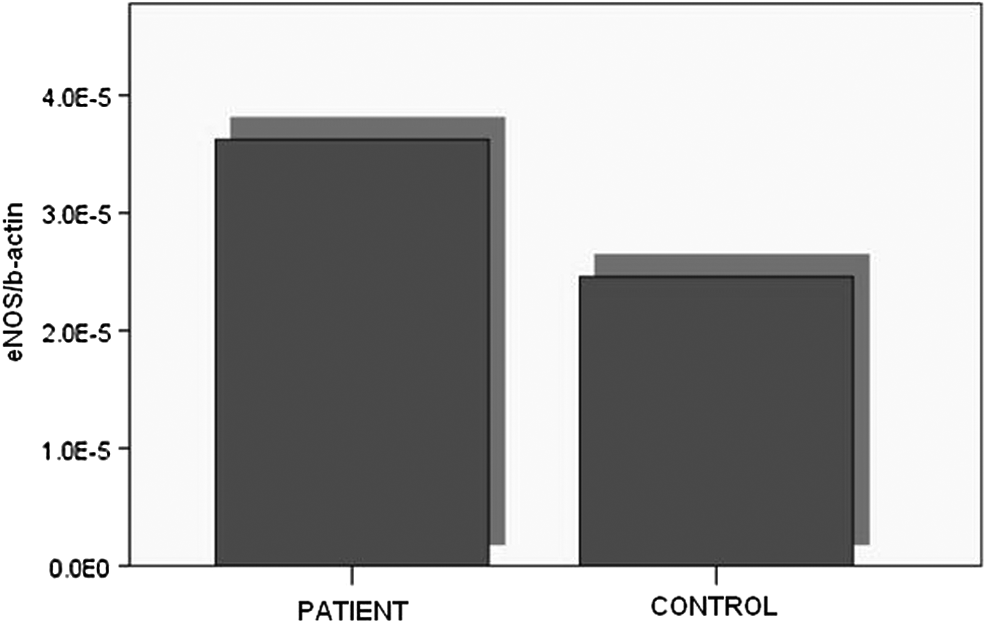
Appearance of the endothelial nitric oxide synthase (eNOS)/b-actin relative expression ratios for investigated cases in the patient and control groups.
When the NOS3 expression levels of the polymorphism subgroups were compared between the patient and control groups, there were statistically no significant differences for the wild-type, T-786C, and 4b/a subgroups (p = 0.508, p = 0.018, and p = 0.564, respectively); however, there was a significant difference for the G894T subgroup (p = 0.037) (Fig. 3). When the expressions of 4 subgroups were compared with each other in the patient and control group, there was statistically no significant difference (p = 0.054 and p = 0.514, respectively).
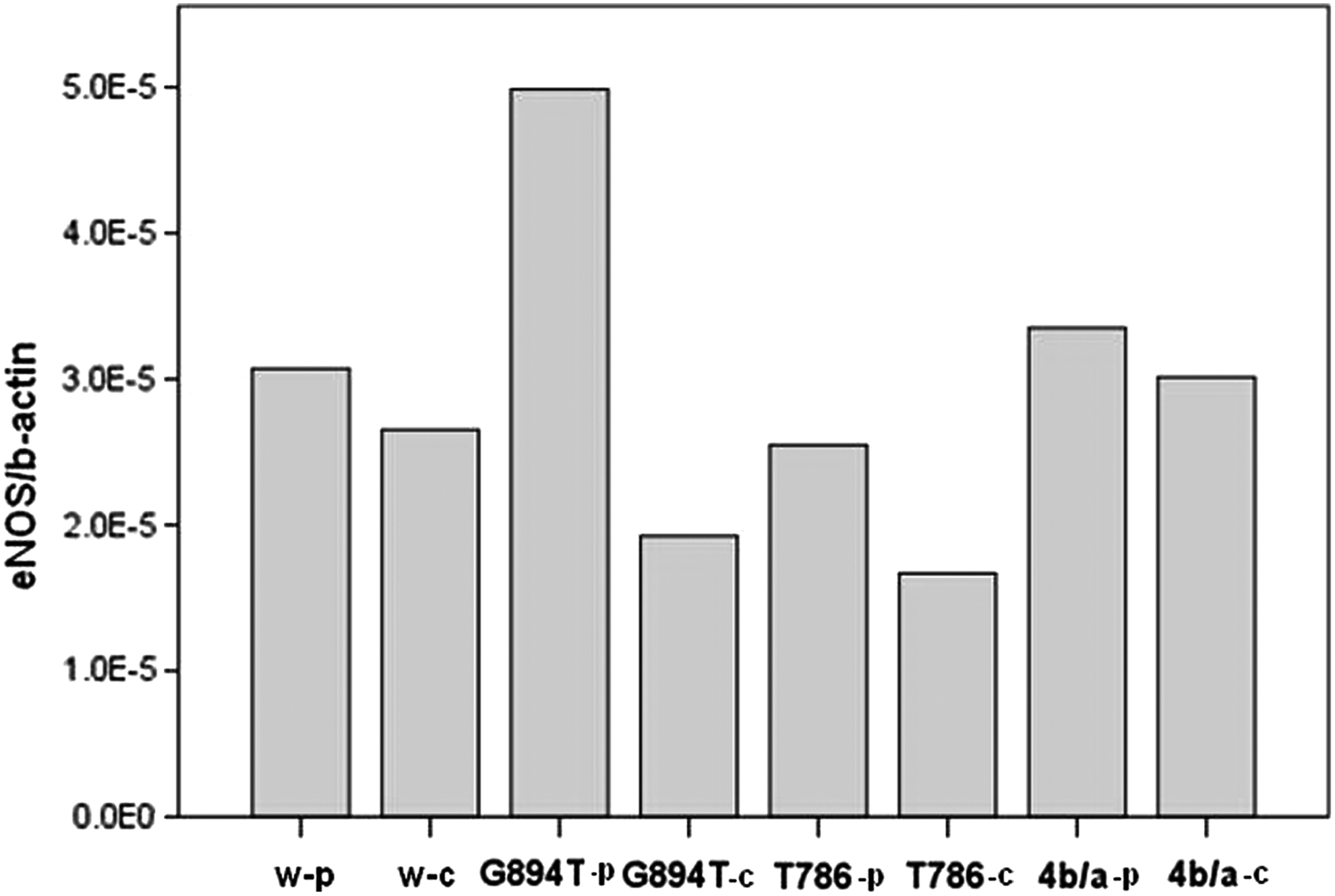
Appearance of the eNOS/b-actin relative expression ratios for polymorphism subgroups for investigated cases in the patient and control groups (w, wild type; p, patient; c, control).
Discussion
There are many publications in the literature evaluating the relationship between NO and varicocele. Although physiologically released NO is an antioxidant, when excessive amounts are released, it is thought to be involved in the reactive oxygen species (ROS)-mediated pathophysiology of varicocele (Kanner et al., 1991). There are few studies examining the relationship between varicocele and ROS (Romeo et al., 2003; Kisa et al., 2004). Also, in some studies, excessive amounts of NO were observed in dilated veins (Mitropoulos et al., 1996; Ozbek et al., 2000; Romeo et al., 2001).
NO, which is an induced vasodilator released from endothelin, is known to have antiatherosclerotic and vasoprotective effects (Li and Forstermann, 2000). Coronary flow was reduced in NOS inhibitor L-NAME used hypertensive rats compared to normotensive rats, and NO bioavailability was lower in basal coronary circulation in hypertensive animals (Crabos et al., 1997; Susic et al., 1998). The inhibition of eNOS in hypertensive rats leads to construction and high blood pressure levels (Garcia et al., 1997). NO is an important mediator especially for basal vascular tone in high pressure and associated with hypertension physiology (Levy et al., 2009). In a study by Huang et al. (1995), high blood pressure was determined in eNOS knockout mice when compared with the control group. NO is thought to be important in vascular resistance and blood pressure control. Endothelium-dependent dilatation is usually provided by eNOS-mediated ways (Levy et al., 2009). The eNOS expression level was decreased in coronary artery endothelial and myocardial arteries in hypertensive rats compared to normotensive rats and low expression levels of eNOS contribute to hypertension accompanying coronary endothelial dysfunction (Crabos et al., 1997; Bauersachs et al., 1998). In the study by Nava et al. (1995), it was suggested that the increased expression of eNOS in the coronary arteries in hypertension may be a compensatory mechanism for maintaining vascular function.
In the literature, there are many studies about the association between eNOS gene polymorphisms and vascular diseases, which has similar pathophysiology with the varicocele such as coronary artery disease and hypertension (Wang and Wang, 2000). In the meta-analysis study by Zintzaras et al. (2006), hypertension was found to be associated with 4b/a polymorphism and it was suggested that it may be protective for hypertension. In the meta-analysis study by Niu and Qi (2011), a significantly increased risk was shown in Asians for G894T and 4b/a polymorphisms and in Caucasians for T-786C polymorphism. T allele for G894T polymorphism and C allele for T-786C polymorphism have been associated with coronary artery disease in Asian and non-Asian populations, but not for 4b/a polymorphism (Li et al., 2010; Zhang et al., 2012; Tian et al., 2013).
The eNOS gene polymorphisms associated with clinical diseases are thought to be related to ethnicity (Tanus-Santos et al., 2001; Marroni et al., 2005; Sinici et al., 2009). In our study, genotype ratios for the G894T polymorphism are GG: 59.9%, GT: 35%, and TT: 5%; for T-786C polymorphism TT: 51%, TC: 35.6%, and CC: 13.4%, and for 4b/a polymorphism bb: 69.8%, ab: 26.7%, and aa: 3.5%. In this study, bb and TT rates were similar and GG was higher when compared with the study by Sinici et al.
Varicocele is known to be one of the most common causes of secondary infertility. There is no publication in the literature examining the relationship between varicocele and eNOS polymorphisms. However, there are few publications on infertility and eNOS polymorphisms (Yun et al., 2008; Buldreghini et al., 2010; Safarinejad et al., 2010; Bianco et al., 2013; Karatas et al., 2014).
The polymorphic genotype (GT+TT) rate for G894T polymorphism was higher in our patient group and this difference was statistically significant. This polymorphism may contribute to the process of varicocele. T-786C polymorphisms showed no significant difference in the patient and control groups. In our study, polymorphic genotype (ab+aa) and “a” allele rates for 4b/a polymorphism were higher and statistically significant in the control group. This polymorphism may be protective for varicocele.
Several studies have found a relationship between varicocele and high eNOS expression in the literature. Expression levels were detected immunohistochemically in these studies (Fujisawa et al., 2001; Erkan et al., 2012). In our study, eNOS gene expression, which was studied by real-time PCR, was increased and statistically significant in varicocele patients compared to the control group.
In the literature, there are several studies searching for the relationship between eNOS polymorphisms and gene expression and they are meaningful (Cattaruzza et al., 2004; Venturelli et al., 2005; Marangoni et al., 2006; Doshi et al., 2010; Alfadhli, 2013). In our study, no association has been found between the polymorphisms and expression. Even though the number of samples was sufficient for the expression study in the patient and control groups, it remained low when divided into subgroups. Therefore, finding no difference statistically may be due to the insufficient number of samples.
In conclusion, 4b/a polymorphism may be protective for varicocele, and G894T polymorphism may contribute to the pathophysiology of varicocele. Significantly, higher expression levels in the patient group compared to the control group may be a compensatory mechanism for the protection of the vascular structures in varicocele. There was no significant difference in eNOS expression for the polymorphism subgroups in the patient and control groups separately. These results indicate that polymorphisms showed no effect on the level of expression. Further studies are needed with more patients.
Footnotes
Author Disclosure Statement
No competing financial interests exist.