




Abstract
Background: The tumor suppressor gene tissue inhibitor of metalloproteinase-3 (TIMP-3) has been reported to be frequently and significantly downregulated in gastric cancer, and its downregulation is correlated with hypermethylation in its promoter region. However, the association between TIMP-3 methylation and gastric cancer risk remains unclear. Aim: In this study, we assessed the relationship between TIMP-3 promoter methylation and gastric cancer risk by performance of a meta-analysis. Methods: Relevant studies were identified in a comprehensive literature search using PubMed, Embase, and Web of Science databases. The strength of the association between TIMP-3 methylation and the risk of gastric cancer was assessed by odds ratio (OR) with the corresponding 95% confidence interval (CI). The heterogeneity among studies was tested using the Q-statistics and I2 metric. The publication bias was examined by Begg's funnel plots and Egger's linear regression test. Results: A total of 1096 subjects from eight studies were included in the present meta-analysis. Overall, a significant association between TIMP-3 methylation and gastric cancer risk was observed (OR = 8.65; 95% CI 4.31-17.37; p < 0.001). Stratified analyses by ethnicity, sample materials, and detection methods also revealed increased gastric cancer risk in individuals harboring methylated TIMP-3. Moreover, no publication bias was detected in the present meta-analysis. Conclusions: Our results show a positive correlation between TIMP-3 promoter methylation and gastric cancer risk and indicated that TIMP-3 promoter methylation may be used as a molecular marker for gastric cancer.
Introduction
G
The tissue inhibitors of metalloproteinases (TIMPs) are naturally occurring molecules that can specifically inhibit the activity of matrix metalloproteinases (MMPs) (Murphy, 2011). The local balance between MMPs and TIMPs is believed to play a major role in extracellular matrix (ECM) remodeling during development and in diseases such as cancer. Unlike other members of the TIMP family, TIMP-3 is secreted and remains attached to the ECM after synthesis (Anand-Apte et al., 1996). The gene encoding tissue TIMP-3 is located at 22q12.3 and is now regarded as a tumor suppressor gene based on the findings that increased expression of TIMP-3 results in suppression of tumor growth and angiogenesis and decreased TIMP-3 levels facilitate tumor invasion and metastasis (Anand-Apte et al., 1996; Gomez et al., 1997; Ahonen et al., 1998; Murphy, 2011). Interestingly, TIMP-3 has been reported to be frequently and significantly downregulated in gastric cancer, and its downregulation has been correlated with hypermethylation in the promoter region (Kang et al., 2000, 2003b; Gu et al., 2008).
Although several studies have reported the association of TIMP-3 promoter methylation with gastric cancer risk, the results of these studies are conflicting. Specifically, a number of studies have shown that hypermethylation of TIMP-3 is associated with an increased risk of gastric cancer (Kang et al., 2003b; Gu et al., 2008; Yao et al., 2012; Guan et al., 2013; Yu et al., 2014), whereas other studies found no significant difference in TIMP-3 methylation frequency between gastric cancer cases and healthy controls (Leung et al., 2005; Ksiaa et al., 2009). Therefore, in the present study, we conducted a systemic meta-analysis to better evaluate the relationship between TIMP-3 promoter methylation and the risk of gastric cancer.
Materials and Methods
Search strategy
A comprehensive literature search was carried out using PubMed, Embase, and Web of Science databases. The last search was performed on October 1, 2015, without any language restrictions. The following key words were used: tissue inhibitor of metalloproteinase-3, TIMP-3, methylation, gastric, and cancer. References from the primary literatures and review articles were also manually checked to search for additional relevant publications.
Study selection and data extraction
Studies were selected for the present meta-analysis if they met the following criteria: (1) the study focused on the relationship between TIMP-3 methylation and the risk of gastric cancer; (2) the subjects in the study comprised gastric cancer patients and healthy controls; and (3) the frequency of TIMP-3 methylation was reported or could be calculated from the data presented. If two or more studies had overlapping data, only the study with the largest case number was included in the meta-analysis.
For each eligible study, the following information was extracted with a standard data extraction form: last name of the first author, publication year, country of the subjects, ethnicity, number of cancer cases and controls, DNA methylation detection method, and sample materials. Two investigators independently collected data and reached a consensus on all items.
Statistical analyses
The strength of the association between TIMP-3 methylation and gastric cancer risk was assessed by odds ratio (OR) with the corresponding 95% confidence interval (CI). The heterogeneity between the studies was tested using chi-square-based Q-statistics and was also quantified using the I2 metric (I2 < 25%, no heterogeneity; I2 = 25-50%, moderate heterogeneity; and I2 > 50%, strong heterogeneity) (Higgins et al., 2003). If heterogeneity was present, then the random-effects model (the DerSimonian and Laird method) was used to calculate the pooled OR (DerSimonian and Laird, 1986). Otherwise, the fixed-effects model (the Mantel-Haenszel method) was used (Mantel and Haenszel, 1959). Stratified analysis was performed based on ethnicities, sample materials, and detection methods. Moreover, a sensitivity analysis, by which a single study in the meta-analysis was deleted each time to determine the influence of the individual data set on the overall pooled OR, was performed to assess the stability of the results. Publication bias was examined by Begg's funnel plots and Egger's linear regression test (Egger et al., 1997). All statistical analyses were performed using Stata software (version 10.1). All p-values were two sided, and p < 0.05 was considered as statistically significant.
Results
Study characteristics
Using our previously described literature search strategy, we identified 13 studies investigating the relationship between TIMP-3 methylation and gastric cancer. Upon further review, three studies were excluded on the basis of inadequate data for acquiring TIMP-3 methylation frequency (Kang et al., 2000; Kim et al., 2005; Bernal et al., 2008) and two were excluded on the basis of overlapping data (Kang et al., 2001, 2003a). Ultimately, a total of 8 studies comprising 1096 subjects (608 cases and 488 controls) were included in the present meta-analysis (Kang et al., 2003b; Leung et al., 2005; Gu et al., 2008; Kim et al., 2009; Ksiaa et al., 2009; Yao et al., 2012; Guan et al., 2013; Yu et al., 2014). Study characteristics are listed in Table 1. The studies were conducted in four countries (China, Germany, Korea, and Tunisia) and published between 2003 and 2014. All studies were written in English. The methylation status was detected using methylation-specific PCR (MSP), quantitative methylation-specific PCR (QMSP), or a MethyLight assay. TIMP-3 methylation status was detected in serum in one study; gastric tissues were used in the remaining seven out of eight studies.
MSP, methylation-specific PCR; QMSP, quantitative methylation-specific PCR.
Quantitative data analysis
Strong heterogeneity was found among the eight studies included in the present meta-analysis (p = 0.017, I2 = 59.2%, Fig. 1 and Table 2). Therefore, we chose the random-effects model to assess the association of TIMP-3 methylation with gastric cancer risk. Overall, TIMP-3 methylation was significantly associated with an increased risk of gastric cancer (OR = 8.65; 95% CI 4.31-17.37; p < 0.001; Fig. 1 and Table 2). We then performed sensitivity analysis to assess the influence of individual studies on the overall effect, and we found that omission of a single study changed the overall OR from 6.29 (95% CI 3.77-10.47) to 10.96 (95% CI 5.56-21.59), suggesting that there was no singly sensitive study. These results indicated a credibly strong association between TIMP-3 methylation and the risk of gastric cancer.
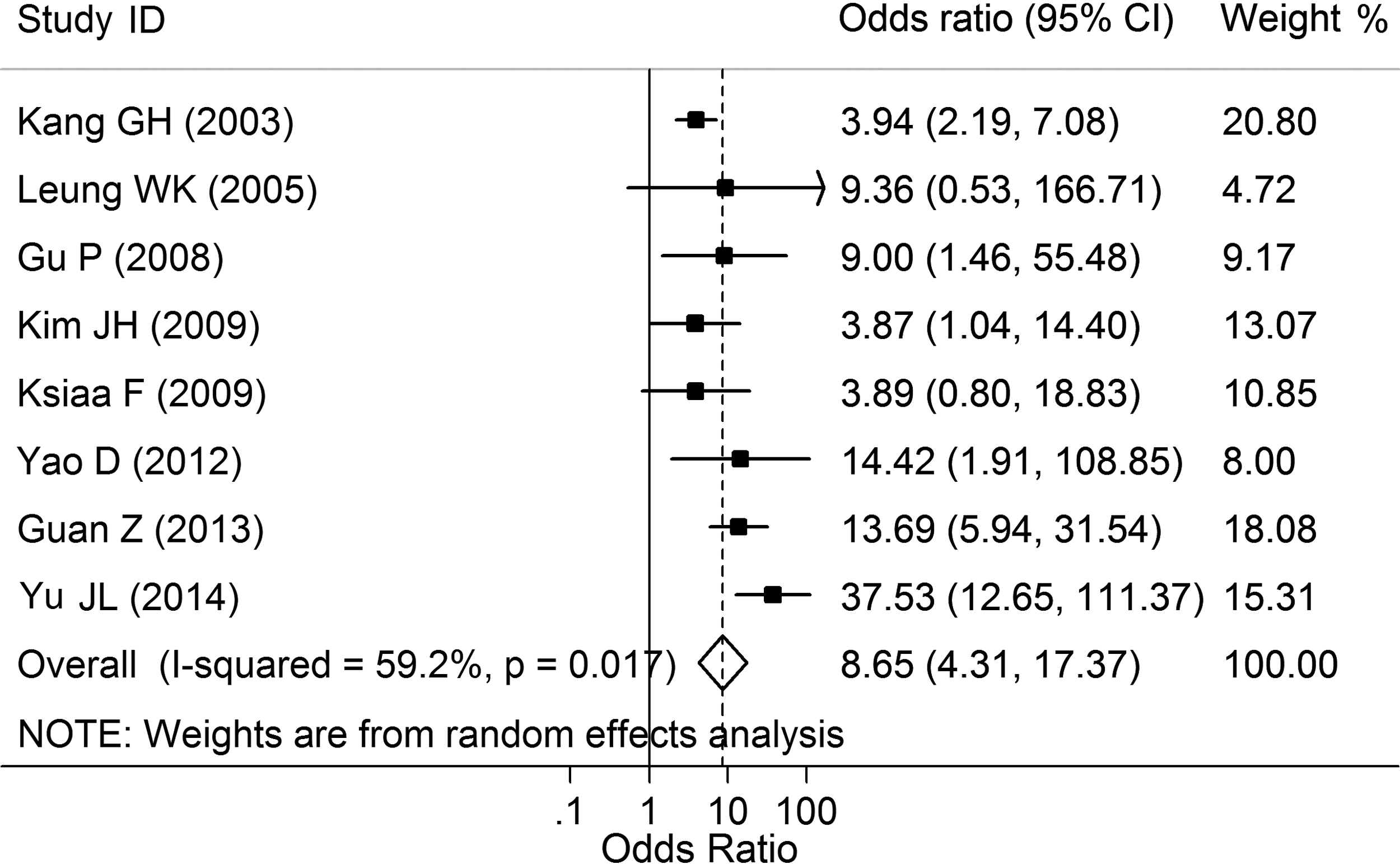
Meta-analysis of the association between TIMP-3 promoter methylation and gastric cancer risk. The squares and the horizontal lines represent the study-specific OR and 95% CI, and the diamond represents the pooled OR and 95% CI. CI, confidence interval; OR, odds ratio.
p-Value of Q test for heterogeneity.
Next, we stratified the association by subject ethnicity, sample material, and detection method. The ethnic-specific OR showed an increased risk for individuals carrying methylated TIMP-3 compared with those without methylated TIMP-3 in Asian populations (OR = 9.71; 95% CI 4.10-23.00; p < 0.001) and Caucasian populations (OR = 5.58; 95% CI 1.69-18.36; p = 0.005). In the subgroup analysis stratified by sample material, significantly increased risk was found in tissue samples (OR = 8.64; 95% CI 4.11-18.13; p < 0.001), but not in the serum samples. When stratified by the methylation detection method, a remarkably increased risk was detected in all of the detection method groups (Table 2).
Publication bias
As shown in Figure 2, visual assessment of the Begg's funnel plot did not reveal any evidence of obvious asymmetry in the present meta-analysis. Further evaluation using the Egger's linear regression test did not show evidence of publication bias in our study (t = 0.69, p = 0.513).

Funnel plot for publication bias test. Each point represents a separate study. The natural logarithm of the OR and its standard error were used for generating the funnel plot.
Discussion
To the best of our knowledge, this is the first meta-analysis to investigate whether DNA methylation of the TIMP-3 gene has an impact on the risk of gastric cancer. In this study, we combined eight independent original studies comprising a total of 1096 samples and revealed that TIMP-3 promoter methylation increased the risk of gastric cancer. The overall OR for TIMP-3 methylation in gastric cancer versus normal samples was 8.65 (95% CI 4.31-17.37; p < 0.001), suggesting a strong positive correlation between TIMP-3 promoter methylation and gastric cancer susceptibility. We also conducted subgroup analyses to identify the relationships between TIMP-3 methylation and gastric cancer risk. The results of subgroup analysis based on ethnicity showed that TIMP-3 promoter methylation was significantly associated with the risk of gastric cancer in both Asian and Caucasian populations, suggesting that there was no ethnic-specific effect of TIMP-3 promoter methylation on gastric cancer susceptibility.
Assessments of the between-study heterogeneity and potential publication bias are regarded as essential components of meta-analyses (Egger et al., 1997; Lau et al., 1998). In this study, we used the Q-test and I2 test to detect heterogeneity within studies and implemented Begg's funnel plots and Egger's linear regression test to detect possible publication bias. No evidence of potential publication bias was found. Notably, we also carried out sensitivity analysis to determine the effects of individual studies on the overall effect and found that there was no singly sensitive study in our meta-analysis. These results demonstrate a reliable association between TIMP-3 promoter methylation and the risk of gastric cancer.
DNA methylation of gene regulatory elements, a well-known epigenetic change, acts as an important alternative to gene mutations or deletions as a strategy for gene inactivation (Jones and Takai, 2001). Hypermethylation within the promoter regions of tumor suppressor genes can result in transcriptional silencing of the gene and lead to subsequent downregulation or loss of protein expression, and this phenomenon has been widely reported in human cancers, including gastric cancer (Das and Singal, 2004; Qu et al., 2013). Hypermethylation of the promoter region of TIMP-3 is the main mechanism of TIMP-3 inactivation (Kang et al., 2000, 2003b; Gu et al., 2008). TIMP-3 functions as a tumor suppressor and is capable of inhibiting growth, angiogenesis, migration, invasion, and metastasis of several cancers (Anand-Apte et al., 1996; Ahonen et al., 1998; Anania et al., 2011; Murphy, 2011; Lin et al., 2012). These previous findings support our conclusion from the present study that TIMP-3 methylation increases the risk of gastric cancer.
Molecular-based diagnostic approaches, such as the identification of epigenetic markers, have been extensively investigated in recent years (Elimova et al., 2015; Tahara and Arisawa, 2015). Along with the advancements made in genetics, nucleotide biochemistry, and DNA sequencing technology, various techniques for DNA methylation analysis have been developed. Of these techniques, MSP seems to be the most useful, owing to its sensitivity, quick and simple methodology, and reproducibility (Das and Singal, 2004; Harrison and Parle-McDermott, 2011). In this study, our data showed a strong association between TIMP-3 methylation and the risk of gastric cancer, especially when the analysis was performed in tissue samples, suggesting that TIMP-3 methylation may be used as a molecular marker for early clinical detection and monitoring of gastric cancer. Although no statistically significant difference in TIMP-3 methylation frequency between gastric cancer patients and controls was found when the analysis was conducted on the serum samples (Leung et al., 2005), it is worth mentioning that the frequency of methylated TIMP-3 in cancer patients was 17%, whereas nonmethylated TIMP-3 DNA was detected in the controls, suggesting a potential diagnostic value of TIMP-3 promoter methylation in serum samples. Moreover, TIMP-3 hypermethylation has been reported to be associated with the progression and clinical outcomes of gastric cancer (Gu et al., 2008; Yu et al., 2014). However, due to the small number of such studies, further studies are required to determine the prognostic value of TIMP-3 methylation in gastric cancer.
In summary, our current meta-analysis provides evidence to support a strong association between TIMP-3 promoter methylation and an increased risk of gastric cancer. Although additional studies with larger sample sizes are still needed to provide a more representative and convincing statistical analysis, detection of TIMP-3 methylation may be utilized as a potential biomarker for gastric cancer diagnosis.
Footnotes
Acknowledgment
This study was supported by grants from the Natural Science Foundation of Shandong Province, China (No. ZR2010HL048 to Xiying Luan).
Author Disclosure Statement
No competing financial interests exist.