




Abstract
Objective: This study aimed to investigate the value of microRNA (miR) gene polymorphisms in evaluating the efficacy of transcatheter arterial chemoembolization (TACE) in primary hepatocellular carcinoma (HCC). Materials and Methods: A total of 507 patients with primary HCC were enrolled at our hospital from August 2010 to December 2014. All of them received TACE and were divided into either an effective treatment group (237 cases), or an ineffective group (270 cases) according to the treatment efficacy. Polymerase chain reaction-restriction fragment length polymorphism was used to genotype the single-nucleotide polymorphisms of miR-196a2 rs11614913, miR-146a rs2910164, miR-499a rs3746444, and miR-149 rs2292832, and the genotypes and allele frequencies between the two groups were compared. Results: The frequencies of the CC genotype of miR-196a2 (rs11614913) and the GG genotype of miR-499a (rs3746444) were significantly higher in the ineffective group than in the effective group (both p < 0.05). For miR-196a2 (rs11614913), the overall survival (OS) of patients with the TT genotype was higher than patients with the CT+CC genotypes (p < 0.05); for miR-499a (rs3746444), the OS of patients with the AA genotype was higher than patients with the AG+GG genotypes (p < 0.05). MiR-196a2 rs11614913, miR-499a rs3746444, hepatitis B surface antigen (HbsAg), hepatitis B history, and Child-Pugh classification were independent prognostic factors for OS (all p < 0.05). Conclusion: MiR-196a2 rs11614913 and miR-499a rs3746444 were significantly associated with a curative effect and a positive prognosis of TACE for primary HCC.
Introduction
A
Transcatheter arterial chemoembolization (TACE) is an essential nonsurgical approach for a majority of HCC patients in the advanced stage who lost opportunities of surgery when diagnosed (Zhao et al., 2014). TACE has characteristics of being precise in targets, having minimal invasion, and being repeatable and well tolerated and, thus, is widely used for unresectable HCC (Xie et al., 2014a). However, it is possible that TACE might cause enhanced expression of vascular endothelial growth factor, which subsequently stimulates tumor angiogenesis, leading to the progression and metastasis of residual tumor (Yao et al., 2015).
MicroRNAs (miRs) are endogenous single-stranded RNAs with ∼22 nucleotides in length and involved in cell proliferation, apoptosis, chromatin rearrangements, and carcinogenesis (Sato et al., 2011; Greene et al., 2013). The presence of single-nucleotide polymorphisms (SNPs) in miRs may alter the miR processing and expression, and/or binding to target mRNA, and, therefore, may contribute to the susceptibility of cancer development (Wang et al., 2013). Epigenetic changes in miRs and their target gene may provide tools for detection and therapeutic intervention in HCC (Khare et al., 2013). It has been reported that a functional polymorphism rs11614913 (T>C) in miR-196a2 was associated with cancer risk by affecting the processing of the pre-miR into a mature and regulatory form (Zhu et al., 2012).
A G/C polymorphism in encoding miR-146a rs2910164 (G>C) could be a risk factor for HCC (Xie et al., 2014b; Xu et al., 2014b). Moreover, a common SNP in pre-mi, rs3746444 in miR-499A>G, has been studied in various cancers, such as breast cancer, gastric cancer, and colorectal cancer (Shan et al., 2013; Zou and Zhao, 2013). The miR-149 rs2292832 T/C SNP may decrease the risks of developing digestive cancers (Li et al., 2015), but only in a poor manner.
However, there were no studies on the roles of miR gene polymorphisms in the evaluating therapeutic efficacy after TACE for primary HCC. Thus, our study chose to analyze the values of the four miR gene polymorphisms, miR-196a2 rs11614913, miR-146a rs2910164, miR-499a rs3746444, and miR-149 rs2292832, in evaluating therapeutic efficacy after TACE for primary HCC.
Materials and Methods
Study participant
A total of 507 patients (mean age: 54.75 ± 12.08 years) with primary HCC were collected at Ningbo No.2 Hospital between August 2010 and December 2014. The inclusion criteria are as follows: the new clinical diagnostic criteria for primary HCC proposed by Chinese Anti-Cancer Association Professional Committee of the Eighth National Conference on HCC (Guo and Thompson, 1992) mainly investigated the following aspects: whether there were cirrhosis and hepatitis B virus (HBV) and/or hepatitis C virus infection, whether there were typical imaging features of HCC, and serum alpha-fetoprotein (AFP) levels:
(1) AFP <400 μg/L, two imaging examinations of B-ultrasound, computed tomography (CT), magnetic resonance imaging (MRI), and so on verified that there was HCC space-occupying lesion, or two HCC markers of des-gamma-carboxy prothrombin (DCP), gamma-glutamyl transferase (GGT) II, alpha-
The exclusion criteria of all participants are as follows: tumor lesions accounted for more than 4/5 of the liver; patients with severe heart, lung, and kidney dysfunction; patients with significant coagulation disorders accompanied by bleeding tendency; patients with active liver disease and metastatic HCC, and systemic undergoing and extensive metastasis; patients with systemic failure in the whole body; and patients with trauma, surgery, pregnancy, and reproductive system embryo-derived tumors and other malignancies recently.
All patients underwent TACE and were divided into the effective group (237 cases) and ineffective group (270 cases) according to the therapeutic effects. All patients or their families of this study signed an informed consent form, thus conforming this study to the standards of the Declaration of Helsinki (Holt, 2014), as well as being approved by the ethics committee of Ningbo No.2 Hospital.
Treatment
According to the Seldinger method, all patients underwent percutaneous femoral artery intubation and hepatic arteriography, and then the CT or MRI was combined to conduct localization and to define lesion locations, numbers, sizes, and blood supply, followed by adjustment of the catheter's entrance to the hepatic segment of hepatic lobe artery to conduct chemotherapy as well as embolization. After the microcatheter superselectively entered into the tumor feeding artery, chemotherapy drugs epirubicin (EPI) (40-80 mg; Pfizer Co., Ltd., Wuxi, China) and hydroxycamptothecin (HCPT) (20-30 mg; Wuhan LiShizhen pharmaceutical Co., Ltd., Wuhan, China) were used in combination.
Patients with Child-Pugh who scored less than 6 points were simultaneously injected with 5-20 mL of emulsified lipiodol to conduct tumor supply vascular embolization, and parts of patients were combined with gelfoam particles. The embolic agent injection rate should be appropriate to prevent the reflux, and when the blood flow was significantly slowed or stopped, the embolization should be terminated and the embolization effects should be observed again. Postoperative infusion for liver protection treatment was conducted for 3-5 days, and then the patients were orally administrated with liver protective drugs. Recheck was conducted every 3 weeks, and the treatment was repeated once.
According to the general condition, imaging evaluation, and tumor markers of patients, the treatment intervals were gradually extended. Periodic rechecks of routine blood test and biochemical indicators were conducted, the acute adverse effects of radiotherapy were carefully observed, hepatoprotection and blood transfusion were performed, as well as symptomatic treatment given when necessary.
Efficacy evaluation
The differences in clinical efficacy of patients in the two groups were recorded. The efficacy evaluation was in accordance with the Solid Tumors Evaluation Criteria published by World Health Organization (WHO) in 2000 (Nishino et al., 2010). (1) Complete remission (CR): all tumor lesions disappeared, and the disappeared lesions maintained for 4 weeks. (2) Partial remission (PR): all tumor lesions shrunk by 30% or more, and the shrunken tumor lesions maintained for 4 weeks. (3) Stable disease (SD): non-PR and disease progression. (4) Progressive disease (PD): lesions increased by 20% and non-PR and disease progression before the lesions increased. CR and PR patients were evaluated as the effective group, while SD and PD patients as the ineffective group.
Detection indexes
The liver function of patients after TACE was detected, including the following indexes: alanine aminotransferase (ALT), aspartate aminotransferase (AST), total bilirubin (TBIL), direct bilirubin (DBIL), alkaline phosphatase (ALP), GGT, and cholinesterase (CHE).
Genotyping
DNA extraction and primer design: the enrolled patients were subjected to fasting for 12 h, and venous blood samples of the patients (2 mL) were collected in ethylenediaminetetraacetic acid (EDTA) through anticoagulated tubes the next morning. The genomic DNA was extracted using a Blood Genome DNA Extraction Kit (Takara, Dalian, China). Primers were designed using a prime 5.0 software and were synthesized by Shanghai Sangon Company (Shanghai, China). The primer sequences are shown in Table 1.
F, forward; miR, microRNA; R, reverse.
The miR-196a2 rs11614913 and miR-146a rs2910164 polymerase chain reaction (PCR) systems were as follows: 25 μL of total reaction system wherein there were 12.5 μL of 2 × Master Mix, 1 μL of each of 10 mM upstream and downstream primer, 1 μg DNA template, and the balanced being ddH2O; PCR conditions: 66°C predenaturation for 2 min, a total of 35 cycles of 94°C denaturation for 30 s, 60°C annealing for 40 s, 72°C extension for 30 s, and a final extension at 72°C for 7 min; and the amplification product was detected with 2% agarose gel electrophoresis. MiR-499a rs3746444 and miR-149 rs2292832 PCR systems were as follows: 50 μL of total reaction system, including 5 μL of 10 × buffer, 4 μL of 25 mM MgCl2, 1 μL of 10 mM dNTPs, 1 μL of each of 25 pM upstream and downstream primers, 1 μL of 5 U/μL Taq DNA polymerase, 10 μL of DNA template, and 27 μL of ddH2O.
The PCR condition of the miR-499a rs3746444 was 95°C predenaturation for 2 min, a total of 40 cycles of 95°C denaturation for 1 min, 60°C annealing for 1 min, 72°C extension for 1 min, a final extension at 72°C for 2 min; the amplification product was detected with a 5% agarose gel electrophoresis. The PCR condition of the miR-149 rs2292832 was 94°C predenaturation for 2 min, a total of 36 cycles of 94°C denaturation for 20 s, 54°C annealing for 30 s, 72°C extension for 30 s, and a final extension at 72°C for 3 min; the amplification product was detected with a 2% agarose gel electrophoresis. The genotypes were determined according to a macrorestriction map (Fig. 1).
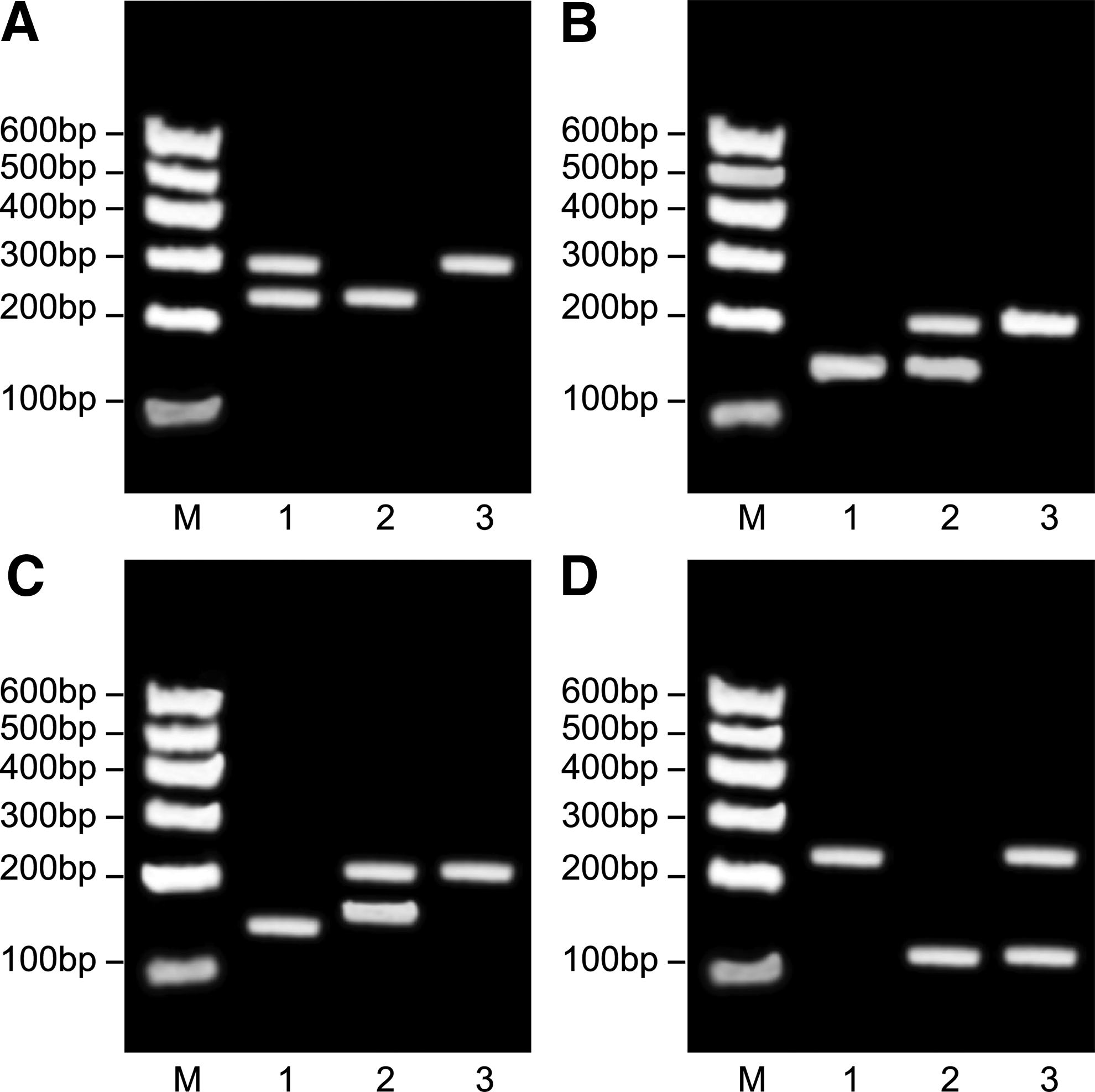
Agarose gel electrophoresis for microRNA (miR) gene polymorphisms.
Follow-up
After undergoing surgical treatment and chemotherapy all with the consent of their families, patients were subjected to data collection by regular telephones, outpatient follow-up, complaint letter and visit, or clinical data consultation. The follow-up time was 60 months with a follow-up rate of 100%. The changes of the patient's conditions were regularly informed through a follow-up feedback to evaluate the overall survival (OS) rate of the therapeutic regimen, and the OS was defined as a follow-up to the time of death caused by any reasons.
Statistical analysis
SPSS 19.0 statistical package (SPSS, Inc., Chiago, IL) was used to process data. Hardy-Weinberg equilibrium was used to judge whether the included population had a group representation, and when p was larger than or equal to 0.05, the sample reached a genetic balance and the group had a good representation. The odds ratios (ORs) and 95% confidence interval (95% CI) were calculated, and logistic regression analysis was conducted to estimate the association strength of each polymorphism mutation and disease. The enumeration data were expressed as ratio or rate, and the comparison was conducted using the χ2 test. The measurement data are expressed as mean ± standard deviation, and the comparison was conducted using the t-test. OS was analyzed using the Kaplan-Meier method. A p < 0.05 was considered statistically significant.
Results
General information of study participants
In this study, there were 237 cases in the effective group and 270 cases in the ineffective group. Clinical data of the two groups were collected and compared, and the results showed that there were no significant differences in age, sex, drinking, tumor size, portal vein thrombosis, and the number of cancer nodules between the effective group and the ineffective group (all p > 0.05). The frequencies of positive hepatitis B surface antigen (HbsAg) and hepatitis B history were significantly lower in the effective group compared to those in the ineffective group (all p < 0.05). Smoking showed no difference between the effective group and the ineffective group (p > 0.05), and the smoking quitting rate was higher in the effective group compared with that in the ineffective group (p < 0.05). Child-Pugh classification showed a significant difference between the two groups (p < 0.05) (Table 2).
HbsAg, hepatitis B surface antigen.
MiRNA gene distribution in patients with different efficacy
The genotype and allele frequency distributions of miR-196a2 rs11614913, miR-146a rs2910164, miR-499a rs3746444, and miR-149 rs2292832 polymorphisms in the effective group and ineffective group are shown in Table 3. The Hardy-Weinberg genetic equilibrium testing showed that each genotype and allele frequency reached the genetic equilibrium (all p > 0.05), suggesting the group was representative. The genotype and allele frequency distributions of miR-196a2 rs11614913 and miR-499a rs3746444 showed significant differences comparing the effective group with the ineffective group. The frequency of CC genotype of miR-196a2 rs11614913 site and the GG genotype of miR-499a rs3746444 site in the ineffective group was significantly higher than the effective group (both p < 0.05).
Comparison between the effective group and the ineffective group, p < 0.05.
95% CI, 95% confidence interval; OR, odds ratio.
The C allele of miR-196a2 rs11614913 was higher in the ineffective group than in the effective group (OR = 1.29, 95% CI: 1.01-1.65, p = 0.043), while the G allele of the miR-499a rs3746444 was higher in the ineffective group than in the effective group (OR = 1.47, 95% CI: 1.04-2.09, p = 0.029). However, there were no significant differences in miR-146a rs2910164 and miR-149 rs2292832 comparing the effective group with the ineffective group (both p > 0.05).
Comparisons of liver functional indexes in patients with different genotypes
For patients after TACE, the ALT, AST, TBIL, and so on, patients with different genotypes were subjected to statistical analysis. The results showed that ALT, AST, and TBIL were significantly higher in the CC genotype of miR-196a2 rs11614913 site than those in the TT genotype and significantly higher in the GG genotype of miR-499a rs3746444 sites than those in the AA genotype (all p < 0.05). The ALP and CHE in the miR-196a2 rs11614913 sites were significantly higher in the CC genotype than those in the TT genotype and were significantly higher in the GG genotype compared to the AA genotype of miR-499a rs3746444 site (all p < 0.05). However, there was no statistical significance in ALT, AST, and TBIL in patients with miR-146a rs2910164 and miR-149 rs2292832 genotype (all p > 0.05) (Table 4).
Comparisons between different genotypes, p < 0.05.
ALP, alkaline phosphatase; ALT, alanine aminotransferase; AST, aspartate aminotransferase; CHE, cholinesterase; DBIL, direct bilirubin; GGT, gamma-glutamyl transferase; TBIL, total bilirubin.
Logistic regression analysis
The effective group and ineffective group were set as dependent variables, and the miR-196a2 rs11614913, miR-499a rs3746444, HbsAg, hepatitis B history, smoking quitting rates, and Child-Pugh classification were subjected to multivariate logistic regression analysis. MiR-196a2 rs11614913 and miR-499a rs3746444 genotypes, HbsAg, hepatitis B history, smoking quitting rates, and Child-Pugh classification were significantly related with the significant therapeutic effects of TACE (all p < 0.05) (Table 5).
SE, standard error.
Genotype polymorphism and survival
After TACE, all patients received 60 months of follow-ups. In the miR-196a2 rs11614913 site, the OS of patients with TT genotype was higher than patients with CT+CC genotype (p < 0.05); in the miR-499a rs3746444 sites, the OS of patients with AA genotype was higher than patients with AG+GG genotype (p < 0.05). There were no statistically significant differences in OS of patients with miR-146a rs2910164 and miR-149 rs2292832 (all p > 0.05) (Table 6 and Fig. 2). Cox multivariate analysis showed that miR-196a2 rs11614913, miR-499a rs3746444, HbsAg, hepatitis B history, and Child-Pugh classification were independent prognostic factors for OS (all p < 0.05) (Table 7).
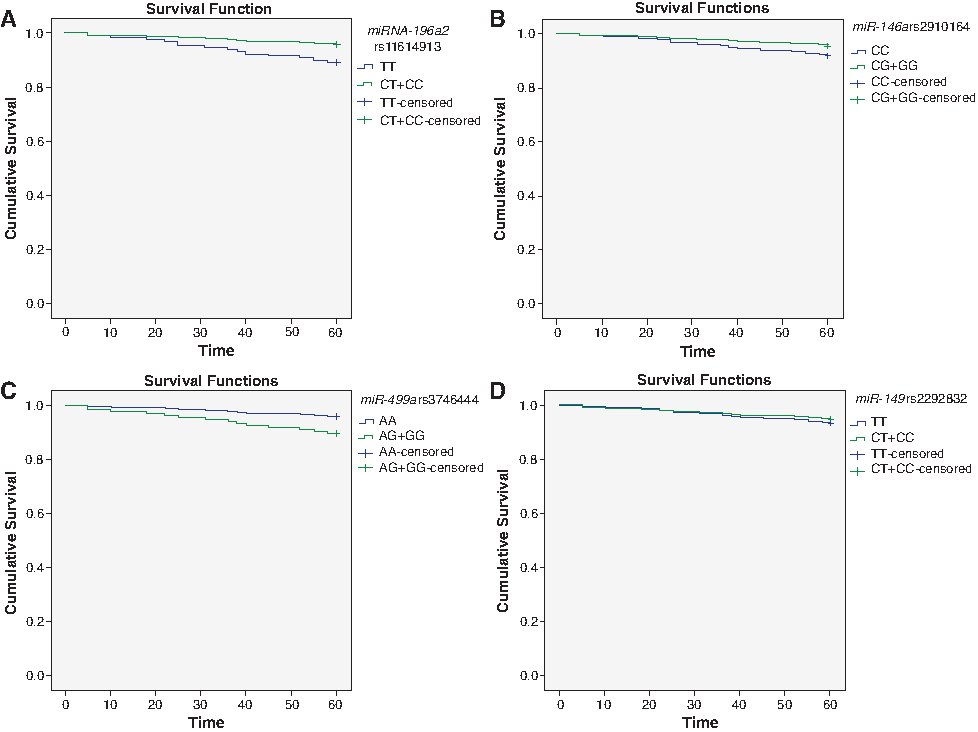
Kaplan-Meier survival curves of
Discussion
Our study investigated the value of miR gene polymorphisms in evaluating the efficacy of TACE for primary HCC; therefore, we analyzed the distributions of miR-196a2 rs11614913, miR-146a rs2910164, miR-499a rs3746444, and miR-149 rs2292832 in patients with different curative effects of TACE. One of our main results showed that the frequency of CC genotype in miR-196a2 rs11614913 and GG genotype in miR-499a rs3746444 was significantly higher in the TACE therapy ineffective group. Besides, the C allele of miR-196a2 rs11614913 and the G allele of the miR-499a rs3746444 were higher in the TACE therapy ineffective group. Those above results indicated that CC genotype and C allele in miR-196a2 rs11614913, as well as GG genotype and G allele in miR-499a rs3746444, were related with poor curative effects of TACE for HCC.
Patients with TC or CC genotypes of miR-196a2 rs11614913 were linked with higher cancer risk than patients with the TT genotype, and CC genotype might relate with breast cancer and lung cancer risks (Chu et al., 2011). MiR-196a2 rs11614913 C/T polymorphisms associated with significantly increased nonsmall cell lung cancer (NSCLC) risk and patients carrying TC or CC genotypes showed high risk of NSCLC (Tian et al., 2009; Hong et al., 2011). MiR-196a2 rs11614913 T variant might decrease cancer susceptibility (Wang et al., 2012). TT genotype of rs11614913 polymorphism was associated with a decreased cancer risk, while the G allele of rs3746444 was related with an increased risk of breast cancer in China (He et al., 2012; Xu et al., 2013).
Another result of our study showed that ALT, AST, and TBIL were significantly higher in the CC genotype of miR-196a2 rs11614913 and in the GG genotype of miR-499a rs3746444. The results indicated that the bilirubin metabolisms of patients carrying CC genotypes in miR-196a2 rs11614913 and carrying GG genotypes in miR-499a rs3746444 were more easily influenced after TACE due to the damaged liver cell membrane. The ALP and CHE in the CC genotype of miR-196a2 rs11614913 and in the AA genotype of miR-499a rs3746444 were significantly higher. The results showed that the TACE affects the hepatic reservational function of patients carrying miR-196a2 rs11614913 CC genotype and miR-499a rs3746444 GG genotype.
AST and ALT are two important enzymes for the diagnosis of liver diseases, and the elevation of AST level is related to alcohol-induced mitochondrial injury (Hsu and Tai, 2011). Abnormal bilirubin levels might lead to worse prognosis of HCC patients who had increased incidence of portal vein thrombosis and tumor multifocality (Carr et al., 2014). TBIL, ALT, and AST are important clinical indicators for screening and diagnosing various kidney and liver diseases (Zhang et al., 2014). Serum liver enzymes of ALT, AST, and ALP are commonly elevated in patients with liver diseases and may reflect the liver injury condition (Xu et al., 2014a). CHE played an important role in predicting postoperative outcome of hepatic resection for HCC (Donadon et al., 2013).
Furthermore, our study also demonstrated that miR-196a2 rs11614913 and miR-499a rs3746444 genotypes, HbsAg, hepatitis B history, and Child-Pugh classification were significantly related with the therapeutic effects of TACE and were independent prognostic factors for OS, which verified the roles of miR-196a2 rs11614913 and miR-499a rs3746444 genotypes in the therapeutic effects of TACE and the prognosis of HCC. HbsAg seropositivity was related with the risk of HCC and HbsAg seroclearance linked with a low risk for HCC development (Wu et al., 2014). Patients with a family history of HCC had increased risk of HCC at each stage of HBV infection and required more intensive management of HBV infection and surveillance for HCC (Loomba et al., 2013). Child-Pugh classification was widely used for HCC patient categorization (Nakagawa et al., 2015).
In conclusion, miR-196a2 rs11614913 and miR-499a rs3746444 polymorphisms were significantly associated with the curative effect and prognosis of TACE for primary HCC. Besides, the curative effect and prognosis of TACE for primary HCC were also related with HbsAg, hepatitis B history, and Child-Pugh classification. Our study could provide valuable clinical references for the treatment of primary HCC with TACE.
Footnotes
Acknowledgment
The authors would like to give their sincere appreciation to the reviewers for their helpful comments on this article.
Author Disclosure Statement
No competing financial interests exist.